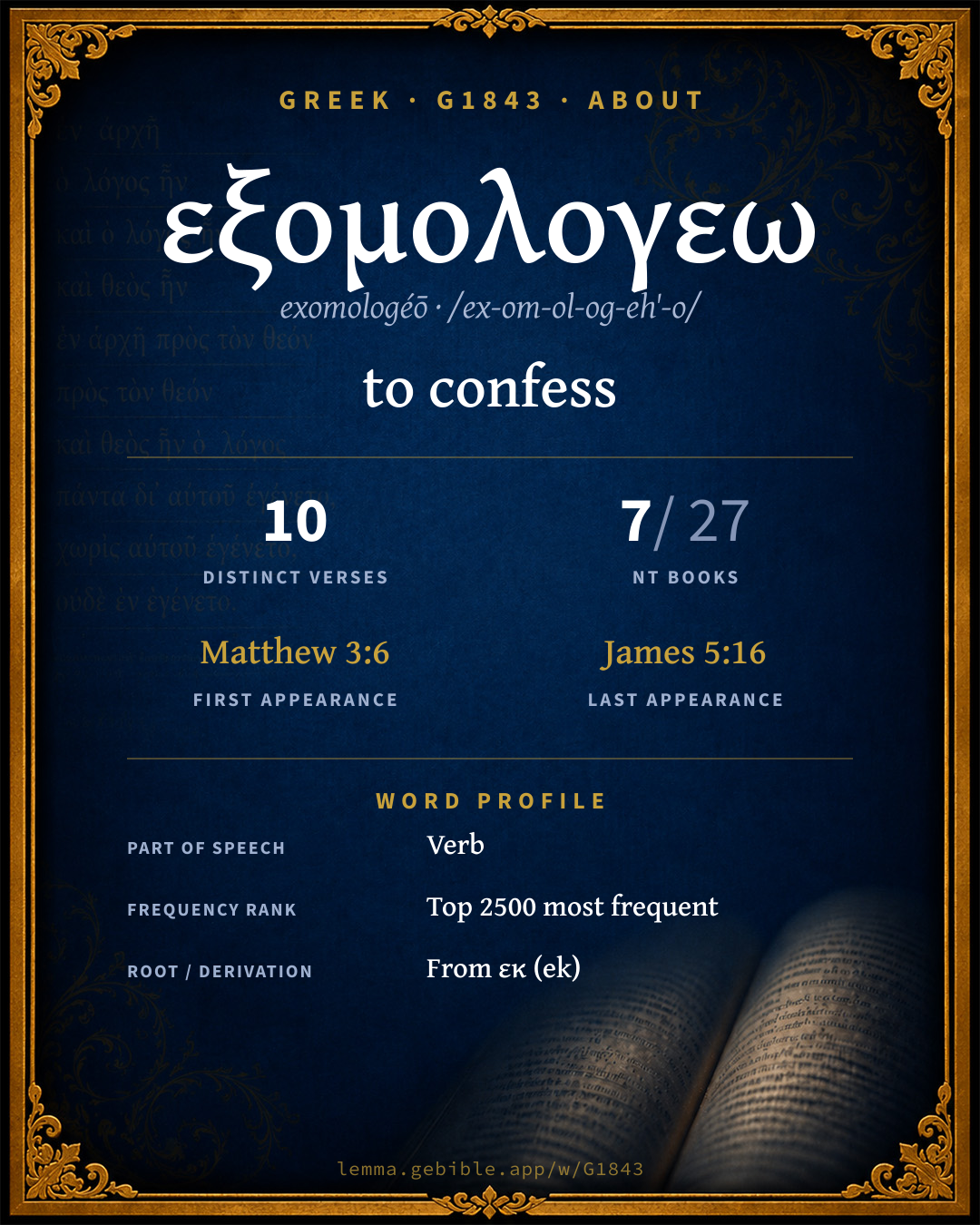
ἐξομολογέω
to confess
‘to confess’ is one of 4 main senses fuller range ↓
Full lexicon entry — Thayer's Greek Lexicon
From Thayer's Greek Lexicon
Where this word appears
See every Present-tense verb in the Greek New Testament →
Grammar key — what these labels mean
Part of speech
- Verb
- An action or state-of-being word.
Tense
- Present
- Ongoing or general action in present time (imperfective aspect).
- Aorist
- Action viewed as a simple whole, without regard to duration — often past (perfective aspect).
- Future
- Action expected in future time.
Voice
- Middle
- The subject acts on or for itself, or with special interest in the action.
- Active
- The subject performs the action.
Mood
- Participle
- A verbal adjective (“writing,” “having written”).
- Indicative
- States a fact or asks a factual question (the mood of reality).
- Subjunctive
- Expresses probability, purpose, or possibility (the mood of contingency).
- Imperative
- Expresses a command or request.
Case
- Nominative
- The case of the subject (and the predicate nominative).
Person
- 1st person
- The speaker (“I / we”).
- 3rd person
- The one spoken about (“he / she / it / they”).
- 2nd person
- The one addressed (“you”).
Gender
- Masculine
- Grammatically masculine.
Number
- Plural
- More than one.
- Singular
- One.
Grammatical forms
- Verb, Present, Middle, Participle, Nominative, Plural, Masculine 3 times (30%)
- Verb, Present, Middle, Indicative, 1st person, Singular 2 times (20%)
- Verb, Aorist, Active, Indicative, 3rd person, Singular 1 time (10%)
- Verb, Aorist, Middle, Subjunctive, 3rd person, Singular 1 time (10%)
- Verb, Future, Middle, Indicative, 1st person, Singular 1 time (10%)
- Verb, Future, Middle, Indicative, 3rd person, Singular 1 time (10%)
- Verb, Present, Middle, Imperative, 2nd person, Plural 1 time (10%)
Parsed forms decoded from the imported morphology (Robinson–Tischendorf, public domain), counted across 10 parsed occurrences — not distinct verses.
Every verse where G1843 appears — 10 distinct verses across 7 books. Click any verse to open its interlinear word-by-word view. Verse text shown in the World English Bible for context — . Each verse’s Greek form is shown with its reference; the English is not keyword-highlighted, since the data carries no word-level English alignment. Use “Compare translations” on any verse to read it across multiple English versions. This concordance covers the Greek New Testament; Septuagint (Greek Old Testament) occurrences of this word are not indexed here.
Matthew 2 verses
- Matthew 3:6 ἐξομολογούμενοι pres mid ptcp nom pl masc They were baptized by him in the Jordan, confessing their sins.
- Matthew 11:25 ἐξομολογοῦμαί pres mid ind 1sg At that time, Jesus answered, "I thank you, Father, Lord of heaven and earth, that you hid these things from the wise and understanding, and revealed them to infants.
Mark 1 verse
Luke 2 verses
- Luke 10:21 ἐξομολογοῦμαί pres mid ind 1sg In that same hour Jesus rejoiced in the Holy Spirit, and said, "I thank you, O Father, Lord of heaven and earth, that you have hidden these things from the wise and understanding, and revealed them to little children. Yes, Father, for so it was well-pleasing in your sight."
- Luke 22:6 ἐξωμολόγησεν aor act ind 3sg He consented, and sought an opportunity to deliver him to them in the absence of the multitude.
Acts 1 verse
Romans 2 verses
- Romans 14:11 ἐξομολογήσεται fut mid ind 3sg For it is written, "'As I live,' says the Lord, 'to me every knee will bow. Every tongue will confess to God.'"
- Romans 15:9 ἐξομολογήσομαί fut mid ind 1sg and that the Gentiles might glorify God for his mercy. As it is written, "Therefore will I give praise to you among the Gentiles, And sing to your name."
Philippians 1 verse
James 1 verse
About this entry
At a glance — auto-summarized from this page’s data, not written by a person. Every figure links to its source below. This summary describes the numbers; it doesn’t interpret them.
εξομολογεω (exomologéō) is a Greek verb most often rendered “to confess.” Its lexical range runs to 4 senses. Spanning 10 verses in 7 books, it ranks among the uncommon words of the Greek New Testament. It first appears in Matthew 3:6. Related forms include εκ, εκβαλλω and εκβασις. For the data behind this summary, explore the sense tree and the renderings breakdown below.
Gloss history
Strong's 1890 vs modern scholarship
About this word
Strong's G1843 catalogs a Greek word from the Greek New Testament.
These counts are not copied from any lexicon or concordance. They are computed here, from the morphology-tagged Greek New Testament. What Lemma adds →
- 10
- distinct verses
- The word appears in 10 distinct verses.
- 7 / 27
- NT books
- The word appears in 7 of 27 New Testament books.
- #1,056
- by frequency
- Top 2500 most frequent Greek words (rank 1,056 of 5,347 Greek words by occurrence).
View all 10 occurrences in the concordance →
By section of the New Testament
By traditional corpus
Conventional, traditional groupings — biblical authorship is debated, so this is a traditional corpus grouping, not an authorship claim. Some books belong to more than one corpus (Luke is in both the Gospels and the Lukan corpus, and so on), so these shares overlap and need not total 100%. Each figure is a share of the word’s 10 distinct verses.
- Gospels 5 verses · 50%
- Lukan (Luke–Acts) 3 verses · 30%
- Pauline corpus 3 verses · 30%
- General (Catholic) Epistles 1 verse · 10%
How translations render this word
Counts come from each version’s own published word-to-Strong’s tagging or interlinear alignment — an approximate guide to how each version renders this word, not a word-level alignment the data otherwise carries. Because each total is that version’s own tagged count, the per-version totals vary from one another and need not match the appearance or distinct-verse counts above. These counts may also differ from a printed concordance because Lemma counts each distinctly tagged rendering and does not collapse phrase taggings into a single head-word total. This is a fixed set of word-tagged versions (KJV, ASV, BSB, ULT) and does not change with the reading translation you choose elsewhere. Each version’s license is shown beside its name below (and on Sources).
- King James Version: Confessing 2×, I thank 2×, I will confess 2×
- American Standard Version: Confessing 3×, I thank 2×
- Berean Standard Bible: Confessing 3×, Confess 2×, I praise 2×
- unfoldingWord Literal Text: Confessing 3×, I praise 2×
King James Version Public Domain
Renders G1843 across 11 tagged occurrences — most commonly:
Plus 5 renderings that appear only once — usually multi-word phrases or single function words the recovered tagging swept in, not distinct renderings.
American Standard Version Public Domain
Renders G1843 across 11 tagged occurrences — most commonly:
Plus 6 renderings that appear only once — usually multi-word phrases or single function words the recovered tagging swept in, not distinct renderings.
Berean Standard Bible Public Domain
Renders G1843 across 10 tagged occurrences — most commonly:
Plus 3 renderings that appear only once — usually multi-word phrases or single function words the recovered tagging swept in, not distinct renderings.
unfoldingWord Literal Text CC BY-SA 4.0
Renders G1843 across 10 tagged occurrences — most commonly:
Plus 5 renderings that appear only once — usually multi-word phrases or single function words the recovered tagging swept in, not distinct renderings.
Senses in Thayer's
The 4 senses Thayer's distinguishes for this word, in lexicon order (not ranked by frequency or importance). The full entry — with sub-senses — is in the Lexicon Entry tab.
- to confess
- acknowledge openly and joyfully
- to one's honour: to celebrate, give praise to
- to profess that one will do something, to promise, agree, engage
Word origin
Derived from εκ (ek) (G1537) — from.
Forms in the corpus
The 7 distinct written forms G1843 takes in the Greek New Testament, most frequent first — each parse links to that tense’s occurrences in the concordance.
| Form | Parsing | Example | Uses |
|---|---|---|---|
| ἐξομολογούμενοι exomologoúmenoi | Verb, Present, Middle, Participle, Nominative, Plural, Masculine | Matthew 3:6 | 3 |
| ἐξομολογοῦμαί exomologoûmaí | Verb, Present, Middle, Indicative, 1st person, Singular | Matthew 11:25 | 2 |
| ἐξομολογήσεται exomologḗsetai | Verb, Future, Middle, Indicative, 3rd person, Singular | Romans 14:11 | 1 |
| ἐξομολογήσηται exomologḗsētai | Verb, Aorist, Middle, Subjunctive, 3rd person, Singular | Philippians 2:11 | 1 |
| ἐξομολογήσομαί exomologḗsomaí | Verb, Future, Middle, Indicative, 1st person, Singular | Romans 15:9 | 1 |
| ἐξομολογεῖσθε exomologeîsthe | Verb, Present, Middle, Imperative, 2nd person, Plural | James 5:16 | 1 |
| ἐξωμολόγησεν exōmológēsen | Verb, Aorist, Active, Indicative, 3rd person, Singular | Luke 22:6 | 1 |
Same root — word family
Other Thayer's entries built from the same root as G1843, grouped by Strong’s listed origin. These share a root / origin per the lexicon — not necessarily a shared meaning. Each links to that word’s own entry.
Derives from
Shares the same root
- εκβαλλω ekbállō G1544 to cast out
- εκβασις ékbasis G1545 exit
- εκγαμιζω ekgamízō G1547 to give in marriage
- εκγαμισκω ekgamískō G1548 to give in marriage
- εκγονον ékgonon G1549 offspring
- εκδαπαναω ekdapanáō G1550 to spend
- εκδεχομαι ekdéchomai G1551 to receive
- εκδηλος ékdēlos G1552 evident
- εκδημεω ekdēméō G1553 to depart
- εκδιδωμι ekdídōmi G1554 to give out
- εκδιηγεομαι ekdiēgéomai G1555 to relate
- εκδικος ékdikos G1558 without justice
- εκδιωκω ekdiṓkō G1559 to banish
- εκδοτος ékdotos G1560 delivered up
- εκδυω ekdýō G1562 to put off
- εκζητεω ekzētéō G1567 to seek out
- εκθαμβος ékthambos G1569 astonished
- εκθετος ékthetos G1570 exposed
- εκκαθαιρω ekkathaírō G1571 to cleanse
- εκκαιω ekkaíō G1572 to burn
- εκκακεω ekkakéō G1573 to be exhausted
- εκκεντεω ekkentéō G1574 to pierce
- εκκλαω ekkláō G1575 to cut off
- εκκλειω ekkleíō G1576 to shut out
+88 more words share this root (not shown).
Compare all same-root words → Showing 4 of 114 — not the complete family. They share a root, not necessarily a meaning.
Septuagint usage
The same Greek word εξομολογεω appears 94 times in the Greek Old Testament (Septuagint), across 87 verses in 9 books.
- 94
- LXX occurrences
- Tagged occurrences of this Greek word in the Septuagint.
- 87
- verses
- Distinct Septuagint verses containing this word.
- 9 / 39
- OT books
- The word appears in 9 of the 39 Old Testament books.
Sample Septuagint occurrences
- Genesis 29:35 ἐκὁμολογέω
- 2 Samuel 22:50 ἐκὁμολογέω
- 1 Kings 8:33 ἐκὁμολογέω
- 1 Chronicles 16:4 ἐκὁμολογέω
- 2 Chronicles 5:13 ἐκὁμολογέω
- Psalms 6:6 ἐκὁμολογέω
- Isaiah 45:23 ἐκὁμολογέω
- Jeremiah 40:11 ἐκὁμολογέω
- Daniel 2:23 ἐκὁμολογέω
Septuagint occurrences (same lexeme)
Every verse where the same Strong’s number (G1843) appears in the Greek Septuagint — showing the first 50 of 87. Verse text shown in the World English Bible for context; the Greek form is the matched word — the English is not keyword-highlighted.
- Genesis 29:35 ἐκὁμολογέω She conceived again, and bare a son. She said, "This time will I praise Yahweh." Therefore she named him Judah. Then she stopped bearing.
- 2 Samuel 22:50 ἐκὁμολογέω Therefore I will give thanks to you, Yahweh, among the nations, Will sing praises to your name.
- 1 Kings 8:33 ἐκὁμολογέω When your people Israel are struck down before the enemy, because they have sinned against you; if they turn again to you, and confess your name, and pray and make supplication to you in this house:
- 1 Kings 8:35 ἐκὁμολογέω When the sky is shut up, and there is no rain, because they have sinned against you; if they pray toward this place, and confess your name, and turn from their sin, when you do afflict them:
- 1 Chronicles 16:4 ἐκὁμολογέω He appointed certain of the Levites to minister before the ark of Yahweh, and to celebrate and to thank and praise Yahweh, the God of Israel:
- 1 Chronicles 16:8 ἐκὁμολογέω Oh give thanks to Yahweh, call on his name; Make known his doings among the peoples.
- 1 Chronicles 16:34 ἐκὁμολογέω Oh give thanks to Yahweh; for he is good; For his loving kindness endures forever.
- 1 Chronicles 23:30 ἐκὁμολογέω and to stand every morning to thank and praise Yahweh, and likewise in the evening;
- 1 Chronicles 29:13 ἐκὁμολογέω Now therefore, our God, we thank you, and praise your glorious name.
- 2 Chronicles 5:13 ἐκὁμολογέω it happened, when the trumpeters and singers were as one, to make one sound to be heard in praising and thanking Yahweh; and when they lifted up their voice with the trumpets and cymbals and instruments of music, and praised Yahweh, [saying], For he is good; for his loving kindness endures forever; that then the house was filled with a cloud, even the house of Yahweh,
- 2 Chronicles 6:24 ἐκὁμολογέω If your people Israel be struck down before the enemy, because they have sinned against you, and shall turn again and confess your name, and pray and make supplication before you in this house;
- 2 Chronicles 7:6 ἐκὁμολογέω The priests stood, according to their offices; the Levites also with instruments of music of Yahweh, which David the king had made to give thanks to Yahweh, (for his loving kindness endures for ever), when David praised by their ministry: and the priests sounded trumpets before them; and all Israel stood.
- 2 Chronicles 20:21 ἐκὁμολογέω When he had taken counsel with the people, he appointed those who should sing to Yahweh, and give praise in holy array, as they went out before the army, and say, Give thanks to Yahweh; for his loving kindness endures forever.
- 2 Chronicles 23:12 ἐκὁμολογέω When Athaliah heard the noise of the people running and praising the king, she came to the people into the house of Yahweh:
- 2 Chronicles 30:22 ἐκὁμολογέω Hezekiah spoke comfortably to all the Levites who had good understanding [in the service] of Yahweh. So they ate throughout the feast for the seven days, offering sacrifices of peace-offerings, and making confession to Yahweh, the God of their fathers.
- 2 Chronicles 31:2 ἐκὁμολογέω Hezekiah appointed the divisions of the priests and the Levites after their divisions, every man according to his service, both the priests and the Levites, for burnt offerings and for peace-offerings, to minister, and to give thanks, and to praise in the gates of the camp of Yahweh.
- Psalms 6:6 ἐκὁμολογέω I am weary with my groaning; Every night I flood my bed; I drench my couch with my tears.
- Psalms 7:18 ἐκὁμολογέω
- Psalms 9:2 ἐκὁμολογέω I will be glad and rejoice in you. I will sing praise to your name, O Most High.
- Psalms 17:50 ἐκὁμολογέω
- Psalms 27:7 ἐκὁμολογέω Hear, Yahweh, when I cry with my voice. Have mercy also on me, and answer me.
- Psalms 29:5 ἐκὁμολογέω The voice of Yahweh breaks the cedars. Yes, Yahweh breaks in pieces the cedars of Lebanon.
- Psalms 29:10 ἐκὁμολογέω Yahweh sat enthroned at the Flood. Yes, Yahweh sits as King forever.
- Psalms 29:13 ἐκὁμολογέω
- Psalms 32:2 ἐκὁμολογέω Blessed is the man to whom Yahweh doesn't impute iniquity, In whose spirit there is no deceit.
- Psalms 34:18 ἐκὁμολογέω Yahweh is near to those who have a broken heart, And saves those who have a crushed spirit.
- Psalms 41:6 ἐκὁμολογέω If he comes to see me, he speaks falsehood. His heart gathers iniquity to itself. When he goes abroad, he tells it.
- Psalms 41:12 ἐκὁμολογέω As for me, you uphold me in my integrity, And set me in your presence forever.
- Psalms 42:4 ἐκὁμολογέω These things I remember, and pour out my soul within me, How I used to go with the crowd, and led them to the house of God, With the voice of joy and praise, a multitude keeping a holy day.
- Psalms 42:5 ἐκὁμολογέω Why are you in despair, my soul? Why are you disturbed within me? Hope in God! For I shall still praise him for the saving help of his presence.
- Psalms 43:9 ἐκὁμολογέω
- Psalms 44:18 ἐκὁμολογέω Our heart has not turned back, Neither have our steps strayed from your path,
- Psalms 48:19 ἐκὁμολογέω
- Psalms 51:11 ἐκὁμολογέω Don't throw me from your presence, And don't take your holy Spirit from me.
- Psalms 53:8 ἐκὁμολογέω
- Psalms 56:10 ἐκὁμολογέω In God, I will praise his word. In Yahweh, I will praise his word.
- Psalms 66:4 ἐκὁμολογέω All the earth will worship you, And will sing to you; They will sing to your name." Selah.
- Psalms 66:6 ἐκὁμολογέω He turned the sea into dry land. They went through the river on foot. There, we rejoiced in him.
- Psalms 70:22 ἐκὁμολογέω
- Psalms 73:19 ἐκὁμολογέω How they are suddenly destroyed! They are completely swept away with terrors.
- Psalms 74:2 ἐκὁμολογέω Remember your congregation, which you purchased of old, Which you have redeemed to be the tribe of your inheritance; Mount Zion, in which you have lived.
- Psalms 75:11 ἐκὁμολογέω
- Psalms 85:12 ἐκὁμολογέω Yes, Yahweh will give that which is good. Our land will yield its increase.
- Psalms 87:11 ἐκὁμολογέω
- Psalms 88:6 ἐκὁμολογέω You have laid me in the lowest pit, In the darkest depths.
- Psalms 91:2 ἐκὁμολογέω I will say of Yahweh, "He is my refuge and my fortress; My God, in whom I trust."
- Psalms 96:12 ἐκὁμολογέω Let the field and all that is in it exult! Then all the trees of the woods shall sing for joy
- Psalms 98:3 ἐκὁμολογέω He has remembered his loving kindness and his faithfulness toward the house of Israel. All the ends of the earth have seen the salvation of our God.
- Psalms 99:4 ἐκὁμολογέω The King's strength also loves justice. You do establish equity. You execute justice and righteousness in Jacob.
- Psalms 104:1 ἐκὁμολογέω Bless Yahweh, my soul. Yahweh, my God, you are very great. You are clothed with honor and majesty.
These are occurrences of the same Greek lexeme (G1843) in the Septuagint — not a translation of any one Hebrew word. The store carries no word-level Hebrew↔Greek alignment, so no Hebrew original is asserted here. Counts come from the recovered LXX Strong's tagging — high-frequency vocabulary is well covered, while rare or late forms may be untagged — so they reflect tagged occurrences and may slightly undercount.