
Psalms 29:10

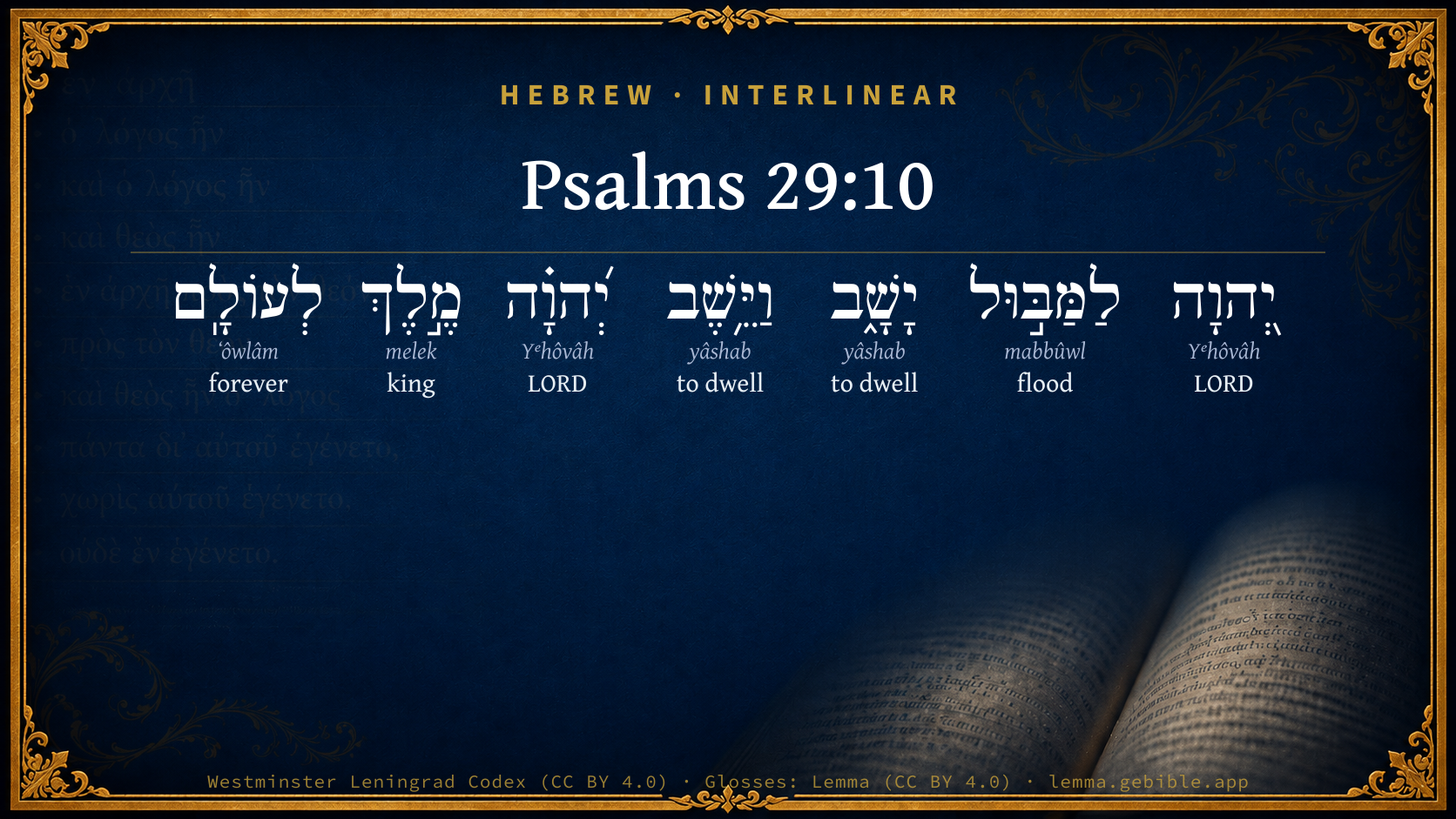
Hebrew (Westminster Leningrad Codex) Psalms 29:10 appears in the Hebrew Old Testament. The text above is from the Westminster Leningrad Codex. Each word links to its Strong’s number, a concise gloss, and parsing drawn from the Open Scriptures Hebrew Bible morphology. Click any word for its full Brown-Driver-Briggs (BDB) entry.
Download image
Cite this verse

Psalms 29:10 (World English Bible). Public Domain. Lemma interlinear Bible study tool, https://lemma.gebible.app/v/psalms/29/10.

Show BibTeX & RIS
BibTeX
RIS
English Translation
Yahweh sat enthroned at the Flood. Yes, Yahweh sits as King forever.
World English Bible · Public Domain
Download a study sheet

One document with this verse’s original text, its word-by-word gloss line, the meaning frame, cross-references with their text, attributed commentary, and full source and license credits — printable, and it pastes into notes with its structure intact.

This verse Autodidact and up

Study sheet (.html) Plain text (.txt)

A passage Seminary Student

Up to 50 verses in one chapter. A passage sheet keeps up to 6 commentary sources and 12 cross-references per verse, in the order this page ranks them, and says so on the sheet whenever that leaves anything out. Ask for a single verse and you get the Autodidact verse sheet above.

Everything on this page stays free to read, with no account — the sheet is a download of what is already on screen, not access to it.

Want to remove ads? Support Godless Engineer
Compare translations 3

The same verse in 3 English versions, stacked beneath the original-language interlinear above. Click any original word for its lexicon entry.

Each is an independent rendering of the whole verse — the interlinear is not word-aligned to these translations.

Highlighted words mark where these versions differ — a whole-verse word diff, not a word-by-word alignment.

  • World English Bible Public Domain
    Yahweh sat enthroned at the Flood. Yes, Yahweh sits as King forever.
  • King James Version Public Domain
    The LORD sitteth upon the flood; yea, the LORD sitteth King for ever.
  • unfoldingWord Literal Text CC BY-SA 4.0
    Yahweh sits over the flood; Yahweh sits as king forever.

unfoldingWord Literal Text — © unfoldingWord, licensed CC BY-SA 4.0. Word-aligned USFM3 via Door43 (git.door43.org/unfoldingWord/en_ult).

Versions to compare (up to 4)

3 of 4 selected

Show all 18 translations

Every available English version of this verse, each an independent rendering of the whole verse.

  • World English Bible Public Domain
    Yahweh sat enthroned at the Flood. Yes, Yahweh sits as King forever.
  • Berean Standard Bible Public Domain
    The LORD sits enthroned over the flood; the LORD is enthroned as King forever.
  • Majority Standard Bible Public Domain
    The LORD sits enthroned over the flood; the LORD is enthroned as King forever.
  • King James Version Public Domain
    The LORD sitteth upon the flood; yea, the LORD sitteth King for ever.
  • American Standard Version (1901) Public Domain
    Jehovah sat `as King' at the Flood; Yea, Jehovah sitteth as King for ever.
  • Revised Version (1885) Public Domain
    The LORD sat as king at the Flood; yea, the LORD sitteth as king for ever.
  • Geneva Bible (1599) Public Domain
    The Lord sitteth vpon the flood, and the Lord doeth remaine King for euer.
  • Douay-Rheims (1899) Public Domain
    The Lord maketh the hood to dwell: and the Lord shall sit king for ever. The Lord will give strength to his people: the Lord will bless his people with peace.
  • Young's Literal Translation Public Domain
    Jehovah on the deluge hath sat, And Jehovah sitteth king -- to the age,
  • Literal Standard Version CC BY-SA 4.0
    YHWH has sat on the flood, || And YHWH sits [as] king for all time,
  • Unlocked Literal Bible CC BY-SA 4.0
    Yahweh sits as king over the flood; Yahweh sits as king forever.
  • unfoldingWord Literal Text CC BY-SA 4.0
    Yahweh sits over the flood; Yahweh sits as king forever.
  • Darby Bible Public Domain
    Jehovah sitteth upon the flood; yea, Jehovah sitteth as king for ever.
  • World Messianic Bible Public Domain
    The LORD sat enthroned at the Flood. Yes, the LORD sits as King forever.
  • Webster's Bible Public Domain
    The LORD sitteth upon the flood; yes, the LORD sitteth king for ever.
  • Free Bible Version CC BY-SA 4.0
    The Lord sits on his throne above the floodwaters; the Lord is the eternal King.
  • Bible in Basic English Public Domain
    The Lord had his seat as king when the waters came on the earth; the Lord is seated as king for ever.
  • JPS Tanakh (1917) Public Domain
    The LORD sat enthroned at the flood; yea, the LORD sitteth as King for ever.

Literal Standard Version (2020), Covenant Press — licensed CC BY-SA 4.0. Text via the HelloAO Bible API (eBible.org). Unlocked Literal Bible (unfoldingWord) — licensed CC BY-SA 4.0. Text via the HelloAO Bible API (eBible.org). unfoldingWord Literal Text — © unfoldingWord, licensed CC BY-SA 4.0. Word-aligned USFM3 via Door43 (git.door43.org/unfoldingWord/en_ult). Free Bible Version, Dr. Jonathan Gallagher — licensed CC BY-SA 4.0. Text via the HelloAO Bible API (eBible.org).

Word by word

More ways to search: Search by grammar → Find every occurrence → Compare this word →

Practice this passage: Drill this verse → Learn its vocabulary →

About this verse

These counts appear in no published source. They are computed here, from the morphology-tagged text and Lemma’s own curated glosses. What Lemma adds →

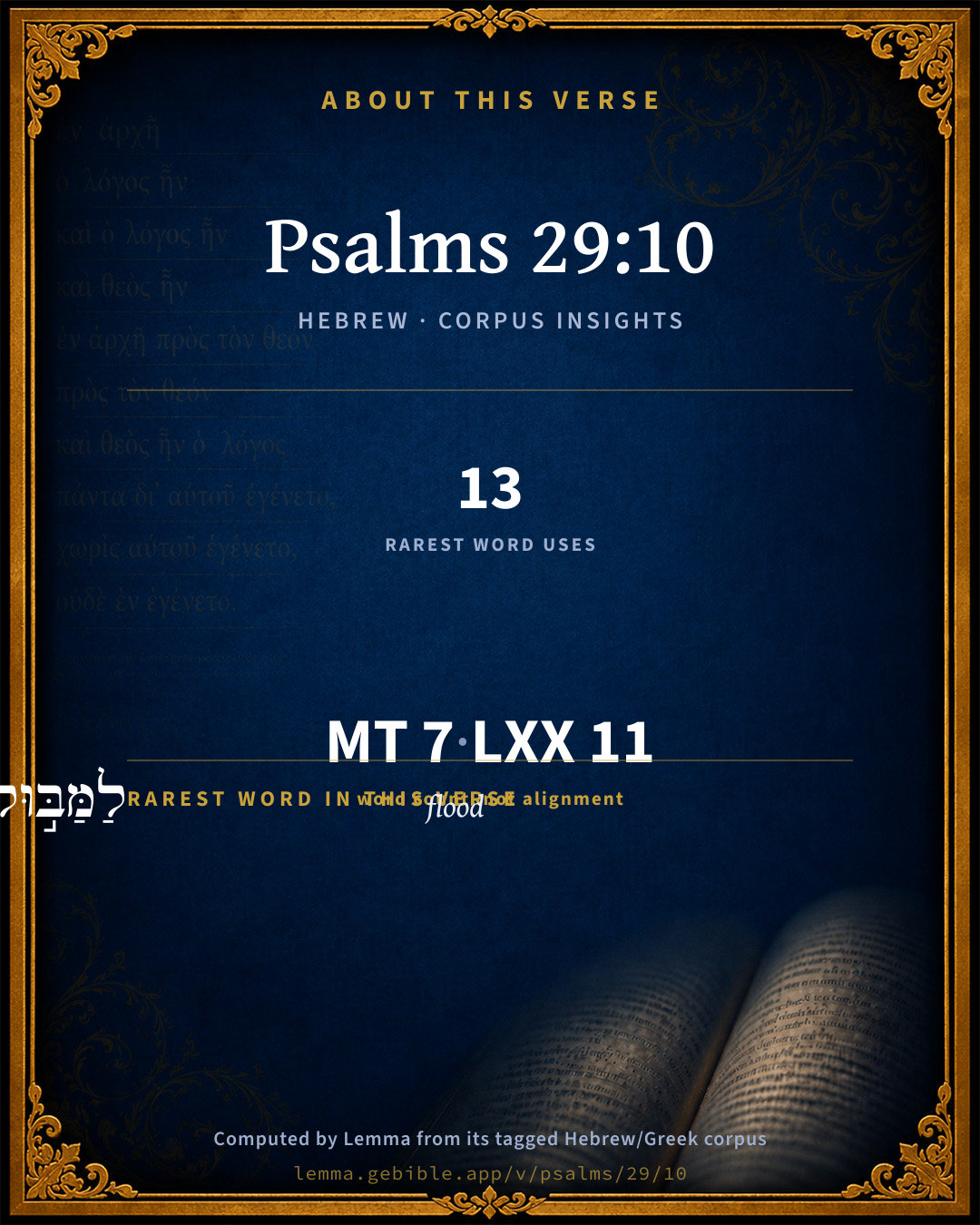
7
words
5
distinct lemmas
Wisdom
section

Notable vocabulary

The rarest word here is לַמַּבּ֣וּל flood H3999 — appearing just 13 times in the whole Hebrew Bible.

Shared distinctive vocabulary

לַמַּבּ֣וּל flood H3999 occurs in 12 verses of the Hebrew Bible. Also found in:

Grammatical profile

  • 2 verbs
  • 5 nouns

Verb forms

  • יָשָׁ֑ב Qal · Perfect
  • וַיֵּ֥שֶׁב Qal · Sequential Imperfect

Repetition

Words recur within this verse — often emphatic in Hebrew:

  • יְ֭הוָה LORD H3068 ×2
  • יָשָׁ֑ב to dwell H3427 ×2

Hebrew & Septuagint length

In English translation the verse runs 12 words from the Hebrew and 16 from the Septuagint (LXX English) — closely comparable.

A rough comparison of the two English renderings, which tokenize alike — not a word-level alignment.

Word counts can differ between the Hebrew and the Greek without any difference in meaning — e.g. the Hebrew direct-object marker אֵת has no separate Greek word, and Greek often adds the article ὁ.

In the original languages it is 7 Hebrew tokens and 11 Greek tokens — but the two are counted differently (Hebrew bundles its prefixes and suffixes into one token; the Greek is in lemma form), so that isn’t a like-for-like length.

Cross-references

15

Topical passages linked to Psalms 29:10 in the Treasury of Scripture Knowledge — connected by theme and wording, ordered by reader-vote popularity; previews shown in the World English Bible.

  • Genesis 6:17 I, even, I do bring the flood of waters on this earth, to destroy all flesh having the breath of life from under the sky. Everything that is in the earth will die.
  • Psalms 10:16 Yahweh is King forever and ever! The nations will perish out of his land.
  • 1 Timothy 1:17 Now to the King eternal, immortal, invisible, to God who alone is wise, be honor and glory forever and ever. Amen.
  • Mark 4:41 They were greatly afraid, and said to one another, "Who then is this, that even the wind and the sea obey him?"
  • Genesis 8:1–2 God remembered Noah, all the animals, and all the cattle that were with him in the ark; and God made a wind to pass over the earth. The waters subsided.
  • Job 38:8–11 "Or who shut up the sea with doors, When it broke forth from the womb,
  • Job 38:25 Who has cut a channel for the flood water, Or the path for the thunderstorm;
  • Psalms 2:6–9 "Yet I have set my king on my holy hill of Zion."
  • Psalms 29:3 Yahweh's voice is on the waters. The God of glory thunders, even Yahweh on many waters.
  • Psalms 65:7 Who stills the roaring of the seas, The roaring of their waves, And the turmoil of the nations.
  • Psalms 93:1 Yahweh reigns! He is clothed with majesty! Yahweh is armed with strength. The world also is established. It can't be moved.
  • Psalms 99:1 Yahweh reigns! Let the peoples tremble. He sits enthroned among the cherubim. Let the earth be moved.
  • Daniel 2:44 In the days of those kings shall the God of heaven set up a kingdom which shall never be destroyed, nor shall the sovereignty of it be left to another people; but it shall break in pieces and consume all these kingdoms, and it shall stand forever.
  • Matthew 6:13 Bring us not into temptation, but deliver us from the evil one. For yours is the Kingdom, the power, and the glory forever. Amen.'
  • Psalms 104:6–9 You covered it with the deep as with a cloak. The waters stood above the mountains.

Cross-references courtesy of OpenBible.info (CC BY 4.0).

Hebrew and Greek witnesses Masoretic Hebrew ↔ Greek Septuagint

The same verse in the two great witnesses to the Old Testament, shown verse-for-verse.

You’re reading Greek Psalm 28 (Hebrew Psalm 29). The Septuagint counts the superscription, so verse numbers can differ from the Hebrew — chapter-level alignment, not verse-by-verse. Numbering follows Rahlfs.

These are two independent witnesses, not word-aligned to each other, and the Septuagint is shown in lemma (dictionary) form.

Hebrew Psalms 29:10 Masoretic · Westminster Leningrad Codex

יְ֭הוָה לַמַּבּ֣וּל יָשָׁ֑ב וַיֵּ֥שֶׁב יְ֝הוָ֗ה מֶ֣לֶךְ לְעוֹלָֽם

Yahweh sat enthroned at the Flood. Yes, Yahweh sits as King forever.

World English Bible · Public Domain

Greek LXX Greek Psalm 28:10 Septuagint · lemma form

κύριος ὁ κατακλυσμός καταοἰκίζω καί καταἵημι κύριος βασιλεύς εἰς ὁ αἰών

The Lord will dwell on the waterflood: and the Lord will sit a king for ever.

LXX2012 (modern English Septuagint) · Public Domain

On this verse, John Calvin's Commentaries discusses the Septuagint’s reading. Read the note in Commentary ↓

Hebrew: Westminster Leningrad Codex (CC BY 4.0). Greek: Septuagint (public domain); English from LXX2012 (modern English Septuagint) (Public Domain). How the Septuagint differs from the Hebrew →

Commentary

Notes on Psalms 29:10 from classic Christian and Jewish commentators (each source and its license shown beneath its notes). The classic Christian expositions comment on the surrounding passage and are grouped to its opening verse, so a note may address several verses; the Jewish commentaries on the Tanakh (Rashi and others) are per-verse, so they appear only where the commentator wrote on this verse.

Lemma curates 59 commentaries, every one of them public domain or Creative Commons licensed, each selected and text-cleaned for this edition rather than reprinted as found. About our sources →

Trapp's Complete Commentary

John Trapp

Psa 29:10 The LORD sitteth upon the flood; yea, the LORD sitteth King for ever.

Ver. 10. The Lord sitteth upon the flood] He reigned in that general deluge in Noah’s days, Gen 6:7, and doth still over those horrible inundations that follow upon thunder and strong tempests; ruling that raging element, and governing all by his providence and sovereign power.

Yea, the Lord sitteth King for ever] And over all; therefore all, even the mightiest, should give him glory, as Psa 29:1.

John Trapp, A Commentary or Exposition upon All the Books of the Old and New Testament (1647–1656) — public domain. Text from a community e-Sword module.

The Biblical Illustrator

Joseph S. Exell

Psa_29:10

The Lord sitteth upon the flood; yea, the Lord sitteth King for ever:

Gods throne upon the flood; or, Divine control

There is a well-known line of an English poet, which tells us to look through Nature up to Natures God.

And not a few of our national poets have nobly done this. But the Bible is the supreme example. Its writers did not refuse to look at Nature; they were ever doing so.

I. That the course of events on earth is full of changes. Calm today, storm to-morrow.

II. but jehovah sits upon the flood. The changes of human life do not disturb Him. Yet more, He controls them all, He sitteth King for ever. Natural science shows how the smallest and seemingly most insignificant events are all guided by law. Nothing is arbitrary or of chance. God watches over and controls them all.

1. Scripture asserts this. There may be seasons when His people seem to be forsaken so that their enemies ask exultingly, Where is now their God? And yet, even then, the answer is, Our God is in the heavens; He hath done whatsoever He hath pleased.

2. Fulfilled prophecies confirm it. For example, the Advent of Christ. That was predicted seven hundred years before He came, and that He should be born at Bethlehem.

3. The continuance of true religion in spite of all opposition.

III. the manner in which events are overruled.

1. By general laws. See the illustration of the text, the flood. That obeys the law of its nature. Now one of Gods general laws is this--that sin is always followed by suffering--and another is--that generation shall be followed by generation: wicked men are removed to make way for better.

2. By special interposition. See the miracles.

IV. lessons.

1. Let the Church of Christ be comforted.

2. Also each individual Christian. (F. Tucker, B. A.)

King at the flood

The king is revealed in the time of the flood. Smaller personalities appear kingly when the waters are smooth; they disappear at the flood. Military officers are very much alike when they are on the parade ground; their genius and quality are revealed on the battlefield. The captain of the boat and the landsmen seem equally efficient when the boat glides over still waters, and the days pass in a long picnic, and games are played on the deck; but when the whirlwind awakes, and the boat staggers like a drunken man, the king is seen enthroned! I will measure and judge any one who seeks the throne of my life by his demeanour and worth amid my crises. Among all the candidates for honour and homage I will yield the crown of my obedience to the one who proves to be king at the flood. Let us look round upon two or three men who have come to one of lifes emergencies, and who are in need of a sovereign helper.

1. I am come unto deep waters where the floods overflow me. What is the character of this mans crisis? Iniquities prevail against me. He is the victim of unclean desire. The inner rooms of the spirit, the holy place, is defiled. He is unable to contemplate the beautiful and to love it. The floods of carnality overflow him. Or perhaps the victim is overborne by the spirit of envy which too frequently manifest itself in deceit and treachery, or he is possessed by the passion of jealousy which makes him a conspirator against his neighbours good. Whatever may be the type of the mans besetment, the flood is at the gate, and he is overpowered by the invasion of its unclean deeps. What shall we say to him? One would perhaps advise him that the secret of his redemption will consist in plain living and high thinking. But the counsel is worthless. We are advising a man who is overborne by appetite to control the appetite, and suggesting that a man who is the victim of his own thought should order it in beautiful regularity. How fares it if we call in the Lord Himself? The Masters speech is full of healing confidence and hope. He speaks of a clean heart and a right spirit. He not only unfolds an ideal, but He offers the power by which it can be realized. The unclean channels are flushed and cleansed, and all the powers in the life are quickened and revived.

2. Save me, O Lord! for the waters are come into my soul. What is the type of this mans sorrow? It is a flood of trouble, perhaps arising from common circumstances such as we are familiar with in our own life.

(1) Here is a case of slow cancer. The growth is eating its way, but, oh, so slowly! Day after day, and night after night, the wolf gnaws at the vitals. Let us speak to the victim. What shall we say to her? Matthew Arnold once said:--In poetry our race will find an ever sure and surer stay. What kind of poetry can we give to the cancer-ridden? If God be gone and the Man of Nazareth is only a pleasing fiction, and immortality only a winsome dream, whatever we offer will be only as dead ashes; gravel where the soul is pining for bread. Let us call in the Lord God. The very thought of His appearing is comforting. What I do thou knowest not now. When thou passest through the waters I will be with thee.

(2) Here are a father and mother whose son is in the far country. Their hopes are blighted, their ambition is overthrown. They are overwhelmed, and the waters have come into their souls. What says the world about their child? He is too far gone; . . . he is a hopeless case; . . . he is too old to mend; . . . there is no remedy for a bad heart. The world has no ministry to offer in the time of the flood. Let us call in the Lord God. Here is His speech: What man of you having a hundred sheep, if he lose one of them, doth not leave the ninety and nine and go after that which is lost until he find it? What a hopeful and uplifting word to speak to a broken-hearted father!

3. All Thy waves and Thy billows have gone over me. The sorrows of death compass me. This type of overwhelming sorrow is one of the most familiar sights in the common way. Here is a beautiful wedded, life. The early intimacy was like a spring day. The wedding was only the welding of ties already sanctified. The home was a haunt of love and peace. Then a storm came, and the billows rolled against the little sanctuary. The sorrows of death compassed it, and the wife is gone I Now, leave God outside, and let us go inside. What shall we say to the bereaved husband? Shall we tell him that other friends remain, that loss is common to the race? Let us call in Jesus. Thy brother shall rise again. I go to prepare a place for you, that where I am there ye shall be also. There remaineth therefore a rest for the people of God. Weeping may endure for a night, but-joy cometh in the morning. He that believeth in Me, though he were dead, yet shall he live. Who is King? The Lord sat as King at the flood. (J. H. Jowett, M. A.)

A turbulent scene and a tranquil God

This psalm shows the influence of Godliness upon the intellectual faculties, the social sympathies, and the religious instincts of human nature. The text gives us:--

I. A turbulent scene. A flood. A flood suggests--

1. Commotion. The moral domain is all commotion. Look at it spiritually: There is no peace, saith my God, etc. Look at it socially,--nationally. Souls are all in commotion here.

2. Innovation. It was broken down barriers, etc. So have souls.

3. Distress. It is furious and violent, etc. The moral world is not like a river, flowing on peacefully in its channel. Nor like the ocean, moving, even when most tumultuous, within its own proper boundaries. It is a flood.

II. A tranquil God. The Lord sitteth. This implies on His part--

1. A consciousness of His right to reign. If He had any moral misgivings He would not be at ease. An usurper could not be tranquil over such a tumultuous empire.

2. A consciousness of a supremacy of power to reign. He has no feeling of incapacity, lie can control with consummate ease the whole. We rejoice in His supremacy over the flood. (Homilist.)

The Biblical Illustrator, edited by Joseph S. Exell (c. 1880s–1900s) — public domain. Text from a community e-Sword module.

Joseph Benson's Commentary

Psa 29:10. The Lord sitteth upon the flood — He moderates and rules the most abundant and violent effusions of waters which are sometimes poured from the clouds, and fall upon the earth, where they cause inundations which would do much mischief if God did not prevent it. And this may be mentioned as another reason why God’s people praised and worshipped him in his temple; because, as he sendeth terrible tempests, thunders, lightnings, and floods, so he restrains and overrules them. But most interpreters refer this to Noah’s flood, to which the word מבול, mabbul, here used, is elsewhere appropriated. And so the words may be rendered, The Lord sat upon the deluge; namely, in Noah’s time, when, it is probable, those vehement and unceasing rains were accompanied with terrible thunders. Bishop Hare thus paraphrases the verse, “This is the same God who, in Noah’s flood, sat as judge, and sent that destruction upon the earth.” And so the psalmist, having spoken of the manifestation of God’s power in storms and tempests in general, takes an occasion to go back to that ancient and most dreadful example of that kind, in which the divine power was most eminently seen. And, having mentioned that instance, he adds, that as God had showed himself to be the King and the Judge of the world at that time, so he doth still sit, and will sit as King for ever, sending such tempests as it pleases him to send. And therefore his people have great reason to worship and serve him.

Joseph Benson's Commentary on the Old and New Testaments (1811–1818) — public domain. Text from a community e-Sword module.

Whedon's Commentary on the Bible

Daniel D. Whedon

10, 11. The Lord sitteth upon the flood—The moral application of the psalm is given in these last two verses. In Psa_29:10, the first corollary is given in the supremacy of God in nature, ruling and directing all its forces to wise and beneficent ends. The second is stated in Psa_29:11, which brings out the special covenant relations of God to his people, to whom “he will give strength,” and the blessing of “peace,” of which this timely rain and terrible display of power are both the pledge and fulfilment.

Daniel D. Whedon (gen. ed.), Commentary on the Old and New Testaments (1874–1909) — public domain. Text from a community e-Sword module.

J. A. Alexander on Psalms

Joseph Addison Alexander

10. (Psa 29:10) Jehovah at the flood sat (enthroned), and Jehovah sits (as) King to eternity. There are only two ways in which this verse can be understood. It must either be explained as introducing a new trait in the description of a tempest, namely, that of a flood or inundation—or referred to the universal deluge, as the grandest instance of the natural changes which had been described. In favour of the latter explanation may be urged the intrinsic grandeur of the image which it calls up, its better agreement with the solemn declaration in the last clause, the peculiar fitness of a great historical example just in this place, and the invariable usage the Hebrew means Noah's flood. The sense of the whole verse may be thus expressed in paraphrase. The God whose voice now produces these effects is the God who sat enthroned upon the deluge, and this same God is still reigning over nature and the elements, and will be able to control them for ever.

Joseph Addison Alexander, The Psalms Translated and Explained (1850) — public domain. Text from a community e-Sword module.

Tyndale Open Study Notes

Tyndale Open Resources

29:10 The image of powerful floodwaters connects with the Genesis flood (Gen 6:17). The Lord reigns as king over the whole created order; no one contests his kingdom.

Tyndale Open Study Notes — © Tyndale Open Resources, licensed CC BY-SA 4.0. Text via the HelloAO Bible API.

Geneva Bible (1599)

Geneva Bible translators

To moderate the rage of the tempest and waters, that they destroy not all.

Geneva Bible (1599) marginal notes — public domain. Text via Bolls.life.

Jamieson, Fausset & Brown

Robert Jamieson, A. R. Fausset & David Brown

Over this terrible raging of the elements God is enthroned, directing and restraining by sovereign power; and hence the comfort of His people. "This awful God is ours, our Father and our Love."

Next: Psalms Chapter 30

Jamieson, Fausset & Brown — Commentary Critical and Explanatory on the Whole Bible (1871) — public domain (CC PDM 1.0). Text via the HelloAO Bible API.

Adam Clarke's Commentary

Verse 10. The Lord sitteth upon the flood] יהוה למבול ישב Jehovah lammabbul yasheb, "Jehovah sat upon the deluge." It was Jehovah that commanded those waters to be upon the earth. He directed the storm; and is here represented, after all the confusion and tempest, as sitting on the floods, appeasing the fury of the jarring elements; and reducing all things, by his governing influence, to regularity and order.

Sitteth king for ever.] He governs universal nature; whatsoever he wills he does, in the heavens above, in the earth beneath, and in all deep places. Every phenomenon is under his government and control. There is something very like this in Virgil's description of Neptune appeasing the storm raised by Juno for the destruction of the fleet of AEneas. See at the end of this Psalm. See Clarke on Ps 29:11.

Adam Clarke's Commentary on the Bible (1810–1826) — public domain. Text from a community e-Sword/MySword module.

John Calvin's Commentaries

10. Jehovah sitteth upon the flood. Some think that David here alludes to that memorable instance of God’s vengeance, when he drowned the world at once by the flood, “Par le deluge.” — Fr. This is the view taken of the passage by the ancient versions. “God,” says the Chaldee, “in the generation of the deluge sat in judgment.” The Septuagint reads, “God shall make the deluge to be inhabited,” or “make the world habitable after it;" the Syriac, “God called back the deluge;” and the Arabic, “God restrained the deluge.” Ainsworth reads, “Jehovah sat at the flood,” and explains it as meaning “Noah’s flood.”

“Que c’est luy seul qui gouverne toutes choses en tout temps.” — Fr.

John Calvin's Commentaries (1540-1563) — public domain. Text from the Calvin Translation Society English edition (1840s-50s) via the Christian Classics Ethereal Library (ccel.org). Calvin's coverage is partial (roughly two-thirds of the Bible); uncommented books and verses are honest gaps, never fabricated. The 19th-century editor's footnotes and remarks are omitted so the notes are faithfully Calvin's own voice.

Ellicott's Commentary for English Readers

(10) The Lord sitteth.—Better, Jehovah was throned upon the flood, and Jehovah will be throned a king for ever. The word translated “flood” is exclusively, except in this place, applied to the Deluge (Genesis 6, 7). Hence we must suppose that the poet was recalled to the thought of the great Flood by the torrents of rain now falling. Jehovah sat then upon the waters as their King, and so He will for ever be throned on high above the storms of earth. Or, perhaps, the Deluge may have passed into a proverbial term for any great rain.

A Bible Commentary for English Readers, edited by Charles John Ellicott (1878–1897) — public domain. Text from a community e-Sword module.

The Cambridge Bible for Schools and Colleges

gen. ed. J. J. S. Perowne

10. The Lord sat as king at the Flood;

yea, the Lord sitteth as king for ever (R.V.).

According to the A.V. the flood appears to mean the deluge of rain which falls in the storm. But the word mabbûl is found nowhere else but in Genesis 6-11, and is best explained by its use there. The storm reminds the poet of the great typical example of judgement and mercy, in which Jehovah’s judicial sovereignty was exhibited.

Literally we may render, sat for the Flood; took His seat on His throne in order to execute that memorable judgement (Psa_9:7).

10, 11. Conclusion. The storm passes, but HE whose glory it declares is the Eternal King, the Judge of the world, the Guardian of His people. Awful as is His power, they need not fear. To them it speaks of peace.

The Cambridge Bible for Schools and Colleges (gen. ed. J. J. S. Perowne; Cambridge University Press, 1878–1918) — public domain. Text from a community e-Sword module.

John Gill's Exposition

The Lord sitteth upon the flood,.... Noah's flood; which is always designed by the word here used, the Lord sat and judged the old world for its wickedness, and brought a flood upon them, and destroyed them; and then he abated it, sent a wind to assuage the waters, stopped up the windows of heaven, and the fountains of the great deep, and restrained rain from heaven; and he now sits upon the confidence of waters in the heavens, at the time of a thunder storm, which threatens with an overflowing flood; and he remembers his covenant, and restrains them from destroying the earth any more: and he sits upon the floods of ungodly men, and stops their rage and fury, and suffers them not to proceed to overwhelm his people and interest; and so the floods of afflictions of every kind, and the floods of Satan's temptations, and of errors and heresies, are at his control, and he permits them to go so far, and no farther;

yea, the Lord sitteth King for ever: he is King of the whole world, over angels and men, and even the kings of the earth; and he is also King of saints, in whose hearts he reigns by his Spirit and grace; and the Gospel dispensation is more eminently his kingdom, in which his spiritual government is most visible; and this will more appear in the latter day glory, when the Lord shall be King over all the earth; and after which the Lord Christ will reign with his saints here a thousand years, and then with them to all eternity, and of his kingdom there shall be no end.

John Gill's Exposition of the Whole Bible (1746–1763) — public domain (CC PDM 1.0). Text via the HelloAO Bible API.

Albert Barnes' Notes on the Bible

The Lord sitteth upon the flood - God is enthroned upon the flood, or presides over it. The obvious meaning is, that God is enthroned upon the storm, or presides over that which produces such consternation. It is not undirected; it is not the result of chance or fate; it is not produced by mere physical laws; it is not without restraint - without a ruler - for Yahweh presides over all, and all this may be regarded as his throne. Compare the notes at Psa 18:7-11. See also Psa 97:2. The word used here is commonly applied to the deluge in the time of Noah, but there would be an obvious unfitness in supposing here that the mind of the psalmist referred to that, or that the course of thought would be directed to that, and it is most natural, therefore, to suppose that the reference is to the floods above - the vast reservoirs of waters in the clouds, pouring down, amidst the fury of the tempest, floods of rain upon the earth.

The Lord sitteth King for ever - This is an appropriate close of the entire description; this is a thought which tends to make the mind calm and confiding when the winds howl and the thunder rolls; this accords with the leading purpose of the psalm - the call upon the sons of the mighty Psa 29:1 to ascribe strength and glory to God. From all the terrors of the storm; from all that is fearful, on the waters, in the forests, on the hills, when it would seem as if everything would be swept away - the mind turns calmly to the thought that God is enthroned upon the clouds; that He presides over all that produces this widespread alarm and commotion, and that He will reign forever and ever.

Albert Barnes' Notes on the Bible (1834–1885) — public domain. Text from a community e-Sword/MySword module.

Matthew Poole's English Annotations

He moderateth and ruleth (which is oft signified by sitting, this being the posture of a judge, or ruler; of which see Psa 9:7-9; 47:8; Joe 3:12) the most abundant and violent inundations of waters, which sometimes fall from the clouds upon the earth; where they would do much mischief if God did not prevent it. And these are here fitly mentioned, as being many times the companions of great thunders. And this may be alleged as another reason why God’s people did praise and worship him in his temple, because as he sendeth terrible tempests, and thunders, and floods, so he also restrains and overrules them. But most interpreters refer this to Noah’s flood, to whom the word here used is elsewhere appropriated. And so the words may be rendered, The Lord did sit upon, or at, the flood in Noah’s time, when it is probable those vehement rains were accompanied with terrible thunders. And so having spoken of the manifestation of God’s power in storms and tempests in general, he takes an occasion to run back to that ancient and most dreadful example of that kind, in which the Divine power was most eminently seen. And having mentioned that instance, he adds, that as God showed himself to be the King and the Judge of the world at that time, so he doth still sit, and will sit, as

King for ever, sending such tempests when it pleaseth him. And therefore his people have great reason to worship and serve him.

Matthew Poole's English Annotations on the Holy Bible (1683–1685) — public domain. Text from a community e-Sword/MySword module.

The Treasury of David

Charles H. Spurgeon

Ver. 10. The Lord sitteth upon the flood. Flood follows tempest, but Jehovah is ready for the emergency. No deluge can undermine the foundation of his throne. He is calm and unmoved, however much the deep may roar and be troubled: his government rules the most unstable and boisterous of created things. Far out on the wild waste of waters, Jehovah "plants his footsteps in the sea, and rides upon the storm, "Yea, the Lord sitteth King for ever. Jesus has the government upon his shoulders eternally: our interests in the most stormy times are safe in his hands. Satan is not a king, but Jehovah Jesus is; therefore let us worship him, and rejoice evermore.

Ver. 10. The ever present and undisturbed government of God.

Psalms 29:11*

Charles H. Spurgeon's The Treasury of David (1869–1885) — public domain. Psalms only. Text from a community e-Sword/MySword module.

The Pulpit Commentary

The Lord sitteth upon the flood. Most moderns translate, "The Lord sat (as King) at the Flood," and understand by "the Flood" the great Noachian Deluge (Rosenmuller, Hengstenberg, Kay, Revised Version). Some, however, regard this as a forced and unnatural interpretation (Bishop Horsley, "Four Friends," "Speaker"s Commentary"), and think the flood accompanying the storm just described (vers. 8-9), or floods and inundations generally, to be meant. It is difficult to decide between the two interpretations. Yea, the Lord sitteth King for ever. As God has sat as King in the past, whether at the great Deluge or at any other flood or floods, so will he ever "sit as King" in the future.

The Pulpit Commentary (1880–1919), ed. H.D.M. Spence-Jones & Joseph S. Exell — public domain. Text from a community e-Sword module.

John Wesley's Explanatory Notes

The flood - The most violent waters, which sometimes fall from the clouds upon the earth. These are fitly mentioned, as being many times the companions of great thunders. And this may be alleged as another reason, why God's people praised him in his temple, because as he sends terrible tempests and thunders, so he also restrains and over-rules them. Sitteth - He doth sit, and will sit as king forever, sending such tempests when it pleaseth him.

John Wesley, Explanatory Notes Upon the Whole Bible (1754–1765) — public domain. Text via the GEBible commentary corpus.

Keil & Delitzsch

C. F. Keil & F. Delitzsch

Luther renders it: "The Lord sitteth to prepare a Flood," thus putting meaning into the unintelligible rendering of the Vulgate and lxx; and in fact a meaning that accords with the language - for ישׁב ל is most certainly intended to be understood after the analogy of ישׁב למשׁפט, Psa 122:5, cf. Psa 9:8 - just as much as with the context; for the poet has not thus far expressly referred to the torrents of rain, in which the storm empties itself. Engelhardt also (Lutherische Zeitschrift, 1861, 216f.), Kurtz (Bibel und Astronomie, S. 568, Aufl. 4), Riehm (Liter. - Blatt of the Allgem. Kirchen-Zeit., 1864, S. 110), and others understand by מבול the quasi-flood of the torrent of rain accompanying the lightning and thunder. But the word is not למבול, but למּבול, and המּבּוּל (Syr. momûl) occurs exclusively in Gen 6-11 as the name of the great Flood. Every tempest, however, calls to mind this judgment and its merciful issue, for it comes before us in sacred history as the first appearance of rain with lightning and thunder, and of the bow in the clouds speaking its message of peace (Genesis, S. 276). The retrospective reference to this event is also still further confirmed by the aorist ויּשׁב which follows the perfect ישׁב (Hofmann, Schriftbeweis i. 208). Jahve - says the poet - sat (upon His throne) at the Flood (to execute it), and sits (enthroned) in consequence thereof, or since that time, as this present revelation of Him in the tempest shows, as King for ever, inasmuch as He rules down here upon earth from His throne in the heavens (Psa 115:16) in wrath and in mercy, judging and dispensing blessing. Here upon earth He has a people, whom from above He endows with a share of His own might and blesses with peace, while the tempests of His wrath burst over their foes. How expressive is בּשּׁלום as the closing word of this particular Psalm! It spans the Psalm like a rain-bow. The opening of the Psalm shows us the heavens opened and the throne of God in the midst of the angelic songs of praise, and the close of the Psalm shows us, on earth, His people victorious and blessed with peace (בּ as in Gen 24:1

(Note: The Holy One, blessed be He-says the Mishna, Uksin iii. 12, with reference to this passage in the Psalms-has not found any other vessel (כלי) to hold the blessing specially allotted to Israel but peace.))

in the midst of Jahve's voice of anger, which shakes all things. Gloria in excelsis is its beginning, and pax in terris its conclusion.

Keil & Delitzsch — Biblical Commentary on the Old Testament (1861–1891) — public domain (CC PDM 1.0). Text via the HelloAO Bible API. (Old Testament only.)

Rashi

Rabbi Shlomo Yitzchaki (Rashi)

The Lord sat [enthroned] at the flood alone in His greatness, and now also, the Lord sits alone forever, “but the idols will completely pass away,” (as in Isa. 2:18), yet to His people He will give strength and a blessing of peace. Our Sages, however, expounded upon it in Midrash Psalms (29:2) that the nations became frightened and startled, and they came to Balaam and said to him, “What is the sound of the stirring that we heard? Is He going to bring a flood upon the world?” He replied to them, “He already swore that He would not bring a flood. Rather, the sound of the stirring that you heard is that the Holy One, blessed be He, is giving a Torah to His people.”

Rashi on the Tanakh — English translations: “The Judaica Press complete Tanach with Rashi, translated by A. J. Rosenberg” (CC BY 4.0); “Pentateuch with Rashi's commentary by M. Rosenbaum and A.M. Silbermann, 1929-1934” (public domain); “The Metsudah Tanach series, Lakewood, N.J” (CC BY 4.0); and “The Book of Joshua, Metsudah Publications, 1997” (CC BY 4.0). Text via Sefaria.

Lesson kit

Teaching starters — assembled from the data on this page, not authored interpretation. Every prompt links to the verse data it draws on. Edit before teaching.

Psalms, in the Wisdom, opens this verse with 7 words (5 distinct Hebrew lemmas). Its most distinctive word is mabbûwl (“flood”). A historical commentator’s framing appears above. Read the whole chapter for the surrounding context.

Discussion questions

  1. The word mabbûwl carries the sense “flood.” How does it shape the verse?
  2. Genesis 6:17 shares the word «flood» with this verse. How do the two illuminate each other?
  3. “LORD” occurs 2× in this one verse. What is the effect of the repetition?
  4. The translations on this page render this verse differently — a whole-verse word diff, not a word-by-word alignment. What might account for the different wordings?
  5. The verb «יָשָׁ֑ב» is Qal Perfect. How does its form color the action?
  6. Reading how Trapp's Complete Commentary and The Biblical Illustrator read this verse, where do the two commentators agree and where do they part?

Things to notice

Reading settings

Reading text

Shown beneath each verse's original-language words.

Old Testament
Old Testament edition

Read the OT as the Masoretic Hebrew (MT) or the Greek Septuagint (LXX).

English shown for the Greek Septuagint (in the Hebrew ↔ Greek comparison).

Comparing translations? Open the Compare panel on any verse page to stack up to four side by side.