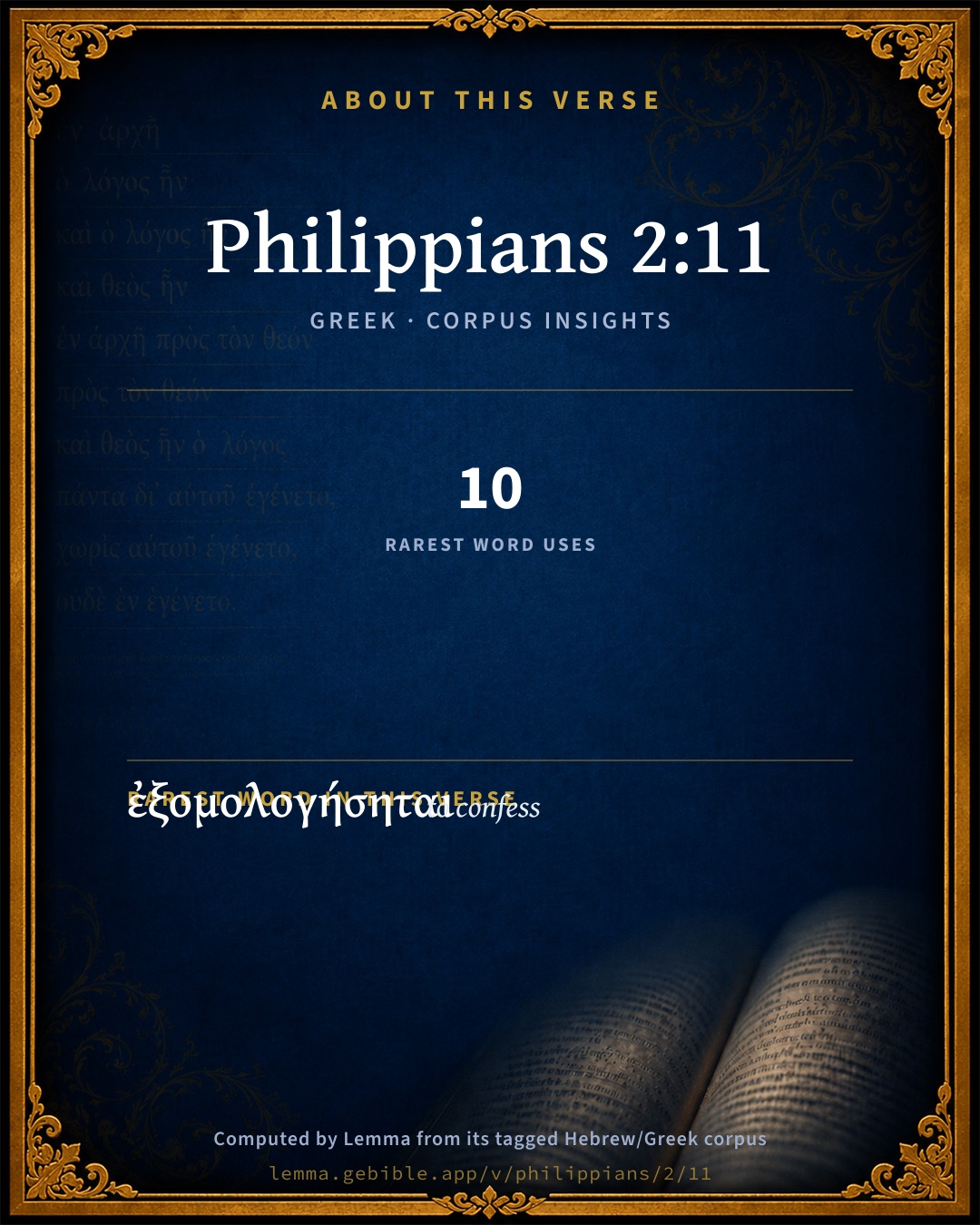
Philippians 2:11

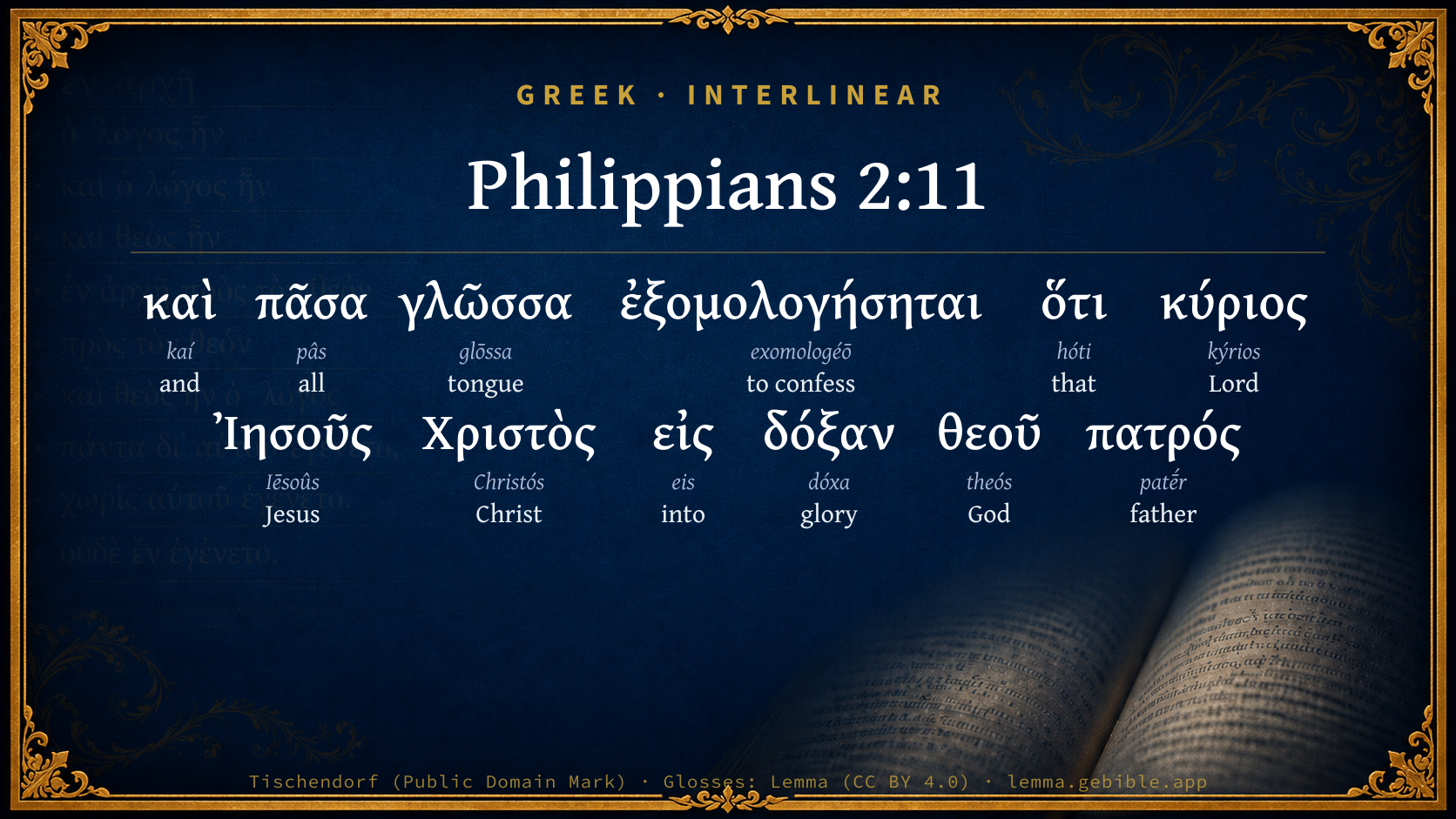
Greek (Tischendorf 8th ed.) Philippians 2:11 appears in the Greek New Testament. The text above is from the Tischendorf 8th edition. Each word links to its Strong’s number and a concise gloss. Click any word for its full Thayer’s Greek Lexicon entry.
Download image
Cite this verse

Philippians 2:11 (World English Bible). Public Domain. Lemma interlinear Bible study tool, https://lemma.gebible.app/v/philippians/2/11.

Show BibTeX & RIS
BibTeX
RIS
English Translation
and that every tongue should confess that Jesus Christ is Lord, to the glory of God the Father.
World English Bible · Public Domain
Download a study sheet

One document with this verse’s original text, its word-by-word gloss line, the meaning frame, cross-references with their text, attributed commentary, and full source and license credits — printable, and it pastes into notes with its structure intact.

This verse Autodidact and up

Study sheet (.html) Plain text (.txt)

A passage Seminary Student

Up to 50 verses in one chapter. A passage sheet keeps up to 6 commentary sources and 12 cross-references per verse, in the order this page ranks them, and says so on the sheet whenever that leaves anything out. Ask for a single verse and you get the Autodidact verse sheet above.

Everything on this page stays free to read, with no account — the sheet is a download of what is already on screen, not access to it.

Want to remove ads? Support Godless Engineer
Compare translations 3

The same verse in 3 English versions, stacked beneath the original-language interlinear above. Click any original word for its lexicon entry.

Each is an independent rendering of the whole verse — the interlinear is not word-aligned to these translations.

Highlighted words mark where these versions differ — a whole-verse word diff, not a word-by-word alignment.

  • World English Bible Public Domain
    and that every tongue should confess that Jesus Christ is Lord, to the glory of God the Father.
  • King James Version Public Domain
    And that every tongue should confess that Jesus Christ is Lord, to the glory of God the Father.
  • unfoldingWord Literal Text CC BY-SA 4.0
    and every tongue would confess that Jesus Christ Lord, to the glory of God the Father.

unfoldingWord Literal Text — © unfoldingWord, licensed CC BY-SA 4.0. Word-aligned USFM3 via Door43 (git.door43.org/unfoldingWord/en_ult).

Versions to compare (up to 4)

3 of 4 selected

Show all 19 translations

Every available English version of this verse, each an independent rendering of the whole verse.

  • World English Bible Public Domain
    and that every tongue should confess that Jesus Christ is Lord, to the glory of God the Father.
  • Berean Standard Bible Public Domain
    and every tongue confess that Jesus Christ is Lord, to the glory of God the Father.
  • Majority Standard Bible Public Domain
    and every tongue confess that Jesus Christ is Lord, to the glory of God the Father.
  • King James Version Public Domain
    And that every tongue should confess that Jesus Christ is Lord, to the glory of God the Father.
  • American Standard Version (1901) Public Domain
    and that every tongue should confess that Jesus Christ is Lord, to the glory of God the Father.
  • Revised Version (1885) Public Domain
    and that every tongue should confess that Jesus Christ is Lord, to the glory of God the Father.
  • Geneva Bible (1599) Public Domain
    And that euery tongue shoulde confesse that Iesus Christ is the Lord, vnto the glory of God the Father.
  • Douay-Rheims (1899) Public Domain
    And that every tongue should confess that the Lord Jesus Christ is in the glory of God the Father.
  • Young's Literal Translation Public Domain
    and every tongue may confess that Jesus Christ `is' Lord, to the glory of God the Father.
  • Literal Standard Version CC BY-SA 4.0
    and every tongue may confess that Jesus Christ [is] LORD, to the glory of God the Father.
  • Unlocked Literal Bible CC BY-SA 4.0
    He did this so that every tongue should confess that Jesus Christ is Lord, to the glory of God the Father.
  • unfoldingWord Literal Text CC BY-SA 4.0
    and every tongue would confess that Jesus Christ Lord, to the glory of God the Father.
  • Darby Bible Public Domain
    and every tongue confess that Jesus Christ [is] Lord to God [the] Father's glory.
  • World Messianic Bible Public Domain
    and that every tongue should confess that Yeshua the Messiah is Lord, to the glory of God the Father.
  • Webster's Bible Public Domain
    And that every tongue should confess that Jesus Christ is Lord, to the glory of God the Father.
  • Free Bible Version CC BY-SA 4.0
    and all will declare that Jesus Christ is Lord, to the glory of God the Father.
  • Bible in Basic English Public Domain
    And that every tongue may give witness that Jesus Christ is Lord, to the glory of God the Father.
  • Text-Critical English NT CC BY 4.0
    and every tongue confess that Jesus Christ is Lord, to the glory of God the Father.
  • Tyndale New Testament (1534) Public Domain
    and that all tonges shuld confesse that Iesus Christ is the lorde vnto the prayse of God the father.

Literal Standard Version (2020), Covenant Press — licensed CC BY-SA 4.0. Text via the HelloAO Bible API (eBible.org). Unlocked Literal Bible (unfoldingWord) — licensed CC BY-SA 4.0. Text via the HelloAO Bible API (eBible.org). unfoldingWord Literal Text — © unfoldingWord, licensed CC BY-SA 4.0. Word-aligned USFM3 via Door43 (git.door43.org/unfoldingWord/en_ult). Free Bible Version, Dr. Jonathan Gallagher — licensed CC BY-SA 4.0. Text via the HelloAO Bible API (eBible.org).

Word by word

More ways to search: Search by grammar → Find every occurrence → Compare this word →

Practice this passage: Drill this verse → Learn its vocabulary →

ἐξομολογήσηται
exomologéō
G1843
“to confess”
Verb, Aorist, Middle, Subjunctive, 3rd person, Singular
Part of Speech
Verb
Tense
Aorist
Voice
Middle
Mood
Subjunctive
Person
3rd person
Number
Singular
Full Thayer's Definition

Origin: from G1537 and G3670

TDNT: 08:19,7

1. to confess 2. to profess a. acknowledge openly and joyfully b. to one's honour: to celebrate, give praise to c. to profess that one will do something, to promise, agree, engage
  1. καὶ kaí G2532 “and” Conjunction
  2. πᾶσα pâs G3956 “all” Adjective, Nominative, Singular, Feminine
  3. γλῶσσα glōssa G1100 “tongue” Noun, Nominative, Singular, Feminine
  4. ὅτι hóti G3754 “that” Conjunction
  5. κύριος kýrios G2962 “Lord” Noun, Nominative, Singular, Masculine
  6. Ἰησοῦς Iēsoûs G2424 “Jesus” Noun, Nominative, Singular, Masculine
  7. Χριστὸς Christós G5547 “Christ” Noun, Nominative, Singular, Masculine
  8. εἰς eis G1519 “into” Preposition
  9. δόξαν dóxa G1391 “glory” Noun, Accusative, Singular, Feminine
  10. θεοῦ theós G2316 “God” Noun, Genitive, Singular, Masculine
  11. πατρός patḗr G3962 “father” Noun, Genitive, Singular, Masculine

About this verse

These counts appear in no published source. They are computed here, from the morphology-tagged text and Lemma’s own curated glosses. What Lemma adds →

12
words
12
distinct lemmas
Pauline Epistles
section

Notable vocabulary

The rarest word here is ἐξομολογήσηται to confess G1843 — appearing just 10 times in the whole Greek New Testament.

Shared distinctive vocabulary

ἐξομολογήσηται to confess G1843 occurs in 10 verses of the Greek New Testament. Also found in:

Cross-references

29

Topical passages linked to Philippians 2:11 in the Treasury of Scripture Knowledge — connected by theme and wording, ordered by reader-vote popularity; previews shown in the World English Bible.

  • 1 John 4:15 Whoever confesses that Jesus is the Son of God, God remains in him, and he in God.
  • Romans 14:11 For it is written, "'As I live,' says the Lord, 'to me every knee will bow. Every tongue will confess to God.'"
  • John 13:13 You call me, 'Teacher' and 'Lord.' You say so correctly, for so I am.
  • Romans 14:9 For to this end Christ died, rose, and lived again, that he might be Lord of both the dead and the living.
  • 1 John 4:2 By this you know the Spirit of God: every spirit who confesses that Jesus Christ has come in the flesh is of God,
  • 1 Corinthians 12:3 Therefore I make known to you that no man speaking by God's Spirit says, "Jesus is accursed." No one can say, "Jesus is Lord," but by the Holy Spirit.
  • John 14:13 Whatever you will ask in my name, that will I do, that the Father may be glorified in the Son.
  • Romans 10:9–12 that if you will confess with your mouth the Lord Jesus, and believe in your heart that God raised him from the dead, you will be saved.
  • Matthew 10:32 Everyone therefore who confesses me before men, him I will also confess before my Father who is in heaven.
  • 1 Corinthians 8:6 yet to us there is one God, the Father, of whom are all things, and we for him; and one Lord, Jesus Christ, through whom are all things, and we live through him.
  • 1 Peter 1:21 who through him are believers in God, who raised him from the dead, and gave him glory; so that your faith and hope might be in God.
  • Revelation 3:5 He who overcomes will be arrayed in white garments, and I will in no way blot his name out of the book of life, and I will confess his name before my Father, and before his angels.
  • Psalms 110:1 Yahweh says to my Lord, "Sit at my right hand, Until I make your enemies your footstool for your feet."
  • John 5:23 that all may honor the Son, even as they honor the Father. He who doesn't honor the Son doesn't honor the Father who sent him.
  • Acts 2:36 "Let all the house of Israel therefore know assuredly that God has made him both Lord and Christ, this Jesus whom you crucified."
  • 1 Corinthians 15:47 The first man is of the earth, made of dust. The second man is the Lord from heaven.
  • Psalms 18:49 Therefore I will give thanks to you, Yahweh, among the nations, And will sing praises to your name.
  • Luke 2:11 For there is born to you, this day, in the city of David, a Savior, who is Christ the Lord.
  • John 9:22 His parents said these things because they feared the Jews; for the Jews had already agreed that if any man would confess him as Christ, he would be put out of the synagogue.
  • John 20:28 Thomas answered him, "My Lord and my God!"
  • Acts 10:36 The word which he sent to the children of Israel, preaching good news of peace by Jesus Christ--he is Lord of all--
  • 2 John 1:7 For many deceivers have gone out into the world, those who don't confess that Jesus Christ came in the flesh. This is the deceiver and the Antichrist.
  • John 12:42 Nevertheless even of the rulers many believed in him, but because of the Pharisees they didn't confess it, so that they wouldn't be put out of the synagogue,
  • John 14:23 Jesus answered him, "If a man loves me, he will keep my word. My Father will love him, and we will come to him, and make our home with him.
  • John 16:14–15 He will glorify me, for he will take from what is mine, and will declare it to you.
  • John 17:1 Jesus said these things, and lifting up his eyes to heaven, he said, "Father, the time has come. Glorify your Son, that your Son may also glorify you;
  • Romans 15:9 and that the Gentiles might glorify God for his mercy. As it is written, "Therefore will I give praise to you among the Gentiles, And sing to your name."
  • Jeremiah 23:6 In his days Judah shall be saved, and Israel shall dwell safely; and this is his name by which he shall be called: Yahweh our righteousness.
  • John 13:31–32 When he had gone out, Jesus said, "Now the Son of Man has been glorified, and God has been glorified in him.

Cross-references courtesy of OpenBible.info (CC BY 4.0).

Commentary

Notes on Philippians 2:11 from classic Christian and Jewish commentators (each source and its license shown beneath its notes). The classic Christian expositions comment on the surrounding passage and are grouped to its opening verse, so a note may address several verses; the Jewish commentaries on the Tanakh (Rashi and others) are per-verse, so they appear only where the commentator wrote on this verse.

Lemma curates 59 commentaries, every one of them public domain or Creative Commons licensed, each selected and text-cleaned for this edition rather than reprinted as found. About our sources →

Bengel's Gnomon

Johann Albrecht Bengel

Php 2:11. Ἐξομολογήσηται, should confess) expressly.—Κύριος, Lord) no longer in the form of a servant.—εἰς, in) That Jesus Christ is Lord, inasmuch as He is in the glory of God the Father [not as Engl. Vers. “to the glory”]. So εἰς, Joh 1:18 [εἰς τὸν κόλπον, “in the bosom,” not into or to the bosom, etc.].—Θεοῦ Πατρὸς, of God the Father) The Son acknowledges, and those who see the glory of the Son also acknowledge, that the Son has this glory with the Father, and from the Father; comp. 1Co 15:28.

Bengel's Gnomon of the New Testament — English translation (T&T Clark, Edinburgh, 1860) — public domain. Text from a community e-Sword module.

Meyer's Critical & Exegetical Commentary

Heinrich August Wilhelm Meyer

Php_2:11 appends the express confession combined with the adoration in Php_2:10, in doing which the concrete form of representation is continued, comp. Rom_14:11; Isa_45:23; hence γλῶσσα is tongue, correlative to the previous γόνυ, not language (Theodoret, Beza, and others).

ἐξομολ.] a strengthening compound. Comp. on Mat_3:6. Respecting the future (see the critical remarks) depending on ἵνα, see on Gal_2:4; Eph_6:3; 1Co_9:18.

κύριος] predicate, placed first with strong emphasis: that Lord is Jesus Christ. This is the specific confession of the apostolic church (Rom_10:9; 2Co_4:5; Act_2:36), whose antithesis is: ἀνάθεμα Ἰησοῦς 1Co_12:3. The κύριον εἶναι refers to the fellowship of the divine dominion (comp. on Eph_1:22 f., Php_4:10; 1Co_15:27 f.); hence it is not to be limited to the rational creatures (Hoelemann, following Flatt and others), or to the church (Rheinwald, Schenkel).

εἰς δόξ. Θεοῦ πατρ.] may be attached to the entire bipartite clause of purpose (Hofmann). Since, however, in the second part a modification of the expression is introduced by the future, it is more probably to be joined to this portion, of which the telic destination, i.e. the final cause, is specified. It is not to be connected merely with κύριος Ἰ. Χ., as Bengel wished: J. Ch. esse dominum, quippe qui sit in gloria Dei patris, making εἰς stand for ἐν, for which the Vulgate, Pelagius, Estius, and others also took it. Schneckenburger also, p. 341 (comp. Calvin, Rheinwald, Matthies, Hoelemann), joins it with κύριος, but takes εἰς δόξαν rightly: to the honour. But, in accordance with Php_2:9, it was self-evident that the κυριότης of the Son tends to the honour of the Father; and the point of importance for the full conclusion was not this, but to bring into prominence that the universal confessing recognition of the κυριότης of Jesus Christ glorifies the Father (whose will and work Christs entire work of salvation is; see especially Ephesians 1; Rom_15:7-9; 2Co_1:20), whereby alone the exaltation, which Christ has received as a recompense from the Father, appears in its fullest splendour. Comp. Joh_12:28; Joh_17:1. The whole contents of Php_2:9 f. is parallel to the ἐν μορφῇ Θεοῦ, namely, as the recompensing re-elevation to this original estate, now accorded to the divine-human person after the completion of the work of humiliation. Complicated and at variance with the words is the view of van Hengel, that ἐξομολ. εἰς δόξαν Θεοῦ is equivalent to ἐξομολ. Θεῷ, to praise God (Gen_29:34, al.; Rom_15:9; Mat_11:25; Luk_10:21), and that ὅτι is quod; hence: laudibus celebrarent, quod hunc filium suum principem fecerit regni divini.

REMARK.

From Php_2:6-11, Baur, whom Schwegler follows, derives his arguments for the assertion that our epistle moves in the circle of Gnostic ideas and expressions, [121] and must therefore belong to the post-apostolic period of Gnostic speculation. But with the true explanation of the various points these arguments [122] fall to pieces of themselves. For (1) if τὸ εἶναι ἴσα Θεῷ be related to ἐν μορφῇ Θεοῦ εἶναι as the essence to its adequate manifestation, and if our explanation of ἁρπαγμός be the linguistically correct one, then must the Gnostic conception of the Aeon Sophiawhich vehemently desired to penetrate into the essence of the original Father (Iren. Haer. i. 2. 2), and thus before the close of the worlds course (Theol. Jahrb. 1849, p. 507 ff.) wished to usurp forcibly something not de jure belonging to it (Paulus, II. p. 51 ff.)be one entirely alien, and dissimilar to the idea of our passage. But this conception is just as inconsistent with the orthodox explanation of our passage, as with the one which takes the εἶναι ἴσα Θεῷ as something future and greater than the μορφὴ Θεοῦ; since in the case of the μορφή, as well as in that of the ἴσα, the full fellowship in the divine nature is already the relation assumed as existing. Consequently (2) the ἑαυτὸν ἐκένωσε cannot be explained by the idea, according to which the Gnostics made that Aeon, which desired to place itself in unwarranted union with the Absolute, fall from the Pleroma to the κένωμαas to which Baur, in this alleged basis for the representation of our passage, lays down merely the distinction, that Paul gives a moral turn to what, with the Gnostics, had a purely speculative signification (Whilst, therefore, in the Gnostic view, that ἁρπαγμός indeed actually takes place, but as an unnatural enterprise neutralizes itself, and has, as its result, merely something negative, in this case, in virtue of a moral self-determination, matters cannot come to any such ἁρπαγμός; and the negative, which even in this case occurs, not in consequence of an act that has failed, but of one which has not taken place at all, is the voluntary self-renunciation and self-denial by an act of the will, an ἑαυτὸν χενοῦν instead of the γενέσθαι ἐν χενώματι). (3) That even the notion of the μορφὴ Θεοῦ arose from the language used by the Gnostics, among whom the expressions μορφή, μορφοῦν, μόρφωσις, were very customary, is all the more arbitrarily assumed by Baur, since these expressions were very prevalent generally, and are not specifically Gnostic designations; indeed, μορφὴ Θεοῦ is not once used by the Gnostics, although it is current among other authors, including philosophers (e.g. Plat. Rep. p. 381 C: μένει ἀεὶ ἁπλῶς ἐν τῇ αὑτοῦ μορφῇ, comp. p. 381 B: ἥχιστʼ ἂν πολλὰς μορφὰς ἴσχοι ὁ Θεός). Further, (4) the erroneousness of the view, which in the phrases ἐν ὁμοιώματι ἀνθρώπων and σχήματι εὑρεθεὶς ὡς ἄνθρ. discovers a Gnostic Docetism, is self-evident from the explanation of these expressions in accordance with the context (see on the passage); and Chrysostom and his successors have rightly brought out the essential difference between what the apostle says in Php_2:7 and the Docetic conceptions (Theophylact: οὐχ ἦν δὲ τὸ φαινόμενον μόνον, namely, man, ἀλλὰ καὶ Θεός, οὐχ ἦν ψιλὸς ἄνθρωπος. Διὰ τοῦτο φήσιν·· ἐν ὁμοιώματι ἀνθρώπων· ἡμεῖς μὲν γὰρ ψυχὴ καὶ σῶμα, ἐκεῖνος δὲ ψυχὴ καὶ σῶμα καὶ Θεός κ.τ.λ. Theodoret: περὶ τοῦ λόγου ταῦτα φήσιν, ὅτι Θεὸς ὢν οὐχ ἑωρᾶτο Θεὸς τὴν ἀνθρωπείαν περικείμενος φύσιν κ.τ.λ.). Comp. on Rom_8:3. Lastly, (5) even the three categories ἐπουρανίων καὶ ἐπιγ. καὶ καταχθ., and also the notion of the descensus ad inferos which the latter recalls, are alleged by Baur to be genuinely Gnostic. But the idea of the descent to Hades is not distinctively Gnostic; it belongs to the N. T., and is a necessary presupposition lying at the root of many passages (see on Luk_23:43; Mat_12:40; Act_2:27 ff.; Rom_10:6 ff.; Eph_4:8 ff.); it is, in fact, the premiss of the entire belief in Christs resurrection ἐκ νεκρῶν. That threefold division of all angels and men (see also Rev_5:13) was, moreover, so appropriate and natural in the connection of the passage (comp. the twofold division, καὶ νεκρῶν καὶ ζώντων, Rom_14:9, Act_10:42, 1Pe_4:5 f., where only men are in question), that its derivation from Gnosticism could only be justified in the event of the Gnostic character of our passage being demonstrated on other grounds. The whole hypothesis is engrafted on isolated expressions, which only become violently perverted into conceptions of this kind by the presupposition of a Gnostic atmosphere. According to the Gnostic view, it would perhaps have been said of the Aeon Sophia: ὃς ἐν μορφῇ Θεοῦ ὑπάρχων οὐ προάλλεσθαι ἡγήσατο εἰς τὸ πλήρωμα τοῦ Θεοῦ κ.τ.λ. The apostles expressions agree entirely with the Christology of his other epistles; it is from these and from his own genuine Gnosis laid down in them, that his words are to be understood fully and rightly, and not from the theosophic phantasmagoria of any subsequent Gnosis whatever.

[121] Its idea is, that Christ divests Himself of that which He already is, in order to receive back that of which He has divested Himself, with the full reality of the idea filled with its absolute contents, Baur, Neutest. Theol. p. 265.

[122] Hinsch, l.c. p. 76, does not adopt them, but yet thinks it un-Pauline that the incarnation of Christ is represented detached from its reference to humanity. This, however, is not the case, as may be gathered from the connection of the passage in its practical bearing with ver. 4 (τὰ ἑτέρων).

Meyer — Critical and Exegetical Commentary on the New Testament — English translation by Peter Christie, edited by Frederick Crombie (T&T Clark, 1880) — public domain. Text from a community e-Sword module.

Expositor's Greek Testament

ed. W. Robertson Nicoll

Phi 2:11 . Κύριος . See on Phi 2:6 supr. This is the characteristic confession of the Apostolic Church. It is most significant that Κύριος has no article, which shows that it has become virtually one of Christ’s proper names. See Simcox, Lang. of N.T. , p. 49, and cf. Act 2:36 , “Know assuredly that God made Him Lord as well as Christ, this Jesus whom you crucified” (so Hort); 1Co 12:3 , Rom 10:9 , 1Co 8:6 , where “One Lord” is parallel to “One God”. Hort (on 1Pe 1:3 ) compares our verse with Phi 2:2-5 . The invocation of one Lord is a bond of unity. The term “Lord” has become one of the most lifeless words in the Christian vocabulary. To enter into its meaning and give it practical effect would be to recreate, in great measure, the atmosphere of the Apostolic Age. [See, on the adoration of Jesus Christ in the Apostolic Age, an interesting essay by T. Zahn in Skizzen aus d. Leben d. alten Kirche , Leipz., 1894, pp. 1 38). εἰς δ . Θ . The whole purpose of the working out of salvation is the glory of God the Father. This end is attained when men yield to His operations and acknowledge Christ as Lord. Cf. esp [1] . Eph 1:9-12 .

[1] especially.

The Expositor's Greek Testament, edited by W. Robertson Nicoll (1897–1910) — public domain. Text from a community e-Sword module.

Geneva Bible (1599)

Geneva Bible translators

Every nation.

Geneva Bible (1599) marginal notes — public domain. Text via Bolls.life.

Jamieson, Fausset & Brown

Robert Jamieson, A. R. Fausset & David Brown

every tongue--Compare "every knee" (Phi 2:10). In every way He shall be acknowledged as Lord (no longer as "servant," Phi 2:7). As none can fully do so "but by the Holy Ghost" (Co1 12:3), the spirits of good men who are dead, must be the class directly meant, Phi 2:10, "under the earth."

to the glory of God the Father--the grand end of Christ's mediatorial office and kingdom, which shall cease when this end shall have been fully realized (Joh 5:19-23, Joh 5:30; Joh 17:1, Joh 17:4-7; Co1 15:24-28).

Jamieson, Fausset & Brown — Commentary Critical and Explanatory on the Whole Bible (1871) — public domain (CC PDM 1.0). Text via the HelloAO Bible API.

Adam Clarke's Commentary

Verse 11. And that every tongue should confess] That all those before mentioned should acknowledge that Jesus Christ is Lord, or absolute governor, and thus glorify God the Father, who has exalted this human nature to this state of ineffable glory, in virtue of its passion, death, resurrection, and the atonement which it has made, by which so many attributes of the Divine nature have become illustrated, the Divine law magnified and made honourable, and an eternal glory provided for man.

Others by things in heaven understand the holy angels; by things on earth, human beings generally; and by things under the earth, fallen spirits of every description. Perhaps the three expressions are designed to comprehend all beings of all kinds, all creatures; as it is usual with the Hebrews, and indeed with all ancient nations, to express, by things in heaven, things on earth, and things under the earth, all beings of all kinds; universal nature. See similar forms of speech, Ex 20:4; De 4:17; De 4:18; Ps 96:11; and Eze 38:20. But intelligent beings seem to be those which are chiefly intended by the words of the apostle; for it appears that nothing less than absolute rule over angels, men, and devils, can be designed in these extraordinary words, and by confessing him to be Lord we may understand that worship which all intelligent creatures are called to pay to God manifested in the flesh; for all should honour the Son even as they honour the Father. And the worship thus offered is to the glory of God; so that far from being idolatrous, as some have rashly asserted, it is to the honour of the Divine Being. We may add, that the tongue which does not confess thus, is a tongue that dishonours the Almighty.

Adam Clarke's Commentary on the Bible (1810–1826) — public domain. Text from a community e-Sword/MySword module.

John Calvin's Commentaries

11 Is Lord, to the glory of God the Father. It might also be read, In the glory, because the particle εἰς (to) is often used in place of ἐν (in.) I prefer, however, to retain its proper signification, as meaning, that as the majesty of God has been manifested to men through Christ, so it shines forth in Christ, and the Father is glorified in the Son. See John 5:17, and you will find an exposition of this passage.

John Calvin's Commentaries (1540-1563) — public domain. Text from the Calvin Translation Society English edition (1840s-50s) via the Christian Classics Ethereal Library (ccel.org). Calvin's coverage is partial (roughly two-thirds of the Bible); uncommented books and verses are honest gaps, never fabricated. The 19th-century editor's footnotes and remarks are omitted so the notes are faithfully Calvin's own voice.

Ellicott's Commentary for English Readers

(11) That Jesus Christ is Lord.—The word “Lord” is the word constantly used in the LXX. to translate, though inadequately, the name Jehovah. The context would suggest that meaning here, for the worship paid is obviously the worship done to God. But, though less perfectly, the acknowledgment of universal lordship and majesty (such as He claimed in Mat_28:18-20) would satisfy the necessities of the passage. For, after all, to what created being can it be due? (On this confession of Jesus as Lord, see Act_2:36; Rom_10:9.)

To the glory of God the Father.—The acknowledgment of the glory of Christ is the acknowledgment of the glory of the Father, as the Source of Deity, manifested perfectly in Him. (See Joh_1:18; Joh_14:9). Note in Joh_5:19-30, our Lord’s repeated profession that His work on earth was to manifest the Father; in Joh_17:4, His declaration that He had so done; and in Joh_17:24, the truth that His glory is the glory given of the Father.

A Bible Commentary for English Readers, edited by Charles John Ellicott (1878–1897) — public domain. Text from a community e-Sword module.

The Cambridge Bible for Schools and Colleges

gen. ed. J. J. S. Perowne

11. every tongue should confess] Again an implicit quotation of Isa_45:23.

The verb rendered “confess,” as Lightfoot points out, has in Scriptural Greek almost resigned its literal meaning of open avowal, to take that of praise and thanksgiving. Our Lord Himself uses it, Mat_11:25; Luk_10:21; (“I thank Thee, O Father, &c.”) Every tongue shall “give thanks to Him for His great glory.”—It may be asked, how shall this be fulfilled in the case of the lost? We reply, either there is no explicit reference here to any but the subjects of final redemption, as in Eph_1:10, where see note in this Series; or the mysterious state of the lost may admit, for all we know, such a recognition that even their hopeless woe is the ordinance of “supremest Wisdom and primeval Love[19],” manifested in Jesus Christ, as shall be tantamount to the adoration indicated here.

[19] “Justice the Founder of my fabric moved,To rear me was the task of power divine,Supremest wisdom and primeval love.All hope abandon, ye who enter here.”Dante, Inferno, canto iii (Cary).

Jesus Christ is Lord] Cp. 1Co_12:3; a passage which teaches us that the Lordship in question is such as to be known only by Divine revelation. It is supreme Lordship, a session on the eternal throne. (Cp. Rev_3:21, and see Rev_22:3.) He “who being in the form of God took the form of a bondservant” of God, and “obeyed even unto the cross,” is now owned and adored as “God, whose throne is for ever and ever” (Heb_1:8), and as exercising His dominion as the Son of Man. The Person is eternally the same; but a new and wonderful condition of His action has come in, the result of His Exinanition and Passion.

It is observable that the Valentinian heretics (cent. 2), according to Irenæus (Bk. I. ch. 1 § 3) ascribed to Jesus the title Saviour, but refused Him that of Lord.

For proof that in apostolic doctrine the supreme Name, Jehovah, was recognized as appropriate to the Person of the Christ, cp. Joh_12:4 with Isa_6:5. In that passage, as here, we have presented to us the personal identity of the Preexistent and the Humiliated Christ.

to the glory of God the Father] the ultimate Object of all adoration, inasmuch as He is the eternal Origin of the eternal Deity of the Son.

Cp. Joh_5:23; Joh_13:31-32; Joh_17:1; 1Pe_1:21; for this profound relation between the glory of the Son and the glory of the Father. But no isolated references can properly represent a subject which is so deeply woven into the texture of the Gospel.

In the light of the Scriptural truth of His Nature, a truth summarized with luminous fulness in the “Nicene” Creed[20], we see the Christ of God as at once properly, divinely, adorable, and the true Medium for our adoration of the Father.

[20] And more elaborately in the “Definition” of the Council of Chalcedon, a.d. 451.

St Chrysostom here in a noble passage shews how the attribution of full and eternal Godhead to the Christ enhances, not diminishes, the Father’s glory. “A mighty proof it is of the Father’s power, and goodness, and wisdom, that He hath begotten such a Son, a Son nowise inferior in goodness and in wisdom … When I say that the Son is not inferior in Essence to the Father, but equal, and of the same Essence, in this also I adore the Lord God, and His power, and goodness, and wisdom, that He has revealed to us Another, begotten of Himself, like to Him in all things, Fatherhood alone excepted” (Hom. vii. in Ep. ad Philipp. c. 4).

Thus closes a passage in which, in the course of practical exhortation, the cardinal truth of the true Godhead and true Manhood of Christ, and that of His example, are presented all the more forcibly because incidentally. The duty of unselfish mutual love and self-sacrifice is enforced by considerations on the condescension of Christ which are quite meaningless if He is not preexistent and Divine, and if the reality of His Manhood is not in itself a sublime example of unforced self-abasement for the good of others. All merely humanitarian views of His Person and Work, however refined and subtilized, are totally at variance with this apostolic passage, written within fresh living memory of His life and death.

The Cambridge Bible for Schools and Colleges (gen. ed. J. J. S. Perowne; Cambridge University Press, 1878–1918) — public domain. Text from a community e-Sword module.

John Gill's Exposition

And that every tongue should confess,.... Whether of angels or men, or of men of whatsoever nation. Confession is either true and hearty, as when the mouth and heart agree in confessing, and which is made only by true believers; or verbal only, or in mere outward form, and by force, as in hypocrites, wicked men, and devils themselves; who all either have confessed, or will confess,

that Jesus Christ is Lord: the holy angels confess him to be Lord, and their Lord truly, and are unfeignedly subject to him; and true believers heartily own him as their Lord, and cheerfully submit to his commands and ordinances; and the foolish virgins, and the goats on Christ's left hand, will, at the last day, call him Lord, Lord; and the worst of men, yea, even devils, will be obliged to own his lordship and dominion; which will be

to the glory of God the Father. The Syriac reads, "his Father", who has chose and constituted him as the Mediator, invested him with his office, ordained him to be Judge of quick and dead, and given him all power and authority, and exalted him at his own right hand; so he that honoureth the Son, honoureth the Father also. The Vulgate Latin version renders the words, "because the Lord Jesus Christ is in the glory of God the Father": being in the form of God, of the same nature and essence with him, and equal to him; as he will appear to be at his second coming, for then he will come in the glory of his Father.

John Gill's Exposition of the Whole Bible (1746–1763) — public domain (CC PDM 1.0). Text via the HelloAO Bible API.

Trapp's Complete Commentary

John Trapp

11 And that every tongue should confess that Jesus Christ is Lord, to the glory of God the Father.

Ver. 11. And that every tongue] The heathens were wont to say, Mutus sit oportet qui non laudarit Herculem. Let that tongue be tied up for ever that cries not out with David, Vivat Dominus, and with Luther, Vivat et regnet Christus, Amen.

John Trapp, A Commentary or Exposition upon All the Books of the Old and New Testament (1647–1656) — public domain. Text from a community e-Sword module.

Albert Barnes' Notes on the Bible

And that every tongue should confess - Everyone should acknowledge him. On the duty and importance of confessing Christ, see the notes at Rom 10:9-10.

That Jesus Christ is Lord - The word “Lord,” here, is used in its primitive and proper sense, as denoting owner, ruler, sovereign; compare the notes at Rom 14:9. The meaning is, that all should acknowledge him as the universal sovereign.

To the glory of God the Father - Such a universal confession would honor God; see the notes at Joh 5:23, where this sentiment is explained.

Albert Barnes' Notes on the Bible (1834–1885) — public domain. Text from a community e-Sword/MySword module.

Matthew Poole's English Annotations

By tongue, not only every language, people, and nation is meant; because it is to be understood, as before particularized, of angels as well as men, for though angels properly, and by nature, want tongues, (as well as knees, which are both here joined, and must not be severed, in the worship given to Christ), yet in their manner of speaking to men, under an extraordinary dispensation, they may use them, (or that which is equivalent), 1Co 13:1; and, in a way proper to them, can

confess, or express, their adoration of Christ, Rev 7:9-12, either with delight, or by a forced subjection, Rev 6:16, and acknowledge that he is Lord, i.e. of glory, Rom 11:36; 1Co 2:8; 8:6, the Son of God, 2Co 4:5; Heb 1:2,4, having only power to command the soul and conscience, Jam 4:12, and to save, Heb 7:27, being Lord both of the dead and of the living, Rom 14:9.

To the glory of God the Father; some render, in the glory of the Father. Either in that the honour of Christ redoundeth to the honour of the Father, Pro 10:1, with Joh 5:23; Eph 1:6; or the Father doth most glorify the Son in his exaltation, who had most glorified him in his humiliation, Joh 12:28, with Joh 17:5,6.

Matthew Poole's English Annotations on the Holy Bible (1683–1685) — public domain. Text from a community e-Sword/MySword module.

Whedon's Commentary on the Bible

Daniel D. Whedon

11. Confess—The thing to be confessed is the universal Lordship of Jesus Christ. Men hated, persecuted, and killed him; and in every age they reject him: Satan tempted and would have destroyed him, and, with his legions of devils, still contests the question of the sovereignty of the earth. But all haters and opposers of him will finally, in love or in fear, confess that the Jesus of the cross is Lord of the universe, and to him the unwilling knee will, in the day of coming judgment, be compelled to bow. Such honour done to Jesus, and such acknowledgment of his Lordship, will redound to the glory of God the Father, whose Son he is, and who has thus exalted him.

Daniel D. Whedon (gen. ed.), Commentary on the Old and New Testaments (1874–1909) — public domain. Text from a community e-Sword module.

The Pulpit Commentary

And that every tongue should confess that Jesus Christ is Lord. Every tongue; all creatures endowed with the gift of speech. The word rendered "confess" is commonly associated with the idea of thanksgiving, as in Mat_11:25, and generally in the Septuagint. Every tongue shall confess with thankful adoration that he who took upon him the form of a slave, is Lord of all. To the glory of God the Father. (1Co_15:28, "That God may be all in all The glory of God the Father, from whom, as the original Source, the whole scheme of salvation proceeds, is the supreme and ultimate object of the Savior"s incarnation.

The Pulpit Commentary (1880–1919), ed. H.D.M. Spence-Jones & Joseph S. Exell — public domain. Text from a community e-Sword module.

John Wesley's Explanatory Notes

And every tongue - Even of his enemies. Confess that Jesus Christ is Lord - Jehovah; not now "in the form of a servant," but enthroned in the glory of God the Father.

John Wesley, Explanatory Notes Upon the Whole Bible (1754–1765) — public domain. Text via the GEBible commentary corpus.

The People's New Testament

B. W. Johnson

11. And that every tongue should confess. All the universe is called to confess him as Lord, and thus glorify God. All will yet confess him, either in joy or shame.

B. W. Johnson's The People's New Testament with Notes (1889–1891) — public domain. Electronic text from the Christian Classics Ethereal Library (CCEL) ThML edition.

Cambridge Greek Testament for Schools and Colleges

11. ἐξομολογήσεται. So ACD2G2K2LP, several cursives, Origen Ath Chrys (alibi). אB, 17, most cursives, Iren Clem Eus Ath (alibi) Chrys (alibi) Cyr ἐξομολογήσηται. L (margin) T Alf Ell Wordsw Ltft WH ἐξομολογήσεται. Tr ἐξομολογήσηται. The Greek patristic evidence is weighty for this latter.

11. πᾶσα γλῶσσα ἐξομολογήσεται. For the reading, see critical note.—Here again cp. Isa 45:24 (in the Alexandrian Text), ἐξομολογήσεται πᾶσα γλῶσσα τῷ θεῷ.

Ἐξομολογεῖσθαι, as Lightfoot points out, has in Biblical Greek almost resigned its meaning of “open avowal” to take that of praise and thanksgiving. (It is used thus, Mat 11:25; Luk 10:21; ἐξομολογοῦμαί σοι, πάτερ.) So “every tongue” is to “give thanks for His great glory” to the exalted Jesus.

It may be asked, how shall this be fulfilled in the case of the lost, ὧν τὸ τέλος ἀπώλεια (Php 3:19)? Either they are not explicitly referred to here at all (see note on Eph 1:10); or their mysterious state may admit, beyond our knowledge, such a recognition that even it is the ordinance of “supremest wisdom and primeval love,”[2] manifested in Jesus Christ, as shall give them a part in the adoration indicated here.

[2] Giustizia mosse il mio alto Fattore:

Fecemi la divina potestate,

La somma sapienza e il primo amore.

Dante, Inferno, III. 4–6.

κύριος Ἰησοῦς Χριστὸς. Cp. 1Co 12:3, where the “Lordship” is seen to be knowable only by Divine revelation. He who took “the form of a bondservant, and became obedient,” even so as to die on the cross, is now seen and worshipped as “God, whose throne is for ever” (Heb 1:8), while yet He is “Christ Jesus, Man” (1Ti 2:5).

It is observable that the Valentinian heretics (cent. ii.), according to their contemporary Irenæus, ascribed to Jesus the title Saviour but denied Him that of Lord.

Assuming κύριος here to represent JEHOVAH (יהוה), it is important to compare Joh 12:41, ταῦτα εἶπεν Ἠσαΐας ὅτε εἷδε τὴν δόξαν αὐτοῦ, with Isa 6:5, the place referred to by the Apostle, “Mine eyes have seen the King, the LORD of hosts,” יְהוָה צְבָאוֹת

εἰς δόξαν θεοῦ πατρός. The Father is the ultimate Object of adoration, as He is the eternal Origin of the eternal Godhead of the Son. Cp. Joh 5:23; Joh 17:1; 1Pe 1:21; for this profound relation between the glory of the Son and the glory of the Father. But no isolated references can properly represent a subject so deeply woven into the very texture of the Gospel.

In the light of the revealed truth of His Nature, summarized with luminous fulness in the “Nicene” Creed, we see the Christ of God as at once divinely adorable in Himself and the true Medium for our adoration of the Father.

St Chrysostom has a noble comment here, shewing how the attribution of proper Godhead to the Son can only enhance the Father’s glory: ὁρᾶς πανταχοῦ, ὄταν ὁ υἱὸς δοξάζηται, τὸν πατέρα δοξαζόμενον … ὅταν λέγωμεν ὅτι … οὐκ ἐλάττων [ἐστὶ] τοῦ πατρός, τοῦτο δόξα τοῦ πατρός … ὅταν εἴπω … ὅτι [υἱὸν ἐγέννησεν] οὐκ ἐλάττονα κατὰ τὴν οὐσίαν, ἀλλʼ ἶσον … καὶ ἐν τούτῳ πάλιν τὸν θεὸν θαυμάζω, ὅτι ἄλλον ἡμῖν τοιοῦτον ἔδειξεν ἐξ αὐτοῦ, πλὴν τοῦ πατέρα εἶναι (Hom. VII. in Philipp. c. 4).

Thus closes a passage of the Epistle in which, in the course of practical exhortation, the cardinal truth of the true Godhead and true Manhood of Christ, and the greatness of His Example, are presented all the more forcibly because incidentally. The duty of self-sacrificing mutual love is enforced by considerations on His condescension which are meaningless if He is not pre-existent and Divine, and if the reality of His Manhood does not thus involve a supreme instance of unforced self-abasement for the good of others. All merely humanitarian views of His Person and Work, however refined, are totally at variance with this apostolic passage, written within fresh living memory of His life and death.

A striking commentary on the passage is afforded by the hymn (by the late Prof. Anstice) Thou the cup of death didst drain (Lord Selborne’s Book of Praise, Appendix, no. 11).

Cambridge Greek Testament for Schools and Colleges (Cambridge University Press, 1896; 21 vols, various authors incl. Carr, Maclear, Plummer, Farrar, Lumby, Moule, M. R. James, Simcox) — public domain. Text from a community e-Sword module.

Alford’s Greek Testament

Henry Alford

11.] and every tongue (of all the classes just named) shall confess (result of the πᾶν γόνυ κάμψαι) that Jesus Christ is Lord (see the predicate κύριος similarly prefixed in 1Co 12:3) to the glory (so as for such confession to issue in the glory) of God the Father (which is the great end of all Christ’s mediation and mediatorial kingdom, cf. 1Co 15:24-28. ‘Ut Dei majestas in Christo reluceat, et Pater glorificetur in Filio. Vide Johan. 5. et 17., et habebis hujus loci expositionem.’ Calv.).

Henry Alford, The Greek Testament (1849–1861) — public domain. Text from a community e-Sword module.

International Critical Commentary

11. ἐξομολογήσηται: ‘should confess.’ The LXX, Isa 45:23, has ὀμεῖται, ‘shall swear,’ for which the seventh-century correctors of א read ἐξομολογήσεται.

WH., Treg., R.T., Weiss. (Txtk. Unt.), read εξομολογησηται with א B; Tisch. εξομολογησεται, with ACDFGKLP. It is possible that εται may have been altered to ηται by transcribers in order to conform it to κάμψῃ.

Lightf. renders ‘confess with thanksgiving.’ He says that the secondary sense of ἐξομολ., ‘to offer thanks,’ has almost entirely supplanted its primary meaning, ‘to declare openly.’ But out of eleven instances in the N.T., four are used of confessing sins, one of Christ’s confession of his servants before the Father, and one of Judas’ ‘agreeing’ or ‘engaging’ with the chief priests. He says, further, that ‘confess with thanksgiving’ is the meaning in Isa 45:23. But the reading there is ὀμεῖται.

Κύριος does not necessarily imply divinity. It is used in LXX of Abraham (Gen 18:12; comp. 1Pe 3:6); of Joseph (Gen 42:10, Gen 42:33); of Elkanah (1Sa 1:8). In the Pauline writings the master of slaves is styled both δεσπότης (1Ti 6:1, 1Ti 6:2; Tit 2:9), and κύριος (Eph 6:9; Col 4:1). Often in N.T. in the general sense of ‘master,’ or in address, ‘sir.’ Of God, Mat 1:20, Mat 1:22, Mat 1:24, Mat 1:2:15; Act 11:16. Ὀ κύριος is used by Mt. of Christ only once (21:3) until after the resurrection (28:16). In the other gospels much oftener. In the progress of Christian thought in the N.T. the meaning develops towards a specific designation of the divine Saviour, as may be seen in the expressions ‘Jesus Christ our Lord,’ ‘Jesus our Lord,’ etc. Von Soden remarks: “God gave him the name Jesus Christ. It was necessary that his human, Messianic character should be developed before men would confess that Jesus is Lord. What God as Jehovah in the old Covenant has determined and prepared, Christ shall now carry out.”

εἰς δόξαν θεοῦ πατρός: ‘to the glory of God the Father.’ (Comp. Joh 12:28, Joh 12:13:31, Joh 12:32, Joh 12:14:13, Joh 12:17:1.) The words are dependent upon ἐξομολ., not on ὅτι. It is the confession that is to be to the glory of God the Father, not the fact that Christ is Lord. (See Rom 15:7-9; Eph 1:6, Eph 1:11, Eph 1:12; 2Co 1:20.) “Everywhere where the Son is glorified the Father is glorified. Where the Son is dishonored the Father is dishonored” (Chr.). (See Luk 10:16; Joh 5:23.)

Some practical exhortations are now drawn from the divine example just portrayed, especially from the spirit of subjection exhibited by the incarnate Lord.

International Critical Commentary — older volumes (1896–1929), various authors — public domain. Text from a community e-Sword module.

Vincent's Word Studies in the New Testament

Marvin R. Vincent

Confess [εξομολογησεται] . See on Mt 3:6; thank, Mt 11:25; Rom 14:11. The verb may also be rendered thank, as Mt 11:25; Luk 10:21, that meaning growing out of the sense of open, joyful acknowledgment. The sense here is that of frank, open confession. 180 To the glory, etc. Connect with confess.

Marvin R. Vincent, Word Studies in the New Testament (1887–1900) — public domain. Text from a community e-Sword/MySword module.

Lesson kit

Teaching starters — assembled from the data on this page, not authored interpretation. Every prompt links to the verse data it draws on. Edit before teaching.

Philippians, in the Pauline Epistles, opens this verse with 12 words (12 distinct Greek lemmas). Its most distinctive word is exomologéō (“to confess”). A historical commentator’s framing appears above. Read the whole chapter for the surrounding context.

Discussion questions

  1. How does “to confess” (exomologéō) shape what this verse is saying?
  2. How does Matthew 3:6, which shares the word «to confess», read alongside this verse?
  3. These translations render this verse differently; the difference is in the English rendering, not the original. What questions does that raise?
  4. Compare how Bengel's Gnomon and Meyer's Critical & Exegetical Commentary read this verse. Where do they agree or differ?

Things to notice

Reading settings

Reading text

Shown beneath each verse's original-language words.

Old Testament
Old Testament edition

Read the OT as the Masoretic Hebrew (MT) or the Greek Septuagint (LXX).

English shown for the Greek Septuagint (in the Hebrew ↔ Greek comparison).

Comparing translations? Open the Compare panel on any verse page to stack up to four side by side.