Psalms 98:3

Hebrew (Westminster Leningrad Codex) Psalms 98:3 appears in the Hebrew Old Testament. The text above is from the Westminster Leningrad Codex. Each word links to its Strong’s number, a concise gloss, and parsing drawn from the Open Scriptures Hebrew Bible morphology. Click any word for its full Brown-Driver-Briggs (BDB) entry.
Download image
Cite this verse

Psalms 98:3 (World English Bible). Public Domain. Lemma interlinear Bible study tool, https://lemma.gebible.app/v/psalms/98/3.

Show BibTeX & RIS
BibTeX
RIS
English Translation
He has remembered his loving kindness and his faithfulness toward the house of Israel. All the ends of the earth have seen the salvation of our God.
World English Bible · Public Domain
Download a study sheet

One document with this verse’s original text, its word-by-word gloss line, the meaning frame, cross-references with their text, attributed commentary, and full source and license credits — printable, and it pastes into notes with its structure intact.

This verse Autodidact and up

Study sheet (.html) Plain text (.txt)

A passage Seminary Student

Up to 50 verses in one chapter. A passage sheet keeps up to 6 commentary sources and 12 cross-references per verse, in the order this page ranks them, and says so on the sheet whenever that leaves anything out. Ask for a single verse and you get the Autodidact verse sheet above.

Everything on this page stays free to read, with no account — the sheet is a download of what is already on screen, not access to it.

Want to remove ads? Support Godless Engineer
Compare translations 3

The same verse in 3 English versions, stacked beneath the original-language interlinear above. Click any original word for its lexicon entry.

Each is an independent rendering of the whole verse — the interlinear is not word-aligned to these translations.

Highlighted words mark where these versions differ — a whole-verse word diff, not a word-by-word alignment.

  • World English Bible Public Domain
    He has remembered his loving kindness and his faithfulness toward the house of Israel. All the ends of the earth have seen the salvation of our God.
  • King James Version Public Domain
    He hath remembered his mercy and his truth toward the house of Israel: all the ends of the earth have seen the salvation of our God.
  • unfoldingWord Literal Text CC BY-SA 4.0
    He remembers his covenant loyalty and his faithfulness to the house of Israel; all the ends of the earth will see the salvation of our God.

unfoldingWord Literal Text — © unfoldingWord, licensed CC BY-SA 4.0. Word-aligned USFM3 via Door43 (git.door43.org/unfoldingWord/en_ult).

Versions to compare (up to 4)

3 of 4 selected

Show all 18 translations

Every available English version of this verse, each an independent rendering of the whole verse.

  • World English Bible Public Domain
    He has remembered his loving kindness and his faithfulness toward the house of Israel. All the ends of the earth have seen the salvation of our God.
  • Berean Standard Bible Public Domain
    He has remembered His love and faithfulness to the house of Israel; all the ends of the earth have seen the salvation of our God.
  • Majority Standard Bible Public Domain
    He has remembered His love and faithfulness to the house of Israel; all the ends of the earth have seen the salvation of our God.
  • King James Version Public Domain
    He hath remembered his mercy and his truth toward the house of Israel: all the ends of the earth have seen the salvation of our God.
  • American Standard Version (1901) Public Domain
    He hath remembered his lovingkindness and his faithfulness toward the house of Israel: All the ends of the earth have seen the salvation of our God.
  • Revised Version (1885) Public Domain
    He hath remembered his mercy and his faithfulness toward the house of Israel: all the ends of the earth have seen the salvation of our God.
  • Geneva Bible (1599) Public Domain
    He hath remembred his mercy and his trueth toward the house of Israel: all the ends of the earth haue seene the saluation of our God.
  • Douay-Rheims (1899) Public Domain
    He hath remembered his mercy his truth toward the house of Israel. All the ends of the earth have seen the salvation of our God.
  • Young's Literal Translation Public Domain
    He hath remembered His kindness, And His faithfulness to the house of Israel, All ends of earth have seen the salvation of our God.
  • Literal Standard Version CC BY-SA 4.0
    He has remembered His kindness, || And His faithfulness to the house of Israel, || All the ends of the earth have seen the salvation of our God.
  • Unlocked Literal Bible CC BY-SA 4.0
    He calls to mind his covenant loyalty and faithfulness for the house of Israel; all the ends of the earth will see the victory of our God.
  • unfoldingWord Literal Text CC BY-SA 4.0
    He remembers his covenant loyalty and his faithfulness to the house of Israel; all the ends of the earth will see the salvation of our God.
  • Darby Bible Public Domain
    He hath remembered his loving-kindness and his faithfulness toward the house of Israel: all the ends of the earth have seen the salvation of our God.
  • World Messianic Bible Public Domain
    He has remembered his loving kindness and his faithfulness toward the house of Israel. All the ends of the earth have seen the salvation of our God.
  • Webster's Bible Public Domain
    He hath remembered his mercy and his truth towards the house of Israel: all the ends of the earth have seen the salvation of our God.
  • Free Bible Version CC BY-SA 4.0
    He has not forgotten to show his trustworthy love and faithfulness to the descendants of Israel. Our God has made his salvation clear to the ends of the earth.
  • Bible in Basic English Public Domain
    He has kept in mind his mercy and his unchanging faith to the house of Israel; all the ends of the earth have seen the salvation of our God.
  • JPS Tanakh (1917) Public Domain
    He hath remembered His mercy and His faithfulness toward the house of Israel; all the ends of the earth have seen the salvation of our God.

Literal Standard Version (2020), Covenant Press — licensed CC BY-SA 4.0. Text via the HelloAO Bible API (eBible.org). Unlocked Literal Bible (unfoldingWord) — licensed CC BY-SA 4.0. Text via the HelloAO Bible API (eBible.org). unfoldingWord Literal Text — © unfoldingWord, licensed CC BY-SA 4.0. Word-aligned USFM3 via Door43 (git.door43.org/unfoldingWord/en_ult). Free Bible Version, Dr. Jonathan Gallagher — licensed CC BY-SA 4.0. Text via the HelloAO Bible API (eBible.org).

Word by word

More ways to search: Search by grammar → Find every occurrence → Compare this word →

Practice this passage: Drill this verse → Learn its vocabulary →

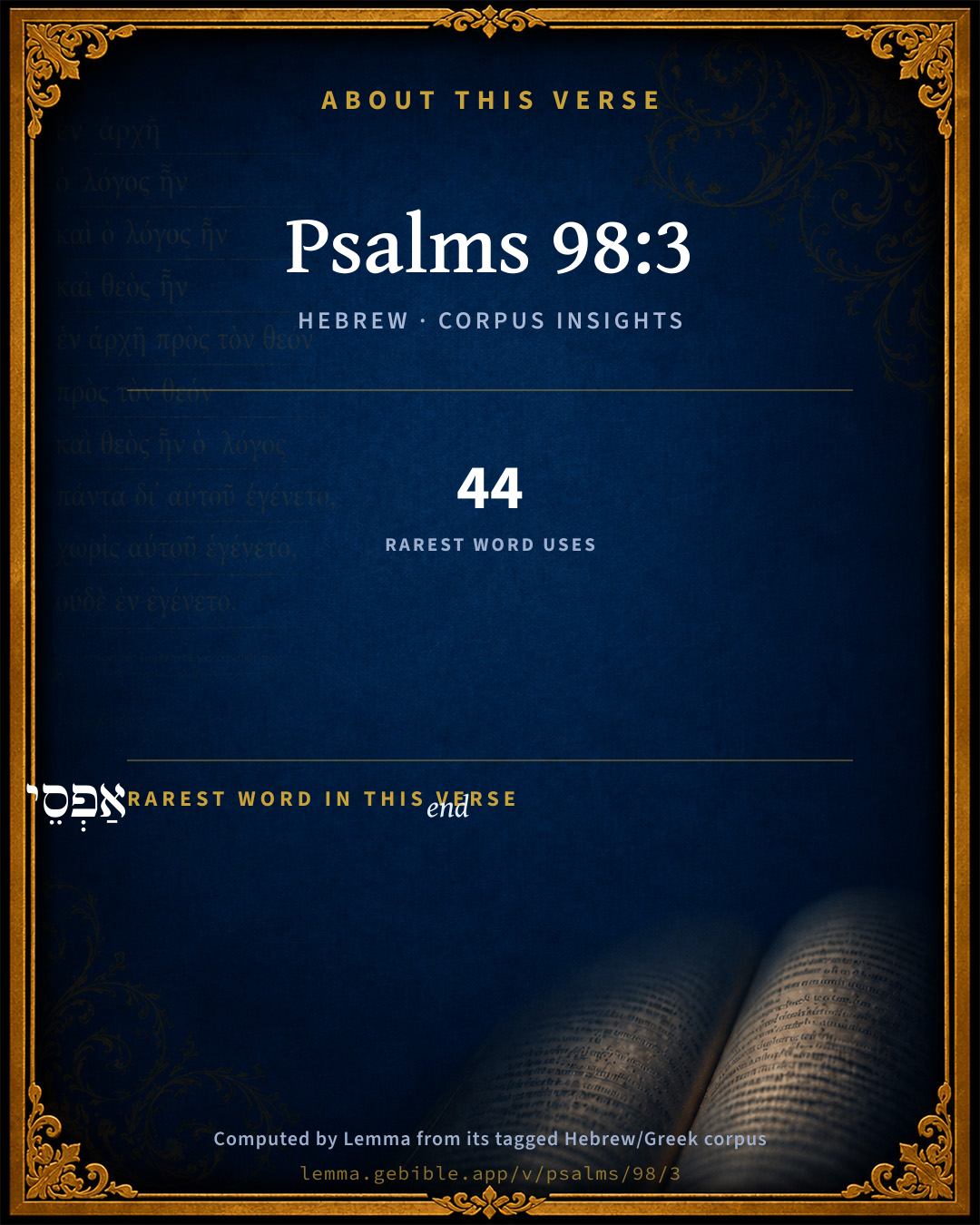
אַפְסֵי
ʼepheç
H657
“ends of”
Noun, Common, Masculine, Plural, Construct
Part of Speech
Noun
Type
Common
Gender
Masculine
Number
Plural
State
Construct
Full BDB Definition

Origin: from H656

TWOT: 147a

ceasing, end, finality
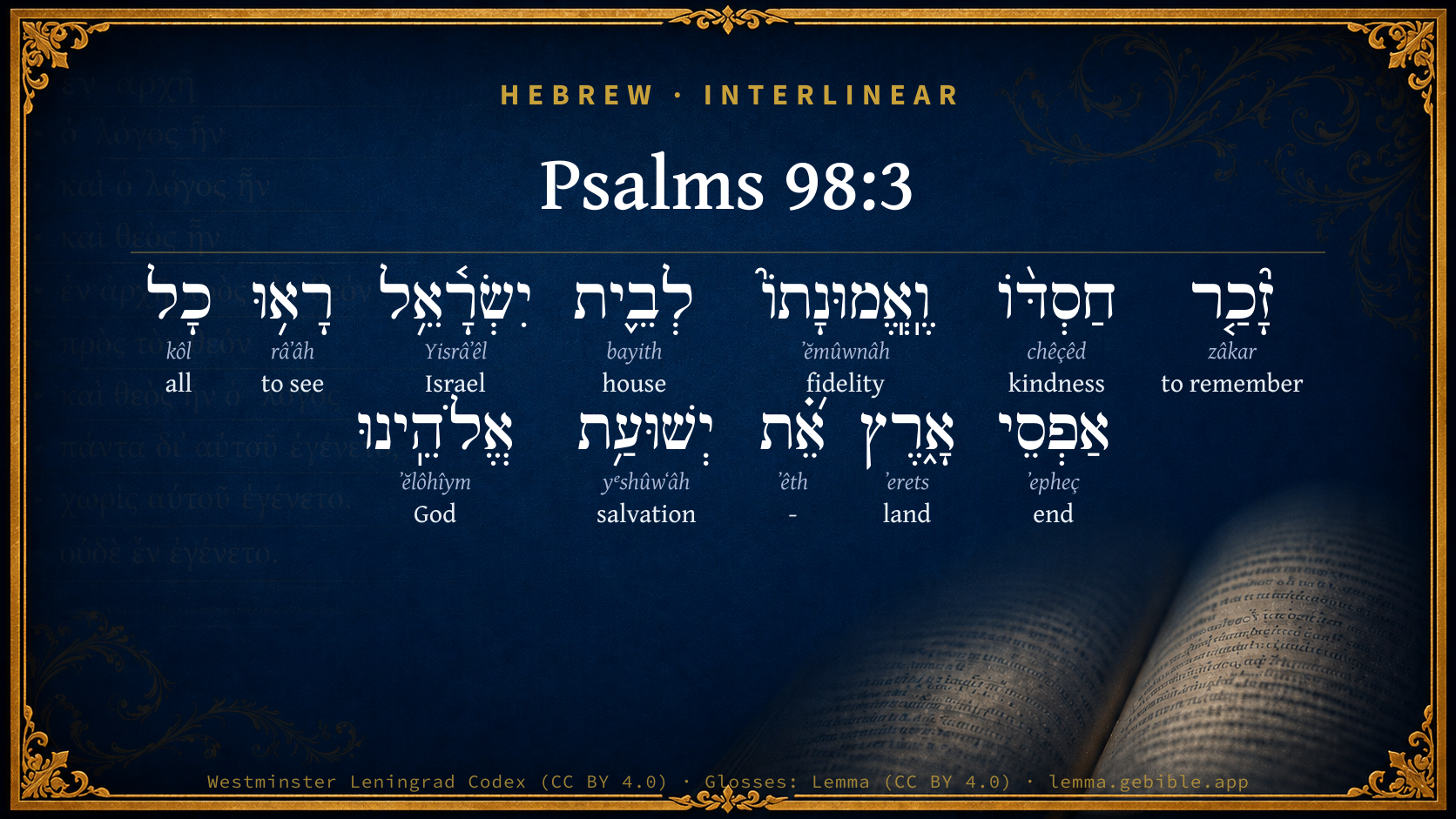
  1. זָ֘כַ֤ר zâkar H2142 “to remember” Verb, Qal, Perfect, 3rd Person, Masculine, Singular
  2. חַסְדּ֨וֹ chêçêd H2617 “kindness · his” Noun, Common, Masculine, Singular, Construct + Suffix, Personal, 3rd Person, Masculine, Singular
  3. וֶֽאֱֽמוּנָתוֹ֮ ʼĕmûwnâh H530 “and · fidelity · his” Conjunction + Noun, Common, Feminine, Singular, Construct + Suffix, Personal, 3rd Person, Masculine, Singular
  4. לְבֵ֪ית bayith H1004 “to/for · house of” Preposition + Noun, Common, Masculine, Singular, Construct
  5. יִשְׂרָ֫אֵ֥ל Yisrâʼêl H3478 “Israel” Noun, Proper
  6. רָא֥וּ râʼâh H7200 “to see” Verb, Qal, Perfect, 3rd Person, Common, Plural
  7. כָל kôl H3605 “all of” Noun, Common, Masculine, Singular, Construct
  8. אָ֑רֶץ ʼerets H776 “land” Noun, Common, Both, Singular, Absolute
  9. אֵ֝֗ת ʼêth H853 “-” Particle, Direct Object
  10. יְשׁוּעַ֥ת yᵉshûwʻâh H3444 “salvation of” Noun, Common, Feminine, Singular, Construct
  11. אֱלֹהֵֽינוּ ʼĕlôhîym H430 “God(s) · our” Noun, Common, Masculine, Plural, Construct + Suffix, Personal, 1st Person, Common, Plural

About this verse

These counts appear in no published source. They are computed here, from the morphology-tagged text and Lemma’s own curated glosses. What Lemma adds →

12
words
12
distinct lemmas
Wisdom
section

Shared distinctive vocabulary

אַפְסֵי end H657 occurs in 43 verses of the Hebrew Bible. Also found in:

Grammatical profile

  • 2 verbs
  • 9 nouns
  • 1 particle

Verb forms

  • זָ֘כַ֤ר Qal · Perfect
  • רָא֥וּ Qal · Perfect

Hebrew & Septuagint length

In English translation the verse runs 27 words from the Hebrew and 28 from the Septuagint (LXX English) — closely comparable.

A rough comparison of the two English renderings, which tokenize alike — not a word-level alignment.

Word counts can differ between the Hebrew and the Greek without any difference in meaning — e.g. the Hebrew direct-object marker אֵת has no separate Greek word, and Greek often adds the article ὁ.

Cross-references

19

Topical passages linked to Psalms 98:3 in the Treasury of Scripture Knowledge — connected by theme and wording, ordered by reader-vote popularity; previews shown in the World English Bible.

  • Psalms 22:27 All the ends of the earth shall remember and turn to Yahweh. All the relatives of the nations shall worship before you.
  • Acts 13:47 For so has the Lord commanded us, saying, 'I have set you as a light for the Gentiles, That you should bring salvation to the uttermost parts of the earth.'"
  • Deuteronomy 4:31 for Yahweh your God is a merciful God; he will not fail you, neither destroy you, nor forget the covenant of your fathers which he swore to them.
  • Luke 1:72 To show mercy towards our fathers, To remember his holy covenant,
  • Acts 28:28 "Be it known therefore to you, that the salvation of God is sent to the Gentiles. They will also listen."
  • Psalms 98:2 Yahweh has made known his salvation. He has openly shown his righteousness in the sight of the nations.
  • Isaiah 52:10 Yahweh has made bare his holy arm in the eyes of all the nations; and all the ends of the earth have seen the salvation of our God.
  • Psalms 67:7 God will bless us. All the ends of the earth shall fear him.
  • Psalms 106:45 He remembered for them his covenant, And repented according to the multitude of his loving kindnesses.
  • Isaiah 45:22 Look to me, and be you saved, all the ends of the earth; for I am God, and there is none else.
  • Isaiah 49:6 yes, he says, It is too light a thing that you should be my servant to raise up the tribes of Jacob, and to restore the preserved of Israel: I will also give you for a light to the Gentiles, that you may be my salvation to the end of the earth.
  • Micah 7:20 You will give truth to Jacob, and mercy to Abraham, As you have sworn to our fathers from the days of old.
  • Luke 1:54–55 He has given help to Israel, his servant, that he might remember mercy,
  • Luke 2:30–31 For my eyes have seen your salvation,
  • Luke 3:6 All flesh will see God's salvation.'"
  • Romans 10:12 For there is no distinction between Jew and Greek; for the same Lord is Lord of all, and is rich to all who call on him.
  • Romans 15:8–9 Now I say that Christ has been made a minister of the circumcision for the truth of God, that he might confirm the promises given to the fathers,
  • Revelation 5:9 They sang a new song, saying, "You are worthy to take the book, And to open its seals: For you were killed, And bought us for God with your blood, Out of every tribe, language, people, and nation,
  • Romans 10:18 But I say, didn't they hear? Yes, most assuredly, "Their sound went out into all the earth, Their words to the ends of the world."

Cross-references courtesy of OpenBible.info (CC BY 4.0).

Hebrew and Greek witnesses Masoretic Hebrew ↔ Greek Septuagint

The same verse in the two great witnesses to the Old Testament, shown verse-for-verse.

You’re reading Greek Psalm 97 (Hebrew Psalm 98). The Septuagint counts the superscription, so verse numbers can differ from the Hebrew — chapter-level alignment, not verse-by-verse. Numbering follows Rahlfs.

These are two independent witnesses, not word-aligned to each other, and the Septuagint is shown in lemma (dictionary) form.

Hebrew Psalms 98:3 Masoretic · Westminster Leningrad Codex

זָ֘כַ֤ר חַסְדּ֨וֹ וֶֽאֱֽמוּנָתוֹ֮ לְבֵ֪ית יִשְׂרָ֫אֵ֥ל רָא֥וּ כָל אַפְסֵי אָ֑רֶץ אֵ֝֗ת יְשׁוּעַ֥ת אֱלֹהֵֽינוּ

He has remembered his loving kindness and his faithfulness toward the house of Israel. All the ends of the earth have seen the salvation of our God.

World English Bible · Public Domain

Greek LXX Greek Psalm 97:3 Septuagint · lemma form

μιμνήσκω ὁ ἔλεος αὐτός ὁ ἰακώβ καί ὁ ἀλήθεια αὐτός ὁ οἶκος ἰσραήλ ὁράω πᾶς ὁ πέρας ὁ γῆ ὁ σωτήριον ὁ θεός ἐγώ

He has remembered his mercy to Jacob, and his truth to the house of Israel; all the ends of the earth have seen the salvation of our God.

LXX2012 (modern English Septuagint) · Public Domain

Hebrew: Westminster Leningrad Codex (CC BY 4.0). Greek: Septuagint (public domain); English from LXX2012 (modern English Septuagint) (Public Domain). How the Septuagint differs from the Hebrew →

Commentary

Notes on Psalms 98:3 from classic Christian and Jewish commentators (each source and its license shown beneath its notes). The classic Christian expositions comment on the surrounding passage and are grouped to its opening verse, so a note may address several verses; the Jewish commentaries on the Tanakh (Rashi and others) are per-verse, so they appear only where the commentator wrote on this verse.

Lemma curates 59 commentaries, every one of them public domain or Creative Commons licensed, each selected and text-cleaned for this edition rather than reprinted as found. About our sources →

Trapp's Complete Commentary

John Trapp

Psa 98:3 He hath remembered his mercy and his truth toward the house of Israel: all the ends of the earth have seen the salvation of our God.

Ver. 3. He hath remembered his mercy, and his truth] His mercy moving him to promise, and his truth binding him to perform, 2Sa 7:18; 2Sa 7:21, and hence all our happiness.

John Trapp, A Commentary or Exposition upon All the Books of the Old and New Testament (1647–1656) — public domain. Text from a community e-Sword module.

J. A. Alexander on Psalms

Joseph Addison Alexander

3. (Psa 98:3) He hath remembered his mercy and his truth for the house of Israel; all the ends of the earth have seen the salvation of our God. The common version connects to the house of Israel with what immediately precedes, the mercy and truth which he formerly exercised towards the house of Israel. But according to the Hebrew idiom and the usage of the psalms, the preposition is dependent on the leading verb: "He has called to mind his mercy and truth for the present benefit of the house of Israel." Truth, fidelity to his engagements. See the same combination in Psa 92:8. The last clause is another citation from Isa 52:10, which shews that the salvation primarily meant is that of Israel. This, however is closely connected in prophecy with that of the Gentiles.

Joseph Addison Alexander, The Psalms Translated and Explained (1850) — public domain. Text from a community e-Sword module.

Geneva Bible (1599)

Geneva Bible translators

God was moved by none other means to gather his Church of the Jews and Gentiles, but because he would perform his promise.

Geneva Bible (1599) marginal notes — public domain. Text via Bolls.life.

Adam Clarke's Commentary

Verse 3. He hath remembered his mercy] His gracious promises to their forefathers.

And his truth] Faithfully accomplishing what he had promised. All this was fulfilled under the Gospel.

Adam Clarke's Commentary on the Bible (1810–1826) — public domain. Text from a community e-Sword/MySword module.

John Calvin's Commentaries

3 He hath remembered his goodness Having spoken of the general manifestation of his salvation, he now celebrates his goodness more particularly to his own chosen people. God exhibited himself as a Father to Gentiles as well as Jews; but to the Jews first, who were, so to speak, the first-born. The glory of the Gentiles lay in their being adopted and in-grafted into the holy family of Abraham, and the salvation of the whole world sprung from the promise made to Abraham, as Christ said, “Salvation is of the Jews,” (John 4:22) The Psalmist therefore very properly observes, that God in redeeming the world remembered his truth, which he had given to Israel his people — language, too, which implies that he was influenced by no other motive than that of faithfully performing what he had himself promised. The more clearly to show that the promise was not grounded at all on the merit or righteousness of man, he mentions the goodness of God first, and afterwards his faithfulness, which stood connected with it. The cause, in short, was not to be found out of God himself, (to use a common expression,) but in his mere good pleasure, which had been testified long before to Abraham and his posterity. The word remembered is used in accommodation to man’s apprehension; for what has been long suspended seems to have been forgotten. Upwards of two thousand years elapsed from the time of giving the promise to the appearance of Christ, and as the people of God were subjected to many afflictions and calamities, we need not wonder that they should have sighed, and given way to ominous fears regarding the fulfillment of this redemption. When it is added, all the ends of the earth have seen the salvation of God, this is not merely commendatory of the greatness of the salvation, meaning that it should be so illustrious that the report of it would reach the ends of the earth; but it signifies that the nations formerly immersed in delusions and superstitions would participate in it.

John Calvin's Commentaries (1540-1563) — public domain. Text from the Calvin Translation Society English edition (1840s-50s) via the Christian Classics Ethereal Library (ccel.org). Calvin's coverage is partial (roughly two-thirds of the Bible); uncommented books and verses are honest gaps, never fabricated. The 19th-century editor's footnotes and remarks are omitted so the notes are faithfully Calvin's own voice.

The Cambridge Bible for Schools and Colleges

gen. ed. J. J. S. Perowne

3. He hath remembered] Though Israel in its despair said, “Jehovah hath forsaken me, and the Lord hath forgotten me” (Isa_49:14), the confidence of the earlier prophet (Mic_7:20) was not misplaced.

his mercy and his truth] His lovingkindness and his faithfulness. Cp. Psa_89:1 ff.; Psa_92:2; Luk_1:54.

all the ends &c.] The prediction of Isa_52:10 has been fulfilled.

The Cambridge Bible for Schools and Colleges (gen. ed. J. J. S. Perowne; Cambridge University Press, 1878–1918) — public domain. Text from a community e-Sword module.

John Gill's Exposition

He hath remembered his mercy and his truth toward the house of Israel,.... His mercy promised them, in raising up a Saviour to them, one that should be the glory of them; and his truth, in fulfilling that and every other promise concerning him; see Luk 1:72,

all the ends of the earth have seen the salvation of our God; either Christ himself, who is the salvation or Saviour of God's appointing, providing, and sending; or the salvation which he has wrought out, the Gospel declaring it; which has been sent throughout the world; and many in all parts of it, even in the most distant parts of it, in the very ends of it, have been made to see the nature, want, worth, and value of it; not every individual person in the world, but some in the several parts, and in the remote corners of it, whither the Gospel has been or will be sent; see Isa 52:10.

John Gill's Exposition of the Whole Bible (1746–1763) — public domain (CC PDM 1.0). Text via the HelloAO Bible API.

Albert Barnes' Notes on the Bible

He hath remembered his mercy - Compare the notes at Luk 1:54-55 (note), Luk 1:72 (note), where this passage in the Psalms was not improbably referred to by Mary and Zacharias. The idea is, that God had called to mind his promise of mercy to his people; that he had not suffered it to pass out of his recollection; that he had kept his word.

And his truth - He has kept his promise; he has shown that he is a God of truth.

Toward the house of Israel - Toward his people.

All the ends of the earth have seen the salvation of our God - This appears to have been quoted from Isa 52:10. See the notes at that passage. The resemblance in the language is so strong as to make it probable that the psalm was composed after the times of Isaiah, and not improbably to be used (as remarked above) in the dedication of the temple after the captivity. The whole psalm would be appropriate to celebrate that deliverance; while, at the same time, like the language in Isaiah, it would be adapted to celebrate a higher deliverance - under the Messiah - of which that was an emblem.

Albert Barnes' Notes on the Bible (1834–1885) — public domain. Text from a community e-Sword/MySword module.

Matthew Poole's English Annotations

He hath now actually given that mercy which he had promised to the Israelites.

All the ends of the earth; all the inhabitants of the earth, from one end to another.

Have seen, i.e. enjoyed it, as this word is oft used, as hath been proved again and again.

Matthew Poole's English Annotations on the Holy Bible (1683–1685) — public domain. Text from a community e-Sword/MySword module.

The Treasury of David

Charles H. Spurgeon

Ver. 3. He hath remembered his mercy and his truth toward the house of Israel. To them Jesus came in the flesh, and to them was the gospel first preached; and though they counted themselves unworthy of eternal life, yet the covenant was not broken, for the true Israel were called into fellowship and still remain so. The mercy which endureth for ever, and the fidelity which cannot forget a promise, secure to the chosen seed the salvation long ago guaranteed by the covenant of grace.

All the ends of the earth have seen the salvation of our God. Not to Abraham's seed alone after the flesh, but to the elect among all nations, has grace been given; therefore, let the whole church of God sing unto him a new song. It was no small blessing, or little miracle, that throughout all lands the gospel should be published in so short a time, with such singular success and such abiding results. Pentecost deserves a new song as well as the Passion and the Resurrection; let out hearts exult as we remember it. Our God, our own for ever blessed God, has been honoured by those who once bowed down before dumb idols; his salvation has not only been heard of but seen among all people, it has been experienced as well as explained; his Son is the actual Redeemer of a multitude out of all nations.

Ver. 3. He hath remembered his mercy and his truth. The psalmist very properly observes, that God in redeeming the world "remembered his truth, "which he had given to Israel his peoplelanguage, too, which implies that he was influenced by no other motive than that of faithfully performing what he had himself promised. The more clearly to show that the promise was not grounded at all on the merit or righteousness of man, he mentions the "mercy" of God first, and afterwards his "faithfulness" which stood connected with it. The cause, in short, was not to be found out of God himself, (to use a common expression,)but in his mere good pleasure, which had been testified long before to Abraham and his posterity. The word "remembered" is used in accommodation to man's apprehension; for what has been long suspended seems to have been forgotten. Upwards of two thousand years elapsed from the time of giving the promise to the appearance of Christ, and as the people of God were subjected to many afflictions and calamities, we need not wonder that they should have sighed, and given way to ominous fears regarding the fulfilment of this redemption. John Calvin.

Ver. 3. He hath remembered his mercy and his truth. His mercy moved him to make his promise, and his truth hath engaged him to perform it; and he hath been mindful of both, by scattering the blessed influences of his light and bounty over the face of the whole earth, and causing all nations to set and partake of the salvation of God. Matthew Hole(-1730).

Ver. 3. All the ends of the earth have seen, etc. O unhappy Judea. The ends of the earth have seen, the salvation of God, every land is moved to joy, the whole globe is glad, the floods clap their hands, the hills rejoice; yet the evil hearts of the Jews believe not, but are smitten with the penalty of unbelief in the darkness of their blindness. Gregory, in Lorinus.

Ver. 3. Have seen. There is a degree of point in the expression have seen; it implies actual faith, united with knowledge, that moves the will to love and to desire; for they cannot be said to have seen God's salvation, who, content with nominal faith never bestow a thought on the Saviour. Bellarmine.

Ver. 3. (first clause). The Lord's memory of his covenant. Times in which he seems to forget it; ways in which even in those times he proves his faithfulness; great deeds of grace by which at other times he shows his memory of his promises; and reasons why he must ever be mindful of his covenant.

Ver. 3. (last clause). All the ends of the earth.

1. Literally. Missionaries have visited every land.

2. Spiritually. Men ready to despair, to perish.

3. Prophetically. Dwell on the grand promises concerning the future, and the triumphs of the church. E.G.G.

Ver. 3. All the ends of the earth have seen, &c.

1. The greatest foreigners have seen it; many have "come from the east and the west; "Greeks, Peter's hearers, the Eunuch, Greenlanders, South Sea Islanders, Negroes, Red Indians, &c., &c.

2. The ripest saints have seen it; they are at the light end of the earth, stepping out of the wilderness into Canaan, &c.

3. The vilest sinners have seen it; those who have wandered so far that they could get no farther without stepping into hell. The dying thief. The woman who was a sinner. Those whom Whitefield called "the devil's castaways." W. J.

Psalms 98:4*

In these three verses we are taught how to praise the Lord.

Charles H. Spurgeon's The Treasury of David (1869–1885) — public domain. Psalms only. Text from a community e-Sword/MySword module.

Whedon's Commentary on the Bible

Daniel D. Whedon

3. He hath remembered—That is, to fulfil and make good his promise. Here is a recognition of covenant promise and relation toward the house of Israel.

Ends of the earth—A clear anticipation of the subjection of the Gentile nations to Christ. The judgments of Jehovah, like the miracles of Egypt, of the Red Sea, and of the wilderness, in Moses’s time, should cause the distant nations to tremble and submit.

Daniel D. Whedon (gen. ed.), Commentary on the Old and New Testaments (1874–1909) — public domain. Text from a community e-Sword module.

The Pulpit Commentary

He hath remembered his mercy and his truth towards the house of Israel. The judgment of the nations involves mercy and deliverance to Israel, which is oppressed by them; and thus manifests God"s faithfulness towards them. All the ends of the earth have seen the salvation of our God. (comp. ver. 2 and Isa_52:10)

The Lord"s memory.

This is regarding God as if he were a man, and acted as men act. Men find the memory of kindnesses they have done become a plea for showing further kindness. To have ever helped any one gives them a sort of natural claim on us to help them again. So the psalmist, full of joy in the blessings God was giving his people in his day, felt quite sure that God must have been recalling, remembering, what great things he had done, in olden days, for his people. We think our great pleas to urge before God are our needs and our deserts. But these are altogether surpassed by the pleas we may use. God"s honour, God"s promise, and what God has already done for us. But herein lies an important distinction between God"s feelings and man"s. Only the very noblest among men fail to be annoyed when past favours are made into a plea for new gifts. We are annoyed at the beggar who comes again and again so hopefully, because he has so often come successfully. God loves to bless those whom he has blessed. We may never think of him as tiring of blessing.

I WHAT MAY WE THINK THE LORD REMEMBERS? See two things.

(1) That he had to be very gentle and merciful toward us.

(2) That he had to keep his promise to help us. Remembers his mercy and truth; his loving kindness and faithfulness. See what persuasion to new "mercy and truth" is in such quickened memory.

1. The exercise of the passive graces purifies and ennobles character, and makes us more able to exercise them, and more anxious to find objects on which to exercise them. Do some act merely for a person, and you may find it tiresome to have to do it again. But show a kindness, be merciful, pitiful, tender, gracious, and you will want to be all these over and over again.

2. Every claim upon a man of truth is an establishing and confirming of his truth, and makes him more determined that men shall have absolute trust in his word. If it be thus with men, how much more so with God!

II HOW MAY WE VENTURE TO QUICKEN THE LORD"S MEMORY? By telling him freely what is in our memories concerning his dealings. This is the way of love. The lover tells his loved one his memories, and that is the best quickening of hers. R.T.

The Pulpit Commentary (1880–1919), ed. H.D.M. Spence-Jones & Joseph S. Exell — public domain. Text from a community e-Sword module.

unfoldingWord translationNotes

Door43 World Missions Community

calls to mind

"remembers." See how "call to mind" is translated in Psalms 20:3. (See: Idiom)

all the ends of the earth ... all the earth

These are metonyms for the people of the earth. AT: "people from all over the world ... all people in the world" (See: Metonymy)

will see the victory of our God

The abstract noun "victory" can be translated using the verb "defeat." AT: "will see our God defeat his enemies" (See: Abstract Nouns)

burst into song

"suddenly begin singing happily"

sing for joy

"sing because you are happy"

sing praises

"sing praises to God"

translationWords

covenant faithfulness

faithful

house

Israel

God

joy

praise

unfoldingWord translationNotes — © Distant Shores Media and the Door43 World Missions Community, licensed CC BY-SA 4.0. Source: git.door43.org/Door43/en_tn.

Lesson kit

Teaching starters — assembled from the data on this page, not authored interpretation. Every prompt links to the verse data it draws on. Edit before teaching.

Psalms, in the Wisdom, opens this verse with 12 words (12 distinct Hebrew lemmas). Its most distinctive word is ʼepheç (“end”). A historical commentator’s framing appears above. Read the whole chapter for the surrounding context.

Discussion questions

  1. The word ʼepheç carries the sense “end.” How does it shape the verse?
  2. Numbers 13:28 shares the word «end» with this verse. How do the two illuminate each other?
  3. The translations on this page render this verse differently — a whole-verse word diff, not a word-by-word alignment. What might account for the different wordings?
  4. The verb «זָ֘כַ֤ר» is Qal Perfect. How does its form color the action?
  5. Reading how Trapp's Complete Commentary and J. A. Alexander on Psalms read this verse, where do the two commentators agree and where do they part?

Things to notice

Reading settings

Reading text

Shown beneath each verse's original-language words.

Old Testament
Old Testament edition

Read the OT as the Masoretic Hebrew (MT) or the Greek Septuagint (LXX).

English shown for the Greek Septuagint (in the Hebrew ↔ Greek comparison).

Comparing translations? Open the Compare panel on any verse page to stack up to four side by side.