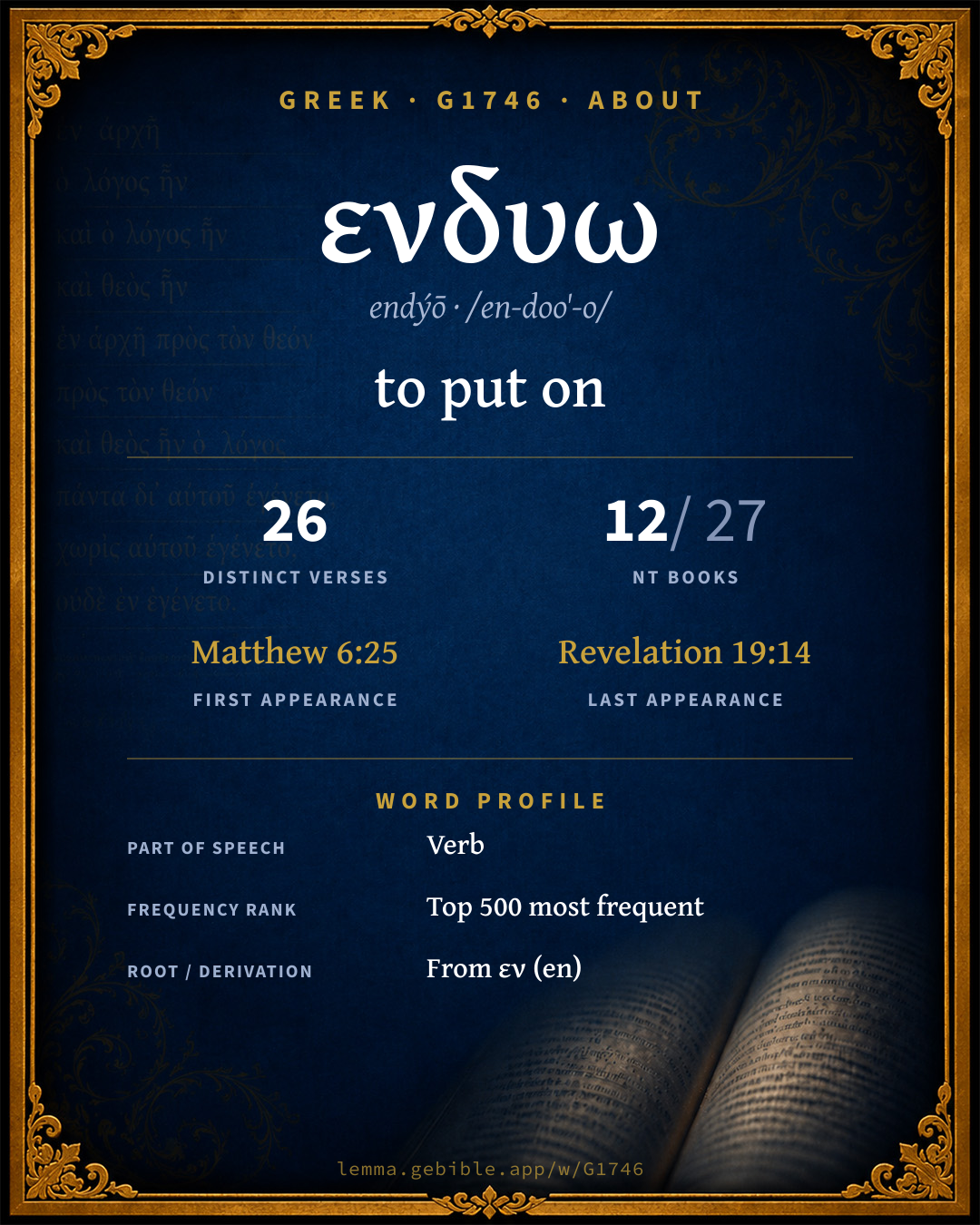
ἐνδύω
to put on
Full lexicon entry — Thayer's Greek Lexicon
From Thayer's Greek Lexicon
Where this word appears
Grammar key — what these labels mean
Part of speech
- Verb
- An action or state-of-being word.
Tense
- Aorist
- Action viewed as a simple whole, without regard to duration — often past (perfective aspect).
- Perfect
- A completed past action with continuing present results.
Voice
- Middle
- The subject acts on or for itself, or with special interest in the action.
- Active
- The subject performs the action.
Mood
- Participle
- A verbal adjective (“writing,” “having written”).
- Subjunctive
- Expresses probability, purpose, or possibility (the mood of contingency).
- Imperative
- Expresses a command or request.
- Infinitive
- A verbal noun (“to write”), unmarked for person or number.
- Indicative
- States a fact or asks a factual question (the mood of reality).
Case
- Nominative
- The case of the subject (and the predicate nominative).
- Accusative
- The case of the direct object and of extent.
Person
- 2nd person
- The one addressed (“you”).
- 3rd person
- The one spoken about (“he / she / it / they”).
- 1st person
- The speaker (“I / we”).
Gender
- Masculine
- Grammatically masculine.
Number
- Plural
- More than one.
- Singular
- One.
Every verse where G1746 appears in the Book of Acts — 1 distinct verse. Click any verse to open its interlinear word-by-word view. Verse text shown in the World English Bible for context — . Each verse’s Greek form is shown with its reference; the English is not keyword-highlighted, since the data carries no word-level English alignment. Use “Compare translations” on any verse to read it across multiple English versions. This concordance covers the Greek New Testament; Septuagint (Greek Old Testament) occurrences of this word are not indexed here.
Acts
About this entry
At a glance — auto-summarized from this page’s data, not written by a person. Every figure links to its source below. This summary describes the numbers; it doesn’t interpret them.
The Greek verb ενδυω centers on the idea of “to put on.” Its earliest occurrence is Matthew 6:25. Spanning 26 verses in 12 books, it ranks among the moderately common words of the Greek New Testament. Related forms include εν, εγγραφω and εγγυος. Dig into 26-verse concordance and the renderings breakdown below.
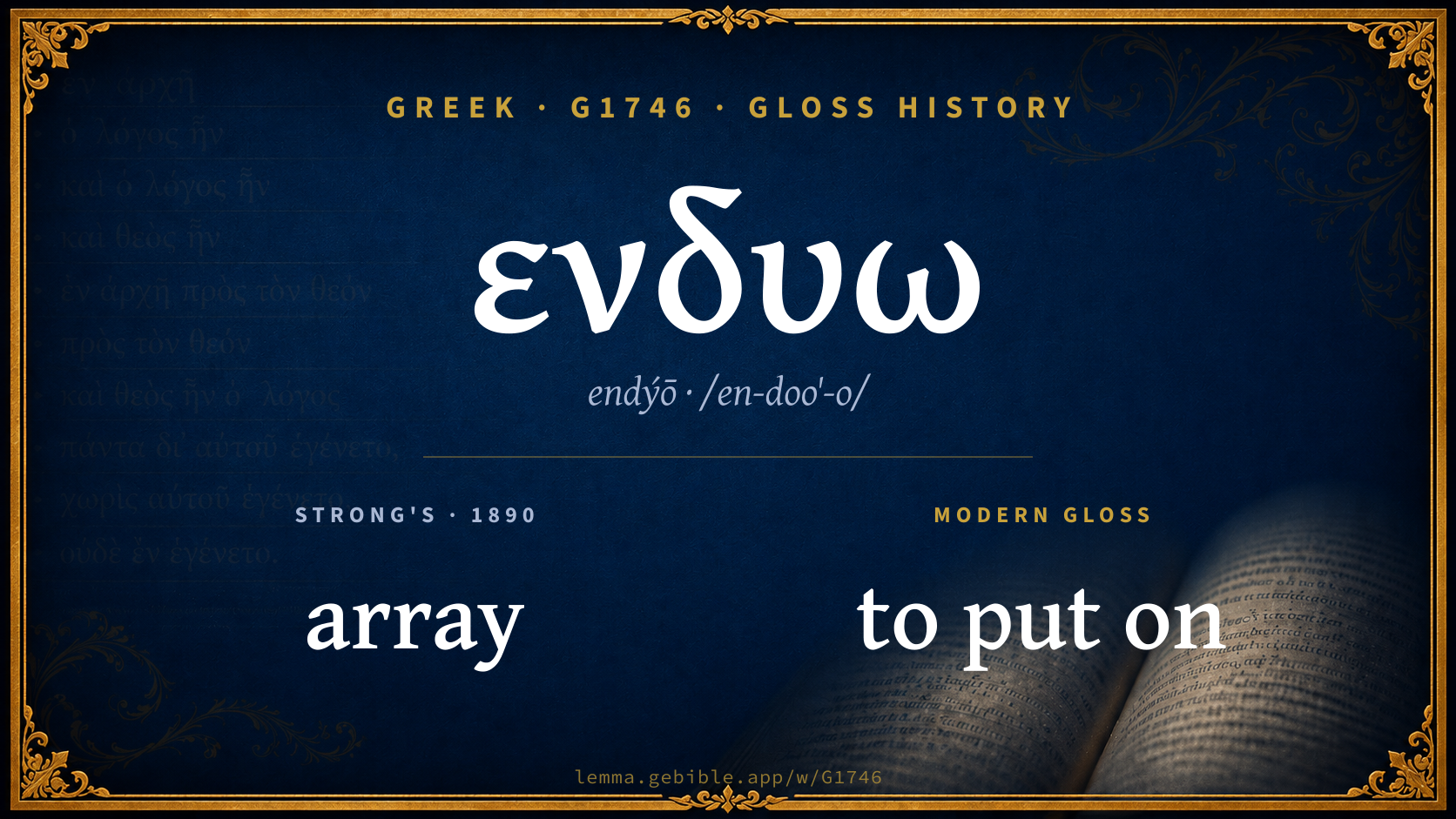
Gloss history
Strong's 1890 vs modern scholarship
About this word
Strong's G1746 catalogs a Greek word from the Greek New Testament.
These counts are not copied from any lexicon or concordance. They are computed here, from the morphology-tagged Greek New Testament. What Lemma adds →
- 26
- distinct verses
- The word appears in 26 distinct verses.
- 12 / 27
- NT books
- The word appears in 12 of 27 New Testament books.
- #485
- by frequency
- Top 500 most frequent Greek words (rank 485 of 5,347 Greek words by occurrence).
View all 26 occurrences in the concordance →
By section of the New Testament
By traditional corpus
Conventional, traditional groupings — biblical authorship is debated, so this is a traditional corpus grouping, not an authorship claim. Some books belong to more than one corpus (Luke is in both the Gospels and the Lukan corpus, and so on), so these shares overlap and need not total 100%. Each figure is a share of the word’s 26 distinct verses.
- Pauline corpus 12 verses · 46%
- Gospels 10 verses · 38%
- Lukan (Luke–Acts) 5 verses · 19%
- Johannine 3 verses · 12%
- Revelation 3 verses · 12%
How translations render this word
Counts come from each version’s own published word-to-Strong’s tagging or interlinear alignment — an approximate guide to how each version renders this word, not a word-level alignment the data otherwise carries. Because each total is that version’s own tagged count, the per-version totals vary from one another and need not match the appearance or distinct-verse counts above. These counts may also differ from a printed concordance because Lemma counts each distinctly tagged rendering and does not collapse phrase taggings into a single head-word total. This is a fixed set of word-tagged versions (KJV, ASV, BSB, ULT) and does not change with the reading translation you choose elsewhere. Each version’s license is shown beside its name below (and on Sources).
- King James Version: Put on 4×, Clothed 3×, On 3×
- American Standard Version: Put on 4×, On 3×, Put 3×
- Berean Standard Bible: Put on 3×, Clothe yourselves with 2×, Dressed in 2×
- unfoldingWord Literal Text: Put on 7×, Having put on 4×, Has put on 2×
King James Version Public Domain
Renders G1746 across 31 tagged occurrences — most commonly:
Plus 13 renderings that appear only once — usually multi-word phrases or single function words the recovered tagging swept in, not distinct renderings. Not rendered by a distinct English word in 1 further occurrence.
American Standard Version Public Domain
Renders G1746 across 31 tagged occurrences — most commonly:
Plus 17 renderings that appear only once — usually multi-word phrases or single function words the recovered tagging swept in, not distinct renderings.
Berean Standard Bible Public Domain
Renders G1746 across 25 tagged occurrences — most commonly:
Plus 14 renderings that appear only once — usually multi-word phrases or single function words the recovered tagging swept in, not distinct renderings. Not rendered by a distinct English word in 3 further occurrences.
unfoldingWord Literal Text CC BY-SA 4.0
Renders G1746 across 32 tagged occurrences — most commonly:
Plus 11 renderings that appear only once — usually multi-word phrases or single function words the recovered tagging swept in, not distinct renderings.
Senses in Thayer's
The 1 sense Thayer's distinguishes for this word, in lexicon order (not ranked by frequency or importance). The full entry — with sub-senses — is in the Lexicon Entry tab.
- to sink into (clothing), put on, clothe one's self
Word origin
Derived from εν (en) (G1722).
Forms in the corpus
The 15 distinct written forms G1746 takes in the Greek New Testament, most frequent first — each parse links to that tense’s occurrences in the concordance.
Same root — word family
Other Thayer's entries built from the same root as G1746, grouped by Strong’s listed origin. These share a root / origin per the lexicon — not necessarily a shared meaning. Each links to that word’s own entry.
Derives from
Shares the same root
- εγγραφω engráphō G1449 to inscribe
- εγγυος éngyos G1450 surety
- εγκαθετος enkáthetos G1455 to spy
- εγκαινια enkaínia G1456 dedication
- εγκαλεω enkaléō G1458 to accuse
- εγκαταλειπω enkataleípō G1459 to abandon
- εγκατοικεω enkatoikéō G1460 to dwell
- εγκεντριζω enkentrízō G1461 to graft
- εγκομβοομαι enkombóomai G1463 band
- εγκοπτω enkóptō G1465 to hinder
- εγκρατης enkratḗs G1468 strong
- εγκρινω enkrínō G1469 to judge worthy
- εγκρυπτω enkrýptō G1470 to conceal
- εγκυος énkyos G1471 pregnant
- εγχριω enchríō G1472 to anoint
- ελλογεω ellogéō G1677 impute
- εμβαινω embaínō G1684 to enter
- εμβαλλω embállō G1685 to cast in
- εμβαπτω embáptō G1686 to dip in
- εμβατευω embateúō G1687 to enter
- εμβιβαζω embibázō G1688 to lead in
- εμβλεπω emblépō G1689 to look at
- εμβριμαομαι embrimáomai G1690 to warn sternly
- εμμαινομαι emmaínomai G1693 to rage against
+58 more words share this root (not shown).
Derived from this word
Compare all same-root words → Showing 4 of 87 — not the complete family. They share a root, not necessarily a meaning.
Septuagint usage
The same Greek word ενδυω appears 90 times in the Greek Old Testament (Septuagint), across 84 verses in 22 books.
- 90
- LXX occurrences
- Tagged occurrences of this Greek word in the Septuagint.
- 84
- verses
- Distinct Septuagint verses containing this word.
- 22 / 39
- OT books
- The word appears in 22 of the 39 Old Testament books.
Sample Septuagint occurrences
- Genesis 3:21 ἐνδύω
- Exodus 28:41 ἐνδύω
- Leviticus 6:3 ἐνδύω
- Numbers 20:26 ἐνδύω
- Deuteronomy 22:5 ἐνδύω
- 1 Samuel 17:5 ἐνδύω
- 2 Samuel 6:14 ἐνδύω
- 1 Kings 22:30 ἐνδύω
- 1 Chronicles 12:19 ἐνδύω
- 2 Chronicles 5:12 ἐνδύω
- Esther 4:1 ἐνδύω
- Job 8:22 ἐνδύω
Septuagint occurrences (same lexeme)
Every verse where the same Strong’s number (G1746) appears in the Greek Septuagint — showing the first 50 of 84. Verse text shown in the World English Bible for context; the Greek form is the matched word — the English is not keyword-highlighted.
- Genesis 3:21 ἐνδύω Yahweh God made coats of skins for Adam and for his wife, and clothed them.
- Genesis 27:15 ἐνδύω Rebekah took the good clothes of Esau, her elder son, which were with her in the house, and put them on Jacob, her younger son.
- Genesis 38:19 ἐνδύω She arose, and went away, and put off her veil from her, and put on the garments of her widowhood.
- Genesis 41:42 ἐνδύω Pharaoh took off his signet ring from his hand, and put it on Joseph's hand, and arrayed him in robes of fine linen, and put a gold chain about his neck,
- Exodus 28:41 ἐνδύω You shall put them on Aaron your brother, and on his sons with him, and shall anoint them, and consecrate them, and sanctify them, that they may minister to me in the priest's office.
- Exodus 29:5 ἐνδύω You shall take the garments, and put on Aaron the coat, the robe of the ephod, the ephod, and the breastplate, and dress him with the skillfully woven band of the ephod;
- Exodus 29:8 ἐνδύω You shall bring his sons, and put coats on them.
- Exodus 29:30 ἐνδύω Seven days shall the son who is priest in his place put them on, when he comes into the tent of meeting to minister in the holy place.
- Exodus 40:13 ἐνδύω You shall put on Aaron the holy garments; and you shall anoint him, and sanctify him, that he may minister to me in the priest's office.
- Exodus 40:14 ἐνδύω You shall bring his sons, and put coats on them.
- Leviticus 6:3 ἐνδύω or has found that which was lost, and dealt falsely therein, and swearing to a lie; in any of all these things that a man does, sinning therein;
- Leviticus 6:4 ἐνδύω then it shall be, if he has sinned, and is guilty, he shall restore that which he took by robbery, or the thing which he has gotten by oppression, or the deposit which was committed to him, or the lost thing which he found,
- Leviticus 8:7 ἐνδύω He put the coat on him, tied the sash on him, clothed him with the robe, put the ephod on him, and he tied the skillfully woven band of the ephod on him, and fastened it to him with it.
- Leviticus 8:13 ἐνδύω Moses brought Aaron's sons, and clothed them with coats, and tied sashes on them, and put headbands on them; as Yahweh commanded Moses.
- Leviticus 16:4 ἐνδύω He shall put on the holy linen coat, and he shall have the linen breeches on his body, and shall put on the linen sash, and he shall be dressed with the linen turban. They are the holy garments. He shall bathe his body in water, and put them on.
- Leviticus 16:23 ἐνδύω "Aaron shall come into the Tent of Meeting, and shall take off the linen garments, which he put on when he went into the Holy Place, and shall leave them there.
- Leviticus 16:24 ἐνδύω Then he shall bathe himself in water in a holy place, and put on his garments, and come out and offer his burnt offering and the burnt offering of the people, and make atonement for himself and for the people.
- Leviticus 16:32 ἐνδύω The priest, who is anointed and who is consecrated to be priest in his father's place, shall make the atonement, and shall put on the linen garments, even the holy garments.
- Leviticus 21:10 ἐνδύω "'He who is the high priest among his brothers, upon whose head the anointing oil is poured, and that is consecrated to put on the garments, shall not let the hair of his head hang loose, nor tear his clothes;
- Numbers 20:26 ἐνδύω and strip Aaron of his garments, and put them on Eleazar his son: and Aaron shall be gathered [to his people], and shall die there.
- Numbers 20:28 ἐνδύω Moses stripped Aaron of his garments, and put them on Eleazar his son; and Aaron died there on the top of the mountain: and Moses and Eleazar came down from the mountain.
- Deuteronomy 22:5 ἐνδύω A woman shall not wear men's clothing, neither shall a man put on women's clothing; for whoever does these things is an abomination to Yahweh your God.
- Deuteronomy 22:11 ἐνδύω You shall not wear a mixed stuff, wool and linen together.
- 1 Samuel 17:5 ἐνδύω He had a helmet of brass on his head, and he was clad with a coat of mail; and the weight of the coat was five thousand shekels of brass.
- 1 Samuel 17:18 ἐνδύω and bring these ten cheeses to the captain of their thousand, and look how your brothers fare, and take their pledge.
- 2 Samuel 6:14 ἐνδύω David danced before Yahweh with all his might; and David was girded with a linen ephod.
- 2 Samuel 14:2 ἐνδύω Joab sent to Tekoa, and fetched there a wise woman, and said to her, please act like a mourner, and put on mourning clothing, Please, and don't anoint yourself with oil, but be as a woman who has a long time mourned for the dead:
- 1 Kings 22:30 ἐνδύω The king of Israel said to Jehoshaphat, I will disguise myself, and go into the battle; but put you on your robes. The king of Israel disguised himself, and went into the battle.
- 1 Chronicles 12:19 ἐνδύω Of Manasseh also there fell away some to David, when he came with the Philistines against Saul to battle: but they didn't help them; for the lords of the Philistines sent him away after consultation, saying, He will fall away to his master Saul to the jeopardy of our heads.
- 2 Chronicles 5:12 ἐνδύω also the Levites who were the singers, all of them, even Asaph, Heman, Jeduthun, and their sons and their brothers, arrayed in fine linen, with cymbals and psalteries and harps, stood at the east end of the altar, and with them one hundred twenty priests sounding with trumpets;)
- 2 Chronicles 6:41 ἐνδύω Now therefore arise, Yahweh God, into your resting-place, you, and the ark of your strength: let your priests, Yahweh God, be clothed with salvation, and let your saints rejoice in goodness.
- 2 Chronicles 18:9 ἐνδύω Now the king of Israel and Jehoshaphat the king of Judah sat each on his throne, arrayed in their robes, and they were sitting in an open place at the entrance of the gate of Samaria; and all the prophets were prophesying before them.
- 2 Chronicles 18:29 ἐνδύω The king of Israel said to Jehoshaphat, I will disguise myself, and go into the battle; but put you on your robes. So the king of Israel disguised himself; and they went into the battle.
- 2 Chronicles 24:20 ἐνδύω The Spirit of God came on Zechariah the son of Jehoiada the priest; and he stood above the people, and said to them, Thus says God, Why disobey you the commandments of Yahweh, so that you can't prosper? because you have forsaken Yahweh, he has also forsaken you.
- 2 Chronicles 28:15 ἐνδύω The men who have been mentioned by name rose up, and took the captives, and with the spoil clothed all who were naked among them, and arrayed them, and shod them, and gave them to eat and to drink, and anointed them, and carried all the feeble of them on donkeys, and brought them to Jericho, the city of palm trees, to their brothers: then they returned to Samaria.
- Esther 4:1 ἐνδύω Now when Mordecai knew all that was done, Mordecai tore his clothes, and put on sackcloth with ashes, and went out into the midst of the city, and cried with a loud and a bitter cry;
- Job 8:22 ἐνδύω Those who hate you shall be clothed with shame. The tent of the wicked shall be no more."
- Job 10:11 ἐνδύω You have clothed me with skin and flesh, And knit me together with bones and sinews.
- Job 29:14 ἐνδύω I put on righteousness, and it clothed me. My justice was as a robe and a diadem.
- Job 39:19 ἐνδύω "Have you given the horse might? Have you clothed his neck with a quivering mane?
- Psalms 34:13 ἐνδύω Keep your tongue from evil, And your lips from speaking lies.
- Psalms 34:26 ἐνδύω
- Psalms 64:14 ἐνδύω
- Psalms 92:1 ἐνδύω It is a good thing to give thanks to Yahweh, To sing praises to your name, Most High;
- Psalms 103:1 ἐνδύω Praise Yahweh, my soul! All that is within me, praise his holy name!
- Psalms 108:18 ἐνδύω
- Psalms 108:29 ἐνδύω
- Psalms 131:9 ἐνδύω
- Psalms 131:16 ἐνδύω
- Psalms 131:18 ἐνδύω
These are occurrences of the same Greek lexeme (G1746) in the Septuagint — not a translation of any one Hebrew word. The store carries no word-level Hebrew↔Greek alignment, so no Hebrew original is asserted here. Counts come from the recovered LXX Strong's tagging — high-frequency vocabulary is well covered, while rare or late forms may be untagged — so they reflect tagged occurrences and may slightly undercount.