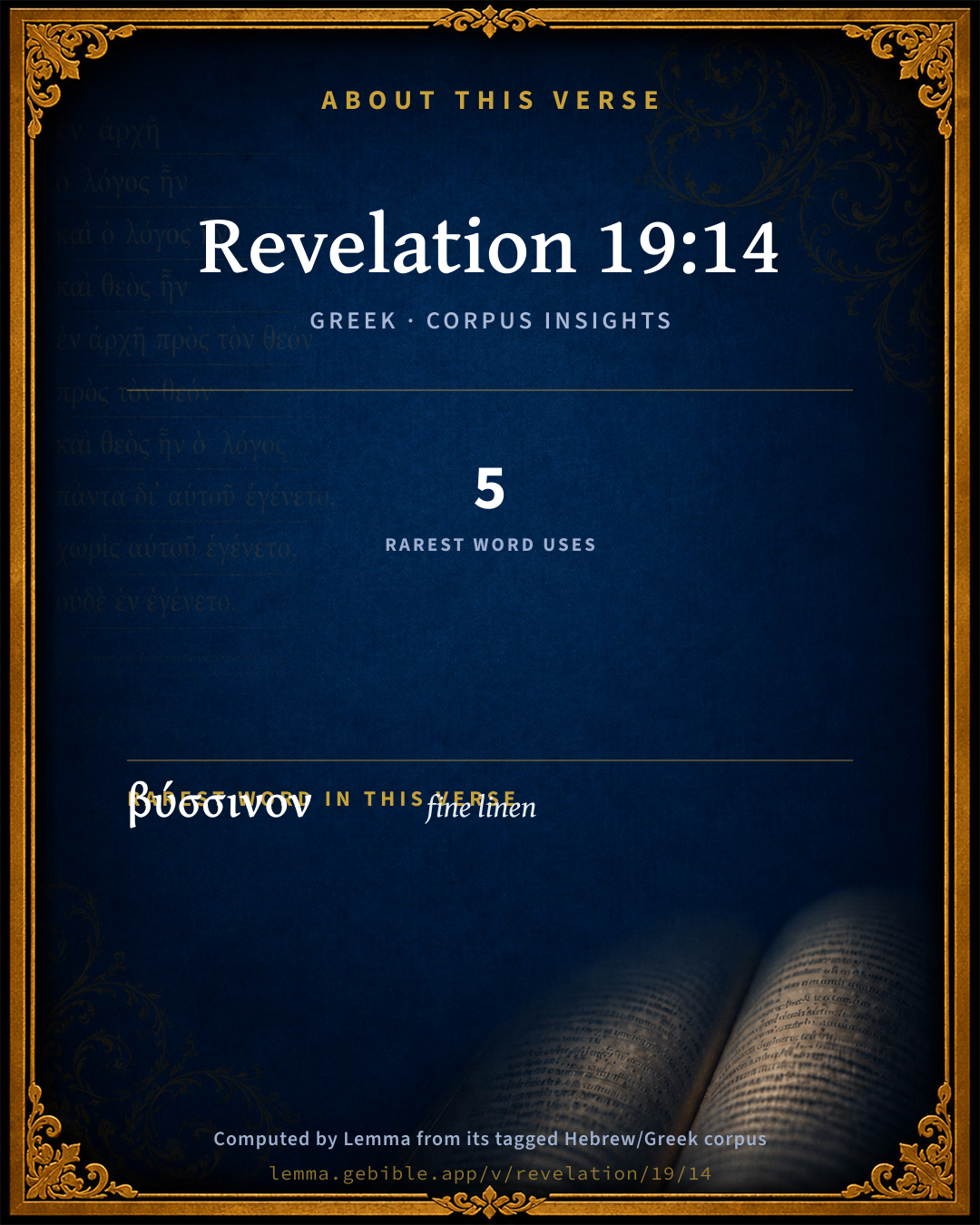
Revelation 19:14

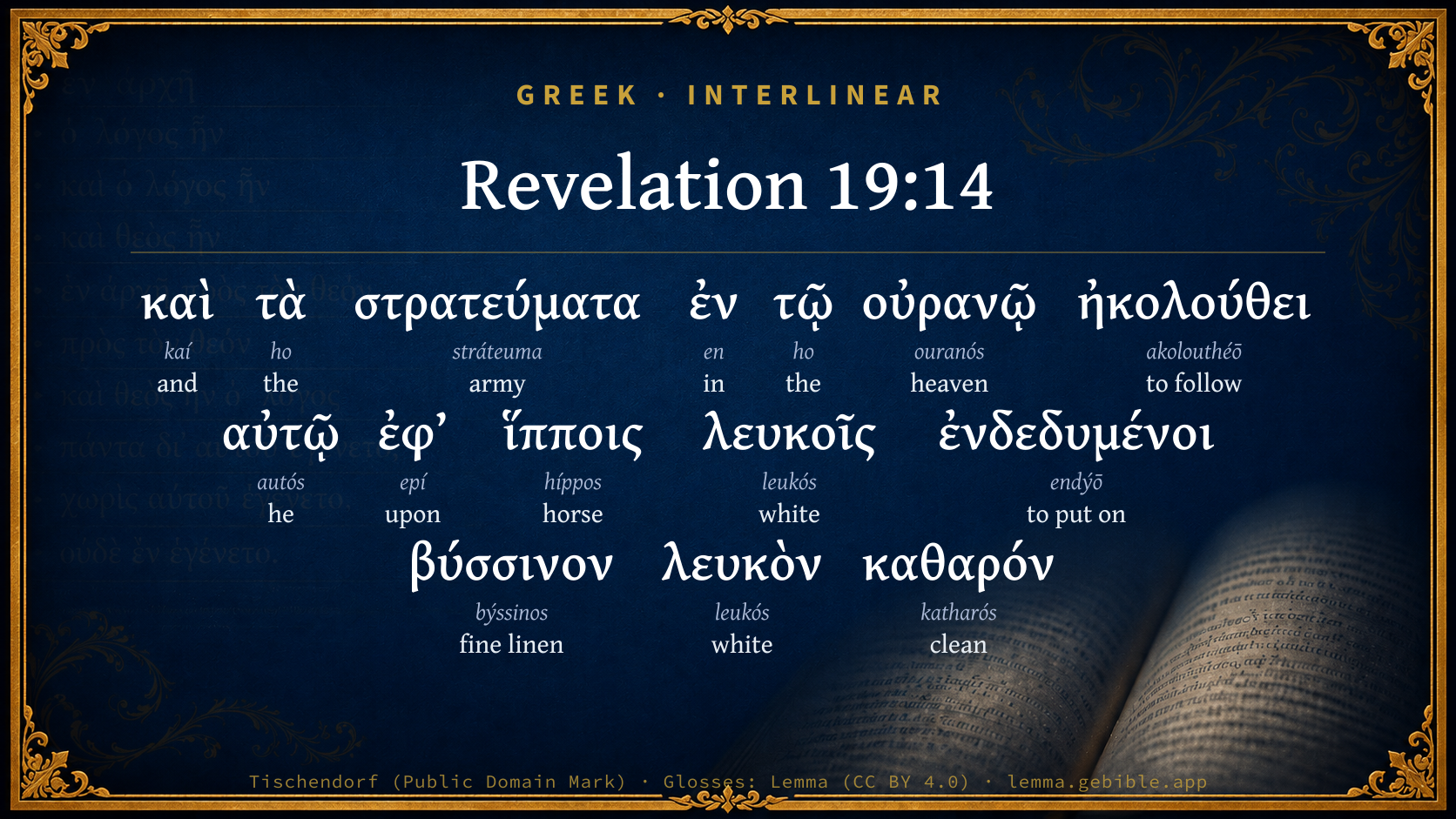
Greek (Tischendorf 8th ed.) Revelation 19:14 appears in the Greek New Testament. The text above is from the Tischendorf 8th edition. Each word links to its Strong’s number and a concise gloss. Click any word for its full Thayer’s Greek Lexicon entry.
Download image
Cite this verse

Revelation 19:14 (World English Bible). Public Domain. Lemma interlinear Bible study tool, https://lemma.gebible.app/v/revelation/19/14.

Show BibTeX & RIS
BibTeX
RIS
English Translation
The armies which are in heaven followed him on white horses, clothed in white, pure, fine linen.
World English Bible · Public Domain
Download a study sheet

One document with this verse’s original text, its word-by-word gloss line, the meaning frame, cross-references with their text, attributed commentary, and full source and license credits — printable, and it pastes into notes with its structure intact.

This verse Autodidact and up

Study sheet (.html) Plain text (.txt)

A passage Seminary Student

Up to 50 verses in one chapter. A passage sheet keeps up to 6 commentary sources and 12 cross-references per verse, in the order this page ranks them, and says so on the sheet whenever that leaves anything out. Ask for a single verse and you get the Autodidact verse sheet above.

Everything on this page stays free to read, with no account — the sheet is a download of what is already on screen, not access to it.

Want to remove ads? Support Godless Engineer
Compare translations 3

The same verse in 3 English versions, stacked beneath the original-language interlinear above. Click any original word for its lexicon entry.

Each is an independent rendering of the whole verse — the interlinear is not word-aligned to these translations.

Highlighted words mark where these versions differ — a whole-verse word diff, not a word-by-word alignment.

  • World English Bible Public Domain
    The armies which are in heaven followed him on white horses, clothed in white, pure, fine linen.
  • King James Version Public Domain
    And the armies which were in heaven followed him upon white horses, clothed in fine linen, white and clean.
  • unfoldingWord Literal Text CC BY-SA 4.0
    And the armies in heaven were following him on white horses, having been clothed in fine linen, white and clean.

unfoldingWord Literal Text — © unfoldingWord, licensed CC BY-SA 4.0. Word-aligned USFM3 via Door43 (git.door43.org/unfoldingWord/en_ult).

Versions to compare (up to 4)

3 of 4 selected

Show all 19 translations

Every available English version of this verse, each an independent rendering of the whole verse.

  • World English Bible Public Domain
    The armies which are in heaven followed him on white horses, clothed in white, pure, fine linen.
  • Berean Standard Bible Public Domain
    The armies of heaven, dressed in fine linen, white and pure, follow Him on white horses.
  • Majority Standard Bible Public Domain
    The armies of heaven, dressed in fine linen, white and pure, follow Him on white horses.
  • King James Version Public Domain
    And the armies which were in heaven followed him upon white horses, clothed in fine linen, white and clean.
  • American Standard Version (1901) Public Domain
    And the armies which are in heaven followed him upon white horses, clothed in fine linen, white `and' pure.
  • Revised Version (1885) Public Domain
    And the armies which are in heaven followed him upon white horses, clothed in fine linen, white and pure.
  • Geneva Bible (1599) Public Domain
    And the hostes which werein heauen, followed him vpon white horses, clothed with fine linnen white and pure.
  • Douay-Rheims (1899) Public Domain
    And the armies that are in heaven followed him on white horses, clothed in fine linen, white and clean.
  • Young's Literal Translation Public Domain
    And the armies in the heaven were following him upon white horses, clothed in fine linen -- white and pure;
  • Literal Standard Version CC BY-SA 4.0
    And the armies in Heaven were following Him on white horses, clothed in fine linen—white and pure;
  • Unlocked Literal Bible CC BY-SA 4.0
    The armies of heaven were following him on white horses, dressed in fine linen, white and clean.
  • unfoldingWord Literal Text CC BY-SA 4.0
    And the armies in heaven were following him on white horses, having been clothed in fine linen, white and clean.
  • Darby Bible Public Domain
    And the armies which [are] in the heaven followed him upon white horses, clad in white, pure, fine linen.
  • World Messianic Bible Public Domain
    The armies which are in heaven, clothed in white, pure, fine linen, followed him on white horses.
  • Webster's Bible Public Domain
    And the armies which were in heaven followed him upon white horses, clothed in fine linen, white and clean.
  • Free Bible Version CC BY-SA 4.0
    Heaven's armies were following him, riding on white horses and clothed in fine linen, white and clean.
  • Bible in Basic English Public Domain
    And the armies which are in heaven went after him on white horses, clothed in delicate linen, white and clean.
  • Text-Critical English NT CC BY 4.0
    The armies of heaven, clothed in fine linen, white and pure, were following him on white horses.
  • Tyndale New Testament (1534) Public Domain
    And the warriers which were in heven folowed him apon whyte horsses clothed with whyte and pure raynes:

Literal Standard Version (2020), Covenant Press — licensed CC BY-SA 4.0. Text via the HelloAO Bible API (eBible.org). Unlocked Literal Bible (unfoldingWord) — licensed CC BY-SA 4.0. Text via the HelloAO Bible API (eBible.org). unfoldingWord Literal Text — © unfoldingWord, licensed CC BY-SA 4.0. Word-aligned USFM3 via Door43 (git.door43.org/unfoldingWord/en_ult). Free Bible Version, Dr. Jonathan Gallagher — licensed CC BY-SA 4.0. Text via the HelloAO Bible API (eBible.org).

Word by word

More ways to search: Search by grammar → Find every occurrence → Compare this word →

Practice this passage: Drill this verse → Learn its vocabulary →

βύσσινον
býssinos
G1039
“fine linen”
Adjective, Accusative, Singular, Neuter
Part of Speech
Adjective
Case
Accusative
Number
Singular
Gender
Neuter
Full Thayer's Definition

Origin: from G1040

TDNT: None

1. a fine linen (garment) 2. made of fine linen
  1. καὶ kaí G2532 “and” Conjunction
  2. τὰ ho G3588 “the” Article, Nominative, Plural, Neuter
  3. στρατεύματα stráteuma G4753 “army” Noun, Nominative, Plural, Neuter
  4. ἐν en G1722 “in” Preposition
  5. τῷ ho G3588 “the” Article, Dative, Singular, Masculine
  6. οὐρανῷ ouranós G3772 “heaven” Noun, Dative, Singular, Masculine
  7. ἠκολούθει akolouthéō G190 “to follow” Verb, Imperfect, Active, Indicative, 3rd person, Singular
  8. αὐτῷ autós G846 “he” Personal pronoun, Dative, Singular, Masculine
  9. ἐφ’ epí G1909 “upon” Preposition
  10. ἵπποις híppos G2462 “horse” Noun, Dative, Plural, Masculine
  11. λευκοῖς leukós G3022 “white” Adjective, Dative, Plural, Masculine
  12. ἐνδεδυμένοι endýō G1746 “to put on” Verb, Perfect, Middle, Participle, Nominative, Plural, Masculine
  13. λευκὸν leukós G3022 “white” Adjective, Accusative, Singular, Neuter
  14. καθαρόν katharós G2513 “clean” Adjective, Accusative, Singular, Neuter

About this verse

These counts appear in no published source. They are computed here, from the morphology-tagged text and Lemma’s own curated glosses. What Lemma adds →

15
words
13
distinct lemmas
Revelation
section

Notable vocabulary

The rarest word here is βύσσινον fine linen G1039 — appearing just 5 times in the whole Greek New Testament.

Shared distinctive vocabulary

βύσσινον fine linen G1039 occurs in 4 verses of the Greek New Testament. Also found in:

Repetition

Words recur within this verse:

  • λευκοῖς white G3022 ×2
  • τὰ the G3588 ×2

Cross-references

14

Topical passages linked to Revelation 19:14 in the Treasury of Scripture Knowledge — connected by theme and wording, ordered by reader-vote popularity; previews shown in the World English Bible.

  • Jude 1:14 About these also Enoch, the seventh from Adam, prophesied, saying, "Behold, the Lord came with ten thousands of his holy ones,
  • Revelation 7:9 After these things I looked, and behold, a great multitude, which no man could number, out of every nation and of all tribes, peoples, and languages, standing before the throne and before the Lamb, dressed in white robes, with palm branches in their hands.
  • Revelation 17:14 These will war against the Lamb, and the Lamb will overcome them, for he is Lord of lords, and King of kings. They also will overcome who are with him, called and chosen and faithful."
  • Revelation 19:8 It was given to her that she would array herself in bright, pure, fine linen: for the fine linen is the righteous acts of the saints.
  • Zechariah 14:5 You shall flee by the valley of my mountains; for the valley of the mountains shall reach to Azel; yes, you shall flee, just like you fled from before the earthquake in the days of Uzziah king of Judah. Yahweh my God will come, and all the holy ones with you.
  • Matthew 28:3 His appearance was like lightning, and his clothing white as snow.
  • Revelation 3:4 Nevertheless you have a few names in Sardis that did not defile their garments. They will walk with me in white, for they are worthy.
  • Revelation 4:4 Around the throne were twenty-four thrones. On the thrones were twenty-four elders sitting, dressed in white garments, with crowns of gold on their heads.
  • Revelation 19:11 I saw the heaven opened, and behold, a white horse, and he who sat on it is called Faithful and True. In righteousness he judges and makes war.
  • Psalms 149:6–9 May the high praises of God be in their mouths, And a two-edged sword in their hand;
  • Revelation 14:1 I saw, and behold, the Lamb standing on Mount Zion, and with him a number, one hundred forty-four thousand, having his name, and the name of his Father, written on their foreheads.
  • Revelation 14:20 The winepress was trodden outside of the city, and blood came out from the winepress, even to the bridles of the horses, as far as one thousand six hundred stadia.
  • Matthew 26:53 Or do you think that I couldn't ask my Father, and he would even now send me more than twelve legions of angels?
  • 2 Thessalonians 1:7 and to give relief to you that are afflicted with us, when the Lord Jesus is revealed from heaven with his mighty angels in flaming fire,

Cross-references courtesy of OpenBible.info (CC BY 4.0).

Commentary

Notes on Revelation 19:14 from classic Christian and Jewish commentators (each source and its license shown beneath its notes). The classic Christian expositions comment on the surrounding passage and are grouped to its opening verse, so a note may address several verses; the Jewish commentaries on the Tanakh (Rashi and others) are per-verse, so they appear only where the commentator wrote on this verse.

Lemma curates 59 commentaries, every one of them public domain or Creative Commons licensed, each selected and text-cleaned for this edition rather than reprinted as found. About our sources →

Tyndale Open Study Notes

Tyndale Open Resources

19:14 Christ’s armies of heaven, dressed in victorious white and riding on white horses, contrast with the locust forces of the abyss (9:3-11), the three frog-like evil spirits (16:13), and the defeated armies at Armageddon (16:16; see also 19:19).

Tyndale Open Study Notes — © Tyndale Open Resources, licensed CC BY-SA 4.0. Text via the HelloAO Bible API.

Bengel's Gnomon

Johann Albrecht Bengel

Rev 19:14. Τὰ στρατεύματα, the armies) called and chosen, and faithful, ch. Rev 17:14.—βύσσινον λευκὸν) Λευκὸν is not a superfluous epithet,[212] for there is some linen which is even yellow.

[212] Hence its omission, though plainly approved of in Ed. Maj., is by the margin of Ed. II. banished to the less supported readings; the Vers. Germ. following this, which has mit reiner weisser Seiden.—E. B.

A Orig. 4.58e Iren. Cypr. h Vulg. support λευκόν. The only good authority for the omission is Orig. 4,55b, which is contradicted by 4,58e.—E.

Bengel's Gnomon of the New Testament — English translation (T&T Clark, Edinburgh, 1860) — public domain. Text from a community e-Sword module.

Geneva Bible (1599)

Geneva Bible translators

The company or retinue of Christ, holy, innumerable, heavenly, judicial, royal and pure.

Geneva Bible (1599) marginal notes — public domain. Text via Bolls.life.

Jamieson, Fausset & Brown

Robert Jamieson, A. R. Fausset & David Brown

the armies . . . in heaven--Compare "the horse bridles," Rev 14:20. The glorified saints whom God "will bring with" Christ at His advent; compare Rev 17:14, "they that are with Him, called, chosen, faithful"; as also "His mighty angels."

white and clean--Greek, "pure." A, B, Vulgate, Syriac, and CYPRIAN omit "and," which ORIGEN and ANDREAS retain, as English Version.

Jamieson, Fausset & Brown — Commentary Critical and Explanatory on the Whole Bible (1871) — public domain (CC PDM 1.0). Text via the HelloAO Bible API.

Adam Clarke's Commentary

Verse 14. The armies which were in heaven] Angels and saints over whom Jesus Christ is Captain,

Clothed in fine linen] All holy, pure, and righteous.

Adam Clarke's Commentary on the Bible (1810–1826) — public domain. Text from a community e-Sword/MySword module.

Ellicott's Commentary for English Readers

(14) And the armies . . .—The words “which were” should be omitted. The armies in heaven followed Him. Some would limit these to angels. The apparel which they wear—the fine linen (byssus) “which is the righteousness of saints” (see Rev_19:8)—is conclusive against this limited view. The saints who have fought the good fight here, and who loved not their lives unto the death, will share the triumph of their king. (Comp. also Rev_17:14.) The horses upon which they are seated are white. The raiment they wear is white, pure. (Comp. Rev_19:8, and Rev_3:4; Rev_7:14.) The hue of triumph is here, but it is the triumph of righteousness. (Comp. also Eze_38:4.)

A Bible Commentary for English Readers, edited by Charles John Ellicott (1878–1897) — public domain. Text from a community e-Sword module.

The Cambridge Bible for Schools and Colleges

gen. ed. J. J. S. Perowne

14. the armies which were in heaven] According to ordinary O. T. usage (e.g. 1Ki_22:19) this would mean the holy Angels exclusively, or at least primarily. But some think that the glorified Saints are at least included: it seems in harmony with the ideas of this Book to represent them, not indeed as executing Christ’s vengeance (which the angels do, Rev_14:19; St Mat_13:39-42), but as spectators of His triumph, which is all that these armies seem to be.

fine linen, white and clean] The dress of Angels in St Mat_28:3 and parallels, Act_1:10; but of Saints in this Book, Rev_3:4, Rev_7:9, and probably Rev_4:4 : compare the almost exactly similar words of Rev_19:8. Here this costume contrasts with the blood-dyed one of their Leader. The probable meaning is, that they have no need to take part in the work of slaughter, see Rev_19:21. We cannot argue that Martyrs who shed their own blood for their Lord are not included, nor yet that these are not of those for whom His Blood was shed; for Rev_7:14 shews that that Blood does not leave a stain.

The Cambridge Bible for Schools and Colleges (gen. ed. J. J. S. Perowne; Cambridge University Press, 1878–1918) — public domain. Text from a community e-Sword module.

John Gill's Exposition

And the armies which were in heaven,.... Not the angels, though they are God's host, and are the armies of the heavens; they are in heaven, and dwell there, and follow Christ, attend upon him, and minister to him, and have been sometimes represented by horses and horsemen, Kg2 2:11 and they are pure and holy creatures, and will come with Christ to judgment: but this vision refers not to the day of judgment; and besides, the saints are meant, as appears by their habit, for the fine linen, white and clean, is the righteousness of the saints, Rev 19:8 and the righteousness of angels and saints is not the same. Moreover, these are the same company described in Rev 17:14. The saints are in a state of warfare, have many enemies to fight with, sin, Satan, and the world; they are enlisted as volunteers under Christ, the Captain of salvation; they are provided with the whole armour of God, and are very numerous, and always more than conquerors through Christ: these are described by the place where they were, "in heaven"; not being glorified saints in heaven; with these indeed Christ will come to judgment, even with all his saints with him; but members of the church militant, said to be in heaven, because that is often called the kingdom of heaven; and because their names are written in heaven, and they are of heavenly extract; they are born from above, and are partakers of the heavenly calling; they belong to heaven, they are citizens of it, and are pressing on to it. And these

followed him; Christ, their Leader and Commander in the exercise of grace, and in the discharge of duty; having gone on in his ways through a train of sufferings, and cleaved unto him, and now attend him; not to assist in fighting, but to add to the glorious and triumphant appearance of their General; and therefore are said to be

upon white horses; they had served Christ in his Gospel, which some of them had preached, and all professed, and had maintained the purity of it in doctrine and practice, and now triumphed in Christ, and along with him, riding upon horses of the same colour with his, as being his princes and nobles, and whom he had made kings as well as priests; the former may be signified by their horses; see Jdg 5:10 and the latter by their following habit,

clothed in fine linen, white and clean; not the horses, but the armies on them; which designs not their inward purity, which was very glorious; nor their outward conversation garments, washed and made white in the blood of the Lamb; but the robe of Christ's righteousness, which is pure and spotless: these have no armour on, for they are not to strike a blow, only their General, who has the bloody garment on, is to tread the winepress, and destroy antichrist with the breath of his mouth, or with his sword proceeding out of it, as follows.

John Gill's Exposition of the Whole Bible (1746–1763) — public domain (CC PDM 1.0). Text via the HelloAO Bible API.

Trapp's Complete Commentary

John Trapp

14 And the armies which were in heaven followed him upon white horses, clothed in fine linen, white and clean.

Ver. 14. And the armies which were in heaven] The heavenly minded heroes that fight his battles, are all in his livery, horsed and habited as he, in whom they are more than conquerors, because they are sure to conquer before they fight.

John Trapp, A Commentary or Exposition upon All the Books of the Old and New Testament (1647–1656) — public domain. Text from a community e-Sword module.

Albert Barnes' Notes on the Bible

And the armies which were in heaven followed him - The heavenly hosts; particularly, it would seem, the redeemed, as there would be some incongruity in representing the angels as riding in this manner. Doubtless the original of this picture is Isa 63:3; “I have trodden the wine-press alone, and of the people there was none with me.” These hosts of the redeemed on white horses accompany him to be witnesses of his victory, and to participate in the joy of the triumph, not to engage in the work of blood.

Upon white horses - Emblems of triumph or victory. See the notes on Rev 6:2.

Clothed in fine linen, white and clean - The usual raiment of those who are in heaven, as everywhere represented in this book. See Rev 3:4-5; Rev 4:4; Rev 7:9, Rev 7:13; Rev 15:6.

Albert Barnes' Notes on the Bible (1834–1885) — public domain. Text from a community e-Sword/MySword module.

Haydock's Catholic Bible Commentary

The armies, &c. The celestial armies of saints follow the Son of God, as their captain and commander; they are all like him, mounted on white horses, and clothed in fine linen, white and clean, a symbol of their merit and glory. (Pastorini)

George Leo Haydock (1774–1849), Haydock's Catholic Family Bible and Commentary, 1859 edition — public domain. Excludes Psalms (Douay-Rheims chapter numbering differs from Protestant) and Deuterocanonical books (Catholic canon only).

Matthew Poole's English Annotations

And the armies which were in heaven followed him; the glorious angels, 2Th 1:7, and ten thousands of his saints, Jud 1:14, who follow the Lamb whithersoever he goeth.

Upon white horses; to prophesy success and victory.

Clothed in fine linen, white and clean; to denote their glory, purity, and holiness.

Matthew Poole's English Annotations on the Holy Bible (1683–1685) — public domain. Text from a community e-Sword/MySword module.

The Pulpit Commentary

And the amiss which were in heaven followed him upon white horses, clothed in fine linen, white and clean; which are... white, pure. These armies are not merely the angels, but the "called, chosen, and faithful" of Rev_17:14, "the bride" of ver. 8, who are described as being arrayed in white in Rev_6:11, and ver. 8 of this chapter. Those commentators who consider that the angels only are intended, and not the saints, forget the double nature of the vision; it is not only a description of Judgment meted out, but also of a war waged. (On "white" and "fine linen," see previous chapters)

Armies invisible and distant on the side of good.

"The armies which were in heaven followed him upon white horses, clothed in fine linen, white and clean." Heaven, it would seem, is populated with numerous intelligent beings, existing in various types of condition, influence, power, etc. It is suggested

I THE HOSTS OF HEAVEN ARE INTERESTED IN THE MORAL CAMPAIGN WHICH CHRIST IS PROSECUTING ON THIS EARTH. They not only know what is going on in this little planet, but throb with earnest interest in its history. They desire to look into its great moral concerns. No wonder some in heaven are related to some on earth; they participate in the same nature, sustain the same relation, and are subject to the same laws. Here, too, stupendous events have occurred in connection with him who is the Head of all principalities, powers, and that must ever thrill the universe.

II THE HOSTS OF HEAVEN LEND THEIR AID TO CHRIST IN HIS TREMENDOUS BATTLES. "The armies which were in heaven followed him upon white horses." If you ask me in what way they can render him aid, I can suggest many probable methods. We know that one great thought struck into the soul of an exhausted and despairing man can revive and reinvigorate him. May it not be possible for departed souls and unfallen spirits to breathe such thoughts into the breasts of feeble men on earth? If you ask me why Christ should accept such aid as theirs, or the aid of any creature in his mighty struggles, I answer, not because he requires their services for he could do his work alone but for their own good. By it he gratifies their noblest instincts, engages their highest faculties, and gains for them their highest honours and sublimest joys.

III THE HOSTS OF HEAVEN ARE FULLY EQUIPPED FOR SERVICE IN THIS MARTIAL UNDERTAKING ON EARTH. "Upon white horses, clothed in fine linen, white and clean." It was customary in Oriental lands for soldiers of the highest rank to go forth to battle on steeds. It is a law of Christ"s kingdom that those only who are holy and pure can enter therein; hence these heavenly soldiers are furnished with "white horses," the emblem of purity, and "white linen" also. No one in heaven or on earth will Christ allow to fight under his banner who are not qualified, both in capacity and character, for the work they undertake.

Encouraging subject this! Small as this little planet of ours is, it is not isolated from the family of worlds. As materially this globe, by the law of gravitation, is linked to the most distant planet, so the meanest human spirit here is linked to the highest hierarchies in the great realm of mind. They are all at the bidding of the great Leader in the battle of life. "Thinkest thou that I could not pray to my Father, and he will send me twelve legions of angels?" etc. "More are they that are for us than those that are against us. D.T.

The Pulpit Commentary (1880–1919), ed. H.D.M. Spence-Jones & Joseph S. Exell — public domain. Text from a community e-Sword module.

The People's New Testament

B. W. Johnson

14. And the armies which were in heaven followed him. These armies are the armies of the saints, purified, holy, a conquering host, led by Christ to victory.

B. W. Johnson's The People's New Testament with Notes (1889–1891) — public domain. Electronic text from the Christian Classics Ethereal Library (CCEL) ThML edition.

unfoldingWord translationNotes

Door43 World Missions Community

Out of his mouth goes a sharp sword

The sword blade was sticking out of his mouth. The sword itself was not in motion. See how you translated a similar phrase in Revelation 1:16.

strikes down the nations

"destroys the nations" or "brings the nations under his control"

rule them with an iron rod

John speaks of the rider's power as if he were ruling with an iron rod. See how you translated this in Revelation 12:5. (See: Metaphor)

He tramples in the winepress of the fury of the wrath of God Almighty

John speaks of the rider's destroying his enemies as if they were grapes that a person tramples in a winepress. Here "wrath" refers to God's punishment of evil persons. AT: "He crushes his enemies according to the judgment of God Almighty, just as a person crushes grapes in a winepress" (See: Metaphor and Assumed Knowledge and Implicit Information)

He has a name written on his robe and on his thigh:

This can be stated in active form. AT: "Someone has written a name on his robe and thigh:" (See: Active or Passive)

translationWords

heaven

horse

sword

nation

rod

winepress

wrath

God

Almighty

robe

name

king

lord

unfoldingWord translationNotes — © Distant Shores Media and the Door43 World Missions Community, licensed CC BY-SA 4.0. Source: git.door43.org/Door43/en_tn.

Cambridge Greek Testament for Schools and Colleges

14. τὰ στρατεύματα ἐν τῷ οὐρανῷ. According to ordinary O.T. usage (e.g. 1Ki 22:19) this would mean the holy Angels exclusively, or at least primarily. But some think that the glorified Saints are at least included: it seems in harmony with the ideas of this Book to represent them, not indeed as executing Christ’s vengeance (which the Angels do, Rev 14:19, Mat 13:39-42), but as spectators of His triumph, which is all that these armies seem to be.

βύσσινον λευκὸν καὶ καθαρόν. The dress of Angels in St Matt, Mat 28:3 and parallels, Act 1:10; but of Saints in this Book, Rev 3:4, Rev 7:9, and probably Rev 4:4: compare the almost exactly similar words of Rev 19:8. Here this costume contrasts with the blood-dyed one of their Leader. The contrast is plainly intentional (for the mention of the armies interrupts the description of the Leader). If we explain it by supposing that they have no need to take part in the work of slaughter, it will follow, since there is blood on His raiment, that He has already executed judgement on Jerusalem and trodden the winepress there, Rev 14:20, and is now to do the like to the kings of the earth. If the armies in heaven are Saints, as the ancients seem to suppose, we must understand that their robes are washed white in His Blood, Rev 7:14, which perhaps weakens the contrast which is expressed by pointing to another which is not. οὶ μετʼ αὐτοῦ, Rev 17:14, are most naturally explained as the faithful on earth. On the whole it seems simplest to take the heavenly armies for the Angels, the rather that the Saints who are to reign with Christ have not yet risen at this point of the vision.

Cambridge Greek Testament for Schools and Colleges (Cambridge University Press, 1896; 21 vols, various authors incl. Carr, Maclear, Plummer, Farrar, Lumby, Moule, M. R. James, Simcox) — public domain. Text from a community e-Sword module.

Vincent's Word Studies in the New Testament

Marvin R. Vincent

Followed [ηκολουθει] . Note the imperfect tense denoting progression, and thus describing the advancing movement of the host.

Marvin R. Vincent, Word Studies in the New Testament (1887–1900) — public domain. Text from a community e-Sword/MySword module.

Lesson kit

Teaching starters — assembled from the data on this page, not authored interpretation. Every prompt links to the verse data it draws on. Edit before teaching.

Revelation, in the Revelation, opens this verse with 15 words (13 distinct Greek lemmas). Its most distinctive word is býssinos (“fine linen”). A historical commentator’s framing appears above. Read the whole chapter for the surrounding context.

Discussion questions

  1. What does “fine linen” (býssinos) contribute to the verse as a whole?
  2. Revelation 18:12 shares the word «fine linen» with this verse. How do the two illuminate each other?
  3. “white” occurs 2× in this one verse. What is the effect of the repetition?
  4. These translations render this verse differently. What is at stake in choosing one wording over another?
  5. Reading how Tyndale Open Study Notes and Bengel's Gnomon read this verse, where do the two commentators agree and where do they part?

Things to notice

  • These translations choose different wording for 8 words in this verse.
  • “white” occurs 2× in this single verse.
  • 13 distinct Greek lemmas span 15 words in this verse.

Reading settings

Reading text

Shown beneath each verse's original-language words.

Old Testament
Old Testament edition

Read the OT as the Masoretic Hebrew (MT) or the Greek Septuagint (LXX).

English shown for the Greek Septuagint (in the Hebrew ↔ Greek comparison).

Comparing translations? Open the Compare panel on any verse page to stack up to four side by side.