
Leviticus 8:7

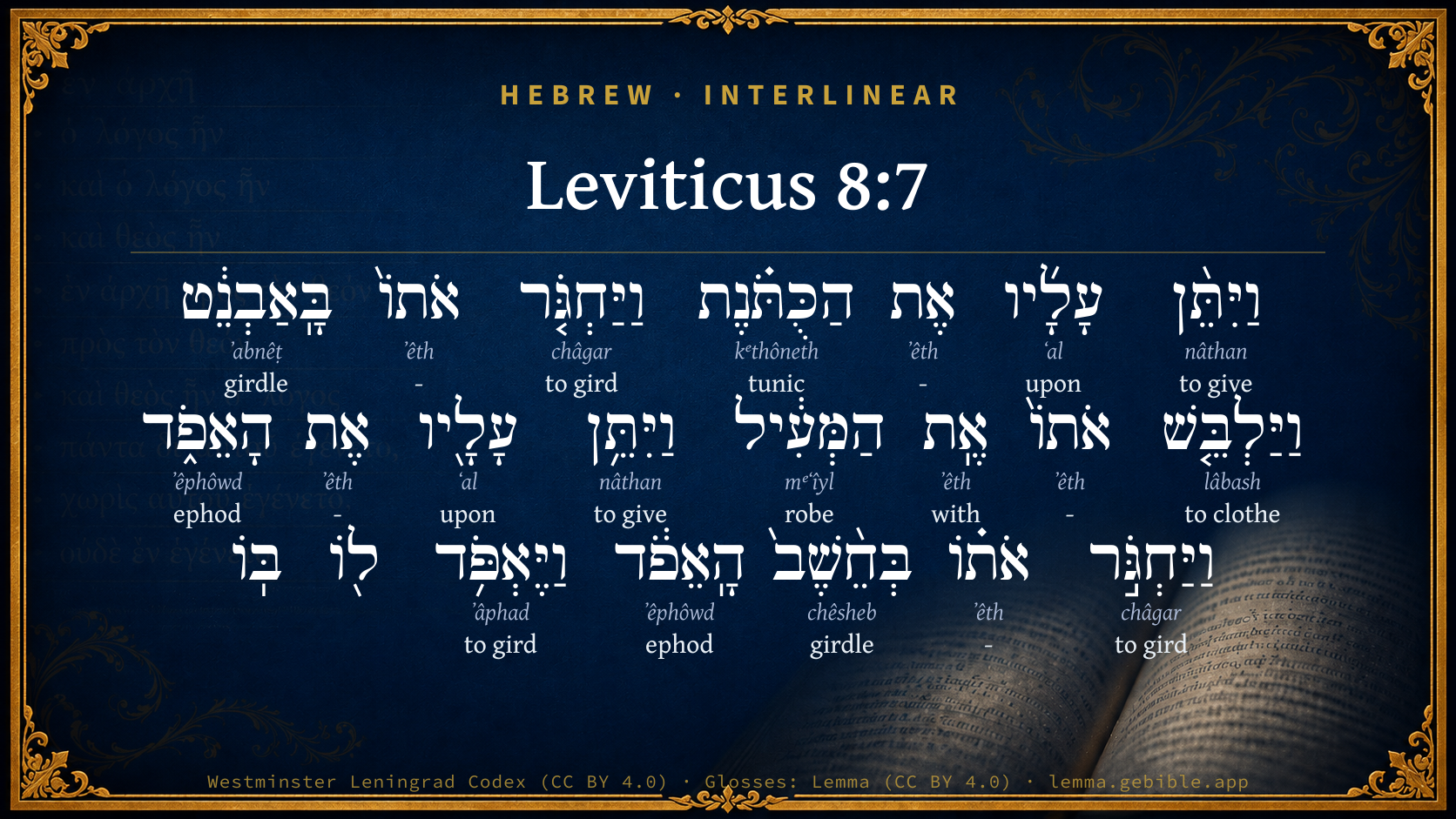
Hebrew (Westminster Leningrad Codex) Leviticus 8:7 appears in the Hebrew Old Testament. The text above is from the Westminster Leningrad Codex. Each word links to its Strong’s number, a concise gloss, and parsing drawn from the Open Scriptures Hebrew Bible morphology. Click any word for its full Brown-Driver-Briggs (BDB) entry.
Download image
Cite this verse

Leviticus 8:7 (World English Bible). Public Domain. Lemma interlinear Bible study tool, https://lemma.gebible.app/v/leviticus/8/7.

Show BibTeX & RIS
BibTeX
RIS
English Translation
He put the coat on him, tied the sash on him, clothed him with the robe, put the ephod on him, and he tied the skillfully woven band of the ephod on him, and fastened it to him with it.
World English Bible · Public Domain
Download a study sheet

One document with this verse’s original text, its word-by-word gloss line, the meaning frame, cross-references with their text, attributed commentary, and full source and license credits — printable, and it pastes into notes with its structure intact.

This verse Autodidact and up

Study sheet (.html) Plain text (.txt)

A passage Seminary Student

Up to 50 verses in one chapter. A passage sheet keeps up to 6 commentary sources and 12 cross-references per verse, in the order this page ranks them, and says so on the sheet whenever that leaves anything out. Ask for a single verse and you get the Autodidact verse sheet above.

Everything on this page stays free to read, with no account — the sheet is a download of what is already on screen, not access to it.

Want to remove ads? Support Godless Engineer
Compare translations 3

The same verse in 3 English versions, stacked beneath the original-language interlinear above. Click any original word for its lexicon entry.

Each is an independent rendering of the whole verse — the interlinear is not word-aligned to these translations.

Highlighted words mark where these versions differ — a whole-verse word diff, not a word-by-word alignment.

  • World English Bible Public Domain
    He put the coat on him, tied the sash on him, clothed him with the robe, put the ephod on him, and he tied the skillfully woven band of the ephod on him, and fastened it to him with it.
  • King James Version Public Domain
    And he put upon him the coat, and girded him with the girdle, and clothed him with the robe, and put the ephod upon him, and he girded him with the curious girdle of the ephod, and bound it unto him therewith.
  • unfoldingWord Literal Text CC BY-SA 4.0
    And he put the tunic on him, and he wrapped him with the sash, and he clothed him the robe, and he put the ephod on him. And he wrapped him with the finely woven waistband of the ephod, and he fastened on him with it.

unfoldingWord Literal Text — © unfoldingWord, licensed CC BY-SA 4.0. Word-aligned USFM3 via Door43 (git.door43.org/unfoldingWord/en_ult).

Versions to compare (up to 4)

3 of 4 selected

Show all 18 translations

Every available English version of this verse, each an independent rendering of the whole verse.

  • World English Bible Public Domain
    He put the coat on him, tied the sash on him, clothed him with the robe, put the ephod on him, and he tied the skillfully woven band of the ephod on him, and fastened it to him with it.
  • Berean Standard Bible Public Domain
    He put the tunic on Aaron, tied the sash around him, clothed him with the robe, and put the ephod on him. He tied the woven band of the ephod around him and fastened it to him.
  • Majority Standard Bible Public Domain
    He put the tunic on Aaron, tied the sash around him, clothed him with the robe, and put the ephod on him. He tied the woven band of the ephod around him and fastened it to him.
  • King James Version Public Domain
    And he put upon him the coat, and girded him with the girdle, and clothed him with the robe, and put the ephod upon him, and he girded him with the curious girdle of the ephod, and bound it unto him therewith.
  • American Standard Version (1901) Public Domain
    And he put upon him the coat, and girded him with the girdle, and clothed him with the robe, and put the ephod upon him, and he girded him with the skilfully woven band of the ephod, and bound it unto him therewith.
  • Revised Version (1885) Public Domain
    And he put upon him the coat, and girded him with the girdle, and clothed him with the robe, and put the ephod upon him, and he girded him with the cunningly woven band of the ephod, and bound it unto him therewith.
  • Geneva Bible (1599) Public Domain
    And put vpon him the coate, and girded him with a girdle, and clothed him with the robe, and put the Ephod on him, which he girded with the broydred garde of the Ephod, and bounde it vnto him therewith.
  • Douay-Rheims (1899) Public Domain
    He vested the high priest with the strait linen garment, girding him with the girdle, and putting on him the violet tunick, and over it he put the ephod,
  • Young's Literal Translation Public Domain
    and doth put on him the coat, and doth gird him with the girdle, and doth clothe him with the upper robe, and doth put on him the ephod, and doth gird him with the girdle of the ephod, and doth bind `it' to him with it,
  • Literal Standard Version CC BY-SA 4.0
    and puts the coat on him, and girds him with the girdle, and clothes him with the upper robe, and puts the ephod on him, and girds him with the girdle of the ephod, and binds [it] to him with it,
  • Unlocked Literal Bible CC BY-SA 4.0
    He put on Aaron the tunic and tied the sash around his waist, clothed him with the robe and put the ephod on him, and then he tied the ephod around him with the finely-woven waistband and bound it to him.
  • unfoldingWord Literal Text CC BY-SA 4.0
    And he put the tunic on him, and he wrapped him with the sash, and he clothed him the robe, and he put the ephod on him. And he wrapped him with the finely woven waistband of the ephod, and he fastened on him with it.
  • Darby Bible Public Domain
    And he put upon him the vest and girded him with the girdle, and clothed him with the cloak, and put the ephod on him, and he girded him with the girdle of the ephod, and fastened the ephod on him.
  • World Messianic Bible Public Domain
    He put the tunic on him, tied the sash on him, clothed him with the robe, put the ephod on him, and he tied the skillfully woven band of the ephod on him and fastened it to him with it.
  • Webster's Bible Public Domain
    And he put upon him the coat, and girded him with the girdle, and clothed him with the robe, and put the ephod upon him, and he girded him with the curious girdle of the ephod, and bound it to him with it.
  • Free Bible Version CC BY-SA 4.0
    He dressed Aaron with the tunic, tied the sash around him, put the robe on him and then the ephod. He tied the waistband of the ephod around him, fastening it to him.
  • Bible in Basic English Public Domain
    He put the coat on him, making it tight with its band, and then the robe, and over it the ephod, with its band of needlework to keep it in place.
  • JPS Tanakh (1917) Public Domain
    And he put upon him the tunic, and girded him with the girdle, and clothed him with the robe, and put the ephod upon him, and he girded him with the skilfully woven band of the ephod, and bound it unto him therewith.

Literal Standard Version (2020), Covenant Press — licensed CC BY-SA 4.0. Text via the HelloAO Bible API (eBible.org). Unlocked Literal Bible (unfoldingWord) — licensed CC BY-SA 4.0. Text via the HelloAO Bible API (eBible.org). unfoldingWord Literal Text — © unfoldingWord, licensed CC BY-SA 4.0. Word-aligned USFM3 via Door43 (git.door43.org/unfoldingWord/en_ult). Free Bible Version, Dr. Jonathan Gallagher — licensed CC BY-SA 4.0. Text via the HelloAO Bible API (eBible.org).

Word by word

More ways to search: Search by grammar → Find every occurrence → Compare this word →

Practice this passage: Drill this verse → Learn its vocabulary →

וַיֶּאְפֹּ֥ד
ʼâphad
H640
“and · to gird”
Conjunction + Verb, Qal, Sequential Imperfect, 3rd Person, Masculine, Singular
Part of Speech
Conjunction + Verb
Stem
Qal
Form
Sequential Imperfect
Person
3rd Person
Gender
Masculine
Number
Singular
Full BDB Definition

Origin: a primitive root [rather a denominative from H646 ]

TWOT: 142 . 1

(Qal) bind, gird - to gird on (ephod) - (TWOT) ephod
  1. וַיִּתֵּ֨ן nâthan H5414 “and · to give” Conjunction + Verb, Qal, Sequential Imperfect, 3rd Person, Masculine, Singular
  2. עָלָ֜יו ʻal H5921 “upon · him” Preposition + Suffix, Personal, 3rd Person, Masculine, Singular
  3. אֶת ʼêth H853 “-” Particle, Direct Object
  4. הַכֻּתֹּ֗נֶת kᵉthôneth H3801 “the · tunic” Particle, Definite Article + Noun, Common, Feminine, Singular, Absolute
  5. וַיַּחְגֹּ֤ר châgar H2296 “and · to gird” Conjunction + Verb, Qal, Sequential Imperfect, 3rd Person, Masculine, Singular
  6. אֹתוֹ֙ ʼêth H853 “- · him” Particle, Direct Object + Suffix, Personal, 3rd Person, Masculine, Singular
  7. בָּֽאַבְנֵ֔ט ʼabnêṭ H73 “in/at the · girdle” Preposition, Determined + Noun, Common, Masculine, Singular, Absolute
  8. וַיַּלְבֵּ֤שׁ lâbash H3847 “and · to clothe” Conjunction + Verb, Hiphil, Sequential Imperfect, 3rd Person, Masculine, Singular
  9. אֹתוֹ֙ ʼêth H853 “- · him” Particle, Direct Object + Suffix, Personal, 3rd Person, Masculine, Singular
  10. אֶֽת ʼêth H854 “with” Preposition
  11. הַמְּעִ֔יל mᵉʻîyl H4598 “the · robe” Particle, Definite Article + Noun, Common, Masculine, Singular, Absolute
  12. וַיִּתֵּ֥ן nâthan H5414 “and · to give” Conjunction + Verb, Qal, Sequential Imperfect, 3rd Person, Masculine, Singular
  13. עָלָ֖יו ʻal H5921 “upon · him” Preposition + Suffix, Personal, 3rd Person, Masculine, Singular
  14. אֶת ʼêth H853 “-” Particle, Direct Object
  15. הָאֵפֹ֑ד ʼêphôwd H646 “the · ephod” Particle, Definite Article + Noun, Common, Masculine, Singular, Absolute
  16. וַיַּחְגֹּ֣ר châgar H2296 “and · to gird” Conjunction + Verb, Qal, Sequential Imperfect, 3rd Person, Masculine, Singular
  17. אֹת֗וֹ ʼêth H853 “- · him” Particle, Direct Object + Suffix, Personal, 3rd Person, Masculine, Singular
  18. בְּחֵ֨שֶׁב֙ chêsheb H2805 “in/at · girdle of” Preposition + Noun, Common, Masculine, Singular, Construct
  19. הָֽאֵפֹ֔ד ʼêphôwd H646 “the · ephod” Particle, Definite Article + Noun, Common, Masculine, Singular, Absolute

About this verse

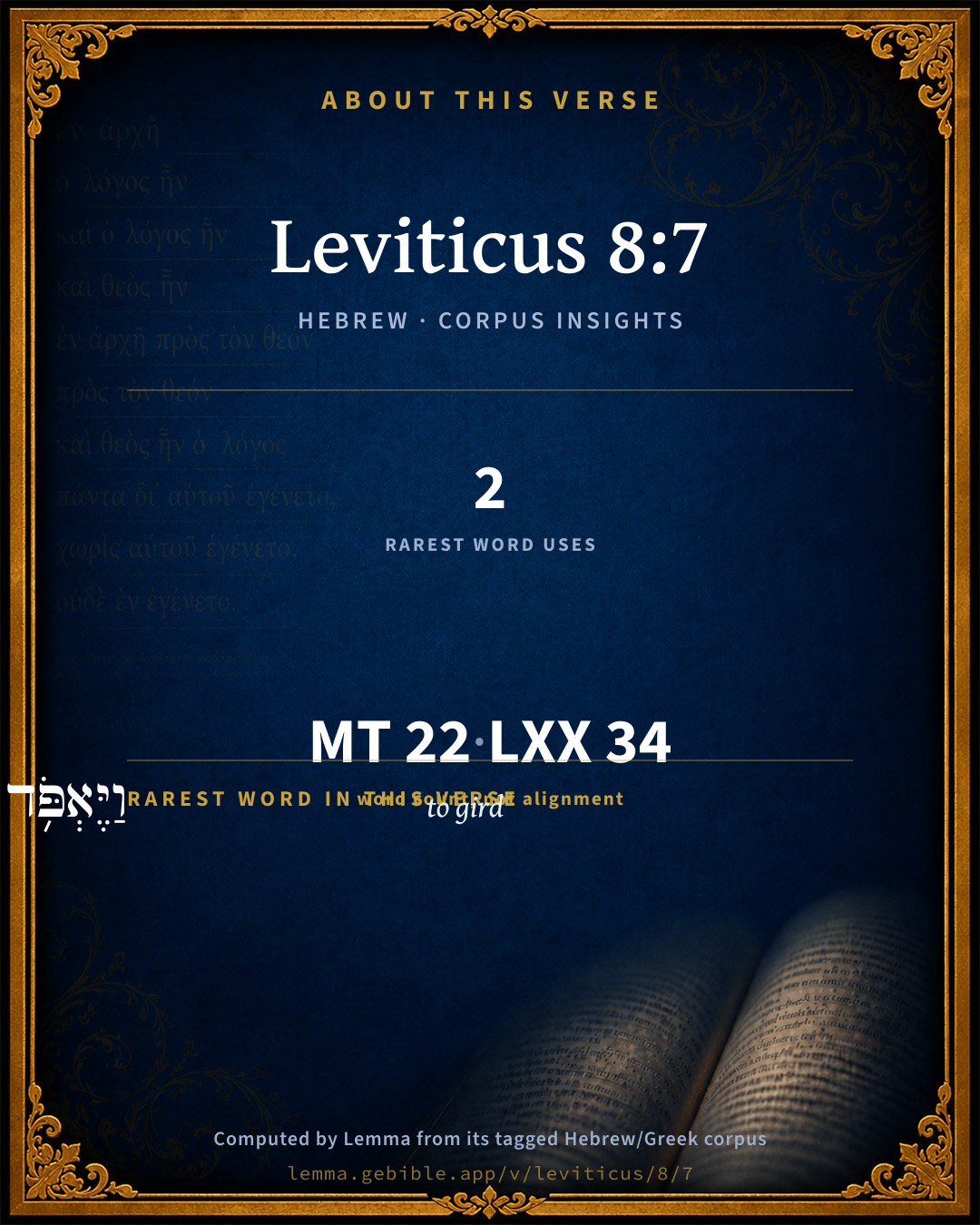
These counts appear in no published source. They are computed here, from the morphology-tagged text and Lemma’s own curated glosses. What Lemma adds →

22
words
12
distinct lemmas
Pentateuch
section

Notable vocabulary

The rarest word here is וַיֶּאְפֹּ֥ד to gird H640 — appearing just 2 times in the whole Hebrew Bible.

Shared distinctive vocabulary

וַיֶּאְפֹּ֥ד to gird H640 occurs in 2 verses of the Hebrew Bible. Also found in:

Grammatical profile

  • 6 verbs
  • 6 nouns
  • 5 prepositions
  • 5 particles

Verb forms

  • וַיִּתֵּ֨ן Qal · Sequential Imperfect
  • וַיַּחְגֹּ֤ר Qal · Sequential Imperfect
  • וַיַּלְבֵּ֤שׁ Hiphil · Sequential Imperfect
  • וַיִּתֵּ֥ן Qal · Sequential Imperfect
  • וַיַּחְגֹּ֣ר Qal · Sequential Imperfect
  • וַיֶּאְפֹּ֥ד Qal · Sequential Imperfect

Repetition

Words recur within this verse — often emphatic in Hebrew:

  • וַיִּתֵּ֨ן to give H5414 ×2
  • עָלָ֜יו upon H5921 ×2
  • וַיַּחְגֹּ֤ר to gird H2296 ×2
  • הָאֵפֹ֑ד ephod H646 ×2

Hebrew & Septuagint length

In English translation the verse runs 40 words from the Hebrew and 24 from the Septuagint (LXX English) — the Septuagint runs noticeably shorter here. See the side-by-side →

A rough comparison of the two English renderings, which tokenize alike — not a word-level alignment.

Word counts can differ between the Hebrew and the Greek without any difference in meaning — e.g. the Hebrew direct-object marker אֵת has no separate Greek word, and Greek often adds the article ὁ.

In the original languages it is 22 Hebrew tokens and 34 Greek tokens — but the two are counted differently (Hebrew bundles its prefixes and suffixes into one token; the Greek is in lemma form), so that isn’t a like-for-like length.

Cross-references

8

Topical passages linked to Leviticus 8:7 in the Treasury of Scripture Knowledge — connected by theme and wording, ordered by reader-vote popularity; previews shown in the World English Bible.

  • Exodus 28:4 These are the garments which they shall make: a breastplate, and an ephod, and a robe, and a coat of checker work, a turban, and a sash: and they shall make holy garments for Aaron your brother, and his sons, that he may minister to me in the priest's office.
  • Exodus 29:5 You shall take the garments, and put on Aaron the coat, the robe of the ephod, the ephod, and the breastplate, and dress him with the skillfully woven band of the ephod;
  • Exodus 39:1–7 Of the blue, purple, and scarlet, they made finely worked garments, for ministering in the holy place, and made the holy garments for Aaron; as Yahweh commanded Moses.
  • Isaiah 61:10 I will greatly rejoice in Yahweh, my soul shall be joyful in my God; for he has clothed me with the garments of salvation, he has covered me with the robe of righteousness, as a bridegroom decks himself with a garland, and as a bride adorns herself with her jewels.
  • Romans 3:22 even the righteousness of God through faith in Jesus Christ to all and on all those who believe. For there is no distinction,
  • Romans 13:14 But put on the Lord Jesus Christ, and make no provision for the flesh, for its lusts.
  • Galatians 3:27 For as many of you as were baptized into Christ have put on Christ.
  • Isaiah 61:3 to appoint to those who mourn in Zion, to give to them a garland for ashes, the oil of joy for mourning, the garment of praise for the spirit of heaviness; that they may be called trees of righteousness, the planting of Yahweh, that he may be glorified.

Cross-references courtesy of OpenBible.info (CC BY 4.0).

Hebrew and Greek witnesses Masoretic Hebrew ↔ Greek Septuagint

The same verse in the two great witnesses to the Old Testament, shown verse-for-verse.

Here the Septuagint runs noticeably shorter than the Hebrew — LXX2012 (modern English Septuagint) 24 words vs World English Bible 40. A rough length comparison of the two English translations, not a word-level alignment — read both below.

These are two independent witnesses, not word-aligned to each other, and the Septuagint is shown in lemma (dictionary) form.

Hebrew Leviticus 8:7 Masoretic · Westminster Leningrad Codex

וַיִּתֵּ֨ן עָלָ֜יו אֶת הַכֻּתֹּ֗נֶת וַיַּחְגֹּ֤ר אֹתוֹ֙ בָּֽאַבְנֵ֔ט וַיַּלְבֵּ֤שׁ אֹתוֹ֙ אֶֽת הַמְּעִ֔יל וַיִּתֵּ֥ן עָלָ֖יו אֶת הָאֵפֹ֑ד וַיַּחְגֹּ֣ר אֹת֗וֹ בְּחֵ֨שֶׁב֙ הָֽאֵפֹ֔ד וַיֶּאְפֹּ֥ד ל֖וֹ בּֽוֹ

He put the coat on him, tied the sash on him, clothed him with the robe, put the ephod on him, and he tied the skillfully woven band of the ephod on him, and fastened it to him with it.

World English Bible · Public Domain

Greek LXX Leviticus 8:7 Septuagint · lemma form

καί ἐνδύω αὐτός ὁ χιτών καί ζωννύω αὐτός ὁ ζωνή καί ἐνδύω αὐτός ὁ ὑποδύτης καί ἐπιτίθημι ἐπί αὐτός ὁ ἐπωμίς καί συνζώννυμι αὐτός κατά ὁ ποίησις ὁ ἐπωμίς καί συνσφίγγω αὐτός ἐν αὐτός

and put on him the coat, and girded him with the girdle, and clothed him with the tunic, and put on him the ephod;

LXX2012 (modern English Septuagint) · Public Domain

Hebrew: Westminster Leningrad Codex (CC BY 4.0). Greek: Septuagint (public domain); English from LXX2012 (modern English Septuagint) (Public Domain). How the Septuagint differs from the Hebrew →

Targum (Aramaic paraphrase)

2

The Targum is the ancient Jewish Aramaic paraphrase of the Hebrew Scriptures — an interpretive translation, not the Hebrew text itself. Onkelos (literal) and Pseudo-Jonathan (expansive) render the Torah, and Jonathan the Prophets. Coverage is partial: where no permissively-licensed English translation exists for a verse, only the Aramaic is shown. This is verse-level text, not a word-by-word alignment to the Hebrew.

  1. Targum Onkelos Torah (Genesis–Deuteronomy)
    וִיהַב עֲלוֹהִי יָת כִּתּוּנָא וְזָרֵז יָתֵהּ בְּהֶמְיָנָא וְאַלְבֵּשׁ יָתֵהּ יָת מְעִילָא וִיהַב עֲלוֹהִי יָת אֵפוֹדָא וְזָרֵז יָתֵהּ בְּהֶמְיַן אֵפוֹדָא וְאַתְקֵן לֵהּ בֵּהּ

    (no public-domain English translation for this verse)

    Targum Onkelos — Aramaic: “Onkelos Genesis” (public domain); “Onkelos Exodus” (public domain); “Onkelos Leviticus” (public domain); “Onkelos Numbers” (public domain); “Onkelos Deuteronomy” (public domain). English: “Sefaria Community Translation” (CC0 1.0 (public-domain dedication)); “J.W. Etheridge. The Targums of Onkelos and Jonathan Ben Uzziel on the Pentateuch. London: Longmans, Green, 1862” (public domain). Text via Sefaria.

  2. Targum Pseudo-Jonathan Torah (Genesis–Deuteronomy)
    וְסַדֵר עֲלוֹי יַת כִּיתּוּנָא וְזָרֵיז יָתֵיהּ בִּקְמוּרָא וְאַלְבֵּישׁ יָתֵיהּ יַת מִנְטַר מְעִילָא וִיהַב עֲלוֹי יַת אֵיפוֹדָא וְזָרִיז יָתֵיהּ בְּהֶמְיַן אֵיפוֹדָא וְאַתְקִין לֵיהּ בֵּיהּ

    And he set in order upon him the vestment, and girded him with the girdle, and clothed him with the mantle robe, and put upon him the ephod, and bound him with the band of the ephod, and ordained him therewith.

    Targum Pseudo-Jonathan — Aramaic: “Targum Jonathan on Genesis” (public domain); “Targum Jonathan on Exodus” (public domain); “Targum Jonathan on Leviticus” (public domain); “Targum Jonathan on Numbers” (public domain); “Targum Jonathan on Deuteronomy” (public domain). English: “The Targum of Jonathan ben Uzziel, trans. J. W. Etheridge, London, 1862” (public domain). Text via Sefaria.

Commentary

Notes on Leviticus 8:7 from classic Christian and Jewish commentators (each source and its license shown beneath its notes). The classic Christian expositions comment on the surrounding passage and are grouped to its opening verse, so a note may address several verses; the Jewish commentaries on the Tanakh (Rashi and others) are per-verse, so they appear only where the commentator wrote on this verse.

Lemma curates 59 commentaries, every one of them public domain or Creative Commons licensed, each selected and text-cleaned for this edition rather than reprinted as found. About our sources →

The Expositor's Bible

THE INVESTITURE

Lev_8:7-9

"And he put upon him the coat, and girded him with the girdle, and clothed him with the robe, and put the ephod upon him, and he girded him with the cunningly woven band of the ephod, and bound it unto him therewith. And he placed the breastplate upon him: and in the breastplate he put the Urim and the Thummim. And he set the mitre upon his head: and upon the mitre, in front, did he set the golden plate, the holy crown; as the Lord commanded Moses."

The next ceremony of the consecration was the Investiture of Aaron with his official high priestly robes, as they had been appointed of God to be made. {Exodus 28} The investiture of the sons of Aaron significantly takes place only after the anointing of the tabernacle, and of Aaron as high priest. Of the investiture of Aaron we read in Lev_8:7-9, above.

As these garments were official, we must needs regard them as symbolical; a thought which is the more emphasised by the very minute and special directions given by the Lord for making them. Nothing was left to the fancy of man; all was prescribed by the Lord. The official robes of the high priest consisted of eight pieces, four of which, the coat, the girdle, the turban (or "mitre"), and the breeches, were, with the exception of the turban, of white linen, and identical in every respect with the official dress of the ordinary priests.

Four pieces more were peculiar to himself, the special insignia of his office, and unlike the dress of the ordinary priest, were richly made in gold and various colours, "garments for glory and for beauty." These were: the robe of the ephod, made all of blue, with a border of pendant pomegranates and golden bells in alternation; the ephod itself consisting of two pieces, broidered in gold and blue, purple, scarlet, and fine white linen, the one hanging in front, the other behind, over the robe of the ephod, and joined on the shoulders with two onyx stones, on which were graven the names of the twelve tribes, six on the one shoulder and six on the other; it was girt about him with a girdle of the same material and colours. The third was the breastplate, which was a double square of the same material and colours as the ephod, within the fold of which, as it hung from his shoulders by golden chains, was placed the Urim and the Thummim, whatever these may have been, and upon the front of which were set twelve precious stones, on which, severally, were engraved the names of the twelve tribes of the children of Israel. And the fourth and last article of his attire was "the golden plate, the holy crown"; a band of gold bound about his forehead over the turban, with blue lace, on which were engraven the words, "Holiness to Jehovah."

This dress of the high priest represented him, in the first place, as the appointed minister of the tabernacle. The number of pieces, twice four, like the four of the common priests attire, answered to the four which was represented in the ground plan of the tabernacle, quadrangular both in its form as a whole and in its several parts, the Holy of Holies being a perfect cube; four being in Scripture constantly the number which symbolises the universe, as created by God and bearing witness to Him. So also the garments of the high priest marked him as the minister of the tabernacle by their colours, also four in number, and the same as those of the latter, namely, blue, purple, scarlet, and white.

But the official robes of the high priest marked him, in the second place, as the servant of the God of the tabernacle, whose livery he wore. For these colours, various modifications of light, all thus had a symbolic reference to the God of light, who made the universe of which the Mosaic tabernacle was a type. Of these, the blue, the colour of the overarching heaven, has been in many lands and religions naturally regarded as the colour symbolising God, as the God of the heaven, bowing to the earth in condescending love and self-revelation. In like manner, we find it repeatedly recurring in the symbolic manifestations of Jehovah in the Holy Scriptures, where it always brings God before us with special reference to His condescending love as entering into covenant with man, and revealing for their good His holy law. The purple, as will occur to everyone, is everywhere recognised as the colour of royalty, and therefore symbolised the kingly exaltation and majesty of God, as the Ruler of heaven and earth. The scarlet reminds us at once of the colour of blood, which stands in the very foreground of the Mosaic symbolism as the symbol of life, and thus points us to the conception of God, as the essentially Living One, who is Himself the sole primal source of all life, whether physical or spiritual, in the creature. No one can mistake, again, the symbolic meaning of the white, which, not only in the Scripture, but among all nations, has ever been the symbol of purity and holiness, and thus represented the high priest as the minister of God, as the Most Holy One. By this investiture, therefore, Aaron was symbolically constituted the minister of the tabernacle, on the one hand, and of God, on the other; and, in particular, of God as the God of revelation, in covenant with Israel; of God as the Most High, the King of Israel; of God as the God of life, the Giver of life in the redemption of Israel; and, finally, of God as the Most Holy, the God "who is light," and "with whom is no darkness at all."

The "robe of the ephod" was woven in one piece, and all of blue. In that it was thus without seam, was symbolised the wholeness and absolute integrity necessary to him who should bear the high priestly office. In that it was made all of blue, the colour which symbolised the God of heaven as manifesting Himself to Israel in condescending love, in the holy law and covenant, this robe of the ephod specially marked the high priest as the minister of Jehovah and of His revealed law.

The ephod, which depended from the shoulders before and behind, according to the usage of Scripture, was the garment specially significant of rule and authority; a thought which reached full expression in the breastplate which was fastened to it, which contained the Urim and Thummim, by which Gods will was made known to Israel in times of perplexity, and was called "the breastplate of judgment."

The ornamentation of these garments had also a symbolic meaning, though it may not be in each instance equally clear. In that the high priest, as thus robed, bore upon the ephod and the breastplate of judgment, graven on precious stones, the names of the twelve tribes of Israel, he was marked as one who in all his high priestly work before and with God, presented and represented Israel. In that the names were engraven upon precious stones was signified the exceeding preciousness of Israel in Gods sight, as His "peculiar treasure." In that, again, they were worn upon his shoulders, Aaron was represented to Israel as upholding and bearing them before God in the strength of his office; in that he wore their names upon his breast, he was represented as also bearing them upon. his heart in love and affection.

The symbolic meaning of the pomegranates and golden bells, which formed the border of the robe of the ephod, is not quite so clear. But we may probably find a hint as to their significance in the Divine direction as to the border of blue which every Israelite was to wear upon the bottom of his garment. {Num_15:39} The purpose of this is said to be that it might be for a continual reminder of the law: "It shall be unto you for a fringe, that ye may look upon it, and remember all the commandments of the Lord, and do them." If then this border in the garment of each individual member of the priestly nation was designed symbolically to mark them as the keepers of the law of the God of heaven, we may safely infer an analogous meaning in the similar border to the official garment of the high priest. And if so, then we shall perhaps not be far out of the way if in this case we follow Jewish tradition in regarding the pomegranate, a fruit distinguished by being filled to the full with seeds, as the symbol, par excellence, of the law of commandments, the words of the living God, as "incorruptible seed," endowed by Him with vital energy and power.

As for the bells, we naturally think at once of the common use of the bell to give a signal, and announce what one may be concerned to know. So we read of these golden bells, {Exo_28:35} "the sound thereof shall be heard when he goeth in unto the holy place before the Lord that he die not."

These golden bells in the border of his garment, between each pair of pomegranates, thus announced him as officially appearing before God as the fulfiller of the law of commandments, and as, for this reason, acceptable to God in the execution of his high priestly functions.

As to the Urim and Thummim, "Light and Perfection," which were apparently placed within the fold of the breastplate of judgment, as the tables of the law within the ark of the covenant, there has been in all ages much debate; but what they were cannot be said to have been certainly determined. Most probable appears the opinion that they were two sacred lots which on solemn occasions were used by the high priest for determining the will of God. So much, in any case, is clear from the Scripture, that in some way through them the will of God as the King of Israel was made known to the high priest, for the direction of the nation in doubtful matters. Most fitly, therefore, they were placed within the breastplate of judgment, which, indeed, may have received this name from this circumstance. The high priest, therefore, as the bearer of the Urim and Thummim, was set forth, in accordance with the meaning of these words, as one who in virtue of his office received perfect enlightenment from God as to His will, in all that concerned Israels action.

The plate of graven gold, called the "holy crown" was bound by Moses with a lace of blue upon the mitre of Aaron in front. The precious metal here, as elsewhere in the official garments of the high priest, and in the tabernacle, was symbolic of the boundless riches of the glory of the God of Israel, whose minister the high priest was. The special significance, however, of this holy crown, is found in the words which appeared upon it, "Holiness to Jehovah." This was a continual visible mark and reminder of the fact that the high priest, in all that he was, and in all that he did, was a person in the highest possible sense consecrated to Jehovah, the heavenly King of Israel, whose livery he wore. And in that this golden plate with this inscription is called his "crown," it is further suggested that in this last-named fact is found the crowning glory and dignity of the high priests office. He is the minister of the God of Israel, Jehovah, whose own supreme glory is just this, that He is holy. In the directions given for this crown in Exo_28:36-38 it is said that in virtue of his wearing this, or, rather in virtue of the fact thus set forth, "Aaron shall bear the iniquity of the holy things which the children of Israel shall hallow in all their holy gifts; and it shall always be upon his forehead, that they may be accepted before the Lord." That is, even Israels consecrated things, their holiest gifts, are yet defiled by the ever abiding sinfulness of those who offer them; but they are nevertheless graciously accepted, as being offered by Aaron, himself "holy to the Lord."

Such then appears to have been the symbolic meaning of these "garments for glory and for beauty," with which Moses now robed Aaron, in token of his investiture with the manifold dignities of the exalted office to which God had called him. But we must not forget that we are not, in all this, dealing merely with matters of antiquarian or archaeological interest. Nothing is plainer than the teaching of the New Testament, that Aaron, as the high priest, not by accident, but by Divine intention, prefigured Christ. In all the directions given concerning his investiture with his office, and the work which, as high priest, he had to do, the Holy Ghost intended to prefigure, directly or indirectly, something concerning the person, office, and work of Jesus Christ, as our heavenly High Priest, the Fulfiller of all these types. As Aaron appears in his fourfold high priestly garments of four colours, which represented him as the minister, on the one hand, of the tabernacle, and, on the other, of the God of Israel, the Inhabitant of the tabernacle, so are we reminded how Christ is appointed as the "Minister of the greater and more perfect tabernacle, not made with hands," {Heb_9:11} the earth, the heaven, and the heaven of heavens, to reconcile, by the offering of His blood, "both the things which are on earth and those which are in the heavens". {Col_1:20} We look upon the blue robe of the ephod, and remember how Christ is made a minister of "a better covenant, enacted upon better promises," {Heb_8:6} representing, as that old covenant did not, the fulness of the revelation of Gods condescending love and saving mercy. So also the inwoven scarlet reminds us how Christ, again, as the great High Priest, is the minister of the God of life, and is also Himself life and the Giver of life to all His people. We look upon the high priests purple and gold, and are reminded again that Christ, the High Priest, is also invested with regal power and dominion, all authority being given unto Him in heaven and on earth. {Mat_28:18}

Again, we look on the ephod of fine linen, inwoven with blue, and scarlet, and purple, and gold, with its girdle, symbolising service, and its pendant breastplate of judgment, and are reminded how Christ in all the relations thus pertaining to Him as High Priest, is the Ruler and the Judge of His people, who, as the bearer of the true Urim and Thummim, is not only Priest, and King, and Judge, but also, and in order to the salvation of His people, their Prophet, continually revealing unto those who seek Him, the will of God for their direction and guidance in every emergency of life. The girdle, the symbol of service, brings to mind, again, how in all this He is the Servant of the Lord, serving the Father in Saving us.

The symbolism of the pomegranates and the golden bells reminds us, for the strengthening of our faith, how our exalted High Priest, who appears before God in our behalf in the Holiest, appears there as the great Preserver and Fulfiller of the Divine law, supremely qualified, no less by His supreme merit than by Divine appointment, to urge our needs with prevalence before God, His very presence in the heavenly sanctuary vocal with sweet music. Did Aaron bear the names of the twelve tribes of Israel on his shoulders and on his breast before God continually? Even so, does his great Antitype bear continually all His people before God, as He executes His high priestly office; and this, too, not merely in a vague and general way, but tribe by tribe, community by community, each with its peculiar case and special need; nay, we may say even more; each individual, as such, is thus borne continually on the shoulders and the breast of the heavenly Priest; on His shoulders He bears them, to support them by His power; on His heart, in tenderest love and sympathy. And so often as we are distressed and discouraged by the consciousness of defilement still pertaining even to the holiest of our holy things, consecration ever imperfect at the best, we may bethink ourselves of the golden crown which Aaron wore, and its inscription, and remember how the Lord Jesus is in fullest reality "holy to the Lord"; so that we may take heart of grace as, with full reason and right, we apply to Him what is said of this crown of holiness on Aarons brow: "The crown of holiness is ever on His forehead, and He shall bear the iniquity of the holy things which we shall hallow in all our holy gifts; it is always on His forehead, that our works may be accepted before the Lord." And so we are taught by this symbolism ever to look away from all conscious defilement and sin to the infinite holiness of the person of the Lord Jesus, as He continually appears before God as High Priest in our behalf, the all-sufficient Surety for the acceptance of our persons and of our imperfect works, for His own sake.

The investiture, as also the anointing, of the sons of Aaron, followed the robing and anointing of Aaron. We read (Lev_8:13): "Moses brought Aarons sons, and clothed them with coats, and girded them with girdles, and bound head-tires upon them; as the Lord commanded Moses."

To the three articles of their attire here mentioned, must he added the "linen breeches"; {Exo_28:42} so that they also, in the several parts of their official vestments, bore the number four, the signature of the creaturely, as represented in the tabernacle. All was of pure white linen, signifying the holiness and righteousness of those who should act as priests before God. So once and again in the Apocalypse, the same symbol is used to denote the spotless holiness and righteousness of the blood-bought saints, who are made "a kingdom and priests" unto God: as, for instance, it is said of that same holy body, symbolised as the bride of the Lamb, that "it was given unto her that she should array herself in fine linen, bright and pure: for the fine linen is the righteous acts of the saints". {Rev_19:8}

William Robertson Nicoll, ed., The Expositor's Bible (London: Hodder & Stoughton, 1887–1910) — public domain. 65 of 66 books (1 Corinthians is not separately keyed, as that volume carries no machine-parseable verse references); section-level commentary keyed to the opening verse. Introductory and overview sections not keyed to a specific passage are excluded.

Tyndale Open Study Notes

Tyndale Open Resources

8:7 The tunic (see Exod 28:39) was woven of patterned linen cloth. • The same type of material used for the Tabernacle curtains was used for the embroidered ephod (see Exod 28:4, 6-14). This garment’s precise shape and size are unclear, but it seems to have been a long, sleeveless vest, fitted close to the body and tied about the waist. It was joined at the shoulders by gold settings; each setting bore an onyx stone engraved with the names of six of the tribes of Israel (Exod 28:9). Later, an ephod also referred to a venerated image (Judg 8:27; 18:17). • The decorative sash was embroidered and was made of the same materials as the ephod (see Exod 28:8).

Tyndale Open Study Notes — © Tyndale Open Resources, licensed CC BY-SA 4.0. Text via the HelloAO Bible API.

Jamieson, Fausset & Brown

Robert Jamieson, A. R. Fausset & David Brown

he put upon him the coat, and girded him with the girdle--The splendor of the official vestments, together with the gorgeous tiara of the high priest, was intended, doubtless, in the first instance, to produce in the minds of the people a high respect for the ministers of religion; and in the next, from the predominant use of linen, to inculcate upon Aaron and his sons the duty of maintaining unspotted righteousness in their characters and lives.

Jamieson, Fausset & Brown — Commentary Critical and Explanatory on the Whole Bible (1871) — public domain (CC PDM 1.0). Text via the HelloAO Bible API.

Ellicott's Commentary for English Readers

(7) And he put upon him the coat.—Better, and he put upon him the tunic. For this garment see Lev_6:10, and Exo_28:39. It will be seen that the first article of dress—viz., the drawers—distinctly mentioned in Exo_28:42, is here omitted. This arises from the fact that, being nearest to the skin, Aaron put them on himself behind the curtain, immediately after his ablution.

And girded him with the girdle.—Not the band of the ephod, which is mentioned further on by the name of “curious girdle,” but the one made of needlework, with which the tunic was girded about the loins. (See Lev_6:10, and Exo_28:39.)

The robe.—Called in Exo_28:31-35, “the robe of the ephod,” which was woven without seam, and was wholly blue. (See Lev_6:10.)

And put the ephod upon him.—The ephod, which was the distinctive vestment of the high priest, was a sleeveless garment, and was worn over the shoulders. It was made of blue, purple, scarlet, and fine-twined linen, interwoven with golden threads. (See Exo_28:6-7.)

And he girded him with the curious girdle.—Better, and girded him with the band. This band was not only made of the same costly materials as the ephod, but was woven out of the same piece on either side of the garment, so that the ephod had as it were two hands, which constituted the band. (See Exo_28:8.) It will be seen that this is entirely different from the girdle which was tied around the tunic, mentioned in the former part of this verse.

A Bible Commentary for English Readers, edited by Charles John Ellicott (1878–1897) — public domain. Text from a community e-Sword module.

The Cambridge Bible for Schools and Colleges

gen. ed. J. J. S. Perowne

7–9. (b) vesting; cp. Exo_29:5-6. The garments are mentioned in a different order in Exo_28:4, and some of them are there described more fully in Lev_8:6 ff. The reader may refer to the notes in Driver’s commentary. The ‘linen breeches’ (Exo_28:42) are not mentioned here.

the coat] the tunic, Heb. kuttoneth or kĕthoneth. A long tunic with sleeves, secured by a girdle, or sash, somewhat like a dressing gown. It was the principal garment of ordinary life, and made of cotton, linen, or wool. The high priest’s coat, or tunic, was made of fine linen (shçsh) and ornamented with a pattern. Cp. Exo_28:4, where it is described as ‘a coat of chequer work’ (a broidered coat, A.V.), and in Exo_28:39 as woven ‘in chequer work of fine linen’; the exact meaning of the Heb. is uncertain, but it not improbably denotes something of the nature of a check.

the girdle] sash, the work of the embroiderer (Exo_28:39), made in the same way as the screen (hanging A.V.) for the entrance to the Tent (Exo_26:36) and to the Court (Lev_27:16). It was of considerable length (according to the Talmud about 48 ft.) and was passed round the body several times (Jos. Ant. iii. 7. 2). It seems to have been accidentally omitted in Exo_29:5. It must be distinguished from the ‘cunningly woven band of the ephod’ (cp. Exo_28:8, etc.), translated in A.V. ‘curious girdle.’

the robe] called ‘the robe of the ephod,’ Exo_28:31; Exo_29:5; Exo_39:22 f. A garment all blue with a hole for the head, and a binding of woven work round the whole to prevent its being rent. The Heb. word mì‘îl is applied to the robe (A.V. coat) made by Hannah for her son Samuel (1Sa_2:19), and to the robe (A.V. mantle) of Samuel which was rent by Saul (1Sa_15:27). The clothing of the High Priest, though of costly material, is so far like that of other people, and similar to that worn by the Arabs of the present day; an under garment bound with a sash, and an outer robe reaching nearly to the ground, but this outer garment is now worn open in front. According to Josephus (Ant. iii. 7. 4, B.J. 8:5. 7) the robe of the ephod reached to the feet, but some writers describe it as shorter than the tunic. Its fringe of pomegranates and bells is described Exo_28:33-35; Exo_39:24-26 note the addition of ‘pure’ to ‘gold’ in the second passage), but being a part of the robe is not mentioned here or in Exodus 29.

the ephod] This garment (described Exo_28:6 ff; Exo_39:2-5) was made of fine twined linen with blue purple and scarlet threads, and fine gold wire. Its exact shape cannot be determined. There were two shoulder straps, on each of which was an engraved onyx stone, and a band made of the same material as the ephod and woven with it in one piece, which served to gird the ephod over the other garments. This band is called ‘the cunningly woven band’ (the curious girdle A.V.) of the ephod; the Heb. ḥçshĕb denotes textile work of the highest grade, employed only for the curtains of the Dwelling, the veil, the ephod, and the pouch for the Urim and Thummim. See note on Exo_26:1, where terms used for the different kinds of woven work are distinguished. The words ‘cunning,’ ‘cunningly’ were in Old English used to denote what is now termed ‘skilful,’ ‘skilfully.’ If the ephod consisted of front and back pieces, then the whole garment with its band would form a kind of waistcoat; if it consisted of a front piece only, it would resemble an apron. See Driver on Exo_28:5-12 and p. 312.

The Cambridge Bible for Schools and Colleges (gen. ed. J. J. S. Perowne; Cambridge University Press, 1878–1918) — public domain. Text from a community e-Sword module.

John Gill's Exposition

And he put upon him the coat,.... The embroidered coat of fine linen, which was next to his flesh; Exo 28:39 and all the garments were put on just in the order they are here declared; no mention is made indeed of the linen breeches, since it is highly probable these were put on by Aaron himself in some apartment in the tabernacle, or before came thither; it not being so decent to put on, or have these put on, in the sight of the whole congregation:

and girded him with the girdle; the girdle of needlework with which the linen coat was girt to him, and was distinct from the curious girdle of the ephod after mentioned, Exo 28:39.

and clothed him with the robe: the robe of the ephod, which had at the hem of it golden bells and pomegranates, Exo 28:31.

and put the ephod upon him; made of gold, blue, purple, scarlet, and fine twined linen, which had two shoulder pieces, and on them two onyx stones, on which were engraved the names of the twelve tribes, Exo 28:6.

and he girded him with the curious girdle of the ephod, and bound it unto him therewith; which was made of the same with the ephod, and by which it was girt close unto him; of the mystical meaning of these garments. See Gill on Exo 28:39, Exo 28:31, Exo 28:32, Exo 28:33, Exo 28:34, Exo 28:35, Exo 28:6, Exo 28:7, Exo 28:8, Exo 28:9, Exo 28:10, Exo 28:11, Exo 28:12.

John Gill's Exposition of the Whole Bible (1746–1763) — public domain (CC PDM 1.0). Text via the HelloAO Bible API.

Albert Barnes' Notes on the Bible

See the notes at Exo. 28.

Lev 8:9

The holy crown - The golden plate of the mitre was so called as the distinctive badge of the high priest’s consecration. See Lev 21:12.

Albert Barnes' Notes on the Bible (1834–1885) — public domain. Text from a community e-Sword/MySword module.

Haydock's Catholic Bible Commentary

Garment, subucula, which is styled a strait tunic, Exodus xxviii. This was girded close, while the upper garment (mail) was fastened by the ephod, contrary to what Josephus and others have asserted. (Calmet) --- Truth. When the ephod and rational were joined together, God gave his oracles, 1 Kings xxiii. 9. No woman could wear the ornaments, which were made by divine wisdom. (St. Cyril, in Lev. xiii. 6.) (Worthington)

George Leo Haydock (1774–1849), Haydock's Catholic Family Bible and Commentary, 1859 edition — public domain. Excludes Psalms (Douay-Rheims chapter numbering differs from Protestant) and Deuterocanonical books (Catholic canon only).

Matthew Poole's English Annotations

The linen breeches prescribed Exo 28:42 are not here mentioned, because they were not to be put on at his consecration, but afterwards in the execution of his office.

Matthew Poole's English Annotations on the Holy Bible (1683–1685) — public domain. Text from a community e-Sword/MySword module.

Whedon's Commentary on the Bible

Daniel D. Whedon

7. The coat — This is the cethoneth, corresponding to the Greek χιτων, a closely-fitting garment in form and use like our shirt, by which term it should be translated. A person wearing this alone was described as naked.

1Sa_19:24; Isa_20:2; Joh_21:7.

The girdle — The abhnet was an ornamental belt or sash, worn only by priests and state officers. Aaron’s was of fine twilled linen, tricoloured, blue, purple, and scarlet, embroidered with flowers of needlework. Exo_39:29. It was tied in a knot, so that the ends hung down in front nearly to the feet, and were thrown over the left shoulder in time of sacrifice. The length, according to Maimonides, was thirty-two cubits, and it was wrapped several times round the body, just below the armpits; its breadth was three fingers.

The robe — The me’il. This was a cloak worn over the cethoneth, and under the girdle, reaching down to the feet.

The ephod — The term is transferred from the Hebrew. This sacred vestment was originally for the high priest, but it was afterwards worn by ordinary priests, (1Sa_22:18,) and deemed characteristic of the office. Hos_3:4. It was divided below the armpits into two parts, one covering the front, to which the breastplate was attached, and the other the back, the two parts being united on the shoulders by clasps of gold or precious stones. It reached down to the middle of the thighs, and was worn over the robe. Much gold was used in making it. Exo_39:2-21. To make a new style of ephod implied the introduction of a new system of worship.

The curious girdle of the ephod — “Curious” is an adjective not found in the original. What is meant is, the band for the two parts of the ephod, which was of the same material and of one piece with it. Exo_28:8.

Daniel D. Whedon (gen. ed.), Commentary on the Old and New Testaments (1874–1909) — public domain. Text from a community e-Sword module.

The Pulpit Commentary

Vers. 7-9. The robing. The various articles of the priestly dress had been appointed and described before. (Ex 28, 29) In these verses we see the order in which they were put on. After the priests had, no doubt, changed their linen drawers, there came, first, the coat, that is, a close-fitting tunic of white linen, made with sleeves and covering the whole body; next the girdle of the tunic, that is, a linen sash for tying the tunic round the body, with variegated ends hanging on each side to the ankles; thirdly, the robe, that is, a blue vesture, woven of one piece, with holes for the head and arms to pass through, reaching from the neck to below the knee, the bottom being ornamented with blue, purple, and scarlet pomegranates, alternating with golden bells; fourthly, the ephod, which consisted of two shoulder-pieces, or epaulettes, made of variegated linen and gold thread, fastened together in front and at the back by a narrow strap or band, from which hung, before and behind the wearer, two pieces of cloth confined below by the curious girdle of the ephod, that is, by a sash made of the same material as the ephod itself. Into the ephod were sewn two onyxes, one on each shoulder, in gold filigree settings, one of them engraven with the names of half of the tribes, and the other with the remaining half; and from two rosettes or buttons by the side of these stones depended twisted gold chains for the support of the breastplate. Fifth came the breastplate, which was a square pocket, made of embroidered linen, a span long and a span broad, worn upon the breast and hanging from the gold chains above mentioned, the lower ends of the gold chain being tied to two rings at the upper and outer corner of the breastplate, while the upper and inner corner of the same was attached to the ephod by blue thread running through two sets of rings in the breastplate and ephod respectively. The outer side of the breastplate was stiffened and adorned by twelve precious stones, set in four rows of three, each stone having on it the name of one of the tribes of Israel. The breastplate being double and the two sides and the bottom being sewn up, the pocket formed by it had its opening at the top. Into this pocket were placed the Urim and the Thummim, which were probably two balls of different colours, one of which on being drawn out indicated the approval of God, and the other his disapproval, as to any point on which the high priest consulted him. (The Jewish tradition, that the Divine answer by the Urim and the Thummim came by a supernatural light thrown on certain letters in the names of the tribes, has no foundation.) The last part of the dress to be put on was the mitre, or head-dress of linen, probably of the nature of a turban; to which, by a blue string, was attached the golden plate, in such a way that it rested lengthwise on the forehead, and on this plate or holy crown were inscribed the words," Holiness to the Lord." The investiture took place as the Lord commanded Moses, that is, in accordance with the instructions given in Ex 28.

Its purpose and its meaning in the eyes of the people would have been twofold: first, after the manner of the king"s crown and the judge"s robe, it served to manifest the fact that the function of priest was committed to the wearer; and next, it symbolized the necessity of being clothed upon with the righteousness of God, in order to be able to act as interpreter and mediator between God and man, thus foreshadowing the Divine Nature of him who should be the Mediator in antitype.

Vers. 7-9. The holy garments of Aaron.

The high priest of the Levitical dispensation is allowed to be an eminent type of the "Great High Priest of our profession." His attire was intended to foreshow the qualities by which the Redeemer is distinguished. Else it would be difficult to account for the minute care with which they were designed, and the manner in which the workmen were inspired to make them. (see Exo_28:2-4 Exo_31:3-6) Let us attend to

I THE COAT WITH ITS GIRDLE.

1. The coat.

(1) According to Josephus, "it was a tunic circumscribing the body, with light sleeves for the arms, and reaching to the heels" ("Ant.," 3:7). It was white, to denote purity.

(2) It was bound with the girdle about the loins. This also was white, and denoted truth, which is another expression for purity. (see Eph_6:14)

(3) The coat was an inner garment, and bound close to the body with the girdle, to suggest that purity and truth should be found "in the inner parts". (Psa_51:6 Jer_31:33 Rom_2:29)

2. There were also breeches.

(1) These are not mentioned here, but they are described in Exo_28:42, "And thou shalt make them linen breeches to cover their nakedness" (Hebrew, "the flesh," etc.); "from the loins even unto the thighs they shall reach.

(2) These also were white, expressive of purity, and without these the priest may not appear in the presence of God. They imported that "flesh and blood cannot enter into the kingdom of heaven" until "clothed upon". (see Eze_44:17, 18 2Co_5:2, 3 Pro_3:18)

II THE EPHOD WITH ITS ROBE.

1. The ephod.

(1) It was a short tunic, according to Josephus, reaching to the loins. It consisted of a rich cloth composed of blue, purple, scarlet, and fine twined linen, interwoven with threads of gold, and wrought, some think, into figures of cherubim and palm trees. It was without sleeves, but resting upon the shoulders.

(2) It was an emblem of redemption. Ephod (dwpa) comes from the verb (dp or hdp), to redeem. This is the derivation given by Alexander Pirie, the author of a learned "Dissertation on Hebrew Roots.

2. The robe of the ephod.

(1) This, and the holy garments in general which were associated with the ephod, from it derive the name of the "robe of righteousness" and "garments of salvation". (see Isa_61:10, margin) They were the garments in which the typical high priest carried out the business of redemption.

(2) The colour of the robe was blue the dye of heaven, which was with the ancients the symbol of divinity. This over the coat, the emblem of purity, would mark the purity of Messiah to be Divine; so, not derived, but essential and absolute.

(3) Upon the hem of the robe round about were "golden bells," which, when they sounded, indicated the sound of salvation. And they were on the "hem" of the robe when the high priest went up into the holy place, that the sound might be heard below. The sound of the gospel accordingly was heard below, as a "sound from heaven," when Jesus went up into the heavens.

(4) The pomegranates alternating with the bells suggested the fruit which follows the preaching of the gospel.

III THE BREASTPLATE WITH THE URIM AND THUMMIM.

1. The Urim and Thummim were the stones set in the breastplate.

(1) In the text we read of the Urim and Thummim, but here is no mention of the stones. In the parallel place (Exo_29:8-12) the stones are mentioned, but we read there nothing of the Urim and Thummim. This is intelligible if they be the same; but if not, the double omission in things so important is inexplicable.

(2) An attentive consideration of Exo_28:29, 30 will show that the Urim and Thummim are the substance upon which the names of the tribes were engraven. The use ascribed to the stones in one verse is in the next ascribed to the Urim and Thummim.

2. They represented the saints as cherished in the heart of Christ.

(1) The names of the tribes of Israel were there; and the spiritual Israel are upon the heart of Jesus. These names were engraven to show how deeply and permanently our interests have entered into his sympathies. They are engraven in gems to show how precious to him are his saints. (Mal_3:17) The gems were various, and yet all were united in the breastplate of the high priest, to show how individuality can be preserved in those who are united in the love of Jesus.

(2) These were called the Urim and Thummim, lights and perfections, or lights and perfect ones. So are Christians called the lights of the world, because they reflect the splendours of the Light of the world. They are perfect ones also, viz. in the loveliness of Jesus. (Mat_5:15, 16 Jud_1:24)

(3) The breastplate was fastened to the ephod with golden chains, which were also connected with rings in the curious girdle of the ephod, from which it was forbidden to separate it. (Exo_28:28) So are we with precious bonds girded to the Redeemer, from which blessed union it would be sinful and disastrous to become dislinked.

(4) There were also connected with this robe of redemption on the shoulders of the high priest onyx stones, set in sockets of gold, upon which the names of the tribes of Israel were again engraven. So does Jesus bear his saints upon his shoulder as well as upon his heart. They have his sustaining power as well as the animation of his love.

IV THE MITRE WITH ITS GOLDEN PLATE.

1. The mitre.

(1) This was like a turban bound round the head.

(2) It was an ornament of honourable distinction. The term here used is rendered "diadem" in Job_29:14.

2. The golden plate.

(1) This was upon the front of the mitre. It appears to have been ornamented with flowers and leaves. Possibly there is an allusion to this when the Psalmist, speaking of Messiah, says, "but upon himself shall his crown flourish." This plate is called the "holy crown" in the text.

(2) The inscription upon it characterized Christ. The words were "Holiness unto the Lord," or "The Holy One of Jehovah." If these holy garments were intended to create respect for the priesthood among the people of Israel, how we should reverence the glorious Antitype! J.A.M.

Vers. 7-9. The human and Divine priesthood comparison.

Between the priesthood of Aaron and that of the Lord Jesus Christ there are not only points of contrast (see above) but also of resemblance. The "holy garments" in which the human priest was attired supplied marked and intentional suggestions of the attributes and the work of the Divine. Thus we are reminded by Aaron"s appearance of

I HIS PERSONAL HOLINESS. "The stuff of all of them was linen, and... must be understood to have been white." This was associated with the idea of bodily cleanness, and hence with righteousness of soul. (see Rev_19:8) The High Priest of our profession was he "that loved righteousness," of whom it was true that "the scepter of righteousness was the scepter of his kingdom". (Heb_1:8, Heb_1:9)

II HIS ALL-SUFFICIENT STRENGTH. The girdle with which Aaron was girded (verse 7) was suggestive of strength, activity, readiness for the appointed work. To "gird up the loins" was to be prepared for immediate and effective action. Christ is he who always stands ready and mighty to save; prepared at the moment of our readiness to put forth his arm of power, and to redeem us with the "saving strength of his right hand.

III HIS REPRESENTATIVE CHARACTER. On the breastplate of the ephod (verse 8) were the names of the twelve tribes of Israel. With these on his person he appeared before God in the holy place; evidently representing them and appearing on their behalf. Our Divine Redeemer, assuming our human nature, suffered and died in our stead, and now "appears in the presence of God for us". (Heb_9:24)

IV HIS SPIRITUAL FITNESS FOR HIS GREAT WORK. The "Urim and Thummim" (verse 8) signified "lights" and "perfections;" they were the means by which Aaron received inspiration from Jehovah. Our Lord was one "in whom dwelleth all the fullness of the godhead bodily", (Col_1:9) particularly (see context) Divine wisdom. He is not merely has, but is "the truth", (Joh_14:6) and He is "the wisdom of God". (1Co_1:24, 30 Col_2:8) He who, in the exercise of absolute wisdom, knows the mind of the Father, and "knows what is in man" also, is that omniscient One who is perfectly equipped for the wondrous problem he has undertaken to work out.

V THE FINAL TRIUMPH OF HIS CAUSE. "He put the mitre upon his head" (verse 9). The high priest of Israel had a touch of royalty he wore a crown upon his head. The High Priest of man is royal also. "Upon his head are many crowns." He is "exalted to be a prince" as well as a Saviour. And he is "able even to subdue all things unto himself". (Php_3:21; see Php_2:9, 10)

VI HIS ULTIMATE DESIGN. "Upon the mitre, even upon his forefront, did he put the golden plate" (verse 9), and on this golden diadem were inscribed the sacred, significant words, "Holiness to the Lord". (Exo_28:36) Did not this sentence, placed in the forefront of the high priest"s mitre, signify that the great end of his ministrations was the establishment among all the tribes of Israel of" Holiness to the Lord"? The purpose for which he was appointed would not be attained until that great and noble aim was reached. For that he lived and wrought. That, too, is the end of the Divine priesthood. Christ came to "put away sin by the sacrifice of himself", (Heb_9:26) to establish on the earth that kingdom of God which is "righteousness, peace, and joy in the Holy Ghost.

Let us learn

1. The exceeding greatness of our privilege. In Jesus Christ himself (and in his salvation) are these great excellencies; they were only upon and outside the Hebrew priest.

2. The corresponding guilt of

a. defiant rejection,

b. frivolous disregard,

c. continued indecision. C. (Heb_2:3)

Vers. 7-9. Aaron"s dress.

Coat, girdle, robe, ephod, breastplate, Urim and Thummim, mitre, golden plate, and crown, all significant, and fulfilled in Christ. The two main ideas are mediation and government.

I The high priest is clothed as MEDIATOR.

1. To offer sacrifice for sins.

2. To enter into the presence of Jehovah as intercessor.

3. To obtain and pronounce, as representative, the Divine benediction.

II The high priest is clothed as KING.

1. With power to guide, counsel, command as an oracle.

2. With exalted personality to receive homage as the king of righteousness, the glory of God revealed.

3. As crowned, to establish and maintain his kingdom among men ruling their hearts and lives, not by the power of this world, but by the priestly power of fellowship with God, for man is himself made kingly as he is admitted into the innermost chamber of God"s presence. R.

The Pulpit Commentary (1880–1919), ed. H.D.M. Spence-Jones & Joseph S. Exell — public domain. Text from a community e-Sword module.

Ramban (Nachmanides)

Rabbi Moshe ben Nachman (Ramban / Nachmanides)

AND HE PUT UPON HIM THE TUNIC AND HE GIRDED HIM WITH THE BELT. This was the order in which Moses did it. But in the section containing the command, He said, and thou shalt put upon Aaron the tunic, and the robe of the ephod [and mentioned the belt only later on in the section, and not right after the tunic, as here], because there He wanted to mention the belt for Aaron and his sons in one command, saying, And thou shalt gird them with belts, Aaron and his sons., Verse 9. Thus the command for the belt, referring as it did to both Aaron as High Priest and his sons as common priests, is mentioned there once in connection with both, in order to save repeating it; but here where the actual fulfillment of the command is narrated, Scripture mentions all the garments that Aaron was clothed in together, separate from those of his sons. Thus Moses clothed Aaron with the tunic and the belt, and afterwards with the robe and the ephod, in the order mentioned there., Verse 5. Here [when performing the command] he girded him with the skilfully-woven band of the ephod before he placed the breastplate upon him, [while in the section containing the command the breastplate is mentioned before the skilfully-woven band of the ephod], for Moses knew that the usual way of dressing is that immediately after putting on a garment, one girds it with the belt made for it. Therefore, he girded him with the belt immediately after the tunic, and with the skilfully-woven band [of the ephod] immediately after the ephod, it being improper that the putting on of the ephod should be done with intermissions. But there [in the section containing the command] it is said, and the ephod, and the breastplate, and gird him with the skilfully-woven band of the ephod, Verse 5. because He dealt briefly there with the subject of the breastplate, and did not say that it be placed on the ephod, nor that he should put in it the Urim and the Thummim, since He had already commanded all this in explaining the work of the ephod and the breastplate.

Ramban (Nachmanides) on the Tanakh — English translation: “Commentary on the Torah by Ramban (Nachmanides). Translated and annotated by Charles B. Chavel. New York, Shilo Pub. House, 1971-1976” (CC BY 4.0). Text via Sefaria.

Lesson kit

Teaching starters — assembled from the data on this page, not authored interpretation. Every prompt links to the verse data it draws on. Edit before teaching.

Leviticus, in the Pentateuch, opens this verse with 22 words (12 distinct Hebrew lemmas). Its most distinctive word is ʼâphad (“to gird”). The Greek Septuagint runs shorter here. A historical commentator’s framing appears above. Read the whole chapter for the surrounding context.

Discussion questions

  1. The word ʼâphad carries the sense “to gird.” How does it shape the verse?
  2. How does Exodus 29:5, which shares the word «to gird», read alongside this verse?
  3. What does the repetition of “to give” (2× in this one verse) do in this verse?
  4. The Septuagint runs shorter here than the Hebrew. What might account for the difference?
  5. These translations render this verse differently. What is at stake in choosing one wording over another?
  6. «וַיִּתֵּ֨ן» is a Qal Sequential Imperfect verb. How does that grammatical form shape the action described?
  7. Compare how The Expositor's Bible and Tyndale Open Study Notes read this verse. Where do they agree or differ?

Things to notice

Reading settings

Reading text

Shown beneath each verse's original-language words.

Old Testament
Old Testament edition

Read the OT as the Masoretic Hebrew (MT) or the Greek Septuagint (LXX).

English shown for the Greek Septuagint (in the Hebrew ↔ Greek comparison).

Comparing translations? Open the Compare panel on any verse page to stack up to four side by side.