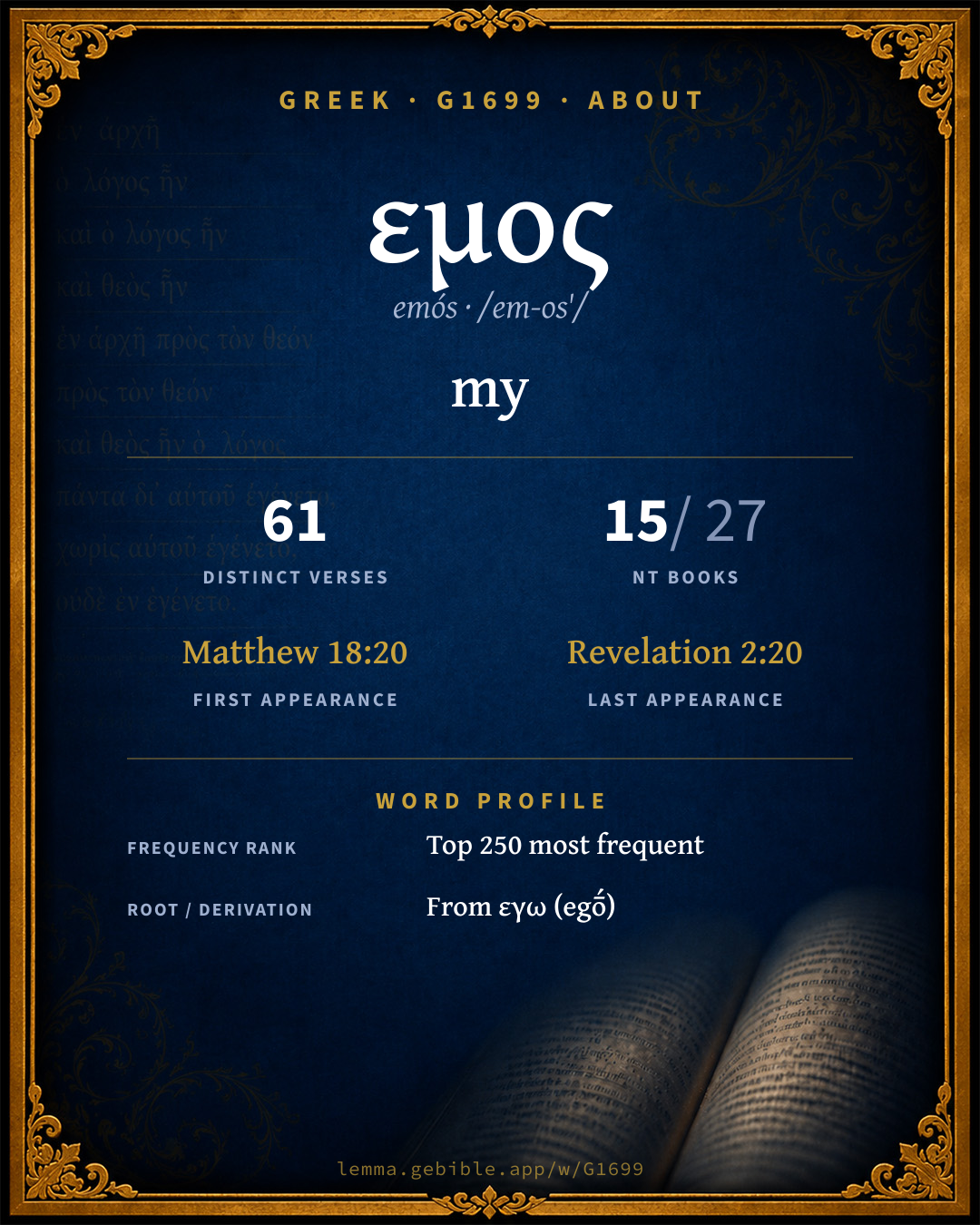
ἐμός
my
Full lexicon entry — Thayer's Greek Lexicon
From Thayer's Greek Lexicon
Where this word appears
See every Accusative-case word in the Greek New Testament →
Grammar key — what these labels mean
Part of speech
- Possessive pronoun
- Marks possession (“my,” “your,” “his”).
Case
- Accusative
- The case of the direct object and of extent.
- Nominative
- The case of the subject (and the predicate nominative).
- Dative
- The case of the indirect object, means, or location — “to / for / with / in.”
- Genitive
- The case of source, possession, or “of” — answers “whose / from what.”
Person
- 1st person
- The speaker (“I / we”).
Gender
- Feminine
- Grammatically feminine.
- Neuter
- Grammatically neuter.
- Masculine
- Grammatically masculine.
Number
- Singular
- One.
- Plural
- More than one.
Every verse where G1699 appears in the Book of Matthew — 4 distinct verses. Click any verse to open its interlinear word-by-word view. Verse text shown in the World English Bible for context — . Each verse’s Greek form is shown with its reference; the English is not keyword-highlighted, since the data carries no word-level English alignment. Use “Compare translations” on any verse to read it across multiple English versions. This concordance covers the Greek New Testament; Septuagint (Greek Old Testament) occurrences of this word are not indexed here.
Matthew
- Matthew 18:20 ἐμὸν poss.pron 1 acc sg neut For where two or three are gathered together in my name, there I am in the midst of them."
- Matthew 20:15 ἐμοῖς poss.pron 1 dat pl neut Isn't it lawful for me to do what I want to with what I own? Or is your eye evil, because I am good?'
- Matthew 20:23 ἐμὸν poss.pron 1 nom sg neut He said to them, "You will indeed drink my cup, and be baptized with the baptism that I am baptized with, but to sit on my right hand and on my left hand is not mine to give; but it is for whom it has been prepared by my Father."
- Matthew 25:27 ἐμὸν poss.pron 1 acc sg neut You ought therefore to have deposited my money with the bankers, and at my coming I should have received back my own with interest.
About this entry
At a glance — auto-summarized from this page’s data, not written by a person. Every figure links to its source below. This summary describes the numbers; it doesn’t interpret them.
εμος (emós) is a Greek word most often rendered “my.” It first appears in Matthew 18:20. With 61 verses in 15 books, it is a moderately common word in the Greek New Testament. It concentrates in John, which alone accounts for 48% of its uses. It clusters with εγω, εμου and ημας under a shared root. The sections below give every sense, occurrence, and version rendering.
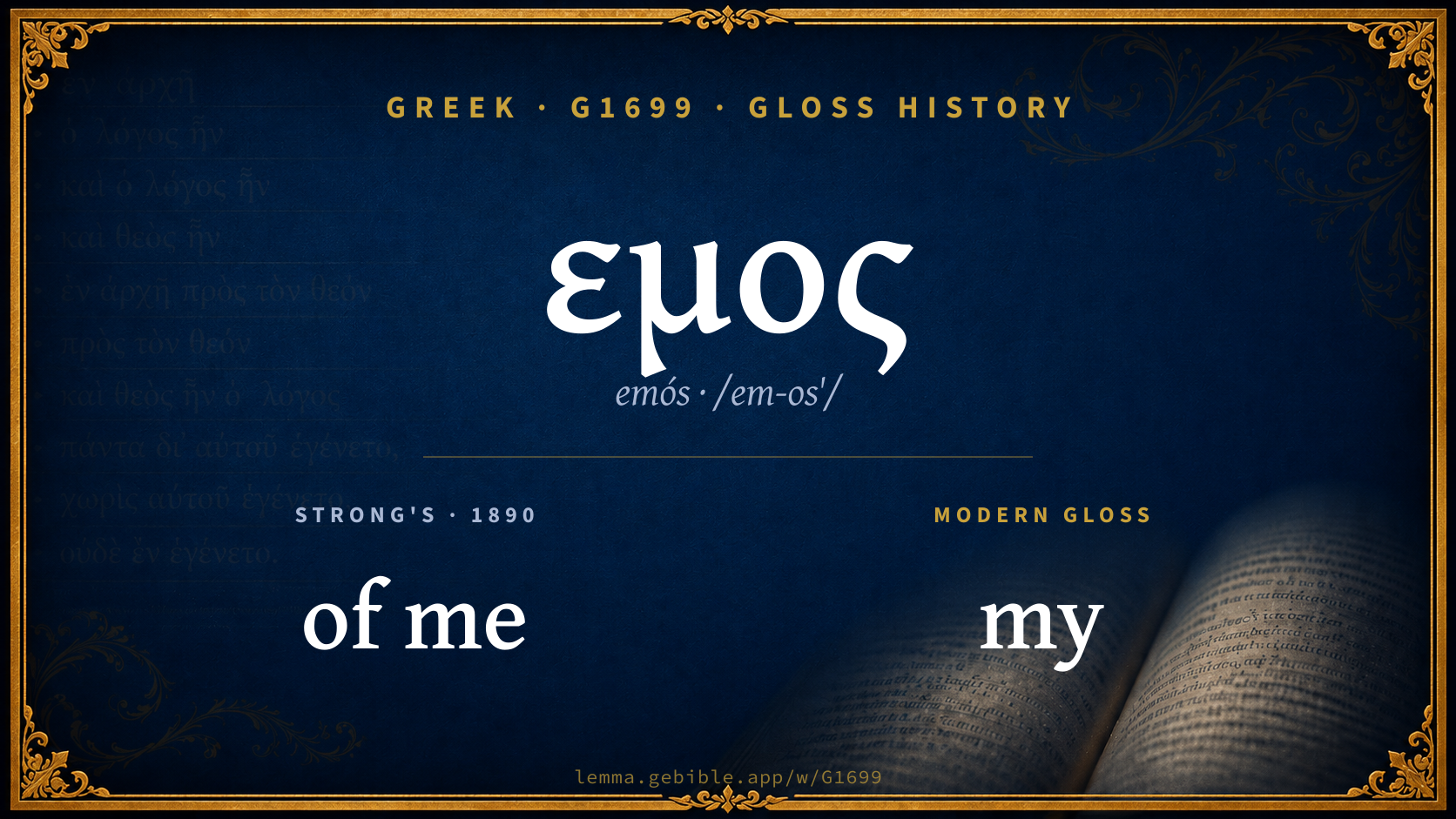
Gloss history
Strong's 1890 vs modern scholarship
About this word
Strong's G1699 catalogs a Greek word from the Greek New Testament.
These counts are not copied from any lexicon or concordance. They are computed here, from the morphology-tagged Greek New Testament. What Lemma adds →
- 61
- distinct verses
- The word appears in 61 distinct verses.
- 15 / 27
- NT books
- The word appears in 15 of 27 New Testament books.
- #241
- by frequency
- Top 250 most frequent Greek words (rank 241 of 5,347 Greek words by occurrence).
View all 61 occurrences in the concordance →
Most concentrated in
- John 29 verses 48%
- 1 Corinthians 7 verses 11%
- Matthew 4 verses 7%
By section of the New Testament
By traditional corpus
Conventional, traditional groupings — biblical authorship is debated, so this is a traditional corpus grouping, not an authorship claim. Some books belong to more than one corpus (Luke is in both the Gospels and the Lukan corpus, and so on), so these shares overlap and need not total 100%. Each figure is a share of the word’s 61 distinct verses.
- Gospels 38 verses · 62%
- Johannine 31 verses · 51%
- Pauline corpus 20 verses · 33%
- Lukan (Luke–Acts) 3 verses · 5%
- General (Catholic) Epistles 2 verses · 3%
- Revelation 1 verse · 2%
How translations render this word
Counts come from each version’s own published word-to-Strong’s tagging or interlinear alignment — an approximate guide to how each version renders this word, not a word-level alignment the data otherwise carries. Because each total is that version’s own tagged count, the per-version totals vary from one another and need not match the appearance or distinct-verse counts above. These counts may also differ from a printed concordance because Lemma counts each distinctly tagged rendering and does not collapse phrase taggings into a single head-word total. This is a fixed set of word-tagged versions (KJV, ASV, BSB, ULT) and does not change with the reading translation you choose elsewhere. Each version’s license is shown beside its name below (and on Sources).
- King James Version: My 49×, Mine 11×, Own 11×
- American Standard Version: My 44×, Own 8×, Mine 7×
- Berean Standard Bible: My 48×, Mine 9×, Own 8×
- unfoldingWord Literal Text: My 57×, Mine 11×, Own 4×
King James Version Public Domain
Renders G1699 across 78 tagged occurrences — most commonly:
Plus 3 renderings that appear only once — usually multi-word phrases or single function words the recovered tagging swept in, not distinct renderings.
American Standard Version Public Domain
Renders G1699 across 70 tagged occurrences — most commonly:
Plus 7 renderings that appear only once — usually multi-word phrases or single function words the recovered tagging swept in, not distinct renderings.
Berean Standard Bible Public Domain
Renders G1699 across 73 tagged occurrences — most commonly:
Plus 2 renderings that appear only once — usually multi-word phrases or single function words the recovered tagging swept in, not distinct renderings. Not rendered by a distinct English word in 2 further occurrences.
unfoldingWord Literal Text CC BY-SA 4.0
Renders G1699 across 76 tagged occurrences — most commonly:
Plus 2 renderings that appear only once — usually multi-word phrases or single function words the recovered tagging swept in, not distinct renderings.
Senses in Thayer's
The 1 sense Thayer's distinguishes for this word, in lexicon order (not ranked by frequency or importance). The full entry — with sub-senses — is in the Lexicon Entry tab.
- my, mine, etc.
Word origin
Derived from εγω (egṓ) (G1473) — I.
Forms in the corpus
The 16 distinct written forms G1699 takes in the Greek New Testament, most frequent first — each parse links to that case’s occurrences in the concordance.
Same root — word family
Other Thayer's entries built from the same root as G1699, grouped by Strong’s listed origin. These share a root / origin per the lexicon — not necessarily a shared meaning. Each links to that word’s own entry.
Derives from
Shares the same root
- εμου emoû G1700 me
- ημας hēmâs G2248 us
- ημεις hēmeîs G2249 we
- ημιν hēmîn G2254 us
- ημων hēmōn G2257 our
Compare all same-root words → Showing 4 of 7 — not the complete family. 1 of the same-root words is a proper name (a person or place). They share a root, not necessarily a meaning.
Septuagint usage
The same Greek word εμος appears 99 times in the Greek Old Testament (Septuagint), across 78 verses in 14 books.
- 99
- LXX occurrences
- Tagged occurrences of this Greek word in the Septuagint.
- 78
- verses
- Distinct Septuagint verses containing this word.
- 14 / 39
- OT books
- The word appears in 14 of the 39 Old Testament books.
Sample Septuagint occurrences
- Genesis 22:18 ἐμός
- Exodus 19:5 ἐμός
- Leviticus 25:23 ἐμός
- Judges 12:2 ἐμός
- 2 Samuel 14:31 ἐμός
- 1 Kings 1:33 ἐμός
- Job 2:9 ἐμός
- Psalms 49:10 ἐμός
- Proverbs 1:23 ἐμός
- Song of Solomon 1:6 ἐμός
- Isaiah 3:6 ἐμός
- Jeremiah 30:31 ἐμός
Septuagint occurrences (same lexeme)
Every verse where the same Strong’s number (G1699) appears in the Greek Septuagint — showing the first 50 of 78. Verse text shown in the World English Bible for context; the Greek form is the matched word — the English is not keyword-highlighted.
- Genesis 22:18 ἐμός In your seed will all the nations of the earth be blessed, because you have obeyed my voice."
- Genesis 24:41 ἐμός Then will you be clear from my oath, when you come to my relatives. If they don't give her to you, you shall be clear from my oath.'
- Genesis 26:5 ἐμός because Abraham obeyed my voice, and kept my charge, my commandments, my statutes, and my laws."
- Genesis 31:31 ἐμός Jacob answered Laban, "Because I was afraid, for I said, 'Lest you should take your daughters from me by force.'
- Genesis 31:43 ἐμός Laban answered Jacob, "The daughters are my daughters, the children are my children, the flocks are my flocks, and all that you see is mine: and what can I do this day to these my daughters, or to their children whom they have borne?
- Genesis 33:10 ἐμός Jacob said, "Please, no, if I have now found favor in your sight, then receive my present at my hand, because I have seen your face, as one sees the face of God, and you were pleased with me.
- Genesis 37:7 ἐμός for, behold, we were binding sheaves in the field, and behold, my sheaf arose and also stood upright; and behold, your sheaves came around, and bowed down to my sheaf."
- Genesis 47:5 ἐμός Pharaoh spoke to Joseph, saying, "Your father and your brothers have come to you.
- Genesis 49:25 ἐμός Even by the God of your father, who will help you, By the Almighty, who will bless you, With blessings of heaven above, Blessings of the deep that lies below, Blessings of the breasts, and of the womb.
- Genesis 49:29 ἐμός He charged them, and said to them, "I am to be gathered to my people. Bury me with my fathers in the cave that is in the field of Ephron the Hittite,
- Exodus 19:5 ἐμός Now therefore, if you will indeed obey my voice, and keep my covenant, then you shall be my own possession from among all peoples; for all the earth is mine;
- Exodus 23:22 ἐμός But if you indeed listen to his voice, and do all that I speak, then I will be an enemy to your enemies, and an adversary to your adversaries.
- Leviticus 25:23 ἐμός "'The land shall not be sold in perpetuity, for the land is mine; for you are strangers and live as foreigners with me.
- Judges 12:2 ἐμός Jephthah said to them, I and my people were at great strife with the children of Ammon; and when I called you, you didn't save me out of their hand.
- 2 Samuel 14:31 ἐμός Then Joab arose, and came to Absalom to his house, and said to him, Why have your servants set my field on fire?
- 2 Samuel 15:34 ἐμός but if you return to the city, and tell Absalom, I will be your servant, O king; as I have been your father's servant in time past, so will I now be your servant; then will you defeat for me the counsel of Ahithophel.
- 1 Kings 1:33 ἐμός The king said to them, Take with you the servants of your lord, and cause Solomon my son to ride on my own mule, and bring him down to Gihon:
- 1 Kings 2:20 ἐμός Then she said, I ask one small petition of you; don't deny me. The king said to her, Ask on, my mother; for I will not deny you.
- 1 Kings 21:3 ἐμός Naboth said to Ahab, Yahweh forbid it me, that I should give the inheritance of my fathers to you.
- 1 Kings 21:4 ἐμός Ahab came into his house sullen and angry because of the word which Naboth the Jezreelite had spoken to him; for he had said, I will not give you the inheritance of my fathers. He laid him down on his bed, and turned away his face, and would eat no bread.
- Job 2:9 ἐμός Then his wife said to him, "Do you still maintain your integrity? Renounce God, and die."
- Job 6:21 ἐμός For now you are nothing. You see a terror, and are afraid.
- Job 16:4 ἐμός I also could speak as you do. If your soul were in my soul's place, I could join words together against you, And shake my head at you.
- Job 23:2 ἐμός "Even today is my complaint rebellious. His hand is heavy in spite of my groaning.
- Job 29:21 ἐμός "Men listened to me, waited, And kept silence for my counsel.
- Job 29:22 ἐμός After my words they didn't speak again; My speech fell on them.
- Job 29:23 ἐμός They waited for me as for the rain. Their mouths drank as with the spring rain.
- Job 30:1 ἐμός "But now those who are younger than I, have me in derision, Whose fathers I would have disdained to put with my sheep dogs.
- Job 41:3 ἐμός Will he make many petitions to you? Or will he speak soft words to you?
- Psalms 49:10 ἐμός For he sees that wise men die; Likewise the fool and the senseless perish, And leave their wealth to others.
- Psalms 49:12 ἐμός But man, despite his riches, doesn't endure. He is like the animals that perish.
- Psalms 59:9 ἐμός Oh, my Strength, I watch for you, For God is my high tower.
- Psalms 107:9 ἐμός For he satisfies the longing soul. He fills the hungry soul with good.
- Psalms 119:7 ἐμός I will give thanks to you with uprightness of heart, When I learn your righteous judgments.
- Proverbs 1:23 ἐμός Turn at my reproof. Behold, I will pour out my spirit on you. I will make known my words to you.
- Proverbs 1:25 ἐμός But you have ignored all my counsel, And wanted none of my reproof;
- Proverbs 1:30 ἐμός They wanted none of my counsel. They despised all my reproof.
- Proverbs 2:1 ἐμός My son, if you will receive my words, And store up my commandments within you;
- Proverbs 3:1 ἐμός My son, don't forget my teaching; But let your heart keep my commandments:
- Proverbs 3:21 ἐμός My son, let them not depart from your eyes. Keep sound wisdom and discretion:
- Proverbs 4:2 ἐμός For I give you sound learning. Don't forsake my law.
- Proverbs 4:10 ἐμός Listen, my son, and receive my sayings. The years of your life will be many.
- Proverbs 4:13 ἐμός Take firm hold of instruction. Don't let her go. Keep her, for she is your life.
- Proverbs 4:20 ἐμός My son, attend to my words. Turn your ear to my sayings.
- Proverbs 5:1 ἐμός My son, pay attention to my wisdom. Turn your ear to my understanding:
- Proverbs 5:2 ἐμός That you may maintain discretion, That your lips may preserve knowledge.
- Proverbs 5:7 ἐμός Now therefore, my sons, listen to me. Don't depart from the words of my mouth.
- Proverbs 7:1 ἐμός My son, keep my words. Lay up my commandments within you.
- Proverbs 7:2 ἐμός Keep my commandments and live; Guard my teaching as the apple of your eye.
- Proverbs 8:4 ἐμός "To you men, I call! I send my voice to the sons of mankind.
These are occurrences of the same Greek lexeme (G1699) in the Septuagint — not a translation of any one Hebrew word. The store carries no word-level Hebrew↔Greek alignment, so no Hebrew original is asserted here. Counts come from the recovered LXX Strong's tagging — high-frequency vocabulary is well covered, while rare or late forms may be untagged — so they reflect tagged occurrences and may slightly undercount.