Job 16:4

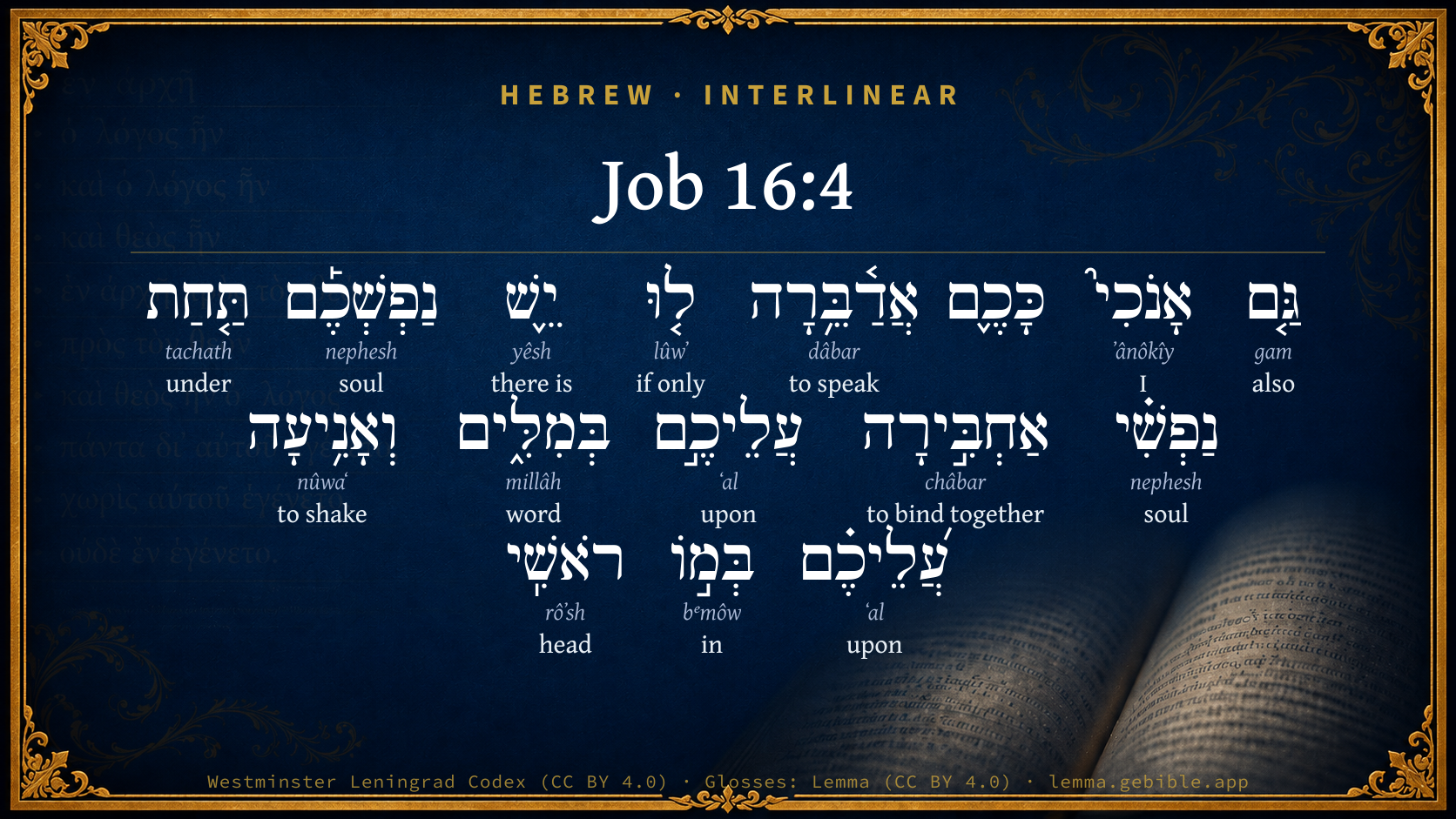
Hebrew (Westminster Leningrad Codex) Job 16:4 appears in the Hebrew Old Testament. The text above is from the Westminster Leningrad Codex. Each word links to its Strong’s number, a concise gloss, and parsing drawn from the Open Scriptures Hebrew Bible morphology. Click any word for its full Brown-Driver-Briggs (BDB) entry.
Download image
Cite this verse

Job 16:4 (World English Bible). Public Domain. Lemma interlinear Bible study tool, https://lemma.gebible.app/v/job/16/4.

Show BibTeX & RIS
BibTeX
RIS
English Translation
I also could speak as you do. If your soul were in my soul's place, I could join words together against you, And shake my head at you.
World English Bible · Public Domain
Download a study sheet

One document with this verse’s original text, its word-by-word gloss line, the meaning frame, cross-references with their text, attributed commentary, and full source and license credits — printable, and it pastes into notes with its structure intact.

This verse Autodidact and up

Study sheet (.html) Plain text (.txt)

A passage Seminary Student

Up to 50 verses in one chapter. A passage sheet keeps up to 6 commentary sources and 12 cross-references per verse, in the order this page ranks them, and says so on the sheet whenever that leaves anything out. Ask for a single verse and you get the Autodidact verse sheet above.

Everything on this page stays free to read, with no account — the sheet is a download of what is already on screen, not access to it.

Want to remove ads? Support Godless Engineer
Compare translations 3

The same verse in 3 English versions, stacked beneath the original-language interlinear above. Click any original word for its lexicon entry.

Each is an independent rendering of the whole verse — the interlinear is not word-aligned to these translations.

Highlighted words mark where these versions differ — a whole-verse word diff, not a word-by-word alignment.

  • World English Bible Public Domain
    I also could speak as you do. If your soul were in my soul's place, I could join words together against you, And shake my head at you.
  • King James Version Public Domain
    I also could speak as ye do: if your soul were in my soul's stead, I could heap up words against you, and shake mine head at you.
  • unfoldingWord Literal Text CC BY-SA 4.0
    I also would speak like you if your souls were where my soul is. I would join words together against you and I would shake my head at you.

unfoldingWord Literal Text — © unfoldingWord, licensed CC BY-SA 4.0. Word-aligned USFM3 via Door43 (git.door43.org/unfoldingWord/en_ult).

Versions to compare (up to 4)

3 of 4 selected

Show all 18 translations

Every available English version of this verse, each an independent rendering of the whole verse.

  • World English Bible Public Domain
    I also could speak as you do. If your soul were in my soul's place, I could join words together against you, And shake my head at you.
  • Berean Standard Bible Public Domain
    I could also speak like you if you were in my place; I could heap up words against you and shake my head at you.
  • Majority Standard Bible Public Domain
    I could also speak like you if you were in my place; I could heap up words against you and shake my head at you.
  • King James Version Public Domain
    I also could speak as ye do: if your soul were in my soul's stead, I could heap up words against you, and shake mine head at you.
  • American Standard Version (1901) Public Domain
    I also could speak as ye do; If your soul were in my soul's stead, I could join words together against you, And shake my head at you.
  • Revised Version (1885) Public Domain
    I also could speak as ye do; if your soul were in my soul’s stead, I could join words together against you, and shake mine head at you.
  • Geneva Bible (1599) Public Domain
    I could also speake as yee doe: (but woulde God your soule were in my soules stead) I could keepe you company in speaking, and could shake mine head at you,
  • Douay-Rheims (1899) Public Domain
    I also could speak like you: and would God your soul were for my soul.
  • Young's Literal Translation Public Domain
    I also, like you, might speak, If your soul were in my soul's stead. I might join against you with words, And nod at you with my head.
  • Literal Standard Version CC BY-SA 4.0
    I also, like you, might speak, || If your soul were in my soul’s stead. I might join against you with words, || And nod at you with my head.
  • Unlocked Literal Bible CC BY-SA 4.0
    I also could speak as you do, if you were in my place; I could collect and join words together against you and shake my head at you in mockery.
  • unfoldingWord Literal Text CC BY-SA 4.0
    I also would speak like you if your souls were where my soul is. I would join words together against you and I would shake my head at you.
  • Darby Bible Public Domain
    I also could speak as ye: if your soul were in my soul's stead, I could join together words against you, and shake my head at you;
  • World Messianic Bible Public Domain
    I also could speak as you do. If your soul were in my soul’s place, I could join words together against you, and shake my head at you,
  • Webster's Bible Public Domain
    I also could speak as ye do: if your soul were in my soul's stead, I could heap up words against you, and shake my head at you.
  • Free Bible Version CC BY-SA 4.0
    I could talk like you do if you were in my place, stringing words together to criticize you, ridiculing you with a toss of my head.
  • Bible in Basic English Public Domain
    It would not be hard for me to say such things if your souls were in my soul's place; joining words together against you, and shaking my head at you:
  • JPS Tanakh (1917) Public Domain
    I also could speak as ye do; if your soul were in my soul's stead, I could join words together against you, and shake my head at you.

Literal Standard Version (2020), Covenant Press — licensed CC BY-SA 4.0. Text via the HelloAO Bible API (eBible.org). Unlocked Literal Bible (unfoldingWord) — licensed CC BY-SA 4.0. Text via the HelloAO Bible API (eBible.org). unfoldingWord Literal Text — © unfoldingWord, licensed CC BY-SA 4.0. Word-aligned USFM3 via Door43 (git.door43.org/unfoldingWord/en_ult). Free Bible Version, Dr. Jonathan Gallagher — licensed CC BY-SA 4.0. Text via the HelloAO Bible API (eBible.org).

Word by word

More ways to search: Search by grammar → Find every occurrence → Compare this word →

Practice this passage: Drill this verse → Learn its vocabulary →

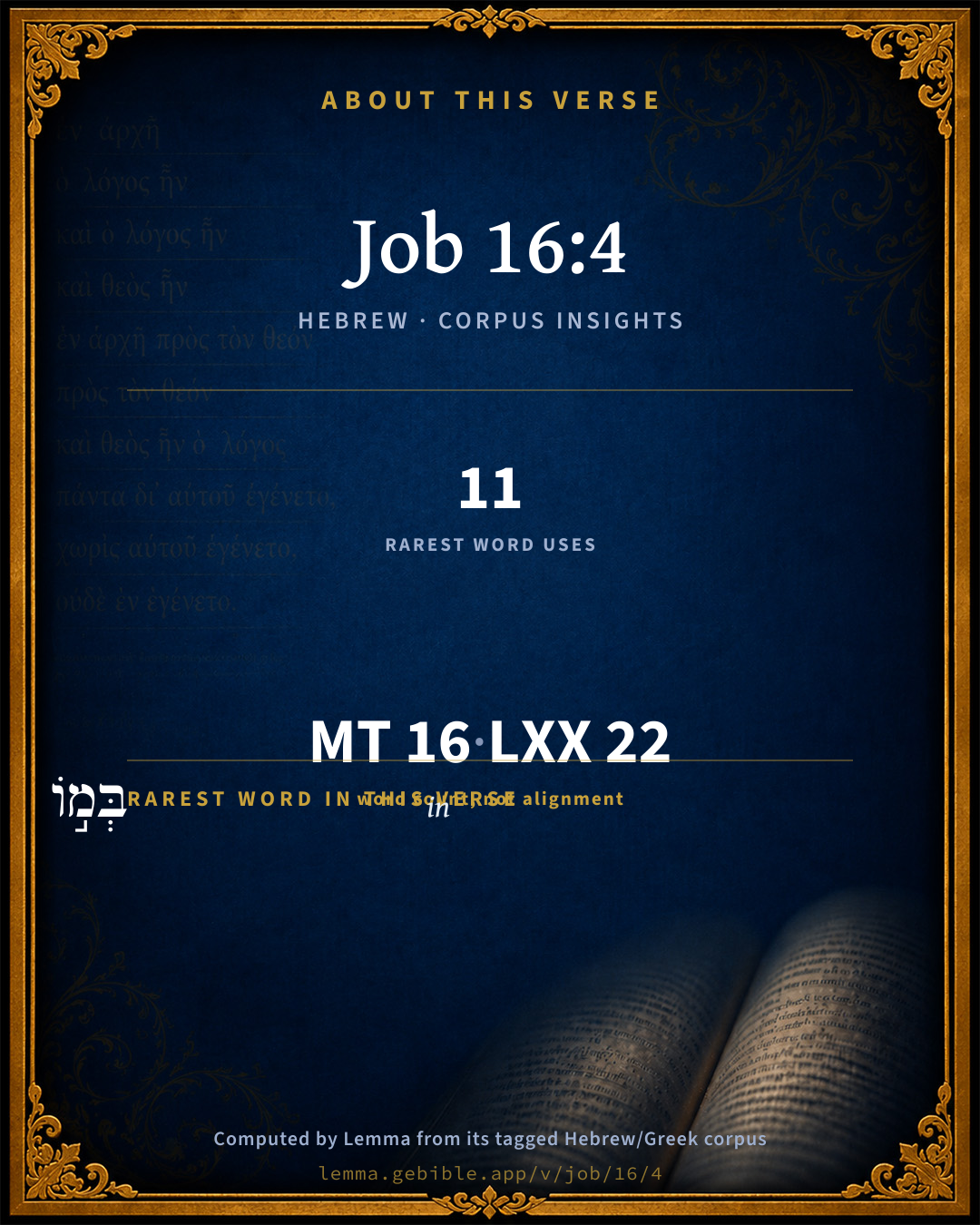
בְּמ֣וֹ
bᵉmôw
H1119
“in”
Preposition
Part of Speech
Preposition
Full BDB Definition

Origin: prolongation for prepositional prefix

TWOT: 193

in, at, by
  1. גַּ֤ם gam H1571 “also” Particle, Accusative
  2. אָנֹכִי֮ ʼânôkîy H595 “I” Pronoun, Personal, 1st Person, Common, Singular
  3. אֲדַ֫בֵּ֥רָה dâbar H1696 “to speak” Verb, Piel, Cohortative, 1st Person, Common, Singular
  4. ל֤וּ lûwʼ H3863 “if only” Conjunction
  5. יֵ֪שׁ yêsh H3426 “there is” Particle, Demonstrative
  6. נַפְשְׁכֶ֡ם nephesh H5315 “soul · your” Noun, Common, Both, Singular, Construct + Suffix, Personal, 2nd Person, Masculine, Plural
  7. תַּ֤חַת tachath H8478 “under” Preposition
  8. נַפְשִׁ֗י nephesh H5315 “soul · my” Noun, Common, Both, Singular, Construct + Suffix, Personal, 1st Person, Common, Singular
  9. אַחְבִּ֣ירָה châbar H2266 “to bind together” Verb, Hiphil, Cohortative, 1st Person, Common, Singular
  10. עֲלֵיכֶ֣ם ʻal H5921 “upon · you” Preposition + Suffix, Personal, 2nd Person, Masculine, Plural
  11. בְּמִלִּ֑ים millâh H4405 “in/at · words” Preposition + Noun, Common, Feminine, Plural, Absolute
  12. וְאָנִ֥יעָה nûwaʻ H5128 “and · to shake” Conjunction + Verb, Hiphil, Cohortative, 1st Person, Common, Singular
  13. עֲ֝לֵיכֶ֗ם ʻal H5921 “upon · you” Preposition + Suffix, Personal, 2nd Person, Masculine, Plural
  14. רֹאשִֽׁי rôʼsh H7218 “head · my” Noun, Common, Masculine, Singular, Construct + Suffix, Personal, 1st Person, Common, Singular

About this verse

These counts appear in no published source. They are computed here, from the morphology-tagged text and Lemma’s own curated glosses. What Lemma adds →

16
words
13
distinct lemmas
Wisdom
section

Notable vocabulary

The rarest word here is בְּמ֣וֹ in H1119 — appearing just 11 times in the whole Hebrew Bible.

Shared distinctive vocabulary

בְּמ֣וֹ in H1119 occurs in 10 verses of the Hebrew Bible. Also found in:

Grammatical profile

  • 3 verbs
  • 4 nouns
  • 1 pronoun
  • 5 prepositions
  • 1 conjunction
  • 2 particles

Verb forms

  • אֲדַ֫בֵּ֥רָה Piel · Cohortative
  • אַחְבִּ֣ירָה Hiphil · Cohortative
  • וְאָנִ֥יעָה Hiphil · Cohortative

Repetition

Words recur within this verse — often emphatic in Hebrew:

  • נַפְשְׁכֶ֡ם soul H5315 ×2
  • עֲלֵיכֶ֣ם upon H5921 ×2

Hebrew & Septuagint length

In English translation the verse runs 28 words from the Hebrew and 16 from the Septuagint (LXX English) — the Septuagint runs noticeably shorter here. See the side-by-side →

A rough comparison of the two English renderings, which tokenize alike — not a word-level alignment.

Word counts can differ between the Hebrew and the Greek without any difference in meaning — e.g. the Hebrew direct-object marker אֵת has no separate Greek word, and Greek often adds the article ὁ.

In the original languages it is 16 Hebrew tokens and 22 Greek tokens — but the two are counted differently (Hebrew bundles its prefixes and suffixes into one token; the Greek is in lemma form), so that isn’t a like-for-like length.

Cross-references

17

Topical passages linked to Job 16:4 in the Treasury of Scripture Knowledge — connected by theme and wording, ordered by reader-vote popularity; previews shown in the World English Bible.

  • Psalms 22:7 All those who see me mock me. They insult me with their lips. They shake their heads, saying,
  • Psalms 109:25 I have also become a reproach to them. When they see me, they shake their head.
  • Lamentations 2:15 All that pass by clap their hands at you; They hiss and wag their head at the daughter of Jerusalem, [saying], Is this the city that men called The perfection of beauty, The joy of the whole earth?
  • 2 Kings 19:21 This is the word that Yahweh has spoken concerning him: The virgin daughter of Zion has despised you and ridiculed you; the daughter of Jerusalem has shaken her head at you.
  • Jeremiah 18:16 to make their land an astonishment, and a perpetual hissing; everyone who passes thereby shall be astonished, and shake his head.
  • Matthew 7:12 Therefore whatever you desire for men to do to you, you shall also do to them; for this is the law and the prophets.
  • Romans 12:15 Rejoice with those who rejoice. Weep with those who weep.
  • Job 6:2–5 "Oh that my anguish were weighed, And all my calamity laid in the balances!
  • Job 6:14 "To him who is ready to faint, kindness should be shown from his friend; Even to him who forsakes the fear of the Almighty.
  • Job 11:2 "Shouldn't the multitude of words be answered? Should a man full of talk be justified?
  • Job 35:16 Therefore Job opens his mouth with empty talk, And he multiplies words without knowledge."
  • Psalms 44:14 You make us a byword among the nations, A shaking of the head among the peoples.
  • Proverbs 10:19 In the multitude of words there is no lack of disobedience, But he who restrains his lips does wisely.
  • Ecclesiastes 10:14 A fool also multiplies words. Man doesn't know what will be; and that which will be after him, who can tell him?
  • Zephaniah 2:15 This is the joyous city that lived carelessly, that said in her heart, "I am, and there is none besides me." How she has become a desolation, a place for animals to lie down in! Everyone who passes by her will hiss, and shake their fists.
  • Matthew 27:39–40 Those who passed by blasphemed him, wagging their heads,
  • 1 Corinthians 12:26 When one member suffers, all the members suffer with it. Or when one member is honored, all the members rejoice with it.

Cross-references courtesy of OpenBible.info (CC BY 4.0).

Hebrew and Greek witnesses Masoretic Hebrew ↔ Greek Septuagint

The same verse in the two great witnesses to the Old Testament, shown verse-for-verse.

Here the Septuagint runs noticeably shorter than the Hebrew — LXX2012 (modern English Septuagint) 16 words vs World English Bible 28. A rough length comparison of the two English translations, not a word-level alignment — read both below.

These are two independent witnesses, not word-aligned to each other, and the Septuagint is shown in lemma (dictionary) form.

Hebrew Job 16:4 Masoretic · Westminster Leningrad Codex

גַּ֤ם אָנֹכִי֮ כָּכֶ֪ם אֲדַ֫בֵּ֥רָה ל֤וּ יֵ֪שׁ נַפְשְׁכֶ֡ם תַּ֤חַת נַפְשִׁ֗י אַחְבִּ֣ירָה עֲלֵיכֶ֣ם בְּמִלִּ֑ים וְאָנִ֥יעָה עֲ֝לֵיכֶ֗ם בְּמ֣וֹ רֹאשִֽׁי

I also could speak as you do. If your soul were in my soul's place, I could join words together against you, And shake my head at you.

World English Bible · Public Domain

Greek LXX Job 16:4 Septuagint · lemma form

καΐἐγώ κατά σύ λαλέω εἰ ὑποκεῖμαι γέ ὁ ψυχή σύ ἀντί ὁ ἐμός εἶτα ἐνἅλλομαι σύ ῥῆμα κινέω δέ κατά σύ κεφαλή

I also will speak as you⌃ do: if indeed your soul were in my soul's stead,

LXX2012 (modern English Septuagint) · Public Domain

On this verse, Albert Barnes' Notes on the Bible discusses the Septuagint’s reading. Read the note in Commentary ↓

Hebrew: Westminster Leningrad Codex (CC BY 4.0). Greek: Septuagint (public domain); English from LXX2012 (modern English Septuagint) (Public Domain). How the Septuagint differs from the Hebrew →

Commentary

Notes on Job 16:4 from classic Christian and Jewish commentators (each source and its license shown beneath its notes). The classic Christian expositions comment on the surrounding passage and are grouped to its opening verse, so a note may address several verses; the Jewish commentaries on the Tanakh (Rashi and others) are per-verse, so they appear only where the commentator wrote on this verse.

Lemma curates 59 commentaries, every one of them public domain or Creative Commons licensed, each selected and text-cleaned for this edition rather than reprinted as found. About our sources →

Trapp's Complete Commentary

John Trapp

Job 16:4 I also could speak as ye [do]: if your soul were in my soul’s stead, I could heap up words against you, and shake mine head at you.

Ver. 4. I also could speak as you do, &c.] Every whit as curiously, as furiously. I could scold and scoff as freely as you do, but I know no warrant so to retort and retaliate; "being reviled, we bless; being defamed, we entreat," 1Co 4:12-13. To render railing for railing is to think to wash off dirt with dirt.

If your soul were in my soul’s stead] Some read it optatively, as Isa 64:1, Would to God your soul were in my soul’s stead; for then I would heap up words against you, and act your part upon you; but Job was not so malicious or vindictive as to think that tallying of injuries is but justice. Hypocritis nihil est crudelius, impatientius, et vindictae cupidius, saith Luther. Hypocrites are cruel, spiteful, and revengeful; but Job was none such. He, therefore, telleth his friends that if they were in his condition he would deal much more mildly with them.

I could heap up words against you] I could, but would not. Posse et nolle, nobile est (Sen.). Or thus, Would I heap up, &c., and handle you thus discourteously, by speeches and gestures, as you do me? It were easy to wag a wicked tongue, and to shake my head at you in despite and mockery; but were this religion? Doth not moral philosophy say, If a wise man speak evil of thee, endure him; if a fool, pardon him? Vincit qui patitar, as David did Saul, overcoming evil with good, though, when he marched against Nabal, how rough and rash was he in a resolution of revenge! 1Sa 25:32.

John Trapp, A Commentary or Exposition upon All the Books of the Old and New Testament (1647–1656) — public domain. Text from a community e-Sword module.

Joseph Benson's Commentary

Job 16:4. I could also speak as ye do — It is an easy thing to trample upon those that are down, and to find fault with what those say who are in extremity of pain and affliction. If your soul were in my soul’s stead — If our conditions were changed, and you were in misery like me, and I at ease like you; I could heap up words against you — As you do against me; that is, I could multiply accusations and reproaches against you, and how would you like it? how would you bear it? and shake my head at you — In a way of derision, as this phrase is commonly used. Heath renders these clauses interrogatively, thus: If your soul were in my soul’s stead, would I accumulate sentences against you? would I shake my head at you? Which rendering gives the verse a very pathetic turn.

Joseph Benson's Commentary on the Old and New Testaments (1811–1818) — public domain. Text from a community e-Sword module.

Tyndale Open Study Notes

Tyndale Open Resources

16:4 Job might have wanted to shake his head in mockery or in horror (2 Kgs 19:21; Pss 22:7; 109:25; Isa 37:22; Jer 18:16; Lam 2:15; Matt 27:39).

Tyndale Open Study Notes — © Tyndale Open Resources, licensed CC BY-SA 4.0. Text via the HelloAO Bible API.

Geneva Bible (1599)

Geneva Bible translators

I would you felt that which I do.

That is, mock at your misery, as you do at mine.

Geneva Bible (1599) marginal notes — public domain. Text via Bolls.life.

Jamieson, Fausset & Brown

Robert Jamieson, A. R. Fausset & David Brown

heap up--rather, "marshal together (an army of) words against you."

shake . . . head--in mockery; it means nodding, rather than shaking; nodding is not with us, as in the East, a gesture of scorn (Isa 37:22; Jer 18:16; Mat 27:39).

Jamieson, Fausset & Brown — Commentary Critical and Explanatory on the Whole Bible (1871) — public domain (CC PDM 1.0). Text via the HelloAO Bible API.

Adam Clarke's Commentary

Verse 4. I also could speak] It is probably better to render some of these permissives or potential verbs literally in the future tense, as in the Hebrew: I also WILL speak. Mr. Good has adopted this mode.

If your soul were in my soul's stead] If you were in my place, I also could quote many wise sayings that might tend to show that you were hypocrites and wicked men; but would this be fair? Even when I might not choose to go farther in assertion, I might shake my head by way of insinuation that there was much more behind, of which I did not choose to speak; but would this be right? That such sayings are in memory, is no proof that they were either made for me, or apply to my case.

Adam Clarke's Commentary on the Bible (1810–1826) — public domain. Text from a community e-Sword/MySword module.

Ellicott's Commentary for English Readers

(4) If your soul.—i.e., person=“ If you were in my place, I could heap up words,” &c. It is doubtful whether this is in contrast to what comes afterwards in the fifth verse, as in the Authorised Version, or whether it may not be in parallelism with it; thus: “I would make myself a companion to you—condole and sympathise with you. in words, and shake my head at you as a mark of sympathy.” The phrase differs somewhat from that in Psa_22:7; Isa_37:22, where to shake the head expresses contempt and derision.

A Bible Commentary for English Readers, edited by Charles John Ellicott (1878–1897) — public domain. Text from a community e-Sword module.

The Cambridge Bible for Schools and Colleges

gen. ed. J. J. S. Perowne

4. I could heap up words] Rather, I could compose words. By “composing” or joining together words Job means making formal, artificial and heartless speeches; cf. the string of traditional sayings put together by Eliphaz, ch. Job_15:20 seq.

shake mine head at you] “A gesture of astonishment, as much as to say ‘Eh! I would not have thought that the pious man, as it appears from his misfortunes, had been so great a sinner’ ” (Hitzig), cf. Psa_22:7, Isa_37:22.

4, 5. Job then, with the supercilious contempt peculiar to him and in justification of his rejection of their “comfort,” holds up a picture of it before them: their method is not a difficult one, he also could adopt it, if his case were theirs; he could shake his head over them and give them lip-comfort enough.

The Cambridge Bible for Schools and Colleges (gen. ed. J. J. S. Perowne; Cambridge University Press, 1878–1918) — public domain. Text from a community e-Sword module.

John Gill's Exposition

But I would strengthen you with my mouth,.... Comfort them with the words of his mouth; so God strengthens his people with strength in their souls, when he answers them with good and comfortable words; an angel strengthened Christ as man when in an agony, comforting him, suggesting comfortable things to him; so one saint may strengthen and comfort another when in distress, whether of soul or body; see Psa 138:3; and thus Job had strengthened and comforted others, with his words in former times, as Eliphaz himself owns, Job 4:3 and so he would again, were there a change in his circumstances, and objects presented:

and the moving of my lips should assuage your grief: words uttered by him, which are done by the moving of the lips, should be such as would have a tendency to allay grief, to stop, restrain, forbid, and lessen sorrow; at least that it might not break out in an extravagant way, and exceed bounds, and that his friends might not be swallowed up with overmuch sorrow.

John Gill's Exposition of the Whole Bible (1746–1763) — public domain (CC PDM 1.0). Text via the HelloAO Bible API.

Albert Barnes' Notes on the Bible

I also could speak as ye do - In the same reproachful manner, and stringing together old proverbs and maxims as you have.

If your soul were in my soul’s stead - If you were in my place. The idea is, that there is no difficulty in finding arguments to overwhelm the afflicted - a truth which most persons who have been unfortunate, have had opportunity to experience.

I could heap up words against you - Or, rather, “I could string together words against you.” The idea is not that of heaping up, or accumulating; it is that of tying together, or uniting; and refers here to stringing together old maxims, saws, and proverbs, in the form of a set argument or discourse. The idea of Job is, that their discourses were nothing but ancient proverbs, thrown together, or strung along without regard to order, pertinency, or force. The Hebrew word used here (חבר châbar) means to bind, to bind together, to associate, to be confederate. It may be applied to friends - united in friendship; to nations - united in an alliance, etc. Gesenius supposes that it means here that he “would make a league with words against them;” but the above seems to be the more probable interpretation. The Septuagint renders it, “then I could insult you - ἐναλοῦμαι enaloumai - with words.” Jerome (Vulgate) “I would console you with words, and move my head over you.” The Chaldee is as the Hebrew - חבר châbar. Dr. Good renders it, “against you will I string together old sayings.”

And shake mine head at you - An action common to all countries and ages, expressive of contempt, or of threatening; compare Jer 18:16; Lam 2:15; Zep 2:15; Mat 27:39. So Lucretius ii. 1163:

Jamque caput quassans grandis suspirat ararat

Crebrius incassum magnum cecidisse laborem.

In like manner Virgil, Aeneid xii. 292:

Tum quassanos caput, haec effudit pectore dicta.

So, also, Homer, Odyssey ε e:

Κινήσας δὲ κάρη πρότι ὅν μυθήσατο Θυμόν.

Kinēsas de karē proti hon muthēsato thumon.

The meaning of Job here is, that be could as easily have expressed contempt, reproach, and scorn, as they did. It required no uncommon talent to do it, and he felt that he would have been fully sufficient for the task.

Albert Barnes' Notes on the Bible (1834–1885) — public domain. Text from a community e-Sword/MySword module.

Haydock's Catholic Bible Commentary

My soul. If you had experienced my state of misery, (Haydock) I surely would not have behaved thus to you. (Calmet) Facile, cum valemus, recta consilia ægrotis damus:

Tu si hic sis, aliter sentias. (Terent. Andria.)

George Leo Haydock (1774–1849), Haydock's Catholic Family Bible and Commentary, 1859 edition — public domain. Excludes Psalms (Douay-Rheims chapter numbering differs from Protestant) and Deuterocanonical books (Catholic canon only).

Matthew Poole's English Annotations

If your soul, i.e. your person, as Gen 12:5.

I could heap up words against you, i.e. I could multiply accusations and reproaches against you, as you do against me.

Shake mine head at you; in way of derision, as this phrase is most commonly used; as 2Ki 19:21; Psa 22:7; Isa 37:22; Mat 27:39.

Matthew Poole's English Annotations on the Holy Bible (1683–1685) — public domain. Text from a community e-Sword/MySword module.

Whedon's Commentary on the Bible

Daniel D. Whedon

4. Heap up words — Knit together words. The ministry of words is nothing without the ministry of the heart.

Daniel D. Whedon (gen. ed.), Commentary on the Old and New Testaments (1874–1909) — public domain. Text from a community e-Sword module.

The Pulpit Commentary

I also could speak as ye do: if your soul were in my soul"s stead, I could heap up words against you. It is only too easy to heap up rhetorical declamation against an unfortunate sufferer, whose physical and mental agonies absorb almost his whole attention. If you were in my place and condition, and I in yours, I could moralize in your tone and spirit for hours. And shake my head at you. A Hebrew mode of expressing condemnation of a man"s conduct. (see Psa_22:7 Isa_37:22 Jer_18:16 Mat_27:39, etc.)

The Pulpit Commentary (1880–1919), ed. H.D.M. Spence-Jones & Joseph S. Exell — public domain. Text from a community e-Sword module.

unfoldingWord translationNotes

Door43 World Missions Community

I could collect and join words together

Job speaks of thinking of useless things to say as if his words were random items that he collected and joined together. AT: "I could think of things to say" (See: Metaphor)

shake my head

This is an action that shows disapproval. (See: Symbolic Action)

in mockery

The word "mockery" can be expressed as a verb. AT: "to mock you" (See: Abstract Nouns)

I would strengthen you with my mouth, and the quivering of my lips will bring you relief!

The words "mouth" and "lips" are metonyms for the words or messages that a person speaks using his mouth and lips. Here Job is speaking sarcastically and means the opposite of what he says. AT: "My words would surely not be encouraging to you! They would surely not lighten your grief" or "By speaking to you as you spoke to me earlier, I would not encourage you or lighten your grief!" (See: Metonymy and Irony)

with my mouth

Here Job's "mouth" represents what he says. AT: "with what I say" (See: Metonymy)

the quivering of my lips

This is a metonym for the words or message that he speaks. AT: "my comforting words" (See: Metonymy)

will bring you relief

This speaks of grief as if it were a heavy physical burden. AT: "will lessen your grief" or "will help you feel less grief" (See: Metaphor)

translationWords

word

mock

comfort

unfoldingWord translationNotes — © Distant Shores Media and the Door43 World Missions Community, licensed CC BY-SA 4.0. Source: git.door43.org/Door43/en_tn.

Rashi

Rabbi Shlomo Yitzchaki (Rashi)

could speak like you I know how to chide as you do.

if your soul were in pain instead of my soul, I too would join words together against you and shake my head at you in your cry, and encourage you with my mouth, saying, “Be still, have courage, and endure your sufferings,” just as you are saying to me.

Rashi on the Tanakh — English translations: “The Judaica Press complete Tanach with Rashi, translated by A. J. Rosenberg” (CC BY 4.0); “Pentateuch with Rashi's commentary by M. Rosenbaum and A.M. Silbermann, 1929-1934” (public domain); “The Metsudah Tanach series, Lakewood, N.J” (CC BY 4.0); and “The Book of Joshua, Metsudah Publications, 1997” (CC BY 4.0). Text via Sefaria.

Lesson kit

Teaching starters — assembled from the data on this page, not authored interpretation. Every prompt links to the verse data it draws on. Edit before teaching.

Job, in the Wisdom, opens this verse with 16 words (13 distinct Hebrew lemmas). Its most distinctive word is bᵉmôw (“in”). The Greek Septuagint runs shorter here. A historical commentator’s framing appears above. Read the whole chapter for the surrounding context.

Discussion questions

  1. The word bᵉmôw carries the sense “in.” How does it shape the verse?
  2. Job 9:30 shares the word «in» with this verse. How do the two illuminate each other?
  3. “soul” occurs 2× in this one verse. What is the effect of the repetition?
  4. Compared with the Hebrew, the Septuagint runs shorter here. What questions does that raise?
  5. The translations on this page render this verse differently — a whole-verse word diff, not a word-by-word alignment. What might account for the different wordings?
  6. The verb «אֲדַ֫בֵּ֥רָה» is Piel Cohortative. How does its form color the action?
  7. Reading how Trapp's Complete Commentary and Joseph Benson's Commentary read this verse, where do the two commentators agree and where do they part?

Things to notice

Reading settings

Reading text

Shown beneath each verse's original-language words.

Old Testament
Old Testament edition

Read the OT as the Masoretic Hebrew (MT) or the Greek Septuagint (LXX).

English shown for the Greek Septuagint (in the Hebrew ↔ Greek comparison).

Comparing translations? Open the Compare panel on any verse page to stack up to four side by side.