
Job 29:23

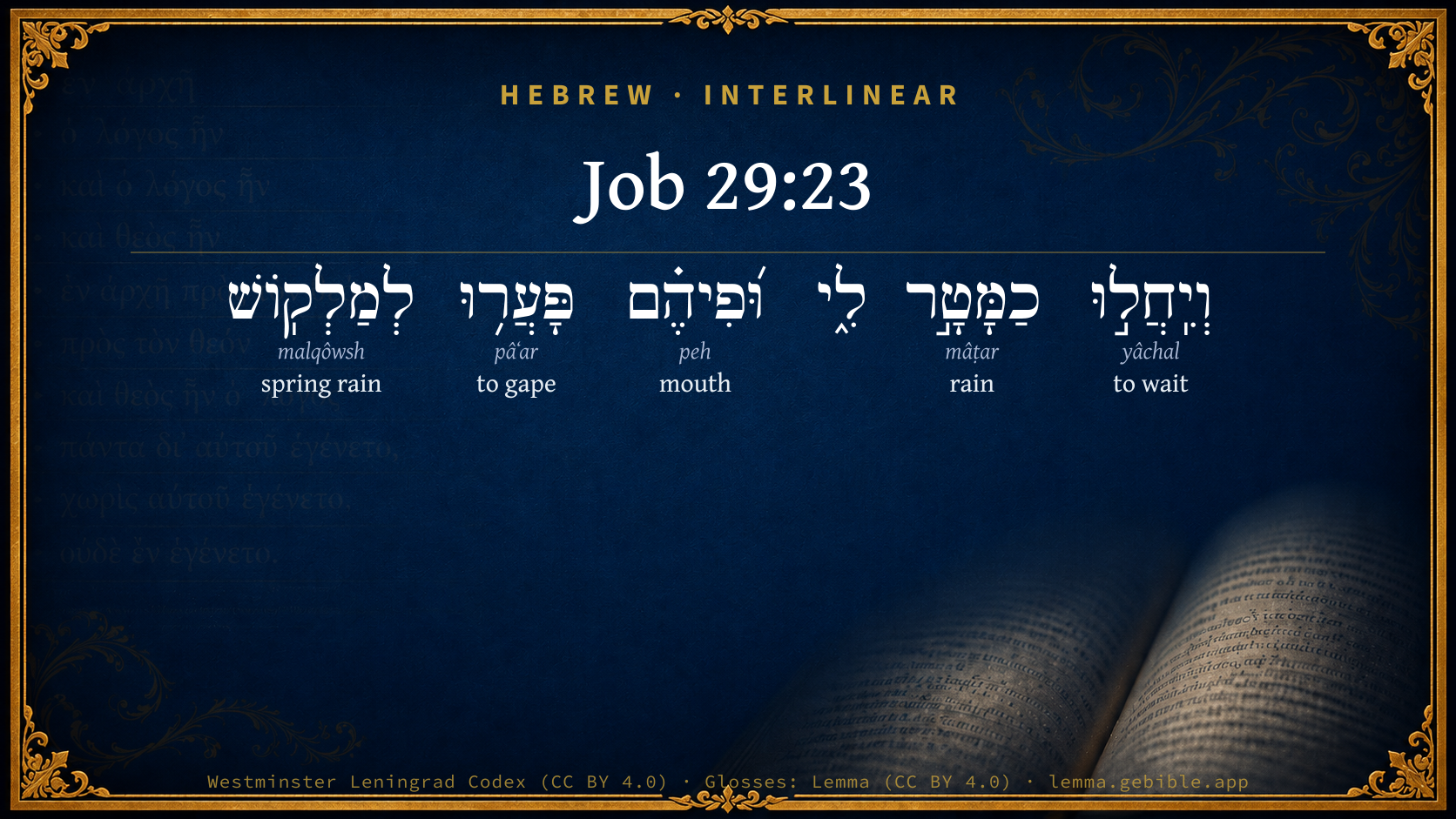
Hebrew (Westminster Leningrad Codex) Job 29:23 appears in the Hebrew Old Testament. The text above is from the Westminster Leningrad Codex. Each word links to its Strong’s number, a concise gloss, and parsing drawn from the Open Scriptures Hebrew Bible morphology. Click any word for its full Brown-Driver-Briggs (BDB) entry.
Download image
Cite this verse

Job 29:23 (World English Bible). Public Domain. Lemma interlinear Bible study tool, https://lemma.gebible.app/v/job/29/23.

Show BibTeX & RIS
BibTeX
RIS
English Translation
They waited for me as for the rain. Their mouths drank as with the spring rain.
World English Bible · Public Domain
Download a study sheet

One document with this verse’s original text, its word-by-word gloss line, the meaning frame, cross-references with their text, attributed commentary, and full source and license credits — printable, and it pastes into notes with its structure intact.

This verse Autodidact and up

Study sheet (.html) Plain text (.txt)

A passage Seminary Student

Up to 50 verses in one chapter. A passage sheet keeps up to 6 commentary sources and 12 cross-references per verse, in the order this page ranks them, and says so on the sheet whenever that leaves anything out. Ask for a single verse and you get the Autodidact verse sheet above.

Everything on this page stays free to read, with no account — the sheet is a download of what is already on screen, not access to it.

Want to remove ads? Support Godless Engineer
Compare translations 3

The same verse in 3 English versions, stacked beneath the original-language interlinear above. Click any original word for its lexicon entry.

Each is an independent rendering of the whole verse — the interlinear is not word-aligned to these translations.

Highlighted words mark where these versions differ — a whole-verse word diff, not a word-by-word alignment.

  • World English Bible Public Domain
    They waited for me as for the rain. Their mouths drank as with the spring rain.
  • King James Version Public Domain
    And they waited for me as for the rain; and they opened their mouth wide as for the latter rain.
  • unfoldingWord Literal Text CC BY-SA 4.0
    And they waited for me as rain, and they opened their mouth for the latter rain.

unfoldingWord Literal Text — © unfoldingWord, licensed CC BY-SA 4.0. Word-aligned USFM3 via Door43 (git.door43.org/unfoldingWord/en_ult).

Versions to compare (up to 4)

3 of 4 selected

Show all 18 translations

Every available English version of this verse, each an independent rendering of the whole verse.

  • World English Bible Public Domain
    They waited for me as for the rain. Their mouths drank as with the spring rain.
  • Berean Standard Bible Public Domain
    They waited for me as for rain and drank in my words like spring showers.
  • Majority Standard Bible Public Domain
    They waited for me as for rain and drank in my words like spring showers.
  • King James Version Public Domain
    And they waited for me as for the rain; and they opened their mouth wide as for the latter rain.
  • American Standard Version (1901) Public Domain
    And they waited for me as for the rain; And they opened their mouth wide `as' for the latter rain.
  • Revised Version (1885) Public Domain
    And they waited for me as for the rain; and they opened their mouth wide as for the latter rain.
  • Geneva Bible (1599) Public Domain
    And they wayted for me, as for the raine, and they opened their mouth as for the latter rayne.
  • Douay-Rheims (1899) Public Domain
    They waited for me as for rain, and they opened their mouth as for a latter shower.
  • Young's Literal Translation Public Domain
    And they wait as `for' rain for me, And their mouth they have opened wide `As' for the latter rain.
  • Literal Standard Version CC BY-SA 4.0
    And they wait for me as [for] rain, || And they have opened wide their mouth || [As] for the spring rain.
  • Unlocked Literal Bible CC BY-SA 4.0
    They always waited for me as they waited for rain; they opened their mouth wide to drink in my words, as they would do for the latter rain.
  • unfoldingWord Literal Text CC BY-SA 4.0
    And they waited for me as rain, and they opened their mouth for the latter rain.
  • Darby Bible Public Domain
    And they waited for me as for the rain, and they opened their mouth wide as for the latter rain.
  • World Messianic Bible Public Domain
    They waited for me as for the rain. Their mouths drank as with the spring rain.
  • Webster's Bible Public Domain
    And they waited for me as for the rain; and they opened their mouth wide as for the latter rain.
  • Free Bible Version CC BY-SA 4.0
    They waited for me like people waiting for rain; their mouths wide open for the spring rain.
  • Bible in Basic English Public Domain
    They were waiting for me as for the rain, opening their mouths wide as for the spring rains.
  • JPS Tanakh (1917) Public Domain
    And they waited for me as for the rain; and they opened their mouth wide as for the latter rain.

Literal Standard Version (2020), Covenant Press — licensed CC BY-SA 4.0. Text via the HelloAO Bible API (eBible.org). Unlocked Literal Bible (unfoldingWord) — licensed CC BY-SA 4.0. Text via the HelloAO Bible API (eBible.org). unfoldingWord Literal Text — © unfoldingWord, licensed CC BY-SA 4.0. Word-aligned USFM3 via Door43 (git.door43.org/unfoldingWord/en_ult). Free Bible Version, Dr. Jonathan Gallagher — licensed CC BY-SA 4.0. Text via the HelloAO Bible API (eBible.org).

Word by word

More ways to search: Search by grammar → Find every occurrence → Compare this word →

Practice this passage: Drill this verse → Learn its vocabulary →

About this verse

These counts appear in no published source. They are computed here, from the morphology-tagged text and Lemma’s own curated glosses. What Lemma adds →

6
words
5
distinct lemmas
Wisdom
section

Notable vocabulary

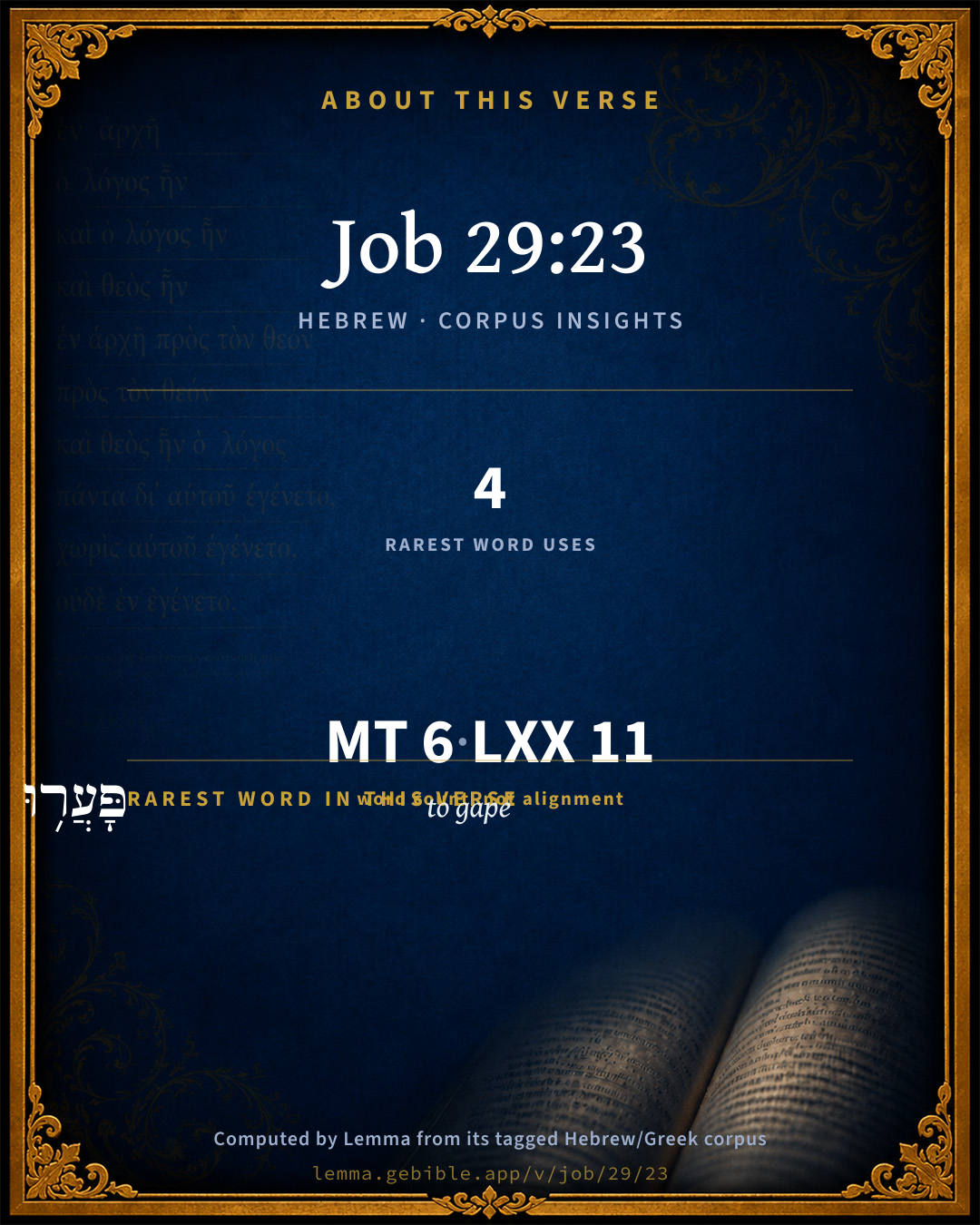
The rarest word here is פָּעֲר֥וּ to gape H6473 — appearing just 4 times in the whole Hebrew Bible.

Shared distinctive vocabulary

פָּעֲר֥וּ to gape H6473 occurs in 4 verses of the Hebrew Bible. Also found in:

Grammatical profile

  • 2 verbs
  • 3 nouns
  • 1 preposition

Verb forms

  • וְיִֽחֲל֣וּ Piel · Perfect
  • פָּעֲר֥וּ Qal · Perfect

Hebrew & Septuagint length

In English translation the verse runs 16 words from the Hebrew and 13 from the Septuagint (LXX English) — closely comparable.

A rough comparison of the two English renderings, which tokenize alike — not a word-level alignment.

Word counts can differ between the Hebrew and the Greek without any difference in meaning — e.g. the Hebrew direct-object marker אֵת has no separate Greek word, and Greek often adds the article ὁ.

In the original languages it is 6 Hebrew tokens and 11 Greek tokens — but the two are counted differently (Hebrew bundles its prefixes and suffixes into one token; the Greek is in lemma form), so that isn’t a like-for-like length.

Cross-references

3

Topical passages linked to Job 29:23 in the Treasury of Scripture Knowledge — connected by theme and wording, ordered by reader-vote popularity; previews shown in the World English Bible.

  • Hosea 6:3 Let us acknowledge Yahweh. Let us press on to know Yahweh. As surely as the sun rises, Yahweh will appear. He will come to us like the rain, Like the spring rain that waters the earth."
  • Psalms 72:6 He will come down like rain on the mown grass, As showers that water the earth.
  • Zechariah 10:1 Ask of Yahweh rain in the spring time, Yahweh who makes storm clouds, And he gives rain showers to everyone for the plants in the field.

Cross-references courtesy of OpenBible.info (CC BY 4.0).

Hebrew and Greek witnesses Masoretic Hebrew ↔ Greek Septuagint

The same verse in the two great witnesses to the Old Testament, shown verse-for-verse.

These are two independent witnesses, not word-aligned to each other, and the Septuagint is shown in lemma (dictionary) form.

Hebrew Job 29:23 Masoretic · Westminster Leningrad Codex

וְיִֽחֲל֣וּ כַמָּטָ֣ר לִ֑י וּ֝פִיהֶ֗ם פָּעֲר֥וּ לְמַלְקֽוֹשׁ

They waited for me as for the rain. Their mouths drank as with the spring rain.

World English Bible · Public Domain

Greek LXX Job 29:23 Septuagint · lemma form

ὥσπερ γῆ διψάω προςδέχομαι ὁ ὑετός οὕτως οὗτος ὁ ἐμός λαλιά

As the thirsty earth expecting the rain, so they waited for my speech.

LXX2012 (modern English Septuagint) · Public Domain

Hebrew: Westminster Leningrad Codex (CC BY 4.0). Greek: Septuagint (public domain); English from LXX2012 (modern English Septuagint) (Public Domain). How the Septuagint differs from the Hebrew →

Commentary

Notes on Job 29:23 from classic Christian and Jewish commentators (each source and its license shown beneath its notes). The classic Christian expositions comment on the surrounding passage and are grouped to its opening verse, so a note may address several verses; the Jewish commentaries on the Tanakh (Rashi and others) are per-verse, so they appear only where the commentator wrote on this verse.

Lemma curates 59 commentaries, every one of them public domain or Creative Commons licensed, each selected and text-cleaned for this edition rather than reprinted as found. About our sources →

Trapp's Complete Commentary

John Trapp

Job 29:23 And they waited for me as for the rain; and they opened their mouth wide [as] for the latter rain.

Ver. 23. And they waited for me as for the rain] Which in those hot countries was highly prized, and dearly longed for.

And they opened their mouth wide] Stupebant, me loquente, et ore hiabant; they gaped, as if they would have eaten my words; they listened as for life.

As for the latter rain] A rain which came very seldom in that country, saith Diodati; but was much desired for the refreshing and nourishing of the grain and other fruits and benefits of the earth, Pro 26:1 Zec 10:1. Merlin collecteth from this text that Job came not into the public assemblies there to speak, and give counsel, but upon deliberate premeditation. Demosthenes would not be drawn to speak extemporarily to an audience. Aristides being by the emperor put upon such a task, answered, Propound today, and I will answer tomorrow; for I am not of those that spit or vomit out my conceptions; but of those that weigh things before I utter them, and polish before I publish them, ου γαρ εσμεν των εμουντων αλλα των ακριβουντων. Mr Bradshaw was called the weighing divine; and Melancthon took time to answer Eckius’s cavils, though by him and his Popish party he was jeered for so doing. It must be an elaborate speech that shall persuade or prevail much. Among the Romans the prince was not to be treated with otherwise than by writing. Caesar brought in this custom, that he might have time to consider that which was demanded, and what answer to return. Augustus sermones libello habuit, ne plus minusve loqueretur, Augustus had his speeches set down in a book, lest he should say more or less than what he thought of (Sueton.).

John Trapp, A Commentary or Exposition upon All the Books of the Old and New Testament (1647–1656) — public domain. Text from a community e-Sword module.

Geneva Bible (1599)

Geneva Bible translators

As the dry ground thirsteth for the rain.

Geneva Bible (1599) marginal notes — public domain. Text via Bolls.life.

Jamieson, Fausset & Brown

Robert Jamieson, A. R. Fausset & David Brown

Image of Job 29:22 continued. They waited for my salutary counsel, as the dry soil does for the refreshing rain.

opened . . . mouth--panted for; Oriental image (Psa 119:131). The "early rain" is in autumn and onwards, while the seed is being sown. The "latter rain" is in March, and brings forward the harvest, which ripens in May or June. Between the early and latter rains, some rain falls, but not in such quantities as those rains. Between March and October no rain falls (Deu 11:14; Jam 5:7).

Jamieson, Fausset & Brown — Commentary Critical and Explanatory on the Whole Bible (1871) — public domain (CC PDM 1.0). Text via the HelloAO Bible API.

Adam Clarke's Commentary

Verse 23. They waited for me as for the rain] The idea continued. They longed as much to hear me speak, to receive my counsel and my decisions, as the thirsty land does for refreshing waters.

They opened their mouth wide] A metaphor taken from ground chapped with long drought.

The latter rain.] The rain that falls a little before harvest, in order to fill and perfect the grain. The former rain is that which falls about seed-time, or in spring, in order to impregnate and swell the seed, and moisten the earth to produce its nourishment.

Adam Clarke's Commentary on the Bible (1810–1826) — public domain. Text from a community e-Sword/MySword module.

John Gill's Exposition

And they waited for me as for the rain,.... The former rain, as appears by the following clause, which fell in autumn, about October, after seedtime, in order to nourish and cherish it, and bring it up; now as the husbandman waited for this, was in daily expectation of it, and greatly desired it, and longed for it; see Jam 5:7; so the people waited for Job, for his coming into their public assemblies, whether civil or religious, and longed to hear him speak, for their counsel and instruction, for their comfort and direction in all things they stood in need of:

and they opened their mouth wide as for the latter rain; which fell in the spring about March, in the time of harvest, which was of use to fatten the kernals of grain, and make them fuller, and the flour finer; now Job's hearers opened their mouths, as the dry and parched earth gapes for rain; or the husbandman, or the gardener, as the Targum, opens his mouth, and asks and prays for rain; or as a hungry and thirsty man opens his mouth to take in refreshment, or expresses thereby his desire of it; or as persons somewhat deaf open their mouths to hear the better, there being a way through the mouth to the internal ear, as anatomists (h) observe; which lies through the Eustachian tube, out of the palate, to the internal cavity of the ear, called the "concha"; wherefore such persons naturally open their mouths when they would hear attentively; all which expresses the eager desire of Job's hearers after his doctrine, which, like the rain, would be useful, profitable, and edifying to them; their view was not to indulge their curiosity, to please their ears, but to affect their hearts, and instruct their minds.

(h) Scheuchzer, ut supra. (Physic. Sacr. l. vol. 4. p. 759.)

John Gill's Exposition of the Whole Bible (1746–1763) — public domain (CC PDM 1.0). Text via the HelloAO Bible API.

Albert Barnes' Notes on the Bible

And they waited for me as for the rain - That is, as the dry and thirsty earth waits for the rain. This is a continuation of the beautiful image commenced in the previous verse, and conveys the idea that his counsel was as necessary in the assemblies of people as the rain was to give growth to the seed, and beauty to the landscape.

And they opened their mouth wide - Expressive of earnest desire; compare Psa 119:131 : “I opened my mouth and panted.”

As for the latter rain - The early and the latter rains are frequently spoken of in the Scriptures, and in Palestine and the adjacent regions are both necessary to the harvest. The early, or autumnal rains, commence in the latter half of October, or the beginning of November, not suddenly, but by degrees, so as to give the husbandman an opportunity to sow his wheat and barley. The rains come mostly from the west, or southwest, continuing for two or three days at a time, and failing especially during the nights. During the months of November and December, they continue to fall heavily; afterward they return only at longer intervals, and are less heavy; but at no period during the winter do they entirely cease to occur. Rain continues to fall more or less during the month of March, but it is rare after that period. The latter rains denote those which fall in the month of March, and which are so necessary in order to bring forward the harvest, which ripens early in May or June. If those rains fail, the harvest materially suffers, and hence, the expressions in the Scriptures, that “the husbandman waits for that rain;” compare Jam 5:7; Pro 16:15. The expression, “the early and the latter rain” seems, unless some material change has occurred in Palestine, not to imply that no rain fell in the interval, but that those rains were usually more copious, or were especially necessary, first for sowing, and then for bringing forward the harvest. In the interval between the “latter” and the “early” rains - between March and October - rain never falls, and the sky is usually serene; see Robinson’s Bibl. Researches, vol. ii. pp. 96-100. The meaning here is, that they who were assembled in counsel, earnestly desired Job to speak, as the farmer desires the rain that will bring forward his crop.

Albert Barnes' Notes on the Bible (1834–1885) — public domain. Text from a community e-Sword/MySword module.

Haydock's Catholic Bible Commentary

Shower, in autumn, at which season only, and in spring, it rained in those countries. (Calmet) (Deuteronomy xi. 14.) (Menochius) --- It would, of course, be very acceptable after the drought of summer, Proverbs xvi. 15.

George Leo Haydock (1774–1849), Haydock's Catholic Family Bible and Commentary, 1859 edition — public domain. Excludes Psalms (Douay-Rheims chapter numbering differs from Protestant) and Deuterocanonical books (Catholic canon only).

Matthew Poole's English Annotations

As for the rain; as the earth or the husbandman waiteth for the rain, to wit, the former rain, of which see Deu 11:14, because the

latter rain is here opposed to it: see Jam 5:7.

They opened their mouth to receive my words, and therewith to satisfy their thirst, as the dry and parched earth gapes or opens its mouth to receive the rain.

Matthew Poole's English Annotations on the Holy Bible (1683–1685) — public domain. Text from a community e-Sword/MySword module.

Whedon's Commentary on the Bible

Daniel D. Whedon

23. The latter rain — Falls in the months of March and April, and is quite indispensable for the ripening of vegetation.

Daniel D. Whedon (gen. ed.), Commentary on the Old and New Testaments (1874–1909) — public domain. Text from a community e-Sword module.

The Pulpit Commentary

They waited for me as for the rain; i.e. "they were as eager to heat" me speak as the parched ground is to receive the winter rain, which it expects and waits for and absorbs greedily." And they opened their mouth wide as for the latter rain. They drank in my discourse as the spring vegetation drinks in the spring showers, known in the East generally as "the latter rains."

The Pulpit Commentary (1880–1919), ed. H.D.M. Spence-Jones & Joseph S. Exell — public domain. Text from a community e-Sword module.

unfoldingWord translationNotes

Door43 World Missions Community

They always waited for me as they waited for rain

People waited for Job patiently and expected to hear good things. (See: Simile)

they opened their mouth wide to drink in my words

This represents waiting eagerly for Job to speak in order to benefit from what said. AT: "they eagerly waited for me to speak in order to benefit from what I said" (See: Metaphor)

as they would do for the latter rain

"as farmers wait eagerly for the latter rain"

the latter rain

This refers to the large amount of rain that falls just before the dry season.

I smiled on them

It can be stated clearly that the purpose of smiling was to encourage them. AT: "I smiled on them to encourage them" (See: Assumed Knowledge and Implicit Information)

the light of my face

This represents the kindness they saw in Job's face. (See: Metaphor)

translationWords

light

face

unfoldingWord translationNotes — © Distant Shores Media and the Door43 World Missions Community, licensed CC BY-SA 4.0. Source: git.door43.org/Door43/en_tn.

Rashi

Rabbi Shlomo Yitzchaki (Rashi)

after a long time After a long time they would speak, because most of their time was spent in silence, for they were anxiously waiting to hear my words.

Rashi on the Tanakh — English translations: “The Judaica Press complete Tanach with Rashi, translated by A. J. Rosenberg” (CC BY 4.0); “Pentateuch with Rashi's commentary by M. Rosenbaum and A.M. Silbermann, 1929-1934” (public domain); “The Metsudah Tanach series, Lakewood, N.J” (CC BY 4.0); and “The Book of Joshua, Metsudah Publications, 1997” (CC BY 4.0). Text via Sefaria.

Lesson kit

Teaching starters — assembled from the data on this page, not authored interpretation. Every prompt links to the verse data it draws on. Edit before teaching.

Job, in the Wisdom, opens this verse with 6 words (5 distinct Hebrew lemmas). Its most distinctive word is pâʻar (“to gape”). A historical commentator’s framing appears above. Read the whole chapter for the surrounding context.

Discussion questions

  1. What does “to gape” (pâʻar) contribute to the verse as a whole?
  2. How does Job 16:10, which shares the word «to gape», read alongside this verse?
  3. The translations on this page render this verse differently — a whole-verse word diff, not a word-by-word alignment. What might account for the different wordings?
  4. «וְיִֽחֲל֣וּ» is a Piel Perfect verb. How does that grammatical form shape the action described?
  5. Compare how Trapp's Complete Commentary and Geneva Bible (1599) read this verse. Where do they agree or differ?

Things to notice

Reading settings

Reading text

Shown beneath each verse's original-language words.

Old Testament
Old Testament edition

Read the OT as the Masoretic Hebrew (MT) or the Greek Septuagint (LXX).

English shown for the Greek Septuagint (in the Hebrew ↔ Greek comparison).

Comparing translations? Open the Compare panel on any verse page to stack up to four side by side.