
Proverbs 5:7

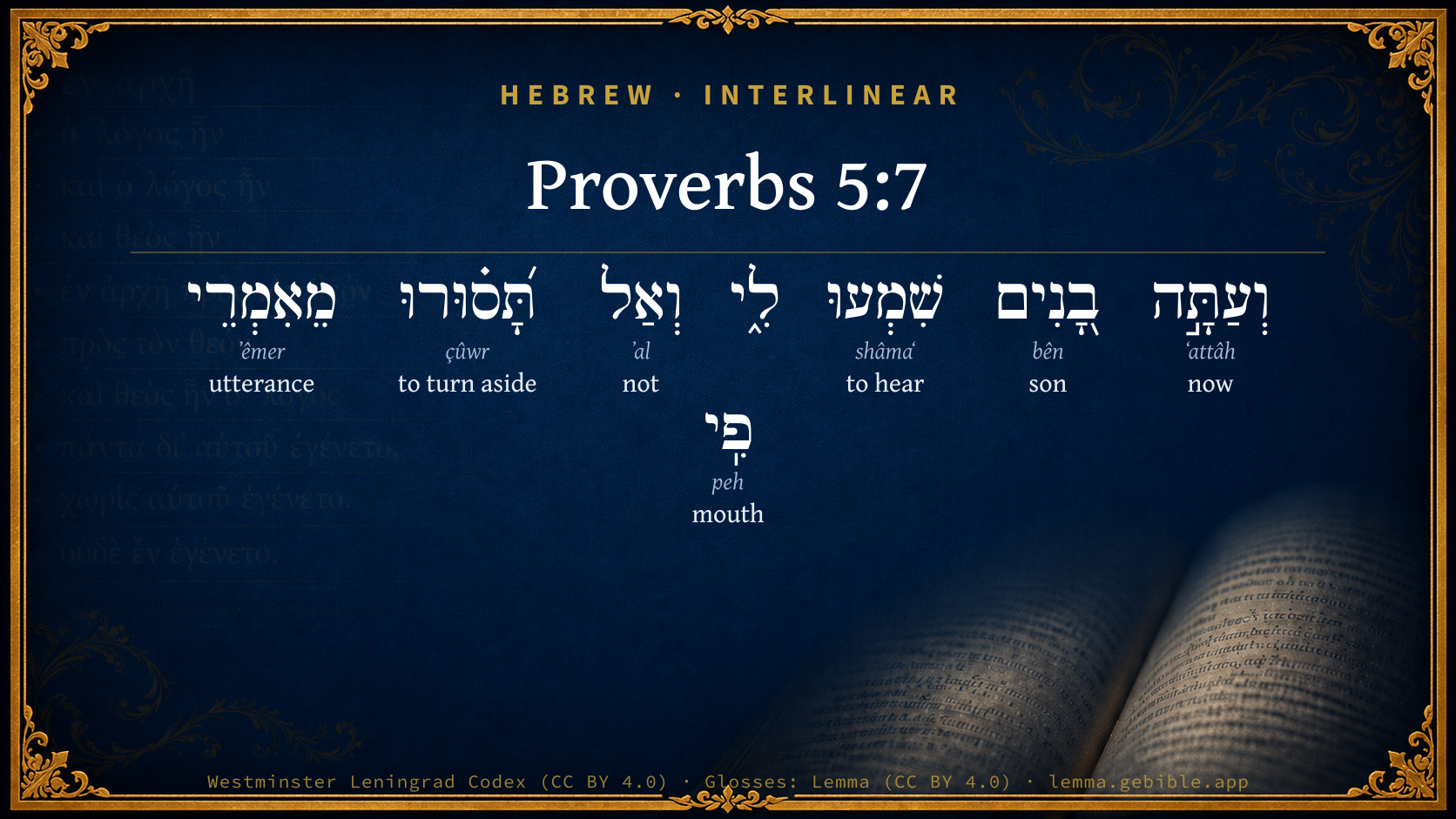
Hebrew (Westminster Leningrad Codex) Proverbs 5:7 appears in the Hebrew Old Testament. The text above is from the Westminster Leningrad Codex. Each word links to its Strong’s number, a concise gloss, and parsing drawn from the Open Scriptures Hebrew Bible morphology. Click any word for its full Brown-Driver-Briggs (BDB) entry.
Download image
Cite this verse

Proverbs 5:7 (World English Bible). Public Domain. Lemma interlinear Bible study tool, https://lemma.gebible.app/v/proverbs/5/7.

Show BibTeX & RIS
BibTeX
RIS
English Translation
Now therefore, my sons, listen to me. Don't depart from the words of my mouth.
World English Bible · Public Domain
Download a study sheet

One document with this verse’s original text, its word-by-word gloss line, the meaning frame, cross-references with their text, attributed commentary, and full source and license credits — printable, and it pastes into notes with its structure intact.

This verse Autodidact and up

Study sheet (.html) Plain text (.txt)

A passage Seminary Student

Up to 50 verses in one chapter. A passage sheet keeps up to 6 commentary sources and 12 cross-references per verse, in the order this page ranks them, and says so on the sheet whenever that leaves anything out. Ask for a single verse and you get the Autodidact verse sheet above.

Everything on this page stays free to read, with no account — the sheet is a download of what is already on screen, not access to it.

Want to remove ads? Support Godless Engineer
Compare translations 3

The same verse in 3 English versions, stacked beneath the original-language interlinear above. Click any original word for its lexicon entry.

Each is an independent rendering of the whole verse — the interlinear is not word-aligned to these translations.

Highlighted words mark where these versions differ — a whole-verse word diff, not a word-by-word alignment.

  • World English Bible Public Domain
    Now therefore, my sons, listen to me. Don't depart from the words of my mouth.
  • King James Version Public Domain
    Hear me now therefore, O ye children, and depart not from the words of my mouth.
  • unfoldingWord Literal Text CC BY-SA 4.0
    And now, sons, listen to me; and do not turn away from the sayings of my mouth.

unfoldingWord Literal Text — © unfoldingWord, licensed CC BY-SA 4.0. Word-aligned USFM3 via Door43 (git.door43.org/unfoldingWord/en_ult).

Versions to compare (up to 4)

3 of 4 selected

Show all 18 translations

Every available English version of this verse, each an independent rendering of the whole verse.

  • World English Bible Public Domain
    Now therefore, my sons, listen to me. Don't depart from the words of my mouth.
  • Berean Standard Bible Public Domain
    So now, my sons, listen to me, and do not turn aside from the words of my mouth.
  • Majority Standard Bible Public Domain
    So now, my sons, listen to me, and do not turn aside from the words of my mouth.
  • King James Version Public Domain
    Hear me now therefore, O ye children, and depart not from the words of my mouth.
  • American Standard Version (1901) Public Domain
    Now therefore, `my' sons, hearken unto me, And depart not from the words of my mouth.
  • Revised Version (1885) Public Domain
    Now therefore, my sons, hearken unto me, and depart not from the words of my mouth.
  • Geneva Bible (1599) Public Domain
    Heare yee me nowe therefore, O children, and depart not from the wordes of my mouth.
  • Douay-Rheims (1899) Public Domain
    Now therefore, my son, hear me, and depart not from the words of my mouth.
  • Young's Literal Translation Public Domain
    And now, ye sons, hearken to me, And turn not from sayings of my mouth.
  • Literal Standard Version CC BY-SA 4.0
    And now, you sons, listen to me, || And do not turn from sayings of my mouth.
  • Unlocked Literal Bible CC BY-SA 4.0
    Now, my sons, listen to me; do not turn away from listening to the words of my mouth.
  • unfoldingWord Literal Text CC BY-SA 4.0
    And now, sons, listen to me; and do not turn away from the sayings of my mouth.
  • Darby Bible Public Domain
    And now, children, hearken unto me, and depart not from the words of my mouth.
  • World Messianic Bible Public Domain
    Now therefore, my sons, listen to me. Don’t depart from the words of my mouth.
  • Webster's Bible Public Domain
    Hear me now therefore, O ye children, and depart not from the words of my mouth.
  • Free Bible Version CC BY-SA 4.0
    Now, my son, listen to me; don't reject what I have taught you.
  • Bible in Basic English Public Domain
    Give ear to me then, my sons, and do not put away my words from you.
  • JPS Tanakh (1917) Public Domain
    Now therefore, O ye children, hearken unto me, and depart not from the words of my mouth.

Literal Standard Version (2020), Covenant Press — licensed CC BY-SA 4.0. Text via the HelloAO Bible API (eBible.org). Unlocked Literal Bible (unfoldingWord) — licensed CC BY-SA 4.0. Text via the HelloAO Bible API (eBible.org). unfoldingWord Literal Text — © unfoldingWord, licensed CC BY-SA 4.0. Word-aligned USFM3 via Door43 (git.door43.org/unfoldingWord/en_ult). Free Bible Version, Dr. Jonathan Gallagher — licensed CC BY-SA 4.0. Text via the HelloAO Bible API (eBible.org).

Word by word

More ways to search: Search by grammar → Find every occurrence → Compare this word →

Practice this passage: Drill this verse → Learn its vocabulary →

About this verse

These counts appear in no published source. They are computed here, from the morphology-tagged text and Lemma’s own curated glosses. What Lemma adds →

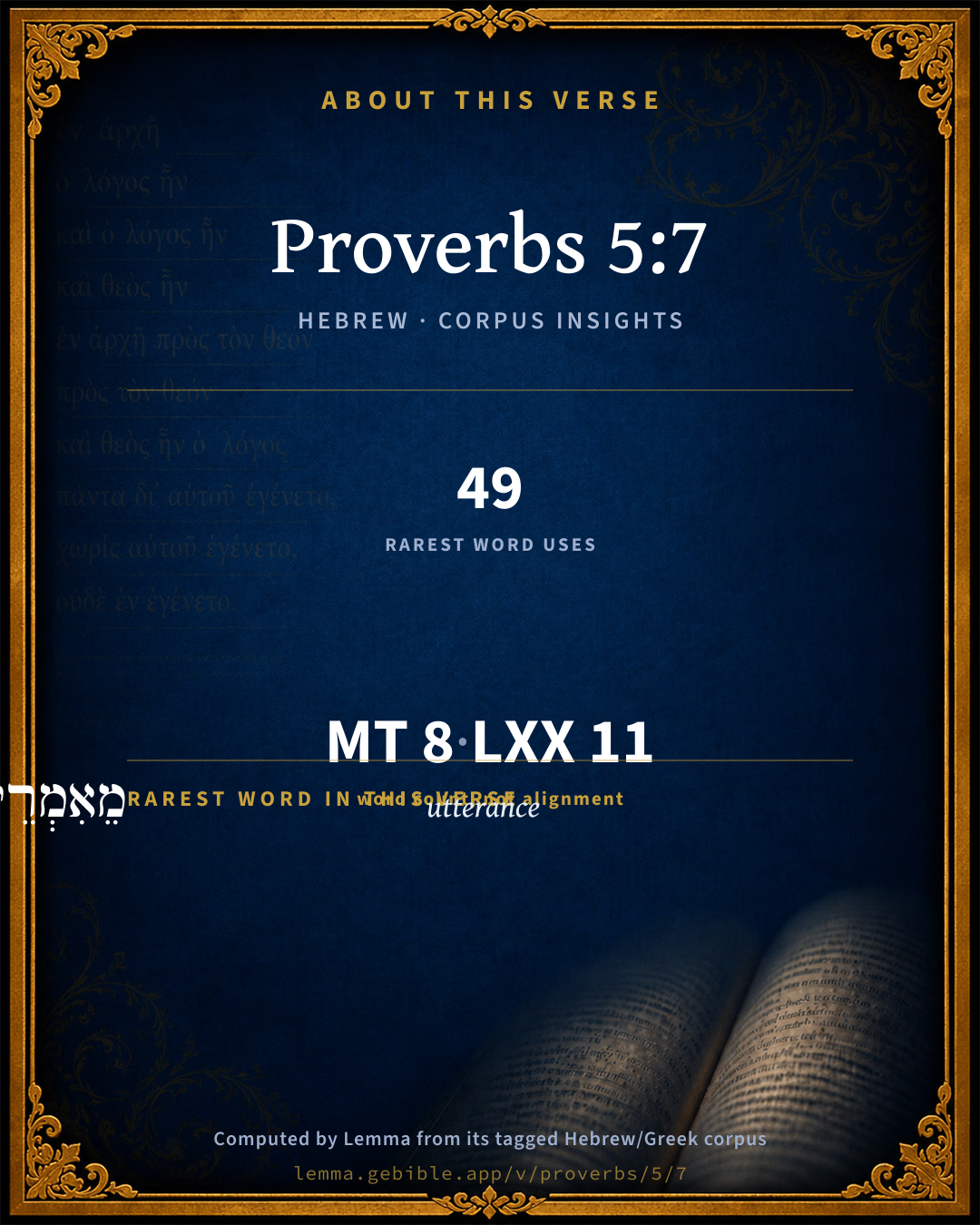
8
words
7
distinct lemmas
Wisdom
section

Shared distinctive vocabulary

מֵאִמְרֵי utterance H561 occurs in 47 verses of the Hebrew Bible. Also found in:

Grammatical profile

  • 2 verbs
  • 3 nouns
  • 1 preposition
  • 1 adverb
  • 1 particle

Verb forms

  • שִׁמְעוּ Qal · Imperative
  • תָּ֝ס֗וּרוּ Qal · Jussive

Hebrew & Septuagint length

In English translation the verse runs 15 words from the Hebrew and 14 from the Septuagint (LXX English) — closely comparable.

A rough comparison of the two English renderings, which tokenize alike — not a word-level alignment.

Word counts can differ between the Hebrew and the Greek without any difference in meaning — e.g. the Hebrew direct-object marker אֵת has no separate Greek word, and Greek often adds the article ὁ.

In the original languages it is 8 Hebrew tokens and 11 Greek tokens — but the two are counted differently (Hebrew bundles its prefixes and suffixes into one token; the Greek is in lemma form), so that isn’t a like-for-like length.

Cross-references

7

Topical passages linked to Proverbs 5:7 in the Treasury of Scripture Knowledge — connected by theme and wording, ordered by reader-vote popularity; previews shown in the World English Bible.

  • Proverbs 4:1 Listen, sons, to a father's instruction. Pay attention and know understanding;
  • Proverbs 7:24 Now therefore, sons, listen to me. Pay attention to the words of my mouth.
  • Proverbs 22:17–21 Turn your ear, and listen to the words of the wise. Apply your heart to my teaching.
  • Proverbs 3:21 My son, let them not depart from your eyes. Keep sound wisdom and discretion:
  • Proverbs 4:21 Let them not depart from your eyes. Keep them in the midst of your heart.
  • Hebrews 12:25 See that you don't refuse him who speaks. For if they didn't escape when they refused him who warned on the Earth, how much more will we not escape who turn away from him who warns from heaven,
  • Proverbs 8:32–36 "Now therefore, my sons, listen to me, For blessed are those who keep my ways.

Cross-references courtesy of OpenBible.info (CC BY 4.0).

Hebrew and Greek witnesses Masoretic Hebrew ↔ Greek Septuagint

The same verse in the two great witnesses to the Old Testament, shown verse-for-verse.

These are two independent witnesses, not word-aligned to each other, and the Septuagint is shown in lemma (dictionary) form.

Hebrew Proverbs 5:7 Masoretic · Westminster Leningrad Codex

וְעַתָּ֣ה בָ֭נִים שִׁמְעוּ לִ֑י וְאַל תָּ֝ס֗וּרוּ מֵאִמְרֵי פִֽי

Now therefore, my sons, listen to me. Don't depart from the words of my mouth.

World English Bible · Public Domain

Greek LXX Proverbs 5:7 Septuagint · lemma form

νῦν οὖν υἱός ἀκούω ἐγώ καί μή ἄκυρος ποιέω ἐμός λόγος

Now then, my son, hear me, and make not my words of none effect.

LXX2012 (modern English Septuagint) · Public Domain

On this verse, Keil & Delitzsch discusses the Septuagint’s reading. Read the note in Commentary ↓

Hebrew: Westminster Leningrad Codex (CC BY 4.0). Greek: Septuagint (public domain); English from LXX2012 (modern English Septuagint) (Public Domain). How the Septuagint differs from the Hebrew →

Commentary

Notes on Proverbs 5:7 from classic Christian and Jewish commentators (each source and its license shown beneath its notes). The classic Christian expositions comment on the surrounding passage and are grouped to its opening verse, so a note may address several verses; the Jewish commentaries on the Tanakh (Rashi and others) are per-verse, so they appear only where the commentator wrote on this verse.

Lemma curates 59 commentaries, every one of them public domain or Creative Commons licensed, each selected and text-cleaned for this edition rather than reprinted as found. About our sources →

Ellicott's Commentary for English Readers

(h). Eighth Discourse:—Against Adultery, and in Praise of Marriage (Pro_5:7-23).

(7) Hear me now therefore, O ye children.—In this verse Solomon apparently ceases to report the words of his father, and resumes his speech in his own person.

A Bible Commentary for English Readers, edited by Charles John Ellicott (1878–1897) — public domain. Text from a community e-Sword module.

Trapp's Complete Commentary

John Trapp

Pro 5:7 Hear me now therefore, O ye children, and depart not from the words of my mouth.

Ver. 7. O ye children.] See Pro 4:1. Shechem, though at ripeness of age, yet is called a child. {Gen 39:19} Neque distulit puer. And the young man, or the child, deferred not to do the thing. A child he is called, that is, a fool, quia non ratione sed affectu rapitur, saith an interpreter, {a} because not reason but lust overruled him. "As for thee, thou shalt be as one of the fools in Israel," said she to her libidinous {b} brother Amnon. {1Sa 23:13}

{a} Pareus.

{b} Of persons, their lives, actions, desires: Given to, full of, or characterized by lust or lewdness; lustful, lecherous, lewd.

John Trapp, A Commentary or Exposition upon All the Books of the Old and New Testament (1647–1656) — public domain. Text from a community e-Sword module.

Adam Clarke's Commentary

Verse 7. Hear me - O ye children] בנים banim, sons, young men in general: for these are the most likely to be deceived and led astray.

Adam Clarke's Commentary on the Bible (1810–1826) — public domain. Text from a community e-Sword/MySword module.

The Cambridge Bible for Schools and Colleges

gen. ed. J. J. S. Perowne

7. ye children] Rather, my sons, R.V., as the same Heb. word is rendered throughout these exhortations.

The Cambridge Bible for Schools and Colleges (gen. ed. J. J. S. Perowne; Cambridge University Press, 1878–1918) — public domain. Text from a community e-Sword module.

John Gill's Exposition

Hear me now therefore, O ye children,.... Since such is the character, this the wretched end, and these the ways of the adulterous woman; those that are young in years, and liable to be ensnared by her, should hear what Solomon, or Christ, here says, for their caution and instruction; and especially such who are, or profess themselves to be, the children of God and of Christ; and therefore, as dear children, should be followers of them, and not of an harlot;

and depart not from the words of my mouth; the warnings, directions, and exhortations given to avoid the whorish woman; the doctrines of Christ, the truths of the Gospel: these should not be forsaken, but abode by; and also his precepts and ordinances, which should be closely attended unto.

John Gill's Exposition of the Whole Bible (1746–1763) — public domain (CC PDM 1.0). Text via the HelloAO Bible API.

Whedon's Commentary on the Bible

Daniel D. Whedon

7. Hear me — Compare Pro_7:24.

Daniel D. Whedon (gen. ed.), Commentary on the Old and New Testaments (1874–1909) — public domain. Text from a community e-Sword module.

The Pulpit Commentary

Vers. 7-14. The ruinous consequences of indulgence in illicit pleasures.

The subject of which the teacher is heating demands the utmost attention of youth. Enough, it might be supposed, had been said to deter from intercourse with the "strange woman." She has been portrayed in her real colours, plunging recklessly into ruin herself, and carrying her victims with her; deceitful, full of intrigues, neither walking in nor knowing the way of life. But the warning is amplified and made more impressive. There is another side of the picture, the complete bodily and temporal ruin of her victim. The argumentum ad hominem is applied. There is an appeal to personal interest in the details which follow, which ought not to fail in holding youth back. The form of the address which is repeated is very similar to that in Pro_7:24. The plural form, "O ye children", (cf. Pro_4:1 and Pro_7:24) immediately passes into the singular for the reason mentioned before, that, though the address is made to all, yet each individually is to apply it to himself.

The Pulpit Commentary (1880–1919), ed. H.D.M. Spence-Jones & Joseph S. Exell — public domain. Text from a community e-Sword module.

Keil & Delitzsch

C. F. Keil & F. Delitzsch

The eighth discourse springs out of the conclusion of the seventh, and connects itself by its reflective מעליה so closely with it that it appears as its continuation; but the new beginning and its contents included in it, referring only to social life, secures its relative independence. The poet derives the warning against intercourse with the adulteress from the preceding discourse, and grounds it on the destructive consequences.

7 And now, ye sons, hearken unto me,

And depart not from the words of my mouth.

8 Hold thy path far from her neighbourhood,

And come not to the door of her house!

9 That thou mayest not give the freshness of thy youth to another,

Nor thy years to the cruel one;

10 That strangers may not sate themselves with thy possessions,

And the fruit of thy toils come into the house of a stranger,

11 And thou groanest at the end,

When thy flesh and thy body are consumed.

Neither here nor in the further stages of this discourse is there any reference to the criminal punishment inflicted on the adulterer, which, according to Lev 20:10, consisted in death, according to Eze 16:40, cf. John. Pro 8:5, in stoning, and according to a later traditional law, in strangulation (חנק). Ewald finds in Pro 5:14 a play on this punishment of adultery prescribed by law, and reads from Pro 5:9. that the adulterer who is caught by the injured husband was reduced to the state of a slave, and was usually deprived of his manhood. But that any one should find pleasure in making the destroyer of his wife his slave is a far-fetched idea, and neither the law nor the history of Israel contains any evidence for this punishment by slavery or the mutilation of the adulterer, for which Ewald refers to Grimm's Deutsche Rechtsaltertmer. The figure which is here sketched by the poet is very different. He who goes into the net of the wanton woman loses his health and his goods. She stands not alone, but has her party with her, who wholly plunder the simpleton who goes into her trap. Nowhere is there any reference to the husband of the adulteress. The poet does not at all think on a married woman. And the word chosen directs our attention rather to a foreigner than to an Israelitish woman, although the author may look upon harlotry as such as heathenish rather than Israelitish, and designate it accordingly. The party of those who make prostitutes of themselves consists of their relations and their older favourites, the companions of their gain, who being in league with her exhaust the life-strength and the resources of the befooled youth (Fl.). This discourse begins with ועתּה, for it is connected by this concluding application (cf. Pro 7:24) with the preceding.

Pro 5:8-9

In Pro 5:8, one must think on such as make a gain of their impurity. מעל, Schultens remarks, with reference to Eze 23:18, crebrum in rescisso omni commercio: מן denotes the departure, and על the nearness, from which one must remove himself to a distance. Regarding הוד gn (Pro 5:9), which primarily, like our Pracht (bracht from brechen = to break) pomp, magnificence, appears to mean fulness of sound, and then fulness of splendour, see under Job 39:20; here there is a reference to the freshness or the bloom of youth, as well as the years, against the sacrifice of which the warning is addressed - in a pregnant sense they are the fairest years, the years of youthful fulness of strength. Along with אחרים the singulare-tantum אכזרי (vid., Jer 50:42) has a collective sense; regarding the root-meaning, vid., under Isa 13:9. It is the adj. relat. of אכזר after the form אכזב, which is formed not from אך זר, but from an unknown verb כּזר. The ancients referred it to death and the devil; but the אכזרי belongs to the covetous society, which impels ever anew to sin, which is their profit, him who has once fallen into it, and thus brings bodily ruin upon him; they are the people who stand far aloof from this their sacrifice, and among them are barbarous, rude, inexorably cruel monsters (Unmenschen) (Graecus Venetus, τῷ ἀπανθρώπῳ), who rest not till their victim is laid prostrate on the ground and ruined both bodily and financially.

Pro 5:10

This other side of the ruin Pro 5:10 presents as an image of terror. For הוד refers to the person in his stately appearance, but כּח to his possessions in money and goods; for this word, as well as in the strikingly similar passage Hos 7:9, is used as the synonym of חיל (Gen 34:29, etc.), in the sense of ability, estate. This meaning is probably mediated by means of a metonymy, as Gen 4:12; Job 31:39, where the idea of the capability of producing is passed over into that of the produce conformable to it; so here the idea of work-power passes over into that of the gain resulting therefrom. ועצביך (and thy toils) is not, like כּחך, the accusative governed by ישׂבּעוּ; the carrying over of this verb disturbs the parallelism, and the statement in the passage besides does not accord therewith, which, interpreted as a virtual predicate, presents 10b as an independent prohibitive clause: neve sint labores tui in domo peregrini, not peregrina; at least נכרי according to the usage of the language is always personal, so that בּית נכרי (cf. Lam 5:2), like מלבושׁ נכרי, Zep 1:8, is to be explained after עיר נכרי, Jdg 19:12. עצב (from עצב, Arab. 'aṣab, to bind fast, to tie together, then to make effort, ποιεῖν, laborare) is difficult work (Pro 10:22), and that which is obtained by it; Fleischer compares the Ital. i miei sudori, and the French mes sueurs.

Pro 5:11

The fut. ישׂבּעוּ and the יהיוּ needed to complete 10b are continued in Pro 5:11 in the consec. perf. נהם, elsewhere of the hollow roaring of the sea, Isa 5:30, the growling of the lion, Pro 28:15, here, as also Eze 24:23, of the hollow groaning of men; a word which echoes the natural sound, like הוּם, המה. The lxx, with the versions derived from it, has καὶ μεταμεληθήσῃ, i.e., ונחמתּ (the Niph. נחם, to experience the sorrow of repentance, also an echo-word which imitates the sound of deep breathing) - a happy quid pro quo, as if one interchanged the Arab. naham, fremere, anhelare, and nadam, poenitere. That wherein the end consists to which the deluded youth is brought, and the sorrowful sound of despair extorted from him, is stated in 11b: his flesh is consumed away, for sensuality and vexation have worked together to undermine his health. The author here connects together two synonyms to strengthen the conception, as if one said: All thy tears and thy weeping help thee nothing (Fl.); he loves this heaping together of synonyms, as we have shown at p. 33. When the blood-relation of any one is called שׁאר בּשׂרו, Lev 18:6; Lev 25:49, these two synonyms show themselves in subordination, as here in close relation. שׁאר appears to be closely connected with שׁרירים, muscles and sinews, and with שׁר, the umbilical cord, and thus to denote the flesh with respect to its muscular nature adhering to the bones (Mic 3:2), as בּשׂר denotes it with respect to its tangible outside clothed with skin (vid., under Isaiah, p. 418).

Keil & Delitzsch — Biblical Commentary on the Old Testament (1861–1891) — public domain (CC PDM 1.0). Text via the HelloAO Bible API. (Old Testament only.)

unfoldingWord translationNotes

Door43 World Missions Community

Now

Here the teacher shifts from warning about the adulteress to giving advice.

listen to me ... do not turn away from listening

These two phrases express the same idea to make the student pay attention. (See: Parallelism)

do not turn away from listening

The writer speaks of stopping an action as if the person physically turned away from it. AT: "do not stop listening" (See: Metaphor)

the words of my mouth

Here the word "mouth" represents the person who is speaking. AT: "my words" or "what I am saying" (See: Synecdoche)

Keep your path far away from her

Here the word "path" represents the person's daily conduct and circumstances. AT: "Keep yourself far away from her" or "Stay away from her" (See: Metonymy)

do not come near the door of her house

Here "the door of her house" represents the house itself. It may be more appropriate to use the word "go" instead of "come" since the latter might imply that the speaker is at the door of her house. AT: "do not go near the door of her house" or "do not even go near her house" (See: Synecdoche and Go and Come)

translationWords

turn

word

unfoldingWord translationNotes — © Distant Shores Media and the Door43 World Missions Community, licensed CC BY-SA 4.0. Source: git.door43.org/Door43/en_tn.

Lesson kit

Teaching starters — assembled from the data on this page, not authored interpretation. Every prompt links to the verse data it draws on. Edit before teaching.

Proverbs, in the Wisdom, opens this verse with 8 words (7 distinct Hebrew lemmas). Its most distinctive word is ʼêmer (“utterance”). A historical commentator’s framing appears above. Read the whole chapter for the surrounding context.

Discussion questions

  1. How does “utterance” (ʼêmer) shape what this verse is saying?
  2. How does Genesis 49:21, which shares the word «utterance», read alongside this verse?
  3. These translations render this verse differently; the difference is in the English rendering, not the original. What questions does that raise?
  4. «שִׁמְעוּ» is a Qal Imperative verb. How does that grammatical form shape the action described?
  5. Compare how Ellicott's Commentary for English Readers and Trapp's Complete Commentary read this verse. Where do they agree or differ?

Things to notice

Reading settings

Reading text

Shown beneath each verse's original-language words.

Old Testament
Old Testament edition

Read the OT as the Masoretic Hebrew (MT) or the Greek Septuagint (LXX).

English shown for the Greek Septuagint (in the Hebrew ↔ Greek comparison).

Comparing translations? Open the Compare panel on any verse page to stack up to four side by side.