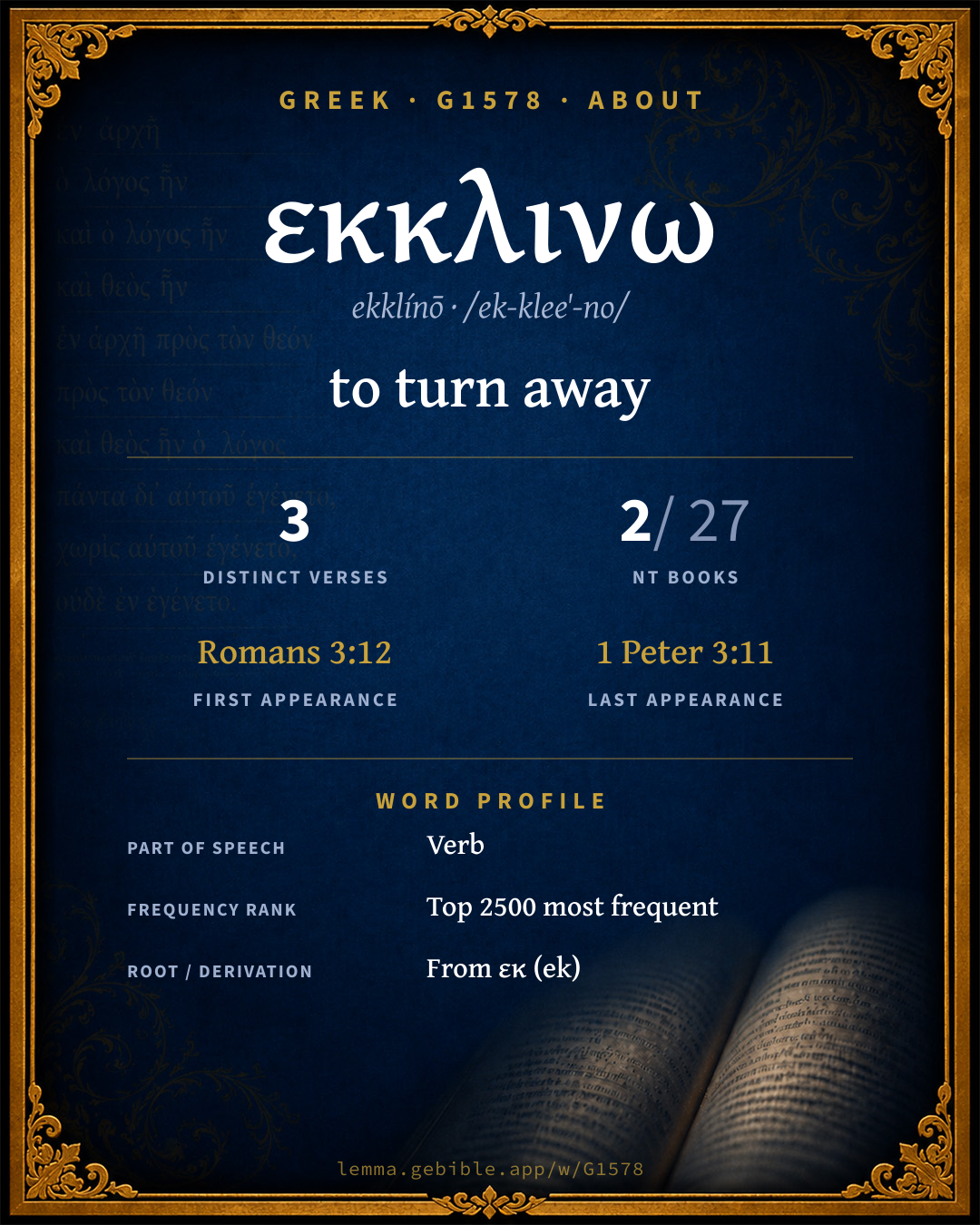
ἐκκλίνω
to turn away
‘to turn away’ is one of 3 main senses fuller range ↓
Full lexicon entry — Thayer's Greek Lexicon
From Thayer's Greek Lexicon
Where this word appears
See every Aorist-tense verb in the Greek New Testament →
Grammar key — what these labels mean
Part of speech
- Verb
- An action or state-of-being word.
Tense
- Aorist
- Action viewed as a simple whole, without regard to duration — often past (perfective aspect).
- Present
- Ongoing or general action in present time (imperfective aspect).
Voice
- Active
- The subject performs the action.
Mood
- Indicative
- States a fact or asks a factual question (the mood of reality).
- Imperative
- Expresses a command or request.
Person
- 3rd person
- The one spoken about (“he / she / it / they”).
- 2nd person
- The one addressed (“you”).
Number
- Plural
- More than one.
- Singular
- One.
Grammatical forms
- Verb, Aorist, Active, Indicative, 3rd person, Plural 1 time (33%)
- Verb, Aorist, Active, Imperative, 3rd person, Singular 1 time (33%)
- Verb, Present, Active, Imperative, 2nd person, Plural 1 time (33%)
Parsed forms decoded from the imported morphology (Robinson–Tischendorf, public domain), counted across 3 parsed occurrences — not distinct verses.
Every verse where G1578 appears — 3 distinct verses across 2 books. Click any verse to open its interlinear word-by-word view. Verse text shown in the World English Bible for context — . Each verse’s Greek form is shown with its reference; the English is not keyword-highlighted, since the data carries no word-level English alignment. Use “Compare translations” on any verse to read it across multiple English versions. This concordance covers the Greek New Testament; Septuagint (Greek Old Testament) occurrences of this word are not indexed here.
Romans 2 verses
- Romans 3:12 ἐξέκλιναν aor act ind 3pl They have all turned aside. They have together become unprofitable. There is no one who does good, No, not, so much as one."
- Romans 16:17 ἐκκλίνετε pres act impv 2pl Now I beg you, brothers, look out for those who are causing the divisions and occasions of stumbling, contrary to the doctrine which you learned, and turn away from them.
1 Peter 1 verse
About this entry
At a glance — auto-summarized from this page’s data, not written by a person. Every figure links to its source below. This summary describes the numbers; it doesn’t interpret them.
εκκλινω — transliterated ekklínō — is a Greek verb carrying the sense “to turn away.” The Greek New Testament uses it only 3 verses. Its uses cluster heavily in Romans (67% of all occurrences). Its earliest occurrence is Romans 3:12. Thayer's distinguishes 3 senses for it. Each statement above links to its evidence; the full detail follows below.
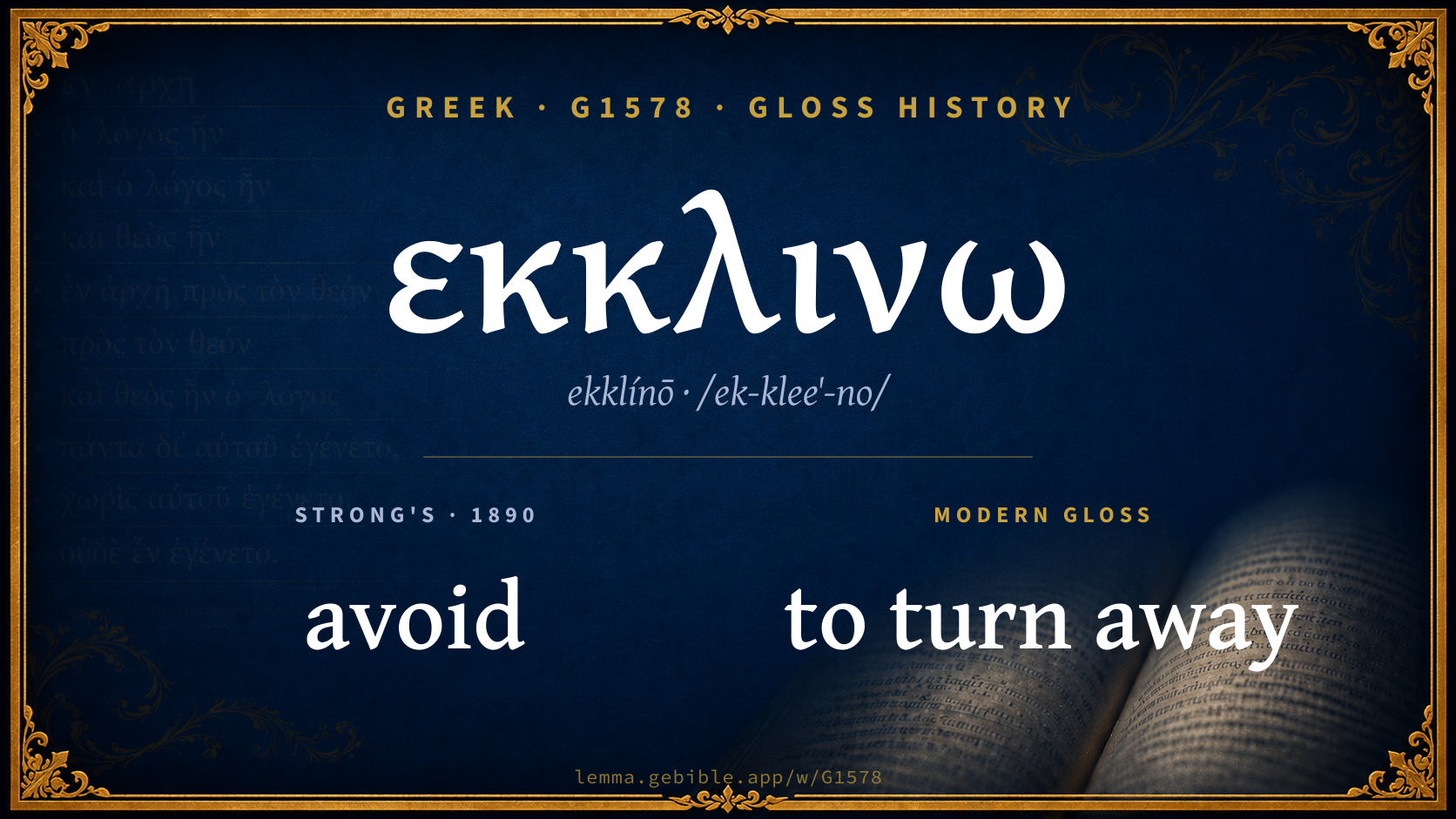
Gloss history
Strong's 1890 vs modern scholarship
About this word
Strong's G1578 catalogs a Greek word from the Greek New Testament.
These counts are not copied from any lexicon or concordance. They are computed here, from the morphology-tagged Greek New Testament. What Lemma adds →
- 3
- distinct verses
- The word appears in 3 distinct verses.
- 2 / 27
- NT books
- The word appears in 2 of 27 New Testament books.
- #2,203
- by frequency
- Top 2500 most frequent Greek words (rank 2,203 of 5,347 Greek words by occurrence).
View all 3 occurrences in the concordance →
By traditional corpus
Conventional, traditional groupings — biblical authorship is debated, so this is a traditional corpus grouping, not an authorship claim. Some books belong to more than one corpus (Luke is in both the Gospels and the Lukan corpus, and so on), so these shares overlap and need not total 100%. Each figure is a share of the word’s 3 distinct verses.
- Pauline corpus 2 verses · 67%
- General (Catholic) Epistles 1 verse · 33%
How translations render this word
Counts come from each version’s own published word-to-Strong’s tagging or interlinear alignment — an approximate guide to how each version renders this word, not a word-level alignment the data otherwise carries. Because each total is that version’s own tagged count, the per-version totals vary from one another and need not match the appearance or distinct-verse counts above. These counts may also differ from a printed concordance because Lemma counts each distinctly tagged rendering and does not collapse phrase taggings into a single head-word total. This is a fixed set of word-tagged versions (KJV, ASV, BSB, ULT) and does not change with the reading translation you choose elsewhere. Each version’s license is shown beside its name below (and on Sources).
- King James Version: Avoid 1×, Gone out of the way 1×, Let him eschew 1×
- American Standard Version: Let him turn away 1×, They have 1×, Turn away 1×
- Berean Standard Bible: Have turned away 1×, He must turn 1×, Turn away 1×
- unfoldingWord Literal Text: Let him turn away 1×, Turn away 1×, Turned away 1×
King James Version Public Domain
Renders G1578 across 4 tagged occurrences — most commonly:
American Standard Version Public Domain
Renders G1578 across 4 tagged occurrences — most commonly:
Berean Standard Bible Public Domain
Renders G1578 across 3 tagged occurrences — most commonly:
unfoldingWord Literal Text CC BY-SA 4.0
Renders G1578 across 3 tagged occurrences — most commonly:
Senses in Thayer's
The 3 senses Thayer's distinguishes for this word, in lexicon order (not ranked by frequency or importance). The full entry — with sub-senses — is in the Lexicon Entry tab.
- to turn aside, deviate (from the right way and course)
- to turn (one's self) away, to turn away from, keep aloof from one's society
- to shun one
Word origin
Derived from εκ (ek) (G1537) — from.
Forms in the corpus
The 3 distinct written forms G1578 takes in the Greek New Testament, most frequent first — each parse links to that tense’s occurrences in the concordance.
| Form | Parsing | Example | Uses |
|---|---|---|---|
| ἐκκλίνετε ekklínete | Verb, Present, Active, Imperative, 2nd person, Plural | Romans 16:17 | 1 |
| ἐκκλινάτω ekklinátō | Verb, Aorist, Active, Imperative, 3rd person, Singular | 1 Peter 3:11 | 1 |
| ἐξέκλιναν exéklinan | Verb, Aorist, Active, Indicative, 3rd person, Plural | Romans 3:12 | 1 |
Same root — word family
Other Thayer's entries built from the same root as G1578, grouped by Strong’s listed origin. These share a root / origin per the lexicon — not necessarily a shared meaning. Each links to that word’s own entry.
Derives from
Shares the same root
- εκβαλλω ekbállō G1544 to cast out
- εκβασις ékbasis G1545 exit
- εκγαμιζω ekgamízō G1547 to give in marriage
- εκγαμισκω ekgamískō G1548 to give in marriage
- εκγονον ékgonon G1549 offspring
- εκδαπαναω ekdapanáō G1550 to spend
- εκδεχομαι ekdéchomai G1551 to receive
- εκδηλος ékdēlos G1552 evident
- εκδημεω ekdēméō G1553 to depart
- εκδιδωμι ekdídōmi G1554 to give out
- εκδιηγεομαι ekdiēgéomai G1555 to relate
- εκδικος ékdikos G1558 without justice
- εκδιωκω ekdiṓkō G1559 to banish
- εκδοτος ékdotos G1560 delivered up
- εκδυω ekdýō G1562 to put off
- εκζητεω ekzētéō G1567 to seek out
- εκθαμβος ékthambos G1569 astonished
- εκθετος ékthetos G1570 exposed
- εκκαθαιρω ekkathaírō G1571 to cleanse
- εκκαιω ekkaíō G1572 to burn
- εκκακεω ekkakéō G1573 to be exhausted
- εκκεντεω ekkentéō G1574 to pierce
- εκκλαω ekkláō G1575 to cut off
- εκκλειω ekkleíō G1576 to shut out
+88 more words share this root (not shown).
Compare all same-root words → Showing 4 of 114 — not the complete family. They share a root, not necessarily a meaning.
Septuagint usage
The same Greek word εκκλινω appears 130 times in the Greek Old Testament (Septuagint), across 122 verses in 26 books.
- 130
- LXX occurrences
- Tagged occurrences of this Greek word in the Septuagint.
- 122
- verses
- Distinct Septuagint verses containing this word.
- 26 / 39
- OT books
- The word appears in 26 of the 39 Old Testament books.
Sample Septuagint occurrences
- Genesis 18:5 ἐκκλίνω
- Exodus 10:6 ἐκκλίνω
- Numbers 20:17 ἐκκλίνω
- Deuteronomy 2:27 ἐκκλίνω
- Joshua 1:7 ἐκκλίνω
- Judges 2:17 ἐκκλίνω
- Ruth 4:1 ἐκκλίνω
- 1 Samuel 8:3 ἐκκλίνω
- 2 Samuel 2:19 ἐκκλίνω
- 1 Kings 11:2 ἐκκλίνω
- 2 Kings 4:8 ἐκκλίνω
- 1 Chronicles 13:9 ἐκκλίνω
Septuagint occurrences (same lexeme)
Every verse where the same Strong’s number (G1578) appears in the Greek Septuagint — showing the first 50 of 122. Verse text shown in the World English Bible for context; the Greek form is the matched word — the English is not keyword-highlighted.
- Genesis 18:5 ἐκκλίνω I will get a morsel of bread so you can refresh your heart. After that you may go your way, now that you have come to your servant." They said, "Very well, do as you have said."
- Genesis 19:2 ἐκκλίνω and he said, "See now, my lords, please turn aside into your servant's house, stay all night, wash your feet, and you will rise up early, and go on your way." They said, "No, but we will stay in the street all night."
- Genesis 19:3 ἐκκλίνω He urged them greatly, and they came in with him, and entered into his house. He made them a feast, and baked unleavened bread, and they ate.
- Genesis 38:16 ἐκκλίνω He turned to her by the way, and said, "Please come, let me come in to you:" for he didn't know that she was his daughter-in-law. She said, "What will you give me, that you may come in to me?"
- Exodus 10:6 ἐκκλίνω Your houses shall be filled, and the houses of all your servants, and the houses of all the Egyptians; as neither your fathers nor your fathers' fathers have seen, since the day that they were on the earth to this day.'" He turned, and went out from Pharaoh.
- Exodus 23:2 ἐκκλίνω You shall not follow a crowd to do evil; neither shall you testify in court to side with a multitude to pervert justice;
- Numbers 20:17 ἐκκλίνω Please let us pass through your land: we will not pass through field or through vineyard, neither will we drink of the water of the wells: we will go along the king's highway; we will not turn aside to the right hand nor to the left, until we have passed your border.
- Numbers 20:21 ἐκκλίνω Thus Edom refused to give Israel passage through his border: why Israel turned away from him.
- Numbers 21:22 ἐκκλίνω Let me pass through your land: we will not turn aside into field, or into vineyard; we will not drink of the water of the wells: we will go by the king's highway, until we have passed your border.
- Numbers 22:23 ἐκκλίνω The donkey saw the angel of Yahweh standing in the way, with his sword drawn in his hand; and the donkey turned aside out of the way, and went into the field: and Balaam struck the donkey, to turn her into the way.
- Numbers 22:26 ἐκκλίνω The angel of Yahweh went further, and stood in a narrow place, where was no way to turn either to the right hand or to the left.
- Numbers 22:33 ἐκκλίνω and the donkey saw me, and turned aside before me these three times: unless she had turned aside from me, surely now I had even slain you, and saved her alive.
- Deuteronomy 2:27 ἐκκλίνω Let me pass through your land: I will go along by the highway, I will turn neither to the right hand nor to the left.
- Deuteronomy 5:32 ἐκκλίνω You shall observe to do therefore as Yahweh your God has commanded you: you shall not turn aside to the right hand or to the left.
- Deuteronomy 16:19 ἐκκλίνω You shall not wrest justice: you shall not respect persons; neither shall you take a bribe; for a bribe does blind the eyes of the wise, and pervert the words of the righteous.
- Deuteronomy 17:11 ἐκκλίνω according to the tenor of the law which they shall teach you, and according to the judgment which they shall tell you, you shall do; you shall not turn aside from the sentence which they shall show you, to the right hand, nor to the left.
- Deuteronomy 20:3 ἐκκλίνω and shall tell them, Hear, Israel, you draw near this day to battle against your enemies: don't let your heart faint; don't be afraid, nor tremble, neither be scared of them;
- Deuteronomy 24:17 ἐκκλίνω You shall not wrest the justice [due] to the foreigner, [or] to the fatherless, nor take the widow's clothing to pledge;
- Deuteronomy 27:19 ἐκκλίνω Cursed be he who wrests the justice [due] to the foreigner, fatherless, and widow. All the people shall say, Amen.
- Deuteronomy 29:17 ἐκκλίνω and you have seen their abominations, and their idols, wood and stone, silver and gold, which were among them);
- Deuteronomy 31:29 ἐκκλίνω For I know that after my death you will utterly corrupt yourselves, and turn aside from the way which I have commanded you; and evil will happen to you in the latter days; because you will do that which is evil in the sight of Yahweh, to provoke him to anger through the work of your hands.
- Joshua 1:7 ἐκκλίνω Only be strong and very courageous, to observe to do according to all the law, which Moses my servant commanded you: don't turn from it to the right hand or to the left, that you may have good success wherever you go.
- Joshua 23:6 ἐκκλίνω Therefore be you very courageous to keep and to do all that is written in the book of the law of Moses, that you not turn aside from it to the right hand or to the left;
- Judges 2:17 ἐκκλίνω Yet they didn't listen to their judges; for they played the prostitute after other gods, and bowed themselves down to them: they turned aside quickly out of the way in which their fathers walked, obeying the commandments of Yahweh; [but] they didn't do so.
- Judges 4:18 ἐκκλίνω Jael went out to meet Sisera, and said to him, Turn in, my lord, turn in to me; don't be afraid. He came in to her into the tent, and she covered him with a rug.
- Judges 10:16 ἐκκλίνω They put away the foreign gods from among them, and served Yahweh; and his soul was grieved for the misery of Israel.
- Judges 14:8 ἐκκλίνω After a while he returned to take her; and he turned aside to see the carcass of the lion: and, behold, there was a swarm of bees in the body of the lion, and honey.
- Judges 18:3 ἐκκλίνω When they were by the house of Micah, they knew the voice of the young man the Levite; and they turned aside there, and said to him, Who brought you here? and what do you in this place? and what have you here?
- Judges 18:15 ἐκκλίνω They turned aside there, and came to the house of the young man the Levite, even to the house of Micah, and asked him of his welfare.
- Judges 19:11 ἐκκλίνω When they were by Jebus, the day was far spent; and the servant said to his master, Please come and let us turn aside into this city of the Jebusites, and lodge in it.
- Judges 19:12 ἐκκλίνω His master said to him, We won't turn aside into the city of a foreigner, that is not of the children of Israel; but we will pass over to Gibeah.
- Judges 19:15 ἐκκλίνω They turned aside there, to go in to lodge in Gibeah: and he went in, and sat him down in the street of the city; for there was no man who took them into his house to lodge.
- Ruth 4:1 ἐκκλίνω Now Boaz went up to the gate, and sat him down there: and, behold, the near kinsman of whom Boaz spoke came by; to whom he said, Ho, such a one! turn aside, sit down here. He turned aside, and sat down.
- 1 Samuel 8:3 ἐκκλίνω His sons didn't walk in his ways, but turned aside after lucre, and took bribes, and perverted justice.
- 1 Samuel 12:20 ἐκκλίνω Samuel said to the people, "Don't be afraid; you have indeed done all this evil; yet don't turn aside from following Yahweh, but serve Yahweh with all your heart:
- 1 Samuel 14:7 ἐκκλίνω His armor bearer said to him, Do all that is in your heart: turn you, behold, I am with you according to your heart.
- 1 Samuel 15:6 ἐκκλίνω Saul said to the Kenites, Go, depart, get you down from among the Amalekites, lest I destroy you with them; for you shown kindness to all the children of Israel, when they came up out of Egypt. So the Kenites departed from among the Amalekites.
- 1 Samuel 17:33 ἐκκλίνω Saul said to David, You are not able to go against this Philistine to fight with him; for you are but a youth, and he a man of war from his youth.
- 1 Samuel 25:14 ἐκκλίνω But one of the young men told Abigail, Nabal's wife, saying, Behold, David sent messengers out of the wilderness to Greet our master; and he railed at them.
- 2 Samuel 2:19 ἐκκλίνω Asahel pursued after Abner; and in going he didn't turn to the right hand nor to the left from following Abner.
- 2 Samuel 2:21 ἐκκλίνω Abner said to him, Turn you aside to your right hand or to your left, and lay you hold on one of the young men, and take you his armor. But Asahel would not turn aside from following him.
- 2 Samuel 3:27 ἐκκλίνω When Abner was returned to Hebron, Joab took him aside into the midst of the gate to speak with him quietly, and struck him there in the body, so that he died, for the blood of Asahel his brother.
- 2 Samuel 6:10 ἐκκλίνω So David would not remove the ark of Yahweh to him into the city of David; but David carried it aside into the house of Obed-edom the Gittite.
- 1 Kings 11:2 ἐκκλίνω of the nations concerning which Yahweh said to the children of Israel, You shall not go among them, neither shall they come among you; for surely they will turn away your heart after their gods: Solomon joined to these in love.
- 1 Kings 11:4 ἐκκλίνω For it happened, when Solomon was old, that his wives turned away his heart after other gods; and his heart was not perfect with Yahweh his God, as was the heart of David his father.
- 1 Kings 11:9 ἐκκλίνω Yahweh was angry with Solomon, because his heart was turned away from Yahweh, the God of Israel, who had appeared to him twice,
- 1 Kings 15:5 ἐκκλίνω because David did that which was right in the eyes of Yahweh, and didn't turn aside from anything that he commanded him all the days of his life, except only in the matter of Uriah the Hittite.
- 1 Kings 16:28 ἐκκλίνω So Omri slept with his fathers, and was buried in Samaria; and Ahab his son reigned in his place.
- 1 Kings 22:43 ἐκκλίνω He walked in all the way of Asa his father; He didn't turn aside from it, doing that which was right in the eyes of Yahweh: however the high places were not taken away; the people still sacrificed and burnt incense in the high places.
- 2 Kings 4:8 ἐκκλίνω It fell on a day, that Elisha passed to Shunem, where was a great woman; and she constrained him to eat bread. So it was, that as often as he passed by, he turned in there to eat bread.
These are occurrences of the same Greek lexeme (G1578) in the Septuagint — not a translation of any one Hebrew word. The store carries no word-level Hebrew↔Greek alignment, so no Hebrew original is asserted here. Counts come from the recovered LXX Strong's tagging — high-frequency vocabulary is well covered, while rare or late forms may be untagged — so they reflect tagged occurrences and may slightly undercount.