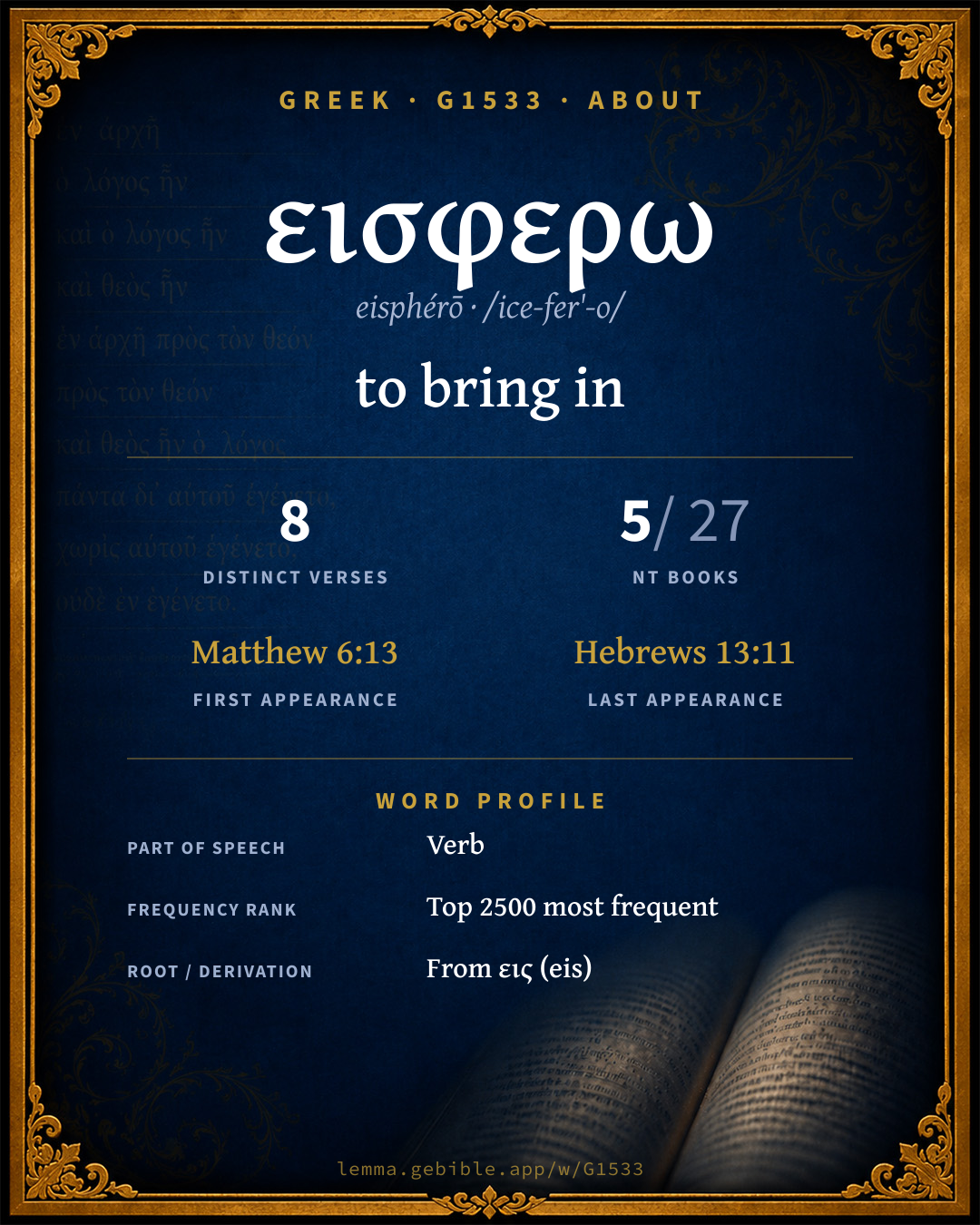
εἰσφέρω
to bring in
‘to bring in’ is one of 2 main senses fuller range ↓
Full lexicon entry — Thayer's Greek Lexicon
From Thayer's Greek Lexicon
Where this word appears
See every Aorist-tense verb in the Greek New Testament →
Grammar key — what these labels mean
Part of speech
- Verb
- An action or state-of-being word.
Tense
- Aorist
- Action viewed as a simple whole, without regard to duration — often past (perfective aspect).
- Present
- Ongoing or general action in present time (imperfective aspect).
Voice
- Active
- The subject performs the action.
- Passive
- The subject receives the action.
Mood
- Subjunctive
- Expresses probability, purpose, or possibility (the mood of contingency).
- Infinitive
- A verbal noun (“to write”), unmarked for person or number.
- Indicative
- States a fact or asks a factual question (the mood of reality).
Person
- 2nd person
- The one addressed (“you”).
- 3rd person
- The one spoken about (“he / she / it / they”).
- 1st person
- The speaker (“I / we”).
Number
- Singular
- One.
- Plural
- More than one.
Every verse where G1533 appears in the Book of Luke — 4 distinct verses. Click any verse to open its interlinear word-by-word view. Verse text shown in the World English Bible for context — . Each verse’s Greek form is shown with its reference; the English is not keyword-highlighted, since the data carries no word-level English alignment. Use “Compare translations” on any verse to read it across multiple English versions. This concordance covers the Greek New Testament; Septuagint (Greek Old Testament) occurrences of this word are not indexed here.
Luke
- Luke 5:18 εἰσενεγκεῖν aor act inf Behold, men brought a paralyzed man on a cot, and they sought to bring him in to lay before Jesus.
- Luke 5:19 εἰσενέγκωσιν aor act subj 3pl Not finding a way to bring him in because of the multitude, they went up to the housetop, and let him down through the tiles with his cot into the midst before Jesus.
- Luke 11:4 εἰσενέγκῃς aor act subj 2sg Forgive us our sins, For we ourselves also forgive everyone who is indebted to us. Bring us not into temptation, But deliver us from the evil one.'"
- Luke 12:11 εἰσφέρωσιν pres act subj 3pl When they bring you before the synagogues, the rulers, and the authorities, don't be anxious how or what you will answer, or what you will say;
About this entry
At a glance — auto-summarized from this page’s data, not written by a person. Every figure links to its source below. This summary describes the numbers; it doesn’t interpret them.
εισφερω — transliterated eisphérō — is a Greek verb carrying the sense “to bring in.” More than half of its appearances fall in Luke. The Greek New Testament uses it across 8 verses — uncommon. Debuting at Matthew 6:13, it then recurs through the corpus. Thayer's distinguishes 2 senses for it. See the sense tree, 8-verse concordance, and the renderings breakdown below.
Gloss history
Strong's 1890 vs modern scholarship

About this word
Strong's G1533 catalogs a Greek word from the Greek New Testament.
These counts are not copied from any lexicon or concordance. They are computed here, from the morphology-tagged Greek New Testament. What Lemma adds →
- 8
- distinct verses
- The word appears in 8 distinct verses.
- 5 / 27
- NT books
- The word appears in 5 of 27 New Testament books.
- #1,240
- by frequency
- Top 2500 most frequent Greek words (rank 1,240 of 5,347 Greek words by occurrence).
View all 8 occurrences in the concordance →
By section of the New Testament
By traditional corpus
Conventional, traditional groupings — biblical authorship is debated, so this is a traditional corpus grouping, not an authorship claim. Some books belong to more than one corpus (Luke is in both the Gospels and the Lukan corpus, and so on), so these shares overlap and need not total 100%. Each figure is a share of the word’s 8 distinct verses.
- Gospels 5 verses · 63%
- Lukan (Luke–Acts) 5 verses · 63%
- Pauline corpus 1 verse · 13%
- Hebrews 1 verse · 13%
How translations render this word
Counts come from each version’s own published word-to-Strong’s tagging or interlinear alignment — an approximate guide to how each version renders this word, not a word-level alignment the data otherwise carries. Because each total is that version’s own tagged count, the per-version totals vary from one another and need not match the appearance or distinct-verse counts above. These counts may also differ from a printed concordance because Lemma counts each distinctly tagged rendering and does not collapse phrase taggings into a single head-word total. This is a fixed set of word-tagged versions (KJV, ASV, BSB, ULT) and does not change with the reading translation you choose elsewhere. Each version’s license is shown beside its name below (and on Sources).
- King James Version: In 2×, Lead 2×
- American Standard Version: Bring 2×, In 2×
- Berean Standard Bible: Lead 2×
- unfoldingWord Literal Text: Bring 4×, Do 2×
King James Version Public Domain
Renders G1533 across 9 tagged occurrences — most commonly:
Plus 5 renderings that appear only once — usually multi-word phrases or single function words the recovered tagging swept in, not distinct renderings.
American Standard Version Public Domain
Renders G1533 across 8 tagged occurrences — most commonly:
Plus 4 renderings that appear only once — usually multi-word phrases or single function words the recovered tagging swept in, not distinct renderings.
Berean Standard Bible Public Domain
Renders G1533 across 7 tagged occurrences — most commonly:
Plus 5 renderings that appear only once — usually multi-word phrases or single function words the recovered tagging swept in, not distinct renderings. Not rendered by a distinct English word in 1 further occurrence.
unfoldingWord Literal Text CC BY-SA 4.0
Renders G1533 across 12 tagged occurrences — most commonly:
Plus 6 renderings that appear only once — usually multi-word phrases or single function words the recovered tagging swept in, not distinct renderings.
Senses in Thayer's
The 2 senses Thayer's distinguishes for this word, in lexicon order (not ranked by frequency or importance). The full entry — with sub-senses — is in the Lexicon Entry tab.
- to bring into, in or to
- to lead into
Word origin
Derived from εις (eis) (G1519) — into.
Forms in the corpus
The 7 distinct written forms G1533 takes in the Greek New Testament, most frequent first — each parse links to that tense’s occurrences in the concordance.
| Form | Parsing | Example | Uses |
|---|---|---|---|
| εἰσενέγκῃς eisenénkēs | Verb, Aorist, Active, Subjunctive, 2nd person, Singular | Matthew 6:13 | 2 |
| εἰσενέγκωσιν eisenénkōsin | Verb, Aorist, Active, Subjunctive, 3rd person, Plural | Luke 5:19 | 1 |
| εἰσενεγκεῖν eisenenkeîn | Verb, Aorist, Active, Infinitive | Luke 5:18 | 1 |
| εἰσηνέγκαμεν eisēnénkamen | Verb, Aorist, Active, Indicative, 1st person, Plural | 1 Timothy 6:7 | 1 |
| εἰσφέρεις eisphéreis | Verb, Present, Active, Indicative, 2nd person, Singular | Acts 17:20 | 1 |
| εἰσφέρεται eisphéretai | Verb, Present, Passive, Indicative, 3rd person, Singular | Hebrews 13:11 | 1 |
| εἰσφέρωσιν eisphérōsin | Verb, Present, Active, Subjunctive, 3rd person, Plural | Luke 12:11 | 1 |
Same root — word family
Other Thayer's entries built from the same root as G1533, grouped by Strong’s listed origin. These share a root / origin per the lexicon — not necessarily a shared meaning. Each links to that word’s own entry.
Derives from
Shares the same root
- εισαγω eiságō G1521 to bring in
- εισακουω eisakoúō G1522 to obey
- εισδεχομαι eisdéchomai G1523 to receive
- εισειμι eíseimi G1524 to go in
- εισερχομαι eisérchomai G1525 to enter
- εισκαλεω eiskaléō G1528 to invite
- εισοδος eísodos G1529 entrance
- εισπηδαω eispēdáō G1530 to rush in
- εισπορευομαι eisporeúomai G1531 to enter
- ειστρεχω eistréchō G1532 to run in
- εν en G1722 in
- εσοπτρον ésoptron G2072 mirror
- εσω ésō G2080 within
- σκυβαλον skýbalon G4657 refuse
Compare all same-root words → Showing 4 of 16 — not the complete family. They share a root, not necessarily a meaning.
Septuagint usage
The same Greek word εισφερω appears 86 times in the Greek Old Testament (Septuagint), across 82 verses in 24 books.
- 86
- LXX occurrences
- Tagged occurrences of this Greek word in the Septuagint.
- 82
- verses
- Distinct Septuagint verses containing this word.
- 24 / 39
- OT books
- The word appears in 24 of the 39 Old Testament books.
Sample Septuagint occurrences
- Genesis 27:10 εἰςφέρω
- Exodus 4:6 εἰςφέρω
- Leviticus 4:5 εἰςφέρω
- Numbers 31:54 εἰςφέρω
- Deuteronomy 7:26 εἰςφέρω
- Joshua 6:19 εἰςφέρω
- Judges 3:22 εἰςφέρω
- 1 Samuel 5:1 εἰςφέρω
- 2 Samuel 9:10 εἰςφέρω
- 1 Kings 7:37 εἰςφέρω
- 2 Kings 12:14 εἰςφέρω
- 1 Chronicles 9:28 εἰςφέρω
Septuagint occurrences (same lexeme)
Every verse where the same Strong’s number (G1533) appears in the Greek Septuagint — showing the first 50 of 82. Verse text shown in the World English Bible for context; the Greek form is the matched word — the English is not keyword-highlighted.
- Genesis 27:10 εἰςφέρω You shall bring it to your father, that he may eat, so that he may bless you before his death."
- Genesis 27:18 εἰςφέρω He came to his father, and said, "My father?" He said, "Here I am. Who are you, my son?"
- Genesis 27:25 εἰςφέρω He said, "Bring it near to me, and I will eat of my son's venison, that my soul may bless you." He brought it near to him, and he ate. He brought him wine, and he drank.
- Genesis 27:33 εἰςφέρω Isaac trembled violently, and said, "Who, then, is he who has taken venison, and brought it me, and I have eaten of all before you came, and have blessed him? Yes, he will be blessed."
- Genesis 37:32 εἰςφέρω They took the coat of many colors, and they brought it to their father, and said, "We have found this. Examine it, now, whether it is your son's coat or not."
- Genesis 47:14 εἰςφέρω Joseph gathered up all the money that was found in the land of Egypt, and in the land of Canaan, for the grain which they bought: and Joseph brought the money into Pharaoh's house.
- Exodus 4:6 εἰςφέρω Yahweh said furthermore to him, "Now put your hand inside your cloak." He put his hand inside his cloak, and when he took it out, behold, his hand was leprous, as white as snow.
- Exodus 4:7 εἰςφέρω He said, "Put your hand inside your cloak again." He put his hand inside his cloak again, and when he took it out of his cloak, behold, it had turned again as his other flesh.
- Exodus 16:5 εἰςφέρω It shall come to pass on the sixth day, that they shall prepare that which they bring in, and it shall be twice as much as they gather daily."
- Exodus 23:19 εἰςφέρω The first of the first fruits of your ground you shall bring into the house of Yahweh your God. "You shall not boil a kid in its mother's milk.
- Exodus 26:33 εἰςφέρω You shall hang up the veil under the clasps, and shall bring the ark of the testimony in there within the veil: and the veil shall separate the holy place from the most holy for you.
- Exodus 40:4 εἰςφέρω You shall bring in the table, and set in order the things that are on it. You shall bring in the lampstand, and light the lamps of it.
- Exodus 40:21 εἰςφέρω He brought the ark into the tent, and set up the veil of the screen, and screened the ark of the testimony, as Yahweh commanded Moses.
- Leviticus 4:5 εἰςφέρω The anointed priest shall take some of the blood of the bull, and bring it to the Tent of Meeting.
- Leviticus 4:16 εἰςφέρω The anointed priest shall bring of the blood of the bull to the Tent of Meeting:
- Leviticus 6:23 εἰςφέρω Every meal offering of a priest shall be wholly burned. It shall not be eaten."
- Leviticus 16:12 εἰςφέρω He shall take a censer full of coals of fire from off the altar before Yahweh, and two handfuls of sweet incense beaten small, and bring it within the veil:
- Leviticus 16:15 εἰςφέρω "Then he shall kill the goat of the sin offering, that is for the people, and bring his blood within the veil, and do with his blood as he did with the blood of the bull, and sprinkle it on the mercy seat, and before the mercy seat:
- Leviticus 16:27 εἰςφέρω The bull for the sin offering, and the goat for the sin offering, whose blood was brought in to make atonement in the Holy Place, shall be carried forth outside the camp; and they shall burn their skins, their flesh, and their dung with fire.
- Numbers 31:54 εἰςφέρω Moses and Eleazar the priest took the gold of the captains of thousands and of hundreds, and brought it into the tent of meeting, for a memorial for the children of Israel before Yahweh.
- Deuteronomy 7:26 εἰςφέρω You shall not bring an abomination into your house, and become a devoted thing like it: you shall utterly detest it, and you shall utterly abhor it; for it is a devoted thing.
- Deuteronomy 11:14 εἰςφέρω that I will give the rain of your land in its season, the former rain and the latter rain, that you may gather in your grain, and your new wine, and your oil.
- Deuteronomy 28:38 εἰςφέρω You shall carry much seed out into the field, and shall gather little in; for the locust shall consume it.
- Joshua 6:19 εἰςφέρω But all the silver, and gold, and vessels of brass and iron, are holy to Yahweh: they shall come into the treasury of Yahweh.
- Joshua 6:24 εἰςφέρω They burnt the city with fire, and all that was therein; only the silver, and the gold, and the vessels of brass and of iron, they put into the treasury of the house of Yahweh.
- Judges 3:22 εἰςφέρω and the haft also went in after the blade; and the fat closed on the blade, for he didn't draw the sword out of his body; and it came out behind.
- Judges 9:27 εἰςφέρω They went out into the field, and gathered their vineyards, and trod [the grapes], and held festival, and went into the house of their god, and did eat and drink, and cursed Abimelech.
- Judges 12:9 εἰςφέρω He had thirty sons; and thirty daughters he sent abroad, and thirty daughters he brought in from abroad for his sons. He judged Israel seven years.
- Judges 19:3 εἰςφέρω Her husband arose, and went after her, to speak kindly to her, to bring her again, having his servant with him, and a couple of donkeys: and she brought him into her father's house; and when the father of the young lady saw him, he rejoiced to meet him.
- Judges 19:21 εἰςφέρω So he brought him into his house, and gave the donkeys fodder; and they washed their feet, and ate and drink.
- 1 Samuel 5:1 εἰςφέρω Now the Philistines had taken the ark of God, and they brought it from Ebenezer to Ashdod.
- 1 Samuel 5:2 εἰςφέρω The Philistines took the ark of God, and brought it into the house of Dagon, and set it by Dagon.
- 1 Samuel 9:7 εἰςφέρω Then said Saul to his servant, But, behold, if we go, what shall we bring the man? for the bread is spent in our vessels, and there is not a present to bring to the man of God: what have we?
- 2 Samuel 9:10 εἰςφέρω You shall till the land for him, you, and your sons, and your servants; and you shall bring in [the fruits], that your master's son may have bread to eat: but Mephibosheth your master's son shall eat bread always at my table." Now Ziba had fifteen sons and twenty servants.
- 2 Samuel 13:10 εἰςφέρω Amnon said to Tamar, Bring the food into the chamber, that I may eat from your hand. Tamar took the cakes which she had made, and brought them into the chamber to Amnon her brother.
- 1 Kings 7:37 εἰςφέρω After this manner he made the ten bases: all of them had one casting, one measure, and one form.
- 1 Kings 8:6 εἰςφέρω The priests brought in the ark of the covenant of Yahweh to its place, into the oracle of the house, to the most holy place, even under the wings of the cherubim.
- 1 Kings 14:6 εἰςφέρω It was so, when Ahijah heard the sound of her feet, as she came in at the door, that he said, Come in, you wife of Jeroboam; why feign you yourself to be another? for I am sent to you with heavy news.
- 1 Kings 15:15 εἰςφέρω He brought into the house of Yahweh the things that his father had dedicated, and the things that himself had dedicated, silver, and gold, and vessels.
- 2 Kings 12:14 εἰςφέρω for they gave that to those who did the work, and repaired therewith the house of Yahweh.
- 2 Kings 12:17 εἰςφέρω Then Hazael king of Syria went up, and fought against Gath, and took it; and Hazael set his face to go up to Jerusalem.
- 2 Kings 20:20 εἰςφέρω Now the rest of the acts of Hezekiah, and all his might, and how he made the pool, and the conduit, and brought water into the city, aren't they written in the book of the chronicles of the kings of Judah?
- 2 Kings 22:4 εἰςφέρω Go up to Hilkiah the high priest, that he may sum the money which is brought into the house of Yahweh, which the keepers of the threshold have gathered of the people:
- 2 Kings 22:9 εἰςφέρω Shaphan the scribe came to the king, and brought the king word again, and said, Your servants have emptied out the money that was found in the house, and have delivered it into the hand of the workmen who have the oversight of the house of Yahweh.
- 2 Kings 23:34 εἰςφέρω Pharaoh Necoh made Eliakim the son of Josiah king in the room of Josiah his father, and changed his name to Jehoiakim: but he took Jehoahaz away; and he came to Egypt, and died there.
- 1 Chronicles 9:28 εἰςφέρω Certain of them had charge of the vessels of service; for by count were these brought in and by count were these taken out.
- 1 Chronicles 13:5 εἰςφέρω So David assembled all Israel together, from the Shihor [the brook] of Egypt even to the entrance of Hamath, to bring the ark of God from Kiriath Jearim.
- 1 Chronicles 13:12 εἰςφέρω David was afraid of God that day, saying, How shall I bring the ark of God home to me?
- 1 Chronicles 16:1 εἰςφέρω They brought in the ark of God, and set it in the midst of the tent that David had pitched for it: and they offered burnt offerings and peace-offerings before God.
- 1 Chronicles 22:19 εἰςφέρω Now set your heart and your soul to seek after Yahweh your God; arise therefore, and build the sanctuary of Yahweh God, to bring the ark of the covenant of Yahweh, and the holy vessels of God, into the house that is to be built to the name of Yahweh.
These are occurrences of the same Greek lexeme (G1533) in the Septuagint — not a translation of any one Hebrew word. The store carries no word-level Hebrew↔Greek alignment, so no Hebrew original is asserted here. Counts come from the recovered LXX Strong's tagging — high-frequency vocabulary is well covered, while rare or late forms may be untagged — so they reflect tagged occurrences and may slightly undercount.