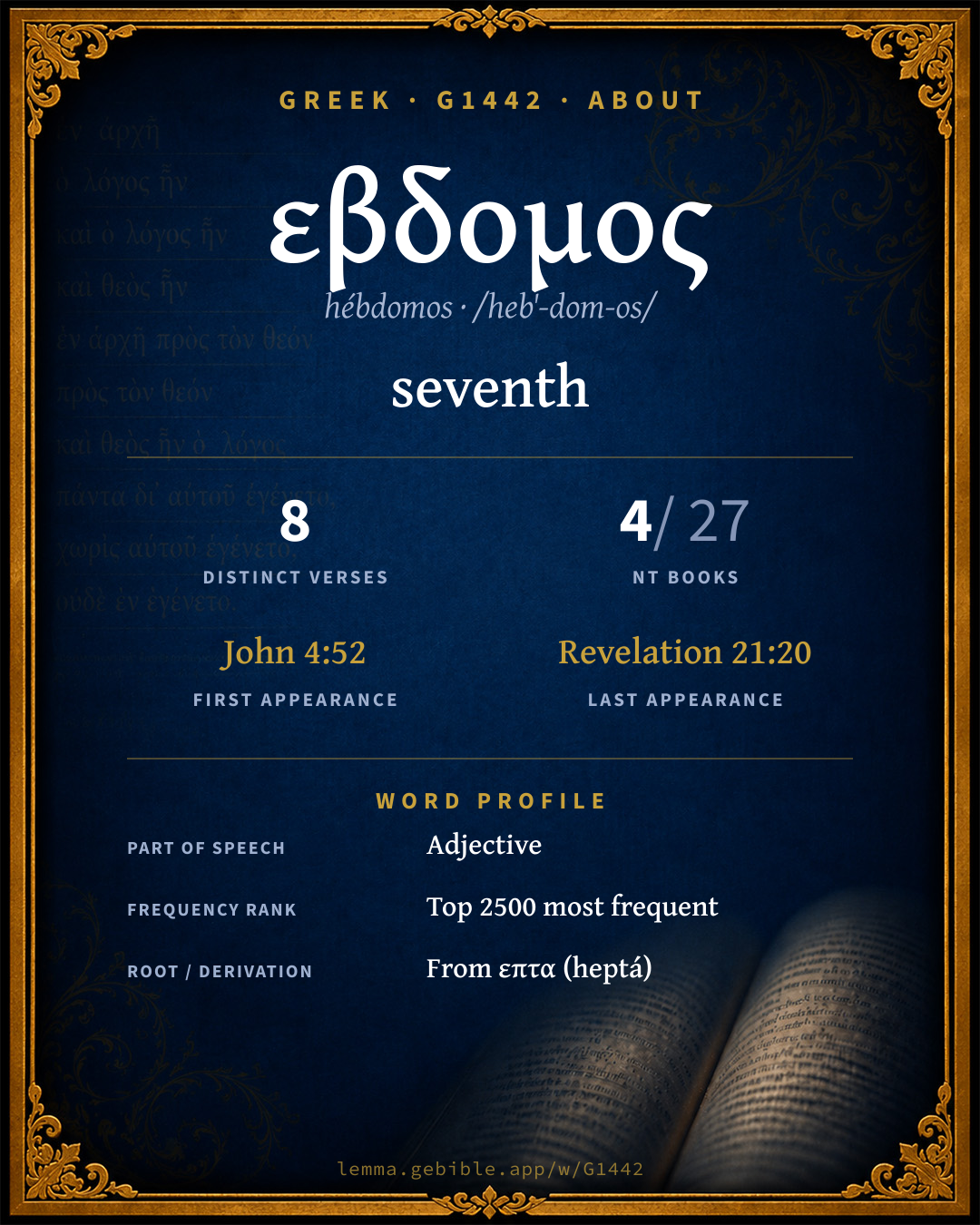
ἕβδομος
seventh
Full lexicon entry — Thayer's Greek Lexicon
From Thayer's Greek Lexicon
Where this word appears
See every Nominative-case word in the Greek New Testament →
Grammar key — what these labels mean
Part of speech
- Adjective
- A word that describes or qualifies a noun.
Case
- Nominative
- The case of the subject (and the predicate nominative).
- Accusative
- The case of the direct object and of extent.
- Dative
- The case of the indirect object, means, or location — “to / for / with / in.”
- Genitive
- The case of source, possession, or “of” — answers “whose / from what.”
Gender
- Masculine
- Grammatically masculine.
- Feminine
- Grammatically feminine.
Number
- Singular
- One.
2 distinct verses where G1442 appears in the Accusative case, across 2 books. Filtered view — show all forms. Click any verse to open its interlinear word-by-word view. Verse text shown in the World English Bible for context — . Each verse’s Greek form is shown with its reference; the English is not keyword-highlighted, since the data carries no word-level English alignment. Use “Compare translations” on any verse to read it across multiple English versions. This concordance covers the Greek New Testament; Septuagint (Greek Old Testament) occurrences of this word are not indexed here.
John 1 verse
Revelation 1 verse
About this entry
At a glance — auto-summarized from this page’s data, not written by a person. Every figure links to its source below. This summary describes the numbers; it doesn’t interpret them.
εβδομος (hébdomos) is a Greek adjective most often rendered “seventh.” Revelation dominates its distribution — 5 of 8 verses. The Greek New Testament uses it across 8 verses — uncommon. Debuting at John 4:52, it then recurs through the corpus. Related forms include επτα, επτακις and εβδομηκοντα. For the data behind this summary, explore the sense tree and the renderings breakdown below.
Gloss history
Strong's 1890 vs modern scholarship
About this word
Strong's G1442 catalogs a Greek word from the Greek New Testament.
These counts are not copied from any lexicon or concordance. They are computed here, from the morphology-tagged Greek New Testament. What Lemma adds →
- 8
- distinct verses
- The word appears in 8 distinct verses.
- 4 / 27
- NT books
- The word appears in 4 of 27 New Testament books.
- #1,140
- by frequency
- Top 2500 most frequent Greek words (rank 1,140 of 5,347 Greek words by occurrence).
View all 8 occurrences in the concordance →
Most concentrated in
- Revelation 5 verses 63%
- John 1 verse 13%
- Hebrews 1 verse 13%
By section of the New Testament
By traditional corpus
Conventional, traditional groupings — biblical authorship is debated, so this is a traditional corpus grouping, not an authorship claim. Some books belong to more than one corpus (Luke is in both the Gospels and the Lukan corpus, and so on), so these shares overlap and need not total 100%. Each figure is a share of the word’s 8 distinct verses.
- Johannine 6 verses · 75%
- Revelation 5 verses · 63%
- Gospels 1 verse · 13%
- Hebrews 1 verse · 13%
- General (Catholic) Epistles 1 verse · 13%
How translations render this word
Counts come from each version’s own published word-to-Strong’s tagging or interlinear alignment — an approximate guide to how each version renders this word, not a word-level alignment the data otherwise carries. Because each total is that version’s own tagged count, the per-version totals vary from one another and need not match the appearance or distinct-verse counts above. These counts may also differ from a printed concordance because Lemma counts each distinctly tagged rendering and does not collapse phrase taggings into a single head-word total. This is a fixed set of word-tagged versions (KJV, ASV, BSB, ULT) and does not change with the reading translation you choose elsewhere. Each version’s license is shown beside its name below (and on Sources).
- King James Version: Seventh 8×
- American Standard Version: Seventh 8×
- Berean Standard Bible: Seventh 9×
- unfoldingWord Literal Text: Seventh 9×
King James Version Public Domain
Renders G1442 across 8 tagged occurrences — most commonly:
Not rendered by a distinct English word in 1 further occurrence.
American Standard Version Public Domain
Renders G1442 across 8 tagged occurrences — most commonly:
Berean Standard Bible Public Domain
Renders G1442 across 9 tagged occurrences — most commonly:
unfoldingWord Literal Text CC BY-SA 4.0
Renders G1442 across 10 tagged occurrences — most commonly:
Plus 1 rendering that appears only once — usually multi-word phrases or single function words the recovered tagging swept in, not distinct renderings.
Senses in Thayer's
The 1 sense Thayer's distinguishes for this word, in lexicon order (not ranked by frequency or importance). The full entry — with sub-senses — is in the Lexicon Entry tab.
- seventh
Word origin
Derived from επτα (heptá) (G2033) — seven.
Ordinal from G2033 ; seventh : - seventh.
— Strong’s Exhaustive Concordance (1890), public domain.
Forms in the corpus
The 5 distinct written forms G1442 takes in the Greek New Testament, most frequent first — each parse links to that case’s occurrences in the concordance.
| Form | Parsing | Example | Uses |
|---|---|---|---|
| ἕβδομος hébdomos | Adjective, Nominative, Singular, Masculine | Jude 1:14 | 4 |
| ἑβδόμην hebdómēn | Adjective, Accusative, Singular, Feminine | John 4:52 | 2 |
| ἑβδόμης hebdómēs | Adjective, Genitive, Singular, Feminine | Hebrews 4:4 | 1 |
| ἑβδόμου hebdómou | Adjective, Genitive, Singular, Masculine | Revelation 10:7 | 1 |
| ἑβδόμῃ hebdómē | Adjective, Dative, Singular, Feminine | Hebrews 4:4 | 1 |
Same root — word family
Other Thayer's entries built from the same root as G1442, grouped by Strong’s listed origin. These share a root / origin per the lexicon — not necessarily a shared meaning. Each links to that word’s own entry.
Derives from
Shares the same root
Derived from this word
Compare all same-root words → They share a root, not necessarily a meaning.
Septuagint usage
The same Greek word εβδομος appears 114 times in the Greek Old Testament (Septuagint), across 107 verses in 19 books.
- 114
- LXX occurrences
- Tagged occurrences of this Greek word in the Septuagint.
- 107
- verses
- Distinct Septuagint verses containing this word.
- 19 / 39
- OT books
- The word appears in 19 of the 39 Old Testament books.
Sample Septuagint occurrences
- Genesis 2:2 ἕβδομος
- Exodus 12:15 ἕβδομος
- Leviticus 13:5 ἕβδομος
- Numbers 6:9 ἕβδομος
- Deuteronomy 5:14 ἕβδομος
- Joshua 6:15 ἕβδομος
- Judges 14:17 ἕβδομος
- 2 Samuel 12:18 ἕβδομος
- 1 Kings 18:44 ἕβδομος
- 2 Kings 11:4 ἕβδομος
- 1 Chronicles 2:15 ἕβδομος
- 2 Chronicles 5:3 ἕβδομος
Septuagint occurrences (same lexeme)
Every verse where the same Strong’s number (G1442) appears in the Greek Septuagint — showing the first 50 of 107. Verse text shown in the World English Bible for context; the Greek form is the matched word — the English is not keyword-highlighted.
- Genesis 2:2 ἕβδομος On the seventh day God finished his work which he had made; and he rested on the seventh day from all his work which he had made.
- Genesis 2:3 ἕβδομος God blessed the seventh day, and made it holy, because he rested in it from all his work which he had created and made.
- Genesis 7:11 ἕβδομος In the six hundredth year of Noah's life, in the second month, on the seventeenth day of the month, on the same day all the fountains of the great deep were burst open, and the sky's windows were opened.
- Genesis 8:4 ἕβδομος The ark rested in the seventh month, on the seventeenth day of the month, on Ararat's mountains.
- Genesis 8:14 ἕβδομος In the second month, on the twenty-seventh day of the month, the earth was dry.
- Genesis 29:27 ἕβδομος Fulfill the week of this one, and we will give you the other also for the service which you will serve with me yet seven other years."
- Genesis 29:28 ἕβδομος Jacob did so, and fulfilled her week. He gave him Rachel his daughter as wife.
- Exodus 12:15 ἕβδομος Seven days shall you eat unleavened bread; even the first day you shall put away yeast out of your houses, for whoever eats leavened bread from the first day until the seventh day, that soul shall be cut off from Israel.
- Exodus 12:16 ἕβδομος In the first day there shall be to you a holy convocation, and in the seventh day a holy convocation; no manner of work shall be done in them, except that which every man must eat, that only may be done by you.
- Exodus 13:6 ἕβδομος Seven days you shall eat unleavened bread, and in the seventh day shall be a feast to Yahweh.
- Exodus 16:26 ἕβδομος Six days you shall gather it, but on the seventh day is the Sabbath. In it there shall be none."
- Exodus 16:27 ἕβδομος It happened on the seventh day, that some of the people went out to gather, and they found none.
- Exodus 16:29 ἕβδομος Behold, because Yahweh has given you the Sabbath, therefore he gives you on the sixth day the bread of two days. Everyone stay in his place. Let no one go out of his place on the seventh day."
- Exodus 16:30 ἕβδομος So the people rested on the seventh day.
- Exodus 20:10 ἕβδομος but the seventh day is a Sabbath to Yahweh your God. You shall not do any work in it, you, nor your son, nor your daughter, your man-servant, nor your maid-servant, nor your cattle, nor your stranger who is within your gates;
- Exodus 20:11 ἕβδομος for in six days Yahweh made heaven and earth, the sea, and all that is in them, and rested the seventh day; therefore Yahweh blessed the Sabbath day, and made it holy.
- Exodus 21:2 ἕβδομος If you buy a Hebrew servant, he shall serve six years and in the seventh he shall go out free without paying anything.
- Exodus 23:11 ἕβδομος but the seventh year you shall let it rest and lie fallow, that the poor of your people may eat; and what they leave the animal of the field shall eat. In like manner you shall deal with your vineyard and with your olive grove.
- Exodus 23:12 ἕβδομος "Six days you shall do your work, and on the seventh day you shall rest, that your ox and your donkey may have rest, and the son of your handmaid, and the alien may be refreshed.
- Exodus 24:16 ἕβδομος The glory of Yahweh settled on Mount Sinai, and the cloud covered it six days. The seventh day he called to Moses out of the midst of the cloud.
- Exodus 31:15 ἕβδομος Six days shall work be done, but on the seventh day is a Sabbath of solemn rest, holy to Yahweh. Whoever does any work on the Sabbath day shall surely be put to death.
- Exodus 31:17 ἕβδομος It is a sign between me and the children of Israel forever; for in six days Yahweh made heaven and earth, and on the seventh day he rested, and was refreshed.'"
- Exodus 34:21 ἕβδομος Six days you shall work, but on the seventh day you shall rest: in plowing time and in harvest you shall rest.
- Exodus 35:2 ἕβδομος 'Six days shall work be done, but on the seventh day there shall be a holy day for you, a Sabbath of solemn rest to Yahweh: whoever does any work in it shall be put to death.
- Exodus 38:16 ἕβδομος All the hangings around the court were of fine twined linen.
- Leviticus 13:5 ἕβδομος The priest shall examine him on the seventh day, and, behold, if in his eyes the plague is arrested, and the plague hasn't spread in the skin, then the priest shall isolate him for seven more days.
- Leviticus 13:6 ἕβδομος The priest shall examine him again on the seventh day; and, behold, if the plague has faded, and the plague hasn't spread in the skin, then the priest shall pronounce him clean. It is a scab. He shall wash his clothes, and be clean.
- Leviticus 13:27 ἕβδομος The priest shall examine him on the seventh day. If it has spread in the skin, then the priest shall pronounce him unclean. It is the plague of leprosy.
- Leviticus 13:32 ἕβδομος On the seventh day the priest shall examine the plague; and, behold, if the itch hasn't spread, and there is no yellow hair in it, and the appearance of the itch isn't deeper than the skin,
- Leviticus 13:34 ἕβδομος On the seventh day, the priest shall examine the itch; and, behold, if the itch hasn't spread in the skin, and its appearance isn't deeper than the skin, then the priest shall pronounce him clean. He shall wash his clothes, and be clean.
- Leviticus 13:51 ἕβδομος He shall examine the plague on the seventh day. If the plague has spread in the garment, either in the warp, or in the woof, or in the skin, whatever use the skin is used for, the plague is a destructive mildew. It is unclean.
- Leviticus 14:9 ἕβδομος It shall be on the seventh day, that he shall shave all his hair off his head and his beard and his eyebrows, even all his hair he shall shave off. He shall wash his clothes, and he shall bathe his body in water, then he shall be clean.
- Leviticus 14:39 ἕβδομος The priest shall come again on the seventh day, and look. If the plague has spread in the walls of the house,
- Leviticus 16:29 ἕβδομος "It shall be a statute to you forever: in the seventh month, on the tenth day of the month, you shall afflict your souls, and shall do no manner of work, the native-born, or the stranger who lives as a foreigner among you:
- Leviticus 23:3 ἕβδομος "'Six days shall work be done: but on the seventh day is a Sabbath of solemn rest, a holy convocation; you shall do no manner of work. It is a Sabbath to Yahweh in all your dwellings.
- Leviticus 23:8 ἕβδομος But you shall offer an offering made by fire to Yahweh seven days. In the seventh day is a holy convocation: you shall do no regular work.'"
- Leviticus 23:24 ἕβδομος "Speak to the children of Israel, saying, 'In the seventh month, on the first day of the month, shall be a solemn rest to you, a memorial of blowing of trumpets, a holy convocation.
- Leviticus 23:27 ἕβδομος "However on the tenth day of this seventh month is the day of atonement: it shall be a holy convocation to you, and you shall afflict yourselves; and you shall offer an offering made by fire to Yahweh.
- Leviticus 23:34 ἕβδομος "Speak to the children of Israel, and say, 'On the fifteenth day of this seventh month is the feast of tents for seven days to Yahweh.
- Leviticus 23:39 ἕβδομος "'So on the fifteenth day of the seventh month, when you have gathered in the fruits of the land, you shall keep the feast of Yahweh seven days: on the first day shall be a solemn rest, and on the eighth day shall be a solemn rest.
- Leviticus 23:41 ἕβδομος You shall keep it a feast to Yahweh seven days in the year: it is a statute forever throughout your generations; you shall keep it in the seventh month.
- Leviticus 25:4 ἕβδομος but in the seventh year there shall be a Sabbath of solemn rest for the land, a Sabbath to Yahweh. You shall not sow your field or prune your vineyard.
- Leviticus 25:9 ἕβδομος Then you shall sound the loud trumpet on the tenth day of the seventh month. On the Day of Atonement you shall sound the trumpet throughout all your land.
- Leviticus 25:20 ἕβδομος If you said, "What shall we eat the seventh year? Behold, we shall not sow, nor gather in our increase;"
- Numbers 6:9 ἕβδομος "If any man dies very suddenly beside him, and he defiles the head of his separation; then he shall shave his head in the day of his cleansing. On the seventh day he shall shave it.
- Numbers 7:48 ἕβδομος On the seventh day Elishama the son of Ammihud, prince of the children of Ephraim
- Numbers 19:12 ἕβδομος the same shall purify himself therewith on the third day, and on the seventh day he shall be clean: but if he doesn't purify himself the third day, then the seventh day he shall not be clean.
- Numbers 19:19 ἕβδομος and the clean person shall sprinkle on the unclean on the third day, and on the seventh day: and on the seventh day he shall purify him; and he shall wash his clothes, and bathe himself in water, and shall be clean at even.
- Numbers 28:25 ἕβδομος On the seventh day you shall have a holy convocation: you shall do no servile work.
- Numbers 29:1 ἕβδομος In the seventh month, on the first day of the month, you shall have a holy convocation; you shall do no servile work: it is a day of blowing of trumpets to you.
These are occurrences of the same Greek lexeme (G1442) in the Septuagint — not a translation of any one Hebrew word. The store carries no word-level Hebrew↔Greek alignment, so no Hebrew original is asserted here. Counts come from the recovered LXX Strong's tagging — high-frequency vocabulary is well covered, while rare or late forms may be untagged — so they reflect tagged occurrences and may slightly undercount.