Revelation 21:20

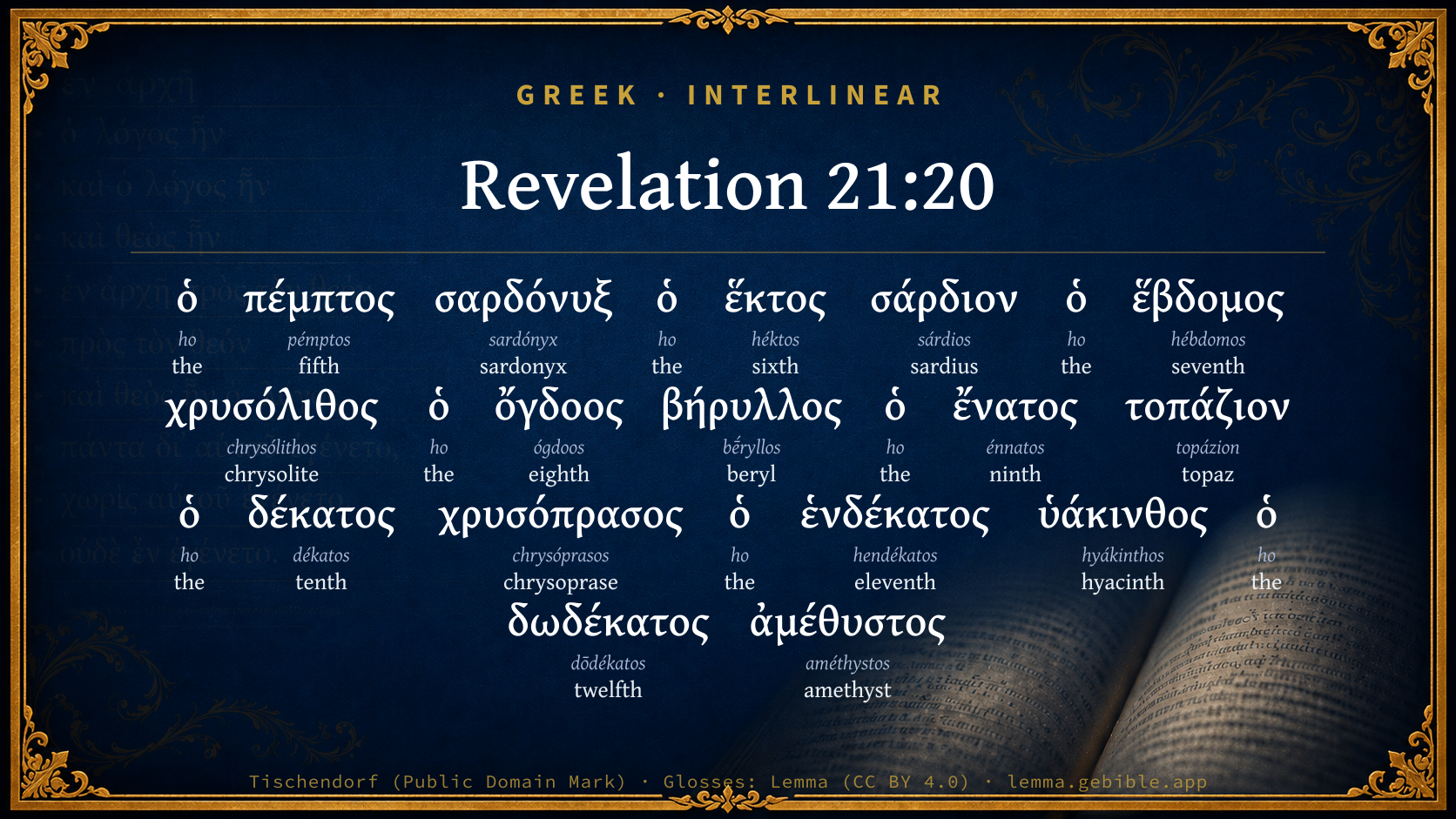
Greek (Tischendorf 8th ed.) Revelation 21:20 appears in the Greek New Testament. The text above is from the Tischendorf 8th edition. Each word links to its Strong’s number and a concise gloss. Click any word for its full Thayer’s Greek Lexicon entry.
Download image
Cite this verse

Revelation 21:20 (World English Bible). Public Domain. Lemma interlinear Bible study tool, https://lemma.gebible.app/v/revelation/21/20.

Show BibTeX & RIS
BibTeX
RIS
English Translation
the fifth, sardonyx; the sixth, sardius; the seventh, chrysolite; the eighth, beryl; the ninth, topaz; the tenth, chrysoprasus; the eleventh, jacinth; and the twelfth, amethyst.
World English Bible · Public Domain
Highlights
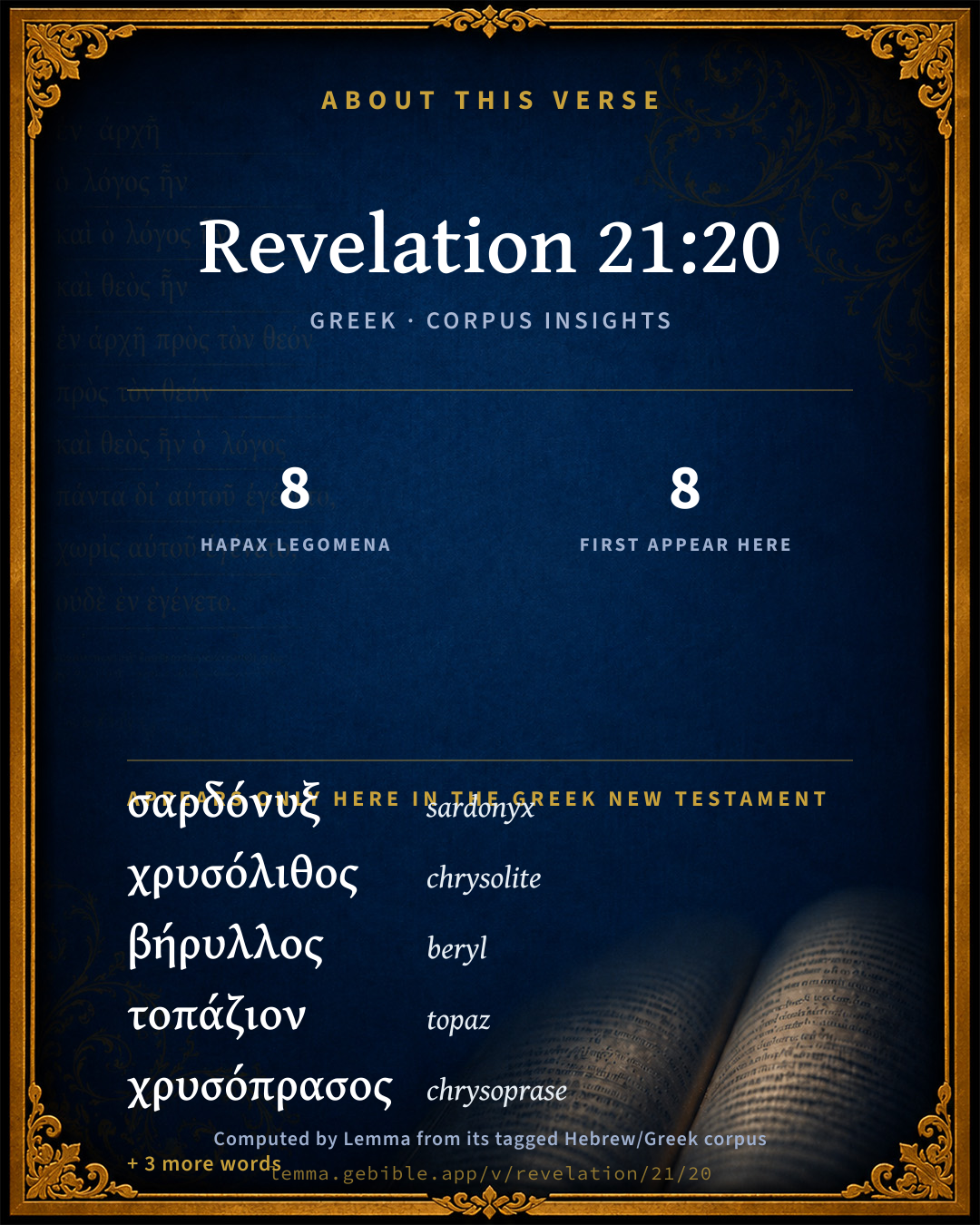
  • 6 hapax legomena — only here in the Greek New Testament
  • 8 first appearances in the Greek New Testament
Full analysis ↓
Download a study sheet

One document with this verse’s original text, its word-by-word gloss line, the meaning frame, cross-references with their text, attributed commentary, and full source and license credits — printable, and it pastes into notes with its structure intact.

This verse Autodidact and up

Study sheet (.html) Plain text (.txt)

A passage Seminary Student

Up to 50 verses in one chapter. A passage sheet keeps up to 6 commentary sources and 12 cross-references per verse, in the order this page ranks them, and says so on the sheet whenever that leaves anything out. Ask for a single verse and you get the Autodidact verse sheet above.

Everything on this page stays free to read, with no account — the sheet is a download of what is already on screen, not access to it.

Want to remove ads? Support Godless Engineer
Compare translations 3

The same verse in 3 English versions, stacked beneath the original-language interlinear above. Click any original word for its lexicon entry.

Each is an independent rendering of the whole verse — the interlinear is not word-aligned to these translations.

Highlighted words mark where these versions differ — a whole-verse word diff, not a word-by-word alignment.

  • World English Bible Public Domain
    the fifth, sardonyx; the sixth, sardius; the seventh, chrysolite; the eighth, beryl; the ninth, topaz; the tenth, chrysoprasus; the eleventh, jacinth; and the twelfth, amethyst.
  • King James Version Public Domain
    The fifth, sardonyx; the sixth, sardius; the seventh, chrysolyte; the eighth, beryl; the ninth, a topaz; the tenth, a chrysoprasus; the eleventh, a jacinth; the twelfth, an amethyst.
  • unfoldingWord Literal Text CC BY-SA 4.0
    the fifth sardonyx, the sixth carnelian, the seventh chrysolite, the eighth beryl, the ninth topaz, the tenth chrysoprase, the eleventh jacinth, the twelfth amethyst.

unfoldingWord Literal Text — © unfoldingWord, licensed CC BY-SA 4.0. Word-aligned USFM3 via Door43 (git.door43.org/unfoldingWord/en_ult).

Versions to compare (up to 4)

3 of 4 selected

Show all 19 translations

Every available English version of this verse, each an independent rendering of the whole verse.

  • World English Bible Public Domain
    the fifth, sardonyx; the sixth, sardius; the seventh, chrysolite; the eighth, beryl; the ninth, topaz; the tenth, chrysoprasus; the eleventh, jacinth; and the twelfth, amethyst.
  • Berean Standard Bible Public Domain
    the fifth sardonyx, the sixth carnelian, the seventh chrysolite, the eighth beryl, the ninth topaz, the tenth chrysoprase, the eleventh jacinth, and the twelfth amethyst.
  • Majority Standard Bible Public Domain
    the fifth sardonyx, the sixth carnelian, the seventh chrysolite, the eighth beryl, the ninth topaz, the tenth chrysoprase, the eleventh jacinth, and the twelfth amethyst.
  • King James Version Public Domain
    The fifth, sardonyx; the sixth, sardius; the seventh, chrysolyte; the eighth, beryl; the ninth, a topaz; the tenth, a chrysoprasus; the eleventh, a jacinth; the twelfth, an amethyst.
  • American Standard Version (1901) Public Domain
    the fifth, sardonyx; the sixth, sardius; the seventh, chrysolite; the eighth, beryl; the ninth, topaz; the tenth, chrysoprase; the eleventh, jacinth; the twelfth, amethyst.
  • Revised Version (1885) Public Domain
    the fifth, sardonyx; the sixth, sardius; the seventh, chrysolite; the eighth, beryl; the ninth, topaz; the tenth, chrysoprase; the eleventh, jacinth; the twelfth, amethyst.
  • Geneva Bible (1599) Public Domain
    The fift of a Sardonix: the sixt of a Sardius: the seueth of a Chrysolite: the eight of a Beryl: the ninth of a Topaze: the tenth of a Chrysoprasus: the eleuenth of a Iacynth: the twelfth an Amethyst.
  • Douay-Rheims (1899) Public Domain
    The fifth, sardonyx: the sixth, sardius: the seventh, chrysolite: the eighth, beryl: the ninth, a topaz: the tenth, a chrysoprasus: the eleventh, a jacinth: the twelfth, an amethyst.
  • Young's Literal Translation Public Domain
    the fifth, sardonyx; the sixth, sardius; the seventh, chrysolite; the eighth, beryl; the ninth, topaz; the tenth, chrysoprasus; the eleventh, jacinth; the twelfth, amethyst.
  • Literal Standard Version CC BY-SA 4.0
    the fifth sardonyx, the sixth sardius, the seventh chrysolite, the eighth beryl, the ninth topaz, the tenth chrysoprase, the eleventh jacinth, the twelfth amethyst.
  • Unlocked Literal Bible CC BY-SA 4.0
    the fifth was onyx, the sixth was carnelian, the seventh was chrysolite, the eighth was beryl, the ninth was topaz, the tenth was chrysoprase, the eleventh was jacinth, and the twelfth was amethyst.
  • unfoldingWord Literal Text CC BY-SA 4.0
    the fifth sardonyx, the sixth carnelian, the seventh chrysolite, the eighth beryl, the ninth topaz, the tenth chrysoprase, the eleventh jacinth, the twelfth amethyst.
  • Darby Bible Public Domain
    the fifth, sardonyx; the sixth, sardius; the seventh, chrysolite; the eighth, beryl; the ninth, topaz; the tenth, chrysoprasus; the eleventh, jacinth; the twelfth, amethyst.
  • World Messianic Bible Public Domain
    the fifth sardonyx, the sixth sardius, the seventh chrysolite, the eighth beryl, the ninth topaz, the tenth chrysoprase, the eleventh jacinth, and the twelfth amethyst.
  • Webster's Bible Public Domain
    The fifth, sardonyx; the sixth, sardius; the seventh, chrysolite; the eighth, beryl; the ninth, a topaz; the tenth, a chrysoprase; the eleventh, a jacinth; the twelfth, an amethyst.
  • Free Bible Version CC BY-SA 4.0
    the fifth sardonyx, the sixth carnelian, the seventh chrysolite, the eighth beryl, the ninth topaz, the tenth, chrysoprase, the eleventh jacinth, the twelfth amethyst.
  • Bible in Basic English Public Domain
    The fifth, sardonyx; the sixth, sardius; the seventh, chrysolite; the eighth, beryl; the ninth, topaz; the tenth, chrysoprase; the eleventh, jacinth; the twelfth, amethyst.
  • Text-Critical English NT CC BY 4.0
    the fifth, sardonyx; the sixth, carnelian; the seventh, chrysolite; the eighth, beryl; the ninth, topaz; the tenth, chrysoprase; the eleventh, jacinth; and the twelfth, amethyst.
  • Tyndale New Testament (1534) Public Domain
    the fyft sardonix: the sixt sardeos: the seventh crysolite the ayght berall: the nynth a topas: the tenth a crysoprasos: the eleventh a iacyncte: the twelfe an amatist.

Literal Standard Version (2020), Covenant Press — licensed CC BY-SA 4.0. Text via the HelloAO Bible API (eBible.org). Unlocked Literal Bible (unfoldingWord) — licensed CC BY-SA 4.0. Text via the HelloAO Bible API (eBible.org). unfoldingWord Literal Text — © unfoldingWord, licensed CC BY-SA 4.0. Word-aligned USFM3 via Door43 (git.door43.org/unfoldingWord/en_ult). Free Bible Version, Dr. Jonathan Gallagher — licensed CC BY-SA 4.0. Text via the HelloAO Bible API (eBible.org).

Word by word

More ways to search: Search by grammar → Find every occurrence → Compare this word →

Practice this passage: Drill this verse → Learn its vocabulary →

σαρδόνυξ
sardónyx
G4557
“sardonyx”
Noun, Nominative, Singular, Feminine
Part of Speech
Noun
Case
Nominative
Number
Singular
Gender
Feminine
Full Thayer's Definition

Origin: "from the base of G4556 and onux (the nail of a finger, hence the "onyx" stone)"

TDNT: None

1. a sardonyx, a precious stone marked by the red colours of the carnelian (sard) and the white of the onyx
  1. ὁ ho G3588 “the” Article, Nominative, Singular, Masculine
  2. πέμπτος pémptos G3991 “fifth” Adjective, Nominative, Singular, Masculine
  3. ὁ ho G3588 “the” Article, Nominative, Singular, Masculine
  4. ἕκτος héktos G1623 “sixth” Adjective, Nominative, Singular, Masculine
  5. σάρδιον sárdios G4556 “sardius” Noun, Nominative, Singular, Neuter
  6. ὁ ho G3588 “the” Article, Nominative, Singular, Masculine
  7. ἕβδομος hébdomos G1442 “seventh” Adjective, Nominative, Singular, Masculine
  8. χρυσόλιθος chrysólithos G5555 “chrysolite” Noun, Nominative, Singular, Masculine
  9. ὁ ho G3588 “the” Article, Nominative, Singular, Masculine
  10. ὄγδοος ógdoos G3590 “eighth” Adjective, Nominative, Singular, Masculine
  11. βήρυλλος bḗryllos G969 “beryl” Noun, Nominative, Singular, Masculine
  12. ὁ ho G3588 “the” Article, Nominative, Singular, Masculine
  13. ἔνατος énnatos G1766 “ninth” Adjective, Nominative, Singular, Masculine
  14. τοπάζιον topázion G5116 “topaz” Noun, Nominative, Singular, Neuter
  15. ὁ ho G3588 “the” Article, Nominative, Singular, Masculine
  16. δέκατος dékatos G1182 “tenth” Adjective, Nominative, Singular, Masculine
  17. χρυσόπρασος chrysóprasos G5556 “chrysoprase” Noun, Nominative, Singular, Masculine
  18. ὁ ho G3588 “the” Article, Nominative, Singular, Masculine
  19. ἑνδέκατος hendékatos G1734 “eleventh” Adjective, Nominative, Singular, Masculine
  20. ὑάκινθος hyákinthos G5192 “hyacinth” Noun, Nominative, Singular, Masculine
  21. ὁ ho G3588 “the” Article, Nominative, Singular, Masculine
  22. δωδέκατος dōdékatos G1428 “twelfth” Adjective, Nominative, Singular, Masculine
  23. ἀμέθυστος améthystos G271 “amethyst” Noun, Nominative, Singular, Feminine

About this verse

These counts appear in no published source. They are computed here, from the morphology-tagged text and Lemma’s own curated glosses. What Lemma adds →

24
words
17
distinct lemmas
Revelation
section

Notable vocabulary

8 hapax legomena — words that appear only here in the entire Greek New Testament:

  • σαρδόνυξ sardonyx G4557
  • χρυσόλιθος chrysolite G5555
  • βήρυλλος beryl G969
  • τοπάζιον topaz G5116
  • χρυσόπρασος chrysoprase G5556
  • ὑάκινθος hyacinth G5192

First appearance in Scripture

These words make their first canonical appearance in the Greek New Testament here:

  • σαρδόνυξ sardonyx G4557
  • χρυσόλιθος chrysolite G5555
  • βήρυλλος beryl G969
  • τοπάζιον topaz G5116
  • χρυσόπρασος chrysoprase G5556
  • ὑάκινθος hyacinth G5192
  • δωδέκατος twelfth G1428
  • ἀμέθυστος amethyst G271

Shared distinctive vocabulary

σάρδιον sardius G4556 occurs in 2 verses of the Greek New Testament. Also found in:

Repetition

A word recurs within this verse:

Cross-references

1

Topical passages linked to Revelation 21:20 in the Treasury of Scripture Knowledge — connected by theme and wording, ordered by reader-vote popularity; previews shown in the World English Bible.

  • Revelation 4:3 that looked like a jasper stone and a sardius. There was a rainbow around the throne, like an emerald to look at.

Cross-references courtesy of OpenBible.info (CC BY 4.0).

Commentary

Notes on Revelation 21:20 from classic Christian and Jewish commentators (each source and its license shown beneath its notes). The classic Christian expositions comment on the surrounding passage and are grouped to its opening verse, so a note may address several verses; the Jewish commentaries on the Tanakh (Rashi and others) are per-verse, so they appear only where the commentator wrote on this verse.

Lemma curates 59 commentaries, every one of them public domain or Creative Commons licensed, each selected and text-cleaned for this edition rather than reprinted as found. About our sources →

Bengel's Gnomon

Johann Albrecht Bengel

Rev 21:20. Σάρδιος) The most approved MSS. have here σάρδιον,[234] and the LXX. and Epiphanius. Let this be compared with the Syntagmata of Hiller, p. 86.

[234] Hence the decision of the Ed. maj. being set aside, σάρδιον is preferred in the margin of Ed. 2.—E. B. AB Memph, have σάρδιον· h Vulg. and Rec. Text, σάρδιος.—E.

Bengel's Gnomon of the New Testament — English translation (T&T Clark, Edinburgh, 1860) — public domain. Text from a community e-Sword module.

Jamieson, Fausset & Brown

Robert Jamieson, A. R. Fausset & David Brown

sardonyx--a gem having the redness of the cornelian, and the whiteness of the onyx.

sardius--(See on Rev 4:3).

chrysolite--described by PLINY as transparent and of a golden brightness, like our topaz: different from our pale green crystallized chrysolite.

beryl--of a sea-green color.

topaz--PLINY [37.32], makes it green and transparent, like our chrysolite.

chrysoprasus--somewhat pale, and having the purple color of the amethyst [PLINY, 37, 20, 21].

jacinth--The flashing violet brightness in the amethyst is diluted in the jacinth [PLINY, 37.41].

Jamieson, Fausset & Brown — Commentary Critical and Explanatory on the Whole Bible (1871) — public domain (CC PDM 1.0). Text via the HelloAO Bible API.

Adam Clarke's Commentary

Verse 20. The fifth, sardonyx] The onyx is an accidental variety of the agate kind; it is of a dark horny colour, in which is a plate of a bluish white, and sometimes of red. When on one or both sides of the white there happens to lie also a plate of a reddish colour, the jewellers call the stone a sardonyx.

The sixth, sardius] The sardius, sardel, or sardine stone, is a precious stone of a blood-red colour.

The seventh, chrysolite] The gold stone. It is of a dusky green with a cast of yellow. It is a species of the topaz.

The eighth, beryl] This is a pellucid gem of a bluish green colour.

The ninth, a topaz] A pale dead green, with a mixture of yellow. It is considered by the mineralogists as a variety of the sapphire.

The tenth, a chrysoprasus] A variety of the chrysolite, called by some the yellowish green and cloudy topaz. It differs from the chrysolite only in having a bluish hue.

The eleventh, a jacinth] A precious stone of a dead red colour, with a mixture of yellow. It is the same as the hyacenet or cinnamon stone.

The twelfth, an amethyst.] A gem generally of a purple or violet colour, composed of a strong blue and deep red.

These stones are nearly the same with those on the breastplate of the high priest, Ex 28:17, &c., and probably were intended to express the meaning of the Hebrew words there used. See the notes on the above passages, where these gems are particularly explained.

Adam Clarke's Commentary on the Bible (1810–1826) — public domain. Text from a community e-Sword/MySword module.

The Cambridge Bible for Schools and Colleges

gen. ed. J. J. S. Perowne

20. chrysolite … topaz] According to the best authorities, the ancient application of these names was the reverse of the modern. Chrysolite ought, according to the etymology, to be a “golden stone,” while the modern chrysolite is green. Perhaps the ancient chrysolite included the modern jacinth as well as the true “Oriental topaz”.

chrysoprasus] A variety of the beryl, of a more yellowish-green: probably that now called chrysolite.

jacinth] Probably our sapphire, the “sapphire” above being lapis lazuli. The modern jacinth is a crystalline stone, usually red.

amethyst] This, the emerald, sardius, and beryl are undoubtedly the stones now so called.

The Cambridge Bible for Schools and Colleges (gen. ed. J. J. S. Perowne; Cambridge University Press, 1878–1918) — public domain. Text from a community e-Sword module.

John Gill's Exposition

And the twelve gates were twelve pearls,.... Denoting the purity and preciousness of Christ, by whom the saints enter, and of the saints who enter in thereat, as well as of the place into which they enter.

Every several gate was of one pearl; the pearl of great price, the Lord Jesus Christ, who is the only gate, door, and way into this happy state: this shows that this account cannot be taken literally, but mystically, for no such pearl was ever known, large enough to make a gate of.

"A pearl is a hard, white, shining body, usually roundish, found in a shell fish resembling an oyster, but is three or four times the size of the common oyster; and which ordinarily yields ten or twelve pearls, and sometimes more. Those of the largest size that have been known are that of Cleopatra, valued by Pliny at centies H S, or at 80,000 pound sterling; and that brought in 1574 to Philip the Second, of the size of a pigeon's egg, worth 14,400 ducats; and that of the Emperor Rudolph, mentioned by Boetius, called "la peregrina", or the incomparable, of the size of a muscade pear, and weighing 30 carats; and that mentioned by Tavernier, in the hands of the emperor of Persia in 1633, bought of an Arab for 32,000 tomans, which, at three pounds nine shillings the toman, amounts to 110,400 pounds sterling (p).''

But what is one of these pearls to make a gate of, for a wall which was an hundred and forty four cubits high? Rev 21:17. The Jews say (q), that the holy blessed God will bring precious stones and "pearls" of thirty cubits by thirty, &c. and place them "in the gates of Jerusalem", as it is said, Isa 54:12 which must be understood also not in a literal but mystical sense: and L'Empereur (r) makes mention of an ancient commentary on Psa 87:1 which says, that the holy blessed God will make a gate at the east (of the temple), and in it two doors, each of one pearl. So R. Joshua ben Levi says (s), that there are in paradise two gates of agates or diamonds; some render the word rubies.

And the street of the city was pure gold, as it were transparent glass; denoting the preciousness and delightfulness of the saints' conversation one with another; and the purity and cleanness of it, there being no mire and filth of sin in these streets; and the sincerity and openness of it, each one walking in his uprightness; which will be seen and known of all, as clearly as anything can be beheld in a transparent glass. So the Jews say (t) of paradise, that the ground is paved with precious stones, the lustre of which may be compared to the light of burning torches.

(p) Chambers's Cyclopedia in the word "Pearl". (q) T. Bab. Sanhedrin, fol. 100. 1. & Bava Bathra, fol. 75. 1. & Yalkut, par. 2. fol. 54. 1. (r) Misn. Middot, c. 4. sect. 2. Vid. Yalkut Simconi, par. 2. fol. 54. 1. (s) Yalkut Simeoni, par. 1. fol. 7. 1. (t) Sepher. Avodah Hakkodesh, fol. 46. 1.

John Gill's Exposition of the Whole Bible (1746–1763) — public domain (CC PDM 1.0). Text via the HelloAO Bible API.

Trapp's Complete Commentary

John Trapp

20 The fifth, sardonyx; the sixth, sardius; the seventh, chrysolite; the eighth, beryl; the ninth, a topaz; the tenth, a chrysoprasus; the eleventh, a jacinth; the twelfth, an amethyst.

Ver. 20. The fifth, sardonyx] Search is here made through all the bowels of the earth for something of worth to shadow out the saints’ happiness; which if it could be fully known (as it cannot) it would be no strange thing or thankworthy for the most horrible Belialist to become presently the holiest saint, or the world’s greatest minion the most mortified man. He that desires to know the natures and virtues of these precious stones, may read Epiphanius, Philo, Franciseus, Rurus, and others, De gemmis; Josephus also in the third book of his Jewish Antiquities. That was an odd conceit, and scarce worth relating, held by Anaxagoras, Caelum ex lapidibus constare, et aliquando collapsurum, that heaven was made up of stones, and would one day fall upon men’s heads. That other saying of his is much more memorable, when being asked, Wherefore he was born? He answered, Ut caelum contemplar, that I might busy my thoughts about heaven.

John Trapp, A Commentary or Exposition upon All the Books of the Old and New Testament (1647–1656) — public domain. Text from a community e-Sword module.

Albert Barnes' Notes on the Bible

The fifth, sardonyx - This word does not occur elsewhere in the New Testament. The “name” is derived from “Sardis,” a city in Asia Minor (notes on Rev 3:1), and ὄνυξ onux, a nail - so named, according to Pliny, from the resemblance of its color to the flesh and the nail. It is a silicious stone or gem, nearly allied to the onyx. The color is a reddish yellow, nearly orange (Webster, Dictionary).

The sixth, sardius - This word does not elsewhere occur in the New Testament. It is also derived from “Sardis,” and the name was probably given to the gem because it was found there. It is a stone of a blood-red or flesh color, and is commonly known as a “carnelian.” It is the same as the sardine stone mentioned in Rev 4:3. See the notes on that place.

The seventh, chrysolite - This word does not elsewhere occur in the New Testament. It is derived from χρυσὸς chrusos, “gold,” and λίθος lithos, “stone,” and means “golden stone,” and was applied by the ancients to all gems of a golden or yellow color, probably designating particularly the topaz of the moderns (Robinson, Lexicon). But in Webster’s Dictionary it is said that its prevalent color is green. It is sometimes transparent. This is the “modern” chrysolite. The ancients undoubtedly understood by the name a “yellow” gem.

The eighth, beryl - This word occurs nowhere else in the New Testament. The beryl is a mineral of great hardness, and is of a green or bluish-green color. It is identical with the emerald, except in the color, the emerald having a purer and richer green color, proceeding from a trace of oxide of chrome. Prisms of beryl are sometimes found nearly two feet in diameter in the state of New Hampshire (Webster).

The ninth, a topaz - This word does not elsewhere occur in the New Testament. The topaz is a well-known mineral, said to be so called from “Topazos,” a small island in the Arabian Gulf. It is generally of a yellowish color, and pellucid, but it is also found of greenish, bluish, or brownish shades.

The tenth, a chrysoprasus - This word χρυσόπρασος chrusoprasos does not occur elsewhere in the New Testament. It is derived from χρυσὸς chrusos, “gold,” and πράσον prason, “a leek,” and denotes a precious stone of greenish golden color, like a leek; that is, “apple-green passing into a grass-green” (Robinson, Lexicon). “It is a variety of quartz. It is commonly apple-green, and often extremely beautiful. It is translucent, or sometimes semi-transparent; its hardness little inferior to flint” (Webster, Dictionary).

The eleventh, a jacinth - The word does not occur elsewhere in the New Testament. It is the same word as “hyacinth” - ὑάκινθος huakinthos - and denotes properly the well-known flower of that name, usually of a deep purple or reddish blue. Here it denotes a gem of this color. It is a red variety of “zircon.” See Webster’s Dictionary under the word “hyacinth.”

The twelfth, an amethyst - This word, also, is found only in this place in the New Testament. It denotes a gem of a deep purple or violet color. The word is derived from α a, the alpha privative (“not”), and μεθύω methuō, to be intoxicated, because this gem was supposed to be an antidote against drunkenness. It is a species of quartz, and is used in jewelry.

Albert Barnes' Notes on the Bible (1834–1885) — public domain. Text from a community e-Sword/MySword module.

Matthew Poole's English Annotations

I cannot tell what to make of these precious stones, with which they are said to be garnished, unless it be their spiritual gifts and habits of grace; the various manifestations of the Holy Spirit given to the apostles to profit the church withal, with which they adorned the doctrine of the gospel, and won upon the pagan world, making themselves admirable in the eyes of men and women. Nor were it hard to descant upon these several sorts of stones, and to show of what graces they may be types: the jasper, of steadiness and constancy; the sapphire, of heavenly mindedness (it being a stone of the colour of the heavens); the chalcedony, of zeal; the emerald of vigour and liveliness; the sardonyx, (a stone of various colours), of various gifts and graces; the sardius, of courage and fortitude, and a readiness to shed their blood for Christ; the chrysolyte, of love, or wisdom, and knowledge; the beryl, of a quickness of sight and understanding; the topaz, of searching out Divine mysteries; the chrysoprasus, of gravity and severity; the jacinth, of spiritual joy, calmness, and serenity of mind; the amethyst, of sobriety and temperence. But it seems to me too great curiosity to philosophize so far upon the nature of these stones; take them together, they probably signify all the gifts and graces of the blessed apostles, by which the religion of the gospel was first commended, and made to appear lovely to the world.

Matthew Poole's English Annotations on the Holy Bible (1683–1685) — public domain. Text from a community e-Sword/MySword module.

Whedon's Commentary on the Bible

Daniel D. Whedon

20. “Sardonyx is a mixture of chalcedony and cornelian, which last is of a flesh colour. Sardius is probably the cornelian. Sometimes, however, the red is quite vivid. Chrysolite, as its name imports, is of a yellow or gold colour, and is pellucid. From this was probably taken the conception of the pellucid gold which constitutes the material of the city. Beryl is of a sea-green colour. The topaz of the present day seems to be reckoned as yellow; but that of the ancients appears to have been pale green. Chrysoprasus, of a pale yellow and greenish colour, like a scallion. Sometimes it is classed at the present day under topaz. Jacinth, (hyacinth,) of a deep red or violet colour.

Amethyst—A gem of great hardness and brilliancy, of a violet colour, and usually found in India.

“In looking over these various classes we find the first four to be of a green or bluish cast; the fifth and sixth, of a red or scarlet; the seventh, yellow; the eighth, ninth, and tenth, of different shades of the lighter green; the eleventh and twelfth, of a scarlet or splendid red. There is classification, therefore, in this arrangement—a mixture not dissimilar to the arrangement in the rainbow, with the exception that it is more complex. The splendour of such a foundation, or basis of the wall, admits of no question. As to the order of arrangement of colours, it is difficult to say what rule is followed, and mere mental conception about propriety of order is hardly adequate to guide us. Whether this arrangement is in conformity with some ornamental arrangements of the day which were regarded as beautiful, we cannot positively affirm; yet, in itself, this is highly probable. At all events, the precious stones here named were the same, beyond any reasonable doubt, which are mentioned as set into the breastplate of the Jewish high priest.

Exo_28:17-20; Exo_39:10-13. On these stones in the breastplate, moreover, were engraved the names of the twelve tribes of Israel, (Exo_28:21; Exo_39:14,) just as the names of the twelve apostles are here said to be engraved on the precious stones in the foundation. Rev_21:14.”—Stuart.

Daniel D. Whedon (gen. ed.), Commentary on the Old and New Testaments (1874–1909) — public domain. Text from a community e-Sword module.

The Pulpit Commentary

The fifth, sardonyx. A variety of agate a kind of onyx, valued for its use in engraving into cameos. The name onyx appears to be owing to the resemblance in colour to the fingernails. The sixth, sardius. Probably the modern carnelian. (see on Rev_4:3) The seventh, chrysolyte. A variety of the gem of which that called topaz (the ninth stone) is another kind. This species contained a considerable amount of yellow colour, whence the name "golden stone." It has been suggested that it is identical with the modern jacinth or amber. The eighth, beryl. A variety of emerald, of less decided green shade than the pure emerald. The ninth, a topaz. Not the modern topaz, but a variety of chrysolite (see the seventh stone, supra), of a yellowish-green colour, the latter predominating. The tenth, a chrysoprasus. The name "golden leek green" appears to point to a species of beryl, and the modern aquamarine. It is thus probably a variety of emerald, being of a yellowish pale green hue. The eleventh, a jacinth. "A red variety of zircon, which is found in square prisms, of a white, grey, red, reddish brown, yellow, or pale green colour" (Smith"s "Dictionary of the Bible"). "The sapphire of the moderns" (King). The twelfth, an amethyst. A purple stone, possibly the common amethyst.

The Pulpit Commentary (1880–1919), ed. H.D.M. Spence-Jones & Joseph S. Exell — public domain. Text from a community e-Sword module.

John Wesley's Explanatory Notes

A sardonyx is red streaked with white; a sardius, of a deep red; a chrysolite, of a deep yellow; a beryl, sea-green; a topaz, pale yellow; a chrysoprase is greenish and transparent, with gold specks; a jacinth, of a red purple; an amethyst, violet purple.

John Wesley, Explanatory Notes Upon the Whole Bible (1754–1765) — public domain. Text via the GEBible commentary corpus.

Cambridge Greek Testament for Schools and Colleges

20. χρυσόλιθος … τοπάζιον. According to the best authorities, the ancient application of these names was the reverse of the modern. Chrysolite ought, according to the etymology, to be a “golden stone,” while the modern chrysolite is green. As early as Epiphanius the oriental chrysolite or chrysoberyl had taken the name of chrysolite which passed from it to the softer peridot, the ancient topaz, and as the chrysoberyl was also a “topaz” this became a possible name for all yellow stones.

χρυσόπρασος. A variety of beryl, of a more yellowish green; probably one of the stones now called chrysolite, our chrysoprasus being then unknown.

ὑάκινθος. Our sapphire, see on Rev 9:17.

ἀμέθυστος. This, the emerald, sardius, sardonyx and beryl are undoubtedly the stones now so called.

Cambridge Greek Testament for Schools and Colleges (Cambridge University Press, 1896; 21 vols, various authors incl. Carr, Maclear, Plummer, Farrar, Lumby, Moule, M. R. James, Simcox) — public domain. Text from a community e-Sword module.

Vincent's Word Studies in the New Testament

Marvin R. Vincent

Sardonyx [σαρδονυξ] . The most beautiful and rarest variety of onyx. Pliny defines it as originally signifying a white mark in a sard, like the human nail [ονυξ] placed upon flesh, and both of them transparent. Onyx is called from the resemblance of its white and yellow veins to the shades in the human finger - nail. The early Greeks make no distinction between the onyx and the sardonyx.

Sardius. See on ch. Rev 4:3.

Chrysolite [χρυσολιθος] . From crusov gold and liqov stone. Lit., gold - stone. Identified by some with our topaz, by others with amber.

Pliny describes it as "translucent with golden luster."

Beryl [βηρυλλος] . Pliny says that it resembled the greenness of the pure sea. It has been supposed to be of the same or similar nature with the emerald.

Topaz (topazion). Compare Job 28:19. The name was derived from an island in the Red Sea where the gem was first discovered. The stone is our peridot. The Roman lapidaries distinguished the two varieties, the chrysopteron, our chrysolite, and the prasoides, our peridot. The former is much harder, and the yellow color predominates over the green. The modern topaz was entirely unknown to the ancients.

Chrysoprasus. Rev., chrysoprase. From crusov gold and prason a leek; the color being a translucent, golden green, like that of a leek. According to Pliny it was a variety of the beryl.

Jacinth [υακινθος] . See on ch. Rev 9:17.

Amethyst [αμεθυστος] . From aj not and mequw to be drunken in wine, the stone being supposed to avert intoxication. Pliny distinguishes it from the jacinth, in that, in the latter, the violet hue of the amethyst is diluted. The stone is the amethystine quartz, or rock - crystal, colored purple by manganese of iron.

Marvin R. Vincent, Word Studies in the New Testament (1887–1900) — public domain. Text from a community e-Sword/MySword module.

Lesson kit

Teaching starters — assembled from the data on this page, not authored interpretation. Every prompt links to the verse data it draws on. Edit before teaching.

Revelation, in the Revelation, opens this verse with 24 words (17 distinct Greek lemmas). Its most distinctive word is sardónyx (“sardonyx”). A historical commentator’s framing appears above. Read the whole chapter for the surrounding context.

Discussion questions

  1. The word sardónyx carries the sense “sardonyx.” How does it shape the verse?
  2. This verse holds 8 words here found nowhere else in the Greek New Testament. What might the rare words draw attention to?
  3. 8 words here appear for the first time in Scripture. What is being introduced at this debut?
  4. Revelation 4:3 shares the word «sardius» with this verse. How do the two illuminate each other?
  5. “the” occurs 8× in this one verse. What is the effect of the repetition?
  6. The translations on this page render this verse differently — a whole-verse word diff, not a word-by-word alignment. What might account for the different wordings?
  7. Reading how Bengel's Gnomon and Jamieson, Fausset & Brown read this verse, where do the two commentators agree and where do they part?

Things to notice

  • 8 words in this verse appear nowhere else in the Greek New Testament.
  • 8 words make their first canonical appearance in Scripture here.
  • These translations choose different wording for 6 words in this verse.
  • “the” occurs 8× in this single verse.
  • 17 distinct Greek lemmas span 24 words in this verse.

Reading settings

Reading text

Shown beneath each verse's original-language words.

Old Testament
Old Testament edition

Read the OT as the Masoretic Hebrew (MT) or the Greek Septuagint (LXX).

English shown for the Greek Septuagint (in the Hebrew ↔ Greek comparison).

Comparing translations? Open the Compare panel on any verse page to stack up to four side by side.