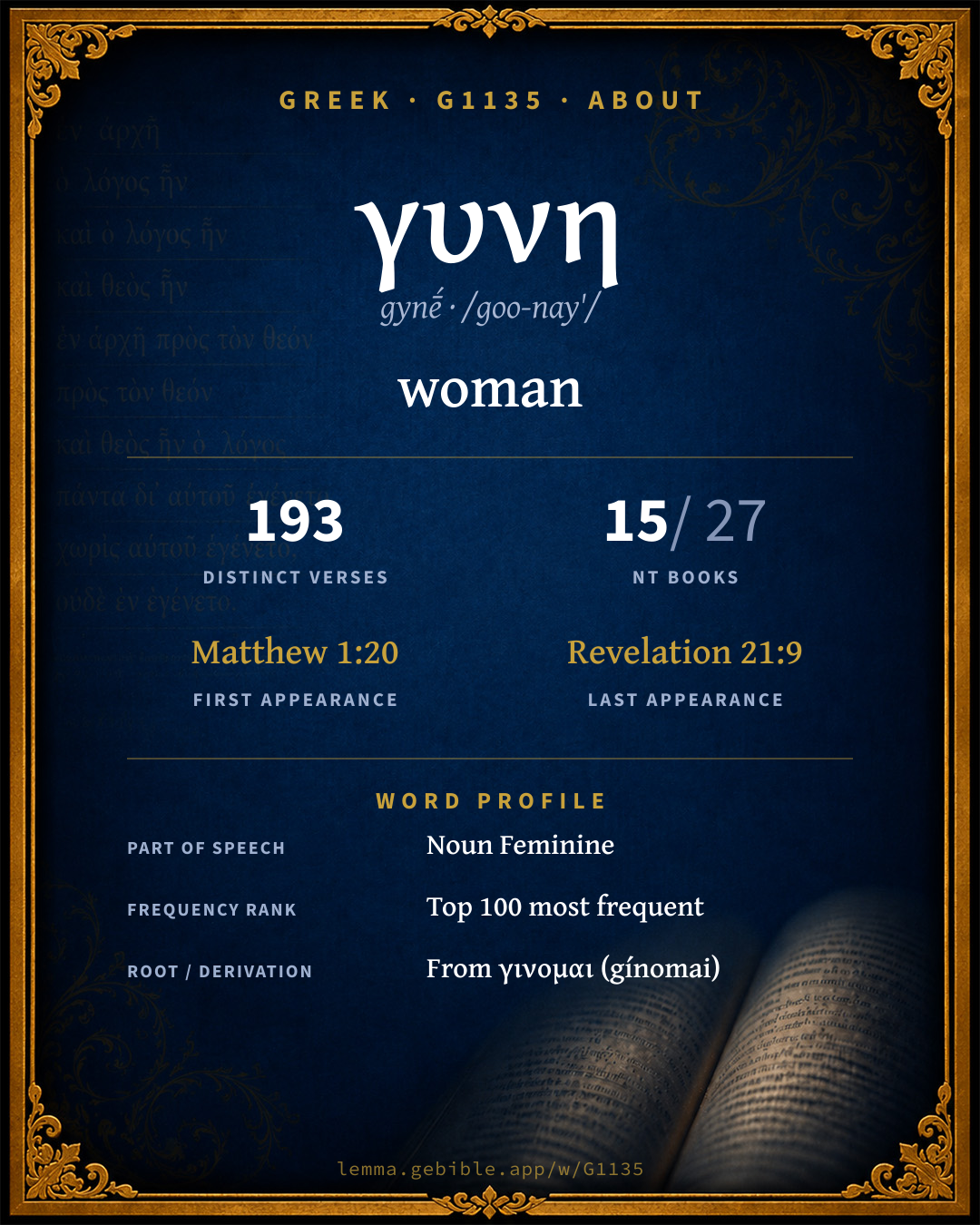
γυνή
woman
‘woman’ is one of 2 main senses fuller range ↓
Full lexicon entry — Thayer's Greek Lexicon
From Thayer's Greek Lexicon
Where this word appears
See every Nominative-case word in the Greek New Testament →
Grammar key — what these labels mean
Part of speech
- Noun
- A naming word — a person, place, thing, or idea.
Case
- Nominative
- The case of the subject (and the predicate nominative).
- Accusative
- The case of the direct object and of extent.
- Genitive
- The case of source, possession, or “of” — answers “whose / from what.”
- Dative
- The case of the indirect object, means, or location — “to / for / with / in.”
- Vocative
- The case of direct address (“O Lord”).
Gender
- Feminine
- Grammatically feminine.
Number
- Singular
- One.
- Plural
- More than one.
2 verses where G1135 appears in the Nominative case in the Book of 1 Peter. Filtered view — show all forms. Click any verse to open its interlinear word-by-word view. Verse text shown in the World English Bible for context — . Each verse’s Greek form is shown with its reference; the English is not keyword-highlighted, since the data carries no word-level English alignment. Use “Compare translations” on any verse to read it across multiple English versions. This concordance covers the Greek New Testament; Septuagint (Greek Old Testament) occurrences of this word are not indexed here.
1 Peter
- 1 Peter 3:1 γυναῖκες γυναικῶν n nom pl fem n gen pl fem In like manner, wives, be in subjection to your own husbands; so that, even if any don't obey the Word, they may be won by the behavior of their wives without a word;
- 1 Peter 3:5 γυναῖκες n nom pl fem For this is how the holy women before, who hoped in God, also adorned themselves, being in subjection to their own husbands:
About this entry
At a glance — auto-summarized from this page’s data, not written by a person. Every figure links to its source below. This summary describes the numbers; it doesn’t interpret them.
γυνη (gynḗ) is a Greek noun most often rendered “woman.” It first appears in Matthew 1:20. It turns up in 193 verses across 15 books, a common footprint. Its lexical range runs to 2 senses. From the same root come γινομαι, γενος and γονευς. The sections below give every sense, occurrence, and version rendering.
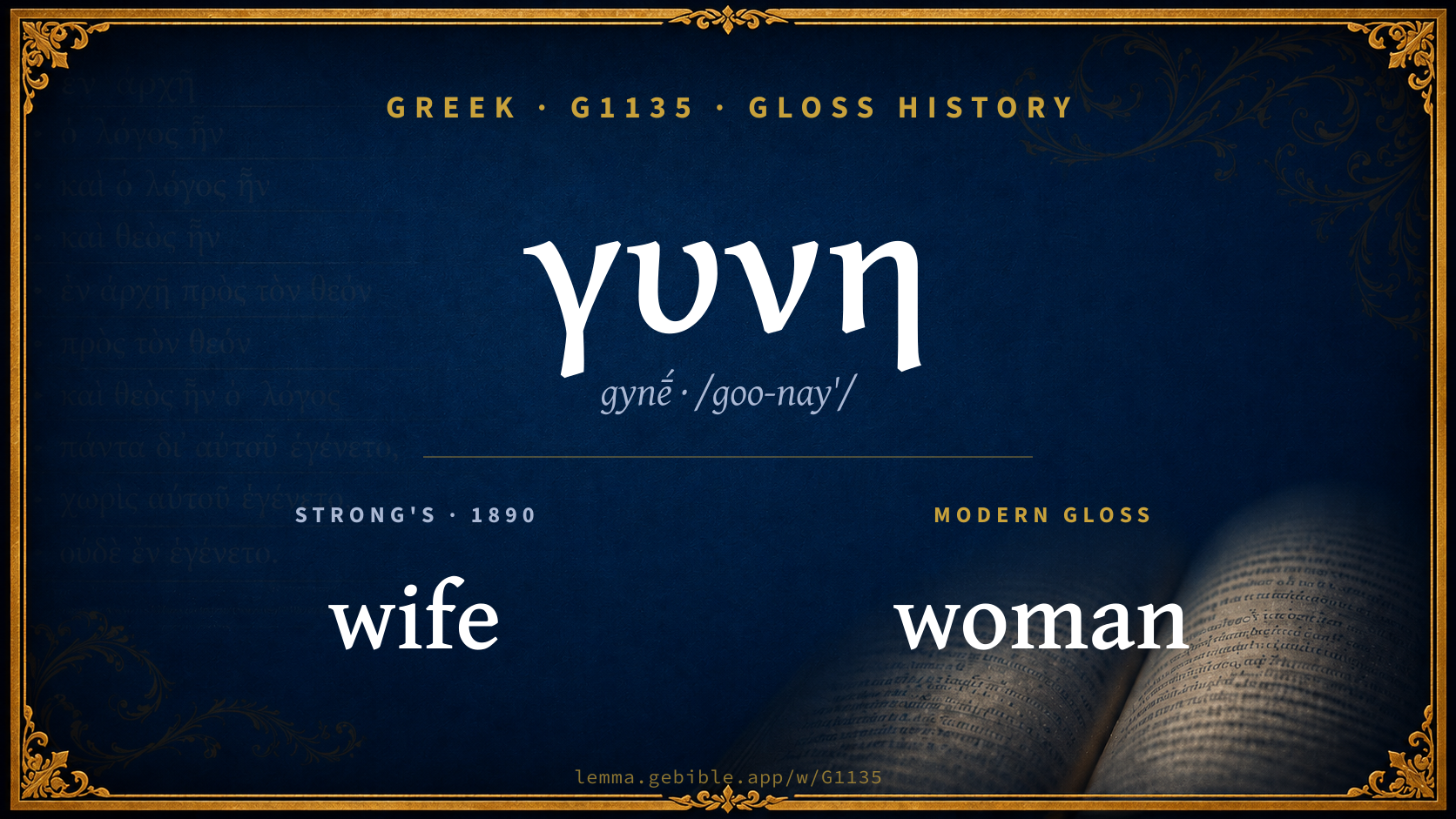
Gloss history
Strong's 1890 vs modern scholarship
About this word
Strong's G1135 catalogs a Greek word from the Greek New Testament.
These counts are not copied from any lexicon or concordance. They are computed here, from the morphology-tagged Greek New Testament. What Lemma adds →
- 193
- distinct verses
- The word appears in 193 distinct verses.
- 15 / 27
- NT books
- The word appears in 15 of 27 New Testament books.
- #76
- by frequency
- Top 100 most frequent Greek words (rank 76 of 5,347 Greek words by occurrence).
View all 193 occurrences in the concordance →
Most concentrated in
- Luke 37 verses 19%
- 1 Corinthians 30 verses 16%
- Matthew 29 verses 15%
By section of the New Testament
By traditional corpus
Conventional, traditional groupings — biblical authorship is debated, so this is a traditional corpus grouping, not an authorship claim. Some books belong to more than one corpus (Luke is in both the Gospels and the Lukan corpus, and so on), so these shares overlap and need not total 100%. Each figure is a share of the word’s 193 distinct verses.
- Gospels 101 verses · 52%
- Lukan (Luke–Acts) 56 verses · 29%
- Pauline corpus 51 verses · 26%
- Johannine 40 verses · 21%
- Revelation 19 verses · 10%
- General (Catholic) Epistles 2 verses · 1%
- Hebrews 1 verse · 1%
How translations render this word
Counts come from each version’s own published word-to-Strong’s tagging or interlinear alignment — an approximate guide to how each version renders this word, not a word-level alignment the data otherwise carries. Because each total is that version’s own tagged count, the per-version totals vary from one another and need not match the appearance or distinct-verse counts above. These counts may also differ from a printed concordance because Lemma counts each distinctly tagged rendering and does not collapse phrase taggings into a single head-word total. This is a fixed set of word-tagged versions (KJV, ASV, BSB, ULT) and does not change with the reading translation you choose elsewhere. Each version’s license is shown beside its name below (and on Sources).
- King James Version: Woman 95×, Wife 80×, Women 33×
- American Standard Version: Woman 90×, Wife 65×, Women 32×
- Berean Standard Bible: Woman 93×, Wife 66×, Women 32×
- unfoldingWord Literal Text: Woman 97×, Wife 73×, Women 32×
King James Version Public Domain
Renders G1135 across 221 tagged occurrences — most commonly:
Plus 4 renderings that appear only once — usually multi-word phrases or single function words the recovered tagging swept in, not distinct renderings.
American Standard Version Public Domain
Renders G1135 across 216 tagged occurrences — most commonly:
Plus 13 renderings that appear only once — usually multi-word phrases or single function words the recovered tagging swept in, not distinct renderings.
Berean Standard Bible Public Domain
Renders G1135 across 210 tagged occurrences — most commonly:
Plus 6 renderings that appear only once — usually multi-word phrases or single function words the recovered tagging swept in, not distinct renderings. Not rendered by a distinct English word in 5 further occurrences.
unfoldingWord Literal Text CC BY-SA 4.0
Renders G1135 across 233 tagged occurrences — most commonly:
Plus 6 renderings that appear only once — usually multi-word phrases or single function words the recovered tagging swept in, not distinct renderings.
Senses in Thayer's
The 2 senses Thayer's distinguishes for this word, in lexicon order (not ranked by frequency or importance). The full entry — with sub-senses — is in the Lexicon Entry tab.
- a woman of any age, whether a virgin, or married, or a widow
- of a betrothed woman
Word origin
Derived from γινομαι (gínomai) (G1096) — to become.
Probably from the base of G1096 ; a woman ; specifically a wife : - wife woman.
— Strong’s Exhaustive Concordance (1890), public domain.
Forms in the corpus
The 17 distinct written forms G1135 takes in the Greek New Testament, most frequent first — each parse links to that case’s occurrences in the concordance.
Same root — word family
Other Thayer's entries built from the same root as G1135, grouped by Strong’s listed origin. These share a root / origin per the lexicon — not necessarily a shared meaning. Each links to that word’s own entry.
Derives from
Shares the same root
Derived from this word
Compare all same-root words → Showing 4 of 6 — not the complete family. They share a root, not necessarily a meaning.
Septuagint usage
The same Greek word γυνη appears 771 times in the Greek Old Testament (Septuagint), across 671 verses in 31 books.
- 771
- LXX occurrences
- Tagged occurrences of this Greek word in the Septuagint.
- 671
- verses
- Distinct Septuagint verses containing this word.
- 31 / 39
- OT books
- The word appears in 31 of the 39 Old Testament books.
Sample Septuagint occurrences
- Genesis 2:22 γυνή
- Exodus 1:19 γυνή
- Leviticus 12:2 γυνή
- Numbers 5:6 γυνή
- Deuteronomy 2:34 γυνή
- Joshua 1:14 γυνή
- Judges 1:12 γυνή
- Ruth 1:1 γυνή
- 1 Samuel 1:2 γυνή
- 2 Samuel 1:26 γυνή
- 1 Kings 2:17 γυνή
- 2 Kings 4:1 γυνή
Septuagint occurrences (same lexeme)
Every verse where the same Strong’s number (G1135) appears in the Greek Septuagint — showing the first 50 of 671. Verse text shown in the World English Bible for context; the Greek form is the matched word — the English is not keyword-highlighted.
- Genesis 2:22 γυνή He made the rib, which Yahweh God had taken from the man, into a woman, and brought her to the man.
- Genesis 2:23 γυνή The man said, "This is now bone of my bones, and flesh of my flesh. She will be called Woman, because she was taken out of Man."
- Genesis 2:24 γυνή Therefore a man will leave his father and his mother, and will join with his wife, and they will be one flesh.
- Genesis 2:25 γυνή They were both naked, the man and his wife, and were not ashamed.
- Genesis 3:1 γυνή Now the serpent was more subtle than any animal of the field which Yahweh God had made. He said to the woman, "Yes, has God said, 'You shall not eat of any tree of the garden?'"
- Genesis 3:2 γυνή The woman said to the serpent, "Of the fruit of the trees of the garden we may eat,
- Genesis 3:4 γυνή The serpent said to the woman, "You won't surely die,
- Genesis 3:6 γυνή When the woman saw that the tree was good for food, and that it was a delight to the eyes, and that the tree was to be desired to make one wise, she took of the fruit of it, and ate; and she gave some to her husband with her, and he ate.
- Genesis 3:8 γυνή They heard the voice of Yahweh God walking in the garden in the cool of the day, and the man and his wife hid themselves from the presence of Yahweh God among the trees of the garden.
- Genesis 3:12 γυνή The man said, "The woman whom you gave to be with me, she gave me of the tree, and I ate."
- Genesis 3:13 γυνή Yahweh God said to the woman, "What is this you have done?" The woman said, "The serpent deceived me, and I ate."
- Genesis 3:15 γυνή I will put enmity between you and the woman, and between your offspring and her offspring. He will bruise your head, and you will bruise his heel."
- Genesis 3:16 γυνή To the woman he said, "I will greatly multiply your pain in childbirth. In pain you will bring forth children. Your desire will be for your husband, and he will rule over you."
- Genesis 3:17 γυνή To Adam he said, "Because you have listened to your wife's voice, and have eaten of the tree, of which I commanded you, saying, 'You shall not eat of it,' cursed is the ground for your sake. In toil you will eat of it all the days of your life.
- Genesis 3:20 γυνή The man called his wife Eve, because she was the mother of all living.
- Genesis 3:21 γυνή Yahweh God made coats of skins for Adam and for his wife, and clothed them.
- Genesis 4:1 γυνή The man knew Eve his wife. She conceived, and gave birth to Cain, and said, "I have gotten a man with Yahweh's help."
- Genesis 4:17 γυνή Cain knew his wife. She conceived, and gave birth to Enoch. He built a city, and called the name of the city, after the name of his son, Enoch.
- Genesis 4:19 γυνή Lamech took two wives: the name of the one was Adah, and the name of the other Zillah.
- Genesis 4:23 γυνή Lamech said to his wives, "Adah and Zillah, Hear my voice, You wives of Lamech, listen to my speech, For I have slain a man for wounding me, A young man for bruising me.
- Genesis 4:25 γυνή Adam knew his wife again. She gave birth to a son, and named him Seth. For, she said, "God has appointed me another child instead of Abel, for Cain killed him."
- Genesis 6:2 γυνή that God's sons saw that men's daughters were beautiful, and they took for themselves wives of all that they chose.
- Genesis 6:18 γυνή But I will establish my covenant with you. You shall come into the ark, you, your sons, your wife, and your sons' wives with you.
- Genesis 7:7 γυνή Noah went into the ark with his sons, his wife, and his sons' wives, because of the waters of the flood.
- Genesis 7:13 γυνή In the same day Noah, and Shem, Ham, and Japheth, the sons of Noah, and Noah's wife, and the three wives of his sons with them, entered into the ark;
- Genesis 8:16 γυνή "Go forth from the ark, you, and your wife, and your sons, and your sons' wives with you.
- Genesis 8:18 γυνή Noah went forth, with his sons, his wife, and his sons' wives with him.
- Genesis 11:29 γυνή Abram and Nahor took wives. The name of Abram's wife was Sarai, and the name of Nahor's wife, Milcah, the daughter of Haran who was also the father of Iscah.
- Genesis 11:31 γυνή Terah took Abram his son, Lot the son of Haran, his son's son, and Sarai his daughter-in-law, his son Abram's wife. They went forth from Ur of the Chaldees, to go into the land of Canaan. They came to Haran, and lived there.
- Genesis 12:5 γυνή Abram took Sarai his wife, Lot his brother's son, all their substance that they had gathered, and the souls who they had gotten in Haran; and they went forth to go into the land of Canaan. Into the land of Canaan they came.
- Genesis 12:11 γυνή It happened, when he was come near to enter into Egypt, that he said to Sarai his wife, "See now, I know that you are a beautiful woman to look on.
- Genesis 12:12 γυνή It will happen, when the Egyptians will see you, that they will say, 'This is his wife.' They will kill me, but they will save you alive.
- Genesis 12:14 γυνή It happened that when Abram had come into Egypt, the Egyptians saw that the woman was very beautiful.
- Genesis 12:17 γυνή Yahweh plagued Pharaoh and his house with great plagues because of Sarai, Abram's wife.
- Genesis 12:18 γυνή Pharaoh called Abram, and said, "What is this that you have done to me? Why didn't you tell me that she was your wife?
- Genesis 12:19 γυνή Why did you say, 'She is my sister,' so that I took her to be my wife? Now therefore, see your wife, take her, and go your way."
- Genesis 12:20 γυνή Pharaoh gave men charge concerning him: and they brought him on the way, and his wife, and all that he had.
- Genesis 13:1 γυνή Abram went up out of Egypt: he, his wife, all that he had, and Lot with him, into the South.
- Genesis 14:16 γυνή He brought back all the goods, and also brought back his relative, Lot, and his goods, and the women also, and the people.
- Genesis 16:1 γυνή Now Sarai, Abram's wife, bore him no children. She had a handmaid, an Egyptian, whose name was Hagar.
- Genesis 16:3 γυνή Sarai, Abram's wife, took Hagar the Egyptian, her handmaid, after Abram had lived ten years in the land of Canaan, and gave her to Abram her husband to be his wife.
- Genesis 17:15 γυνή God said to Abraham, "As for Sarai your wife, you shall not call her name Sarai, but her name will be Sarah.
- Genesis 17:19 γυνή God said, "No, but Sarah, your wife, will bear you a son. You shall call his name Isaac. I will establish my covenant with him for an everlasting covenant for his seed after him.
- Genesis 18:9 γυνή They said to him, "Where is Sarah, your wife? He said, "See, in the tent."
- Genesis 18:10 γυνή He said, "I will certainly return to you when the season comes round. Behold, Sarah your wife will have a son." Sarah heard in the tent door, which was behind him.
- Genesis 19:15 γυνή When the morning arose, then the angels hurried Lot, saying, "Arise, take your wife, and your two daughters who are here, lest you be consumed in the iniquity of the city."
- Genesis 19:16 γυνή But he lingered; and the men laid hold on his hand, and on the hand of his wife, and on the hand of his two daughters, Yahweh being merciful to him; and they took him out, and set him outside of the city.
- Genesis 19:26 γυνή But his wife looked back from behind him, and she became a pillar of salt.
- Genesis 20:2 γυνή Abraham said about Sarah his wife, "She is my sister." Abimelech king of Gerar sent, and took Sarah.
- Genesis 20:3 γυνή But God came to Abimelech in a dream of the night, and said to him, "Behold, you are a dead man, because of the woman whom you have taken. For she is a man's wife."
These are occurrences of the same Greek lexeme (G1135) in the Septuagint — not a translation of any one Hebrew word. The store carries no word-level Hebrew↔Greek alignment, so no Hebrew original is asserted here. Counts come from the recovered LXX Strong's tagging — high-frequency vocabulary is well covered, while rare or late forms may be untagged — so they reflect tagged occurrences and may slightly undercount.