
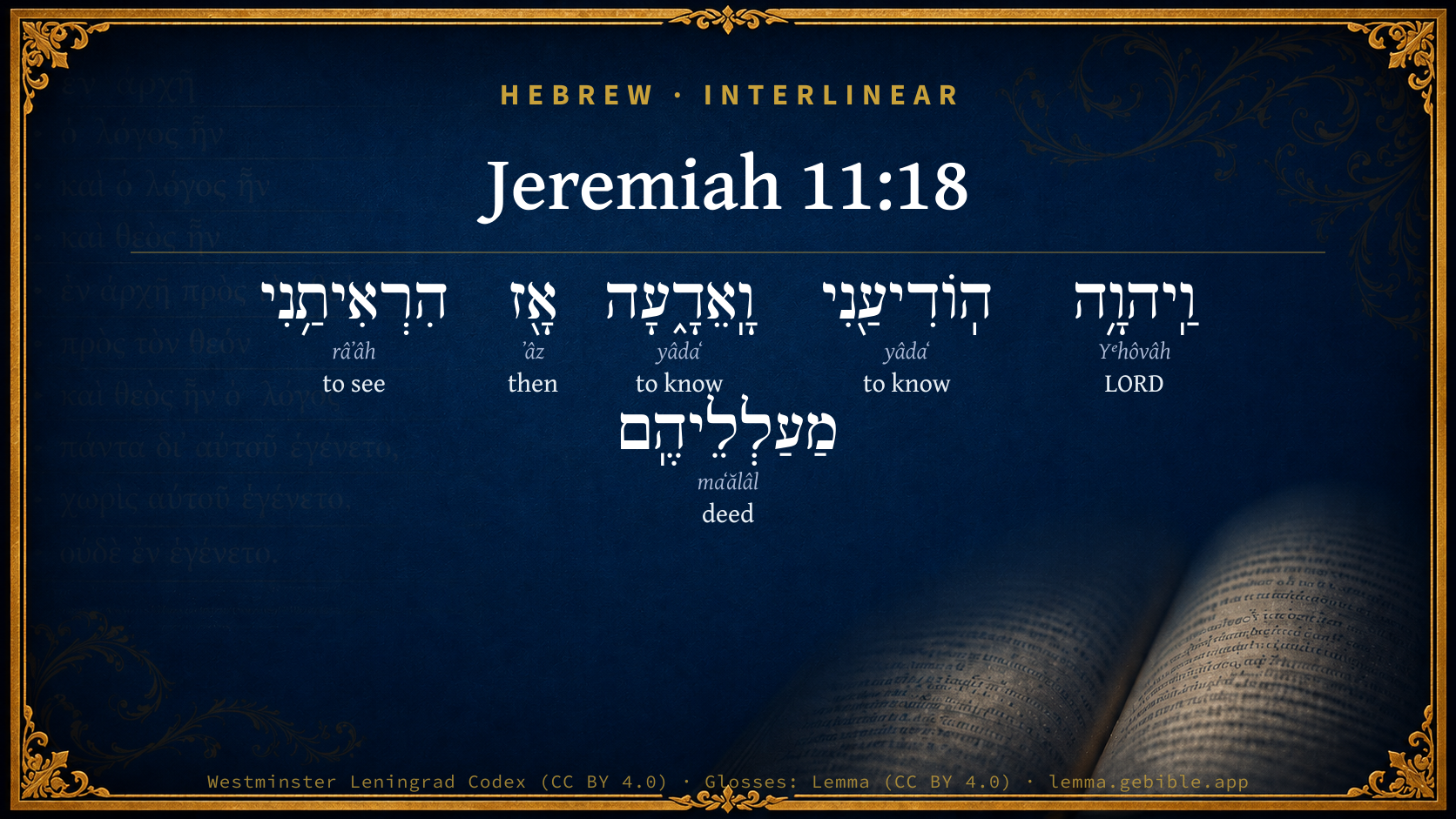
Jeremiah 11:18

Hebrew (Westminster Leningrad Codex) Jeremiah 11:18 appears in the Hebrew Old Testament. The text above is from the Westminster Leningrad Codex. Each word links to its Strong’s number, a concise gloss, and parsing drawn from the Open Scriptures Hebrew Bible morphology. Click any word for its full Brown-Driver-Briggs (BDB) entry.
Download image
Cite this verse

Jeremiah 11:18 (World English Bible). Public Domain. Lemma interlinear Bible study tool, https://lemma.gebible.app/v/jeremiah/11/18.

Show BibTeX & RIS
BibTeX
RIS
English Translation
Yahweh gave me knowledge of it, and I knew it: then you shown me their doings.
World English Bible · Public Domain
Download a study sheet

One document with this verse’s original text, its word-by-word gloss line, the meaning frame, cross-references with their text, attributed commentary, and full source and license credits — printable, and it pastes into notes with its structure intact.

This verse Autodidact and up

Study sheet (.html) Plain text (.txt)

A passage Seminary Student

Up to 50 verses in one chapter. A passage sheet keeps up to 6 commentary sources and 12 cross-references per verse, in the order this page ranks them, and says so on the sheet whenever that leaves anything out. Ask for a single verse and you get the Autodidact verse sheet above.

Everything on this page stays free to read, with no account — the sheet is a download of what is already on screen, not access to it.

Want to remove ads? Support Godless Engineer
Compare translations 3

The same verse in 3 English versions, stacked beneath the original-language interlinear above. Click any original word for its lexicon entry.

Each is an independent rendering of the whole verse — the interlinear is not word-aligned to these translations.

Highlighted words mark where these versions differ — a whole-verse word diff, not a word-by-word alignment.

  • World English Bible Public Domain
    Yahweh gave me knowledge of it, and I knew it: then you shown me their doings.
  • King James Version Public Domain
    And the LORD hath given me knowledge of it, and I know it: then thou shewedst me their doings.
  • unfoldingWord Literal Text CC BY-SA 4.0
    And Yahweh made me know, and I knew; then you showed me their deeds.

unfoldingWord Literal Text — © unfoldingWord, licensed CC BY-SA 4.0. Word-aligned USFM3 via Door43 (git.door43.org/unfoldingWord/en_ult).

Versions to compare (up to 4)

3 of 4 selected

Show all 18 translations

Every available English version of this verse, each an independent rendering of the whole verse.

  • World English Bible Public Domain
    Yahweh gave me knowledge of it, and I knew it: then you shown me their doings.
  • Berean Standard Bible Public Domain
    And the LORD informed me, so I knew. Then You showed me their deeds.
  • Majority Standard Bible Public Domain
    And the LORD informed me, so I knew. Then You showed me their deeds.
  • King James Version Public Domain
    And the LORD hath given me knowledge of it, and I know it: then thou shewedst me their doings.
  • American Standard Version (1901) Public Domain
    And Jehovah gave me knowledge of it, and I knew it: then thou showedst me their doings.
  • Revised Version (1885) Public Domain
    And the LORD gave me knowledge of it, and I knew it: then thou shewedst me their doings.
  • Geneva Bible (1599) Public Domain
    And the Lord hath taught me, and I knowe it, euen then thou shewedst mee their practises.
  • Douay-Rheims (1899) Public Domain
    But thou, O Lord, hast shewn me, and I have known: then thou shewedst me their doings.
  • Young's Literal Translation Public Domain
    And, O Jehovah, cause me to know, and I know, Then Thou hast showed me their doings.
  • Literal Standard Version CC BY-SA 4.0
    And, O YHWH, cause me to know, and I know, || Then You have showed me their doings.
  • Unlocked Literal Bible CC BY-SA 4.0
    Yahweh made me know these things, so I know them. You, Yahweh, made me see their deeds.
  • unfoldingWord Literal Text CC BY-SA 4.0
    And Yahweh made me know, and I knew; then you showed me their deeds.
  • Darby Bible Public Domain
    And Jehovah hath given me knowledge, and I know [it]; then thou shewedst me their doings.
  • World Messianic Bible Public Domain
    The LORD gave me knowledge of it, and I knew it. Then you showed me their doings.
  • Webster's Bible Public Domain
    And the LORD hath given me knowledge of it, and I know it: then thou showedst me their doings.
  • Free Bible Version CC BY-SA 4.0
    The Lord told me about it, so I knew. Then he showed me what they were actually doing.
  • Bible in Basic English Public Domain
    And the Lord gave me knowledge of it and I saw it: then you made clear to me their doings.
  • JPS Tanakh (1917) Public Domain
    And the LORD gave me knowledge of it, and I knew it; then Thou showedst me their doings.

Literal Standard Version (2020), Covenant Press — licensed CC BY-SA 4.0. Text via the HelloAO Bible API (eBible.org). Unlocked Literal Bible (unfoldingWord) — licensed CC BY-SA 4.0. Text via the HelloAO Bible API (eBible.org). unfoldingWord Literal Text — © unfoldingWord, licensed CC BY-SA 4.0. Word-aligned USFM3 via Door43 (git.door43.org/unfoldingWord/en_ult). Free Bible Version, Dr. Jonathan Gallagher — licensed CC BY-SA 4.0. Text via the HelloAO Bible API (eBible.org).

Word by word

More ways to search: Search by grammar → Find every occurrence → Compare this word →

Practice this passage: Drill this verse → Learn its vocabulary →

About this verse

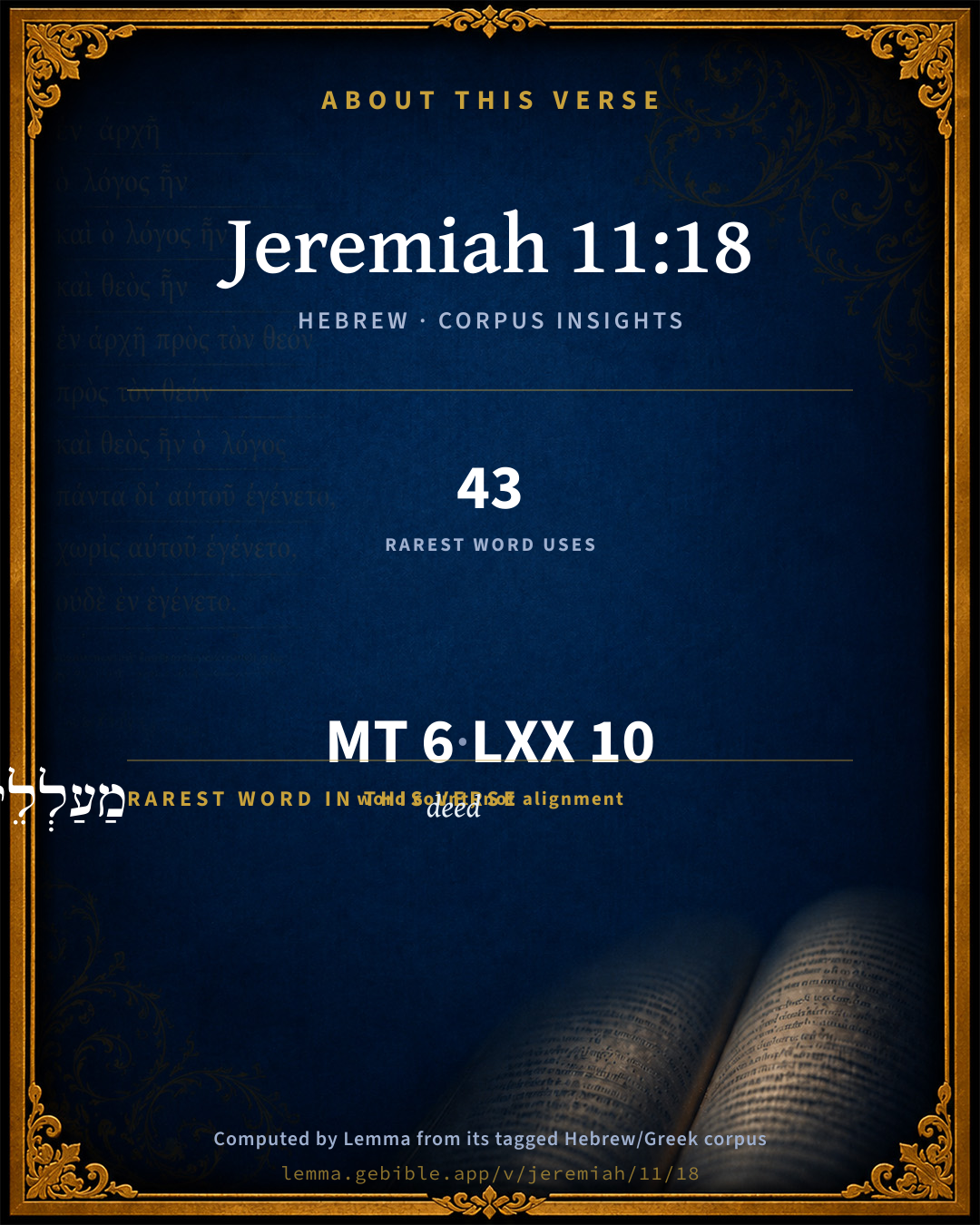
These counts appear in no published source. They are computed here, from the morphology-tagged text and Lemma’s own curated glosses. What Lemma adds →

6
words
5
distinct lemmas
Prophets
section

Shared distinctive vocabulary

מַעַלְלֵיהֶֽם deed H4611 occurs in 41 verses of the Hebrew Bible. Also found in:

Grammatical profile

  • 3 verbs
  • 2 nouns
  • 1 adverb

Verb forms

  • הֽוֹדִיעַ֖נִי Hiphil · Perfect
  • וָֽאֵדָ֑עָה Qal · Sequential Imperfect
  • הִרְאִיתַ֥נִי Hiphil · Perfect

Repetition

A word recurs within this verse — often emphatic in Hebrew:

  • הֽוֹדִיעַ֖נִי to know H3045 ×2

Hebrew & Septuagint length

In the original languages it is 6 Hebrew tokens and 10 Greek tokens — but the two are counted differently (Hebrew bundles its prefixes and suffixes into one token; the Greek is in lemma form), so that isn’t a like-for-like length.

Cross-references

6

Topical passages linked to Jeremiah 11:18 in the Treasury of Scripture Knowledge — connected by theme and wording, ordered by reader-vote popularity; previews shown in the World English Bible.

  • 1 Samuel 23:11–12 Will the men of Keilah deliver me up into his hand? will Saul come down, as your servant has heard? Yahweh, the God of Israel, I beg you, tell your servant. Yahweh said, He will come down.
  • 2 Kings 6:9–10 The man of God sent to the king of Israel, saying, Beware that you not pass such a place; for there the Syrians are coming down.
  • Ezekiel 8:6–18 He said to me, Son of man, see you what they do? even the great abominations that the house of Israel do commit here, that I should go far off from my sanctuary? but you shall again see yet other great abominations.
  • 2 Kings 6:14–20 Therefore sent he there horses, and chariots, and a great host: and they came by night, and surrounded the city.
  • Jeremiah 11:19 But I was like a gentle lamb that is led to the slaughter; and I didn't know that they had devised devices against me, [saying], Let us destroy the tree with the fruit of it, and let us cut him off from the land of the living, that his name may be no more remembered.
  • Romans 3:7 For if the truth of God through my lie abounded to his glory, why am I also still judged as a sinner?

Cross-references courtesy of OpenBible.info (CC BY 4.0).

Hebrew and Greek witnesses Masoretic Hebrew ↔ Greek Septuagint

The same verse in the two great witnesses to the Old Testament, shown verse-for-verse.

These are two independent witnesses, not word-aligned to each other, and the Septuagint is shown in lemma (dictionary) form.

Hebrew Jeremiah 11:18 Masoretic · Westminster Leningrad Codex

וַֽיהוָ֥ה הֽוֹדִיעַ֖נִי וָֽאֵדָ֑עָה אָ֖ז הִרְאִיתַ֥נִי מַעַלְלֵיהֶֽם

Yahweh gave me knowledge of it, and I knew it: then you shown me their doings.

World English Bible · Public Domain

Greek LXX Structure differs

In the Septuagint, Jeremiah is about an eighth shorter than the Hebrew and arranges its material differently — the Oracles Against the Nations (Hebrew chapters 46–51) appear in the middle of the Greek book, after 25:13. Because the chapter and verse boundaries do not line up, a verse-for-verse comparison with the Hebrew is not shown.

A verse-for-verse comparison isn’t shown here because the chapters and verses don’t line up. Switch to the LXX edition with the MT / LXX toggle above to read the Greek directly.

On this verse, John Gill's Exposition discusses the Septuagint’s reading. Read the note in Commentary ↓

Hebrew: Westminster Leningrad Codex (CC BY 4.0). Greek: Septuagint (public domain); English from a public-domain English Septuagint. How the Septuagint differs from the Hebrew →

Targum (Aramaic paraphrase)

1

The Targum is the ancient Jewish Aramaic paraphrase of the Hebrew Scriptures — an interpretive translation, not the Hebrew text itself. Onkelos (literal) and Pseudo-Jonathan (expansive) render the Torah, and Jonathan the Prophets. Coverage is partial: where no permissively-licensed English translation exists for a verse, only the Aramaic is shown. This is verse-level text, not a word-by-word alignment to the Hebrew.

  1. Targum Jonathan Prophets (Joshua–Malachi)
    וַיָי אַלְפַנִי וַאֲלִיפֵית בְּכֵן אַחֲזֵיתַנִי עוֹבָדֵיהוֹן:

    (no public-domain English translation for this verse)

    Targum Jonathan — Aramaic: “Mikraot Gedolot” (public domain). English: “Sefaria Community Translation” (CC0 1.0 (public-domain dedication)); “London "Chaldee Paraphrase," 1871” (public domain). Text via Sefaria.

Commentary

Notes on Jeremiah 11:18 from classic Christian and Jewish commentators (each source and its license shown beneath its notes). The classic Christian expositions comment on the surrounding passage and are grouped to its opening verse, so a note may address several verses; the Jewish commentaries on the Tanakh (Rashi and others) are per-verse, so they appear only where the commentator wrote on this verse.

Lemma curates 59 commentaries, every one of them public domain or Creative Commons licensed, each selected and text-cleaned for this edition rather than reprinted as found. About our sources →

The Cambridge Bible for Schools and Colleges

gen. ed. J. J. S. Perowne

18–23. See summary at commencement of section, and for the date of Jer_11:18 to Jer_12:6 see introd. notes on the section. The abruptness with which the mention of the plots against Jeremiah is here introduced suggests either that some introductory words have fallen out, or, better (with Co.), that we should transpose these vv. with Jer_12:1-6. In this way “it” and “their” of Jer_11:18 will be explained by Jer_12:6, and the Lord’s warning in the latter v. will fit in with Jer_11:18.

The Cambridge Bible for Schools and Colleges (gen. ed. J. J. S. Perowne; Cambridge University Press, 1878–1918) — public domain. Text from a community e-Sword module.

Trapp's Complete Commentary

John Trapp

Jer 11:18 And the LORD hath given me knowledge [of it], and I know [it]: then thou shewedst me their doings.

Ver. 18. And the Lord hath given me knowledge of it,] i.e., Of the treacherous plot of my countrymen of Anathoth against me, who should never have dreamt of any such danger; Deus pro suis excubat. God keeps watch for his own.

John Trapp, A Commentary or Exposition upon All the Books of the Old and New Testament (1647–1656) — public domain. Text from a community e-Sword module.

Albert Barnes' Notes on the Bible

Rather, “gave me knowledge of it, and I knew it.” Jeremiah shows Jer 11:18-23, that the general conspiracy of the people against Yahweh and the special plot against himself was revealed to him by God.

Albert Barnes' Notes on the Bible (1834–1885) — public domain. Text from a community e-Sword/MySword module.

Joseph Benson's Commentary

Jer 11:18-19. And the Lord hath given me knowledge of it, &c. — This relates to the ill designs which the men of Anathoth had contrived against the prophet, which he here saith God had revealed to him. See the following verses. But I was like a lamb or an ox, &c. — A proverbial speech, expressing a false security, or insensibility of danger. Dr. Waterland, in agreement with the Vulgate, Bochart, and Houbigant, reads this clause, But I was like a gentle lamb; and Blaney, For I was like a tame lamb that is led to the slaughter. But Lowth justly observes, we may very well admit of the common translation. For the word יאלוŠhere used, certainly frequently signifies an ox, and the disjunctive particle, supplied by or, is elsewhere often understood, though not expressed. The meaning here is, that the prophet would have met with a fate similar to that of a slaughtered lamb or ox, if God had not revealed to him the designs of his enemies. Many commentators suppose that Jeremiah here speaks of his own sufferings as figurative of those of the Messiah. “All the churches agree,” says St. Jerome, “that these and the following words respect Jesus Christ and his passion. It was against his life that they formed their designs: he was the true lamb, meek and innocent. Jeremiah is here a figure of the divine Saviour; he here suffers from his brethren, and represents, in his person, him who was a man of grief, and tried by all sorts of afflictions.”

Let us destroy the tree with the fruit thereof — Let us not only put an end to his prophesying, but to his life. The Hebrew is literally, Let us destroy the tree (or the stock) with the bread thereof; and bread, it must be observed, is sometimes used for the corn of which bread is made, as Jer 5:17. The meaning then is, Let us destroy the prophet and his doctrine. We have no other mention of this conspiracy but this here. It is, however, very plain, both from this verse and what follows, that the men of Anathoth (which was Jeremiah’s own town) were offended at his prophesying, and had conspired to kill him.

Joseph Benson's Commentary on the Old and New Testaments (1811–1818) — public domain. Text from a community e-Sword module.

Keil & Delitzsch

C. F. Keil & F. Delitzsch

Evidence that Judah is Unreclaimable, and that the Sore Judgments Threatened cannot be Averted. - As a practical proof of the people's determination not to reform, we have in Jer 11:18-23 an account of the designs of the inhabitants of Anathoth against the prophet's life, inasmuch as it was their ill-will towards his prophecies that led them to this crime. They are determined not to hear the word of God, chiding and punishing them for their sins, and so to put the preacher of this word out of the way. - Jer 11:18. "And Jahveh gave me knowledge of it, and I knew it; then showedst Thou me their doings. Jer 11:19. And I was as a tame lamb that is led to the slaughter, and knew not that they plotted designs against me: Let us destroy the three with the fruit thereof, and cut him off out of the land of the living, that his name may be no more remembered. Jer 11:20. But Jahveh of hosts, that judgeth justly, trieth reins and heart-I shall see Thy vengeance on them, for to Thee have I confided my case. Jer 11:21. Therefore thus hath Jahveh spoken against the men of Anathoth, that seek after thy life, saying, Thou shalt not prophesy in the name of Jahveh, that thou die not by our hand. Jer 11:22. Therefore thus hath Jahveh of hosts spoken: Behold, I will punish them; the young men shall die by the sword, their sons and daughters shall die by famine. Jer 11:23. And a remnant shall not remain to them; for I bring evil upon the men of Anathoth, the year of their visitation."

Jeremiah had not himself observed the designs of the people of Anathoth against his life, because the thing was carried on in secret; but the Lord made it known to him. אז, then, sc. when I knew nought of their murderous intent; cf. Jer 11:19. "Their doings," i.e., those done in secret. Jer 11:19. כּבשׂ , agnus mansuetus, a tame pet-lamb, such as the Arabs used to keep, such as the Hebrews too, Sa2 12:3, kept; familiar with the household, reared by them in the house, that does not suspect when it is being taken to be killed. In like manner Jeremiah had no suspicion that his countrymen were harbouring evil designs against him. These designs are quoted directly without לאמר. The saying is a figurative or proverbial one: we will destroy the tree בּלחמו. This word is variously taken. The ordinary meaning, food for men and beasts, usually bread, seems not to be suitable. And so Hitz. wishes to read בּלחו, in its sap (cf. Deu 34:7; Eze 21:3), because לחם may mean grain, but it does not mean fruit. Ng. justly remarks against this view: What is here essential is simply the produce of the tree, furnished for the use of man. The word of the prophet was a food which they abhorred (cf. Jer 11:21). As לחם originally meant food, we here understand by it the edible product of the tree, that is, its fruit, in opposition to sap, wood, leaves. This interpretation is confirmed by the Arabic; the Arabs use both lahûmun and ukulu of the fruit of a tree, see ill. in Rosenm. Schol. ad h. l. The proverbial saying is given in plain words in the next clause. We will cut him (i.e., the prophet) off, etc.

Jer 11:20-23

Therefore Jeremiah calls upon the Lord, as the righteous judge and omniscient searcher of hearts, to punish his enemies. This verse is repeated almost verbally in Jer 20:12, and in substance in Jer 17:10. Who trieth reins and heart, and therefore knows that Jeremiah has done no evil. אראה is future as expressing certainty that God will interfere to punish; for to Him he has wholly committed his cause. גּלּיתי, Pi. of גּלה, is taken by Hitz., Ew., etc. in the sense of גּלל: on Thee have I rolled over my cause; in support of this they adduce Psa 22:9; Psa 37:5; Pro 16:3, as parallel passages. It is true that this interpretation can be vindicated grammatically, for גלל might have assumed the form of גלה (Ew. 121, a). But the passages quoted are not at all decisive, since Jeremiah very frequently gives a new sense to quotations by making slight alterations on them; and in the passage cited we read גּלל את ריב. We therefore adhere, with Grot. and Ros., to the usual meaning of גּלה; understanding that in making known there is included the idea of entrusting, a force suggested by the construction with אל instead of ל. ריב, controversy, cause. - The prophet declares God's vengeance to the instigators of the plots against his life, Jer 11:21-23. The introductory formula in Jer 11:21 is repeated in Jer 11:22, on account of the long intervening parenthesis. "That thou diest not" is introduced by the ו of consecution. The punishment is to fall upon the entire population of Anathoth; on the young men of military age (בּחוּרים), a violent death in war; on the children, death by famine consequent on the siege. Even though all had not had a share in the complot, yet were they at heart just as much alienated from God and ill-disposed towards His word. "Year of their visitation" is still dependent on "bring." This construction is simpler than taking שׁנת for accus. adverb., both here and in Jer 23:12.

Keil & Delitzsch — Biblical Commentary on the Old Testament (1861–1891) — public domain (CC PDM 1.0). Text via the HelloAO Bible API. (Old Testament only.)

Tyndale Open Study Notes

Tyndale Open Resources

11:18-23 The Lord warned Jeremiah of the plots against him. Jeremiah prayed, and the Lord promised to rescue him.

11:18-19 The Lord had warned Jeremiah at the time of his commissioning (1:19) that opposition would threaten his life. Jeremiah saw himself as a lamb being led to the slaughter, with no power to resist. This opposition occurred before Jeremiah’s trial in the Temple courtyard, early in the reign of Jehoiakim (between 608 and 605 BC; see ch 26). Some scholars believe that this verse prefigures the death of Christ, as does the suffering servant of Isa 53:7.

Tyndale Open Study Notes — © Tyndale Open Resources, licensed CC BY-SA 4.0. Text via the HelloAO Bible API.

Geneva Bible (1599)

Geneva Bible translators

Which went about privily to conspire my death.

Geneva Bible (1599) marginal notes — public domain. Text via Bolls.life.

Matthew Henry's Commentary

The prophet Jeremiah has much in his writings concerning himself, much more than Isaiah had, the times he lived in being very troublesome. Here we have (as it should seem) the beginning of his sorrows, which arose from the people of his own city, Anathoth, a priest's city, and yet a malignant one. Observe here,

I. Their plot against him, Jer 11:19. They devised devices against him, laid their heads together to contrive how they might be in the most plausible and effectual manner the death of him. Malice is ingenious in its devices, as well as industrious in its prosecutions. They said concerning Jeremiah, Let us destroy the tree with the fruit thereof - a proverbial expression, meaning, "Let us utterly destroy him root and branch. Let us destroy both the father and the family" (as, when Naboth was put to death for treason, his sons were put to death with him), or rather "both the prophet and the prophecy; let us kill the one and defeat the other. Let us cut him off from the land of the living, as a false prophet, and load him with ignominy and disgrace, that his name may be no more remembered with respect. Let us sink his reputation, and so spoil the credit of his predictions." This was their plot; and 1. It was a cruel one; but so cruel have the persecutors of God's prophets been. They hunt for no less than the precious life, and very precious the lives are that they hunt for. But, (2.) It was a baffled one. They thought to put an end to his days, but he survived most of his enemies; they thought to blast his memory, but it lives to this day, and will be blessed while time lasts.

II. The information which God gave him of this conspiracy against him. He knew nothing of it himself, so artfully had they concealed it; he came to Anathoth, meaning no harm to them and therefore fearing no harm from them, like a lamb or an ox, that thinks he is driven as usual to the field, when he is brought to the slaughter; so little did poor Jeremiah dream of the design his citizens that hated him had upon him. None of his friends could, and none of his enemies would, give him any notice of his danger, that he might shift for his own safety, as Paul's sister's son gave him intelligence of the Jews that were lying in wait for him. There is but a step between Jeremiah and death; but then the Lord gave him knowledge of it, by dream or vision, or impression upon his spirit, that he might save himself, as the king of Israel did upon the notice Elisha gave him, Kg2 6:10. Thus he came to know it. God showed him their doings; and such were their devices that the discovering of them was the defeating of them. If God had not let him know his own danger, it would have been improved by unreasonable men against the reputation of his predictions, that he who foretold the ruin of his country could not foresee his own peril and avoid it. See what care God takes of his prophets: He suffers no man to do them wrong; all the rage of their enemies cannot prevail to take them off till they have finished their testimony. God knows all the secret designs of his and his people's enemies, and can, when he pleases, make them know. A bird of the air shall carry the voice.

III. His appeal to God hereupon, Jer 11:20. His eye is to God as the Lord of hosts, that judges righteously. It is a matter of comfort to us, when men deal unjustly with us, that we have a God to go to who does and will plead the cause of injured innocency and appear against the injurious. God's justice, which is a terror to the wicked, is a comfort to the godly. His eye is towards him as the God that tries the reins and the heart, that perfectly sees what is in man, what are his thoughts and intents. He knew the integrity that was in Jeremiah's heart, and that he was not the man they represented him to be. He knew the wickedness that was in their hearts, though ever so cunningly concealed and disguised. Now, 1. Jeremiah prays judgment against them: "Let me see thy vengeance on them, that is, do justice between me and them in such a way as thou pleasest." Some think there was something of human frailty in this prayer; at least Christ has taught us another lesson, both by precept and by pattern, which is to pray for our persecutors. Others think it comes from a pure zeal for the glory of God and a pious and prophetic indignation against men that were by profession priests, the Lord's ministers, and yet were so desperately wicked as to fly out against one that did them no harm, merely for the service he did to God. This petition was a prediction that he should see God's vengeance on them. 2. He refers his cause entirely to the judgment of God: "Unto thee have I revealed my cause; to thee I have committed it, not desiring nor expecting to interest any other in it." Note, It is our comfort, when we are wronged, that we have a God to commit our cause to, and our duty to commit it to him, with a resolution to acquiesce in his definitive sentence, to subscribe, and not prescribe, to him.

IV. Judgment given against his persecutors, the men of Anathoth. It was to no purpose for him to appeal to the courts at Jerusalem, he could not have justice done him there: the priests there would stand by the priests at Anathoth, and rather second them than discountenance them; but God will therefore take cognizance of the cause himself, and we are sure that his judgment is according to truth. Here is, 1. Their crime recited, on which the sentence is grounded, Jer 11:21. They sought the prophet's life, for they forbad him to prophesy upon pain of death; they were resolved either to silence him or to slay him. The provocation he gave them was his prophesying in the name of the Lord without license from those that were the governors of the city which he was a member of, and not prophesying such smooth things as they always bespoke. Their forbidding him to prophesy was in effect seeking his life, for it was seeking to defeat the end and business of his life and to rob him of the comfort of it. It is as bad to God's faithful ministers to have their mouth stopped as to have their breath stopped. But especially when it was resolved that if he did prophesy, as certainly he would notwithstanding their inhibition, he should die by their hand; they would be accusers, judges, executioners, and all. It used to be said that a prophet could not perish but at Jerusalem, for there the great council sat; but so bitter were the men of Anathoth against Jeremiah that they would undertake to be the death of him themselves. A prophet then shall find not only no honour, but no favour, in his own country. 2. The sentence passed upon them for this crime, Jer 11:22, Jer 11:23. God says, I will punish them; let me alone to deal with them. I will visit this upon them; so the word is. God will enquire into it and reckon for it. Two of God's four sore judgments shall serve to ruin their town: - The sword shall devour their young men, though they were young priests, not men of war (their character shall not be their protection), and famine shall destroy the children, sons and daughters, that tarry at home, which is a more grievous death than that by the sword, Lam 4:9. The destruction shall be final (Jer 11:23): There shall be no remnant of them left, none to be the seed of another generation. They sought Jeremiah's life, and therefore they shall die; they would destroy him root and branch, that his name might be no more remembered, and therefore there shall be no remnant of them; and herein the Lord is righteous. Thus evil is brought upon them, even the year of their visitation, and that is evil enough, a recompence according to their deserts. Then shall Jeremiah see his desire upon his enemies. Note, Their condition is sad who have the prayers of good ministers and good people against them.

Matthew Henry's Commentary on the Whole Bible (1708–1710) — public domain (CC PDM 1.0). Text via the HelloAO Bible API.

Jamieson, Fausset & Brown

Robert Jamieson, A. R. Fausset & David Brown

Jeremiah here digresses to notice the attempt on his life plotted by his townsmen of Anathoth. He had no suspicion of it, until Jehovah revealed it to him (Jer 12:6).

the Lord . . . thou--The change of person from the third to the second accords with the excited feelings of the prophet.

then--when I was in peril of my life.

their doings--those of the men of Anathoth. His thus alluding to them, before he has mentioned their name, is due to his excitement.

Jamieson, Fausset & Brown — Commentary Critical and Explanatory on the Whole Bible (1871) — public domain (CC PDM 1.0). Text via the HelloAO Bible API.

Adam Clarke's Commentary

Verse 18. The Lord hath given me knowledge of it] The men of Anathoth had conspired against his life, because he reproved them for their sins, and denounced the judgments of God against them. Of this God had given him a secret warning, that he might be on his guard.

Adam Clarke's Commentary on the Bible (1810–1826) — public domain. Text from a community e-Sword/MySword module.

John Calvin's Commentaries

We know that they were all very wicked; and though they were proved guilty, yet they were not wining to yield, to acknowledge and confess their fault; but they raged against God and rose up against the prophets. And as they dared not to vomit forth their blasphemies against God, they assailed his servants and wished to appear as though their contest was with them. And this is not the vice only of one age, but we find that it prevails at this day; for when we boldly reprove hidden vices, immediately the profane make a clamor and say, “What! these divine; but who has made these things known to them? Have they this oracle from heaven?” As though, indeed, neither the word of God nor his Spirit can shew their power, except when children become judges! But the ungodly rise up against God’s servants for this end, that they may with impunity do this and that, and everything, except what may draw them before an earthly tribunal, and be proved by clear and many evidences

For this reason the Prophet says, that made known, to him had been the vices of his own nation; as though he had said, “I see that you will be ready to raise an objection, as ye are wont proudly to resist all reproofs and threatenings, as though you contended only with men; but I testify to you now beforehand, that I bring nothing of my own, nor divine of myself what any one of you thinks within: but know ye that God, who knoweth the heart, has committed to me my office. He has then appointed me to be the herald of his vengeance, he has appointed me as a herald to denounce war on you. So I do not come nor act in my own name: there is, then, no reason for you to deceive yourselves, according to your usual manner, as though I presumptuously reproved you, when yet your vices are concealed, it being peculiar to God to know what is hid in the hearts of men. The recesses of the heart are indeed intricate, and great darkness is within; but God sees more dearly than men. Cease then to make this objection which ye are wont to raise against me, that I am presumptuous in bringing forth to light what lies hid in darkness, for God has appointed me to bring these commands to you: as he knows the heart, and as nothing escapes him, and as he penetrates into our thoughts and feelings, so he has also designed by his word which he has put in my mouth to render public what ye think is concealed.”

We now see the design of the Prophet: but some take a different view, that God had made known to his servant Jeremiah the impious conspiracy of which he afterwards speaks, and thus connect the two verses. But I doubt not that the Prophet intended here to shew what and how much weight belonged to his doctrine, the credit and authority of which the Jews thought of detracting by boastfully alleging that he, a mortal man, assumed too much, and announced uncertain divinations. Hence, to repel such calum — nies, he wished to testify that he threatened them not inconsiderately, nor spoke what he supposed or conjectured, when he exposed their sins, but that he only declared faith. — fully what had been enjoined by God and revealed also by the Holy Spirit. This is what is meant. It afterwards follows —

John Calvin's Commentaries (1540-1563) — public domain. Text from the Calvin Translation Society English edition (1840s-50s) via the Christian Classics Ethereal Library (ccel.org). Calvin's coverage is partial (roughly two-thirds of the Bible); uncommented books and verses are honest gaps, never fabricated. The 19th-century editor's footnotes and remarks are omitted so the notes are faithfully Calvin's own voice.

Ellicott's Commentary for English Readers

(18) And the Lord hath given me knowledge.—A new section opens abruptly, and the prophet speaks no longer of the sins of Israel and Judah at large, but of the “doings” of his own townsmen, of their plots against his life. Unless this is altogether a distinct fragment, connected, possibly, with Jer_9:8, the abruptness suggests the inference that the plots of the men of Anathoth against him had suddenly been brought under his notice.

A Bible Commentary for English Readers, edited by Charles John Ellicott (1878–1897) — public domain. Text from a community e-Sword module.

John Gill's Exposition

But I was like a lamb, or an ox,.... The word "alluph", rendered an ox, is by many considered as an adjective to the word lamb (n); since the disjunctive particle or is not in the next; and is differently translated; by the Vulgate Latin version, "as a meek or tame lamb"; by the Septuagint and Arabic versions, "as an harmless lamb": and by the Syriac version, "as a pure" or "clean lamb"; and by the Targum,

"as a choice lamb;''

and so R. Menachem in Jarchi, a large or principal one; but the words respect not the excellency, the meekness, patience, innocence, and harmlessness of the prophet; but his security and insensibility of danger, like one or both of these creatures:

that is brought to the slaughter; to be sacrificed by the priest, or killed by the butcher; not knowing but it is going to the pasture to feed in, or to the fold or stall to lie down in; so ignorant was the prophet of the designs of his townsmen against him, and not at all jealous that they wished him ill; since he meant none to them, but sought their good:

and I knew not that they had devised devices against me; that they had met and consulted together, and devised mischief against him:

saying, let us destroy the tree with the fruit thereof; meaning either the prophet and his family, root and branch; or him and his prophecies; for taking away his life would put an end to his prophesying. Some think this respects the manner in which they proposed to take away his life, as by poison; so the Targum,

"let us cast (put) poison (or the savour of death) into his food;''

for the word rendered fruit signifies bread; and so the Septuagint, Arabic, and Vulgate Latin versions render it, "let us cast, or put wood into his bread" (o); either some poisonous plant or tree, or rotten wood; or give him wood instead of bread, and so starve him. De Dieu observes, that translated "fruit", signifies, both in the Hebrew and Arabic languages, "flesh"; and renders it, "let us break wood upon his flesh", (p) or body; that is, beat him with staves till they are broken upon him, and so kill him. The ancient fathers understand this of Christ, who is the bread of life, and of his crucifixion upon the wood of the cross. Jerom says it is the consent of all the churches that these things are said of Christ in the person of Jeremiah, even in this and the preceding verse, and the following one:

let us cut him off from the land of the living. The Targum explains it of the land of Israel; but it designs the world in general, and the taking away of his life out of it, and from among men:

that his name may be remembered no more; that he and his prophecies may be buried in everlasting oblivion; he no more spoken of, and his predictions no more regarded: but, as they failed in the former in taking away his life, he outliving many of them, so in the latter; for as what he foretold exactly came to pass, his name and his prophesying are in remembrance to this day; and, as the wise man says, "the memory of the just is blessed", Pro 10:7.

(n) "quasi agnus mansuetus", V. L. "agnus assuefactus"; so some in De Dieu; "tanquam agnus amicabilis", De Dieu; "un agneau aimable", Gallic version. (o) "mittamus lignum in panem ejus", V. L. "corrumpamus veneno cibum", Pagninus; "corrumpamus lignum in pane ejus", Montanus, Vatablus, Calvin. (p) "Rumpamus lignum in earnem ejus", De Dieu.

John Gill's Exposition of the Whole Bible (1746–1763) — public domain (CC PDM 1.0). Text via the HelloAO Bible API.

Haydock's Catholic Bible Commentary

Shewedst me. He insinuates that something more than what appears must be understood. (Theodoret) --- All Christians explain what follows of Jesus Christ, (St. Jerome; Worthington) whom Jeremias prefigured in his sufferings. (Calmet) --- "Let us follow the rule which shews that all the prophets did most things for a type of our Lord and Saviour; and what was now done by Jeremias, foreshewed what would happen to our Lord." (St. Jerome)

George Leo Haydock (1774–1849), Haydock's Catholic Family Bible and Commentary, 1859 edition — public domain. Excludes Psalms (Douay-Rheims chapter numbering differs from Protestant) and Deuterocanonical books (Catholic canon only).

Matthew Poole's English Annotations

This may be understood either more generally, as relating to all the wicked actions of his countrymen, to obviate their saying, How comest thou to know our doings? or else (which seemeth most probable) more specially, with relation to that conspiracy against him which is mentioned in the following verses.

Matthew Poole's English Annotations on the Holy Bible (1683–1685) — public domain. Text from a community e-Sword/MySword module.

The Pulpit Commentary

Here, as Naegelsbaeh puts it, begins the second stage of the "conspiracy." Hath given me knowledge, etc.; rather, gave me knowledge, and I knew it. Then; i.e. when I was in utter unconsciousness. Jeremiah had no presentiment of the murderous purpose of his townsmen, till by some "special providence" it came to his knowledge.

Vers. 18-23. The conspiracy of Anathoth.

This incident may afford us some lessens on the subject of persecution, in its occasion and character, the behavior of the persecuted and the righteous action of God in dealing with it.

I THE OCCASION OF THE CONSPIRACY ILLUSTRATES A COMMON CAUSE OF PERSECUTION. Jeremiah had been proclaiming unwelcome truths. He had exposed sin and threatened judgment. Such preaching was unpopular, and the men of Anathoth sought to stay it by force (Ver. 21).

1. The faithful preacher must expect to meet with opposition. Unpopularity is no proof of incompetence (i.e. if it arises from the subject-matter of the teaching, not from the style of the teacher). Christ, who began his mission with public favor, ended it amidst universal contumely.

2. The most needful truth is the most unwelcome. The smooth words of false prophets of "peace" are acceptable. But they are narcotics given to men who should be roused to flee for their lives. The only hope for those who are spending wicked lives is in their being awakened to a sense of guilt and danger. The effort to awaken them, however, stirs their resentment.

II THE CONDUCT OF THE CONSPIRATORS REVEALS THE TRUE CHARACTER OF PERSECUTORS.

1. It is foolish. Truth cannot be destroyed by suppressing the voice that utters it. Some day it will declare itself in spite of all hindrance.

2. It is unfair. Words are met by force. To silence a voice is not to reply to it. Violent opposition to the spread of ideas is a tacit confession of inability to meet them on their own ground of reason, a virtual confession of their force of truth.

3. It is destructive of social order. Jeremiah"s fellow-townsmen conspire against him. The persecuting spirit divides nearest neighbors. It is the greatest enemy to brotherly charity. (Mat_10:36)

4. It is treacherous. While Jeremiah was ignorant of their enmity led like a lamb to the slaughter the men of Anathoth were plotting against his life.

5. It is murderous. The tree is to be destroyed with its fruit. Professing a good purpose, persecution is invariably possessed by a cruel spirit.

6. It covers enmity to God in opposition to his servants. Jeremiah was bidden no longer to prophesy in the Name of Jehovah. It could not be denied that he spoke with Divine authority. Therefore to silence him was to refuse to receive the message of God.

III THE BEHAVIOR OF THE VICTIM EXEMPLIFIES THE RIGHT COURSE TO BE PURSUED UNDER PERSECUTION.

I Not to desist from the duty which provoked the persecution. Jeremiah met with little but opposition throughout his long life; yet he remained faithful to the last.

1. Not to rashly embrace danger. Jeremiah sought deliverance. It is childish to court persecution.

2. To seek help from God. Jeremiah at once committed his cause to God. God alone

a. can help;

b. has the authority to execute vengeance; (Rom_12:19)

c. judges righteously, impartially, without the bias of passion; and

d. discerns the motive of men and the degrees of guilt trying "the reins and the heart.

IV THE ACTION OF GOD TYPIFIES THE ULTIMATE EXECUTION OF DIVINE JUDGMENT.

1. Punishment must follow such wickedness. Though it is delayed, the vengeance must come.

2. This punishment will be severe. "The young men shall die by the sword," the children by famine. Fearful sin must bring fearful penalties.

3. This punishment will be without exception. No remnant of the men of Anathoth will be spared. All are guilty; all must suffer. There is a popular impression to the effect that the number of sinful persons lessens the blame attaching to each individual. It is a mistake. If all sin, each will be punished individually as much as if one only were guilty. No conspiracy of men, however widespread, however subtle in schemes, however violent in action, can defeat the ends of Divine justice. (Pro_11:21)

Vers. 18-23. Perils of prophesying.

The conspiracy of which these verses speak seems to have been sudden as it was secret. It affected the mind of the prophet in a peculiarly painful way, as it was the men of his own district who were concerned in it his friends, probably even kinsfolk, who locked upon him as their worst enemy. The crime was all the more heinous that the means taken to execute it were underhand. It is possible that they greeted him with expressions of kindness and hospitality, and that everything was done to prevent his suspecting his real danger. Upon his discovering the plot, it is possible that they ceased to conceal their intentions, and, thinking him in their power, urged him "prophesy not in the Name of the Lord.

I THE PERILS OF THE PROPHET arose from:

1. A hatred of the truth in his hearers. There was something unpalatable in the continual denunciations of their wickedness. Their spiritual and patriotic pride was wounded. The demands made upon them by the righteousness of Jehovah they did not care to yield to; and the dislike of the prophet arose from his association with his message. No vengeance, therefore, could be too great. It is not imprisonment they seek to inflict, but death itself, and death in such an obscure and ignominious way that "his name may be no more remembered.

2. Their fear of the consequences of his prophecies. The future which he described as inevitable was not pleasant to contemplate. The words he spoke threatened to overturn their most cherished designs and to rob them of their precious things.

3. Ignorance as to how thee might be averted. By an easy process of association they came to look upon Jeremiah as not simply declaring, but in a sense causing, the evils of which he prophesied. They reasoned, therefore, to the foolish conclusion that if they could destroy him they would free themselves from the dangers which he threatened. The preacher has often to incur dislike of this sort from his hearers. It is of the nature of the carnal mind so to misapprehend the things of God and the things that make for peace. At certain times stern denunciation and declaring of the true consequences of evil action are not to be regarded as enmity, but friendship. The word spoken by an inspired mind is to be distinguished from the expression of mere bitterness and dislike. Paul had to entreat his converts not to count him their enemy when he sharply reproved them.

II THESE PERILS ARE WARDED OFF by:

1. Direct revelation. This is an advantage which the ordinary servants of God may not count upon. It was vouchsafed occasionally to prophets and apostles, but there is something in the spiritual mind which enables it to detect more quickly than others the symptoms of hatred to the truth. Promptings and suggestions to certain action in the midst of circumstances to ordinarily human eyes unsuspicious, have been too frequent in the history of the Church to be doubted. And even where no direct information may be given as to the mason of certain courses of action, which God"s saints may be moved to observe, the results clearly prove the presence of a careful and ever-watchful Providence.

2. Faith in God. Jeremiah said, "Unto thee have I revealed my cause" (better, "Upon thee have I devolved my cause"). He evidently felt that his duty was to commit the whole matter into the hands of God. And this is ever the safest way. The judgment, the prevision of man, are to be distrusted. The soul should cast itself by faith upon God, who is able to save.

3. Greater boldness in the course of action assumed. This was a distinct moral advantage. The men whose action was inspired by fear were certain to be influenced by it. Superstitions dread of the effects of his words would produce a reaction from their cowardly plans. And they would feel themselves more and more helpless as they saw how they aggravated their own punishment. So the preachers of the gospel and the servants of Christ generally must not consult with flesh and blood, but be bold in proclaiming the whole will of God, in preaching the Word, being "instant in season and out of season." There are allies and reinforcements latent in the constitution even of the worst enemies of the cross of Christ. M.

Vers. 18-23. The baffled plot.

These verses are an episode. Like as the miracle of the healing of her who touched the hem of our Lord"s garment was an episode in connection with the healing of the daughter of Jairus, (Mar_5:21, etc.) so this account of the plot against Jeremiah"s life comes in here, breaking the thread of his discourse, which is not renewed again till Jer_12:7. Scripture has many instances of similar plots contrived against the servants of the Lord; they are found in the histories of Joseph, David, Nehemiah, Elisha, Paul, of our Lord, and of others. In this one, note

I ITS CIRCUMSTANCES. Jeremiah had given dire offence to the men of Anathoth, his own city, men who, like himself probably, were associated with the priestly office. "Between the priesthood and the prophets there had hitherto been more or less of conflict, but now that conflict was exchanged for a fatal union. A wonderful and horrible thing was committed in the land; the prophets prophesied falsely, and the priests bore rule by their means; and he who by each of his callings was naturally led to sympathize with both, was the doomed antagonist of both victim of one of the strongest passions, the hatred of priests against a priest who attacks his own order, the hatred of prophets against a prophet who ventures to have a voice and will of his own. His own village, occupied by members of the sacred tribe, was for him a nest of conspirators against his life. Of him first in the sacred history was the saying literally fulfilled, "A prophet hath no honor in his own birthplace (En th patridi, autou , Luk_4:24) (Stanley). They objected not so much to his prophesying, for there were plenty of them who did this, but to his strenuous assertion an assertion that their own consciences assented to, that he spoke in the Name of the Lord (Ver. 21). Warnings so faithful but yet so terrible were little liked, as they ever are by those who so much needed them. And since they could not silence him in any other way, they determined to take away his life. Secretly and craftily they laid their plot. Jeremiah had not the least suspicion of it. "I was," says he (Ver. 19), "like a lamb," that is, a pot or house lamb, such as the Orientals often keep (see Exposition). He went in and out amongst his brethren, trusting them, and thinking no ill, whilst all the time this dark and deadly plot was being devised against him. And it would have been successful, we can hardly doubt, had he not been warned of the Lord (Ver. 18). The shock, the dread revulsion of feeling, which the tidings caused him is evident in the almost unmeasured grief and indignation which the following verses express. His first utterance is a cry for vengeance (Ver. 20) on them, an appeal to the righteous God to uphold his cause. Then comes a denunciation of the Divine doom upon them, then an aggrieved remonstrance (Jer_12:1) and complaint addressed to God himself in view of the prosperity of these ungodly and wicked men, followed by a fierce demand for revenge; (Jer_12:3) all which is replied to (Jer_12:5) by a sharp but loving rebuke, a revelation of yet further treachery, and that on the part, not of mere acquaintances and neighbors, but of his own brethren, the inmates of the same home: children of the same father; and finally (Jer_12:6) God, who had already baffled their first plottings against him, now puts him on his guard against all that they should afterwards devise, bidding him believe them not though" etc (Jer_12:6) Of the manner in which they purposed to carry out their deadly scheme, or how God revealed to his servant what was going on, we are not told; only the above noted facts are stated. But these are full of interest and instruction. Note, therefore, some of

II THE SUGGESTED LESSONS. They are such as these.

1. "Having the form of godliness but denying the power thereof, means subjection to the power of all ungodliness though denying the form thereof." See these would-be murderers of the prophet; they were consecrated priests.

2. He that keepeth Israel shall neither slumber nor sleep." The plotters against the prophet"s life were discovered and declared by him to whom "the darkness and the light are both alike," and so his servant was forewarned and saved. Therefore, "They that trust in the Lord shall be," etc.

3. "The servant will often have to be as his Master, and the disciple as his Lord." Like the Lord Jesus, Jeremiah was hated of his countrymen and brethren (cf. Homily on Jer_1:1-3, p. 10, for more of these resemblances). Several of them are recorded in these verses. The hatred felt towards him by his countrymen and in his father"s house. The cause of that hatred. The deadly plots which were devised against him. The innocence and gentleness a lamb," etc. which characterized the hated one. And such fellowship with Christ is the law of his service.

4. "Resemblance between the Master and his servant may be often close but is never complete." However natural Jeremiah"s outburst of rage and indignation, we cannot help noticing how far short in moral elevation he falls of him who prayed, "Father, forgive them," etc., and of the first Christian martyr, who was taught of Christ to pray, "Lord, lay not this sin," etc. The perfect Example is Christ; we can "call none good but One," that is, him.

5. Wrongs that God will suffer against himself he will not suffer against his people." Jeremiah was avenged within a very little time and in ample manner, but the wrongs God had suffered from the same people he had borne for centuries, and even then there was a reserve of mercy he made not "a full end.

6. "Let our eyes be ever toward the Lord, for he will pluck our feet out of every net Satan"s, Sin"s, Sorrow"s, Doubt"s, Death"s. C.

Vers. 18-23. The prophet in his own country.

This passage describes a peculiar peril to Jeremiah, and a peculiar peril to those who conspired against him.

I A PECULIAR PERIL TO JEREMIAH. His life was full of perils perils from his own countrymen" in many ways, perils from the palace with its great men, from priests and false prophets, from every devotee of idolatry, from every one, in short, whose vices and iniquities he lashed with the scourge of his Heaven-inspired tongue. He would expect to make enemies in these directions. But here is peril from an unexpected source. He was not at all prepared for it, and when the knowledge of it in all its hideous reality came upon him, he was correspondingly excited. Yet, though the peril was unexpected, it was by no means to be marveled at. As soon as we lock at the position of Jeremiah and the consequent feeling of his kindred, we cease to wonder. Much may be said, and justly, of the strength of natural affection; but the selfishness so deeply settled in every human breast, and so potent, is stronger than any tie of nature. Perhaps a mother"s love may be trusted to stand out against it, but Scripture shows, in more than one instance, to what lengths a brother"s jealousy will go. Think of Cain and Abel, Joseph and his brethren, Moses and Miriam, and David and his elder brethren. Christ said that "a man"s foes should be they of his own household;" but this was not a new thing. It was but the continuing of an old and sad difficulty in the way of regenerating the world. If things had gone as they ought to have gone, it was in the comparative retirement of Anathoth that Jeremiah should have found some slight opportunities of rest in the midst of his arduous public labors. That he had some quiet place of rest and of converse with like-minded spirits is very probable, but he would find it as Jesus did. Jesus, we know, found his nearest approaches to home life in Capernaum and Bethany, and not at all in Nazareth. We may surmise that he never had as much as one quiet day there after his public ministry began. The relatives of Jesus said that he was beside himself, and probably they feared that the strange things he did and the ever-increasing hostility he provoked would bring suspicion on themselves. And so it was very awkward for these kinsfolk of Jeremiah in Anathoth. Every one ran the risk of being pointed at as brother, or uncle, or cousin of that madman the prophet. Further, this peril, being from an unsuspected source, went on to its height without suspicion. The prophet puts his position very touchingly and forcibly by the figure of the tame lamb. As the lamb goes along with those to whose company it has been accustomed, all. unconscious of their slaughtering, designs so the prophet meets his brethren, those with whom he played as a child, those whose faces were among the first he could remember. Why should he suspect them? True, he knows that far too often brother has been the sworn and relentless enemy of brother; but let this be the experience of others. He cannot believe it till by actual taste he finds the bitterness in his own cup. Jeremiah"s experience stands here to teach us, not to be suspicious, not to let caution and wariness degenerate into a cynical putting on of armor against everybody, but to let both our safety, and our peace of mind lie in our nearness to God. The nearest of brother men is too weak, too uncertain, to he made an object of trust.

II THERE WAS A PECULIAR PERIL TO THE CONSPIRATORS. Though there was a danger where Jeremiah never thought of looking, it was precisely upon that danger that Jehovah had his observant eye. (Jer_17:9, Jer_17:10) What the conspirators would reckon one of their greatest helps, namely, that the proposed victim did not in the least suspect their designs, doubtless proved in the end a very material help to the faith and endurance of the prophet. Had not God made a sure provision for him where he did not even suspect that there was anything needing to he provided? Let the wicked know this, that whatever they reckon to be their peculiar advantage will assuredly turn out to be their peculiar weakness, difficulty, and, indeed, weapon of decisive overthrow. The prophet"s kinsfolk made the not uncommon blunder of thinking that they would get rid of difficulties in getting rid of one peculiarly awkward and irritating difficulty that lay close to them. There is one great difficulty we never can get rid of, and that is the omniscience of God. Let there be a warning, then, to all those who belong to the patria of a prophet. Let them be careful how they set themselves against anything strange and peculiar in any one belonging to them. Self-delusion, of course, is possible, and a man may mistake some "Will-o" the-wisp" for the steady prophetic illumination. But he is not likely to be converted by threatening and repression. It is only by Gamaliel"s policy that either impostors or victims of delusion can be truly exposed. The men of Anathoth, kinsfolk and neighbors alike, were not required to believe in Jeremiah on his first appearance, but they were required to wait and see whereto this thing might grow. What a pity they had not some shrewd and commanding Gamaliel to keep them in the path of prudence! Y.

The Pulpit Commentary (1880–1919), ed. H.D.M. Spence-Jones & Joseph S. Exell — public domain. Text from a community e-Sword module.

John Wesley's Explanatory Notes

Thou shewedst me - This may be understood with relation to that conspiracy which is mentioned in the following verses.

John Wesley, Explanatory Notes Upon the Whole Bible (1754–1765) — public domain. Text via the GEBible commentary corpus.

unfoldingWord translationNotes

Door43 World Missions Community

Yahweh made me know these things, so I know them

"You have revealed things to me and so I know them." The refers to Yahweh revealing to Jeremiah that his enemies were planning to kill him.

made me see their deeds

The refers to Yahweh revealing to Jeremiah that his enemies were planning to kill him. This is spoken of here as if Jeremiah has already see their actions. AT: "have revealed to me their evil plans" (See: Metaphor)

I was like a gentle lamb being led to a butcher

This speaks of Jeremiah being unaware of his enemies' plans to kill him by comparing him to a lamb who is being led to be slaughtered. (See: Metaphor)

being led to a butcher

This can be stated in active form. AT: "that my enemies were leading to a butcher" (See: Active or Passive)

Let us destroy the tree with its fruit

Here Jeremiah's enemies speak of killing him as if he were a fruit tree that they were planning to destroy. (See: Metaphor)

Let us cut him off from the land of the living

The phrase "cut him off" means to destroy him. Also, "the living" refers to living people. AT: "Let us kill him so he is no longer in the land of those who are alive" or "Let us destroy him so that he is no longer among the world of living people" (See: Idiom)

his name will be no longer remembered

This can be stated in active form. AT: "people will no longer remember his name" (See: Active or Passive)

the heart and the mind

The heart is a metonym for what a person feels and desires and "the mind" is a metonym for what a person thinks and decides. AT: "a person's feelings and thoughts" (See: Metonymy)

I will witness your vengeance

The word "vengeance" here can be expressed as a verb. AT: "I will watch you take revenge" (See: Abstract Nouns)

translationWords

know

works

lamb

fruit

cut off

life

name

righteous

judge, judges

heart

mind

testimony

avenge

unfoldingWord translationNotes — © Distant Shores Media and the Door43 World Missions Community, licensed CC BY-SA 4.0. Source: git.door43.org/Door43/en_tn.

Rashi

Rabbi Shlomo Yitzchaki (Rashi)

And the Lord let me know So said the prophet, The Holy One, blessed be He, let me know their retribution.

Rashi on the Tanakh — English translations: “The Judaica Press complete Tanach with Rashi, translated by A. J. Rosenberg” (CC BY 4.0); “Pentateuch with Rashi's commentary by M. Rosenbaum and A.M. Silbermann, 1929-1934” (public domain); “The Metsudah Tanach series, Lakewood, N.J” (CC BY 4.0); and “The Book of Joshua, Metsudah Publications, 1997” (CC BY 4.0). Text via Sefaria.

Lesson kit

Teaching starters — assembled from the data on this page, not authored interpretation. Every prompt links to the verse data it draws on. Edit before teaching.

Jeremiah, in the Prophets, opens this verse with 6 words (5 distinct Hebrew lemmas). Its most distinctive word is maʻălâl (“deed”). A historical commentator’s framing appears above. Read the whole chapter for the surrounding context.

Discussion questions

  1. How does “deed” (maʻălâl) shape what this verse is saying?
  2. Deuteronomy 28:20 shares the word «deed» with this verse. How do the two illuminate each other?
  3. “to know” occurs 2× in this one verse. What is the effect of the repetition?
  4. The translations on this page render this verse differently — a whole-verse word diff, not a word-by-word alignment. What might account for the different wordings?
  5. The verb «הֽוֹדִיעַ֖נִי» is Hiphil Perfect. How does its form color the action?
  6. Reading how The Cambridge Bible for Schools and Colleges and Trapp's Complete Commentary read this verse, where do the two commentators agree and where do they part?

Things to notice

Reading settings

Reading text

Shown beneath each verse's original-language words.

Old Testament
Old Testament edition

Read the OT as the Masoretic Hebrew (MT) or the Greek Septuagint (LXX).

English shown for the Greek Septuagint (in the Hebrew ↔ Greek comparison).

Comparing translations? Open the Compare panel on any verse page to stack up to four side by side.