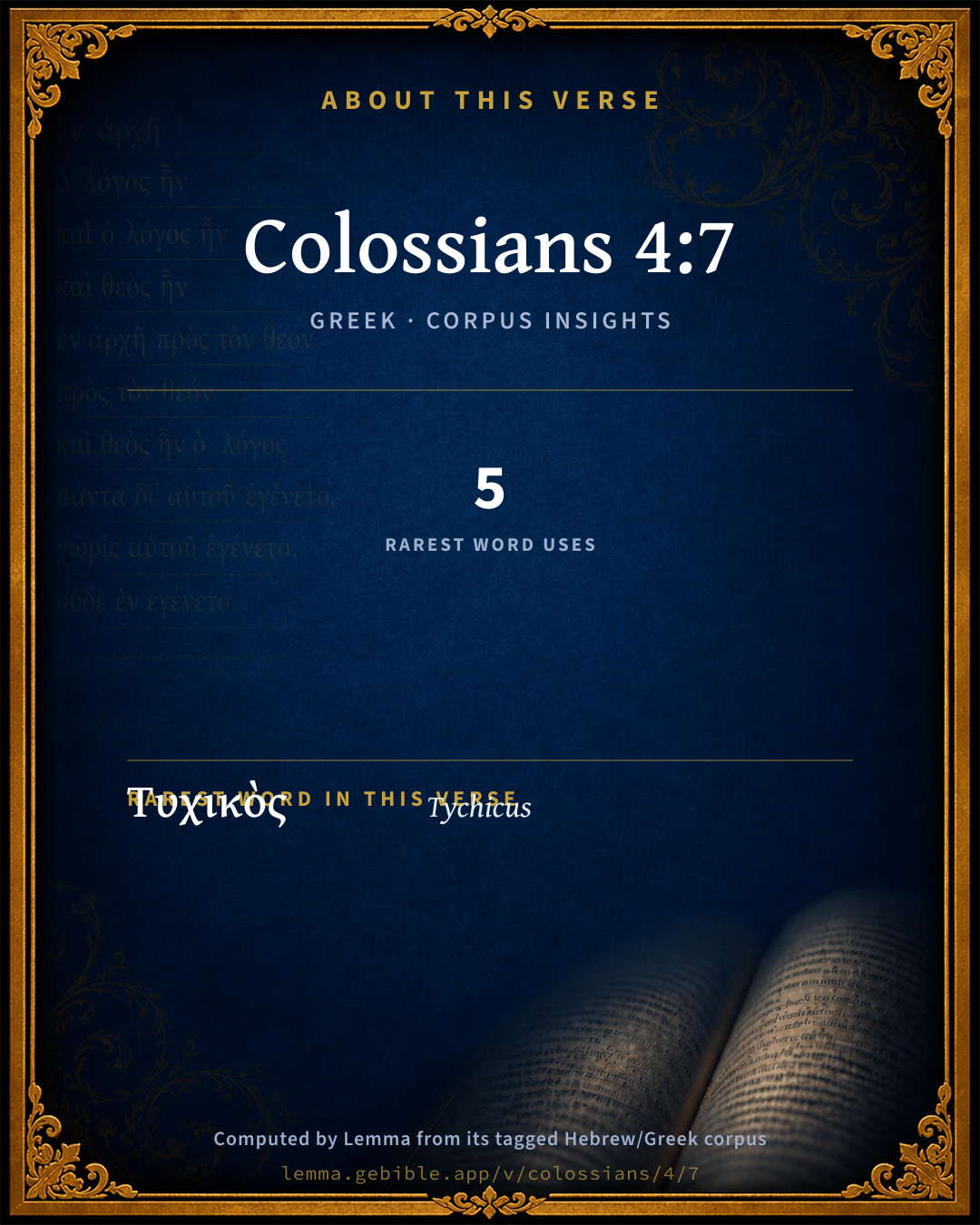
Colossians 4:7

Greek (Tischendorf 8th ed.) Colossians 4:7 appears in the Greek New Testament. The text above is from the Tischendorf 8th edition. Each word links to its Strong’s number and a concise gloss. Click any word for its full Thayer’s Greek Lexicon entry.
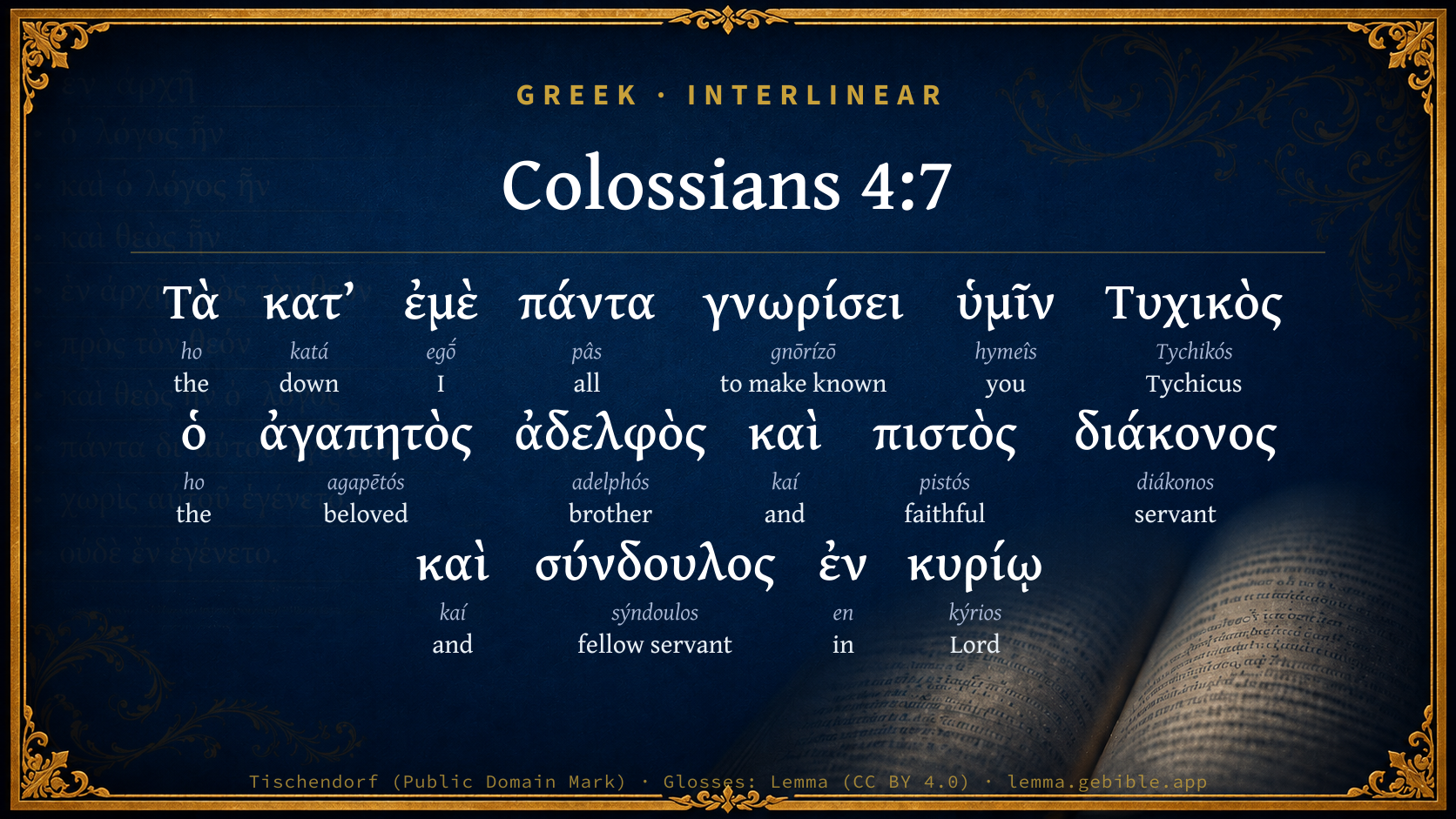
Download image
Cite this verse

Colossians 4:7 (World English Bible). Public Domain. Lemma interlinear Bible study tool, https://lemma.gebible.app/v/colossians/4/7.

Show BibTeX & RIS
BibTeX
RIS
English Translation
All my affairs will be made known to you by Tychicus, the beloved brother, faithful servant, and fellow bondservant in the Lord.
World English Bible · Public Domain
Download a study sheet

One document with this verse’s original text, its word-by-word gloss line, the meaning frame, cross-references with their text, attributed commentary, and full source and license credits — printable, and it pastes into notes with its structure intact.

This verse Autodidact and up

Study sheet (.html) Plain text (.txt)

A passage Seminary Student

Up to 50 verses in one chapter. A passage sheet keeps up to 6 commentary sources and 12 cross-references per verse, in the order this page ranks them, and says so on the sheet whenever that leaves anything out. Ask for a single verse and you get the Autodidact verse sheet above.

Everything on this page stays free to read, with no account — the sheet is a download of what is already on screen, not access to it.

Want to remove ads? Support Godless Engineer
Compare translations 3

The same verse in 3 English versions, stacked beneath the original-language interlinear above. Click any original word for its lexicon entry.

Each is an independent rendering of the whole verse — the interlinear is not word-aligned to these translations.

Highlighted words mark where these versions differ — a whole-verse word diff, not a word-by-word alignment.

  • World English Bible Public Domain
    All my affairs will be made known to you by Tychicus, the beloved brother, faithful servant, and fellow bondservant in the Lord.
  • King James Version Public Domain
    All my state shall Tychicus declare unto you, who is a beloved brother, and a faithful minister and fellowservant in the Lord:
  • unfoldingWord Literal Text CC BY-SA 4.0
    All the things concerning me, Tychicus will make known to you, the beloved brother and faithful servant and fellow slave in the Lord,

unfoldingWord Literal Text — © unfoldingWord, licensed CC BY-SA 4.0. Word-aligned USFM3 via Door43 (git.door43.org/unfoldingWord/en_ult).

Versions to compare (up to 4)

3 of 4 selected

Show all 19 translations

Every available English version of this verse, each an independent rendering of the whole verse.

  • World English Bible Public Domain
    All my affairs will be made known to you by Tychicus, the beloved brother, faithful servant, and fellow bondservant in the Lord.
  • Berean Standard Bible Public Domain
    Tychicus will tell you all the news about me. He is a beloved brother, a faithful minister, and a fellow servant in the Lord.
  • Majority Standard Bible Public Domain
    Tychicus will tell you all the news about me. He is a beloved brother, a faithful minister, and a fellow servant in the Lord.
  • King James Version Public Domain
    All my state shall Tychicus declare unto you, who is a beloved brother, and a faithful minister and fellowservant in the Lord:
  • American Standard Version (1901) Public Domain
    All my affairs shall Tychicus make known unto you, the beloved brother and faithful minister and fellow-servant in the Lord:
  • Revised Version (1885) Public Domain
    All my affairs shall Tychicus make known unto you, the beloved brother and faithful minister and fellow-servant in the Lord:
  • Geneva Bible (1599) Public Domain
    Tychicus our beloued brother and faithfull minister, and fellow seruant in the Lord, shall declare vnto you my whole state:
  • Douay-Rheims (1899) Public Domain
    All the things that concern me, Tychicus, our dearest brother, and faithful minister and fellow servant in the Lord, will make known to you,
  • Young's Literal Translation Public Domain
    All the things concerning me make known to you shall Tychicus -- the beloved brother, and faithful ministrant, and fellow-servant in the Lord --
  • Literal Standard Version CC BY-SA 4.0
    Tychicus will make known to you all the things concerning me—the beloved brother, and faithful servant, and fellow-servant in the LORD—
  • Unlocked Literal Bible CC BY-SA 4.0
    As for the things concerning me, Tychicus will make them known to you. He is a beloved brother, a faithful servant, and fellow slave in the Lord.
  • unfoldingWord Literal Text CC BY-SA 4.0
    All the things concerning me, Tychicus will make known to you, the beloved brother and faithful servant and fellow slave in the Lord,
  • Darby Bible Public Domain
    Tychicus, the beloved brother and faithful minister and fellow-bondman in [the] Lord, will make known to you all that concerns me;
  • World Messianic Bible Public Domain
    All my affairs will be made known to you by Tychicus, the beloved brother, faithful servant, and fellow bondservant in the Lord.
  • Webster's Bible Public Domain
    All my state shall Tychicus declare to you, who is a beloved brother, and a faithful minister and fellow-servant in the Lord:
  • Free Bible Version CC BY-SA 4.0
    Tychicus will tell you all about what's happening to me. He's a dear brother, a trustworthy minister and co-worker in the Lord.
  • Bible in Basic English Public Domain
    Tychicus will give you news of all my business: he is a dear brother and true servant and helper in the word;
  • Text-Critical English NT CC BY 4.0
    Tychicus will tell you all the news about me. He is our beloved brother, a faithful minister and fellow servant in the Lord.
  • Tyndale New Testament (1534) Public Domain
    The deare brother Tichicos shall tell you of all my busynes which is a faythfull minister and felowe servaunt in the Lorde

Literal Standard Version (2020), Covenant Press — licensed CC BY-SA 4.0. Text via the HelloAO Bible API (eBible.org). Unlocked Literal Bible (unfoldingWord) — licensed CC BY-SA 4.0. Text via the HelloAO Bible API (eBible.org). unfoldingWord Literal Text — © unfoldingWord, licensed CC BY-SA 4.0. Word-aligned USFM3 via Door43 (git.door43.org/unfoldingWord/en_ult). Free Bible Version, Dr. Jonathan Gallagher — licensed CC BY-SA 4.0. Text via the HelloAO Bible API (eBible.org).

Word by word

More ways to search: Search by grammar → Find every occurrence → Compare this word →

Practice this passage: Drill this verse → Learn its vocabulary →

Τυχικὸς
Tychikós
G5190
“Tychicus”
Noun, Nominative, Singular, Masculine
Part of Speech
Noun
Case
Nominative
Number
Singular
Gender
Masculine
Full Thayer's Definition

Origin: from a derivative of G5177

TDNT: None

Tychicus = "fateful" 1. an Asiatic Christian, friend and companion of the apostle Paul
  1. Τὰ ho G3588 “the” Article, Accusative, Plural, Neuter
  2. κατ’ katá G2596 “down” Preposition
  3. ἐμὲ egṓ G1473 “I” Personal pronoun, 1st person, Accusative, Singular
  4. πάντα pâs G3956 “all” Adjective, Accusative, Plural, Neuter
  5. γνωρίσει gnōrízō G1107 “to make known” Verb, Future, Active, Indicative, 3rd person, Singular
  6. ὑμῖν hymeîs G5210 “you” Personal pronoun, 2nd person, Dative, Plural
  7. ὁ ho G3588 “the” Article, Nominative, Singular, Masculine
  8. ἀγαπητὸς agapētós G27 “beloved” Adjective, Nominative, Singular, Masculine
  9. ἀδελφὸς adelphós G80 “brother” Noun, Nominative, Singular, Masculine
  10. καὶ kaí G2532 “and” Conjunction
  11. πιστὸς pistós G4103 “faithful” Adjective, Nominative, Singular, Masculine
  12. διάκονος diákonos G1249 “servant” Noun, Nominative, Singular, Masculine
  13. καὶ kaí G2532 “and” Conjunction
  14. σύνδουλος sýndoulos G4889 “fellow servant” Noun, Nominative, Singular, Masculine
  15. ἐν en G1722 “in” Preposition
  16. κυρίῳ kýrios G2962 “Lord” Noun, Dative, Singular, Masculine

About this verse

These counts appear in no published source. They are computed here, from the morphology-tagged text and Lemma’s own curated glosses. What Lemma adds →

17
words
15
distinct lemmas
Pauline Epistles
section

Notable vocabulary

The rarest word here is Τυχικὸς Tychicus G5190 — appearing just 5 times in the whole Greek New Testament.

Shared distinctive vocabulary

Τυχικὸς Tychicus G5190 occurs in 5 verses of the Greek New Testament. Also found in:

Repetition

Words recur within this verse:

Cross-references

8

Topical passages linked to Colossians 4:7 in the Treasury of Scripture Knowledge — connected by theme and wording, ordered by reader-vote popularity; previews shown in the World English Bible.

  • Ephesians 6:21–23 But that you also may know my affairs, how I am doing, Tychicus, the beloved brother and faithful servant in the Lord, will make known to you all things;
  • Acts 20:4 These accompanied him as far as Asia: Sopater of Beroea; Aristarchus and Secundus of the Thessalonians; Gaius of Derbe; Timothy; and Tychicus and Trophimus of Asia.
  • 2 Timothy 4:12 But I sent Tychicus to Ephesus.
  • Titus 3:12 When I send Artemas to you, or Tychicus, be diligent to come to me to Nicopolis, for I have determined to winter there.
  • 1 Corinthians 4:1–4 So let a man think of us as Christ's servants, and stewards of God's mysteries.
  • Colossians 4:9 together with Onesimus, the faithful and beloved brother, who is one of you. They will make known to you everything that is going on here.
  • Philippians 2:25 But I counted it necessary to send to you Epaphroditus, my brother, fellow worker, fellow soldier, and your apostle and minister to my need;
  • Colossians 4:12 Epaphras, who is one of you, a servant of Christ, salutes you, always striving for you in his prayers, that you may stand perfect and complete in all the will of God.

Cross-references courtesy of OpenBible.info (CC BY 4.0).

Commentary

Notes on Colossians 4:7 from classic Christian and Jewish commentators (each source and its license shown beneath its notes). The classic Christian expositions comment on the surrounding passage and are grouped to its opening verse, so a note may address several verses; the Jewish commentaries on the Tanakh (Rashi and others) are per-verse, so they appear only where the commentator wrote on this verse.

Lemma curates 59 commentaries, every one of them public domain or Creative Commons licensed, each selected and text-cleaned for this edition rather than reprinted as found. About our sources →

Matthew Henry's Commentary

In the close of this epistle the apostle does several of his friends the honour to leave their names upon record, with some testimony of his respect, which will be spoken of wherever the gospel comes, and last to the end of the world.

I. Concerning Tychicus, Col 4:7. By him this epistle was sent; and he does not give them an account in writing of his present state, because Tychicus would do it by word of mouth more fully and particularly. He knew they would be glad to hear how it fared with him. The churches cannot but be concerned for good ministers and desirous to know their state. He gives him this character, A beloved brother and faithful minister. Paul, though a great apostle, owns a faithful minister for a brother and a beloved brother. Faithfulness in any one is truly lovely, and renders him worthy our affection and esteem. And a fellow-servant in the Lord. Ministers are servants to Christ, and fellow-servants to one another. They have one Lord, though they have different stations and capacities of service. Observe, It adds much to the beauty and strength of the gospel ministry when ministers are thus loving and condescending one to another, and by all just means support and advance one another's reputation. Paul sent him not only to tell them of his affairs, but to bring him an account of theirs: Whom I have sent unto you for the same purpose, that he might know your estate, and comfort your hearts, Col 4:8. He was willing to hear from them as they could be to hear from him, and thought himself as much obliged to sympathize with them as he thought them obliged to sympathize with him. It is a great comfort, under the troubles and difficulties of life, to have the mutual concern of fellow-christians.

II. Concerning Onesimus (Col 4:9): With Onesimus, a faithful and beloved brother, who is one of you. He was sent back from Rome along with Tychicus. This was he whom Paul had begotten in his bonds, Plm 1:10. He had been servant to Philemon, and was a member, if not a minister, of their church. He was converted at Rome, whither he had fled from his master's service; and was now sent back, it is probable, with the epistle to Philemon, to introduce him again into his master's family. Observe, Though he was a poor servant, and had been a bad man, yet, being now a convert, Paul calls him a faithful and beloved brother. The meanest circumstance of life, and greatest wickedness of former life, make no difference in the spiritual relation among sincere Christians: they partake of the same privileges, and are entitles to the same regards. The righteousness of God by faith of Jesus Christ is unto all and upon all those that believe; for there is no difference (Rom 3:22): and there is neither Jew nor Greek, neither bond nor free, for you are all one in Christ Jesus, Gal 3:28. Perhaps this was some time after he was converted and sent back to Philemon, and by this time he had entered into the ministry, because Paul calls him a brother.

III. Aristarchus, a fellow-prisoner. Those who join in services and sufferings should be thereby engaged to one another in holy love. Paul had a particular affection for his fellow-servants and his fellow-prisoners.

IV. Marcus, sister's son to Barnabas. This is supposed to be the same who wrote the gospel which bears his name. If he come unto you receive him. Paul had a quarrel with Barnabas upon the account of this Mark, who was his nephew, and thought not good to take him with them, because he departed from them from Pamphylia, and went not with them to the work, Act 15:38. He would not take Mark with him, but took Silas, because Mark had deserted them; and yet Paul is not only reconciled to him himself, but recommends him to the respect of the churches, and gives a great example of a truly Christian forgiving spirit. If men have been guilty of a fault, it must not be always remembered against them. We must forget as well as forgive. If a man be overtaken in a fault, you who are spiritual restore such a one in the spirit of meekness, Gal 6:1.

V. Here is one who is called Jesus, which is the Greek name for the Hebrew Joshua. If Jesus had given them rest, then would he not afterwards have spoken of another day, Heb 4:8. Who is called Justus. It is probable that he changed his name for that of Justus, in honour to the name of the Redeemer. Or else Jesus was his Jewish name, for he was of the circumcision; and Justus his Roman or Latin name. These are my fellow-labourers unto the kingdom of God, who have been a comfort unto me. Observe, What comfort the apostle had in the communion of saints and ministers! One is his fellow-servant, another his fellow-prisoner, and all his fellow-workers, who were working out their own salvation and endeavouring to promote the salvation of others. Good ministers take great comfort in those who are their fellow-workers unto the kingdom of God. Their friendship and converse together are a great refreshment under the sufferings and difficulties in their way.

VI. Epaphras (Col 4:12), the same with Epaphroditus. He is one of you, one of your church; he salutes you, or sends his service to you, and his best affections and wishes. Always labouring fervently for you in prayers. Epaphras had learned of Paul to be much in prayer for his friends. Observe, 1. In what manner he prayed for them. He laboured in prayer, laboured fervently, and always laboured fervently for them. Those who would succeed in prayer must take pains in prayer; and we must be earnest in prayer, not only for ourselves, but for others also. It is the effectual fervent prayer which is the prevailing prayer, and availeth much (Jam 5:16), and Elias prayed earnestly that it might not rain, Col 4:17. 2. What is the matter of this prayer: That you may stand perfect and complete in all the will of God. Observe, To stand perfect and complete in the will of God is what we should earnestly desire both for ourselves and others. We must stand complete in all the will of God; in the will of his precepts by a universal obedience, and in the will of his providence by a cheerful submission to it: and we stand perfect and complete in both by constancy and perseverance unto the end. The apostle was witness for Epaphras that he had a great zeal for them: "I bear him record; I can testify for him that he has a great concern for you, and that all he does for you proceeds from a warm desire for your good." And his zeal extended to all about them: to those who are in Laodicea and Hierapolis. He had a great concern for the Christian interest in the neighbouring places, as well as among them.

VII. Luke is another here mentioned, whom he calls the beloved physician. This is he who wrote the Gospel and Acts, and was Paul's companion. Observe, He was both a physician and an evangelist. Christ himself both taught and healed, and was the great physician as well as prophet of the church. He was the beloved physician; one who recommended himself more than ordinary to the affections of his friends. Skill in physic is a useful accomplishment in a minister and may be improved to more extensive usefulness and greater esteem among Christians.

VIII. Demas. Whether this was written before the second epistle to Timothy or after is not certain. There we read (Ti2 4:10), Demas hath forsaken me, having loved this present world. Some have thought that this epistle was written after; and then it is an evidence that, though Demas forsook Paul, yet he did not forsake Christ; or he forsook him but for a time, and recovered himself again, and Paul forgave him and owned him as a brother. But others think more probably that this epistle was written before the other; this in anno 62, that in 66, and then it is an evidence how considerable a man Demas was, who yet afterwards revolted. Many who have made a great figure in profession, and gained a great name among Christians, have yet shamefully apostatized: They went forth from us, because they were not of us, Jo1 2:19.

IX. The brethren in Laodicea are here mentioned, as living in the neighbourhood of Colosse: and Paul sends salutations to them, and orders that this epistle should be read in the church of the Laodiceans (Col 4:16), that a copy of it should be sent thither, to be read publicly in their congregation. And some think Paul sent another epistle at this time to Laodicea, and ordered them to send for that from Laodicea, and read it in their church: And that you likewise read the epistle from Laodicea. If so, that epistle is now lost, and did not belong to the canon; for all the epistles which the apostles ever wrote were not preserved, any more than the words and actions of our blessed Lord. There are many other things which Jesus did, which if they should be written every one, I suppose the world itself could not contain the books which would be written, Joh 21:25. But some think it was the epistle to the Ephesians, which is still extant.

X. Nymphas is mentioned (Col 4:15) as one who lived at Colosse, and had a church in his house; that is, either a religious family, where the several parts of worship were daily performed; or some part of the congregation met there, when they had no public places of worship allowed, and they were forced to assemble in private houses for fear of their enemies. The disciples were assembled for fear of the Jews (Joh 20:19), and the apostle preached in his own lodging and hired house, Act 28:23, Act 28:30. In the former sense it showed his exemplary piety; in the latter his zeal and public spirit.

XI. Concerning Archippus, who was one of their ministers at Colosse. They are bidden to admonish him to mind his work as a minister, to take heed to it, and to fulfil it - to be diligent and careful of all the parts of it, and to persevere in it unto the end. They must attend to the main design of their ministry, without troubling themselves or the people with things foreign to it, or of less moment. Observe, (1.) The ministry we have received is a great honour; for it is received in the Lord, and is by his appointment and command. (2.) Those who have received it must fulfil it, or do the full duty of it. Those betray their trust, and will have a sad account at last, who do this work of the Lord negligently. (3.) The people may put their ministers in mind of their duty, and excite them to it: Say to Archippus, Take heed to the ministry, though no doubt with decency and respect, not from pride and conceit.

XII. Concerning himself (Col 4:18): The salutation of me Paul. Remember my bonds. He had a scribe to write all the rest of the epistle, but these words he wrote with his own hand: Remember my bonds. He does not say, "Remember I am a prisoner, and send me supply;" but, "Remember I am in bonds as the apostle of the Gentiles, and let this confirm your faith in the gospel of Christ:" it adds weight to this exhortation: I therefore, the prisoner of the Lord, beseech you to walk worthy, Eph 4:1. "Grace be with you. The favour of God, and all good, the blessed fruits and effects of it, be with you, and be your portion."

Matthew Henry's Commentary on the Whole Bible (1708–1710) — public domain (CC PDM 1.0). Text via the HelloAO Bible API.

The Biblical Illustrator

Joseph S. Exell

Col_4:7-11

All my state shall Tychicus declare unto you.

Christian commendations and salutations

What is in a name! Nothing, is the ordinary reply, but there may be much. The names of Solomon, Alexander, Napoleon, and Paul are associated with important events in history. Each is a record, and stirs up admiration, desire, dislike, or sorrow as the case may be. If the names of great men interest us, those of the good men who shared the labours of St. Paul may also do so. Those labours are more important than the conquests of captains and the speculations of philosophers. Note--

I. The value of Christian friendship. True friendship will--

1. Show a kindly interest in the welfare of its objects. Paul had such an interest in the Colossians and vice versa.

2. Mutual interest will lead to reciprocal communications. Paul could not go to Colossae so he sent Tychicus and Onesimus to inform them of himself and the affairs of Christs kingdom, to comfort them and bring back a report.

3. Distance and difficulty will not be allowed to stand in the way. Colossae was far off and Paul was in prison, but both were surmounted.

4. Written messages will not be allowed to supersede personal communications when the latter are practicable. So Paul sent his Epistle by trusted friends who were charged also with verbal communications, better spoken than written,

II. The propriety of Christian commendations. In naming the two messengers he speaks of them in high terms, but not in the style of fulsome eulogy.

1. Tychicus is

(1) a beloved brother which indicates his relation to the Church.

(2) Faithful minister, or attendant, which indicates his relation to the Apostle as a trusty helper.

(3) Fellow servant in the Lord, which indicates his relation to Christ--a coadjutor of the apostle in the service of the same Master.

2. Onesimus, the whilom runaway slave, is now a faithful and beloved brother a commendation which would secure for him the welcome that he sorely needed.

3. The spirit of this commendation should be cultivated. The true ground of honour is not in a mans social standing, but in his moral worth and relation to Christ.

III. The force of Christian salutations.

1. Christianity sanctifies the commonest things. How common for us to send our respects to some friend through the letter of another. Give him my kind regards, etc. We have only to think of St. Paul as here using the expressions equivalent in his day. Little did these good men think that their simple expressions of affection would be handed down to prove the sympathy and the unity of the Church throughout the world and time.

2. The saluting brethren were Jews, which would show to the Gentile Church that they had learned what the apostle would teach them, not to call anything that God had cleansed common or unclean.

IV. The solace of christian co-operation.

1. Loneliness is very depressing, but the apostle was spared this.

2. Co-operation in labour divides its burden and ensures success.

3. Unity in Christian toil brings the greatest in touch with the humblest, and gives the humblest a share in the glory of the greatest. (J. Spence, D. D.)

Side lights on Church life in the early times

A straw will indicate the direction of a current; a bit of glass will reveal a star; a kick of the foot may discover a treasure; a word, a look, an involuntary movement will disclose the leading tendency of an individual character; so, on the crowded stage of life it is not always gigantic and public scenes that are most instructive, but rather trivial, undesigned incidents unnoticed by an ordinary observer. We learn--

I. Christian sympathy.

1. As fostering mutual interest in tidings concerning the work of God. The apostle, though in prison and separated from the Colossians, does not abate anything of his interest in their welfare.

2. As a source of encouragement and strength in the Christian life. That he might know your estate and comfort your heart.

II. Christian commendation (verse 7)

. The apostle speaks of his two messengers in a way calculated to ensure their favourable reception by the Colossians, and a respectful attention to their message.

III. Christian courtesy. Those who sent their salutations were of the circumcision. The Christian spirit triumphed over their prejudices, and their greeting would be all the more valued as an expression of their personal esteem, their brotherly affection, and their oneness in Christ. That courtesy is most refined, graceful, gentle, and acceptable that springs from a Christian spirit.

IV. Christian helpfulness (verse 11). How consoling is the sympathy and co-operation of a faithful few. (G. Barlow.)

The sympathetic spirit.

I. Out of a common faith in Christ springs a common sympathy. Here is a man who never saw the Colossians writing to them as a mother might write to her son. Epaphras, not he, had brought them to Christ, yet he loves them as much as though they had been his own children in the faith. This arose out of the simple fact that they both believed in a common Saviour. And as it was with them it should be with us. Man is a social being, and there are many points in his nature which are sympathetic. There are intellectual affinities and moral affinities; besides which there are extra grounds of sympathy. But apart from blood relationships there is no sphere in which the sympathetic spirit works so mightily as in the Christian Church. The same faith incites us believers of the nineteenth century as incited those of the first. Our faith was theirs: their sympathy should be ours.

II. Christian sympathy will seek and find outlet and manifestation.

1. Pauls heart is touched with sympathy; how can he show it. He is a prisoner. It is true he clings to the hope of revisiting Asia, but sympathy does not like delays. And as he cannot go himself he sends Tychicus as his deputy. Here, as in other things, Where theres a will theres a way.

2. Where there is genuine sympathy the best way for its manifestation will somehow open up. That was the ease here. Tychicus was an Asiatic (Act_20:4)

, and was therefore a convenient messenger. Perhaps he had offered himself for the mission. And besides, Onesimus had to go to Colossae to his master.

III. Christian sympathy is hard to satisfy. When it is at full heat it does not ask how little, but how much it may do. The letter itself indicates the deepest thought and care for their welfare; but this is not enough. Tychicus and Onesimus must be bearers of oral messages of comfort. You manifest sympathy as you run down a steep hill. When once you set off you must go on; only there is this difference, when the foot of the hill is reached you stop, but in the path of love there is no stopping.

IV. The sympathetic spirit will as a rule act wisely. The messenger in this case was the best who could have been selected.

1. He was the beloved brother (Eph_6:21); a brother who had a large heart, and who, consequently, had insinuated himself into the good graces of his fellow Christians. He was a favourite among them, they all liked him, and so he was just the man to send.

2. He was a faithful minister. The apostle speaks from personal experience. Tychicus had taken care of Paul, and was therefore a tried man. His conscience was as largo as his heart; his kindness was not at the expense of his justice. Faithfulness was needed at Colossae as much as kindness, her Paul had a great conflict about that Church.

3. A fellow servant. Whoever went to Colossae must be armed with authority, and therefore Paul places the messenger on the same footing as himself.

V. The sympathetic spirit is both contagious and infectious. Some things are contagious which are not infectious; sympathy is both. Tychicus and Onesimus caught it; it was conveyed to the distant Colossians. I can touch my neighbour and make him sympathetic too, i.e., if there be any affinity between us; and I can also send its electric current to my friend thousands of miles away. It can be transmitted by the simplest implement--a pen.

VI. The sympathetic spirit never fails. It is a form of charity. It is like the sun--only let it shine on, and as it shines stronger and stronger, the hard frost will relax its deadly grasp, winter will disappear, and spring with its flowers and music will come.

VII. We can all acquire the sympathetic spirit. There is nothing to show that Tychicus was a great man. He was not an apostle, but he had a large warm heart. If we cannot render Christ head service we can heart service. (A. Scott.)

Tychicus and Onesimus, the letter bearers

I. Tychicus.

1. The man and his mission. He was probably one of the fruits of the apostles residence in Ephesus. On his way to Jerusalem after the riot he was joined by seven friends. Tychicus was one of the two from Asia; the other was Trophinius, whom we know to have been an Ephesian (Act_21:29), as Tychicus probably was. This was about 58 A.D. Then came an interval of three or four years, and then the apostle is in Rome. Whether Tychicus was with him all the time we do not know, but these verses, written a.d. 62 or 63, imply a considerable period of service. He is now sent to Colossae. The same words are employed about him in the contemporaneous letter to the Ephesians. Evidently, then, he carried both letters on the same journey, and one reason was that he was a native of the province, and probably of Ephesus. You go, Tychicus. It is your home; they all know you. The most careful students now think that the Ephesian Epistle was meant to go the round of the Churches of Asia Minor, beginning with Ephesus. If that be so Tychicus would necessarily come to Laodicea, which was only a few miles from Colossae, and so could conveniently deliver this Epistle. After this we get two more glimpses of the man; one in the Epistle to Titus, when the apostle intended to despatch him to Crete, and the last in 2Ti_4:2 (a.d. 67). Tychicus have I sent to Ephesus, as if he had said, Now go home, my friend! You have been a faithful servant for ten years. I need you no more. Take my blessing. God be with you! So they parted--he that was for death to die I and he that was for life, to live and treasure the memory of Paul for the rest of his days.

2. His character and work.

(1) As for his personal godliness and goodness, he is a beloved brother, as are all who love Christ.

(2) He was a faithful minister or personal attendant. Paul always seems to have had one or two such about him. Probably he was no great hand at managing affairs, and needed a plain common-sense nature to act as secretary and factotum. Men of genius, and men devoted to some great cause, want some person to fill such a homely office. Common sense, willingness to be troubled with small secular details, and hearty love for the chief, and desire to spare him, were the qualifications. Such probably was Tychicus--no orator, thinker, organizer, but a plain soul who did not shrink from rough work if it would help the cause.

(3) He was a fellow-servant in the Lord. As if he had said, Do not suppose there is much difference between us. We have both, as I have been reminding you, a common Master. The delicacy of the term thus given to the commendation is a beautiful indication of Pauls chivalrous nature. No wonder that such a soul bound men like Tychicus to him.

3. Lessons.

(1) Small things done for Christ are great. In some powerful engine there is a little screw, and if it drop out the huge piston cannot rise nor the huge crank turn. There is a great rudder that steers an ironclad. It moves on a pintle a few inches long. If that bit of iron were gone what would be the use of the ship. There is an old jingle about losing a shoe for the want of a nail, a horse for want of a shoe, a man for want of a horse, a battle for want of a man, a kingdom for loss of a battle. The intervening links may be left out--and the nail and the kingdom brought together. What is the use of writing letters if you cannot get them delivered? It takes both Paul and Tychicus to get the letter into the hands of the Colossians.

(2) The sacredness of secular work done for Christ. When Tychicus is caring for Paul, his work is in the Lord. The distinction between sacred and secular, like that of great and small, disappears from work done for and in Jesus. All done for the same God is the same in essence, for it is all worship.

(3) Fleeting things done for Christ are eternal. How astonished Tychicus would have been if anybody had told him that those two precious letters in his scrip would outlast all the pomp of the city, and that his name, because written in them, would be known to the end of time all over the world.

(a) They are eternal in Christs memory, however they may fall from mans remembrance.

(b) They are perpetual in their consequences.

True, no mans contribution to the sum of righteousness can very long be traced, any more than the rain-drop that refreshed the harebell can be traced in a burn, or river, or sea; but it is there. The Colossian Church, with its sisters, is gone; but Christian men all over the world owe something to Tychicus care. Paul meant to teach a handful of obscure believers; he has edified a world.

(4) As the reward is given not to the outward deed, but to the motive which settles its value, all work done from the same motive is alike in reward, however different in form. Paul in the front, Tychicus in the rear, shall share alike at last. He that receiveth a prophet, etc.

II. Onesimus.

1. The man and his character. He is the same as we read of in Philemon. He had been a good-for-nothing servant, and apparently had robbed his master and then fled to Rome. Somehow or other he had found Paul, and Pauls master had found him. And now he goes back to his owner. With beautiful considerateness the apostle unites him with Tychicus, and refers the Church to him as an authority. But with sensitive regard he omits the fellow-slave, which might have hurt, but he cannot leave out the faithful, because Onesimus had been eminently unfaithful. There is no reference to his flight, etc. The Church has nothing to do with these, only Philemon.

2. Lessons.

(1) The transforming power of Christianity. Slaves had well-known vices of which Onesimus had his full share. Think of him as he left Colossae; and think of him as he went back Pauls trusted representative. What had happened? Nothing but this--the message had come to Him. Onesimus! Christ has died for thee and lives to bless thee. Believest thou this? And he believed. It had changed his whole being, He is a living illustration of Pauls teaching, lie is dead with Christ to his old self; he lives with Christ a new life. The gospel can do that. Nothing else can. The gospel despairs of none; none are beyond its power.

(2) The power the gospel has of binding men into a true brotherhood. We can scarcely picture to ourselves the gulf which separated master from slave; Christianity gathered both into one family. All true union must be based on oneness in Christ. The world must recognize that One is your Master, before it comes to believe that All ye are brethren. (A. Maclaren, D. D.)

Tychicus

was a native of proconsular Asia (Act_20:4)

, and perhaps of Ephesus (2Ti_4:12). He is found with St. Paul at three different epochs in his life.

1. He accompanied him when on his way east ward at the close of the third missionary journey, a.d. 58 (Act_20:4), and probably, like Trophimus (Act_21:29), went with him to Jerusalem. It is probable that Tychicus, together with others mentioned among Pauls numerous retinue on this occasion, was a delegate appointed by his own Church according to the apostles injunctions (1Co_16:3-4), to bear the contributions of his brethren to the poor Christians of Judaea; and, if so, he may possibly be the person commended as the brother, etc. (2Co_8:18).

2. We find Tychicus again in St. Pauls company here, probably towards the end of the first Roman captivity, a.d. 62, 63.

8. Once more at the close of St. Pauls life (about a.d. 671 he appears again to have associated himself with the apostle (Tit_3:12; 2Ti_4:12). Tychicus is not so common a name as some others, but it is found occasionally in inscriptions which belong to Asia Minor, and persons bearing it are commemorated on coins. (Bp. Lightfoot.)

Value of a comforter

But so have I seen the sun kiss the frozen earth, which was bound up with the images of death, and the colder breath of the north; and then the waters break from their enclosures, and melt with joy, and run in useful channels; and the flies do rise again from their little graves in walls, and dance a while in the air, to tell that there is joy within, and that the great Mother of creatures will open the stock of her new refreshment, become useful to mankind, and sing praises to her Redeemer. So is the heart of a sorrowful man under the discourses of a wise comforter. He breaks from the despairs of the grave, and the fetters and chains of sorrow; he blesses God, and he blesses thee, and he feels his life returning; for to be miserable is death, but nothing is life but to be comforted. And God is pleased with no music from below so much as in the thanksgiving songs of relieved widows, of supported orphans, of rejoicing and comforted and thankful persons. (Bp. Taylor.)

The Biblical Illustrator, edited by Joseph S. Exell (c. 1880s–1900s) — public domain. Text from a community e-Sword module.

Joseph Benson's Commentary

Col 4:7-9. All my state — The things which relate to myself; shall Tychicus declare unto you — See on Eph 6:21. With Onesimus, who is one of you — Or, rather, who is from you, as εξ υμων seems to mean; or, who is your countryman; for it does not appear that he could be a member of the church at Colosse before he left his master Philemon, since, it is certain he was converted after that period by the apostle at Rome. See Phm 1:10.

Joseph Benson's Commentary on the Old and New Testaments (1811–1818) — public domain. Text from a community e-Sword module.

Whedon's Commentary on the Bible

Daniel D. Whedon

IV. CONCLUSION, Col_4:7-18.

1. Personal communications, Col_4:7-14.

7. Tychicus—With this and the following verses, Eph_6:21-22, is almost word for word. Our only knowledge of Tychicus before this time is that he was an Asiatic, and he appears in Act_20:4, as one of Paul’s companions from Corinth into Asia. He is now his special messenger to the two Churches, bearing a letter to each, and also is charged with verbal communications respecting the apostle’s condition.

Daniel D. Whedon (gen. ed.), Commentary on the Old and New Testaments (1874–1909) — public domain. Text from a community e-Sword module.

The Preacher's Complete Homiletical Commentary

Joseph S. Exell (gen. ed.)

CRITICAL AND EXPLANATORY NOTES

Col_4:11. A comfort to me.—The word for “comfort” is only found in this place in the New Testament. It is a medical term, and points to relief given in suffering—then, by way of ministering to a mind diseased or in trouble, is used of the speech which soothes and calms.

MAIN HOMILETICS OF THE PARAGRAPH.—Col_4:7-11

Side-lights on Church-life in the Early Times.

A straw will indicate the direction of a current; a bit of glass will reveal a star; a kick of the foot may discover a treasure that will enrich successive generations; a word, a look, an involuntary movement will disclose the leading tendency of an individual character; so on the crowded stage of life it is not always the gigantic and public scenes that are most suggestive and instructive, but rather the trivial, undesigned incidents which are unnoticed by an ordinary observer. A reflective mind will pick up material for thought from the most unexpected and unpromising quarters. The apostle has finished the grand argument of the epistle, and shown the importance of certain duties which grow out of the reception of the truths enforced. In approaching the conclusion, he appears to be chiefly occupied with a mass of personal and miscellaneous matters. The few remaining verses contain little else but a series of names, with the briefest qualifying phrases attached. But here and there light is thrown on truths which, though familiar, are all the more strongly impressed on our minds because of their evident antiquity. In these verses there are sidelights thrown on Church-life in the early times with reference to Christian sympathy, commendations, courtesy, and co-operation. We learn:—

I. The value of Christian sympathy.—

1. As fostering mutual interest in tidings concerning the work of God. “All my state shall Tychicus declare unto you, … whom I have sent unto you for the same purpose; … shall make known unto you all things which are done here” (Col_4:7-9). The apostle, though in prison and separated by a long distance from the Colossians, does not abate anything of his interest in their welfare. He had received tidings of their condition as a Church; of their steadfastness, successes, and perils; and he was sure that intelligence from him would be eagerly welcomed by them. He therefore despatched Tychicus and Onesimus, who could furnish more details concerning the apostle, the exemplary spirit in which he bore his sufferings, his profound anxiety on behalf of the Churches and the progress of the gospel in Rome, than were contained in the epistle they carried. A heart, touched with a genuine Christian sympathy, rejoices in the extension of the work of God, in whatever part of the world, and by whatever Christian agency. The mutual interchange of intelligence tends to excite the interest, promote the union, and stimulate the enterprise of the Churches.

2. As a source of encouragement and strength in the Christian life.—“That he might know your estate and comfort your heart” (Col_4:8). Instead of “that he might know your estate,” another reading of the original, adopted by Lightfoot and other eminent critics, has “that ye might know our affairs.” “But,” as Bishop Wordsworth remarks, “the very purpose for which Paul sent Tychicus to the Colossians was not, it would seem, in order that they might know how St. Paul was faring, but that he might know whether they were standing steadfast in the faith against the attempts of the false teachers.” Whichever reading is adopted, the practical lesson is the same; both express the reality, strength, and beauty of a mutual sympathy. The presence of Tychicus and Onesimus, the character of the tidings they brought, and the fervour of their exhortations, would encourage and reassure the Colossians amid the perplexities and doubts occasioned by the false teachers. Mutual expression of sympathy and intercommunity of intelligence will do much to comfort and edify the Churches.

II. The appropriateness of Christian commendation (Col_4:7).—The apostle speaks highly of his two messengers—not in terms of extravagant flattery, but in a way calculated to ensure their favourable reception by the Colossians and a respectful attention to their message. Tychicus was a native of proconsular Asia, perhaps of Ephesus. He was well known as an authorised delegate of St. Paul, and is mentioned in other places as being with the apostle (Act_20:4; 2Ti_4:12; Tit_3:12). He is spoken of in this verse as “a beloved brother, a faithful minister, a fellow-servant in the Lord.” The great apostle, far from taking advantage of his exalted calling and inspiration, humbled himself before the least of his brethren, spoke in the highest terms of their faithful labours, and associated them with his own. Onesimus, a Colossian, is commended as “a faithful and beloved brother.” It was the more needful he should be thus commended, because if he was known to the Colossians at all it would be as a worthless, runaway slave. Some time before, Onesimus had forsaken his master Philemon, and fled to Rome—the common sink of all nations—probably as a convenient hiding-place where he might escape detection among its crowds, and make a livelihood as best he could. In the metropolis—perhaps accidentally, perhaps through the intervention of Epaphras—he fell in with the apostle, his master’s old friend. St. Paul becomes interested in his case, instructs him in the gospel, and is the instrument of his conversion; and now he is commended to the Colossians, no more as a good-for-nothing slave, but as a brother; no more dishonest and faithless, but trustworthy; no more an object of contempt, but love. The apostle sent him back to his master Philemon, and it is generally thought, having been set at liberty by his owner, he became a faithful and laborious minister of Christ. Such is the transforming power of divine grace in changing and renewing the heart, in obliterating all former distinctions and degradations, and in elevating a poor slave to the dignity of “a faithful and beloved brother” of the greatest of apostles. Christian commendations are valuable according to the character of the persons from whom they issue, and as they are borne out in the subsequent conduct of the persons commended. Every care should be taken that the testimonial of recommendation is strictly true. It is putting a man in a false position and doing him an injury to exaggerate his qualifications by excessive eulogy.

III. Suggestive examples of Christian courtesy.—“Aristarchus my fellow-prisoner saluteth you, and Marcus, sister’s son to Barnabas, (touching whom ye received commandments: if he come unto you, receive him;) and Jesus, which is called Justus, who are of the circumcision” (Col_4:10-11). Aristarchus was a Jew, though a native of Thessalonica. He was with Paul during the riot at Ephesus, and was hurried with Gaius into the theatre by Demetrius and his craftsmen. He accompanied the apostle from Greece to Jerusalem with the collection for the saints. When Paul was imprisoned in Judea, he abode with him; and when he went into Italy, he also went and remained with him there during his confinement, till at length he became, it may be, obnoxious to the magistrates, and was cast into prison; or perhaps he became a voluntary prisoner, that he might share the apostle’s captivity. What a glimpse have we Here of heroic devotion, and of the irresistible charm there must have been in the apostle in attaching men to himself! Marcus was the John Mark frequently referred to in the Acts of the Apostles. He had been the occasion of a contention between Paul and Barnabas, which led to their separating from each other and following different scenes of labour. Mark had, from cowardice or some other motive, “departed from them from Pamphylia, and went not with them out to the work”; and when Barnabas, probably influenced by his affection as near kinsman, wished to take him with them, Paul resolutely refused thus to distinguish a young and unstable disciple. But from the reference here it appears that Mark had repented of his timid and selfish behaviour and returned to a better spirit. Perhaps the displeasure of the apostle weighed upon his mind, and, with Barnabas’ prayers and example, had brought him to a right view of his misconduct. He was now restored to the apostle’s confidence, and it appears Paul had already given directions to the Colossians concerning Mark to welcome him heartily if he paid them a visit—“touching whom ye received commandments: if he come to you, receive him.” The third Hebrew convert who united in sending salutations was Jesus, which was also called Justus—a common name or surname of Jews and proselytes, denoting obedience and devotion to the law. Nothing definite is known of this person; but the apostle held him in such esteem as to join his salutation with the rest. These three friends and companions of Paul were Jews—they were of the circumcision; and yet they send their salutations to a Church composed chiefly of Gentiles. The Christian spirit triumphed over their deep-rooted prejudices, and their greeting would be all the more valued as an expression of their personal esteem, their brotherly affection, and their oneness in Christ. That courtesy is the most refined, graceful, gentle, and acceptable that springs from the Christian spirit.

IV. The solace of Christian co-operation.—“These only are my fellow-workers unto the kingdom of God, which have been a comfort unto me” (Col_4:11). The tendency of the Jewish convert was to lean to the Mosaic ritual, and insist on its necessity in realising the efficacy of the gospel. They thus favoured the false philosophy of the Jewish Platonists, and fell into the errors against which the apostle so faithfully warns in this epistle. The action of the Judaizing teachers and their sympathisers was often a grief and hindrance to him. Of all the Jewish converts in Rome only three were a comfort to him. They thoroughly embraced and advocated the free and unconditional admission of the Gentiles into the Church of Christ, and were devoted and zealous fellow-workers with him in extending the kingdom of God. It is an evidence of the unpopularity among the Jews of the gospel as intended equally for the Gentiles, and of the formidable prejudices and difficulties with which the apostle had to contend in that early time, that there were only three Hebrew converts who were a comfort to him. And yet how consoling is the sympathy and co-operation of the faithful few! Sometimes the noblest men are deserted by timid and time-serving professors, and left to toil on alone in peril and sadness. History records the triumphs of those who have successfully braved the solitary struggle in some great crisis; but it is silent about the vanquished who, with broken hearts and shattered intellects, have sunk into unchronicled oblivion.

Lessons.—

1. Christian experience is the same in all ages.

2. True courtesy costs little and accomplishes much. 3. Genuine sympathy is best shown by an active and self-denying co-operation.

The Preacher's Complete Homiletical Commentary (gen. ed. Joseph S. Exell; Funk & Wagnalls, c. 1892) — public domain (pre-1929). A full-Bible homiletical/sermon-outline anthology covering 65 of 66 books (2 John is absent from the source module). Text from a community e-Sword module.

Lange's Commentary on the Holy Scriptures

IV. THE CONCLUSION

Col_4:7-18.

1. Personal Intelligence

(Chap. 4. 7–9.)

7All my state shall Tychicus declare unto you, who is a beloved brother, and a faithful minister and fellow servant in the Lord; 8whom I have sent unto you for the same [this very] purpose, that he might know4 your estate, and comfort your hearts; 9With Onesimus, a faithful and beloved brother, who is one of you. They shall make known unto you all things which are done here.

EXEGETICAL AND CRITICAL

Col_4:7-8 are the same as Eph_6:21-22, except that here and fellow servant is added after “faithful minister,” having the same adjective and qualifying clause (in the Lord) as the latter. Thus Paul makes Tychicus prominent not, merely as brother, but also as colleague, not however, ascribing apostolic authority to him (Schenkel). [If the reading γνῶ–ἡμῶν be adopted, there is a further variation from Ephesians. Since the Colossian Church was in danger, it would seem more important that Paul should know their state, than that they should know his circumstances, and hence more probable that Tychicus was sent for the former purpose. This is a strong exegetical reason for preferring the reading followed in the E. V.; that he might know your estate. (See Alford and Wordsworth.)—R.]

Col_4:9. With Onesimus, a faithful and beloved brother.—On Onesimus, See Lange’s Comm., Philemon [p. 4, et passim], Paul calls him “brother” on account of his faith, notes that he s faithful (can be relied upon), and is dear and valuable to him. To recommend him, he places him with Tychicus, who has only an official position in advance of him. Πιστός, as in Col_4:7, must mean “faithful,” not “believing,” (Baehr), which is implied in “brother.”

Who is one of you.—He is thus described and recommended as a Colossian, a townsman of the readers. [He who had been a fraudulent runaway slave is restored as “one of themselves,” commended thus in an Epistle to be read publicly in Colosse and elsewhere (Col_4:16). “How much native truth, courage, and beauty is there in Christianity, which enabled the Apostle to speak thus of a runaway slave, to the inhabitants of that city from which he had fled! What other religion in the world could have done this?” (Wordsworth).—R.]

They shall make known unto you all things which are done here.—[Τὰ ὧδε, “things here.”—R.] In common and in agreement they will make known how it is here in general, as Tychicus will especially inform them of the personal circumstances, on account of which he was sent. This clause is thus readily reconcilable with the well attested reading. [According to the other reading, Tychicus was sent to learn officially concerning them, and to comfort them with his tidings, which Onesimus shared with him. Alford: “Is it likely with this re statement (of Col_4:7), that the same should be stated again in the middle of the sentence, which would be the case with the other reading (γνῶτε-ἡμῶν)?”—R.]

DOCTRINAL AND ETHICAL

Comp. Eph_6:21-22. What was common in faith on the Lord, is much more than what was diverse in station and culture. Even the position of an Apostle was not so exalted, that a Christian was not Paul’s brother, and a servant of Christ his colleague.

HOMILETICAL AND PRACTICAL

Starke:—A Christian must not regard the former faults of his neighbor, occurring before his conversion, still less reproach him with them, rather praise and esteem the virtues, which God has granted him since.

[Burkitt:—Nothing endears persons so much to one another, as religion and the grace of God. These ties are stronger than those of nature. No such love as likeness occasions, especially likeness to God.—Happy it is, when the conversation of Christ’s ministers is such, both in public and private, that they need not be ashamed to have it known, or that the Church may understand it.—R.]

[Henry:

Col_4:7. It adds much to the beauty and strength of the gospel-ministry, when ministers are thus loving and condescending one to another, and by all just means support and advance one another’s reputation.

Col_4:9. The meanest circumstance of life, and greatest wickedness of former life, make no difference in the spiritual relation among sincere Christians: they partake of the same privileges, and are entitled to the same regards.—R.]

Footnotes:

[4]Col_4:8.—The reading γνῶτε-ἡμῶν, A. B. and others is better supported than γνῶ-ὑμῶν. In א. τε is erased by another hand and η placed over ὑμῶν, though afterwards cancelled. [The reading which Braune rejects, (followed E. V.) is best supported by versions and adopted by the following editors: Tischendorf, De wette, Alford, Ellicott, Wordsworth. Griesbach, Scholz, Lachmann and Meyer adopt γνῶτε-ἡμῶν. Alford thus accounts for the corrections in א. γνῶ-ὑμῶν was the original reading; א. 1 inserted τε; א. 3 erased it, altering ὑμῶν to ἡμῶν, but correcting it afterwards.—R.]

Lange's Commentary on the Holy Scriptures (Critical, Doctrinal, and Homiletical), ed. John Peter Lange, English translation edited by Philip Schaff (1864–1880) — public domain. Text from a community e-Sword module.

F. W. Grant's Numerical Bible

Section 3. (Col 4:7-18.)

Openings of heart.

Perhaps one may best characterize the closing section of Colossians as "heart-openings." It is in fact the free interchange of brotherly feeling on the part of those who have recognized the place which they have been given with regard to one another. Thus it begins with the provision for mutual knowledge of each other’s state. Tychicus, a beloved and faithful brother, able to enter into such things, is sent from the apostle to convey to the disciples the news as to himself; and to bring back from them the account of their condition. This he realizes as what their hearts would crave for comfort, as united together in the love of Christ.

There follow special greetings and remembrances; as to which there is scarcely much needed by way of explanation, though much may be gained by meditation. The apostle closes with the salutation written with his own hand, certifying the letter to be his own, and bidding them keep in mind his bonds for Christ.

F. W. Grant, The Numerical Bible (4th ed., 1903) — public domain. Text from a community e-Sword module.

The Expositor's Bible

Chapter 4 Part 2

TYCHICUS AND ONESIMUS, THE LETTER BEARERS

Col_4:7-9 (R.V.)

In Pauls days it was perhaps more difficult to get letters delivered than to write them. It was a long, weary journey from Rome to Colossae, -across Italy, then by sea to Greece, across Greece, then by sea to the port of Ephesus, and thence by rough ways to the upland valley where lay Colossae, with its neighbouring towns of Laodicea and Hierapolis. So one thing which the Apostle has to think about is to find messengers to carry his letter. He pitches upon these two, Tychicus and Onesimus. The former is one of his personal attendants, told off for this duty; the other, who has been in Rome under very peculiar circumstances, is going home to Colossae, on a strange errand, in which he may be helped by having a message from Paul to carry.

We shall not now deal with the words before us, so much as with these two figures, whom we may regard as representing certain principles, and embodying some useful lessons.

I. Tychicus may stand as representing the greatness and sacredness of small and secular service done for Christ.

We must first try, in as few words as may be, to change the name into a man. There is something very solemn and pathetic in these shadowy names which appear for a moment on the page of Scripture, and are swallowed up of black night, like stars that suddenly blaze out for a week or two, and then dwindle and at last disappear altogether. They too lived, and loved, and strove, and suffered, and enjoyed: and now-all is gone, gone; the hot fire burned down to such a little handful of white ashes. Tychicus and Onesimus! two shadows that once were men! and as they are, so we shall be.

As to Tychicus, there are several fragmentary notices about him in the Acts of the Apostles and in Pauls letters, and although they do not amount to much, still by piecing them together, and looking at them with some sympathy, we can get a notion of the man.

He does not appear till near the end of Pauls missionary work, and was probably one of the fruits of the Apostles long residence in Ephesus on his last missionary tour, as we do not hear of him till after that period. That stay in Ephesus was cut short by the silversmiths riot-the earliest example of trades unions-when they wanted to silence the preaching of the gospel because it damaged the market for "shrines," and "also" was an insult to the great goddess! Thereupon Paul retired to Europe, and after some months there, decided on his last fateful journey to Jerusalem. On the way he was joined by a remarkable group of friends, seven in number, and apparently carefully selected so as to represent the principal fields of the Apostles labours. There were three Europeans, two from. "Asia"-meaning by that name, of course, only the Roman province, which included mainly the western seaboard-and two from the wilder inland country of Lycaonia. Tychicus was one of the two from Asia; the other was Trophimus, whom we know to have been an Ephesian, {Act_21:29} as Tychicus may not improbably have also been.

We do not know that all the seven accompanied Paul to Jerusalem. Trophimus we know did, and another of them, Aristarchus, is mentioned as having sailed with him on the return voyage from Palestine. {Act_27:2} But if they were not intended to go to Jerusalem, why did they meet him at all? The sacredness of the number seven, the apparent care to secure a representation of the whole field of apostolic activity, and the long distances that some of them must have travelled, make it extremely unlikely that these men should have met him at a little port in Asia Minor for the mere sake of being with him for a few days. It certainly seems much more probable that they joined his company and went on to Jerusalem. What for? Probably as bearers of money contributions from the whole area of the Gentile Churches, to the "poor saints" there-a purpose which would explain the composition of the delegation. Paul was too sensitive and too sagacious to have more to do with money matters than he could help. We learn from his letter to the Church at Corinth that he insisted on another brother being associated with him in the administration of their alms, so that no man could raise suspicions against him. Pauls principle was that which ought to guide every man entrusted with other peoples money to spend for religious or charitable purposes-"I shall not be your almoner unless some one appointed by you stands by me to see that I spend your money rightly"-a good example which, it is much to be desired, were followed by all workers, and required to be followed as a condition of all giving.

These seven, at all events, began the long journey with Paul. Among them is our friend Tychicus, who may have learned to know the Apostle more intimately during it, and perhaps developed qualities in travel which marked him out as fit for the errand on which we here find him.

This voyage was about the year 58 A.D. Then comes an interval of some three or four years, in which occur Pauls arrest and imprisonment at Caesarea, his appearance before governors and kings, his voyage to Italy and shipwreck, with his residence in Rome. Whether Tychicus was with him during all this period, as Luke seems to have been, we do not know, nor at what point he joined the Apostle, if he was not his companion throughout. But the verses before us show that he was with Paul during part of his first Roman captivity, probably about A.D. 62 or 63; and their commendation of him as "a faithful minister," or helper of Paul, implies that for a considerable period before this he had been rendering services to the Apostle.

He is now despatched all the long way to Colossae to carry this letter, and to tell the Church by word of mouth all that had happened in Rome. No information of that kind is in the letter itself. That silence forms a remarkable contrast to the affectionate abundance of personal details in another prison letter, that to the Philippians, and probably marks this Epistle as addressed to a Church never visited by Paul. Tychicus is sent, according to the most probable reading that "ye may know our estate, and that he may comfort your hearts"-encouraging the brethren to Christian steadfastness, not only by his news of Paul, but by his own company and exhortations. The very same words are employed about him in the contemporaneous letter to the Ephesians. Evidently, . then, he carried both epistles on the same journey; and one reason for selecting him as messenger is plainly that he was a native of the province, and probably of Ephesus. When Paul looked round his little circle of attendant friends, his eye fell on Tychicus, as the very man for such an errand. "You go, Tychicus. It is your home; they all know you."

The most careful students now think that the Epistle to the Ephesians was meant to go the round of the Churches of Asia Minor, beginning, no doubt, with that in the great city of Ephesus. If that be so, and Tychicus had to carry it to these Churches in turn, he would necessarily come, in the course of his duty, to Laodicea, which was only a few miles from Colossae, and so could most conveniently deliver this Epistle. The wider and the narrower mission fitted into each other. No doubt he went, and did his work. We can fancy the eager groups, perhaps in some upper room, perhaps in some quiet place of prayer by the river side; in their midst the two messengers, with a little knot of listeners and questioners round each. How they would have to tell the story a dozen times over! How every detail would be precious! How tears would come and hearts would glow! How deep into the night they would talk! And how many a heart that had begun to waver would be con, firmed in cleaving to Christ by the exhortations of Tychicus, by the very sight of Onesimus, and by Pauls words of fire!

What became of Tychicus after that journey we do not know. Perhaps he settled down at Ephesus for a time, perhaps he returned to Paul. At any rate, we get two more glimpses of him at a later period-one in the Epistle to Titus, in which we hear of the Apostles intention to despatch him on another journey to Crete, and the last in the close of the second Epistle to Timothy, written from Rome probably about A.D. 67. The Apostle believes that his death is near, and seems to have sent away most of his staff. Among the notices of their various. appointments we read, "Tychicus have I sent to Ephesus." He is not said to have been sent on any mission connected with the Churches. It may be that he was simply sent away because, by reason of his impending martyrdom, Paul had no more need of him. True, he still has Luke by him, and he wishes Timothy to come and bring his first "minister," Mark, with him. But he has sent away Tychicus, as if he had said; Now, go back to your home, my friend! You have been a faithful servant for ten years. I need you no more. Go to your own people, and take my blessing. God be with you! So they parted, he that was for death, to die! and he that was for life, to live and to treasure the memory of Paul in his heart for the rest of his days. These are the facts; ten years of faithful service to the Apostle, partly during his detention in Rome, and much of it spent in wearisome and dangerous travelling undertaken to carry a couple of letters.

As for his character, Paul has given us something of it in these few words, which have commended him to a wider circle than the handful of Christians at Colossal. As for his personal godliness and goodness, he is "a beloved brother," as are all who love Christ; but he is also a "faithful minister," or personal attendant upon the Apostle. Paul always seems to have had one or two such about him, from the time of his first journey, when John Mark filled the post, to the end of his career. Probably he was no great hand at managing affairs, and needed some plain common sense nature beside him, who would be secretary or amanuensis sometimes, and general helper and factotum. Men of genius and men devoted to some great cause which tyrannously absorbs attention, want some person to fill such a homely office. The person who filled it would be likely to be a plain man, not gifted in any special degree for higher service. Common sense, willingness to be troubled with small details of purely secular arrangements, and a hearty love for the chief, and desire to spare him annoyance and work, were the qualifications. Such probably was Tychicus-no orator, no organiser, no thinker, but simply an honest, loving soul, who did not shrink from rough outward work, if only it might help the cause. We do not read that he was a teacher or preacher, or miracle worker. His gift was-ministry, and he gave himself to his ministry. His business was to run Pauls errands, and, like a true man, he ran them "faithfully." So then, he is fairly taken as representing the greatness and sacredness of small and secular service for Christ. For the Apostle goes on to add something to his eulogium as a "faithful minister"-when he calls him "a fellow servant," or slave, "in the Lord." As if he had said, Do not suppose that because I write this letter, and Tychicus carries it, there is much difference between us. We are both slaves of the same Lord who has set each of us his tasks; and though the tasks be different, the obedience is the same, and the doers stand oil one level. I am not Tychicus master, though he be my minister. We have both, as I have been reminding you that you all have, an owner in heaven. The delicacy of the turn thus given to the commendation is a beautiful indication of Pauls generous, chivalrous nature. No wonder that such a soul bound men like Tychicus to him!

But there is more than merely a revelation of a beautiful character in the words; there are great truths in them. We may draw them out in two or three thoughts.

Small things done for Christ are great. Trifles that contribute and are indispensable to a great result are great; or perhaps, more properly, both words are out of place. In some powerful engine there is a little screw, and if it drop out the great piston cannot rise nor the huge crank turn. What have big and little to do with things which are equally indispensable? There is a great rudder that steers an ironclad. It moves on a "pintle" a few inches long. If that bit of iron were gone, what would become of the rudder, and what would be the use of the ship with all her guns? There is an old jingling rhyme about losing a shoe for want of a nail, and a horse for want of a shoe, and a man for want of a horse, and a battle for want of a man, and a kingdom for loss of a battle. The intervening links may be left out-and the nail and the kingdom brought together. In a similar spirit, we may say that the trifles done for Christ which help the great things are as important as these. What is the use of writing letters if you cannot get them delivered? It takes both Paul and Tychicus to get the letter into the hands of the people at Colossae.

Another thought suggested by the figure of Pauls minister, who was also his fellow slave, is the sacredness of secular work done for Christ. When Tychicus is caring for Pauls comfort, and looking after common things for him, he is serving Christ, and his work is "in the Lord." That is equivalent to saying that the distinction between sacred and secular, religious and nonreligious, like that of great and small, disappears from work done for and in Jesus. Whenever there is organisation, there must be much work concerned with purely material things: and the most spiritual forces must have some organisation. There must be men for "the outward business of the house of God" as well as white-robed priests at the altar, and the rapt gazer in the secret place of the Most High. There are a hundred matters of detail and of purely outward and mechanical sort which must be seen to by somebody. The alternative is to do them in a purely mechanical and secular manner and so to make the work utterly dreary and contemptible, or in a devout and earnest manner and so to hallow them all, and make worship of them all. The difference between two lives is not in the material on which, but in the motive from which, and in the end for which, they are respectively lived. All work done in obedience to the same Lord is the same in essence; for it is all obedience; and all work done for the same God is the same in essence, for it is all worship. The distinction between secular and sacred ought never to have found its way into Christian morals, and ought for evermore to be expelled from Christian life.

Another thought may be suggested-fleeting things done for Christ are eternal. How astonished Tychicus would have been if anybody had told him on that day when he got away from Rome, with the two precious letters in his scrip, that these bits of parchment would outlast all the ostentatious pomp of the city, and that his name, because written in them, would be known to the end of time all over the world! The eternal things are the things done for Christ. They are eternal in His memory who has said, "I will never forget any of their works," however they may fall from mans remembrance. They are perpetual in their consequences. True, no mans contribution to the mighty sum of things "that make for righteousness" can very long be traced as separate from the others, any more than the raindrop that refreshed the harebell on the moor can be traced in burn, and river, and sea. But for all that, it is there. So our influence for good blends with a thousand others, and may not be traceable beyond a short distance, still it is there: and no true work for Christ, abortive as it may seem, but goes to swell the great aggregate of forces which are working on through the ages to bring the perfect Order.

That Colossian Church seems a failure. Where is it now? Gone. Where are its sister Churches of Asia? Gone. Pauls work and Tychicus seem to have vanished from the earth and Mohammedanism to have taken its place. Yes! and here are we today in England, and Christian men all over the world in lands that were mere slaughterhouses of savagery then, learning our best lessons from Pauls words, and owing something for our knowledge of them to Tychicus humble care. Paul meant to teach a handful of obscure believers-he has edified the world. Tychicus thought to carry the precious letter safely over the sea-he was helping to send it across the centuries, and to put it into our hands. So little do we know where our work will terminate. Our only concern is where it begins. Let us look after this end, the motive; and leave God to take care of the other, the consequences.

Such work will be perpetual in its consequences on ourselves. "Though Israel be not gathered, yet shall I be glorious." Whether our service for Christ does others any good or no, it will bless ourselves, by strengthening the motives from which it springs, by enlarging our own knowledge and enriching our own characters, and by a hundred other gracious influences which His work exerts upon the devout worker, and which become indissoluble parts of himself, and abide with them forever, over and above the crown of glory that fadeth not away.

And, as the reward is given not to the outward deed, but to the motive which settles its value, all work done from the same motive is alike in reward, howsoever different in form. Paul in the front, and Tychicus obscure in the Tear, the great teachers and path openers whom Christ through the ages raises up for large spiritual work, and the little people whom Christ through the ages raises up to help and sympathise-shall share alike at last, if the Spirit that moved them has been the same, and if in different administrations they have served the same Lord. "He that receiveth a prophet in the name of a prophet"-though no prophecy come from his lips-"shall receive a prophets reward."

II. We must now turn to a much briefer consideration of the second figure here, Onesimus, as representing the transforming and uniting power of Christian faith.

No doubt this is the same Onesimus as we read of in the Epistle to Philemon. His story is familiar and need not be dwelt on. He had been an "unprofitable servant," good-for-nothing, and apparently had robbed his master, and then fled. He had found his way to Rome, to which all the scum of the empire seemed to drift. There he had burrowed in some hole, and found obscurity and security. Somehow or other he had come across Paul-surely not, as has been supposed, having sought the Apostle as a friend of his masters, which would rather have been a reason for avoiding him. However that may be, he had found Paul, and Pauls Master had found him by the gospel which Paul spoke. His heart had been touched. And now he is to go back to his owner. With beautiful considerateness the Apostle unites him with Tychicus in his mission, and refers the Church to him as an authority. That is most delicate and thoughtful. The same sensitive regard for his feelings marks the language in which he is commended to them. There is now no word about "a fellow slave"-that might have been misunderstood and might have hurt. Paul will only say about him half of what he said about Tychicus. He cannot leave out the "faithful," because Onesimus had been eminently unfaithful, and so he attaches it to that half of his former commendation which he retains, and testifies to him as "a faithful and beloved brother." There are no references to his flight or to his peculations. Philemon is the person to be spoken to about these: The Church has nothing to do with them. The mans past was blotted out-enough that he is "faithful," exercising trust in Christ, and therefore to be trusted. His condition was of no moment-enough that he is "a brother," therefore to be beloved.

Does not then that figure stand forth a living illustration of the transforming power of Christianity? Slaves had well known vices, largely the result of their position-idleness, heartlessness, lying, dishonesty. And this man had had his full share of the sins of his class. Think of him as he left Colossae, slinking from his master, with stolen property in his bosom, madness and mutiny in his heart, an ignorant heathen, with vices and sensualities holding carnival in his soul. Think of him as he came back, Pauls trustee [representative], with desires after holiness in his deepest nature, the light of the knowledge of a loving and pure God in his soul, a great hope before him, ready for all service and even to put on again the abhorred yoke! What had happened? Nothing but this-the message had come to him, "Onesimus! fugitive, rebel thief as thou art, Jesus Christ has died for thee, and lives to cleanse and bless thee. Believest thou this?" And he believed, and leant his whole sinful self on that Saviour, and the corruption faded away from his heart, and out of the thief was made a trustworthy man, and out of the slave a beloved brother. The cross had touched his heart and will. That was all. It had changed his whole being. He is a living illustration of Pauls teaching in this very letter. He is dead with Christ to his old self; he lives with Christ a new life.

The gospel can do that. It can and does do so today and to us, if we will. Nothing else can; nothing else ever has done it; nothing else ever will. Culture may do much; social reformation may do much; but the radical transformation of the nature is only effected by the "love of God shed abroad in the heart," and by the new life which we receive through our faith in Christ. That change can be produced on all sorts and conditions of men. The gospel despairs of none. It knows of no hopelessly irreclaimable classes. It can kindle a soul under the ribs of death. The filthiest rags can be cleaned and made into spotlessly white paper, which may have the name of God written upon it. None is beyond its power; neither the savages in other lands, nor the more hopeless heathens festering and rotting in our back slums, the opprobrium of our civilisation and the indictment of our Christianity. Take the gospel that transformed this poor slave to them, and some hearts will own it, and we shall pick out of the kennel souls blacker than his, and make them like him, brethren, faithful and beloved.

Further, here is a living illustration of the power which the gospel has of binding men into a true brotherhood. We can scarcely picture to ourselves the gulf which separated the master from his slave. "So many slaves, so many enemies," said Seneca. That great crack running through society was a chief weakness and peril of the ancient world. Christianity gathered master and slave into one family, and set them down at one table to commemorate the death of the Saviour who held them all in the embrace of His great love.

All true union among men must be based upon their oneness in Jesus Christ. The brotherhood of man is a consequence of the fatherhood of God, and Christ shows us the Father. If the dreams of mens being knit together in harmony are ever to be more than dreams, the power that makes them facts must flow from the cross. The world must recognise that "One is your master," before it comes to believe as anything more than the merest sentimentality that "all ye are brethren." Much has to be done before the dawn of that day reddens in the east, "when, man to man, the wide world oer, shall brothers be," and much in political and social life has to be swept away before society is organised on the basis of Christian fraternity. The vision tarries. But we may remember how certainly, though slowly, the curse of slavery has disappeared, and take courage to believe that all other evils will fade away in like manner, until the cords of love shall bind all hearts in fraternal unity, because they bind each to the cross of the Elder Brother, through whom we are no more slaves, but sons, and if sons of God, then brethren of one another.

William Robertson Nicoll, ed., The Expositor's Bible (London: Hodder & Stoughton, 1887–1910) — public domain. 65 of 66 books (1 Corinthians is not separately keyed, as that volume carries no machine-parseable verse references); section-level commentary keyed to the opening verse. Introductory and overview sections not keyed to a specific passage are excluded.

Tyndale Open Study Notes

Tyndale Open Resources

4:7-18 Most New Testament letters end with a series of greetings and references to co-workers and travel plans, but this part of Colossians is longer than normal. Paul, being unable to travel, might have been seeking to ensure that the Colossians maintain connections with his co-workers. This would help them not to fall for the enticements of the false teachers.

4:7 Tychicus was from the province of Asia, where Colosse was located (Acts 20:4). He worked with Paul especially in that province (Eph 6:21; 2 Tim 4:12). He was later sent to work with Titus in Crete (Titus 3:12). Tychicus probably carried this letter along with the letters known as Ephesians and Philemon.

Tyndale Open Study Notes — © Tyndale Open Resources, licensed CC BY-SA 4.0. Text via the HelloAO Bible API.

Bengel's Gnomon

Johann Albrecht Bengel

Col 4:7. Τὰ κατʼ ἐμὲ, the things concerning me) Eph 6:21.

Bengel's Gnomon of the New Testament — English translation (T&T Clark, Edinburgh, 1860) — public domain. Text from a community e-Sword module.

Meyer's Critical & Exegetical Commentary

Heinrich August Wilhelm Meyer

Col_4:7-9. Sending of Tychicus, and also of Onesimus. Comp. on Eph_6:21 f.

By ἀδελφ. Paul expresses the relation of Tychicus as a Christian brother generally; by διάκονος, his special relation as the apostles official servant, in which very capacity he employs him for such missions; and by σύνδουλος (Col_1:7) he delicately, as a mark of honour, places him as to official category on a footing of equality with himself; while ἐν κυρίῳ, belonging to the two latter predicates,[171] marks the specific definite character, according to which nothing else than simply Christ

His person, word, and workis the sphere in which these relations of service are active. Comp. Eph_6:21.

εἰς αὐτὸ τοῦτο] for this very object, having a retrospective reference as in Rom_13:6, 2Co_5:5 (in opposition to Hofmann), in order, namely, that ye may learn from him all that concerns me. The following ἵνα γνῶτε τὰ π. ὑμῶν (see the critical remarks) is explicative; πάντα ὑμ. γνωρ. τὰ ὧδε in Col_4:9 then corresponds to both. Comp. on Eph_6:22.

παρακαλ.] may comfort, in your anxiety concerning me, respecting my position. With the reading γνῷ τὰ περὶ ὑμῶν, the reference would be to the sufferings of the readers; δείκνυσι καὶ αὐτοὺς ἐν πειρασμοῖς ὄντας καὶ παρακλήσεως χρήζοντας, Theophylact, comp. Chrysostom.

σὺν Ὀνησίμῳ] belonging to ἔπεμψα. As to this slave of Philemon, see Introd. to the Epistle to Philemon. Paul commends him[172] as his faithful (πιστός, as in Col_4:7, not: having become a believer, as Bähr would render it) and beloved brother, and designates him then as Colossian, not in order to do honour to their city (Chrysostom, Theophylact), but in order to bespeak their special sympathy for Onesimus, the particulars as to whom, especially as regards his conversion, he leaves to be communicated orally.

ἐξ ὑμῶν] As a Colossian he was from among them, that is, one belonging to their church. Comp. Col_4:12.

τὰ ὧδε] the state of matters here, to which τὰ κατʼ ἐμέ, Col_4:7, especially belonged.

[171] διάκονος and σύνδουλος are also connected by the common attribute πιστός, and separated from ἀδελφός, which has its special adjective. Chrysostom, moreover, aptly remarks on the different predicates: τὸ ἀξιόπιστον συνήγαγεν.

[172] And how wisely and kindly, after what had happened with Onesimus! Yet Holtzmann holds that of the whole verse only the name Onesimus is characteristic, and reckons the verse to owe its existence to that name.

Meyer — Critical and Exegetical Commentary on the New Testament — English translation by Peter Christie, edited by Frederick Crombie (T&T Clark, 1880) — public domain. Text from a community e-Sword module.

Expositor's Greek Testament

ed. W. Robertson Nicoll

Col 4:7-18 . COMMENDATION OF THE BEARERS OF THE LETTER, WITH SALUTATIONS FROM HIS FELLOW-WORKERS AND HIMSELF.

Col 4:7-8 parallel to Eph 6:21-22 .

Col 4:7 . Τυχικός is mentioned in Act 20:4 , Eph 6:21 , Tit 3:12 , 2Ti 4:12 . He belonged to the province of Asia, and was sent at this time not only with this letter but with the Epistle to the Ephesians. ἀδελφὸς is usually taken to express his relation to the members of the Church, though Haupt thinks it means Paul’s brother. πιστὸς διάκονος : “faithful minister,” probably to Paul, not to Christ. πις . goes also with σύνδουλος , and since this expresses a relation to Paul it is probable that διάκ . does so too. ἐν Κυρίῳ : to be taken with all three nouns on account of the single article.

The Expositor's Greek Testament, edited by W. Robertson Nicoll (1897–1910) — public domain. Text from a community e-Sword module.

Cambridge Greek Testament for Schools and Colleges

7–17. Personal matters and final words

Col 4:7-9. The messengers commended to them.

(Col 4:7) I said “pray for us,” “I am lying bound,” but you will want to know all about me. This Tychicus will tell you, who is a brother, and dear to me, and a faithful minister, who has served together with me and that in the Lord. (Col 4:8) I am sending him for the very purpose of giving you this information, that you may know about us and that he may cheer your hearts. (Col 4:9) He is accompanying Onesimus, also a brother who is faithful and beloved, who belongs to your own city—these two will tell you everything going on here.

7. τὰ κατʼ ἐμὲ πάντα, “all my circumstances.” The order suggests that πάντα was almost an after-thought.

For τὰ κατʼ ἐμέ, see, besides ||Eph 6:21, Php 1:12; Tob 10:8; cf. Act 25:14.

γνωρίσει ὑμῖν, Col 4:9, Col 1:27.

Τύχικος, mentioned five times in the N.T. (a) Act 20:4-5 (c. A.D. 58). (b) our passage (c. A.D. 63). (c) || Eph 6:21 (c. A.D. 63). (d) Tit 3:12 (c. A.D. 67). (e) 2Ti 4:12 (c. A.D. 68).

From these passages we learn that he was a native of the Roman province of Asia, but probably not of Ephesus itself (contrast the place names in Act 20:4, though this is not conclusive in view of Trophimus, Act 21:29), and almost certainly not of Colossae (contrast the phrase used of Onesimus, Col 4:9, ὅς ἐστιν ἐξ ὑμῶν). He and Trophimus (and possibly the others) met St Paul at Troas on his last journey to Jerusalem, and presumably accompanied him there (cf. Act 21:29). Five years later he takes St Paul’s letter to the Colossians and the Circular Letter (“Ephesians”) to its various recipients. Five years later again we find him with St Paul (apparently) at Nicopolis (probably in Epirus), and about to be sent to Crete. A little later St Paul in his last letter mentions that he has sent him to Ephesus again. What we know of him, that is to say, fully bears out St Paul’s further description in our verse. On the occurrence of the name on inscriptions, and even occasionally in near proximity to that of Onesimus, see Lightfoot.

ὁ ἀγαπητὸς ἀδελφὸς. So of Onesimus, Col 4:9, Phm 1:16, and of St Paul himself in 2Pe 3:15. Compare Col 1:7, note on τοῦ ἀγαπητοῦ.

The phrase here brings out (a) that he was a Christian, (b) that he stood in close intimacy with St Paul and therefore was able to give them full information about him. Cf. Chrys. εἰ ἀγαπητὸς, πάντα οἶδε, καὶ οὐδὲν αὐτὸν ἔκρυπτε … εἰ πιστὸς, οὐδὲ ψεύσεται· εἰ σύνδουλος, κεκοινώνηκε τῶν πειρασμῶν· ὥστε πάντοθεν τὸ ἀξιόπιστον συνήγαγεν.

καὶ πιστὸς διάκονος, “and a faithful minister.” διάκονος is hardly used here in its official sense (Rom 16:1; Php 1:1; 1Ti 3:8; 1Ti 3:12 and possibly Col 1:7). It doubtless refers to Tychicus’ ministering to St Paul in evangelistic work; cf. Act 19:22. There seems to be no reason for carrying the reference of πιστὸς beyond διάκονος, see the two following notes.

καὶ σύνδουλος (Col 1:7) ἐν κυρίῳ. The personal Christian friendship (ἀγαπ. ἀδ.), and the personal ministration (διάκ.), are glorified by the addition of common service and that in the Lord.

Cambridge Greek Testament for Schools and Colleges (Cambridge University Press, 1896; 21 vols, various authors incl. Carr, Maclear, Plummer, Farrar, Lumby, Moule, M. R. James, Simcox) — public domain. Text from a community e-Sword module.

Jamieson, Fausset & Brown

Robert Jamieson, A. R. Fausset & David Brown

Tychicus--(See on Eph 6:2).

who is a beloved brother--rather, "the beloved brother"; the article "the" marks him as well known to them.

Jamieson, Fausset & Brown — Commentary Critical and Explanatory on the Whole Bible (1871) — public domain (CC PDM 1.0). Text via the HelloAO Bible API.

Adam Clarke's Commentary

Verse 7. All my state shall Tychicus] See the note on Eph 6:21. Tychicus well knew the apostle's zeal and perseverance in preaching the Gospel, his sufferings on that account, his success in converting both Jews and Gentiles, and the converts which were made in Caesar's household; he could give these to the Colossians in ample detail, and some of them it would not have been prudent to commit to writing.

Adam Clarke's Commentary on the Bible (1810–1826) — public domain. Text from a community e-Sword/MySword module.

John Calvin's Commentaries

7 My things. That the Colossians may know what concern he has for them, he confirms them, by giving them, in a manner, a pledge. For although he was in prison, and was in danger of his life, making care for himself a secondary matter, he consults for their interests by sending Tychicus to them. In this the singular zeal, no less than prudence of the holy Apostle, shines forth; for it is no small matter that, while he is held prisoner, and is in the most imminent danger on account of the gospel, he, nevertheless, does not cease to employ himself in advancing the gospel, and takes care of all the Churches. Thus, the body, indeed, is under confinement, but the mind, anxious to employ itself in everything good, roams far and wide. His prudence shews itself in his sending a fit and prudent person to confirm them, as far as was necessary, and withstand the craftiness of the false apostles; and, farther, in his retaining Epaphras beside himself, until they should come to learn what and how great an agreement there was in doctrine among all true teachers, and might hear from Tychicus the same thing that they had previously learned from Epaphras. Let us carefully meditate on these examples, that they may stir us up to all imitation of the like pursuit.

John Calvin's Commentaries (1540-1563) — public domain. Text from the Calvin Translation Society English edition (1840s-50s) via the Christian Classics Ethereal Library (ccel.org). Calvin's coverage is partial (roughly two-thirds of the Bible); uncommented books and verses are honest gaps, never fabricated. The 19th-century editor's footnotes and remarks are omitted so the notes are faithfully Calvin's own voice.

Ellicott's Commentary for English Readers

(7, 8) These verses present an almost exact verbal coincidence with Eph_6:21-22, on which see Notes. In the verses, however, which follow, the particularity and detail of this Epistle stand in marked contrast with the brief generality of Eph_6:23-24. Remembering that the two Epistles were sent at the same time, and that Ephesus was a church far better known than Colossæ, we cannot but regard this as supporting the idea of an encyclical character in our Epistle to the Ephesians.

A Bible Commentary for English Readers, edited by Charles John Ellicott (1878–1897) — public domain. Text from a community e-Sword module.

The Cambridge Bible for Schools and Colleges

gen. ed. J. J. S. Perowne

7–9. Personal Information

7. All my state] Rather more lit., My circumstances generally. The same phrase occurs Php_1:12.—Latin Versions, Quœ circa me sunt omnia.

Tychicus] Cp. Eph_6:21; and our note there. Tychicus is named also Act_20:4; 2Ti_4:12; Tit_3:12. He appears to have belonged to the province of Asia, and probably to Ephesus. He was, evidently, loved and honoured by the Apostle; was beside him, occasionally at least, in his first imprisonment; and was faithful to him to the end. His name, though not common, occurs in inscriptions and on coins belonging to Asia Minor.—Wyclif, curiously, has “titicus.”

See the art. Tychicus in Smith’s Dict. of the Bible; Ellicott on Eph_6:21; Lightfoot here, and p. 11 of his Philippians.

a beloved brother] Lit., and better, the &c. So in Ephesians. The article indicates a certain speciality; almost as if it were “that beloved brother, &c.”

faithful minister] Greek, diaconos. So in Ephesians. On the word, see note above, on Col_1:7; and on Eph_6:21. The word here (and in Eph.) points probably to Tychicus’ personal helping attendance on the Apostle.

and fellowservant] A designation not given in Ephesians.

On the word see note above on Col_1:7, where Epaphras is similarly denoted. It is interesting to find these two Asiatic saints alike described by their discriminating father in God as eminently known for active unselfish service.—Lightfoot gives the fact that the term fellowservant was a customary address, in the early Church, from a bishop to a deacon (diaconos); probably because of its use here and Col_1:7; an interesting instance of the birth and growth of formula.

in the Lord] His life, and work, was conditioned and animated by his union with Christ and His Church.

The Cambridge Bible for Schools and Colleges (gen. ed. J. J. S. Perowne; Cambridge University Press, 1878–1918) — public domain. Text from a community e-Sword module.

John Gill's Exposition

All my state shall Tychicus declare unto you,.... This Tychicus was an Asian by birth; see Act 20:4. His name signifies "fortunate", and is the same with "Fortunatus" in Latin, which name is mentioned in Co1 16:17 whether he is the same person may be inquired. It is said that this Tychicus was one of the seventy disciples, and was afterwards bishop of Chalcedon. However, he was employed by the apostle as a messenger to Colosse, as he also was to Ephesus, see Eph 6:21, to inform the members of the church of his state and condition, how it was with him; as that he was in prison at Rome, for the sake of the Gospel, which he continued to abide by, and held fast the profession of, not being in the least moved and intimidated by what he suffered, being supported by the presence of Christ, and the discoveries of his love; and therefore, though his outward state was very mean and uncomfortable, yet the inward state of his soul was right and good; the inward man was renewed day by day. He might also send word by him what his thoughts were about his deliverance, or his dissolution, and what expectation he had of either of these: and that they might give the greater credit to what Tychicus should relate from him, he gives him the following character,

who is a beloved brother, and a faithful minister: the same character is given of him in Eph 6:21; see Gill on Eph 6:21 to which is here added,

and fellow servant in the Lord; he was a "brother" in Christ, being a partaker of the same grace, and in the same spiritual relation; and "beloved" of God, and Christ, of all the churches and saints that knew him, and especially by the apostle; and was also a "minister" of the Gospel, a preacher of Jesus Christ, and a "faithful" one to Christ, to his Gospel, and the souls of men; than which a greater character cannot well be given: and though the apostle was endued with such superior gifts, grace, and usefulness; yet he calls this ministering brother a "fellow servant in the Lord"; he having a commission to preach from the same Lord, and having the same Gospel intrusted with him, and being engaged in the same good work, and having the same ends in view, the glory of Christ, and the good of souls; though he had not equal abilities and qualifications, and was not in the same high post and office as an apostle of Jesus Christ.

John Gill's Exposition of the Whole Bible (1746–1763) — public domain (CC PDM 1.0). Text via the HelloAO Bible API.

Trapp's Complete Commentary

John Trapp

7 All my state shall Tychicus declare unto you, who is a beloved brother, and a faithful minister and fellowservant in the Lord:

Ver. 7. All my state shall Tychicus] {See Trapp on "Eph 6:21"}

John Trapp, A Commentary or Exposition upon All the Books of the Old and New Testament (1647–1656) — public domain. Text from a community e-Sword module.

Albert Barnes' Notes on the Bible

All my state shall Tychicus declare unto you - See these verses explained in the notes at Eph 6:21-22.

Albert Barnes' Notes on the Bible (1834–1885) — public domain. Text from a community e-Sword/MySword module.

Matthew Poole's English Annotations

All my state shall Tychicus declare unto you: the apostle drawing to a conclusion, that he at so great distance might certify them of his love to them, and care for them, doth here acquaint them that with this Epistle he was sending two persons of integrity, for their satisfaction and his, viz. Tychicus, an Asiatic, their countryman and his fellow traveller, Act 20:4, whom he sometimes sent to others, 2Ti 4:12; Tit 3:12, who would give them to understand what circumstances he was in, and all his affairs: see Eph 6:21,22.

Who is a beloved brother; whom he recommends to them as being a good man, a brother, as Timothy, Col 1:1, and Epaphroditus, Phi 2:25, beloved of the people.

And a faithful minister; and whom he had experimentally found to be a faithful deacon, in the larger acceptation, or minister, i.e. of Jesus Christ, and his messenger.

And fellow servant in the Lord; and owned as his colleague, or

fellow servant in the Lord, that they might more kindly receive him.

Matthew Poole's English Annotations on the Holy Bible (1683–1685) — public domain. Text from a community e-Sword/MySword module.

The Pulpit Commentary

Vers. 7-18. SECTION X PERSONAL MESSAGES AND GREETINGS. St. Paul concludes his letter, first, by introducing to the Colossians its bearer, Tychicus, along with whom he commends to them their own Onesimus, returning to his master (vers. 7-9); then, according to his custom, he conveys greetings from his various friends and helpers present with him at the time, in particular from Mark, who was likely to visit them, and from Epaphras their own devoted minister (vers. 10-14); thirdly, he sends greeting to the neighbouring and important Church of Laodicea, specially mentioning Nympha, with directions to exchange letters with the Laodiceans, and with a pointed warning to Archippus, probably a Colossian, having some charge over that Church (vers. 15-17). Finally, he appends, with his own hand, his apostolic greeting and benediction (ver. 18). The personal references of this section, though slight and cursory, are of peculiar value, bearing themselves the strongest marks of genuineness, and decisively attesting the Pauline authorship of the Epistle. At the same time, we gather from them several independent facts throwing light on St. Paul"s position during his imprisonment, and on his relations to other leading personages of the Church.

All that relates to me (literally, the things concerning me) Tychicus, the beloved brother and faithful minister and fellow servant (bondman), will make known to you (Eph_6:21, Eph_6:22; Tit_3:12 1Ti_6:12 2Ti_1:8; 1Th_3:2; Php_2:25) Tychicus appears first in Act_20:4, where he is called an "Asian" (of the Roman province of Asia, of which Ephesus was capital) along with Trophimus, who, in Act_21:29, is styled "the Ephesian." He accompanied the apostle on his voyage to Jerusalem (A.D. 58), with a number of others representing different Churches, and deputed, as Lightfoot thinks, in conformity with the directions of 1Co_16:3, 1Co_16:4, to convey the contributions raised for "the poor saints at Jerusalem." Trophimus was with St. Paul in Jerusalem, (Act_21:29) and so, probably, his colleague, (the words, "as far as Asia," in Act_20:4, are of very doubtful authority) he is now with the apostle in his imprisonment at Rome, about to be sent home with these two letters, (Eph_6:21, Eph_6:22) and in charge of Onesimus, on whose account the apostle sends a private letter to Philemon. In the interval between the first (present) and second imprisonment (2 Timothy), the apostle revisited the Asiatic Churches, (so we infer from 1Ti_1:3) and Tychicus rejoined him; for we find St. Paul proposing to send him to Titus in Crete, (Tit_3:12) and finally sending him from Rome once more to Ephesus. (1Ti_6:12) These facts sustain the high terms in which he is here spoken of. "In the Lord" belongs both to "minister" and "fellow servant." This language is almost identical with that used of Epaphras in Col_1:7 (see notes). Tychicus is "minister" (diakonov), not to Paul himself (thv), (Act_19:22 Act_13:5, uJphre) nor in the official sense of Php_1:1, but "of Christ," "of the gospel," or "the Church", (1Th_3:2) as St. Paul himself. (Col_1:23, Col_1:25) He is "a beloved brother" to his fellow.believers, "a faithful minister" of the Lord Christ, and "a fellow servant" with the apostle (Col_1:7 Col_4:10; Php_2:25) $ Vers. 7-18. Sect. 10.

Personal messages and greetings.

The last section of this letter is of a more purely epistolary character, and is not, therefore, so directly available as the foregoing sections for public instruction, belonging to its framework or setting as a piece of Christian teaching. Nevertheless, these closing verses have their own peculiar interest and value great value for historical and critical purposes, connecting the Epistle as they do by the most authentic notes of circumstantial association with the narrative of the Acts of the Apostles, and bracing it firmly into the whole coherent structure of the history of the apostolic Church. Moreover, in the brief but pointed and striking notices here given us, aided by what we know from other sources of the persons mentioned, we may find not a little of indirect and incidental profit "for teaching, for reproof, for correction, for discipline in righteousness". (2Ti_3:16)

I ST. PAUL"S ASSOCIATES.

1. Tychicus, the faithful messenger. (Vers. 7, 8: comp. (Ephesians (Act_20:4; Tit_3:12; 2Ti_4:12) His association with the apostle in his last journey to Jerusalem, attended with so many affecting circumstances and terminating in his long imprisonment, seems to have led to a devoted attachment on the part of Tychicus to St. Paul. After returning home, as we may suppose, from Jerusalem, he had journeyed again to Rome, very possibly at the request of the Ephesian Church, to assist and comfort the imprisoned apostle and to bring back news of him. And he returns with these three priceless letters in his charge (Ephesians, Colossians, and Philemon), with Onesimus whom he is to accompany as far as Colossae, and as the bearer of reassuring tidings from St. Paul. Again, some years later, when the apostle"s friends were fewer and devotion to his cause still more hazardous, we find Tychicus employed on similar commissions.

(1) The apostle has found him to be, what every Christian should be to his fellow Christians, "a brother beloved;" what every officer of the Church, whether in higher or lower capacity, must strive to be faithful minister and fellow servant in the Lord," faithful to the Lord and faithful in all brotherly love and "good fidelity" to his fellow servants. So Tychicus is a blessing both to the apostle and to the distant Asiatic Churches.

(2) While the Christian depends for strength and consolation in the first place on the fellowship of Christ in the Spirit (2Co_1:3-7; 2Th_2:16, 2Th_2:17; Joh_16:33) yet how precious and helpful is such communion as this with Christian friends at a distance (1Th_3:6-10; Php_4:10; 2Co_7:6) with faithful sufferers in Christ"s cause, with those who bring tidings and words of cheer from brethren far off in other lands!

(3) They are, indeed, "brethren beloved" who, like Tychicus, pass from land to land, from Church to sister Church, in honourable ambassage, as "the messengers of the Churches and the glory of Christ". (2Co_8:23)

2. Onesimus, the converted slave. (Ver. 9.) His position and character will be more fully discussed under the Epistle to Philemon.

(1) He is commended to the Christian circle at Colossae on account of his character "a faithful and beloved brother." The apostle had learned to love and trust him, as the child of his bonds," as "his very heart," for his goodness and proved fidelity and helpful service to himself (Philemon 1013). Greatly had he wished to retain him, but it was the servant"s duty to return to his master. The qualities the apostle marks in him deserve equal respect from us in whatever grade of life they appear. The master who fails to recognize in his loyal and humble Christian servant "a brother beloved in the Lord," is wanting in the simplicity and elevation of the Christian character, and has yet to learn that "in Christ Jesus there is neither bond nor free" (Col_3:11; Gal_3:28) It was, however, for Philemon and his Colossian friends a severe test of Christian conviction and of their confidence in St. Paul to be required to take back this runaway slave as "a faithful and beloved brother.

(2) He is commended to them by his Colossian origin. "Who is one of you." It is a natural and kindly feeling that prompts this reference. Ties of neighbourhood and early association, as well as those of kindred, are providentially formed, and belong to the divinely constituted framework of human life. (Act_17:26) This claim of Onesimus is not destroyed by his being a slave, at the very bottom of the social scale; nor was it forfeited by his misconduct. Now that he repents and returns, he is to be received by his Christian fellow townsmen as one of themselves.

3. Aristarchus, the devoted comrade. (Ver. 10.) He was a representative of the Macedonian Churches, (Act_20:4) who were dearest to the apostle of his children in the faith (1Th_2:19; Php_1:5) in writing to whom he laid aside his official title and was simply Paul, whom alone he allowed to minister to his personal needs (Php_4:10-18; 2Co_11:8-10) And he, along with Luke, shared the hardships of the apostle"s perilous winter voyage to. (Act_27:2) Indeed, he had been with him before he set out from Ephesus, and was seized by the Ephesian mob at the time of the riot there, being evidently a person of some note and distinction. We know nothing more of his services to the cause of Christ, beyond this record of his assiduous and self-sacrificing attendance on St. Paul. How much the apostle, with his physical infirmities and his sensitive nature, owed to such friendship, and how much the Church owes on his account, we cannot tell. Those who may not have great gifts for public usefulness may serve Christ most effectually oftentimes by serving his servants, by their private friendship and aid cheering the hearts and strengthening the hands of those on whom fall the heavier responsibilities of the Church"s care and strife, and who but for such timely help might haply sink beneath their burdens. Little as we know of this man, with what a bright distinction his name is marked, and what a place of honour will be his in the book of life, whom the apostle designates, "Aristarchus, my fellow captive, who has been a comfort to me"!

4. Mark, the recovered friend. (Ver. 10.) He, like Onesimus to his master, had been "aforetime unprofitable" to St. Paul; (Act_13:13 Act_15:36-41) and his unprofitableness had caused a serious breach between the two great Gentile missionaries. But now, and again at a later time, he is marked out as "useful for ministry". (2Ti_4:11) St. Paul"s firmness and fidelity in refusing, at whatever cost, to take with him an untrustworthy man, had, we may presume, helped to rouse in Mark a better spirit.

(1) At any rate, the position in which he now appears and the honour which belong to his name in the Church of Christ, shows that one false step or unworthy act in a Christian life need not be absolutely fatal (Gal_6:1) The immediate result of any lapse must be evil; and it may be followed throughout life by painful consequences. Yet Mark, like Peter, rashly generous and apt to overestimate his strength at first, when chastened and corrected by experience, becomes the trusted and honoured friend of the two chief apostles, as well as of his only less illustrious kinsman Barnabas. And to him it was given to write the priceless second Gospel, which, in its freshness and simplicity of tone, and in its vivacity and dramatic energy of style, indicates those qualities in John Mark which, in spite of his early failure, made him so much valued and beloved.

(2) And St. Pauls treatment of Mark throws an interesting light on his own character. With all his uncompromising sternness and the intensity of his passionate nature, there was no bitterness or suspiciousness, no cherishing of personal resentment in his heart. Some men will never trust again a friend or servant who once, under any circumstances, has failed them. But the apostle shows a more Christian and a wiser disposition. As he bids others, so he acts himself, "forbearing and forgiving if he have blame against any": (Col_3:13) compare the crucial instance of 2Co_2:5-11. As "the Lord forgave" Peter who denied him, so the apostle forgives Mark who had deserted him. And by the way in which he commends him to the regard of this distant Church, he shows how entirely Mark has his approval and confidence. We note also how once more he takes the opportunity of a kindly reference to Barnabas.

5. Jesus Justus, a Catholic-minded Jew. (Ver. 11.) He is known to us here only; but as one of the three (with Aristarchus and Marcus) who alone "of the circumcision" were the apostle"s "fellow workers unto the kingdom of God," and "a comfort unto him." Aristarchus and Mark were old friends and associates of St. Paul, attached to him by many ties. Jesus Justus, we are inclined to think, was a Christian Jew of Rome, and in that case was, it appears, the only member of that community a tolerably large one, as we should gather from the Epistle to the Romans who heartily supported the apostle in this hour of his need and danger. Many of the Jewish brethren at Rome openly opposed him; (Php_1:16) others regarded him with a cold and suspicious indifference. At a later period he has sorrowfully to say of his friends at Rome, "All forsook me". (2Ti_4:16) But, whether Jesus Justus belonged to Rome or not, the fact that he was found at this time by St. Paul"s tide says a great deal for his courage, as well as for his largeness of heart and enlightened views. The three pillar apostles at Jerusalem rather acquiesced in St. Paul"s principles and the policy he had pursued than actively supported them; (Ga 5) and their professed followers in the Jewish Churches denounced them and set up a counter agitation. If for no other reason, then, it was fitting that the name of this Jesus should be honourably recorded. To the apostle who had been in so many "perils from his own countrymen" and "from false brethren", (2Co_11:26) every "fellow labourer of the circumcision" was an especial "comfort." His cognomen Justus attests his reputation amongst his compatriots for legal strictness and uprightness; and this high character would make his attachment to St. Paul the more valuable.

6. Epaphras, the earnest minister. (Vers. 12, 13.) With the name of Epaphras we are familiar already (see homiletics, sect. 1, II 2). Though absent from his people, he is none the less concerned for their welfare. When he can do nothing less, he can pray for them all the more. We note:

(1) The intensity of his ministerial solicitude; " always striving wrestling for you in his prayers" (ver. 12); "he hath much painful labour for you" (ver. 13). The critical state in which he had left his charge at Colossae, the insidious and ominous character of the errors introduced amongst them and with which he had found it so difficult to cope, were constantly weighing upon his mind, and kept him unceasingly active in earnest wrestlings of prayer for his people"s souls.

(2) The extent of his care. "For you, and for them in Laodicea, and for them in Hierapolis." The neighbouring cities with their little Christian flocks, exposed, or likely to be exposed, to the same perils that threatened Colossus, share his solicitude. And the responsibility of the Christian minister cannot at any time be strictly confined to his own immediate charge. Each member shares in the joys and griefs, the dangers and trials, which belong to the whole body of Christ. And Churches bordering on his own and connected with his people by ties of acquaintanceship and frequent intercourse must especially attract his pastoral sympathies and intercession.

(3) The aim of his ministry. "That ye may stand perfect and fully assured in all the will of God" (ver. 13). This is the end of Christ"s redemption and of his whole administration of the Church. (Col_1:22) This was the end of the apostle"s labours. (Col_1:28, Col_1:29) Every true Christian minister will set the same mark before him, namely, the individual and collective perfection of his people in all that goes to make up a complete Christian manhood. (Eph_4:13) And, partly as resulting from, partly as contributing to, their moral perfection, he must seek that their Christian convictions may be deepened and confirmed, may be more intelligently as well as more heartily and practically, and so in every way more surely, held. (Eph_4:13-16) (See homiletics, sects. 1, III 1; 3, I; and 4, I 2).

1. Luke, the beloved physician. (Ver. 14.) Of all the apostle"s friends, none was dearer to him or more serviceable than St. Luke. He was with him to the very last. (2Ti_4:11) His writings, while they keep the writer"s personality modestly out of sight, betray in him a man of a careful and diligent habit of mind, of considerable breadth of culture, and of a tender and sympathetic heart. The Acts of the Apostles show him to have been a warm and admiring, yet impartial, friend of St. Paul And his Gospel is penetrated with that Pauline universalism which both he and his master first found in Christ. The apostle probably owed not a little to Luke"s

2. medical care. And we are all indebted to this quiet and skilful physician, who understood so well St. Paul"s peculiar temperament and the value of his life to the Church, and whose intelligence and special training made his companionship so pleasant and so useful to the apostle. The medical profession is that which stands nearest to the ministry of Christ in the honours of self sacrifice and devotion to humanity. There is no vocation that demands a higher combination of intellectual and moral powers, or that puts a greater strain upon a man"s best qualities. It may bring, and often does bring, the physician into a sympathy with the mind and with the mission of Christ closer and more real in some respects than any other work can do. Its best services are beyond all material and earthly reward. Exercised by a wise and faithful Christian man, it becomes a ministry of unspeakable blessing to soul as well as body, reaching, as did Christ"s miracles of healing, the soul oftentimes through the body. Medical men Christ, "the good Physician," claims above other men for his followers and fellow workers.

3. Demas, the backslider. (Ver. 14; 2Ti_4:9, 2Ti_4:10) This man must have been valued greatly by the apostle, to be mentioned in such company. In his second imprisonment he urgently requires Timothy"s presence, "because Demas had forsaken him." He appears to have depended hitherto upon Demas, and to have prized his aid. Demas had chosen his lot with the persecuted apostle, and for some time served him steadily and well; and then at the last, when the need was greatest, he deserted him, not through fear of danger, it appears, but for the sake of worldly gain loved this present world." Whether he was ever restored to Christian fidelity or not, we cannot tell. His case is so much worse than Mark"s, in that the latter gave way to fear under sudden impulse, and in the unexpected hardships and dangers of his first probation; while Demas seems to have forsaken the apostle deliberately and heartlessly, and when he was no mere novice in the service of Christ. He is an example of those in whom the good seed takes root and grows through the frosts of spring to a fair summer promise, and then "the cares of the world, and the deceitfulness of riches, and the lusts of other things entering in, choke the word, and it becometh unfruitful". (Mar_4:19)

II THE MESSAGE TO LAODICEA. (Vers. 15-17.) This passage assumes a peculiar interest in connection with the after history of the Laodicean Church, and the terrible rebuke addressed to it by Christ in Rev_3:14-22. It is the only instance in which the apostle salutes one Church in writing to another. If the letter received from him by the Laodiceans was our (so called) Epistle to the Ephesians, inasmuch as there is no particular greeting to any Church appended to it, we can understand why he should add this kindly salutation here. The Churches of the Lycus valley were so closely linked together that the state of one was to a large extent the state of all. We are not surprised, therefore, that the contagion of the Colossian evil spread to Laodicea. In that wealthy and luxurious city it bore disastrous fruit, in the corruption that Christ himself through St. John afterwards denounced in his Apocalyptic message.

(1) The Colossians and Laodiceans are bidden to exchange Epistles (ver. 16), as they share the apostle"s greetings and alike excited his anxiety. (Col_2:1) Their similar condition and common dangers called for the same warnings and instructions, and the two Epistles largely explain and supplement each other. And indeed, wherever local circumstances permit, as in the freedom and ease of communication amongst ourselves it is so largely possible, Christian intercourse should be promoted, concerted measures should be taken, the forces of the Church should be combined in resistance to the spread of error and the contagion of vice. "Union is strength.

(2) Nympha (or Nymphas) is greeted by name (ver. 15), according to the apostle"s custom, who loves to single out for honour those who serve the Church by the readiness by which they place their house and means at her service (1Co_16:15, 1Co_16:16; Rom_16:3-5, Rom_16:23)

(3) The most significant sentence of this passage is the warning addressed to Archippus (ver. 17), whom we suppose to have held an office of trust in the Church at Laodicea. He is the son of St. Paul"s honoured friend Philemon, and had been on some former occasion (probably at Ephesus) so closely associated with the apostle in circumstances of labour and danger that, in writing to his father, he calls him "my fellow soldier." And yet symptoms of negligence have appeared in his conduct of affairs at Laodicea, that call forth the gentle yet serious admonition, "Take heed to the ministry that thou receivedst in the Lord, that thou fulfil it." How grave his responsibility if this warning failed to take effect, and if the all but apostate state of the Laodicean Church some years afterwards was in any degree due to the unfaithfulness of its first pastor!

III THE APOSTLE"S FAREWELL. (Ver. 18.) These brief, affecting words proceed from the author"s own hand, the large and difficult characters themselves a reminder of his afflictions in the gospel.

1. He bids the Colossians remember his bonds (comp. Phm_1:10; Php_1:7, 17; Eph_3:1, 13 6:20; 2Ti_2:9, 2Ti_2:10; see homiletics, sect. 3, I 4) so sore a trial to him, so great an advantage and glory to them, calling for their tender and prayerful sympathy, and for their most regardful heed to all that he had written.

2. He wishes them grace grace first and last. (comp.; Col_1:2, and homiletics) the grace they had received already (Col_1:6, Col_1:12, Col_1:21, 27 2:6 3:12, 13; Eph_1:3) being the pledge and the earnest of all the fulness of that "superabounding grace" which reigns "through righteousness unto eternal life through Jesus Christ our Lord" (Rom_5:20, Rom_5:21; 2Co_9:8; Eph_1:3; Joh_1:16)

Vers. 7-9.

The bearers of the Epistle to the Colossians.

Though the apostle had but few friends at this time in Rome to comfort him in his "bonds," he spares two of them to comfort the Colossians.

I THE PERSONS WHO CARRY THE EPISTLE TO COLOSSAE. Tychicus and Onesimus.

1. Tychicus.

(1) His history. He was a native of Asia Minor, (Act_20:4) and probably of Ephesus. (2Ti_4:12) He accompanied the apostle at the close of his third missionary journey. (Act_20:4) He was now again with the apostle at Rome, near the end of the first Roman captivity; and he appears again with him at the very end of the apostle"s life, when the apostle is sending him to Crete and to Ephesus (Tit_3:12; 2Ti_4:12) The name Tychicus appears on Roman inscriptions as well as on inscriptions in Asia Minor.

(2) His character and work. He receives three titles of distinction and praise.

(a) A beloved brother, in relation to the whole Christian Church;

(b) a faithful minister, in relation to his evangelistic services to the apostle; (Act_20:4)

(c) a fellow servant in the Lord, a cooperator with the apostle in Christian labours.

2. Onesimus. This was doubtless the runaway slave of Philemon, whose conversion is recorded in the Epistle to that Colossian brother.

(1) He was a native of Colossae is one of you.

(2) His changed character faithful and beloved brother.

(a) He was lately unfaithful, now he is faithful; he was lately an object of contempt and dislike, he is now an object of love.

(b) The repentance of a sinner is a fact to be gratefully recorded. His former sins ought to be no disparagement to his present standing and repute. "Where God forgives, men should not impute.

(c) The apostle is not ashamed of a poor slave, and commends him to the love of the Church.

II THE DESIGN OF THE SENDING OF TYCHICUS AND ONESIMUS TO COLOSSAE. "Whom I have sent unto you for this very purpose, that ye may know our estate, and that he may comfort your hearts." There are two objects.

1. To make known the affairs of the apostle and of the Roman Church. It was not necessary, therefore, that he should give them any information about himself or the cause of Christ in Rome. The Colossians would hear all by word of mouth.

1. To comfort the hearts of the Colossians. They would comfort them

1. by their very presence;

2. by bringing the Epistles from Rome;

3. by their news concerning the apostle;

4. by their practical exhortations, enforcing the doctrine of the Epistle and the duty of perseverance in faith and grace to the end.

T.C.

Vers. 7-18.

The apostle"s entourage.

At the time when this Epistle was written Paul had a considerable band about him. Though a prisoner in Borne, he has gathered round him a troop of friends. The time has not come when he has to say, "Only Luke is with. (2Ti_4:10) It is interesting to notice these he has at this time around him.

I THE LETTER CARRIERS. (Vers. 7-9.) These are Tychicus and Onesimus. They carry each a letter Tychicus this letter to the Church, Onesimus the letter for Philemon. The freeman and the slave are to journey together as brothers in the Lord, carrying tidings of the imprisoned preacher and the love tokens in his Epistles. What beautiful harmony has Paul summoned forth! Christianity recognizes not the distinctions of the world, but bond and free realize their unity in Christ.

II THE JEWS. (Vers. 10, 11.) He has with him as "fellow prisoner" Aristarchus, the faithful companion who had risked himself in the theatre at Ephesus, and. who seems to have voluntarily shared the imprisonment with the apostle. Mark also, the cousin of Barnabas, is with him, not very reliable or certain in his movements, but with whom Paul has long ago made up his quarrel and can dwell in peace. Jesus also, another Jew, a loyal citizen as his additional name Justus implies, is with Paul, and they are such genuine converts from Judaism as to be most comforting "fellow workers unto the kingdom of God." The large-hearted Jewish apostle has attracted to his side magnanimous, large-souled Jews also to cooperate in the missionary enterprise.

III THE GENTILES. (Vers. 12-15.) We have three Gentiles as a set-off to the three Jewish companions. These are Epaphras, who has come from Colossae to aid. the work, and who seems to have been a specially prayerful man, making his native district the burden of his constant intercessions. Next there is "Luke, the beloved physician," the medical attendant and fast friend for many years of the great apostle. It was he who lingered with him during his second imprisonment, when all the rest had forsaken him, and who saw his end. His writings, the Gospel according to Luke and the Acts of the Apostles, constitute him the "Josephus of the Christian Church," and form the natural and indispensable introduction to the Pauline Epistles. And, lastly, we have Demas, whose loyalty had not been tested at this time fully, but whose sad history is written by Paul later on in the brief words, "Demas hath forsaken me, having loved this present world". (2Ti_4:10) It would thus appear that just as Jesus had a Judas in his band of disciples, so Paul had a Demas in those attracted to his side. The best of men cannot exclude the insincere from the work in which they need. "fellow workers." And it is best, for the hostile at heart are admirable witnesses of the private life of the Christian leaders, Neither Judas nor Demas ever bore bad witness about their masters!

IV THE PUBLIC USE TO BE MADE OF THIS EPISTLE. (Vers. 15, 16.) It was to be handed about to neighbouring Churches, and other letters sought in exchange. Paul was writing, not for Colossae alone, but for all Churches to which his Epistle would crone. It was therefore a public Epistle. The letter Onesimus had in his pocket was private. It was intended for Philemon alone, and yet, blessed be God, it too has become public property. But the other Pauline Epistles were meant by their author to be public documents. We may well rejoice that such precious literary remains have come down to us.

V THE SPECIAL SALUTATION TO ARCHIPPUS, THE MINISTER IN CHARGE. (Ver. 17.) This must have been a solemn and yet a salutary word. The ministry had been received "from the Lord," as some put it. Archippus looked past apostle and all terrestrial officials to Jesus as his Master, and it was a ministry in the Lord he had received. But at the same time he will receive cordially such an exhortation, and his responsibilities shall in consequence be more carefully discharged. It is in increased ministerial conscientiousness that the progress of a Church is to be realized. And thus it is with pathetic warning the interesting Epistle ends. As the apostle puts his bold signature to the document and asks to have his bonds remembered, this Epistle of the captivity goes forth complete to the world wide mission intended by the Spirit. R.M.E.

Vers. 7-18.

The personal.

I AFFAIRS OF THE APOSTLE. He gives his reason for not entering on these in his letter. The paragraph is similar in construction to Eph_6:21, Eph_6:22. The difference is confined to two points.

1. The designation of Tychicus as fellow servant. "All my affairs shall Tychicus make known unto you, the beloved brother and faithful minister and fellow servant in the Lord: whom I have sent unto you for this very purpose, that ye may know our estate, and that he may comfort your hearts." He characterizes what Tychicus was in the Lord, i.e. within the sphere where Christ appoints and animates. Within that sphere he had the qualities which made him beloved as a brother (an important point in a mission). He had also the qualities which, as they made him fit to be entrusted with the gospel, also made him fit to be entrusted with a mission from the apostle. He was, besides, a fellow servant on an equality with the apostle in being at the call of the Master in services to Churches, and they were to receive him at Colossae in the Lord"s name. His mission extended beyond the mere bearing of the letter (which is not mentioned), to conveying intelligence regarding the circumstances, spirit, work, prospects of the apostle and others with him, as would be fitted to cheer their hearts.

2. The association of Onesimus with Tychicus. "Together with Onesimus, the faithful and beloved brother, who is one of you. They shall make known unto you all things that are done here." Onesimus is mentioned as affectionately as Tychicus. The only difference is the absence of any official designation. His being called "brother" illustrates the principle laid down by the apostle in this Epistle, that there is not bondman nor freeman. The renewal after the image of God had commenced, and was going on, in this slave. And therefore he acknowledges him as a brother. Prominence is given to his being a faithful brother. He had formerly been unfaithful, in the service rendered to his master Philemon, and in running away from that service, lie had been so effectually transformed that already (and much time cannot have elapsed) Paul can vouch for his trustworthiness. His being called "beloved brother" shows that he had exhibited singular qualities of heart, which is very touchingly brought out in the Epistle to Philemon. The interesting circumstance is mentioned, that Onesimus was one of them, a native of Colossae (we may understand), one whose name was to be added to their roll of membership, and who would be no mere nominal addition, but an addition to their working strength. Paul trusted him in much, after having trusted him in littles, when he associated him with Tychicus, not only in bearing the letter, but in declaring to the Church at Colossae all things which were done at Rome.

II SALUTATIONS FOR THE COLOSSIANS.

1. From three Jewish Christians.

(1) Aristarchus. "Aristarchus my fellow prisoner saluteth you." That he was an active helper of the apostle, may be gathered from his being classed in the Epistle to Philemon among his fellow workers. The beautiful thing regarding him is, that he is so near to the apostle in seasons of danger. For his connection with him, he was subjected to the violence of the multitude in Ephesus. Then a plot of the Jews brings him into connection with the apostle. Then he appears as a companion of the apostle on his journey as a prisoner to Rome. And here he is styled "fellow prisoner." He was not ashamed of the apostle"s chains. He was not afraid to endanger his own life for his sake. From the fact of his being styled "fellow worker" and Epaphras "fellow prisoner" in the Epistle to Philemon, which was transmitted along with the Epistle to Colossae, it has not unreasonably been concluded that Paul"s friends voluntarily shared his imprisonment by turns.

(2) Mark. "And Mark, the cousin of Barnabas (touching whom ye received commandments; if he come unto you, receive him)." It was an honourable circumstance, which Paul with good feeling notes, that Mark was connected with Barnabas. He seems to have been included within the apostolic circle. He began his Christian career by divesting himself (in no monastic spirit) of the embarrassment of riches. "He was a good man, and full of the Holy Ghost and of faith." He had the advance of Paul in Christian service, and generously introduced him to the Church at Jerusalem, and afterward, when the work could not be overtaken at Antioch, knowing the fitness of Paul, he went forth to Tarsus to seek for him, and when he had found him, brought him on to Antioch. For a long time they laboured conjointly, and for a time we read of Barnabas and Paul as though the older in service exercised an influence over the younger, not yet fully conscious of his powers. But their plans diverged with regard to the kinsman of Barnabas who is mentioned here; and so sharp was the contention between these good men that they parted asunder, one from the other. It may be assumed that Mark was blameworthy in not going with them to the work. He was apparently swayed at the time by some reason of personal convenience. Whether Paul or Barnabas was right in regard to his again being associated with them in service, is a different question. It appears from this notice that Mark had won his way back into the apostle"s confidence. Already commandments touching him had been sent on, and now there is bespoken for him a favourable reception, should it fall in with his plans to pay a visit to Colossae.

(3) Jesus Justus. "And Jesus, which is called Justus." He lived a life upon which light shall one day be cast. All that we know of him is from the notice here. He commended himself to the apostle, as interested in the health of the Colossian community. And he comes in for his share of commendation in the language which follows. The three commended. "Who are of the circumcision: these only are my fellow workers unto the kingdom of God, men that have been a comfort unto me." There would be unbelieving Jews at Rome who would not be sorry for his chains. But there were others (apparently) who had advanced from Judaism to Christianity. It might have been expected, on common Christian grounds, that these would have shown sympathy with him. It is against them (by implication) that he makes complaint. He does not deny altogether that they were helpers, but they were not his fellow helpers; they were not his fellow helpers toward the kingdom of God in the wide sense in which he understood it. They stood aloof from him because of his estimate of the Law. All the more honour, then, to the three in Rome who, free from prejudice, had stood by him, and been a comfort to him when he needed it.

2. From three Gentile Christians.

(1) Epaphras. "Epaphras, who is one of you, a servant of Christ Jesus, saluteth you." This Epaphras, who (probably after he had come under the influence of Paul at the Asiatic centre, Ephesus) founded the Colossian Church, was himself a Colossian. He was formerly styled "fellow servant;" here, without relation to others, he is styled "a servant of Christ Jesus." It would be absurd to translate it "bond servant," though it holds that Christ is absolute Disposer of his servants. Epaphras was a servant in an official sense, at the call of Christ for special service in the Churches. As their minister, he is naturally the first of the Gentile three who sent their salutations to the Colossian Church. The character in which he appears here is float of a minister absent for a time from his flock.

(a) His prayerfulness. "Always striving for you in his prayers, that ye may stand perfect and fully assured in all the will of God." A minister is sometimes necessitated, by the state of his health, to be absent from the sphere of his work proper. In these circumstances his great resort is prayer. Paul had difficulty in telling how greatly he strove for as many as had not seen his face in the flesh. Here he tells how Epaphras was always striving for the Colossians in his prayers. How much they must have been in his thoughts, that they came so much into his prayers, and, when they did come, occasioned so much wrestling! It was a comprehensive object for which he wrestled. It was that they might stand perfect and fully assured in every separate will of God. If we think of a single division of time or single set of circumstances, the prime necessity is to know the will of God regarding it. If we think of our relation to that will, it implies three things. We must not only know, but must stand without wavering in the will of God. Then we must stand, not in part, but in the whole of the will of God, relative to time and circumstances. Lastly, we must not only stand in the whole of the will, but have the full assurance that we are standing. This last is the climax of our relation to it. Beyond all knowledge and rightness of disposition, it is to be desired, for our own comfort, that, before and in the doing of the Divine will, we have an unwavering persuasion that it is really the Divine will, and no ignis fatuus of our own imagination, that we are following. This, indeed, is contained in promise: "And thine ears shall hear a word behind thee, saying, This is the way, walk ye in it, when ye turn to the right hand, and when ye turn to the left.

(b) His labour. "For I bear him witness, that he hath much labour for you, and for them in Laodicea, and for them in Hierapolis." There is a very beautiful association with the name Mizpah: "The Lord watch between me and thee, when we are absent one from another." The Lord"s servant, Paul, was witness between Epaphras and the Colossians, and he vouches for their minister"s labour in his absence. It is a word which approaches in meaning to "anguish." It comprehended much more than his prayers. He was often engaged, by himself and in consultation with Paul, on the Colossian problem. He was often seen (when not sharing the apostle"s confinement) about the city after business affecting the Colossian Church. Nor was his burdensome labour confined to the one Church. It extended to the Church of Laodicea, and to the Church of Hierapolis. These were Churches in the neighbourhood. The three towns were situated in the valley of the Lycus. Colossae was the least important of the three, but it was there, probably, that by means of Epaphras the gospel had been first received, and from which, by his means also, the gospel had been extended to Laodicea and to Hierapolis. If we understand his having had an equal interest in the formation of the three Churches, it was only natural that his anxious labour extended to the three.

(2) Luke. "Luke, the beloved physician." What is the ideal of a physician? He is, in the first place, one who enters thoroughly into the duties of his profession. He is one who keeps abreast of medical knowledge, and may be able at some sacrifice to make contributions to it. He is one who has skill in the practice of his profession, and does not grudge labour, fatigue, even exposure to danger, in seeking to remove disease and alleviate pain. Such a physician has in his hands the means of powerfully attaching men to him, by services rendered to them. He is also one who has Christian sympathies, who enters into the spirit and follows the example of him who, while ministering to men"s bodies, ministered also to men"s souls. He is one who embraces the opportunities which his profession presents of speaking words of warning and of comfort. He, who thus attaches men to him by a double bond, may well be called the beloved physician. The third Gospel, and the Acts of the Apostles, bear evidence to the general culture of Luke. It has been made out that the first of these bears evidence of special medical knowledge. It may be inferred that Luke rendered to Paul valuable professional assistance. He may have been, under God, the means of saving his life. From his being called, in the Epistle to Philemon, a "fellow helper," it may be inferred that his help to the Christian cause was not confined to his professional services nor to his literary services, but that he directly took part in the proclamation of the gospel.

(3) Demas. "And Demas salute you." From the honourable mention of him here, and from his being numbered among the fellow helpers in the Epistle to Philemon, it is evident that at this time he stood in the confidence of the apostle. When we remember his subsequent desertion of the apostle ("Demas forsook me, having loved this present world"), it is remarkable how he is mentioned here without any epithet such as "beloved" or "faithful.

III SALUTATIONS FORT THE LAODICEANS TO BE COMMUNICATED BY THE COLOSSIANS. "Salute the brethren that are in Laodicea, and Nymphas, and the Church that is in their house." It is not to be wondered at that there should be a Church gathering connected with a private house. Where there was a place of general gathering for a Church at that time, it would be very unimportant. We can understand that, as a rule, there would be little gatherings from evening to evening, in private houses, of Christians in the immediate neighbourhood. These at times would grow into large gatherings. The apostle had never been at Laodicea, but he may have seen Nymphas. He had at least heard of him, and he had pleasant associations with him and the little gathering in his house. And, among the brethren in Laodicea, he singles them out for his salutations. The medium of the apostle"s salutations to the Laodicean Church was to be the Colossian Church. They were as a Church to say, "We in Paul"s name salute you." It was an act fitted to promote good fellowship between the two Churches.

IV READING. "And when this Epistle hath been read among you, cause that it be read also in the Church of the Laodiceans and that ye also read the Epistle from Laodicea." This letter was to be read at a general gathering of the Church in Colossae. There was another letter, which had been addressed at a previous period to the Church at Laodicea (salutations only are sent at this time). It was not the will of the Head of the Church that the letter should be preserved. The apocryphal letter to the Laodiceans is only a cento made out of Paul"s writings. There would be what was peculiar in each of these letters, but, being addressed to neighbouring Churches, there would be much that was adapted to them both. And so he instructs that both should be read in both places.

V INSTRUCTIONS FOR ARCHIPPUS BY THE CHURCH. And say to Archippus, Take heed to the ministry which thou hast received in the Lord, that thou fulfil it." We are not told what the ministry was, but the probability is that he ministered in the gospel in the absence of Epaphras. It cannot with certainty be inferred that he had shown remissness in his duties. It is an injunction which may be laid on a minister in any circumstances. It is specially to be laid on a minister, in view of a more critical condition of the Church to which he ministers. There are advantages and incitements, but there are also difficulties and temptations connected with a sacred position. The interests involved are very great, and it is fitting that we should seek to fulfil that service which we have received in the Lord, with a deep feeling of our responsibility to the Lord. In the fact of the injunction being laid on Archippus by the Church, there is an implied rebuke of the hierarchical spirit.

VI CONCLUSION. "The salutation of me Paul with mine own hand. Remember my bonds. Grace be with you." The apostle has, from necessity of his position, employed an amanuensis. When the amanuensis has done his work, Paul takes the pen in hand, and adds, "The salutation of me Paul with mine own hand." And feeling the difficulty of using the pen in consequence of his bonds, he adds, very naturally and very affectingly, "Remember my bonds." This bore evidence to the depth of his interest in them and in the truth. He had not the paths of dalliance trod. He had gone the length of bonds. It is principally to be regarded as a powerful enforcement, of all that he has said, including his request that they should pray for his liberation. There is added the briefest form of benediction: "Grace be with you." Never, however pressed for space or inconvenienced, can he leave out the thought of the Divine bestowal on us in our unworthiness. R. F.

Vers. 7-18.

Christian greeting.

As we read this last paragraph of our Epistle, we are struck:

1. With the humanity of our holy religion. There is a natural tone about the ending of every one of Paul"s letters; there is the naming of men, the greeting of friends, the talk about personal affairs. If the Bible were concerned only with systems, institutions, theories, doctrines, arguments, it would never be, as it surely is, the great heart book of the world. Its charm is its humanness. And it is so of Christianity because its Founder and its Theme, its Alpha and its Omega, is the Son of man.

2. With the mutual fellowship of the early Churches. Between the Christians at Rome and at Colossae, though the waters of the Mediterranean rolled between them, there was, as these greetings indicate, intimate and intelligent personal fellowship. Passing from these introductory considerations of the great principles to be found here, let us notice three things about Christian greetings.

I TRUE CHRISTIAN GREETING RECKONS VERY LITTLE OF SOCIAL POSITION. Who would know, from the form of the greeting, how vastly different were the social positions of Epaphras the Colossian citizen, Luke the cultured Jewish physician, and Onesimus the runaway slave? It has been well said, "Men are not united to the Church of Christ by reason of similarity of calling, of knowledge, or of position; not as rich or poor, learned or ignorant, but as possessors of a common human nature, of common feelings, sorrows, joys, and hopes. Once within its pale, his riches drop from the rich man, and his poverty from the poor, and each beholds a brother soul.

II TRUE CHRISTIAN GREETING RECOGNIZES FULLY THE INDIVIDUALISM OF MEN. There is here no dealing with the mere mass, the group; no speaking of all with the same tones of unctuous endearment as is common in some Churches today. No; each has a separate niche in the esteem and affection of the apostle. In the light of this greeting we see the Church is not a huge piece of mechanism, but a family of dissimilar though related souls.

III TRUE CHRISTIAN GREETING HONOURS GREATLY CHRISTIAN SERVICE. The only letter of introduction to a Church Paul ever wrote is to commend not some wealthy or famous man, but a converted runaway slave. His epithets of praise are not those that describe rank or riches, or even culture, but usefulness. That he honours, and that the Church of Christ ought above all else to honour: come the day when it will. Amen. U.R.T.

Vers. 7-18.

Personal salutations and pastoral cares.

The personal references in Paul"s Epistles are valuable in several ways. "Proper names, although they be recited alone in the Scriptures, are not to be despised". (2Ti_3:16) "For like as if any one should find dry herbs, having neither fragrance nor colour that was pleasing, arranged in the surgery of a doctor, however mean may be their appearance, will yet guess that some virtue or remedy is concealed in them; so in the pharmacopoeia of the Scriptures, if anything occurs that at first sight may seem to be despised by us, yet may we determine of a certainty that there is some spiritual utility to be found in it; because Christ, the Physician of souls, we may suppose, would place nothing insignificant or useless in his pharmacopoeia" (Origen). These personal references are useful:

1. As supplying "undesigned coincidences" (Paley"s "Horae Paulinae," Col 6, 8., and 14.; and Birks" "Horae Apostolicae," Col 6).

2. As correcting errors; e.g. the alleged episcopacy of St. Peter at Rome from A.D. 42-68 is rendered incredible by the silence of St. Paul in all his Epistles from Rome (vers. 10, 11).

3. As helping us to form a vivid idea of the apostle"s circumstances atdifferent periods, and their bearing on his life"s work and teaching. From these twelve verses we gather such facts as these, each of which may suggest some useful lessons. He was a prisoner, adding his autograph message "in a chain"; (Eph_6:20) enjoying for the present considerable indulgence, (Act_28:30, Act_28:31) and hoping for a speedy release. (Phm_1:22) He enjoyed the company of friends both old and new. Here is Tychicus, probably from Ephesus, a tried companion in toil and peril (Act_20:4; Eph_6:21) and Onesimus (a trophy of Divine grace, a jewel rescued as from the common sewer of the corrupt metropolis; teaching us to despair of no one). These two are being sent to tighten the bonds between the Churches in Asia and the apostle at Rome (vers. 7-10; Eph_6:22) Others remain to aid and cheer him. Aristarchus of Thessalonica, one of the firstfruits of Europe, now a voluntary prisoner. (Act_19:29 Act_20:4 Act_27:2) Mark, now enjoying the fullest confidence of St. Paul: (2Ti_4:11) an encouraging illustration of how "patient continuance in well doing" may cast early errors into oblivion and win back confidence once withdrawn; and a caution even to an apostle against too stern a judgment on a young brother. Jesus Justus, the only other Hebrew Christian mentioned, otherwise unknown, yet worthy of honour in all ages, because "a comfort" to the apostle: an encouragement to workers little known in the annals of the Church. (Mat_10:40-42) Epaphras, probably the founder of the Colossian Church, who had often preached to them and. now prayed much for them. Luke, the first medical missionary, a minister to the soul as well as to the body of the sorely tried apostle. Last comes Demas, mentioned without any commendation; still a fellow labourer, (Phm_1:24) but in whom St. Paul may have already detected signs of that worldly mindedness which led him afterwards to withdraw from duty and danger, if not altogether to make shipwreck of faith (2Ti_4:10) a caution against backsliding in heart (Pro_14:14; 1Jn_2:15) The salutations to brethren at Colossae further remind us of the social life and limited conditions of the primitive Christians ("Nymphas, and the Church that is in their house"), of the value of an earnest ministry to the Church (ver. 17), and of the duty of cherishing fraternal sympathy with other Churches (vers. 15, 16). This reference to the Epistle to Laodicea suggests to us that, though a letter may be lost and a Church may languish or die, (Rev_3:14-22) the Word of the Lord in the letter and to the Church endureth for ever. Many of these references group themselves around the names of those who were pastors or evangelists, and suggest final thoughts respecting a minister"s responsibilities, anxieties, and encouragements.

1. Responsibilities. (Ver. 17.) The ministry was "in the Lord." In union with and in subordination to him he was to exercise it; and only by the utmost vigilance and energy could he fulfil it. To every minister such a charge is given as 2Ti_4:1, 2Ti_4:2, 2Ti_4:5, and such promises as 1Ti_4:16. Responsibility inspires zeal, (2Co_4:1, 2 5:9 6:3-10) and fosters that spirit of dependence which ensures the blessing. (1Co_3:7)

2. Anxieties. (Vers. 12, 13.) A faithful minister can aim at nothing less. He cannot adapt the standard of the gospel to the maxims of the day. He has to educate the mind and the conscience, that his flock may be "perfect and fully assured in all the will of God." He must teach and warn, applying general principles to practical details, being himself an example to the flock (1Ti_4:12) in labours and in prayers, so that those who know him best may bear such witness to him as Paul does to Epaphras.

3. Encouragements from three sources: sympathy, such as Paul enjoyed from friends at Rome and at Colossae; cooperation from "fellow workers unto the kingdom of God;" affection, such as love to the one Lord and labours for him promote in men of different temperaments, so that we find Paul speaking of many of his colleagues, not only as honoured fellow-soldiers, but beloved friends. (vers. 7, 9, 14; Rom_16:12) For all such the apostle breathes the concluding prayer in one comprehensive term, "Grace be with you. E.S.P.

The Pulpit Commentary (1880–1919), ed. H.D.M. Spence-Jones & Joseph S. Exell — public domain. Text from a community e-Sword module.

Kretzmann's Popular Commentary

Paul E. Kretzmann

Personal Matters, Greetings, and Concluding Salutation.

The apostle gives a commendation to the bearers of the letter:

v. 7. All my state shall Tychicus declare unto you, who is a beloved brother and a faithful minister and fellow-servant in the Lord;

v. 8. whom I have sent unto you for the same purpose, that he might know your estate and comfort your hearts;

v. 9. with Onesimus, a faithful and beloved brother, who is one of you. They shall make known unto you all things which are done here.

The Colossian Christians were naturally eager for authentic information concerning the welfare of the great apostle, and therefore he makes arrangements to supply that. As bearer of this letter he was sending Tychicus, whom he calls a beloved brother and a faithful minister and fellow-servant in Christ. Tychicus received his faithfulness from, and performed his service for, the Lord, and it is the highest form of praise for a pastor or any worker in the Lord’s vineyard if these designations can be applied to him. Tychicus was to supply the Colossians with all the information which they might desire concerning the apostle, all the circumstances of his imprisonment, all the comfort and consolation which he himself clung to and was dispensing to others, in brief, all the news which interests Christians with regard to the work and activity of their fellow-Christians. At the same time Tychicus was to get information concerning the state of affairs in Colossae; for since the Colossian congregation was in danger, Paul was naturally solicitous for their spiritual welfare. Tychicus could address words of comfort and entreaty to them in the name of the apostle. Paul names also Onesimus, describing him as a faithful and beloved brother. This recommendation was so necessary because Onesimus had left Colossae as a heathen fugitive, having escaped from his master Philemon. Having been converted in Rome through the Gospel as preached by Paul, he was now returning to Colossae as a member of the Church, as a brother who now truly belonged in their midst. Both of these men could make known to the Colossians all the things that were happening in Rome, as they concerned the apostle and the course of the Gospel. Note: The lively interest which was shown regarding the welfare of the several churches in the early days of Christianity may well stimulate the Christians of our days to show a greater activity in this respect.

Paul E. Kretzmann, Popular Commentary of the Bible (1921–1924) — public domain. Text from a community e-Sword module.

Burkitt's Expository Notes on the New Testament

William Burkitt

Observe here, 1. That although St. Paul had now with him but a few friends at Rome to comfort him in his bonds, yet he spares two of them to visit and comfort these Colossians. See the public spirit of our apostle, who preferred the common good of the church at Colosse, before his own comfort at Rome.

Observe, 2. The persons whom St. Paul sent to them, Tychicus and Onesimus, whom he styles brethren, faithful brethren, beloved brethren: Nothing endears persons so much to one another, as religion and the grace of God. These ties are stronger than those of nature: No such love as likeness occasions, especially likeness to God.

Observe, 3. The design and end of St. Paul’s sending these two persons to them, namely,

1. To make known unto them all things done at Rome:

Mark, All things, without exception, both his doings and sufferings, both in public and private, the apostle was ashamed of neither. Happy it is, when the conversation of Christ’s ministers is such, both in public and private, that they need not be ashamed to have it known, or that the church may understand it.

2. That he might comfort their hearts: But how could Tychicus and Onesimus do this?

1. By making known to them the true cause of his sufferings, that it was for the gospel’s sake.

2. To keep them from discouragement at the report of his sufferings, that they might not be offended at his chain, nor sink under the burden of immoderate sorrow upon his account.

3. To comfort their hearts with the report of that holy joy and cheerfulness which the apostle had in his own spirit, under the present burden of his sufferings. See the note on Eph 6:22.

William Burkitt's Expository Notes on the New Testament (1700–1703) — public domain. Text from a community e-Sword module.

The People's New Testament

B. W. Johnson

7–9. All my state shall Tychicus declare. See Eph. 6:21 for note on Tychicus. He carried the Epistle to the Ephesians, and that to the Colossians on the same journey. He was probably a native of Ephesus, and was one of Paul's most trusted evangelists. See Acts 20:4; 2 Tim. 4:12; Titus 3:12. It should be kept in mind that all Paul's Epistles were sent by messengers. There were no postal arrangements for carrying private letters such as exist in our times.

B. W. Johnson's The People's New Testament with Notes (1889–1891) — public domain. Electronic text from the Christian Classics Ethereal Library (CCEL) ThML edition.

unfoldingWord translationNotes

Door43 World Missions Community

Connecting Statement:

Paul closes with special instructions about certain people as well as greetings to and from individual believers.

General Information:

Onesimus was a slave of Philemon in Colossae. He had stolen money from Philemon and run away to Rome where he became a Christian through the ministry of Paul. Now Tychicus and Onesimus are the ones bringing Paul's letter to Colossae.

the things concerning me

"everything that has been happening to me"

fellow slave

"fellow servant." Though Paul is a free man, he sees himself as a servant of Christ and sees Tychicus as a fellow servant.

about us

These words do not include the Colossians. (See: Exclusive and Inclusive "We")

may encourage your hearts

The heart was thought to be the center of many emotions. AT: "may encourage you" (See: Metaphor)

the faithful and beloved brother

Paul calls Onesimus a fellow Christian and servant of Christ.

They will tell

"Tychicus and Onesimus will tell"

everything that has happened here

They will tell the Colossian believers all that is taking place where Paul is currently living. Tradition says Paul was in Rome under house arrest or in prison at this time.

translationWords

Tychicus

beloved

brother

faithful

servant

unfoldingWord translationNotes — © Distant Shores Media and the Door43 World Missions Community, licensed CC BY-SA 4.0. Source: git.door43.org/Door43/en_tn.

Alford’s Greek Testament

Henry Alford

7-18.] Close of the Epistle.

7-9.] Of the bearers of the Epistle, Tychicus and Onesimus.

7.] On Tychicus, see Eph 4:21.

ὁ ἀγ. ἀδελφός, as dear to his heart: πιστ. διάκ., as his tried companion in the ministry,—σύνδ. ἐν κυρίῳ, as one with him in the motives and objects of his active work: ὥστε, as Chrys., αὐτῷ πάντοθεν τὸ ἀξιόπιστον ξυνήγαγεν. There is a delicate touch of affection in ἵνα γνῷ τὰ περὶ ὑμ., which can hardly, in the doubtfulness of the reading, be the work of a corrector. It implies that there were painful circumstances of trial, to which the subsequent παρακαλέσῃ also has reference. δείκνυσιν αὐτοὺς ἐν τοῖς πειρασμοῖς ὄντας, Chrys. The objection (Eadie), that thus the εἰς αὐτὸ τοῦτο will announce another purpose from that enounced above in τὰ κατʼ ἐμὲ π. γνωρ., will apply just as much to the other reading;—for any how the αὐτὸ τοῦτο must iuclude the καὶ παρακαλέσῃ κ.τ.λ. But the fact is, that αὐτὸ τοῦτο may apply exclusively to the following, without any reference to what has preceded: see Rom 9:17; the parallel place, Eph 6:22; Php 1:6.

Henry Alford, The Greek Testament (1849–1861) — public domain. Text from a community e-Sword module.

International Critical Commentary

7-18. Personal commendations and salutations.

7. τὰ κατʼ ἐμέ = Php 1:12, “my matters”; cf. Act 25:14. Not a noun absolute, but the object of γνωρίσει.

On Tychicus, see Eph 6:21, and compare Lightfoot’s very full note here.

ὁ ἀγαπητὸς ἀδελφὸς = Eph. l.c.

καὶ πιστὸς διάκονος καὶ σύνδουλος ἐν Κυρίῳ. ἐν Κυρίῳ is probably to be taken with both substantives, as both require some specifically Christian definition, which ἀδελφός does not; and, moreover, in Eph. l.c. we have πιστὸς διάκονος ἐν Κυρίῳ. σύνδουλος is perhaps added in order to place Tychicus on a level with Epaphras, who is so designated 1:7, and who was in high repute at Colossae. πιστός probably covers both substantives.

8. ὃν ἔπεμψα, κ.τ.λ. = Eph 6:22.

As to the reading, the Rec. Text has ἵνα γυῷ τὰ περὶ ὑμῶν, with אc C Dbc K L and most MSS., f Vulg., Goth., Syr. (both), Boh., Chrys. (expressly), Jerome (on Philemon), Ambrosiaster, al.

ἵνα γνῶτε τὰ περὶ ἡμῶν, A B D* G P a few cursives, d e g Arm., Eth., Theodore Mops., Theodoret, Jerome (on Eph 6:21), Euthalius (cod. Tisch. ).

א* has γνῶτε with ὑμῶν. אo at first corrected ὑμῶν to ἡμῶν to suit γυῶτε but afterwards deleted this correction and substituted γνῷ for γνῶτε. The context, with the emphatic εἰς αὐτὸ τοῦτο, so obviously requires γνῶτε… ἡμῶν, that, considering the weight of authority, we cannot regard this as an alteration made in conformity with Eph 6:22. Besides, it is very unlikely that the writer himself should, to the Ephesians, say, εἰς αὐτὸ τοῦτο ἵνα γνῶτε, κ.τ.λ. , and to the Colossians of the same messenger, εἰς αὐτὸ τοῦτο ἵνα γνῷ, κ.τ.λ On the hypothesis that Eph. is not by the author of Col., it is equally improbable that the former should be written instead of the latter. The error may have arisen from τε accidentally dropping out before τα, or, as Lightfoot suggests, when ύμῶν had once been written in error for ἡμῶν (as in א*), γνῶτε would be read γνῷ τε, as in 111 and John Dam. op. ii. p. 214, and then the superfluous τε would be dropped. These authorities, however, seem too late to be used to explain so early a corruption.

Alford defends the Rec. Text, in which he is followed by Klöpper; but most critics and commentators adopt the other reading.

9. σὺν Ὀνησίμῳ τῷ πιστῷ καὶ ἀγαπητῷ ἀδελφῷ. Observe the delicacy with which Onesimus is given, as far as possible, the same predicates as Tychicus and Epaphras, he and Tychicus being, moreover, associated as subject of γνωριοῦσιν. He was not διάκονος or σύνδουλος, but as a faithful and beloved brother he is not placed below them. Compare Rom 16:6, Rom 16:12.

ὅς ἐστιν ἐξ ὑμῶν, who is of you, i.e. belongs to Colossae; hitherto, indeed, only a slave, but now a brother beloved, Phm 1:16. It deserves notice how St. Paul assumes that Onesimus will be welcomed as such by his former master and by the Church. Calvin’s very natural remark, “Vix est credibile hunc esse servum illum Philemonis, quia furis et fugitivi nomen dedecori subjectum fuisset,” serves to put in strong relief this confidence of the apostle in the Colossians.

πάντα ὑμῖν γνωριοῦσιν τὰ ὧδε. This is not a formal restatement of τὰ κατʼ ἐμέ, but includes more than that phrase, and τά περὶ ἡμῶν, namely, all that concerned the Church at Rome. This would naturally include an account of the conversion of Onesimus, who would be to them a living illustration of the success of St. Paul’s preaching in Rome. Note the change from γνωρίσει to γνωριοῦσιν, in order more expressly to commend Onesimus to their confidence.

G d e f g Vulg. Jerome, Ambrosiaster add after ὧδε, πραττόμενα, a gloss which looks as if it originated in the Latin, which could not literally render τὰ ὧδε.

10. Ἀσπάζεται ὑμᾶς Ἀρίσταρχος. Of Aristarchus we know that he was a Macedonian of Thessalonica, Act 19:20, Act 19:20:4; a member of the deputation to Jerusalem (ib.), and a companion of St. Paul in the first part, at least, of his journey to Rome, Act 27:2. Lightfoot (Philippians, p. 35) thought it probable that he parted from St. Paul at Myra, having accompanied him at first only because he was on his way home to Macedonia. If the centurion in whose charge St. Paul was had not accidentally fallen in at Myra with a ship sailing to Italy, their route would have taken them through Philippi. If this view is correct, Aristarchus must have rejoined St. Paul at Rome at a later date. In any case, the notices in Acts show that he would be well known in proconsular Asia.

ὁ συναιχμάλωτός μου. αἰχμάλωτος properly means a captive taken in war, and hence it has been supposed that it may here have reference to spiritual captivity; cf. Rom 7:23; 2Co 10:5; Eph 4:8. But none of these passages justify such an interpretation. In Rom. the verb is used of captivity to sin; in Eph. it is in a quotation from a Psalm; while in Cor. it is the thoughts that are brought into captivity so as to be obedient to Christ. There is no analogy to support the supposed use of αἰχμάλωτος absolutely in the sense supposed. It would be particularly unlikely to be so used in a letter actually written from prison.

On the other hand, St. Paul speaks of the service of Christ in terms of military service; cf. 2Ti 2:3, and συστρατιώτης, Php 2:25; Phm 1:2. It is in accordance with this that he should use the term συναιχμάλωτος here (and of Epaphras in Phm 1:23). It has been conjectured that St. Paul’s helpers may have voluntarily shared his imprisonment in turn; for Epaphras, who is here a συνεργός, is in Philemon a συναιχμ., and Aristarchus here συναιχμ. is there a συνεργός.

Μάρκος ὁ ἀνεψιὸς ΒαρνάΒα, “cousin,” so defined by Pollux, iii. 28, ἀδελφῶν παῖδες ἀνεψιοί, εἴτε ἐκ πατραδέλφων εἰσι, εἴτε ἐκ μητραδέλφων εἴτε ἐξ ἀδελφοῦ καὶ ἀδελφῆς, εἴτʼ ἐκ δυοῖν ἀρρένων ἀδελφῶν εἴτʼ ἐκ δυοῖν θηλειῶν.The use of it for “nephew” is very late.

The relationship explains why Barnabas was more ready than Paul to condone Mark’s defection, Act 15:37-39. At the same time, the passage throws light in turn on the rather remarkable form of commendation here, “if he comes unto you, receive him.” The Pauline Churches, which were aware of the estrangement, might not be very ready to give a very hearty welcome to Mark. Comp. 2Ti 4:11. δέχεσθαι is a regular term for hospitable reception. See, for example, Mat 10:14; Joh 4:45; often also in classical writers.

περὶ οὗ, κ.τ.λ. These injunctions probably had reference to the friendly reception of Mark, so that their purport is repeated in the following words.

11. Ἰησοῦς ὁ λεγόμενος Ἰοῦστος. Not mentioned elsewhere.

The surname Justus is applied to two other persons in the N.T., namely, Joseph Barsabbas, Act 1:23, and a proselyte at Corinth, Act 18:7. It was a frequent surname amongstom Jews.

οἱ ὄντες ἐκ περιτομῆς. These words are best connected with the following, οὗτοι μόνοι, κ.τ.λ. The sense then is, “of those of the circumcision, these alone are,” etc. Otherwise, οὗτοι μόνοι would not be true (see vv. 12-14), and οἱ ὄντες ἐκ π. would have no significance. This construction, in which the more general notion stands first as in a nominative absolute, and the particular notion follows with the verb, is used by classical writers.

On this οὗτοι μόνοι comp. Php 2:20, οὐδένα ἔχω ἰσόψυχον.

συνεργοί is the predicate, so that the apostle does not apply the term to the opponents.

οἵτινες as usual specifies, not the individuals, but the character, “men that proved.” See on Luk 2:4. The aorist ἐγενήθησαν seems to refer to some definite recent occasion.

παρηγορία, “comfort,” only here in N.T., frequent in Plutarch. There is no ground for Bengel’s distinction, that παραμυθία refers to domestic, and παρηγορία to forensic trouble. So far as the latter word has a technical sense, it is medical (cf. “paregoric”); but it is commonly used of consolation in general.

12. Ἐπαφρᾶς, see 1:7.

ὁ ἐξ ὑμῶν. “Who is one of you.”

δοῦλος χριστοῦ Ἰησοῦ. A title frequently used by St. Paul of himself, once of Timothy in conjunction with himself, Php 1:1, but not elsewhere of any other.

πάντοτε ἀγωνιζόμενος, κ.τ.λ. Compare 1:29.

ἵνα στῆτε τέλειοι καὶ πεπληροφορημένοι. “That ye may stand fast, perfect and fully assured.” στῆναι, as in Eph 6:11, Eph 6:13, al., conveys the idea of standing firm; hence τέλειοι καὶ πεπλ. are secondary predicates, the first expressing the objective moment, the second the subjective; they were not only to be τέλειοι ἐν Χριστῷ, 1:28, but to have full assurance; cf. 2:2. πληροφορεῖν in N.T. means either “to fulfil,” as in 2Ti 4:5, 2Ti 4:17, or, “to persuade fully,” as in Rom 4:21, πληροφορηθεὶς ὅτι … δυνατός ἐστιν; 14:5, ἐν τῷ ἰδίῳ νοῒ πληροφορείτω. It is read in Rom 15:13, in B F G, where the sense is “fill”; but the better attested reading is πληρώσαι.The Rec. Text here has πεπληρωμένοι. See on Luk 1:1.

ἐν παντὶ θελήματι τοῦ Θεοῦ. “In all the will of God” is not quite correct, yet we cannot say “every will of God.” Lightfoot renders “in everything willed by God.” The words are best connected with τελ. καὶ πεπλ., not with στῆτε, as the order of the words shows. παντι probably has reference to the variety of circumstances in which the Christian may find himself, with perhaps a hint at the contrast with the definite external precepts of the false teachers.

στῆτε is the reading of אc A C D G K L P and most MSS., Chrys., Theodoret.

σταθῆτε, א* B 23 71 al., Euthal. (cod. Tisch.). Comp. Mat 2:9, Mat 27:11, in both which passages B C 1 33 have ἐστάθη for the Rec. ἔστη. The passive is adopted by the critical editors in all three places.

πεπληροφορημένοι, א A B C D* G al., Syr-Harcl. marg., Euthal. (cod. Tisch.).

πεπληρωμένοι, Dc K L P most MSS., Syr-Harcl., text. and Pesh., Arm., Chrys., Theodoret. As, however, πληροφορεῖν is sometimes used with the meaning “fill,” the versions cannot be quoted with certainty for the latter reading, which probably slipped in as the more familiar and simpler word.

13. μαρτυρῶ γὰρ αὐτῷ. The apostle confirms by his testimony what he has just said of Epaphras.

ὅτι ἔχει πολὺν πόνον. “That he has much labour.” πόνος is not found elsewhere in N.T. except in the Apocalypse. It is, however, a common word for struggle in battle, and hence corresponds with the ἀγών, of the apostle himself, 2:1, and with the ἀγωνιζόμενος Of ver. 12. The two words occur in juxtaposition in Plato, Phaedr. 247 B, ἔνθα δὴ πόνος τε καὶ ἀγὼν ἔσχατος ψυχῇ πρόκειται.

πολὺν πόνον אA B C P, 80, Euthal. (cod. Tisch.), Old Lat., Vulg., Goth, Boh., Arm.

ζῆλον πολύν, Rec., with K L most MSS., Syr. (both), Chrys., Theodoret., Dbe al. have πολὺν ζῆλον; D* G, πολὺν κόπον.

Five cursives have πόθον, and two (6, 672) ἀγῶνα.

No doubt the rarity of πόνος in the N.T. is responsible for the variety of reading. It is found in the Apocalypse only.

ὑπὲρ ὑμῶν καὶ τῶν ἐν Λαοδικείᾳ καὶ τῶ ἐν Ἰεραπόλει. Laodicea and Hierapolis stood on opposite sides of the valley at a distance of about six miles from one another, and twice as far from Colossae. From the conjunction of the three names here i. appears probable that Epaphras stood in the same relation, as evangelist, to the three, and also that they were threatened by the same dangers; as, indeed, their near neighbourhood and consequent frequent intercourse would suggest. Compare 2:2.

14. ἀσπάζεται ὑμᾶς Λουκᾶς ὁ ἰατρὸς ὁ ἀγαπητός. “Luke the physician, the beloved.” Beyond question the evangelist, named also 2Ti 4:11 as well as Phm 1:24. It is interesting to find two of the evangelists in St. Paul’s company here. The reason of his calling being specified may be that he was attending on St. Paul in his professional capacity. It has been observed that his first appearance in company with St. Paul, Act 16:10, “nearly synchronises with an attack of the apostle’s constitutional malady (Gal 4:13, Gal 4:14), so that he may have joined him partly in a professional capacity” (Lightfoot). From the manner in which he is separated from the group in ver. 10 it is clear that he was a Gentile. This is fatal, not only to the tradition that he was one of the Seventy (which, indeed, is hardly consistent with the preface to his Gospel), but also to the conjecture that he was the author of the Epistle to the Hebrews. See on Luk 1:2, Luk 10:1-16, Luk 24:13-32.

καὶ Δημᾶς. Probably a contraction for Demetrius. It is remarkable that he is named without any epithet of commendation, which is the more striking as coming after ὁ ἀγαπητός. In Phm 1:24 he is named with Mark, Aristarchus, and Luke as a συνεργός of St. Paul. But in 2Ti 4:10 he is mentioned as having deserted St. Paul, ἀγαπήσας τὸν νῦν αἰῶνα. Perhaps the curt mention here foreshadows that desertion.

15. ἀσπάσασθε τοὺς ἐν Λαοδικείᾳ ἀδελφούς, καὶ Νυμφᾶν, καὶ τὴν κατʼ οἶκον αὐτῶν (or αὐτοῦ) ἐκκλησίαν. Nymphas (if this reading is correct) is probably a short form of Nymphodorus; cf. Artemas for Artemidorus, Zenas for Zenodorus (Tit 3:12, Tit 3:13), Olympas for Olympiodorus (Rom 16:15), and perhaps Lucas for Lucanus.

τὴν κατʼ οἶκον, κ.τ.λ., i.e. the Church that assembled in their house. The same expression occurs, Rom 16:5 and 1Co 16:19, of the home of Prisca and Aquila at Rome and at Ephesus respectively; also Phm 1:2. Compare Act 12:12. Separate buildings for the purpose of Christian worship seem not to be traced earlier than the third century. Bingham, Antiq. viii. 1. 13, shows that special rooms were so set apart, but gives no instances of separate buildings. Probst (Kirchliche Disciplin, p. 181 f.) is referred to by Lightfoot as affording similar negative evidence. It is curious that Chrysostom understands the expression to refer only to the household of Nymphas. ὅρα γοῦν πῶς δείκνυσι μέγαν τὸν ἄνδρα, εἴ γε ἡ οἰκία αὐτοῦ ἐκκλησία.

αὐτῶν is difficult. Afford, Lightfoot, al., understand it as referring to οἱ περὶ Νυμφᾶν. Alford compares Xen. Mem. i. 2. 62, ἐάν τις φανερὸς γένηται κλέπτων … τούτοις θάνατός ἐστιν ἡ ζημία, which is clearly not parallel, for τις is one of a class, and τούτοις all those belonging to that class. Lightfoot compares Xen. Anab. iii. 3. 7, προσῄει (Μιθριδάτης) πρὸς τοὺς Ἕλληνας· ἐπεὶ δʼ ἐγγὺς ἐγένοντο, κ.τ.λ., and iv. 5. 33, ἐπεὶ δʼ ἦλθον πρὸς Χειρίσοφον, κατελάμβανον καὶ ἐκείνους σκηνοῦντας. These also are not parallel, since here, as in other languages, the force is called by the name of its commander. Hence Meyer says that the plural cannot without violence be referred to anything but “the brethren in Laodicea and Nymphas.” He thinks, then, that by these brethren is meant a Church distinct from that of Laodicea, but in filial relation to it, and meeting in the same house. Lightfoot also suggests (as an alternative to his first-mentioned view) that the “brethren in Laodicea” may refer to a family of Colossians settled in Laodicea.

The reading varies between αὐτῶν, αὐτοῦ, and αὐτῆς.

For the plural, א A C P 5 9 17 23 34 39 47 73, Boh. (wrongly quoted by Tinch. al. for αὐτοῦ, see Lightfoot), Arab. (Leipz.), Euthalius (cod. Tisch.).

For αὐτοῦ are D G K L 37 (cod. Leic,) nearly all cursives, Goth., Chrys., Theodoret (expressly), Ambrosiaster.

For αὐτῆς, B 672.

The Latin versions have the singular “ejus,” and so both Syriac. In the latter the gender would be indicated only by a point. The Pesh. is pointed inconsistently, making Nympha feminine (Numphē) and the suffix (corresponding to αὐτοῦ or αὐτῆς) masculine. The Harclean, again, has the suffix feminine in the text, masculine in the margin. How the translator intended the proper name to be taken is uncertain; it may be either masc. or fem. Lightfoot thinks probably the latter. The Greek name is accented as feminine (Νύμφαν) in Bc and Euthalius (cod. Tisch.).

Νύμφαν as a feminine name would be Doric, and the occurrence of such a form here is highly improbable. αὐτῆς, then, is probably a correction suggested by this misunderstanding of Νύμφαν. But it seems more probable that the scribe who made the correction had αὐτοῦ before him than αὐτῶν. αὐτῶν, again, might readily have been suggested to the mind of a copyist by his recollection of Rom 16:5 and 1Co 16:19 assisted by the occurrence of ἀδελφούς just before.

αὐτῆς is adopted by Lachmann, Tregelles (margin), WH., v. Soden, Weiss. Νύμφαν being accentuated accordingly.

αὐτῶν, by Tischendorf, Alford, Meyer, Tregelles (text).

αὐτοῦ, by De Wette (who designates αὐτῶν “false and unmeaning”), Ellicott.

16. καὶ ὅταν ἀναγνωσθῇ παρʼ ὑμῖν ἡ ἐπιστολή. Obviously the present Epistle, as Rom 16:22, Τέρτιος ὁ γράψας τὴν ἐπιστολήν: 1Th 5:27, ἀναγνωσθῆναι τὴν ἐπιστολήν: 2Th 3:14, διὰ τῆς ἐπιστολῆς, these latter verses being of the nature of a postscript.

ποιήσατε ἵνα. Cf. Joh 11:37. ποιεῖν, in the sense “take care,” is sometimes followed by ὅπως, as in Herod. i. 8, ποίεε ὅκως ἐκείνην θεήσεαι γυμνήν: ib. 209, ποίεε ὅκως ἐπεάν … ὥς μοι καταστήσῃς τὸν παῖδα. So with ὡς, Xen. Cyrop. vi. 3. 18.

ἵνα καὶ ἐν τῇ Λαοδικέων ἐκκλησίᾳ ἀναγνωσθῇ. See the similar direction 1Th 5:27, ἀναγνωσθῆναι τὴν ἐπ. πᾶσι τοῖς ἀδελφοῖς. The present Ep. was to be read in the assembly of the Church, and a copy sent to Laodicea and similarly read there. Compare the address 2Co 1:1, which implies the sending of copies to neighbouring Churches.

καὶ τὴν ἐκ Λαοδικείας. Chrysostom says that some understood this of a letter written from Laodicea to St. Paul. The SyriacPesh. also renders “written from L.”; and so Theodore Mops., Theodoret, and many others, including Beza, a Lapide, Estius, and some recent commentators. But why should St. Paul direct the Colossians to get from Laodicea the letter written to him, of which he could not assume even that the Laodiceans had retained a copy? and how would the letter of the Laodiceans edify the Colossians? Moreover, καὶ ὑμεῖς obviously implies that the Laodiceans were the receivers of the letter. Theophylact supposes the first Epistle to Timothy to be meant, which, according to the subscription, was written from Laodicea. This subscription, indeed, probably owes its origin to the theory, which was earlier than Theophylact, and appears in the margin of the Philoxenian Syriac. Other Epistles of St. Paul have been similarly said in some of the Versions to be “written from Laodicea” (see Lightfoot). It is fatal to all such hypotheses that St. Paul had not been at Laodicea before this time (2:1), and, even had he been there, had now been some time in prison, and therefore could not have written any letter recently from Laodicea.

These hypotheses are obviously founded on the error that ἡ ἐκ Λ. must mean “the letter written from ‘L.’ ” But this is not so. When the article with a preposition expresses a substantival notion, it is often proleptic, a construction which is called the attraction of prepositions (Jelf, § 647), Thucyd, ii. 34, θάπτουσι τοὺς ἐκ τῶν πολέμων: iii. 22, ἤσθοντο οἱ ἐκ τῶν πύργων φύλακες: vi. 32, ξυνεπεύχοντο δὲ καὶ ὁ ἄλλος ὅμιλος ὁ ἐκ τῆς γῆς. Most of the instances, indeed, cited by Jelf, l.c., and others are with verbs implying motion, as in Luk 11:13, Luk 16:26.

Assuming, then, as certain that the Epistle was one written by St. Paul to Laodicea, we have three alternatives to choose from. First, there is extant an Epistle actually bearing the title “To the Laodiceans.” It is extant only in Latin, but must have been originally written in Greek. Of it Jerome says (Vir. Ill. 5): “legunt quidam et ad Laodicenses, sed ab omnibus exploditur.” It is, indeed, abundantly condemned by internal evidence. It is a mere cento of Pauline phrases put together with no definite connexion or purpose, and absolutely destitute of any local allusion, except in the last line, which is obviously borrowed from the verse before us, viz.: “et facite legi Colosensibus et Colosensium vobis.” As Erasmus truly and strikingly expresses it: “nihil habet Pauli praeter voculas aliquot ex caeteris ejus epistolis mendicatas. … Non est cujusvis hominis Paulinum pectus effingere. Tonat, fulgurat, meras flammas loquitur Paul s. At haec, praeterquam quod brevissima est (about as long as this ch. 4.), quam friget, quam jacet! … Nullum argumentum efficacius persuaserit eam non esse Pauli quam ipsa epistola.” It is found, however, in many copies of the Latin Bible from the sixth to the fifteenth century, and, as Lightfoot observes, for more than nine centuries it “hovered about the doors of the sacred canon, without either finding admission or being peremptorily excluded,” until at the revival of learning it was finally condemned on all sides. The Latin text of the Epistle will be found on p. 308. A full account of its history with a collation of the principal MSS., also a translation into Greek, will be found in Lightfoot.

Secondly, it may be a lost Epistle. We have no reason to question the possibility of St. Paul having written letters which have not come down to us (compare, perhaps, 1Co 5:9); but in the present case we may observe, first, that the Epistle referred to was one to which some importance was attached by St. Paul himself, so that he himself directs that it be read publicly in two distinct Churches (for the passage justifies us in assuming that it was publicly read in Laodicea as well as Colossae); and, secondly, that in consequence of this direction not only must it have been copied, but great publicity was, in fact, assured to it. The Epistle to Philemon, which was in itself unimportant, and private, was not allowed by the Colossians to be lost, how much less an important public letter? Again, we know of three Epistles sent at this time to Asia Minor, namely, those to the Ephesians, to the Colossians, and to Philemon. It is best not to assume a fourth unless we are compelled to do so, which it will be seen we are not. In any case it could hardly have been an Epistle addressed to the Laodiceans, since if it had been we should not have salutations to the Laodiceans in this Epistle, not to say that it would be called τὴν πρὸς Λαοδικέας rather than τὴν ἐκ Λ.

The third alternative is that the Epistle is one of those that we possess under another title. As early as the fourth century the claim was put forward on the part of the Epistle to the Hebrews by Philastrius, apparently from conjecture only, and one or two modern writers have adopted the same hypothesis. But in spite of some partial coincidences, it is really impossible to suppose these two Epistles to have been written at the same time by the same author to the same neighbourhood.

The Epistle to Philemon has also been suggested, and Wieseler (Chronol. des Apost. Zeitalter, p. 450 ff.) speaks of this identification as scarcely open to doubt; but that Epistle is entirely private, and the delicacy of its appeal would be destroyed if St. Paul directed it to be read in public.

There remains the Epistle to the Ephesians, which we know to have been written about the same time as the Epistle to the Colossians, and conveyed by the same messenger, and which, on quite distinct grounds, is, with high probability, regarded as a circular letter (see Introduction).

ἵνα καὶ ὑμεῖς ἀναγνῶτε. “See that ye also read.” It would be rather awkward to make this ἵνα depend directly on ποιήσατε. It may be taken independently, as in Gal 2:10, μόνον τῶν πτωχῶν ἵνα μνημονεύωμεν: 2Co 8:7, ἵνα καὶ ἐν ταύτῃ τῇ χάριτι περισσεύητε (Joh 9:3; 2Th 3:9; 1Jn 2:19 are not quite parallel).

ὅπως is frequently used by classical writers in a similar manner. Here, however, as ποιήσατε has just preceded followed by ἵνα, it is perhaps more natural to understand before this ἵνα, “see that,” taken out of ποιήσατε by a sort of zeugma.

17. καὶ εἴπατε Ἀρχίππῳ. Archippus, called by St. Paul his συστρατιώτης (Phm 1:2), was probably a son of Philemon, and a leading presbyter at Colossae (to suppose him to be a regular bishop would be an anachronism), or perhaps an “evangelist” (Eph 4:11). Lightfoot thinks it more probable that he resided at Laodicea (of which place the Apostolic Constitutions make him bishop), and accounts thus for St. Paul not addressing him directly. Contrast the direct address, Php 4:3. But there the request addressed to the “true yokefellow” is a special one; here it is general, and the form adopted gives it an official character which is natural and suitable; in fact, a direct address would have the appearance of harshness and discourtesy to the Colossians, and this the more the greater the authority he possessed. Would not this be the impression inevitably produced, if after animadverting on the heretical teaching in Colossae, the apostle had added, “and thou, see that thou fulfil thy office”?

βλέπε, “look to”; compare 1Co 1:26, βλέπετε τὴν κλῆσιν ὑμῶν: 10:18, βλέπετε τὸν Ἰσραὴλ κατὰ σάρκα. In Php 3:2, βλέπετε τοὺς κύνας, κ.τ.λ., the idea is of being on one’s watch (against).

τὴν διακονίαν. Clearly some office more important than the diaconate, properly so called, is intended here. So 2Ti 4:5, τὴν διακονίαν σου πληροφόρησον: compare Act 12:25, πληρώσαντες τὴν διακονίαν (of a special mission to Jerusalem).

ἣν παρέλαβες ἐν Κυρίῳ. The qualification ἐν Κυρίῳ probably belongs both to the person and to the reception of the office; as living in the Lord, he received it, and he received it as committed to him in the service of the Lord.

ἵνα αὐτὴν πληροῖς. For the construction, compare 2Jn 1:8 and for the sense, 2Ti 4:5 quoted above.

The admonition reminds us, indeed, of the admonitions to Timothy and Titus. If Archippus was a young man, and recently appointed to his office, it would be a natural reminder of its greatness and its difficulty; and there is no need to suppose that a covert censure on his previous laxity is implied.

18. ὁ ἀσπασμὸς τῇ ἐμῇ χειρὶ Παύλου = 1Co 16:21; 2Th 3:17. In the latter passage St. Paul states that this was his usual custom.

μνημονεύετέ μου τῶν δεσμῶν. An appeal, touching in its brevity, and one which could not proceed from an imitator. He does not ask specially for their prayers, their sympathy, that they should spare him further anxiety, or the like; but all these are included in the request that they “were ever to keep before them the fact that one who so deeply cared for them, and loved them, and to whom their perils of the doctrine occasioned such anxiety, was a prisoner in chains,” Afford; who adds, “when we read of ‘his chains’ we should not forget that they moved over the paper as he wrote. His hand was chained to the soldier that kept him.” This circumstance perhaps explains the singular abruptness of the request.

ἡ χάρις μεθʼ ὑμῶν. This short form of benediction is used also in 1Ti 6:21 and 2Ti 4:22. ἡ χάρις used thus absolutely occurs only in the later Epistles. In the earlier it is defined by the addition of τοῦ Κυρίου [ἡμῶν] Ἰησοῦ [Χριστοῦ].

Ἀμήν is added in אc D K L P and most MSS., d e f Vulg., Goth., Syr. (both), Boh., etc.

Omitted in א* A B C F G 17 672, g al.

For the subscription, א A B C D G L P al. have πρὸς Κολασσαεις (or Κολοσσαεις, Bcor D F G L P, etc.), to which A Bo add ἀπὸ ῥωμης(ῥωμη Α), and so Syr. (both); but Boh. has “scripta Athenis.”

Some later authorities, K L and many cursives, add διὰ Τυχικοῦ καὶ Ὀνησίμου. For other varieties and additions, see Tischnendorf.

Here follows the text of the spurious Epistle from a MS. in the Library of Trinity College, Dublin.

————

AD LAODICENSES

Paulus Apostolus non ab hominibus neque per hominem; sed per Jhesum Christum fratribus qui sunt Laodicie. Gratia vobis et pax a Deo patre nostro et Domino Jhesu Christo.

Gratias ago Deo meo per omnem orationem meam quod permanentes estis in eo et perseverantes in operibus eius, promissum expectantes in die iudicii. Neque destituant vos quorundam vaniloquia insinuantium, ut vos avertant a veritate evangelii quod a me praedicatur etsi faciet Deus ut qui sunt ex me ad perfectum veritatis evangelii et servientes et facientes benignitatem operum salutis vite eterne. Et nunc palam sunt vobis vincla mea quae patior in Christo quibus laetor et gaudeo et hoc mihi est ad salutem perpetuam quod ipsum factum orationibus vestris et administrante Spiritu Sancto, sive per vitam sive per mortem, est enim michi vivere vita in Christo et mori gaudium et in id ipsum vobis faciet misericordiam. suam ut eandem dilectionem habeatis et sitis unanimes. Ergo dilectissimi ut audistis praesentia mei, ita retinete et facite in timore Dei et erit vobis vita eterna, est enim Deus qui operatur in vobis et facite sine retractu quecumque facitis et quod est [reliquum] dilectissimi gaudete in Christo et praecavete sordidos in lucro. Omnes sint petitiones vestre palam apud Deum et estote firmi in sensu Christi et quae integra sunt et vera et pudica et iusta et amabilia facite, et quae audistis et accepistis in corde retinete et erat [sic] vobis pax. Salutant vos sancti. Gratia Domini nostri Jhesu cum spiritu vestro. Et facite legi epistolam colosencium vobis.

Boh Bohairic. Cited by Tisch. as “Coptic,” by Tregelles as “Memphitic,” by WH. as “me.”

Arm Armenian.

Eth Ethiopic.

Tisch. Tischendorf.

Syr-Harcl. The Harclean Syriac.

WH Westcott and Hort.

International Critical Commentary — older volumes (1896–1929), various authors — public domain. Text from a community e-Sword module.

Vincent's Word Studies in the New Testament

Marvin R. Vincent

Tychicus. Mentioned Act 20:4; Eph 6:21; 2Ti 4:12; Tit 3:12.

Minister [διακονος] . Probably to Paul himself. Compare Act 19:22; Act 20:4. Scarcely in the official sense of deacon.

Fellow - servant [συνδουλος] . Used by Paul only here and ch. 1 7, of Epaphras. By this term he designates Tychicus as, in common with himself, a servant of Jesus Christ. Probably not with a strict, but with a quasi official reference.

Marvin R. Vincent, Word Studies in the New Testament (1887–1900) — public domain. Text from a community e-Sword/MySword module.

Lightfoot's Colossians and Philemon

J. B. Lightfoot

ἅλατι] comp. Mark ix. 50 ἐὰν δὲ τὸ ἅλας ἄναλον γένηται, ἐν τίνι αὐτὸ )αρτυσετε · ἔχετε ἐν ἑαυτοῖς ἅλα. The salt has a twofold purpose. (1) It gives a flavour to the discourse and recommends it to the palate: comp. Job vi. 6 εἰ βρωθήσεται ἄρτος ἄνευ ἁλός· εἰ δὲ καὶ ἔστι γεῦμα ἐν ῥήμασι κενοῖς; in which passage the first clause was rendered by Symmachus μήτι βρωθήσεται ἀνάρτυτον τῷ μὴ ἔχειν ἅλα; This is the primary idea of the metaphor here, as the word ἠρτυμένος seems to show. (2) It preserves from corruption and renders wholesome; Ign. Magn. 10 ἁλίσθητε ἐν αὐτῷ ἵνα μὴ διαφθαρῇ τις ἐν ὑμῖν, ἐπὲι ἀπὸ τῆς ὀσμῆς ἐλεγχθήσεσθε. Hence the Pythagorean saying, Diog. Laert. viii. I. 35 οἱ ἅλες πᾶν σώζουσιν ὅ τι καὶ παραλάβωσι. It may be inferred that this secondary application of the metaphor was present to the Apostle’s mind here, because in the parallel epistle, Ephes. iv. 29, he says πᾶς λόγος σαπρὸς ἐκ τοῦ στόματος ὑμῶν μὴ ἐκπορεύεσθω κ.τ.λ. In the first application the opposite to ἅλατι ἠρτυμένος would be μωρός ‘insipid’ (Luke xiv. 34); in the second, σαπρός ‘corrupt’.

Heathen writers also insisted that discourse should be ‘seasoned with salt’; e.g. Cic. de Orat. i. 34 ‘facetiarum quidam lepos quo, tanquam sale, perspergatur omnis oratio’. They likewise dwelt on the connexion between χάρις and ἅλες; e.g. Plut. Mor. p. 514 F χάριν τινὰ παρασκευάζοντες ἀλλήλοις, ὥσπερ ἁλσὶ τοῖς λόγοις ἐφηδύνουσι τὴν διατριβήν, p. 697 D (comp. p. 685 A) οἱ πολλοὶ χάριτας καλοῦσιν [τὸν ἅλα], ὅτι ἐπὶ τὰ πλεῖστα μιγνύμενος εὐάρμοστα τῇ γεύσει καὶ προσφιλῆ ποιεῖ καὶ κεχαρισμένα, p. 669 A ἡ δὲ τῶν ἁλῶν δύναμις ... χάριν αὐτῷ καὶ ἡδονὴν προστίθησι, Dion. Chrys. Or. xviii. § 13. Their notion of ‘salt’ however was wit, and generally the kind of wit which degenerated into the εὐτραπελία denounced by St Paul in Ephes. v. 4 (see the note there).

The form ἅλας is common in the LXX and Greek Testament. Otherwise it is rare: see Buttmann Gramm. I. p. 220, and comp. Plut. Mor. 668 F.

εἰδέναι] ‘so as to know’; see the note on λαλῆσαι ver. 3.

ἑνὶ ἑκάστῳ] ‘Not only must your conversation be opportune as regards the time; it must also be appropriate as regards the person’. The Apostle’s precept was enforced by his own example, for he made it a rule to become τοῖς πᾶσιν πάντα, ἵνα πάντως τινὰς σώσῃ (1 Cor. ix. 22).

7–9. ‘You will learn everything about me from Tychicus, the beloved brother who has ministered to me and served with me faithfully in the Lord. This indeed was my purpose in sending him to you: that you might be informed how matters stand with me, and that he might cheer your hearts and strengthen your resolves by the tidings. Onesimus will accompany him—a faithful and beloved brother, who is one of yourselves, a Colossian. These two will inform you of all that is going on here.’

7. Τὰ κατ’ ἐμὲ πάντα] ‘all that relates to me’; see the note on Phil. i. 12, and comp. Bion in Diog. Laert. iv. 47. So Acts xxv. 14 τὰ κατὰ τὸν Παῦλον.

γνωρίσει] On this word see the note Phil. i. 22.

Τύχικος] Tychicus was charged by St Paul at this same time with a more extended mission. He was entrusted with copies of the circular letter, which he was enjoined to deliver in the principal churches of proconsular Asia (see above, p. 37, and the introduction to the Epistle to the Ephesians). This mission would bring him to Laodicea, which was one of these great centres of Christianity (see p. 8); and, as Colossæ was only a few miles distant, the Apostle would naturally engage him to pay a visit to the Colossians. At the same time the presence of an authorised delegate of St Paul, as Tychicus was known to be, would serve to recommend Onesimus, who owing to his former conduct stood in every need of such a recommendation. The two names Τύχικος and Ὀνήσιμος occur in proximity in Phrygian inscriptions found at Altentash (Bennisoa?) Boeckh 3857r sqq. appx.

Tychicus was a native of proconsular Asia (Acts xx. 4) and perhaps of Ephesus (2 Tim. iv. 12: see Philippians p. 11). He is found with St Paul at three different epochs in his life. (1) He accompanied him when on his way eastward at the close of the third missionary journey A.D. 58 (Acts xx. 4), and probably like Trophimus (Acts xxi. 29) went with him to Jerusalem (for the words ἄχρι τῆς Ἀσίας must be struck out in Acts xx. 4). It is probable indeed that Tychicus, together with others mentioned among the Apostle’s numerous retinue on this occasion, was a delegate appointed by his own church according to the Apostle’s injunctions (1 Cor. xvi. 3, 4) to bear the contributions of his brethren to the poor Christians of Judæa; and if so, he may possibly be the person commended as the brother οὗ ὁ ἔπαινος ἐν τῷ εὐαγγελίῳ διὰ πασῶν τῶν ἐκκλησιῶν (2 Cor. viii. 18): but this will depend on the interpretation of the best supported reading in Acts xx. 5 οὗτοι δὲ προσελθόντες ἔμενον ἡμᾶς ἐν Τρωάδι. (2) We find Tychicus again in St Paul’s company at the time with which we are immediately concerned, when this epistle was written, probably towards the end of the first Roman captivity A.D. 62, 63 (see Philippians p. 31 sq.). (3) Once more, at the close of St Paul’s life (about A.D. 67), he appears again to have associated himself with the Apostle, when his name is mentioned in connexion with a mission to Crete (Tit. iii. 12) and another to Ephesus (2 Tim. iv. 12). For the legends respecting him, which are slight and insignificant, see Act. Sanct. Boll. April. 29 (III. p. 619).

Tychicus is not so common a name as some others which occur in the New Testament, e.g. Onesimus, Trophimus; but it is found occasionally in inscriptions belonging to Asia Minor, e.g. Boeckh C. I. 2918, 3665, [3857 c], 3857 r, (comp. 3865 i, etc.); and persons bearing it are commemorated on the coins of both Magnesia ad Mæandrum (Mionnet III. p. 153 sq., Suppl. VI. p. 236) and Magnesia ad Sipylum (ib. IV. p. 70). The name occurs also in Roman inscriptions; e.g. Muratori, pp. DCCCCXVII, MCCCXCIV, MMLV. Along with several other proper names similarly formed, this word is commonly accentuated Τυχικός (Chandler Greek Accentuation § 255), and so it stands in all the critical Seditions, though according to rule (Winer § vi. p. 58) it should be Τύχικος.

J. B. Lightfoot, St Paul's Epistles to the Colossians and Philemon: a revised text with introductions, notes and dissertations (London: Macmillan, 1875) — public domain. Electronic text from Project Gutenberg (ebook #50857). Covers Colossians and Philemon only (the verse-by-verse notes; introductions and dissertations are omitted); Lightfoot's companion Galatians and Philippians volumes are not included, as the available public-domain scans carry garbled Greek that cannot be faithfully reproduced.

Lesson kit

Teaching starters — assembled from the data on this page, not authored interpretation. Every prompt links to the verse data it draws on. Edit before teaching.

Colossians, in the Pauline Epistles, opens this verse with 17 words (15 distinct Greek lemmas). Its most distinctive word is Tychikós (“Tychicus”). A historical commentator’s framing appears above. Read the whole chapter for the surrounding context.

Discussion questions

  1. The word Tychikós carries the sense “Tychicus.” How does it shape the verse?
  2. How does Acts 20:4, which shares the word «Tychicus», read alongside this verse?
  3. What does the repetition of “the” (2× in this one verse) do in this verse?
  4. These translations render this verse differently; the difference is in the English rendering, not the original. What questions does that raise?
  5. Compare how Matthew Henry's Commentary and The Biblical Illustrator read this verse. Where do they agree or differ?

Things to notice

Reading settings

Reading text

Shown beneath each verse's original-language words.

Old Testament
Old Testament edition

Read the OT as the Masoretic Hebrew (MT) or the Greek Septuagint (LXX).

English shown for the Greek Septuagint (in the Hebrew ↔ Greek comparison).

Comparing translations? Open the Compare panel on any verse page to stack up to four side by side.