Ezekiel 20:11

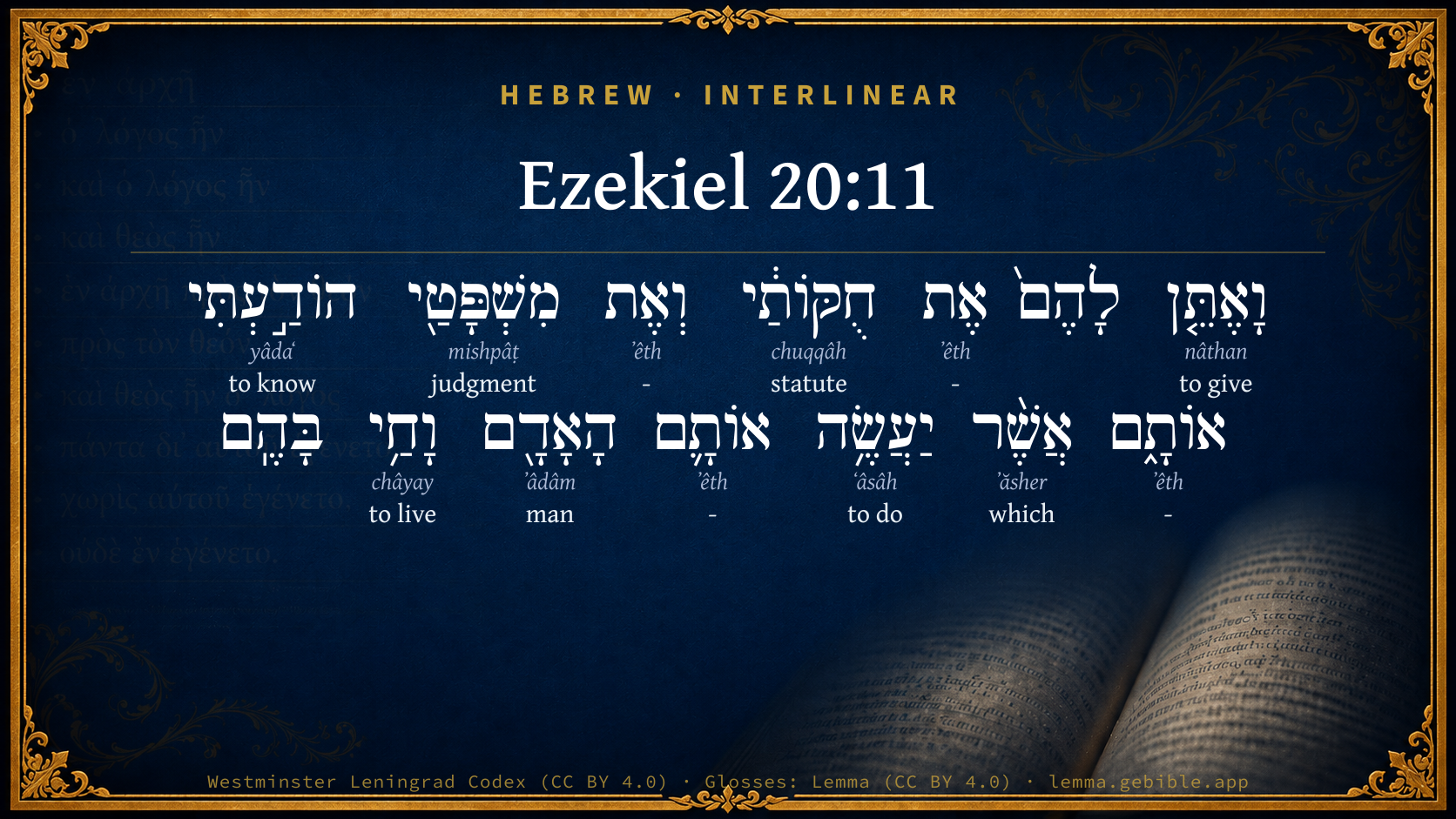
Hebrew (Westminster Leningrad Codex) Ezekiel 20:11 appears in the Hebrew Old Testament. The text above is from the Westminster Leningrad Codex. Each word links to its Strong’s number, a concise gloss, and parsing drawn from the Open Scriptures Hebrew Bible morphology. Click any word for its full Brown-Driver-Briggs (BDB) entry.
Download image
Cite this verse

Ezekiel 20:11 (World English Bible). Public Domain. Lemma interlinear Bible study tool, https://lemma.gebible.app/v/ezekiel/20/11.

Show BibTeX & RIS
BibTeX
RIS
English Translation
I gave them my statutes, and shown them my ordinances, which if a man do, he shall live in them.
World English Bible · Public Domain
Download a study sheet

One document with this verse’s original text, its word-by-word gloss line, the meaning frame, cross-references with their text, attributed commentary, and full source and license credits — printable, and it pastes into notes with its structure intact.

This verse Autodidact and up

Study sheet (.html) Plain text (.txt)

A passage Seminary Student

Up to 50 verses in one chapter. A passage sheet keeps up to 6 commentary sources and 12 cross-references per verse, in the order this page ranks them, and says so on the sheet whenever that leaves anything out. Ask for a single verse and you get the Autodidact verse sheet above.

Everything on this page stays free to read, with no account — the sheet is a download of what is already on screen, not access to it.

Want to remove ads? Support Godless Engineer
Compare translations 3

The same verse in 3 English versions, stacked beneath the original-language interlinear above. Click any original word for its lexicon entry.

Each is an independent rendering of the whole verse — the interlinear is not word-aligned to these translations.

Highlighted words mark where these versions differ — a whole-verse word diff, not a word-by-word alignment.

  • World English Bible Public Domain
    I gave them my statutes, and shown them my ordinances, which if a man do, he shall live in them.
  • King James Version Public Domain
    And I gave them my statutes, and shewed them my judgments, which if a man do, he shall even live in them.
  • unfoldingWord Literal Text CC BY-SA 4.0
    Then I gave them my statutes and made my decrees known to them, by which a man will live if he obeys them.

unfoldingWord Literal Text — © unfoldingWord, licensed CC BY-SA 4.0. Word-aligned USFM3 via Door43 (git.door43.org/unfoldingWord/en_ult).

Versions to compare (up to 4)

3 of 4 selected

Show all 18 translations

Every available English version of this verse, each an independent rendering of the whole verse.

  • World English Bible Public Domain
    I gave them my statutes, and shown them my ordinances, which if a man do, he shall live in them.
  • Berean Standard Bible Public Domain
    And I gave them My statutes and made known to them My ordinances—for the man who does these things will live by them.
  • Majority Standard Bible Public Domain
    And I gave them My statutes and made known to them My ordinances—for the man who does these things will live by them.
  • King James Version Public Domain
    And I gave them my statutes, and shewed them my judgments, which if a man do, he shall even live in them.
  • American Standard Version (1901) Public Domain
    And I gave them my statutes, and showed them mine ordinances, which if a man do, he shall live in them.
  • Revised Version (1885) Public Domain
    And I gave them my statutes, and shewed them my judgments, which if a man do, he shall live in them.
  • Geneva Bible (1599) Public Domain
    And I gaue them my statutes, and declared my iudgements vnto them, which if a man doe, he shall liue in them.
  • Douay-Rheims (1899) Public Domain
    And I gave them my statutes, and I shewed them my judgments, which if a man do, he shall live in them.
  • Young's Literal Translation Public Domain
    And I give to them My statutes, And my judgments I caused them to know, Which the man who doth -- liveth by them.
  • Literal Standard Version CC BY-SA 4.0
    And I give My statutes to them, || And I caused them to know My judgments, || Which the man who does—lives by them.
  • Unlocked Literal Bible CC BY-SA 4.0
    Then I gave them my statutes and made my decrees known to them, by which a man will live if he obeys them.
  • unfoldingWord Literal Text CC BY-SA 4.0
    Then I gave them my statutes and made my decrees known to them, by which a man will live if he obeys them.
  • Darby Bible Public Domain
    And I gave them my statutes, and made known unto them mine ordinances, which if a man do, he shall live by them.
  • World Messianic Bible Public Domain
    I gave them my statutes and showed them my ordinances, which if a man does, he will live in them.
  • Webster's Bible Public Domain
    And I gave them my statutes, and showed them my judgments, which if a man doeth, he shall even live in them.
  • Free Bible Version CC BY-SA 4.0
    There I gave them my laws and explained to them my regulations so that those who kept them would live.
  • Bible in Basic English Public Domain
    And I gave them my rules and made clear to them my orders, which, if a man keeps them, will be life to him.
  • JPS Tanakh (1917) Public Domain
    And I gave them My statutes, and taught them Mine ordinances, which if a man do, he shall live by them.

Literal Standard Version (2020), Covenant Press — licensed CC BY-SA 4.0. Text via the HelloAO Bible API (eBible.org). Unlocked Literal Bible (unfoldingWord) — licensed CC BY-SA 4.0. Text via the HelloAO Bible API (eBible.org). unfoldingWord Literal Text — © unfoldingWord, licensed CC BY-SA 4.0. Word-aligned USFM3 via Door43 (git.door43.org/unfoldingWord/en_ult). Free Bible Version, Dr. Jonathan Gallagher — licensed CC BY-SA 4.0. Text via the HelloAO Bible API (eBible.org).

Word by word

More ways to search: Search by grammar → Find every occurrence → Compare this word →

Practice this passage: Drill this verse → Learn its vocabulary →

וָחַ֥י
châyay
H2425
“and · to live”
Conjunction + Verb, Qal, Sequential Perfect, 3rd Person, Masculine, Singular
Part of Speech
Conjunction + Verb
Stem
Qal
Form
Sequential Perfect
Person
3rd Person
Gender
Masculine
Number
Singular
Full BDB Definition

Origin: a primitive root [compare H2421 ]

TWOT: 644

to live, have life, remain alive, sustain life, live prosperously, live for ever, be quickened, be alive, be restored to life or health - (Qal) - to live - to have life - to continue in life, remain alive - to sustain life, to live on or upon - to live (prosperously) - to revive, be quickened - from sickness - from discouragement - from faintness - from death - (Piel) - to preserve alive, let live - to give life - to quicken, revive, refresh - to restore to life - to cause to grow - to restore - to revive - (Hiphil) - to preserve alive, let live - to quicken, revive - to restore (to health) - to revive - to restore to life

  1. וָאֶתֵּ֤ן nâthan H5414 “and · to give” Conjunction + Verb, Qal, Sequential Imperfect, 1st Person, Common, Singular
  2. אֶת ʼêth H853 “-” Particle, Direct Object
  3. חֻקּוֹתַ֔י chuqqâh H2708 “statutes · my” Noun, Common, Both, Plural, Construct + Suffix, Personal, 1st Person, Common, Singular
  4. וְאֶת ʼêth H853 “and · -” Conjunction + Particle, Direct Object
  5. מִשְׁפָּטַ֖י mishpâṭ H4941 “judgments · my” Noun, Common, Masculine, Plural, Construct + Suffix, Personal, 1st Person, Common, Singular
  6. הוֹדַ֣עְתִּי yâdaʻ H3045 “to know” Verb, Hiphil, Perfect, 1st Person, Common, Singular
  7. אוֹתָ֑ם ʼêth H853 “- · them” Particle, Direct Object + Suffix, Personal, 3rd Person, Masculine, Plural
  8. אֲשֶׁ֨ר ʼăsher H834 “which” Particle, Relative
  9. יַעֲשֶׂ֥ה ʻâsâh H6213 “to do” Verb, Qal, Imperfect, 3rd Person, Masculine, Singular
  10. אוֹתָ֛ם ʼêth H853 “- · them” Particle, Direct Object + Suffix, Personal, 3rd Person, Masculine, Plural
  11. הָאָדָ֖ם ʼâdâm H120 “the · man” Particle, Definite Article + Noun, Common, Masculine, Singular, Absolute

About this verse

These counts appear in no published source. They are computed here, from the morphology-tagged text and Lemma’s own curated glosses. What Lemma adds →

14
words
9
distinct lemmas
Prophets
section

Notable vocabulary

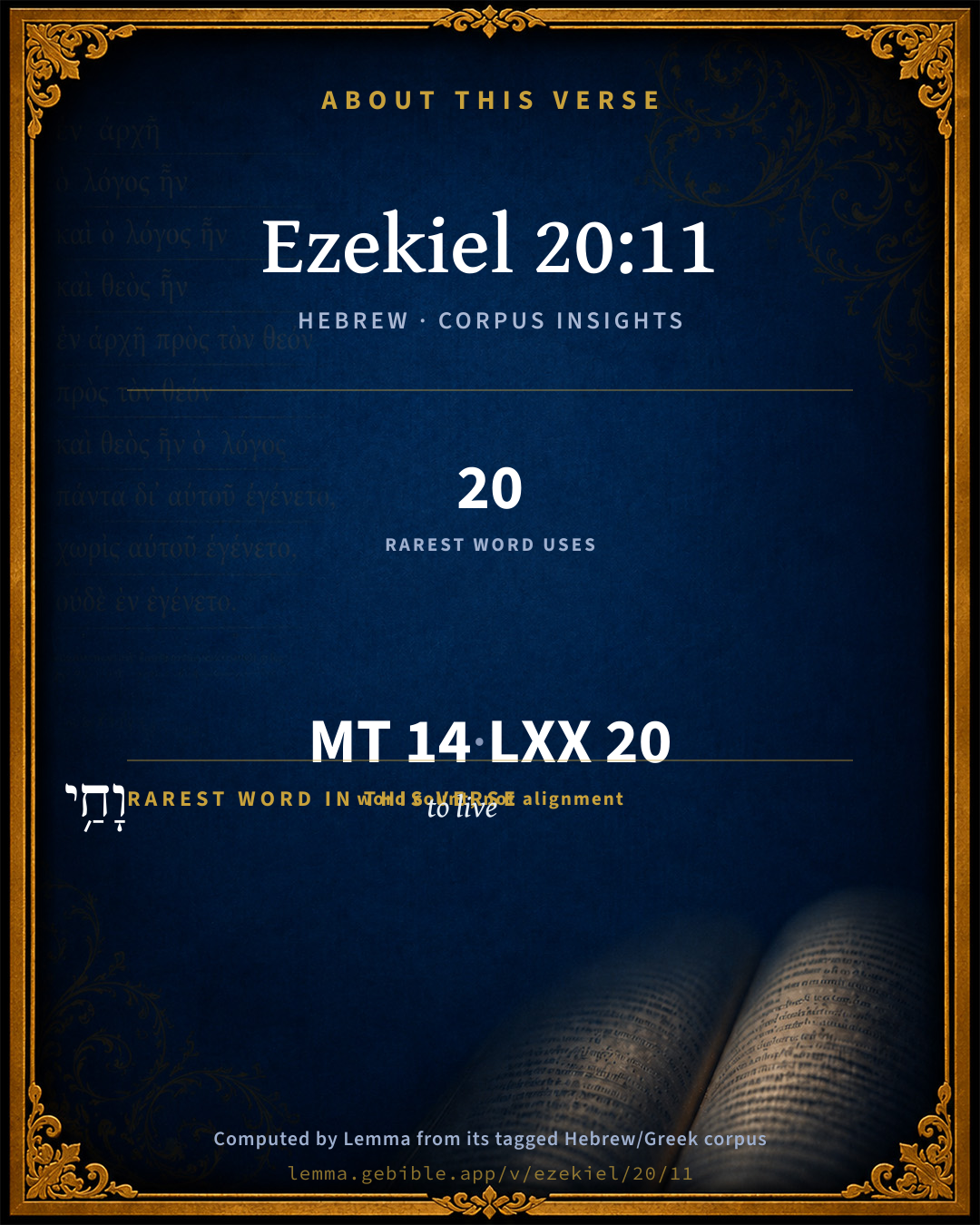
The rarest word here is וָחַ֥י to live H2425 — appearing just 20 times in the whole Hebrew Bible.

Shared distinctive vocabulary

וָחַ֥י to live H2425 occurs in 20 verses of the Hebrew Bible. Also found in:

Grammatical profile

  • 4 verbs
  • 3 nouns
  • 2 prepositions
  • 5 particles

Verb forms

  • וָאֶתֵּ֤ן Qal · Sequential Imperfect
  • הוֹדַ֣עְתִּי Hiphil · Perfect
  • יַעֲשֶׂ֥ה Qal · Imperfect
  • וָחַ֥י Qal · Sequential Perfect

Hebrew & Septuagint length

In English translation the verse runs 20 words from the Hebrew and 26 from the Septuagint (LXX English) — closely comparable.

A rough comparison of the two English renderings, which tokenize alike — not a word-level alignment.

Word counts can differ between the Hebrew and the Greek without any difference in meaning — e.g. the Hebrew direct-object marker אֵת has no separate Greek word, and Greek often adds the article ὁ.

In the original languages it is 14 Hebrew tokens and 20 Greek tokens — but the two are counted differently (Hebrew bundles its prefixes and suffixes into one token; the Greek is in lemma form), so that isn’t a like-for-like length.

Cross-references

11

Topical passages linked to Ezekiel 20:11 in the Treasury of Scripture Knowledge — connected by theme and wording, ordered by reader-vote popularity; previews shown in the World English Bible.

  • Leviticus 18:5 You shall therefore keep my statutes and my ordinances; which if a man does, he shall live in them: I am Yahweh.
  • Romans 10:5 For Moses writes about the righteousness of the law, "The one who does them will live by them."
  • Deuteronomy 4:8 What great nation is there, that has statutes and ordinances so righteous as all this law, which I set before you this day?
  • Luke 10:28 He said to him, "You have answered correctly. Do this, and you will live."
  • Galatians 3:12 The law is not of faith, but, "The man who does them will live by them."
  • Nehemiah 9:13–14 You came down also on Mount Sinai, and spoke with them from heaven, and gave them right ordinances and true laws, good statutes and commandments,
  • Psalms 147:19–20 He shows his word to Jacob; His statutes and his ordinances to Israel.
  • Ezekiel 20:13 But the house of Israel rebelled against me in the wilderness: they didn't walk in my statutes, and they rejected my ordinances, which if a man keep, he shall live in them; and my Sabbaths they greatly profaned. Then I said I would pour out my wrath on them in the wilderness, to consume them.
  • Deuteronomy 20:15–16 Thus shall you do to all the cities which are very far off from you, which are not of the cities of these nations.
  • Ezekiel 20:21 But the children rebelled against me; they didn't walk in my statutes, neither kept my ordinances to do them, which if a man do, he shall live in them; they profaned my Sabbaths. Then I said I would pour out my wrath on them, to accomplish my anger against them in the wilderness.
  • Romans 3:2 Much in every way! Because first of all, they were entrusted with the oracles of God.

Cross-references courtesy of OpenBible.info (CC BY 4.0).

Hebrew and Greek witnesses Masoretic Hebrew ↔ Greek Septuagint

The same verse in the two great witnesses to the Old Testament, shown verse-for-verse.

These are two independent witnesses, not word-aligned to each other, and the Septuagint is shown in lemma (dictionary) form.

Hebrew Ezekiel 20:11 Masoretic · Westminster Leningrad Codex

וָאֶתֵּ֤ן לָהֶם֙ אֶת חֻקּוֹתַ֔י וְאֶת מִשְׁפָּטַ֖י הוֹדַ֣עְתִּי אוֹתָ֑ם אֲשֶׁ֨ר יַעֲשֶׂ֥ה אוֹתָ֛ם הָאָדָ֖ם וָחַ֥י בָּהֶֽם

I gave them my statutes, and shown them my ordinances, which if a man do, he shall live in them.

World English Bible · Public Domain

Greek LXX Ezekiel 20:11 Septuagint · lemma form

καί δίδωμι αὐτός ὁ πρόσταγμα ἐγώ καί ὁ δικαίωμα ἐγώ γνωρίζω αὐτός ὅσος ποιέω αὐτός ἄνθρωπος καί ζάω ἐν αὐτός

And I gave them my commandments, and made known to them my ordinances, all which if a man shall do, he shall even live in them.

LXX2012 (modern English Septuagint) · Public Domain

Hebrew: Westminster Leningrad Codex (CC BY 4.0). Greek: Septuagint (public domain); English from LXX2012 (modern English Septuagint) (Public Domain). How the Septuagint differs from the Hebrew →

Targum (Aramaic paraphrase)

1

The Targum is the ancient Jewish Aramaic paraphrase of the Hebrew Scriptures — an interpretive translation, not the Hebrew text itself. Onkelos (literal) and Pseudo-Jonathan (expansive) render the Torah, and Jonathan the Prophets. Coverage is partial: where no permissively-licensed English translation exists for a verse, only the Aramaic is shown. This is verse-level text, not a word-by-word alignment to the Hebrew.

  1. Targum Jonathan Prophets (Joshua–Malachi)
    וִיהָבֵית לְהוֹן יַת קְיָמַי וְיַת דִינַי הוֹדְעֵית יַתְהוֹן דְאִם יַעְבֵּיד יַתְהוֹן אֱנָשָׁא וִיחֵי בְהוֹן בְּחַיֵי עַלְמָא:

    (no public-domain English translation for this verse)

    Targum Jonathan — Aramaic: “Mikraot Gedolot” (public domain). English: “Sefaria Community Translation” (CC0 1.0 (public-domain dedication)); “London "Chaldee Paraphrase," 1871” (public domain). Text via Sefaria.

Commentary

Notes on Ezekiel 20:11 from classic Christian and Jewish commentators (each source and its license shown beneath its notes). The classic Christian expositions comment on the surrounding passage and are grouped to its opening verse, so a note may address several verses; the Jewish commentaries on the Tanakh (Rashi and others) are per-verse, so they appear only where the commentator wrote on this verse.

Lemma curates 59 commentaries, every one of them public domain or Creative Commons licensed, each selected and text-cleaned for this edition rather than reprinted as found. About our sources →

Trapp's Complete Commentary

John Trapp

Eze 20:11 And I gave them my statutes, and shewed them my judgments, which [if] a man do, he shall even live in them.

Ver. 11. And I gave them my statutes.] Which were far beyond the laws of the twelve tables in Rome, whereof yet Cicero affirmeth that they were far beyond all the libraries of philosophers.

And shewed them my judgments.] Statutes and judgments are usually put in Scripture for one and the same, though the lawyers make a difference of them. Prosper’s conceit was, that this people were called Judaei. because they received ius Dei the law of God.

Which if a man do.] But that he can never do exactly; evangelically he may, and that sufficeth to life eternal.

John Trapp, A Commentary or Exposition upon All the Books of the Old and New Testament (1647–1656) — public domain. Text from a community e-Sword module.

Whedon's Commentary on the Bible

Daniel D. Whedon

11. Shall even live in them — Or, shall live through them (Lev_18:5). Obedience to the Sinaitic law would have saved them from punishment and death (Deu_13:16-18). Obedience prolongs both the individual and national life (Deu_4:40; Deu_5:16; Amo_5:14-15; Mic_6:8; Hos_8:3). Do the “judgments” refer to the Levitical ordinances or to the laws of justice such as are given in Eze_18:5, etc.? Probably to the latter. (See Eze_20:11; Eze_20:21.) The ancient Chaldee paraphrase expands the last clause: “He shall live in them with eternal life” (Cowles).

Daniel D. Whedon (gen. ed.), Commentary on the Old and New Testaments (1874–1909) — public domain. Text from a community e-Sword module.

Jamieson, Fausset & Brown

Robert Jamieson, A. R. Fausset & David Brown

which if a man do, he shall . . . five in them--not "by them," as though they could justify a man, seeing that man cannot render the faultless obedience required (Lev 18:5; Gal 3:12). "By them" is the expression indeed in Rom 10:5; but there the design is to show that, if man could obey all God's laws, he would be justified "by them" (Gal 3:21); but he cannot; he therefore needs to have justification by "the Lord our righteousness" (Jer 23:6); then, having thus received life, he "lives," that is, maintains, enjoys, and exercises this life only in so far as he walks "in" the laws of God. So Deu 30:15-16. The Israelites, as a nation, had life already freely given to them by God's covenant of promise; the laws of God were designed to be the means of the outward expression of their spiritual life. As the natural life has its healthy manifestation in the full exercise of its powers, so their spiritual being as a nation was to be developed in vigor, or else decay, according as they did, or did not, walk in God's laws.

Jamieson, Fausset & Brown — Commentary Critical and Explanatory on the Whole Bible (1871) — public domain (CC PDM 1.0). Text via the HelloAO Bible API.

Adam Clarke's Commentary

Verse 11. I gave them my statutes] I showed them what they should do in order to be safe, comfortable, wise, and happy; and what they should avoid in order to be uninjured in body, mind, and possessions. Had they attended to these things, they should have lived by them. They would have been holy, healthy, and happy.

Adam Clarke's Commentary on the Bible (1810–1826) — public domain. Text from a community e-Sword/MySword module.

John Calvin's Commentaries

Here God enlarges upon his favors, since he had given his law to the Israelites, as if he would prescribe to them a certain rule of living. If they had only been brought out of Egypt, that would have been an inestimable benefit: but God was much more generous, since he deigned to rule them familiarly with his doctrine, lest they should wander to one side or the other; and in this way he testified that he would be their God. He adds a promise: for God might precisely enjoin what he wished on the people of his choice; but he spontaneously adopts the method of indulgence by promising them life. Now, then, we understand why this promise is mentioned; for God might simply command anything, and say, this pleases me, and use but a monosyllable, after the manner of kings issuing a command. Since, then, God not only exacted of the Israelites what he might justly require, but, by annexing a promise, enticed them gently to the pursuit of obedience, this was certainly a mark of his fatherly indulgence. Hence he now exaggerates the people’s ingratitude by this circumstances, that neither by commands nor by kindness could he induce these obstinate and perverse dispositions to bend to the yoke. I gave them, therefore, my statutes and my laws; and afterwards, which if a man do, he shall live in them. He thus briefly reminds them, that it was not his fault if the Israelites were not in any sense happy; for when he stipulated with them for the observance of his law, he bound them in turn to himself, that they should want nothing which contributed to a good and happy life; for in the name of life solid happiness is comprehended.

Yet it is here asked how the Prophet testifies that men should live by the works of the law, when the law, on the testimony of Paul, can only bring us death. (Romans 4:15; Deuteronomy 30:15.) He took this testimony from Moses, and we shall see immediately that he cites it in a different sense. Moses there pronounces that the life of man rests on the observance of the law; that is, — life was surely to be expected through satisfying the law. Some think this absurd, and so restrict what is said to the present life, taking he shall live in them politically or civilly: but this is a cold and trifling comment. The reasoning which influenced them is readily answered: they object, that we owe all things to God; that we ourselves and our possessions are all his by the right of possession; so that if we keep the law a hundred times over, still we are not, worthy of such a reward. But the solution is at hand, that we deserve nothing, but God graciously binds himself to us by this promise, as I have already touched upon. And from this passage it is easy to infer that works are of no value before God, and are not estimated for their intrinsic value, so to speak, but only by agreement. Since, then, it pleased God to descend so far as to promise life to men if they kept his law, they ought to accept this offer as springing from his liberality. There is no absurdity, then, if men do live, that is, if they deserve eternal life according to agreement. But if any one keeps the law, it will follow that he has no need of the grace of Christ. For of what advantage is Christ to us unless we recover life in him? but if this is placed in ourselves, the remedy must not be thought anywhere but in ourselves. Every one, then, may be his own savior if life is placed the observance of the law. But Paul solves this difficulty for us when he determines for us a twofold righteousness of the law and of faith. (Romans 10:5, 6.) He says that this righteousness is of the law when we keep God’s precepts. Now, since we are far distant from such obedience, nay, the very faculty of keeping the law is altogether defective in us: hence it follows that we must fly to the righteousness of faith. For he defines the righteousness of faith, if we believe Christ to be dead, and to be risen again for our justification. We see, therefore, although God promised salvation to his ancient people, if they only kept the law, yet that promise was useless, since no one could satisfy the law and perform God’s commands. Here another question arises. For if this promise does not take effect, God vainly reckons that as a benefit to the Israelites which we see was offered them in vain: hence no utility or fruit would arise from it. But some one may say that the imagination was fallacious, when God promised life, and now by his Prophet blames the Israelites for despising such a benefit. But the reply is easy: although men are not endued with the power of obeying the law, yet they ought not on that account to depart from the goodness of God; for men’s declension by no means hinders them from estimating the value of so liberal a promise: God is treating with men: he might then, as I have said, imperiously demand whatever he pleased, and exact it with the utmost rigor; but he treats according to an agreement, and so there is a mutual obligation between himself and the people. No one will surely deny that God here exhibits a specimen of his mercy when he deigns thus familiarly to make a covenant with men. “Ah! but this is all in vain: God’s promise is of no effect, because no one is able to keep the law.” I confess it: but man’s declension cannot, as I have said, abolish the glory of God’s goodness, since that always remains fixed, and God still acts liberally in being willing thus to enter into covenant with His people. We must then consider the subject simply, and by itself: man’s declension is accidental. God then put forth a remarkable proof of His goodness, in promising life to all who kept His law: and this will remain perfect and entire. It now follows —

John Calvin's Commentaries (1540-1563) — public domain. Text from the Calvin Translation Society English edition (1840s-50s) via the Christian Classics Ethereal Library (ccel.org). Calvin's coverage is partial (roughly two-thirds of the Bible); uncommented books and verses are honest gaps, never fabricated. The 19th-century editor's footnotes and remarks are omitted so the notes are faithfully Calvin's own voice.

Ellicott's Commentary for English Readers

(11) He shall even live in them.—Comp. Deu_30:15-20. It becomes plain, on a careful perusal of this passage, that what was required was not a mere outward, technical, and perfunctory keeping of certain definite precepts, but a living and loving obedience to God’s will from the heart. The same fundamental principle of life underlies the Old Testament as the New; yet the former is justly regarded, and frequently spoken of in the New Testament, as a covenant of works, because the people were not yet sufficiently educated spiritually to be able to receive the principle of faith, and were therefore placed under a law of many definite precepts, that by keeping these with glad alacrity they might show their readiness and desire to do the Lord’s will. It is in this sense that a man should live by doing the statutes of the law, and not on the ground of his thereby earning for himself salvation. But even thus, they failed miserably under the test.

A Bible Commentary for English Readers, edited by Charles John Ellicott (1878–1897) — public domain. Text from a community e-Sword module.

The Cambridge Bible for Schools and Colleges

gen. ed. J. J. S. Perowne

11. gave them … statutes] Reference is to the Sinaitic legislation. The fact of the legislation is, confirmed by the prophet, but his language “statutes and judgments” does not enable us to form an opinion how extensive it was, nor what particulars it embraced besides the law of the sabbath (Eze_20:12), and of course the law that Jehovah was God alone of Israel, because he uses the phrase “statutes and judgments” very generally, for example of the conduct and principles of the people in the wilderness themselves (Eze_20:18).

shall even live in them] Or, shall live by them. Obedience to them will issue in “life,” the word being used in its natural sense, Deu_4:40, “thou shalt keep his statutes … that thou mayest prolong thy days upon the land,” Deu_5:16 (fifth commandment). The precepts of Jehovah given to the people were such that obedience to them would ensure prosperity and life, while disobedience would cause calamity and death, and this not only in the mere government of them by their God, but because the statutes were in themselves “good,” cf. Eze_20:25; Amo_5:14; Hos_8:3; Mic_3:2; Mic_6:8.

11–17. The people delivered from Egypt and brought into the wilderness. There also Jehovah wrought for his name’s sake.

The Cambridge Bible for Schools and Colleges (gen. ed. J. J. S. Perowne; Cambridge University Press, 1878–1918) — public domain. Text from a community e-Sword module.

John Gill's Exposition

And I gave them my statutes,.... The precepts of his law, the law on Mount Sinai, of which there were not the like among other nations; nor were they given unto them, but were a special gift unto Israel, and greatly to be valued, Deu 4:8;

and showed them judgments: the nature, use, and excellency of the the necessity and advantage of observing them: the same as before, called "statutes", because appointed, fixed, and certain, being of inviolable and lasting obligation; and "judgments", being according to strict justice and equity: these, though they were originally written on man's heart, yet so obliterated by sin that there was need not only of their being afresh written and published, but of their being taught and made known; or of pointing out the use of them, and obligation to them:

which if a man do, he shall live in them; or "by them" (g); in the land of Canaan, enjoying all the blessings of a long and happy life: reference seems to be had to Lev 18:5. The Targum adds,

"in eternal life;''

but eternal life is not to be obtained by the works of the law, since no man can perfectly obey or fulfil it, but is the pure gift of the grace of God.

(g) "per ea", Junius & Tremellius, Polanus, Piscator; "propter ea", Pagninus.

John Gill's Exposition of the Whole Bible (1746–1763) — public domain (CC PDM 1.0). Text via the HelloAO Bible API.

Haydock's Catholic Bible Commentary

Live, and enjoy temporal felicity, which was chief promised, though the faithful observers of the law would obtain an eternal reward.

George Leo Haydock (1774–1849), Haydock's Catholic Family Bible and Commentary, 1859 edition — public domain. Excludes Psalms (Douay-Rheims chapter numbering differs from Protestant) and Deuterocanonical books (Catholic canon only).

Matthew Poole's English Annotations

I, who spared them in Egypt, had brought them forth, and owned them as the children of Abraham my friend: God gave his law by Moses, and now Israel’s laws are really of Divine origin, when others did but pretend it. Gave them; appointed and commanded by my authority, and communicated out of my love and kindness to them.

My statutes; the law on Mount Sinai, containing their duty.

Showed them; plainly declared, spake so that they might know.

My judgments; not the terrible executions of his wrath, but judgments here are the rules that God gave them to walk by.

If a man do; if any one, without partiality, whosoever should keep these statutes and judgments with God is no respect of persons.

He shall live: not that any ever did or could by sinless keeping the law attain the eternal blessedness; grace gives that; but it surely points out a future prosperity and flourishing state in this life to all that are careful to keep these statutes and judgments as they can; such should not be cut off, nor brought into captivity, but live and rejoice in their own land.

In them; both in the fruit of them already obeyed, and in the continuance to do them for the future.

Matthew Poole's English Annotations on the Holy Bible (1683–1685) — public domain. Text from a community e-Sword/MySword module.

The Pulpit Commentary

I gave them my statutes, etc. Ezekiel recognizes, almost in the very language of Deu_30:16-20, as fully as the writers of Ps 19 and Ps 119 recognized, the excellence of the Law. A man who kept that Law in its fulness would have life in its fullest and highest sense. He was beginning, however, to recognize, as Jeremiah had (Jer_31:31) the powerlessness of the Law to give that life without the aid of something higher. The "new covenant" was already dawning on the mind of the scholar as on that of the master.

Law and life.

I THE LAW WAS GIVEN AS A MINISTER OF LIFE. God vouchsafed his statutes in order that the Jews might live by means of them. Without those ordinances they were in danger of death, for they were sinners, and the fruit of sin is death. Thus we see that the Law was given in mercy. It came as a blessing. It was in its aim a gospel. Nothing can be further from the truth than the notion that it was a rod of chastisement, or even, as some have regarded it, an evil thing, a sort of curse upon sinners. It was not so regarded by the Old Testament saints, who sang hymns in praise of it, and hailed it with language of affection and rapture. (e.g. Ps 40 and Ps 119)

1. Truth leads to life. The Law was a revelation of God"s eternal verities, without which the soul would perish in the night of its own ignorance.

2. Righteousness would make for life. The Law declared the nature of righteousness, and pointed out the path on which it could be pursued. Thus it was an aid to conscience. Further, by its sanctions of menace and promise it urged the careless to walk in that path.

3. Grace leads to life. The Law did not exclude all grace. On the contrary, it was given in mercy, and it contained saving provisions in various forms of condescension to human weakness and in the great institution of sacrifices for sin.

II THE LAW PROVED TO BE A MESSENGER OF DEATH. (See ver. 25). We have come to regard the Law with aversion under the influence of the arguments of St. Paul. Yet he distinctly teaches that the Law was good, but that the perversion of it led to ruin. (Rom_7:12)

1. The Law condemns sin. Before we have sinned it is a friend to warn us against doing wrong, but by sinning we have turned it into an enemy. The warning beacon has thus become an ominous meteor, the sign post a gallows tree. That which by its guidance protects the innocent from death, by its judgments condemns the guilty to death. (Rom_7:10)

2. The Law is powerless to save from sin.

(1) Its commandments cannot save. They are standards of measurement, not direct powers. Though they urge through conscience, fear, and hope, they only appeal to our nature in its present state. They do not create a new heart. They may drive us to flee from the wrath to come; but they do not provide any refuge.

(2) Its sacrifices cannot save. Ceremonial sacrifices could only save from ceremonial sins. In regard to moral guilt these sacrifices could only typify cleansing, not really accomplish it. (Psa_51:16; Heb_10:4)

III THE GOSPEL OF CHRIST IS THE ONLY EFFECTUAL WAY OF LIFE. The Law was "weak," though not on account of its own imperfection, but "through the flesh," i.e. on account of man"s human degradation, so that man did not respond to it. Therefore God sent his Son to bring the salvation which the Law was powerless to produce. (Rom_8:3)

1. In Christ we have the gift of life. (1Jn_5:12) Nothing less than death is due under the Law; nothing less than life is given by Christ. This we receive by active regenerating grace, not by the erection of a new standard of morals the Sermon on the Mount substituted for the Ten Commandments but by the presence and work of a living Saviour.

2. This life in Christ does not destroy the glory of the Law.

(1) Christ satisfies the Law in his own Person.

(2) He destroys in us the sin which makes the Law our enemy and earns the death penalty.

(3) He gives us his new law of love, his eternal statutes, "which, if a man do, he shall even live in them". (Mat_7:24-27; Joh_15:10)

The Pulpit Commentary (1880–1919), ed. H.D.M. Spence-Jones & Joseph S. Exell — public domain. Text from a community e-Sword module.

Lesson kit

Teaching starters — assembled from the data on this page, not authored interpretation. Every prompt links to the verse data it draws on. Edit before teaching.

Ezekiel, in the Prophets, opens this verse with 14 words (9 distinct Hebrew lemmas). Its most distinctive word is châyay (“to live”). A historical commentator’s framing appears above. Read the whole chapter for the surrounding context.

Discussion questions

  1. How does “to live” (châyay) shape what this verse is saying?
  2. How does Genesis 3:22, which shares the word «to live», read alongside this verse?
  3. The translations on this page render this verse differently — a whole-verse word diff, not a word-by-word alignment. What might account for the different wordings?
  4. «וָאֶתֵּ֤ן» is a Qal Sequential Imperfect verb. How does that grammatical form shape the action described?
  5. Compare how Trapp's Complete Commentary and Whedon's Commentary on the Bible read this verse. Where do they agree or differ?

Things to notice

Reading settings

Reading text

Shown beneath each verse's original-language words.

Old Testament
Old Testament edition

Read the OT as the Masoretic Hebrew (MT) or the Greek Septuagint (LXX).

English shown for the Greek Septuagint (in the Hebrew ↔ Greek comparison).

Comparing translations? Open the Compare panel on any verse page to stack up to four side by side.