
Psalms 105:8

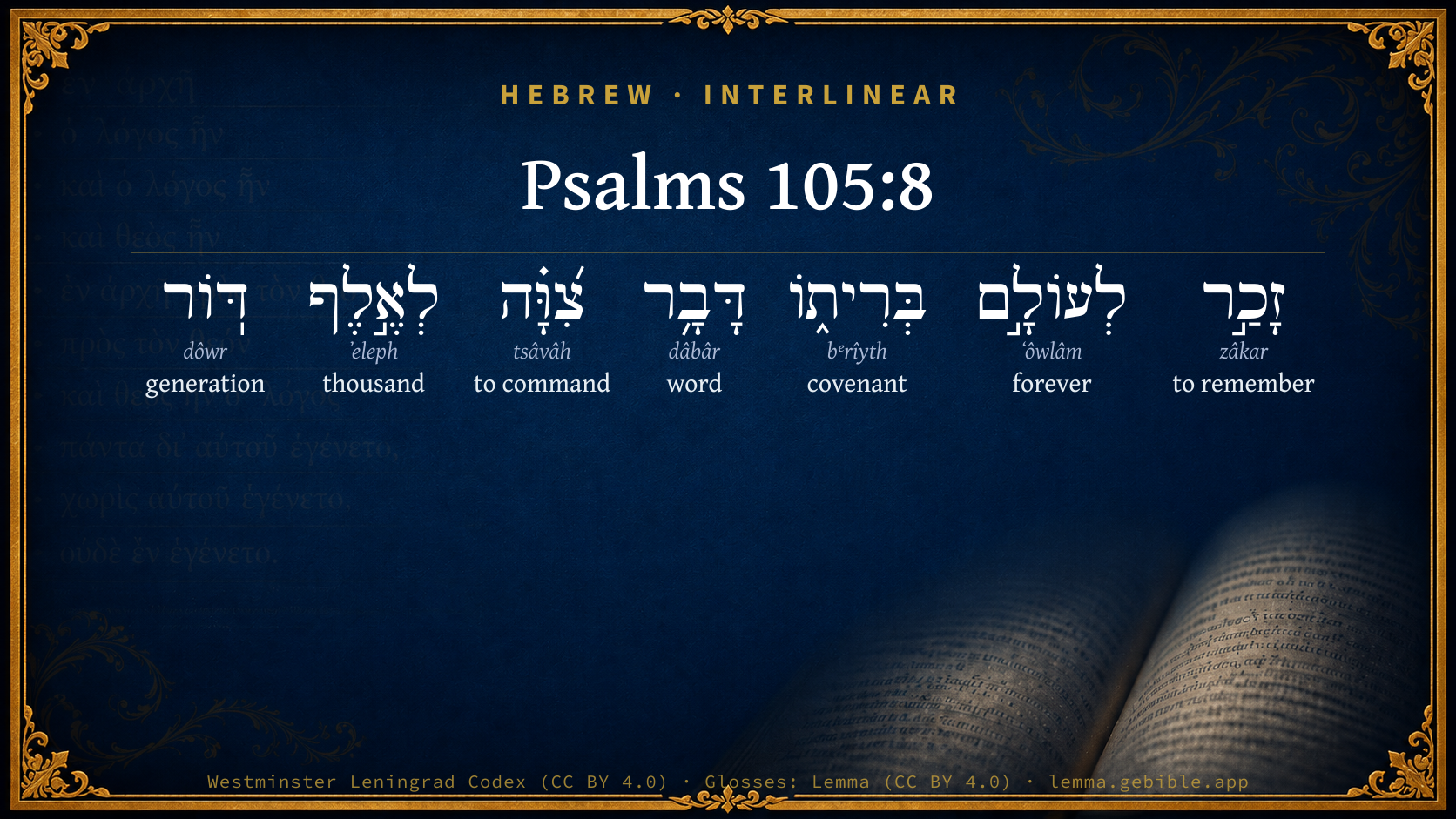
Hebrew (Westminster Leningrad Codex) Psalms 105:8 appears in the Hebrew Old Testament. The text above is from the Westminster Leningrad Codex. Each word links to its Strong’s number, a concise gloss, and parsing drawn from the Open Scriptures Hebrew Bible morphology. Click any word for its full Brown-Driver-Briggs (BDB) entry.
Download image
Cite this verse

Psalms 105:8 (World English Bible). Public Domain. Lemma interlinear Bible study tool, https://lemma.gebible.app/v/psalms/105/8.

Show BibTeX & RIS
BibTeX
RIS
English Translation
He has remembered his covenant forever, The word which he commanded to a thousand generations,
World English Bible · Public Domain
Download a study sheet

One document with this verse’s original text, its word-by-word gloss line, the meaning frame, cross-references with their text, attributed commentary, and full source and license credits — printable, and it pastes into notes with its structure intact.

This verse Autodidact and up

Study sheet (.html) Plain text (.txt)

A passage Seminary Student

Up to 50 verses in one chapter. A passage sheet keeps up to 6 commentary sources and 12 cross-references per verse, in the order this page ranks them, and says so on the sheet whenever that leaves anything out. Ask for a single verse and you get the Autodidact verse sheet above.

Everything on this page stays free to read, with no account — the sheet is a download of what is already on screen, not access to it.

Want to remove ads? Support Godless Engineer
Compare translations 3

The same verse in 3 English versions, stacked beneath the original-language interlinear above. Click any original word for its lexicon entry.

Each is an independent rendering of the whole verse — the interlinear is not word-aligned to these translations.

Highlighted words mark where these versions differ — a whole-verse word diff, not a word-by-word alignment.

  • World English Bible Public Domain
    He has remembered his covenant forever, The word which he commanded to a thousand generations,
  • King James Version Public Domain
    He hath remembered his covenant for ever, the word which he commanded to a thousand generations.
  • unfoldingWord Literal Text CC BY-SA 4.0
    He remembers his covenant forever, the word he commanded for a thousand generations,

unfoldingWord Literal Text — © unfoldingWord, licensed CC BY-SA 4.0. Word-aligned USFM3 via Door43 (git.door43.org/unfoldingWord/en_ult).

Versions to compare (up to 4)

3 of 4 selected

Show all 18 translations

Every available English version of this verse, each an independent rendering of the whole verse.

  • World English Bible Public Domain
    He has remembered his covenant forever, The word which he commanded to a thousand generations,
  • Berean Standard Bible Public Domain
    He remembers His covenant forever, the word He ordained for a thousand generations—
  • Majority Standard Bible Public Domain
    He remembers His covenant forever, the word He ordained for a thousand generations—
  • King James Version Public Domain
    He hath remembered his covenant for ever, the word which he commanded to a thousand generations.
  • American Standard Version (1901) Public Domain
    He hath remembered his covenant for ever, The word which he commanded to a thousand generations,
  • Revised Version (1885) Public Domain
    He hath remembered his covenant for ever, the word which he commanded to a thousand generations;
  • Geneva Bible (1599) Public Domain
    He hath alway remembred his couenant and promise, that he made to a thousand generations,
  • Douay-Rheims (1899) Public Domain
    He hath remembered his covenant for ever: the word which he commanded to a thousand generations.
  • Young's Literal Translation Public Domain
    He hath remembered to the age His covenant, The word He commanded to a thousand generations,
  • Literal Standard Version CC BY-SA 4.0
    He has remembered His covenant for all time, || The word He commanded to one thousand generations,
  • Unlocked Literal Bible CC BY-SA 4.0
    He keeps in mind his covenant forever, the word that he commanded for a thousand generations.
  • unfoldingWord Literal Text CC BY-SA 4.0
    He remembers his covenant forever, the word he commanded for a thousand generations,
  • Darby Bible Public Domain
    He is ever mindful of his covenant, -- the word which he commanded to a thousand generations, --
  • World Messianic Bible Public Domain
    He has remembered his covenant forever, the word which he commanded to a thousand generations,
  • Webster's Bible Public Domain
    He hath remembered his covenant for ever, the word which he commanded to a thousand generations.
  • Free Bible Version CC BY-SA 4.0
    He remembers his agreement forever, the promise he made lasts for a thousand generations;
  • Bible in Basic English Public Domain
    He has kept his agreement in mind for ever, the word which he gave for a thousand generations;
  • JPS Tanakh (1917) Public Domain
    He hath remembered His covenant for ever, the word which He commanded to a thousand generations;

Literal Standard Version (2020), Covenant Press — licensed CC BY-SA 4.0. Text via the HelloAO Bible API (eBible.org). Unlocked Literal Bible (unfoldingWord) — licensed CC BY-SA 4.0. Text via the HelloAO Bible API (eBible.org). unfoldingWord Literal Text — © unfoldingWord, licensed CC BY-SA 4.0. Word-aligned USFM3 via Door43 (git.door43.org/unfoldingWord/en_ult). Free Bible Version, Dr. Jonathan Gallagher — licensed CC BY-SA 4.0. Text via the HelloAO Bible API (eBible.org).

Word by word

More ways to search: Search by grammar → Find every occurrence → Compare this word →

Practice this passage: Drill this verse → Learn its vocabulary →

About this verse

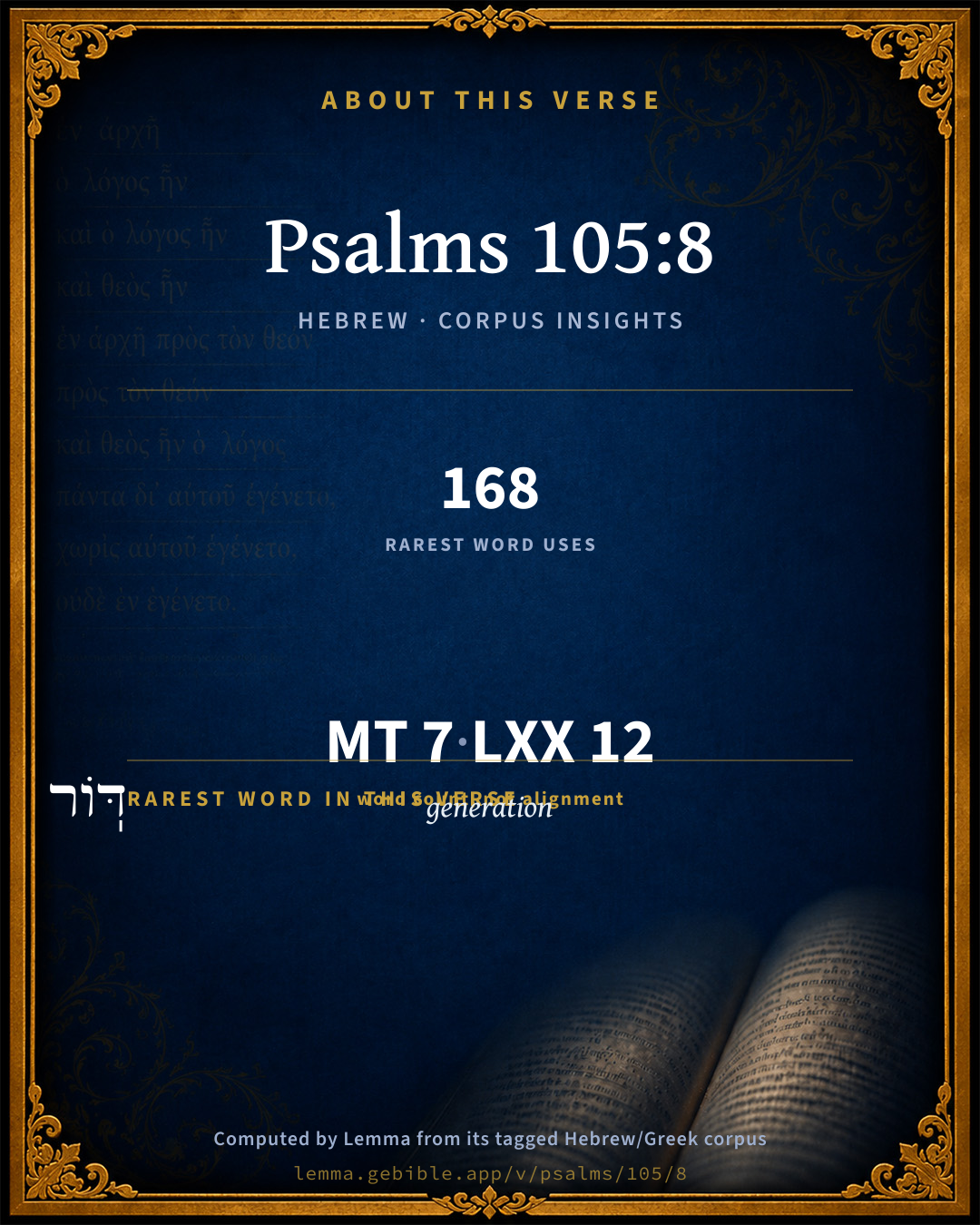
These counts appear in no published source. They are computed here, from the morphology-tagged text and Lemma’s own curated glosses. What Lemma adds →

7
words
7
distinct lemmas
Wisdom
section

Grammatical profile

  • 2 verbs
  • 4 nouns
  • 1 adjective

Verb forms

  • זָכַ֣ר Qal · Perfect
  • צִ֝וָּ֗ה Piel · Perfect

Hebrew & Septuagint length

In English translation the verse runs 15 words from the Hebrew and 16 from the Septuagint (LXX English) — closely comparable.

A rough comparison of the two English renderings, which tokenize alike — not a word-level alignment.

Word counts can differ between the Hebrew and the Greek without any difference in meaning — e.g. the Hebrew direct-object marker אֵת has no separate Greek word, and Greek often adds the article ὁ.

In the original languages it is 7 Hebrew tokens and 12 Greek tokens — but the two are counted differently (Hebrew bundles its prefixes and suffixes into one token; the Greek is in lemma form), so that isn’t a like-for-like length.

Cross-references

9

Topical passages linked to Psalms 105:8 in the Treasury of Scripture Knowledge — connected by theme and wording, ordered by reader-vote popularity; previews shown in the World English Bible.

  • Deuteronomy 7:9 Know therefore that Yahweh your God, he is God, the faithful God, who keeps covenant and loving kindness with them who love him and keep his commandments to a thousand generations,
  • Psalms 106:45 He remembered for them his covenant, And repented according to the multitude of his loving kindnesses.
  • Psalms 111:5 He has given food to those who fear him. He always remembers his covenant.
  • Luke 1:72–74 To show mercy towards our fathers, To remember his holy covenant,
  • 1 Chronicles 16:15 Remember his covenant forever, The word which he commanded to a thousand generations,
  • Psalms 105:42 For he remembered his holy word, And Abraham, his servant.
  • Nehemiah 1:5 and said, I beg you, Yahweh, the God of heaven, the great and awesome God, who keeps covenant and loving kindness with those who love him and keep his commandments:
  • Psalms 111:9 He has sent redemption to his people. He has ordained his covenant forever. His name is holy and awesome!
  • Daniel 9:4 I prayed to Yahweh my God, and made confession, and said, Oh, Lord, the great and dreadful God, who keeps covenant and loving kindness with those who love him and keep his commandments,

Cross-references courtesy of OpenBible.info (CC BY 4.0).

Hebrew and Greek witnesses Masoretic Hebrew ↔ Greek Septuagint

The same verse in the two great witnesses to the Old Testament, shown verse-for-verse.

You’re reading Greek Psalm 104 (Hebrew Psalm 105). The Septuagint counts the superscription, so verse numbers can differ from the Hebrew — chapter-level alignment, not verse-by-verse. Numbering follows Rahlfs.

These are two independent witnesses, not word-aligned to each other, and the Septuagint is shown in lemma (dictionary) form.

Hebrew Psalms 105:8 Masoretic · Westminster Leningrad Codex

זָכַ֣ר לְעוֹלָ֣ם בְּרִית֑וֹ דָּבָ֥ר צִ֝וָּ֗ה לְאֶ֣לֶף דּֽוֹר

He has remembered his covenant forever, The word which he commanded to a thousand generations,

World English Bible · Public Domain

Greek LXX Greek Psalm 104:8 Septuagint · lemma form

μιμνήσκω εἰς ὁ αἰών διαθήκη αὐτός λόγος ὅς ἐντέλλομαι εἰς χίλιοι γενεά

He has remembered his covenant for ever, the word which he commanded for a thousand generation:

LXX2012 (modern English Septuagint) · Public Domain

Hebrew: Westminster Leningrad Codex (CC BY 4.0). Greek: Septuagint (public domain); English from LXX2012 (modern English Septuagint) (Public Domain). How the Septuagint differs from the Hebrew →

Commentary

Notes on Psalms 105:8 from classic Christian and Jewish commentators (each source and its license shown beneath its notes). The classic Christian expositions comment on the surrounding passage and are grouped to its opening verse, so a note may address several verses; the Jewish commentaries on the Tanakh (Rashi and others) are per-verse, so they appear only where the commentator wrote on this verse.

Lemma curates 59 commentaries, every one of them public domain or Creative Commons licensed, each selected and text-cleaned for this edition rather than reprinted as found. About our sources →

Matthew Henry's Commentary

We are here taught, in praising God, to look a great way back, and to give him the glory of what he did for his church in former ages, especially when it was in the founding and forming, which those in its latter ages enjoy the benefit of and therefore should give thanks for. Doubtless we may fetch as proper matter for praise from the histories of the gospels, and the acts of the apostles, which relate the birth of the Christian church, as the psalmist here does from the histories of Genesis and Exodus, which relate the birth of the Jewish church; and our histories greatly outshine theirs. Two things are here made the subject of praise: -

I. God's promise to the patriarchs, that great promise that he would give to their seed the land of Canaan for an inheritance, which was a type of the promise of eternal life made in Christ to all believers. In all the marvellous works which God did for Israel he remembered his covenant (Psa 105:8) and he will remember it for ever; it is the word which he commanded to a thousand generations. See here the power of the promise; it is the word which he commanded and which will take effect. See the perpetuity of the promise; it is commanded to a thousand generations, and the entail of it shall not be cut off. In the parallel place it is expressed as our duty (Ch1 16:15), Be you mindful always of his covenant. God will not forget it and therefore we must not. The promise is here called a covenant, because there was something required on man's part as the condition of the promise. Observe, 1. The persons with whom this covenant was made - with Abraham, Isaac, and Jacob, grandfather, father, and son, all eminent believers, Heb 11:8, Heb 11:9. 2. The ratifications of the covenant; it was made sure by all that is sacred. Is that sure which is sworn to? It is his oath to Isaac and to Abraham. See to whom God swore by himself, Heb 6:13, Heb 6:14. Is that sure which has passed into a law? He confirmed the same for a law, a law never to be repealed. Is that sure which is reduced to a mutual contract and stipulation? This is confirmed for an everlasting covenant, inviolable. 3. The covenant itself: Unto thee will I give the land of Canaan, Psa 105:11. The patriarchs had a right to it, not by providence, but by promise; and their seed should be put in possession of it, not by the common ways of settling nations, but by miracles; God will give it to them himself, as it were with his own hand; it shall be given to them as their lot which God assigns them and measures out to them, as the lot of their inheritance, a sure title, by virtue of their birth; it shall come to them by descent, not by purchase, by the favour of God, and not any merit of their own. Heaven is the inheritance we have obtained, Eph 1:11. And this is the promise which God has promised us (as Canaan was the promise he promised them), even eternal life, Jo1 2:25; Tit 1:2.

II. His providences concerning the patriarchs while they were waiting for the accomplishment of this promise, which represent to us the care God takes of his people in this world, while they are yet on this side the heavenly Canaan; for these things happened unto them for examples and encouragements to all the heirs of promise, that life by faith as they did.

1. They were wonderfully protected and sheltered, and (as the Jewish masters express it) gathered under the wings of the divine Majesty. This is accounted for, Psa 105:12-15. Here we may observe,

(1.) How they were exposed to injuries from men. To the three renowned patriarchs, Abraham, and Isaac, and Jacob, God's promises were very rich; again and again he told them he would be their God; but his performances in this world were so little proportionable that, if he had not prepared for them a city in the other world, he would have been ashamed to be called their God (see Heb 11:16), because he was always generous; and yet even in this world he was not wanting to them, but that he might appear, to do uncommon things for them, he exercised them with uncommon trials. [1.] They were few, very few. Abraham was called alone (Isa 51:2); he had but two sons, and one of them he cast out; Isaac had but two, and one of them was forced for many years to flee from his country; Jacob had more, but some of them, instead of being a defence to him, exposed him, when (as he himself pleads, Gen 34:30) he was but few in number, and therefore might easily be destroyed by the natives, he and his house. God's chosen are but a little flock, few, very few, and yet upheld. [2.] They were strangers, and therefore were the most likely to be abused and to meet with strange usage, and the less able to help themselves. Their religion made them to be looked upon as strangers (Pe1 4:4) and to be hooted at as speckled birds, Jer 12:9. Though the whole land was theirs by promise, yet they were so far from producing and pleading their grant that they confessed themselves strangers in it, Heb 11:13. [3.] They were unsettled (Psa 105:13): They went from one nation to another, from one part of that land to another (for it was then in the holding and occupation of divers nations, Gen 12:8; Gen 13:3, Gen 13:18); nay, from one kingdom to another people, from Canaan to Egypt, from Egypt to the land of the Philistines, which could not but weaken and expose them; yet they were forced to it by famine. Note, Though frequent removals are neither desirable nor commendable, yet sometimes there is a just and necessary occasion for them, and they may be the lot of some of the best men.

(2.) How they were guarded by the special providence of God, the wisdom and power of which were the more magnified by their being so many ways exposed, Psa 105:14, Psa 105:15. They were not able to help themselves and yet, [1.] No men were suffered to wrong them, but even those that hated them, and would gladly have done them a mischief, had their hands tied, and could not do what they would. This may refer to Gen 35:5, where we find that the terror of God (an unaccountable restraint) was upon the cities that were round about them, so that, though provoked, they did not pursue after the sons of Jacob. [2.] Even crowned heads, that did offer to wrong them, were not only checked and chidden for it, but controlled and baffled: He reproved kings for their sakes in dreams and visions, saying, "Touch not my anointed; it is at your peril if you do, nay, it shall not be in your power to do it; do my prophets no harm." Pharaoh king of Egypt was plagued (Gen 12:17) and Abimelech king of Gerar was sharply rebuked (Gen 20:6) for doing wrong to Abraham. Note, First, Even kings themselves are liable to God's rebukes if they do wrong. Secondly, God's prophets are his anointed, for they have the unction of the Spirit, that oil of gladness, Jo1 2:27. Thirdly, Those that offer to touch God's prophets, with design to harm them, may expect to hear of it one way or other. God is jealous for his prophets; whoso touches them touches the apple of his eye. Fourthly, Even those that touch the prophets, nay that kill the prophets (as many did), cannot do them any harm, any real harm. Lastly, God's anointed prophets are dearer to him than anointed kings themselves. Jeroboam's hand was withered when it was stretched out against a prophet.

2. They were wonderfully provided for and supplied. And here also, (1.) They were reduced to great extremity. Even in Canaan, the land of promise, he called for a famine, Psa 105:16. Note, All judgments are at God's call, and no place is exempt from their visitation and jurisdiction when God sends them forth with commission. To try the faith of the patriarchs, God broke the whole staff of bread, even in that good land, that they might plainly see God designed them a better country than that was. (2.) God graciously took care for their relief. It was in obedience to his precept, and in dependence upon his promise, that they were now sojourners in Canaan, and therefore he could not in honour suffer any evil to befal them or any good thing to be wanting to them. As he restrained one Pharaoh from doing them wrong, so he raised up another to do them a kindness, by preferring and entrusting Joseph, of whose story we have here an abstract. He was to be the shepherd and stone of Israel and to save that holy seed alive, Gen 49:24; Gen 50:20. In order to this, [1.] He was humbled, greatly humbled (Psa 105:17, Psa 105:18): God sent a man before them, even Joseph. Many years before the famine began, he was sent before them, to nourish them in the famine; so vast are the foresights and forecasts of Providence, and so long its reaches. But in what character did he go to Egypt who was to provide for the reception of the church there? He went not in quality of an ambassador, no, nor so much as a factor or commissary; but he was sold thither for a servant, a slave for term of life, without any prospect of being ever set at liberty. This was low enough, and, one would think, set him far enough from any probability of being great. And yet he was brought lower; he was made a prisoner (Psa 105:18): His feet they hurt with fetters. Being unjustly charged with a crime no less heinous than a rape upon his mistress, the iron entered into his soul, that is, was very painful to him; and the false accusation which was the cause of his imprisonment did in a special manner grieve him, and went to his heart; yet all this was the way to his preferment. [2.] He was exalted, highly exalted. He continued a prisoner, neither tried nor bailed, until the time appointed of God for his release (Psa 105:19), when his word came, that is, his interpretations of the dreams came to pass, and the report thereof came to Pharaoh's ears by the chief butler. And then the word of the Lord cleared him; that is, the power God gave him to foretel things to come rolled away the reproach his mistress had loaded him with; for it could not be thought that God would give such a power to so bad a man as he was represented to be. God's word tried him, tried his faith and patience, and then it came in power to give command for his release. There is a time set when God's word will come for the comfort of all that trust in it, Hab 2:3. At the end it shall speak, and not lie. God gave the word, and then the king sent and loosed him; for the king's heart is in the hand of the Lord. Pharaoh, finding him to be a favourite of Heaven, First, Discharged him from his imprisonment (Psa 105:20): He let him go free. God has often, by wonderful turns of providence, pleaded the cause of oppressed innocency. Secondly, He advanced him to the highest posts of honour, Psa 105:21, Psa 105:22. He made him lord high chamberlain of his household (he made him lord of his house); nay, he put him into the office of lord-treasurer, the ruler of all his substance. He made him prime-minister of state, lord-president of his council, to command his princes at his pleasure and teach them wisdom, and general of his forces. According to thy word shall all my people be ruled, Gen 41:40, Gen 41:43, Gen 41:44. He made him lord chief justice, to judge even his senators and punish those that were disobedient. In all this Joseph was designed to be, 1. A father to the church that then was, to save the house of Israel from perishing by the famine. He was made great, that he might do good, especially in the household of faith. 2. A figure of Christ that was to come, who, because he humbled himself and took upon him the form of a servant, was highly exalted, and has all judgment committed to him. Joseph being thus sent before, and put into a capacity of maintaining all his father's house, Israel also came into Egypt (Psa 105:23), where he and all his were very honourably and comfortably provided for many years. Thus the New Testament church has a place provided for her even in the wilderness, where she is nourished for a time, times, and half a time, Rev 12:14. Verily she shall be fed.

3. They were wonderfully multiplied, according to the promise made to Abraham that his seed should be as the sand of the sea for multitude, Psa 105:24. In Egypt he increased his people greatly; they multiplied like fishes, so that in a little time they became stronger than their enemies and formidable to them. Pharaoh took notice of it. Exo 1:9, The children of Israel are more and mightier than we. When God pleases a little one shall become a thousand; and God's promises, though they work slowly, work surely.

Matthew Henry's Commentary on the Whole Bible (1708–1710) — public domain (CC PDM 1.0). Text via the HelloAO Bible API.

Trapp's Complete Commentary

John Trapp

Psa 105:8 He hath remembered his covenant for ever, the word [which] he commanded to a thousand generations.

Ver. 8. He hath remembered his covenant] 1Ch 16:15 it is, "Be ye mindful always of his covenant." God ever remembereth, though we many times forget it, and ourselves.

The word which he commanded] The conditions of the covenant.

John Trapp, A Commentary or Exposition upon All the Books of the Old and New Testament (1647–1656) — public domain. Text from a community e-Sword module.

Joseph Benson's Commentary

Psa 105:8-11. He hath remembered his covenant for ever — Or, will remember it; that is, practically, so as to perform and make it good. The word — The promise; which he commanded — Established, or appointed, to a thousand generations — To all generations; a certain number being put for an uncertain. And his oath unto Isaac — Wherewith he ratified the covenant with him, Gen 26:3. And confirmed the same unto Jacob for a law — That it might be as firm and irrevocable as a law; saying, Unto thee will I give the land of Canaan — The patriarchs had no right to it, save by promise, and their seed were to be put in possession of it, not by the common ways of settling nations, but by miracles; God would give it them himself, and, as it were, with his own hand; and so that it should be, as their lot, assigned and measured out to them by God, even the lot of their inheritance — To which they should have a sure title by virtue of their birth: it should come to them by descent, not by purchase; by the favour of God, and not by any merit of their own.

Joseph Benson's Commentary on the Old and New Testaments (1811–1818) — public domain. Text from a community e-Sword module.

J. A. Alexander on Psalms

Joseph Addison Alexander

8. (Psa 105:8) He remembered for ever his covenant, the word he commanded for a thousand generations. There is here a kind of antithetical allusion to the exhortation in ver. 5 (Psa 105:5). They should remember what he did, since he remembers what he promised. What he has done involves a pledge of what he will do. He has remembered (and will remember) his covenant to eternity. The word is the word of promise. He is said to have commanded it, partly because his promise is conditional and annexed to his commandment, and for that reason called a covenant; partly because all that God says must of necessity be said with authority, so that even his promises partake of the nature of commands. The last phrase, a thousand generations, is Mosaic. See Deu 7:9, and compare Exo 20:6.

Joseph Addison Alexander, The Psalms Translated and Explained (1850) — public domain. Text from a community e-Sword module.

Tyndale Open Study Notes

Tyndale Open Resources

105:8 The covenant is the Lord’s irrevocable oath to be the Father of Abraham and his descendants (see Gen 12:1-9; 15:1-21).

Tyndale Open Study Notes — © Tyndale Open Resources, licensed CC BY-SA 4.0. Text via the HelloAO Bible API.

John Calvin's Commentaries

8 He hath remembered his covenant for ever The Psalmist now celebrates the effect and actual fulfillment of the covenant, and proves from the deliverance wrought for the Israelites what he had stated before, namely, That God, while he reigned alike over all nations, extended his peculiar favor to the offspring of Abraham alone. How comes it to pass that God, in delivering his people, displayed the might of his arm by so many miracles, if it was not that he might faithfully perform the promise which he had made to his servants in time past? It is evident, then, that the ancient covenant was the cause of the deliverance granted to the chosen tribes; for in order that God might faithfully keep his promises, it behooved him first to be merciful. As a long series of years had elapsed between the promise and the performance, the prophet uses the word remember, intimating that the Divine promises do not become obsolete by length of time, but that even when the world imagines that they are extinguished and wholly forgotten, God retains as distinct a remembrance of them as ever, that he may accomplish them in due season. This is more strongly confirmed in the next clause, where the correspondence between the form or tenor of the covenant and the accomplishment is celebrated. It is not for a day, he would say, or for a few days, that God has made a covenant with Abraham, nor has he limited the continuance of his covenant to the life of man, but he has promised to be the God of his seed even to a thousand generations. Although, therefore, the fulfillment was for a long time suspended, God nevertheless showed by the effect that his promise did not fail by length of time.

John Calvin's Commentaries (1540-1563) — public domain. Text from the Calvin Translation Society English edition (1840s-50s) via the Christian Classics Ethereal Library (ccel.org). Calvin's coverage is partial (roughly two-thirds of the Bible); uncommented books and verses are honest gaps, never fabricated. The 19th-century editor's footnotes and remarks are omitted so the notes are faithfully Calvin's own voice.

Ellicott's Commentary for English Readers

(8) Commanded.—Better, appointed, or conferred.

A Bible Commentary for English Readers, edited by Charles John Ellicott (1878–1897) — public domain. Text from a community e-Sword module.

The Cambridge Bible for Schools and Colleges

gen. ed. J. J. S. Perowne

8. He hath remembered] Rather, He remembereth. The Heb. perfect here expresses a general truth guaranteed by past experience. Chron. has Remember ye; but the exhortation is out of place here. Jehovah’s covenant is further described as the word of promise which he commanded (cp. Psa_111:9), as it were enacting it as a law (cp. statute, Psa_105:10, and Psa_2:7). To a thousand generations (Deu_7:9), parallel to and synonymous with for ever, is to be connected with He remembereth.

With this and the following verses comp. the promise of Lev_26:42-45.

The Cambridge Bible for Schools and Colleges (gen. ed. J. J. S. Perowne; Cambridge University Press, 1878–1918) — public domain. Text from a community e-Sword module.

John Gill's Exposition

He hath remembered his covenant for ever,.... Another argument of praise taken from the covenant of grace, in which he is our God, and of which he is ever mindful; he remembers his covenant ones, whom he perfectly knows, and never forgets them; he remembers his covenant promises to them, and allows them to put him in remembrance of them; he has respect unto his covenant, and the blessings of it, and bestows them on his people; gives them the sure mercies of David; and he remembers his love, which is the source and spring of all.

The word which he commanded to a thousand generations; that which is properly a covenant with Christ our head on our account, is a word of promise to us; a promise of grace and glory; a free promise, absolute and unconditional: and this he has "commanded", or ordered, decreed, and determined that it shall stand good, and be punctually performed, "to a thousand generations"; that is, for ever; for all his promises are yea and amen in Christ.

John Gill's Exposition of the Whole Bible (1746–1763) — public domain (CC PDM 1.0). Text via the HelloAO Bible API.

Albert Barnes' Notes on the Bible

He hath remembered his covenant forever - That is, God has had it constantly in remembrance, or always. Compare the notes at Luk 1:72. Though the covenant was made long since; though many generations of people have passed by; though great changes have occurred; though many calamities have come upon the nations, yet his ancient covenant and promise have never been forgotten. All his promises have been fulfilled; all ever will be. The “covenant” here referred to is that which was made with Abraham, and through him with the Hebrew people.

The word which he commanded - The thing which he commanded; that is, all which he ordained and appointed.

To a thousand generations - Very many generations; or, any number of generations: that is, always. Compare Exo 20:6. The experience of the people through all the generations of their history has shown that in what he has promised and directed he is unchanging.

Albert Barnes' Notes on the Bible (1834–1885) — public domain. Text from a community e-Sword/MySword module.

Matthew Poole's English Annotations

He hath remembered, practically, so as to perform it; as that word is frequently used in Scripture.

The word; the word of promise, or the covenant, as is explained both in the foregoing and following words. And so the word is taken Jdg 13:12; Luk 1:38.

Commanded, i.e. established, or ordained, or appointed, as this word is oft taken, as Psa 68:28; 71:3; 133:3; Isa 13:3; 23:11. To a thousand generations; to all generations; a certain number being put for an uncertain. He seems to allude to that passage, Exo 20:6.

Matthew Poole's English Annotations on the Holy Bible (1683–1685) — public domain. Text from a community e-Sword/MySword module.

The Treasury of David

Charles H. Spurgeon

Ver. 8. He hath remembered his covenant for ever. Here is the basis of all his dealings with his people: he had entered into covenant with them in their father Abraham, and to this covenant he remained faithful. The exhortation to remember (Ps 105:5) receives great force from the fact that God has remembered. If the Lord has his promise in memory surely we ought not to forget the wonderful manner in which he keeps it. To us it should be matter for deepest joy that never in any instance has the Lord been unmindful of his covenant engagements, nor will he be so world without end. O that we were as mindful of them as he is.

The word which he commanded to a thousand generations. This is only an amplification of the former statement, and serves to set before us the immutable fidelity of the Lord during the changing generations of men. His judgments are threatened upon the third and fourth generations of them that hate him, but his love runs on for ever, even to "a thousand generations." His promise is here said to be commanded, or vested with all the authority of a law. It is a proclamation from a sovereign, the firman of an Emperor whose laws shall stand fast in every jot and tittle though heaven and earth shall pass away. Therefore let us give thanks unto the Lord and talk of all his wondrous works, so wonderful for their faithfulness and truth.

Ver. 8. He hath remembered his covenant. As a long series of years had elapsed between the promise and the performance, the prophet uses the word "remember, "intimating that the Divine promise does not become obsolete by length of time, but that even when the world imagines that they are extinguished and wholly forgotten, God retains as distinct a remembrance of them as ever, that he may accomplish them in due season. John Calvin.

Ver. 8. The word which he commanded. All that God says must of necessity be said with authority, so that even his promises partake of the nature of commands. Joseph Addison Alexander.

Psalms 105:9*

Charles H. Spurgeon's The Treasury of David (1869–1885) — public domain. Psalms only. Text from a community e-Sword/MySword module.

Whedon's Commentary on the Bible

Daniel D. Whedon

8. Covenant—See Genesis 17; Gen_22:16-18; Gen_26:3-5; and Gen_28:13-15. This was the foundation of their national, not less than their church, life and character, and of all the promises of God to them as a people. Compare Gal_3:16-17.

Commanded—Established with authority, as Psa_111:9. This habit of appealing to the perpetuity and validity of the ancient covenant, and later of the covenant with David, is a remarkable feature of the faith of the Hebrews. It was their firm anchorage in perils, and their lifeboat in the wreck of the nation during the Babylonian captivity. See Psa_89:2-4; Psa_89:18-37; Mic_7:20.

Thousand generations—Same as for ever in the first hemistich and Psa_105:10.Deu_7:9. This “covenant” God had faithfully remembered, and the implied admonition to the people to remember it is at once delicate and forcible.

Daniel D. Whedon (gen. ed.), Commentary on the Old and New Testaments (1874–1909) — public domain. Text from a community e-Sword module.

The Pulpit Commentary

He hath remembered his covenant forever. Thirdly, the psalmist praises God"s faithfulness. God entered into a covenant with Israel, and that covenant still holds good. He has not forgotten it, and will never forget it. It is the word which he commanded to a thousand generations. (comp. Deu_7:9) Professor Cheyne concludes, from this passage, that the psalm was not written during the Captivity. But surely a captive in Babylon might have had faith enough to believe that God had not abolished, but only suspended, his covenant.

Covenant faithfulness.

The psalmist, as a just returned, or as a speedily returning, exile one just making preparations for his return is anxious to be right hearted in relation to this new national restoration, and he is anxious to help others to be right hearted. So he thinks over aloud his personal experiences of God"s dealings with himself; (Ps 103) the marvels of God"s handiwork in nature; (Ps 104) the overrulings of Divine providence in the national history; (Ps 105) and the causes for national humiliation. (Ps 106) The leading idea before us, in this and the following psalm, is this. God and Israel entered into mutual covenant. Read the national story how you may, you will find that God has always been faithful to his pledges in that covenant, and the people have constantly been unfaithful. The marvel of mercy is that God"s patient and persistent faithfulness triumphs at last over man"s wilfulness and unfaithfulness.

I GOD MADE COVENANT WITH HIS PEOPLE IN OLD TIMES. It is not only that God made promises the marvel of Divine grace is, that God should condescend to stand on man"s platform, and join with man in putting himself under solemn pledge. Covenant making is an idea of early tribal times, when legal documents could not be written and signed. Illustrate God"s covenant with Abraham, which was renewed again and again. Dwell on the fact that there were two persons, and two sets of conditions, in a covenant; and each was released if the other broke his terms. Lead on to show how the name is preserved in relation to the mission of our Lord Jesus Christ.

II GOD WAS ALWAYS FAITHFUL TO HIS PLEDGES IN COVENANT. This the psalmist treats as an unquestionable historical fact. God was true to Abraham, Isaac, Israel in Egypt, Joseph. True to covenant in dealing with Pharaoh, Israel"s oppressor. True in bringing Israel at last to the promised land. Providences are only rightly read as God"s fulfilment of his covenant. That which is true of Israel is true of our persona lives. God has been to us Provider, Guide, Ruler, and Overruler.

III GOD MAY BE FULLY TRUSTED TO PROVE FAITHFUL IN NEW SCENES. This is the appeal which the psalmist makes to the returning exiles. God has ever been faithful to your fathers; he will be faithful to you. So our trust is in what we know God to be; and we know him by what he has done, and does. He is the "faithful Promiser;" we may fully trust him. R.T.

The Pulpit Commentary (1880–1919), ed. H.D.M. Spence-Jones & Joseph S. Exell — public domain. Text from a community e-Sword module.

John Wesley's Explanatory Notes

Remembered - So as to perform it. The word - The promise. Commanded - Established. Thousand generations - To all generations.

John Wesley, Explanatory Notes Upon the Whole Bible (1754–1765) — public domain. Text via the GEBible commentary corpus.

Rashi

Rabbi Shlomo Yitzchaki (Rashi)

the word He had commanded to the thousandth generation The Torah, which He commanded to make known in the world after a thousand generations, but He saw that the world could not exist without Torah, so he skipped 974 generations of them. It may also be interpreted according to its simple meaning: He remembered for Israel His covenant, which He commanded and promised to keep for them for a thousand generations, as the matter of (Deut. 7:9): “Who keeps the covenant and the kindness for those who love Him and who keep His commandments, to a thousand generations.”

Rashi on the Tanakh — English translations: “The Judaica Press complete Tanach with Rashi, translated by A. J. Rosenberg” (CC BY 4.0); “Pentateuch with Rashi's commentary by M. Rosenbaum and A.M. Silbermann, 1929-1934” (public domain); “The Metsudah Tanach series, Lakewood, N.J” (CC BY 4.0); and “The Book of Joshua, Metsudah Publications, 1997” (CC BY 4.0). Text via Sefaria.

Lesson kit

Teaching starters — assembled from the data on this page, not authored interpretation. Every prompt links to the verse data it draws on. Edit before teaching.

Psalms, in the Wisdom, opens this verse with 7 words (7 distinct Hebrew lemmas). Its most distinctive word is dôwr (“generation”). A historical commentator’s framing appears above. Read the whole chapter for the surrounding context.

Discussion questions

  1. The word dôwr carries the sense “generation.” How does it shape the verse?
  2. Deuteronomy 7:9 shares this passage’s theme. How do the two illuminate each other?
  3. The translations on this page render this verse differently — a whole-verse word diff, not a word-by-word alignment. What might account for the different wordings?
  4. The verb «זָכַ֣ר» is Qal Perfect. How does its form color the action?
  5. Reading how Matthew Henry's Commentary and Trapp's Complete Commentary read this verse, where do the two commentators agree and where do they part?

Things to notice

Reading settings

Reading text

Shown beneath each verse's original-language words.

Old Testament
Old Testament edition

Read the OT as the Masoretic Hebrew (MT) or the Greek Septuagint (LXX).

English shown for the Greek Septuagint (in the Hebrew ↔ Greek comparison).

Comparing translations? Open the Compare panel on any verse page to stack up to four side by side.