
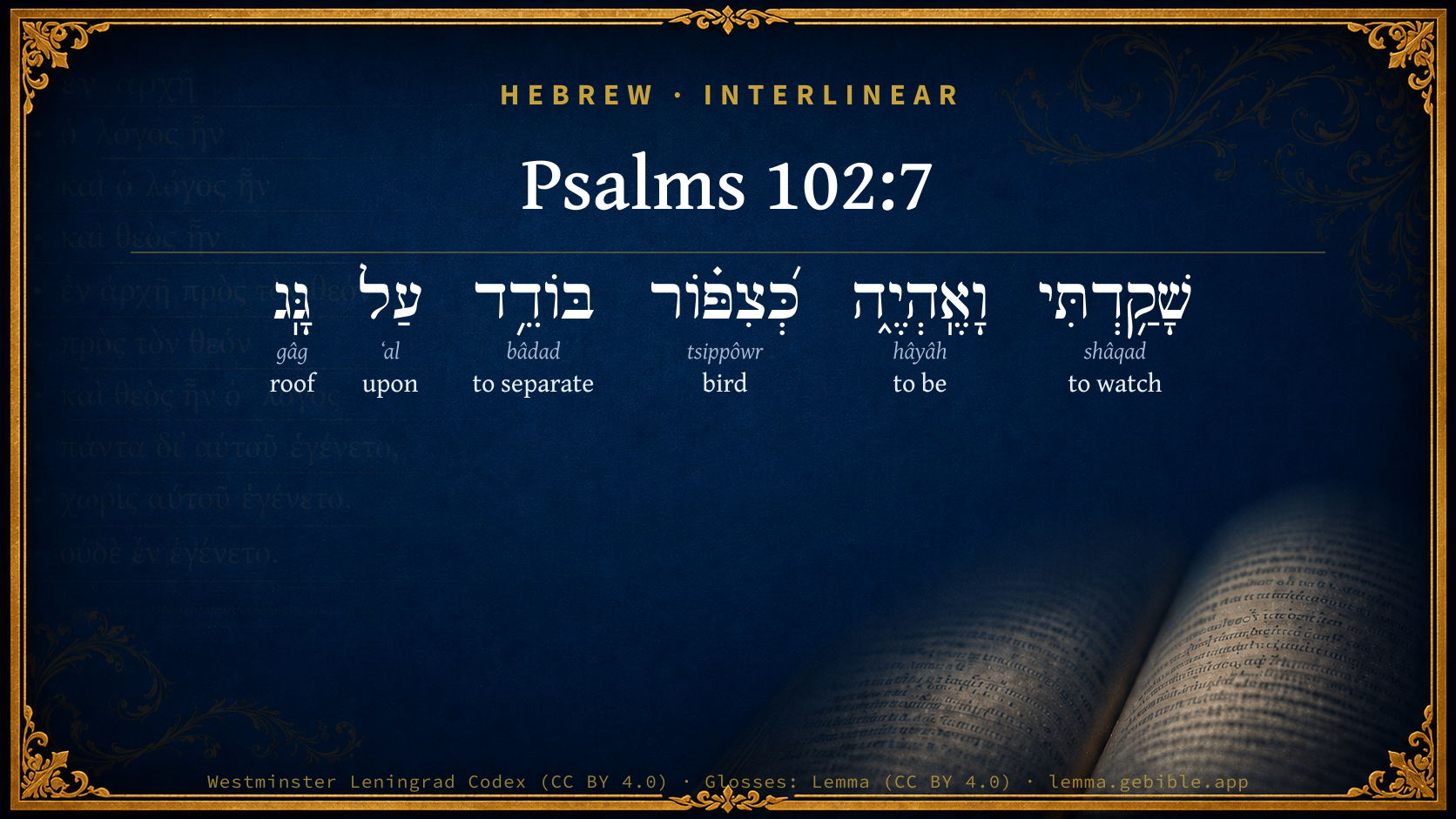
Psalms 102:7

Hebrew (Westminster Leningrad Codex) Psalms 102:7 appears in the Hebrew Old Testament. The text above is from the Westminster Leningrad Codex. Each word links to its Strong’s number, a concise gloss, and parsing drawn from the Open Scriptures Hebrew Bible morphology. Click any word for its full Brown-Driver-Briggs (BDB) entry.
Download image
Cite this verse

Psalms 102:7 (World English Bible). Public Domain. Lemma interlinear Bible study tool, https://lemma.gebible.app/v/psalms/102/7.

Show BibTeX & RIS
BibTeX
RIS
English Translation
I watch, and have become like a sparrow that is alone on the housetop.
World English Bible · Public Domain
Download a study sheet

One document with this verse’s original text, its word-by-word gloss line, the meaning frame, cross-references with their text, attributed commentary, and full source and license credits — printable, and it pastes into notes with its structure intact.

This verse Autodidact and up

Study sheet (.html) Plain text (.txt)

A passage Seminary Student

Up to 50 verses in one chapter. A passage sheet keeps up to 6 commentary sources and 12 cross-references per verse, in the order this page ranks them, and says so on the sheet whenever that leaves anything out. Ask for a single verse and you get the Autodidact verse sheet above.

Everything on this page stays free to read, with no account — the sheet is a download of what is already on screen, not access to it.

Want to remove ads? Support Godless Engineer
Compare translations 3

The same verse in 3 English versions, stacked beneath the original-language interlinear above. Click any original word for its lexicon entry.

Each is an independent rendering of the whole verse — the interlinear is not word-aligned to these translations.

Highlighted words mark where these versions differ — a whole-verse word diff, not a word-by-word alignment.

  • World English Bible Public Domain
    I watch, and have become like a sparrow that is alone on the housetop.
  • King James Version Public Domain
    I watch, and am as a sparrow alone upon the house top.
  • unfoldingWord Literal Text CC BY-SA 4.0
    I am alert, and I have become like a bird alone on a roof.

unfoldingWord Literal Text — © unfoldingWord, licensed CC BY-SA 4.0. Word-aligned USFM3 via Door43 (git.door43.org/unfoldingWord/en_ult).

Versions to compare (up to 4)

3 of 4 selected

Show all 18 translations

Every available English version of this verse, each an independent rendering of the whole verse.

  • World English Bible Public Domain
    I watch, and have become like a sparrow that is alone on the housetop.
  • Berean Standard Bible Public Domain
    I lie awake; I am like a lone bird on a housetop.
  • Majority Standard Bible Public Domain
    I lie awake; I am like a lone bird on a housetop.
  • King James Version Public Domain
    I watch, and am as a sparrow alone upon the house top.
  • American Standard Version (1901) Public Domain
    I watch, and am become like a sparrow That is alone upon the house-top.
  • Revised Version (1885) Public Domain
    I watch, and am become like a sparrow that is alone upon the housetop.
  • Geneva Bible (1599) Public Domain
    I watch and am as a sparrowe alone vpon the house top.
  • Douay-Rheims (1899) Public Domain
    I am become like to a pelican of the wilderness: I am like a night raven in the house.
  • Young's Literal Translation Public Domain
    I have watched, and I am As a bird alone on the roof.
  • Literal Standard Version CC BY-SA 4.0
    I have watched, and I am || As a bird alone on the roof.
  • Unlocked Literal Bible CC BY-SA 4.0
    I lie awake like a solitary bird, alone on the housetop.
  • unfoldingWord Literal Text CC BY-SA 4.0
    I am alert, and I have become like a bird alone on a roof.
  • Darby Bible Public Domain
    I watch, and am like a sparrow alone upon the housetop.
  • World Messianic Bible Public Domain
    I watch, and have become like a sparrow that is alone on the housetop.
  • Webster's Bible Public Domain
    \\102:6\\I am like a pelican of the wilderness: I am like an owl of the desert.
  • Free Bible Version CC BY-SA 4.0
    I can't sleep. I'm like a lonely bird on a rooftop.
  • Bible in Basic English Public Domain
    I keep watch like a bird by itself on the house-top.
  • JPS Tanakh (1917) Public Domain
    (102-8) I watch, and am become like a sparrow that is alone upon the housetop.

Literal Standard Version (2020), Covenant Press — licensed CC BY-SA 4.0. Text via the HelloAO Bible API (eBible.org). Unlocked Literal Bible (unfoldingWord) — licensed CC BY-SA 4.0. Text via the HelloAO Bible API (eBible.org). unfoldingWord Literal Text — © unfoldingWord, licensed CC BY-SA 4.0. Word-aligned USFM3 via Door43 (git.door43.org/unfoldingWord/en_ult). Free Bible Version, Dr. Jonathan Gallagher — licensed CC BY-SA 4.0. Text via the HelloAO Bible API (eBible.org).

Word by word

More ways to search: Search by grammar → Find every occurrence → Compare this word →

Practice this passage: Drill this verse → Learn its vocabulary →

About this verse

These counts appear in no published source. They are computed here, from the morphology-tagged text and Lemma’s own curated glosses. What Lemma adds →

6
words
6
distinct lemmas
Wisdom
section

Notable vocabulary

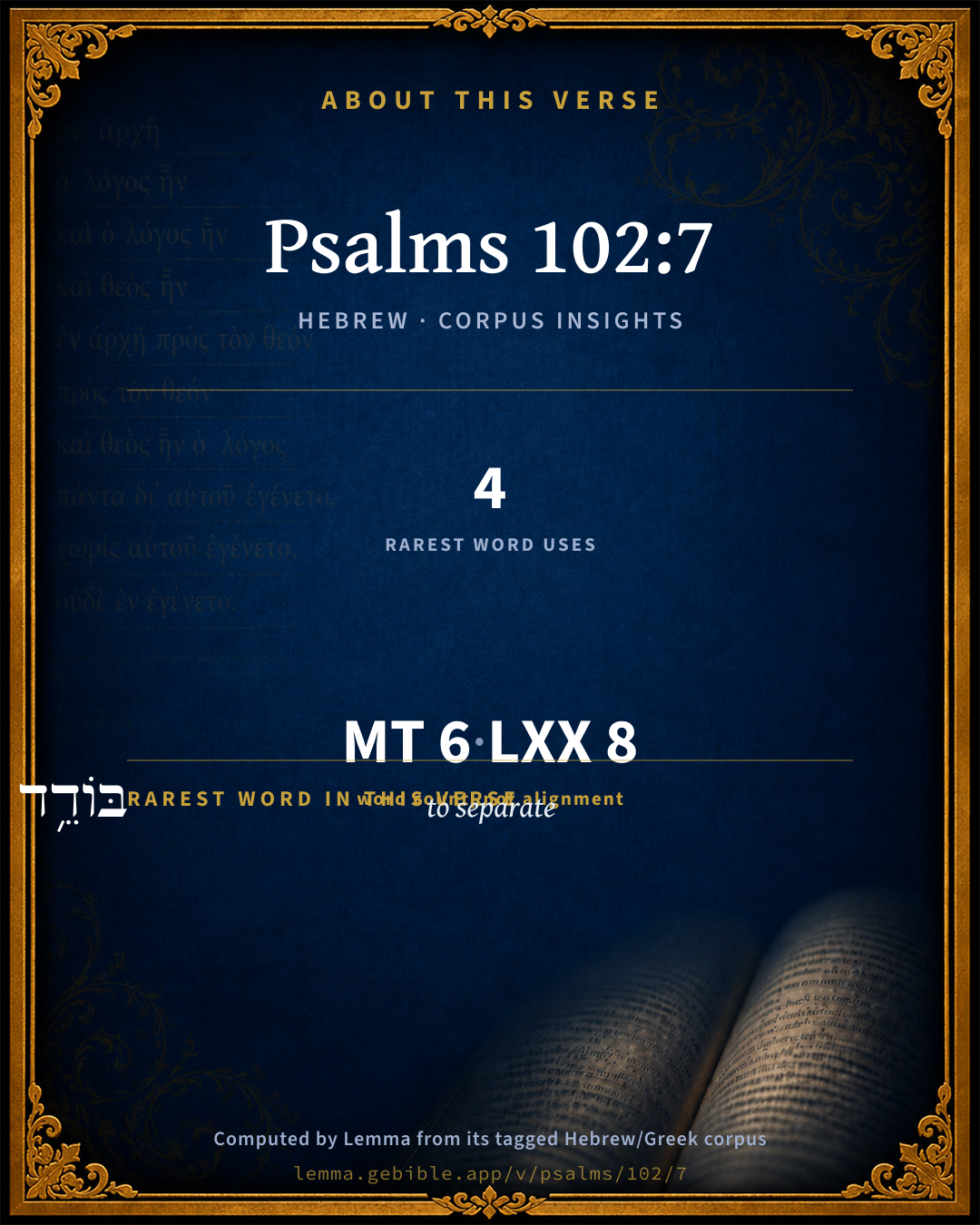
The rarest word here is בּוֹדֵ֥ד to separate H909 — appearing just 4 times in the whole Hebrew Bible.

Shared distinctive vocabulary

בּוֹדֵ֥ד to separate H909 occurs in 4 verses of the Hebrew Bible. Also found in:

Grammatical profile

  • 3 verbs
  • 2 nouns
  • 1 preposition

Verb forms

  • שָׁקַ֥דְתִּי Qal · Perfect
  • וָאֶֽהְיֶ֑ה Qal · Sequential Imperfect
  • בּוֹדֵ֥ד Qal · Participle Active

Hebrew & Septuagint length

In English translation the verse runs 14 words from the Hebrew and 24 from the Septuagint (LXX English) — closely comparable.

A rough comparison of the two English renderings, which tokenize alike — not a word-level alignment.

Word counts can differ between the Hebrew and the Greek without any difference in meaning — e.g. the Hebrew direct-object marker אֵת has no separate Greek word, and Greek often adds the article ὁ.

In the original languages it is 6 Hebrew tokens and 8 Greek tokens — but the two are counted differently (Hebrew bundles its prefixes and suffixes into one token; the Greek is in lemma form), so that isn’t a like-for-like length.

Cross-references

8

Topical passages linked to Psalms 102:7 in the Treasury of Scripture Knowledge — connected by theme and wording, ordered by reader-vote popularity; previews shown in the World English Bible.

  • Psalms 77:4 You hold my eyelids open. I am so troubled that I can't speak.
  • Psalms 38:11 My lovers and my friends stand aloof from my plague. My kinsmen stand far away.
  • Lamentations 3:28–30 Let him sit alone and keep silence, because he has laid it on him.
  • Mark 14:33–37 He took with him Peter, James, and John, and began to be greatly troubled and distressed.
  • Deuteronomy 28:66–67 and your life shall hang in doubt before you; and you shall fear night and day, and shall have no assurance of your life.
  • Job 7:13–16 When I say, 'My bed shall comfort me, My couch shall ease my complaint;'
  • Psalms 22:2 My God, I cry in the daytime, but you don't answer; In the night season, and am not silent.
  • Psalms 130:6 My soul longs for the Lord more than watchmen long for the morning; More than watchmen for the morning.

Cross-references courtesy of OpenBible.info (CC BY 4.0).

Hebrew and Greek witnesses Masoretic Hebrew ↔ Greek Septuagint

The same verse in the two great witnesses to the Old Testament, shown verse-for-verse.

You’re reading Greek Psalm 101 (Hebrew Psalm 102). The Septuagint counts the superscription, so verse numbers can differ from the Hebrew — chapter-level alignment, not verse-by-verse. Numbering follows Rahlfs.

These are two independent witnesses, not word-aligned to each other, and the Septuagint is shown in lemma (dictionary) form.

Hebrew Psalms 102:7 Masoretic · Westminster Leningrad Codex

שָׁקַ֥דְתִּי וָאֶֽהְיֶ֑ה כְּ֝צִפּ֗וֹר בּוֹדֵ֥ד עַל גָּֽג

I watch, and have become like a sparrow that is alone on the housetop.

World English Bible · Public Domain

Greek LXX Greek Psalm 101:7 Septuagint · lemma form

ὁμοιόω πελεκάν ἐρημικός γίγνομαι ὡσεί νυκτικόραξ ἐν οἰκόπεδον

I have become like an owl in a ruined house. I have watched, and am become as a sparrow dwelling alone on a roof.

LXX2012 (modern English Septuagint) · Public Domain

Hebrew: Westminster Leningrad Codex (CC BY 4.0). Greek: Septuagint (public domain); English from LXX2012 (modern English Septuagint) (Public Domain). How the Septuagint differs from the Hebrew →

Commentary

Notes on Psalms 102:7 from classic Christian and Jewish commentators (each source and its license shown beneath its notes). The classic Christian expositions comment on the surrounding passage and are grouped to its opening verse, so a note may address several verses; the Jewish commentaries on the Tanakh (Rashi and others) are per-verse, so they appear only where the commentator wrote on this verse.

Lemma curates 59 commentaries, every one of them public domain or Creative Commons licensed, each selected and text-cleaned for this edition rather than reprinted as found. About our sources →

Trapp's Complete Commentary

John Trapp

Psa 102:7 I watch, and am as a sparrow alone upon the house top.

Ver. 7. I watch] I can as little sleep as eat, Psa 102:4. That nurse of nature, and sweet parenthesis of men’s griefs and cares, sleep, departeth from me,

Nec membris dat cura soporem.

And am as a sparrow] That hath lost his mate, so have I mine associates, which is a sore loss, for optimum solatium sodalitium.

John Trapp, A Commentary or Exposition upon All the Books of the Old and New Testament (1647–1656) — public domain. Text from a community e-Sword module.

J. A. Alexander on Psalms

Joseph Addison Alexander

8. (Psa 102:7) I have watched, and have been like a sparrow dwelling alone upon a house-top. The first words suggest the idea of a solitary vigil. As to the word translated sparrow, see above, on Psa 84:3. The word dwelling is supplied in the translation of the last clause, in order to retain the form of the original expression, which is that of an active participle. Some suppose the idea to be that of a bird, deprived of its mate or of its young.

Joseph Addison Alexander, The Psalms Translated and Explained (1850) — public domain. Text from a community e-Sword module.

Tyndale Open Study Notes

Tyndale Open Resources

102:7-8 The psalmist cannot sleep (see 63:6-8). Like a bird on the roof, he feels isolated from both friends (see 88:8) and enemies.

Tyndale Open Study Notes — © Tyndale Open Resources, licensed CC BY-SA 4.0. Text via the HelloAO Bible API.

Adam Clarke's Commentary

Verse 7. As a sparrow alone] צפור tsippor, seems to be often used for any small bird, such as the swallow, sparrow, or the like. Bochart supposes the screech owl is intended.

Adam Clarke's Commentary on the Bible (1810–1826) — public domain. Text from a community e-Sword/MySword module.

Ellicott's Commentary for English Readers

(7) I watch—i.e., am sleepless,

Sparrow.—See Note, Psa_84:3. Here render, like a lonely bird. Some MSS. read, “a wandering bird.”

A Bible Commentary for English Readers, edited by Charles John Ellicott (1878–1897) — public domain. Text from a community e-Sword module.

The Cambridge Bible for Schools and Colleges

gen. ed. J. J. S. Perowne

7. I keep vigil, and am become

Like a solitary bird upon the housetop.

His nights are sleepless: he spends them like “the moping owl” in mournful complaints. Some solitary, nocturnal bird is clearly meant, perhaps some kind of owl, or according to Tristram (Nat. Hist. of Bible, p. 202), the Blue Thrush. Cp. Verg. Aen. iv. 462,

“Solaque culminibus ferali carmine bubo

Visa queri, et longas in fletum ducere voces.”

For am become we should perhaps read and moan (ואהגה for ואהיה).

Cp. Isa_59:11.

The Cambridge Bible for Schools and Colleges (gen. ed. J. J. S. Perowne; Cambridge University Press, 1878–1918) — public domain. Text from a community e-Sword module.

John Gill's Exposition

Mine enemies reproach me all the day,.... For his principles and practices, being different from theirs; for his religion, and preciseness in it; for his faith and profession of it, and for his holy walk and conversation. Good men have their enemies, and always had; but then they are such who are also enemies to God and Christ, and true religion; and these, not content to reproach now and then, continually throw out their scoffs and jeers; which is not grateful, and is here mentioned as an article of complaint; though the saints should reckon reproach for the sake of Christ and religion greater riches than all the treasures in Egypt:

and they that are mad against me; as the Jews were against Christ, because of his miracles, doctrine, and success, and therefore sought to take away his life; and as the Apostle Paul before conversion was, even exceeding mad against the saints, and persecuted them to strange cities, Luk 6:11, so were the psalmist's enemies quite outrageous and implacable, being his sworn enemies, as follows:

are sworn against me: laid themselves under a curse, to do him all the mischief they could, and it may be to take away his life; as those who sware they would neither eat nor drink till they had killed Paul, Act 23:12 or they sware to lies, false charges and accusations brought against him, like those that Jezebel suborned against Naboth: or "they sware by me" (r); as the words may be rendered; they sware by his calamities and distresses, and wished they might be as he was, if they did not do so and so; and took his name for a curse.

(r) "per me jurant", Tigurine version, Musculus, Junius & Tremellius, Piscator, Cocceius, Gejerus, Michaelis.

John Gill's Exposition of the Whole Bible (1746–1763) — public domain (CC PDM 1.0). Text via the HelloAO Bible API.

Albert Barnes' Notes on the Bible

I watch, and am as a sparrow alone upon the house-top - That is, I am “sleepless;” trouble drives sleep from my eyes, and I am kept awake at night - a common effect of grief. The following remarks, copied from the “Land and the Book” (i. 54, 55), will furnish all the illustration needful of this verse. “They are a tame, troublesome, and impertinent generation, and nestle just where you don’t want them. They stop up your stove and waterpipes with their rubbish, build in the windows and under the beams of the roof, and would stuff your hat full of stubble in half a day if they found it hanging in a place to suit them ... . When one of them has lost its mate - a matter of everyday occurrence - he will sit on the house-top alone, and lament by the hour his sad bereavement.”

Albert Barnes' Notes on the Bible (1834–1885) — public domain. Text from a community e-Sword/MySword module.

Matthew Poole's English Annotations

A sparrow which hath lost its mate, and then is very sad and solitary, as some report; although that be uncertain and improbable. But this Hebrew word doth not only signify a sparrow, but in general any bird, as Lev 14:4; Deu 14:11; Dan 4:12,14,21. And so it may here design any one or more sort of birds which used to sit alone, watching and mourning upon house-tops.

Matthew Poole's English Annotations on the Holy Bible (1683–1685) — public domain. Text from a community e-Sword/MySword module.

The Treasury of David

Charles H. Spurgeon

Ver. 7. I watch, and am like a sparrow alone upon the house top: I keep a solitary vigil as the lone sentry of my nation; my fellows are too selfish, too careless to care for the beloved land, and so like a bird which sits alone on the housetop, I keep up a sad watch over my country. The Psalmist compared himself to a bird, a bird when it has lost its mate or its young, or is for some other reason made to mope alone in a solitary place. Probably he did not refer to the cheerful sparrow of our own land, but if he did, the illustration would not be out of place, for the sparrow is happy in company, and if it were alone, the sole one of its species in the neighbourhood, there can be little doubt that it would become very miserable, and sit and pine away. He who has felt himself to be so weak and inconsiderable as to have no more power over his times than a sparrow over a city, has also, when bowed down with despondency concerning the evils of the age, sat himself down in utter wretchedness to lament the ills which he could not heal. Christians of an earnest, watchful kind often find themselves among those who have no sympathy with them; even in the church they look in vain for kindred spirits; then do they persevere in their prayers and labours, but feel themselves to be as lonely as the poor bird which looks from the ridge of the roof, and meets with no friendly greeting from any of its kind.

Ver. 7. I watch. During the hours allotted to sleep "I wake, " like a little bird which sits solitary on the house-top, while all beneath enjoy the sleep which he giveth to his beloved. Alfred Edersheim.

Ver. 7. A sparrow alone upon the house-top. When one of them has lost its matea matter of every-day occurrencehe will sit on the house-top alone, and lament by the hour his sad bereavement. W. M. Thomson.

Ver. 7. I am as a sparrow alone, etc. It is evident that the "sparrow alone and melancholy upon the house-tops" cannot be the lively, gregarious sparrow which assembles in such numbers on these favourite feeding-places the house-tops of the East. We must therefore look for some other bird, and naturalists are now agreed that we may accept the Blue Thrush (Petrocossyphus cyaneus) as the particular tzippor, or small bird, which sits alone on the house-tops. The colour of this bird is a dark blue, whence it derives its popular name. Its habits exactly correspond with the idea of solitude and melancholy. The Blue Thrushes never assemble in flocks, and it is very rare to see more than a pair together. It is fond of sitting on the tops of houses, uttering its note, which, however agreeable to itself, is monotonous and melancholy to human ear. J.G. Wood, in "Bible Animals."

Ver. 7. A sparrow. Most readers are struck with the incongruity of the image, as it appears in our version, intended by the Psalmist to express a condition of distress and desolation. The sparrow is found, indeed, all over the East, in connection with houses, as it is with ourselves; but it is everywhere one of the most social of birds, cheerful to impertinence; and mischievously disposed, instead of being retiring in its habits, and melancholy in its demeanour. The word, in the original, is a general term for all the small birds, insectivorous and frugivirous, denominated clean, and that might be eaten according to the law, the thrushes, larks, wagtails, finches, as well as sparrows. It seems to be, indeed, a mere imitation of their common note, like the one which we have in the word "chirrup." Most critics are, therefore, content with the rendering, "solitary bird, "or "solitary little bird." But this is very unsatisfactory. It does not identify the species: and there is every probability that there must have been a particular bird which the Psalmist, writing at the close of the Babylonish captivity, had in his eye, corresponding to his representation of it, and illustrative of his isolated condition.

Such there is at the present day, of common occurrence in Southern Europe and Western Asia. Its history is very little known to the world, and its existence has hitherto escaped the notice of all biblical commentators. Remarkably enough, the bird is commonly, but erroneously, called a sparrow, for it is a real thrush in size, in shape, in habits, and in song. It differs singularly from the rest of the tribe, throughout all the East, by a marked preference for sitting solitary upon the habitation of man. It never associates with any other, and only at one season with its own mate; and even then it is often seen quite alone upon the house-top, where it warbles its sweet and plaintive strains, and continues its song, moving from roof to roof. America has its solitary thrush, of another species, and of somewhat different habits. The dark solitary cane and myrtle swamps of the southern states are there the favourite haunts of the recluse bird; and the more dense and gloomy these are the more certainly is it to be found flitting in them. "The Biblical Treasury".

Ver. 7. Alone. But little do men perceive what solitude is, and how far it extendeth; for a crowd is not company, and faces are but a gallery of pictures, and talk but a tinkling cymbal where there is no love. The Latin adage meeteth it a little: "magna civitas, magno solitudo; "because in a great town friends are scattered, so that there is not that fellowship, for the most part, which is in less neighbourhoods; but we may go further, and affirm most truly, that it is a mere and miserable solitude to want true friends, without which the world is but a wilderness; and even in this sense also of solitude, whosoever in the frame of his nature and affections is unfit for friendship, he taketh it of the beast, and not from humanity. Francis Bacon.

Ver. 7. Alone. See the reason why people in trouble love solitariness. They are full of sorrow; and sorrow, if it have taken deep root, is naturally reserved, and flies all conversation. Grief is a thing that is very silent and private. Those people that are very talkative and clamorous in their sorrows, are never very sorrowful. Some are apt to wonder, why melancholy people delight to be so much alone, and I will tell you the reason of it. 1. Because the disordered humours of their bodies alter their temper, their humours, and their inclinations, that they are no more the same that they used to be; their very distemper is averse to what is joyous and diverting; and they that wonder at them may as wisely wonder why they will be diseased, which they would not be if the knew how to help it; but the Disease of Melancholy is so obstinate, and so unknown to all but those who have it, that nothing but the power of God can totally overthrow it, and I know no other cure for it. 2. Another reason why they choose to be alone is, because people do not generally mind what they say, nor believe them, but rather deride them, which they do not use so cruelly to do with those that are in other distempers; and no man is to be blamed for avoiding society, when it does not afford the common credit to his words that is due to the rest of men. But, 3, Another, and the principal reason why people in trouble and sadness choose to be alone is, because they generally apprehend themselves singled out to be the marks of God's peculiar displeasure, and they are often by their sharp afflictions a terror to themselves, and a wonder to others. It even breaks their hearts to see how low they are fallen, how oppressed, that were once as easy, as pleasant, as full of hope as others are, Job 6:21: "Ye see my casting down, and are afraid." Ps 71:7. "I am as a wonder unto many." And it is usually unpleasant to others to be with them. Ps 88:18: "Lover and friend hast thou put far from me, and mine acquaintance into darkness." And though it was not so with the friends of Job, to see a man whom they had once known happy, to be so miserable; one whom they had seen so very prosperous, to be so very poor, in such sorry, forlorn circumstances, did greatly affect them; he, poor man, was changed, they knew him not, Job 2:12-13, "And when they lifted up their eyes afar off, and knew him not, they lifted up their voice, and wept; and they rent every one his mantle, and sprinkled dust upon their heads toward heaven. So they sat down with him upon the ground seven days and seven nights, and none spake a word unto him: for they saw that his grief was very great." As the prophet represents one under spiritual and great afflictions, "That he sitteth alone, and keepeth silence, " La 3:28. Timothy Rogers (1660-1729), in "A Discourse on Trouble of Mind, and the Disease of Melancholy."

Ver. 7. The evils and benefits of solitude; when it may be sought, and when it becomes a folly. Or, the mournful watcheralone, outside the pale of communion, insignificant, wishful for fellowship, set apart to watch.

Psalms 102:8*

Charles H. Spurgeon's The Treasury of David (1869–1885) — public domain. Psalms only. Text from a community e-Sword/MySword module.

Whedon's Commentary on the Bible

Daniel D. Whedon

7. As a sparrow—On the original word for “sparrow,” see note on Psa_84:3. Solitariness is, here, the idea, as in Psa_102:6, and is the characteristic of the bird alluded to. But the common “sparrow” is excessively lively, gregarious, and bold. The text better suits the habits of the blue thrush, (Petrocossyphus cyoneus.) “This bird is fond of sitting on the tops of houses, uttering its note, which, however agreeable to itself, is monotonous and melancholy to the human ear.”—Wood.

Daniel D. Whedon (gen. ed.), Commentary on the Old and New Testaments (1874–1909) — public domain. Text from a community e-Sword module.

The Pulpit Commentary

I watch, and am as a sparrow alone upon the house top. Sparrows are very common in Palestine. Dr. Thomson says that he has often heard a sparrow which had lost its mate, uttering "by the hour" its sad lament, seated upon a housetop ("The Land and the Book," p. 43).

"As a sparrow alone.

A sad, a not unseldom, and often a salutary, condition this. For the soul, when thus left alone of men, retreats into the sure sweet shelter of the love of God. We are apt to think we can do very well without that; when the smiles and favour of our fellow men rest upon us. But unquestionably it is a sad and painful condition, however it may be caused.

I SO, OFTEN, THE SOUL SEEMS TO BE. The world says it: "God hath forsaken him; persecute him and take him." And the soul itself says the same: "Why art thou so far from me, O God?" It is a frequent complaint. Even our Lord knew this distress. "My God, my God, why hast thou forsaken me?" But he was then, and all God"s children were and are wrong; for God never forsakes his people. (Joh_16:31, Joh_16:32) They may think he does.

II SO, AT TIMES, IT WILL BE. But this is in regard to the world. The soul must "come out, and be separate". (2Co_6:17; cf. homily on Jer_12:9, "The speckled bird," p. 325, vol. 1)

III SO EVER IT MUST BE IN REGARD TO GOD IN THE WORLD. There can be no compromise. S.C.

The Pulpit Commentary (1880–1919), ed. H.D.M. Spence-Jones & Joseph S. Exell — public domain. Text from a community e-Sword module.

unfoldingWord translationNotes

Door43 World Missions Community

I lie awake like a solitary bird

The writer compares himself to a bird to emphasize his feeling of loneliness. (See: Simile)

translationWords

adversary

mock

name

curse

unfoldingWord translationNotes — © Distant Shores Media and the Door43 World Missions Community, licensed CC BY-SA 4.0. Source: git.door43.org/Door43/en_tn.

Rashi

Rabbi Shlomo Yitzchaki (Rashi)

Like a bird of Heb. לקאת. It is the name of a bird.

Like an owl of the wasteland Heb. ככוס, the name of a bird, as (Lev. 11:17): “The owl (הכוס), the cormorant, and the night owl.”

wasteland deserts. I was like a bird of the desert. So do we wander from our place to go into exile.

Rashi on the Tanakh — English translations: “The Judaica Press complete Tanach with Rashi, translated by A. J. Rosenberg” (CC BY 4.0); “Pentateuch with Rashi's commentary by M. Rosenbaum and A.M. Silbermann, 1929-1934” (public domain); “The Metsudah Tanach series, Lakewood, N.J” (CC BY 4.0); and “The Book of Joshua, Metsudah Publications, 1997” (CC BY 4.0). Text via Sefaria.

Lesson kit

Teaching starters — assembled from the data on this page, not authored interpretation. Every prompt links to the verse data it draws on. Edit before teaching.

Psalms, in the Wisdom, opens this verse with 6 words (6 distinct Hebrew lemmas). Its most distinctive word is bâdad (“to separate”). A historical commentator’s framing appears above. Read the whole chapter for the surrounding context.

Discussion questions

  1. What does “to separate” (bâdad) contribute to the verse as a whole?
  2. Leviticus 13:46 shares the word «to separate» with this verse. How do the two illuminate each other?
  3. The translations on this page render this verse differently — a whole-verse word diff, not a word-by-word alignment. What might account for the different wordings?
  4. The verb «שָׁקַ֥דְתִּי» is Qal Perfect. How does its form color the action?
  5. Reading how Trapp's Complete Commentary and J. A. Alexander on Psalms read this verse, where do the two commentators agree and where do they part?

Things to notice

Reading settings

Reading text

Shown beneath each verse's original-language words.

Old Testament
Old Testament edition

Read the OT as the Masoretic Hebrew (MT) or the Greek Septuagint (LXX).

English shown for the Greek Septuagint (in the Hebrew ↔ Greek comparison).

Comparing translations? Open the Compare panel on any verse page to stack up to four side by side.