Jeremiah 16:21

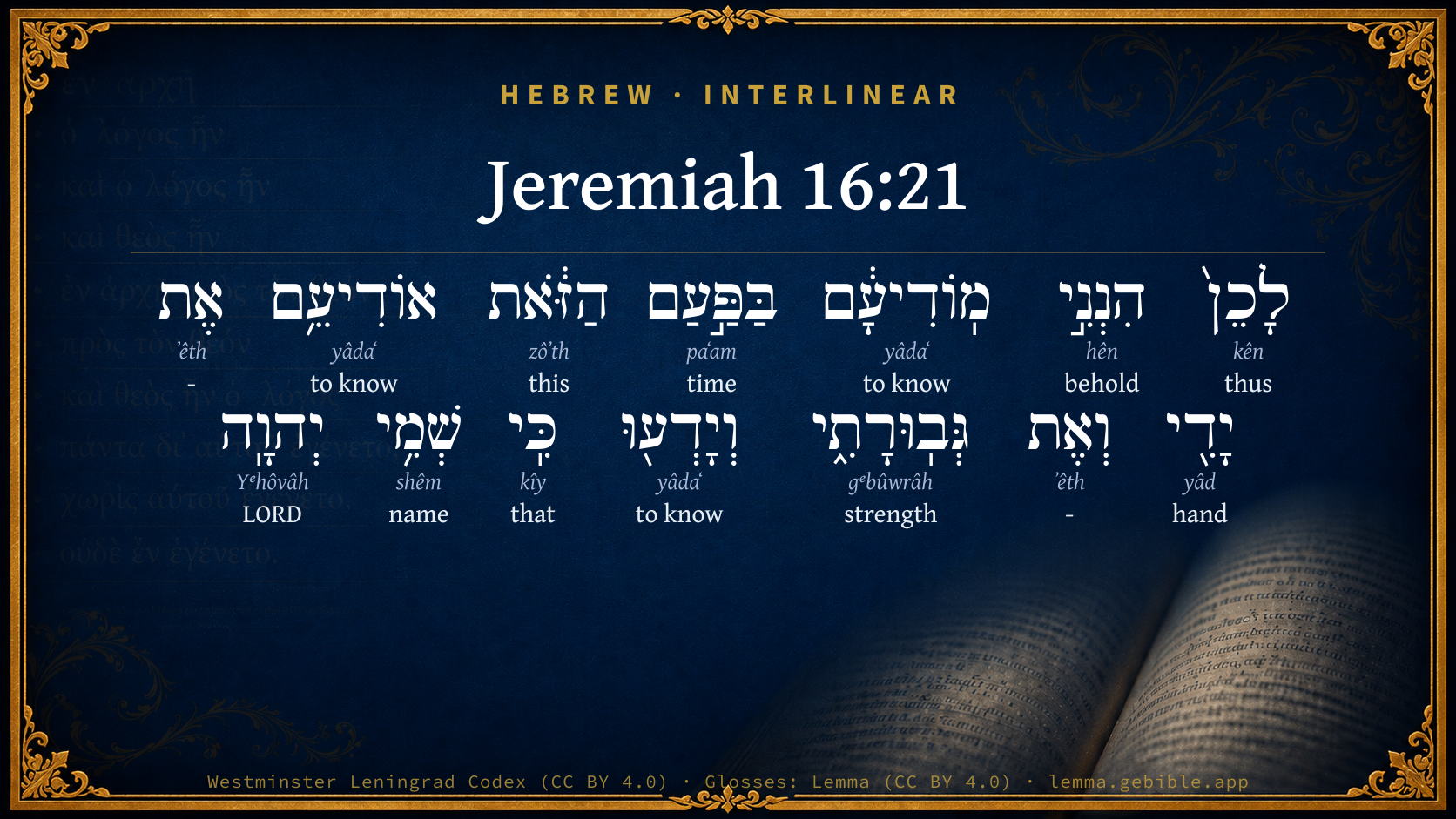
Hebrew (Westminster Leningrad Codex) Jeremiah 16:21 appears in the Hebrew Old Testament. The text above is from the Westminster Leningrad Codex. Each word links to its Strong’s number, a concise gloss, and parsing drawn from the Open Scriptures Hebrew Bible morphology. Click any word for its full Brown-Driver-Briggs (BDB) entry.
Download image
Cite this verse

Jeremiah 16:21 (World English Bible). Public Domain. Lemma interlinear Bible study tool, https://lemma.gebible.app/v/jeremiah/16/21.

Show BibTeX & RIS
BibTeX
RIS
English Translation
Therefore, behold, I will cause them to know, this once will I cause them to know my hand and my might; and they shall know that my name is Yahweh.
World English Bible · Public Domain
Download a study sheet

One document with this verse’s original text, its word-by-word gloss line, the meaning frame, cross-references with their text, attributed commentary, and full source and license credits — printable, and it pastes into notes with its structure intact.

This verse Autodidact and up

Study sheet (.html) Plain text (.txt)

A passage Seminary Student

Up to 50 verses in one chapter. A passage sheet keeps up to 6 commentary sources and 12 cross-references per verse, in the order this page ranks them, and says so on the sheet whenever that leaves anything out. Ask for a single verse and you get the Autodidact verse sheet above.

Everything on this page stays free to read, with no account — the sheet is a download of what is already on screen, not access to it.

Want to remove ads? Support Godless Engineer
Compare translations 3

The same verse in 3 English versions, stacked beneath the original-language interlinear above. Click any original word for its lexicon entry.

Each is an independent rendering of the whole verse — the interlinear is not word-aligned to these translations.

Highlighted words mark where these versions differ — a whole-verse word diff, not a word-by-word alignment.

  • World English Bible Public Domain
    Therefore, behold, I will cause them to know, this once will I cause them to know my hand and my might; and they shall know that my name is Yahweh.
  • King James Version Public Domain
    Therefore, behold, I will this once cause them to know, I will cause them to know mine hand and my might; and they shall know that my name is The LORD.
  • unfoldingWord Literal Text CC BY-SA 4.0
    “Therefore, behold, I am making them to know, this time I will make them to know my hand and my might, and they shall know that my name Yahweh.

unfoldingWord Literal Text — © unfoldingWord, licensed CC BY-SA 4.0. Word-aligned USFM3 via Door43 (git.door43.org/unfoldingWord/en_ult).

Versions to compare (up to 4)

3 of 4 selected

Show all 18 translations

Every available English version of this verse, each an independent rendering of the whole verse.

  • World English Bible Public Domain
    Therefore, behold, I will cause them to know, this once will I cause them to know my hand and my might; and they shall know that my name is Yahweh.
  • Berean Standard Bible Public Domain
    “Therefore behold, I will inform them, and this time I will make them know My power and My might; then they will know that My name is the LORD.
  • Majority Standard Bible Public Domain
    “Therefore behold, I will inform them, and this time I will make them know My power and My might; then they will know that My name is the LORD.
  • King James Version Public Domain
    Therefore, behold, I will this once cause them to know, I will cause them to know mine hand and my might; and they shall know that my name is The LORD.
  • American Standard Version (1901) Public Domain
    Therefore, behold, I will cause them to know, this once will I cause them to know my hand and my might; and they shall know that my name is Jehovah.
  • Revised Version (1885) Public Domain
    Therefore, behold, I will cause them to know, this once will I cause them to know mine hand and my might; and they shall know that my name is Jehovah.
  • Geneva Bible (1599) Public Domain
    Beholde, therefore I will this once teach them: I will shewe them mine hande and my power, and they shall know that my Name is the Lord.
  • Douay-Rheims (1899) Public Domain
    Therefore, behold I will this once cause them to know, I will shew them my hand and my power: and they shall know that my name is the Lord.
  • Young's Literal Translation Public Domain
    Therefore, lo, I am causing them to know at this time, I cause them to know My hand and My might, And they have known that My name `is' Jehovah!
  • Literal Standard Version CC BY-SA 4.0
    “Therefore, behold, I am causing them to know at this time, || I cause them to know My hand and My might, || And they have known that My Name [is] YHWH!”
  • Unlocked Literal Bible CC BY-SA 4.0
    Therefore see! I will cause them to know in this time, I will cause them to know my hand and my power, so they will know that Yahweh is my name.
  • unfoldingWord Literal Text CC BY-SA 4.0
    “Therefore, behold, I am making them to know, this time I will make them to know my hand and my might, and they shall know that my name Yahweh.
  • Darby Bible Public Domain
    Therefore, behold, I will this once cause them to know, I will cause them to know my hand and my might; and they shall know that my name is Jehovah.
  • World Messianic Bible Public Domain
    “Therefore behold, I will cause them to know, this once I will cause them to know my hand and my might. Then they will know that my name is the LORD.”
  • Webster's Bible Public Domain
    Therefore behold, I will this once cause them to know, I will cause them to know my hand and my might; and they shall know that my name is JEHOVAH.
  • Free Bible Version CC BY-SA 4.0
    Now they'll see! I'll show them, and then they'll recognize my power and strength. Then they'll know that I am the Lord!
  • Bible in Basic English Public Domain
    For this reason, truly, I will make them see, this once I will give them knowledge of my hand and my power; and they will be certain that my name is the Lord.
  • JPS Tanakh (1917) Public Domain
    Therefore, behold, I will cause them to know, this once will I cause them to know My hand and My might; and they shall know that My name is the LORD.

Literal Standard Version (2020), Covenant Press — licensed CC BY-SA 4.0. Text via the HelloAO Bible API (eBible.org). Unlocked Literal Bible (unfoldingWord) — licensed CC BY-SA 4.0. Text via the HelloAO Bible API (eBible.org). unfoldingWord Literal Text — © unfoldingWord, licensed CC BY-SA 4.0. Word-aligned USFM3 via Door43 (git.door43.org/unfoldingWord/en_ult). Free Bible Version, Dr. Jonathan Gallagher — licensed CC BY-SA 4.0. Text via the HelloAO Bible API (eBible.org).

Word by word

More ways to search: Search by grammar → Find every occurrence → Compare this word →

Practice this passage: Drill this verse → Learn its vocabulary →

גְּבֽוּרָתִ֑י
gᵉbûwrâh
H1369
“strength · my”
Noun, Common, Feminine, Singular, Construct + Suffix, Personal, 1st Person, Common, Singular
Part of Speech
Noun
Type
Common
Gender
Feminine
Number
Singular
State
Construct
Full BDB Definition

Origin: pass. participle from the same as H1368

TWOT: 310c

strength, might - strength - might, valour, bravery - might, mighty deeds (of God)
  1. לָכֵן֙ kên H3651 “to/for · thus” Preposition + Adverb
  2. הִנְנִ֣י hên H2005 “behold · me” Particle, Demonstrative + Suffix, Personal, 1st Person, Common, Singular
  3. מֽוֹדִיעָ֔ם yâdaʻ H3045 “knowing · them” Verb, Hiphil, Participle Active, Masculine, Singular, Construct + Suffix, Personal, 3rd Person, Masculine, Plural
  4. בַּפַּ֣עַם paʻam H6471 “in/at the · time” Preposition, Determined + Noun, Common, Feminine, Singular, Absolute
  5. הַזֹּ֔את zôʼth H2063 “the · this” Particle, Definite Article + Pronoun, Demonstrative, Feminine, Singular
  6. אוֹדִיעֵ֥ם yâdaʻ H3045 “to know · them” Verb, Hiphil, Imperfect, 1st Person, Common, Singular + Suffix, Personal, 3rd Person, Masculine, Plural
  7. אֶת ʼêth H853 “-” Particle, Direct Object
  8. יָדִ֖י yâd H3027 “hand · my” Noun, Common, Both, Singular, Construct + Suffix, Personal, 1st Person, Common, Singular
  9. וְאֶת ʼêth H853 “and · -” Conjunction + Particle, Direct Object
  10. וְיָדְע֖וּ yâdaʻ H3045 “and · to know” Conjunction + Verb, Qal, Sequential Perfect, 3rd Person, Common, Plural
  11. כִּֽי kîy H3588 “that” Conjunction
  12. שְׁמִ֥י shêm H8034 “name · my” Noun, Common, Masculine, Singular, Construct + Suffix, Personal, 1st Person, Common, Singular
  13. יְהוָֽה Yᵉhôvâh H3068 “LORD” Noun, Proper

About this verse

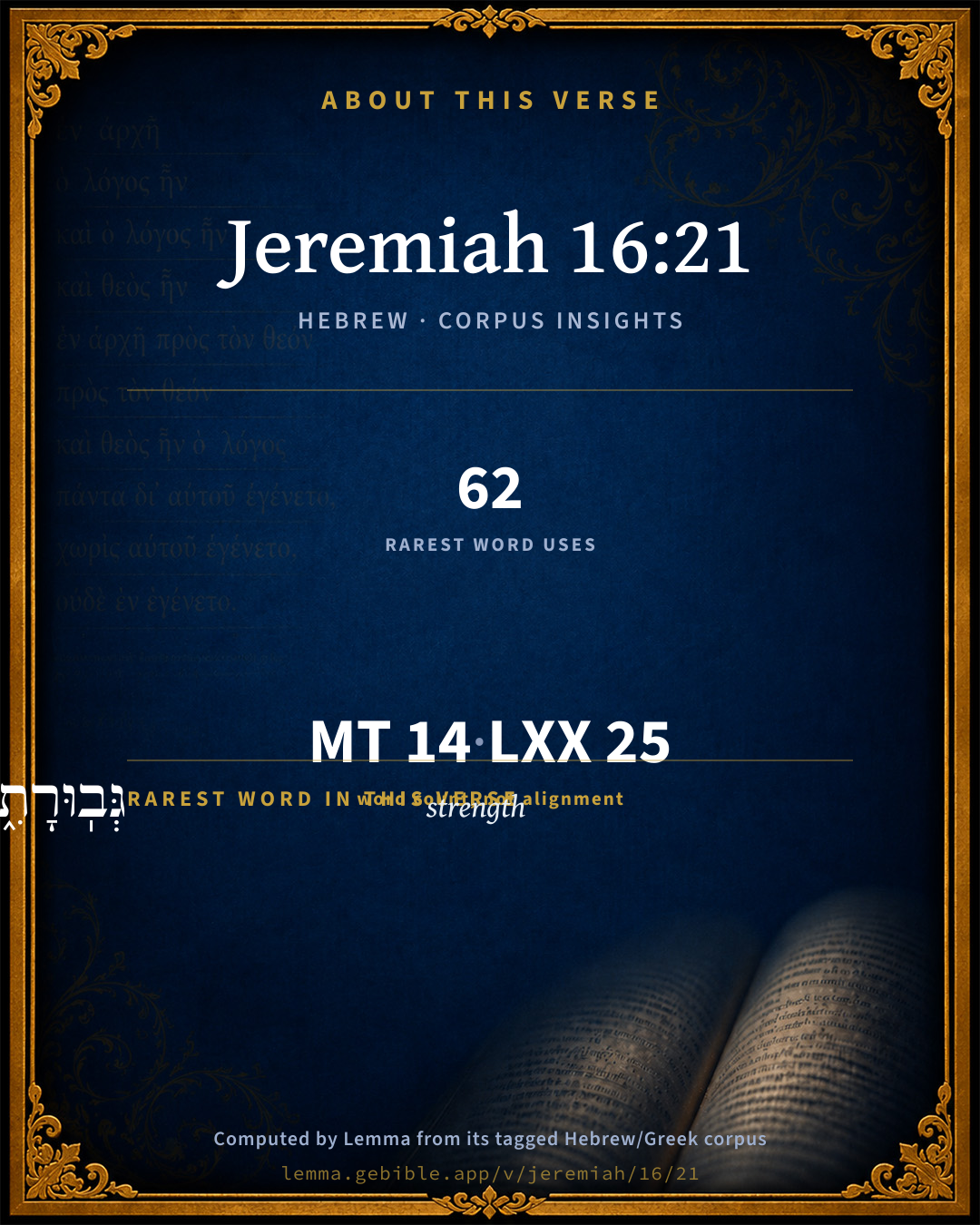
These counts appear in no published source. They are computed here, from the morphology-tagged text and Lemma’s own curated glosses. What Lemma adds →

14
words
11
distinct lemmas
Prophets
section

Grammatical profile

  • 3 verbs
  • 5 nouns
  • 1 pronoun
  • 1 conjunction
  • 1 adverb
  • 3 particles

Verb forms

  • מֽוֹדִיעָ֔ם Hiphil · Participle Active
  • אוֹדִיעֵ֥ם Hiphil · Imperfect
  • וְיָדְע֖וּ Qal · Sequential Perfect

Repetition

A word recurs within this verse — often emphatic in Hebrew:

  • מֽוֹדִיעָ֔ם to know H3045 ×3

Hebrew & Septuagint length

In the original languages it is 14 Hebrew tokens and 25 Greek tokens — but the two are counted differently (Hebrew bundles its prefixes and suffixes into one token; the Greek is in lemma form), so that isn’t a like-for-like length.

Cross-references

12

Topical passages linked to Jeremiah 16:21 in the Treasury of Scripture Knowledge — connected by theme and wording, ordered by reader-vote popularity; previews shown in the World English Bible.

  • Psalms 9:16 Yahweh has made himself known. He has executed judgment. The wicked is snared by the work of his own hands. Meditation. Selah.
  • Psalms 83:18 That they may know that you alone, whose name is Yahweh, Are the Most High over all the earth.
  • Jeremiah 33:2 Thus says Yahweh who does it, Yahweh who forms it to establish it; Yahweh is his name:
  • Amos 5:8 Seek him who made the Pleiades and Orion, And turns the shadow of death into the morning, And makes the day dark with night; Who calls for the waters of the sea, And pours them out on the surface of the earth, Yahweh is his name,
  • Exodus 15:3 Yahweh is a man of war. Yahweh is his name.
  • Isaiah 43:3 For I am Yahweh your God, the Holy One of Israel, your Savior; I have given Egypt as your ransom, Ethiopia and Seba in your place.
  • Exodus 9:14–18 For this time I will send all my plagues against your heart, against your officials, and against your people; that you may know that there is none like me in all the earth.
  • Exodus 14:4 I will harden Pharaoh's heart, and he will follow after them; and I will get honor over Pharaoh, and over all his host; and the Egyptians shall know that I am Yahweh." They did so.
  • Ezekiel 6:7 The slain shall fall in the midst of you, and you shall know that I am Yahweh.
  • Ezekiel 24:24 Thus shall Ezekiel be to you a sign; according to all that he has done shall you do: when this comes, then shall you know that I am the Lord Yahweh.
  • Ezekiel 24:27 In that day shall your mouth be opened to him who is escaped, and you shall speak, and be no more mute: so shall you be a sign to them; and they shall know that I am Yahweh.
  • Ezekiel 25:14 I will lay my vengeance on Edom by the hand of my people Israel; and they shall do in Edom according to my anger and according to my wrath; and they shall know my vengeance, says the Lord Yahweh.

Cross-references courtesy of OpenBible.info (CC BY 4.0).

Hebrew and Greek witnesses Masoretic Hebrew ↔ Greek Septuagint

The same verse in the two great witnesses to the Old Testament, shown verse-for-verse.

These are two independent witnesses, not word-aligned to each other, and the Septuagint is shown in lemma (dictionary) form.

Hebrew Jeremiah 16:21 Masoretic · Westminster Leningrad Codex

לָכֵן֙ הִנְנִ֣י מֽוֹדִיעָ֔ם בַּפַּ֣עַם הַזֹּ֔את אוֹדִיעֵ֥ם אֶת יָדִ֖י וְאֶת גְּבֽוּרָתִ֑י וְיָדְע֖וּ כִּֽי שְׁמִ֥י יְהוָֽה

Therefore, behold, I will cause them to know, this once will I cause them to know my hand and my might; and they shall know that my name is Yahweh.

World English Bible · Public Domain

Greek LXX Structure differs

In the Septuagint, Jeremiah is about an eighth shorter than the Hebrew and arranges its material differently — the Oracles Against the Nations (Hebrew chapters 46–51) appear in the middle of the Greek book, after 25:13. Because the chapter and verse boundaries do not line up, a verse-for-verse comparison with the Hebrew is not shown.

A verse-for-verse comparison isn’t shown here because the chapters and verses don’t line up. Switch to the LXX edition with the MT / LXX toggle above to read the Greek directly.

On this verse, Jamieson, Fausset & Brown discusses the Septuagint’s reading. Read the note in Commentary ↓

Hebrew: Westminster Leningrad Codex (CC BY 4.0). Greek: Septuagint (public domain); English from a public-domain English Septuagint. How the Septuagint differs from the Hebrew →

Targum (Aramaic paraphrase)

1

The Targum is the ancient Jewish Aramaic paraphrase of the Hebrew Scriptures — an interpretive translation, not the Hebrew text itself. Onkelos (literal) and Pseudo-Jonathan (expansive) render the Torah, and Jonathan the Prophets. Coverage is partial: where no permissively-licensed English translation exists for a verse, only the Aramaic is shown. This is verse-level text, not a word-by-word alignment to the Hebrew.

  1. Targum Jonathan Prophets (Joshua–Malachi)
    בְּכֵן הָא אֲנָא מְחַוֵי לְהוֹן בְּזִמְנָא הָדָא אֲחַוִינוּן יַת פּוּרְעֲנוּתִי וְיַת מְחַת גְבוּרְתִּי וְיֵדְעוּן אֲרֵי שְׁמִי יְיָ:

    (no public-domain English translation for this verse)

    Targum Jonathan — Aramaic: “Mikraot Gedolot” (public domain). English: “Sefaria Community Translation” (CC0 1.0 (public-domain dedication)); “London "Chaldee Paraphrase," 1871” (public domain). Text via Sefaria.

Commentary

Notes on Jeremiah 16:21 from classic Christian and Jewish commentators (each source and its license shown beneath its notes). The classic Christian expositions comment on the surrounding passage and are grouped to its opening verse, so a note may address several verses; the Jewish commentaries on the Tanakh (Rashi and others) are per-verse, so they appear only where the commentator wrote on this verse.

Lemma curates 59 commentaries, every one of them public domain or Creative Commons licensed, each selected and text-cleaned for this edition rather than reprinted as found. About our sources →

Trapp's Complete Commentary

John Trapp

Jer 16:21 Therefore, behold, I will this once cause them to know, I will cause them to know mine hand and my might; and they shall know that my name [is] The LORD.

Ver. 21. I will for this once.] And "this once" shall stand for all. Affliction shall not rise up the second time. {Nah 1:9}

And I will make them to know.] Effectu magis quam affectu. Effecting more than affecting.

My hand and my might,] i.e., My mighty hand, mine irresistible power in their just punishment.

John Trapp, A Commentary or Exposition upon All the Books of the Old and New Testament (1647–1656) — public domain. Text from a community e-Sword module.

Joseph Benson's Commentary

Jer 16:21. Therefore I will this once — Or, as בפעם הזאתmay be rendered, at this time, as the same expression is rendered, 2Sa 17:7. Cause them to know my hand and my might, &c. — “The time alluded to is undoubtedly that when the gospel was to be preached to, and embraced by, the Gentiles; when God promises that he would make such a display of his mighty power as should amply convince them of the truth of his existence and divinity. They shall know that my name is JEHOVAH — A name which implies absolute and necessary existence, the real source and origin of all perfection; and they shall know it by the blessings which shall, from my providence, be derived to them.” — Blaney.

Joseph Benson's Commentary on the Old and New Testaments (1811–1818) — public domain. Text from a community e-Sword module.

Tyndale Open Study Notes

Tyndale Open Resources

16:21 The Lord will require all people to know his power and might and to understand that he is the Lord (cp. Exod 6:7; 8:22).

Tyndale Open Study Notes — © Tyndale Open Resources, licensed CC BY-SA 4.0. Text via the HelloAO Bible API.

Geneva Bible (1599)

Geneva Bible translators

They shall once again feel my power and mercy for their deliverance, that they may learn to worship me.

Geneva Bible (1599) marginal notes — public domain. Text via Bolls.life.

Jamieson, Fausset & Brown

Robert Jamieson, A. R. Fausset & David Brown

Therefore--In order that all may be turned from idols to Jehovah, He will now give awful proof of His divine power in the judgments He will inflict.

this once--If the punishments I have heretofore inflicted have not been severe enough to teach them.

my name . . . Lord--Jehovah (Psa 83:18): God's incommunicable name, to apply which to idols would be blasphemy. Keeping His threats and promises (Exo 6:3).

The the Septuagint omits the first four verses, but other Greek versions have them.

Next: Jeremiah Chapter 17

Jamieson, Fausset & Brown — Commentary Critical and Explanatory on the Whole Bible (1871) — public domain (CC PDM 1.0). Text via the HelloAO Bible API.

Adam Clarke's Commentary

Verse 21. Therefore, behold, I will this once] I will not now change my purpose. They shall be visited and carried into captivity; nothing shall prevent this: and they shall know that my name is JEHOVAH. Since they would not receive the abundance of my mercies, they shall know what the true God can do in the way of judgment.

Adam Clarke's Commentary on the Bible (1810–1826) — public domain. Text from a community e-Sword/MySword module.

John Calvin's Commentaries

The Prophet again threatens the Jews, because their impiety was inexcusable, especially when attended with so great an obstinacy, he therefore says that God was already present as a judge: Behold I, he says — the demonstrative particle shews the near approach of vengeance — I will shew at this time: the words are emphatical, for God indirectly intimates that the Babylonian exile would be an extraordinary event, far exceeding every other which had preceded it. At this time, he says — that is, if ye have hitherto been tardy and insensible, or, if the punishments I have already inflicted have not been sufficiently severe — I will at this time shew to them my hand and my power; and they shall know that my name is Jehovah

This way of speaking often occurs in Scripture; but God here, no doubt, reproves the false sentiments with which the Jews were imbued, and by which they were led astray from true religion — for they had devised for themselves many gods; hence he says, They shall know that my name is Jehovah, that is, that my name is sacred, and ought not to be given to others. But at the same time he intimates that he would shew to them his power by destroying them, which they had refused to acknowledge in the preservation promised to them. They would indeed have ever found the God of Abraham to be the same, had they not deprived themselves of his favor. As then they had wandered after their own delusions and inventions, God says now, I will shew to them my hand, that is, for their ruin; and they shall now know for their own misery what they had refused to acknowledge for their own safety — that I am the only true God.

Here let us first learn that it was wholly a diabolical madness, when men dared to devise for themselves a god; for had they regarded their own beginning and their own end, doubtless they could not have betrayed so much presumption and audacity as to invent a god for themselves. If this only came to the mind of an idolater, “What art thou? whence is thine origin? where goest thou, and what end awaits thee?” all his false imaginations would have instantly fallen to the ground; he would no longer think of forming a god for himself, nor of worshipping anything he might invent. How then does it happen that men proceed to such a madness as to devise gods for themselves, according to their own fancies, except that they know not themselves? It is then no wonder that men are blind in seeking God, when they do not consider nor examine themselves. It hence follows that God cannot be rightly worshipped except men are made humble. And humility is the best preparation for faith, that there may be a submission to the word of God. Idolaters do indeed pretend some kind of humility, but they afterwards involve themselves in such stupidity, that they are unwining to make any enquiry, so as to make any difference between light and darkness. But true humility leads us to seek God in his word.

But when the Prophet asks this question, “Shall man make a god for himself?” he does not mean, that either the Egyptians or the Assyrians were so ignorant as to think that they could give divinity to wood or stone; but that whatever men dared to invent for themselves as to divine worship, was nothing else but the creation of a god. As soon then as we allow ourselves the liberty to worship God in this or in that way, or to imagine God to be such and such a being, we create gods for ourselves. And as to that point where he says, They shall know that my name is Jehovah, we must observe, that what is his own is taken away from God, except we acquiesce in him alone, so as to allow no other divinities to creep in and to be received; for God does not retain his own right or his own glory, except he be regarded as the only true God. Now follows —

John Calvin's Commentaries (1540-1563) — public domain. Text from the Calvin Translation Society English edition (1840s-50s) via the Christian Classics Ethereal Library (ccel.org). Calvin's coverage is partial (roughly two-thirds of the Bible); uncommented books and verses are honest gaps, never fabricated. The 19th-century editor's footnotes and remarks are omitted so the notes are faithfully Calvin's own voice.

Ellicott's Commentary for English Readers

(21) I will this once cause them to know . . .—The warning comes with all the emphasis of iteration, this once. As in a way without a parallel, once for all, they should learn that the name of the God they had rejected was Jehovah, the Eternal (Exo_3:14), unchangeable in His righteousness. The thought is parallel to that of Eze_12:15.

A Bible Commentary for English Readers, edited by Charles John Ellicott (1878–1897) — public domain. Text from a community e-Sword module.

The Cambridge Bible for Schools and Colleges

gen. ed. J. J. S. Perowne

21. Gi. considers this v. to be late, as being in the style of the second Is. (cp. Isa_42:6) and Ezek. (Eze_36:23).

The Cambridge Bible for Schools and Colleges (gen. ed. J. J. S. Perowne; Cambridge University Press, 1878–1918) — public domain. Text from a community e-Sword module.

Albert Barnes' Notes on the Bible

This once - Whether we consider the greatness of the national disgrace and suffering caused by it, or its effect upon the mind of the Jews, the burning of Jerusalem by Nebuchadnezzar, followed by the captivity of the people at Babylon, stands out as the greatest manifestation of God’s “hand” in all His dealings with them.

Albert Barnes' Notes on the Bible (1834–1885) — public domain. Text from a community e-Sword/MySword module.

Haydock's Catholic Bible Commentary

CHAPTER XVI.

Power, in taking vengeance on idolatry. --- Lord. "He who is;" (Calmet) Jehova. (Haydock)

George Leo Haydock (1774–1849), Haydock's Catholic Family Bible and Commentary, 1859 edition — public domain. Excludes Psalms (Douay-Rheims chapter numbering differs from Protestant) and Deuterocanonical books (Catholic canon only).

Matthew Poole's English Annotations

Because all the goodness and mercy that I have showed them will not learn them to know me, my power and might, I will once for all make them to understand it by the dreadful strokes of my vengeance. They shall know that my name is Jehovah; that I am not such a one as their idols, but one who have my being from myself, and give life and being to all other things, and have all might and power in my hand, and can do whatsoever I please; and one that will make good whatsoever I have spoken, whether in a way of promise or threatening.

Matthew Poole's English Annotations on the Holy Bible (1683–1685) — public domain. Text from a community e-Sword/MySword module.

Whedon's Commentary on the Bible

Daniel D. Whedon

21. This once — There is here most significant and portentous emphasis. The intimation is, that they were on the eve of such a signal display of God’s power as to compel, even from the heathen, the confession that his name is Jehovah.

Daniel D. Whedon (gen. ed.), Commentary on the Old and New Testaments (1874–1909) — public domain. Text from a community e-Sword module.

The Pulpit Commentary

The final answer of Jehovah. There will be no further grace-time. I will this once cause them to know; rather, I will this time (comp. Jer_10:18) cause them to acknowledge. The judgment which Jeremiah has had the sad duty of announcing will prove to the blinded Jews that Jehovah alone is true God, alone can strike and heal.

The Pulpit Commentary (1880–1919), ed. H.D.M. Spence-Jones & Joseph S. Exell — public domain. Text from a community e-Sword module.

John Wesley's Explanatory Notes

Therefore - Because all the mercy I have shewed them, will not learn them to know my might, I will once for all make them to understand it, by the dreadful strokes of my vengeance. And - They shall know that my name is Jehovah; that I am not such a one as their idols, but one who have my being from myself, and give life and being to all other things, and have all might and power in my hand, and can do whatsoever I please.

John Wesley, Explanatory Notes Upon the Whole Bible (1754–1765) — public domain. Text via the GEBible commentary corpus.

Scofield Reference Notes

C. I. Scofield

The Lord

Or, JEHOVAH. Psa 83:18.

The Scofield Reference Bible (1917 edition), notes by C. I. Scofield — public domain. Text from a community e-Sword module.

Rashi

Rabbi Shlomo Yitzchaki (Rashi)

that My name is the Lord As its apparent meaning, a ruler and a sovereign to fulfill My decree.

Rashi on the Tanakh — English translations: “The Judaica Press complete Tanach with Rashi, translated by A. J. Rosenberg” (CC BY 4.0); “Pentateuch with Rashi's commentary by M. Rosenbaum and A.M. Silbermann, 1929-1934” (public domain); “The Metsudah Tanach series, Lakewood, N.J” (CC BY 4.0); and “The Book of Joshua, Metsudah Publications, 1997” (CC BY 4.0). Text via Sefaria.

Lesson kit

Teaching starters — assembled from the data on this page, not authored interpretation. Every prompt links to the verse data it draws on. Edit before teaching.

Jeremiah, in the Prophets, opens this verse with 14 words (11 distinct Hebrew lemmas). Its most distinctive word is gᵉbûwrâh (“strength”). A historical commentator’s framing appears above. Read the whole chapter for the surrounding context.

Discussion questions

  1. What does “strength” (gᵉbûwrâh) contribute to the verse as a whole?
  2. How does Psalms 9:16, which shares this passage’s theme, read alongside this verse?
  3. What does the repetition of “to know” (3× in this one verse) do in this verse?
  4. These translations render this verse differently. What is at stake in choosing one wording over another?
  5. «מֽוֹדִיעָ֔ם» is a Hiphil Participle Active verb. How does that grammatical form shape the action described?
  6. Compare how Trapp's Complete Commentary and Joseph Benson's Commentary read this verse. Where do they agree or differ?

Things to notice

Reading settings

Reading text

Shown beneath each verse's original-language words.

Old Testament
Old Testament edition

Read the OT as the Masoretic Hebrew (MT) or the Greek Septuagint (LXX).

English shown for the Greek Septuagint (in the Hebrew ↔ Greek comparison).

Comparing translations? Open the Compare panel on any verse page to stack up to four side by side.