
Psalms 94:18

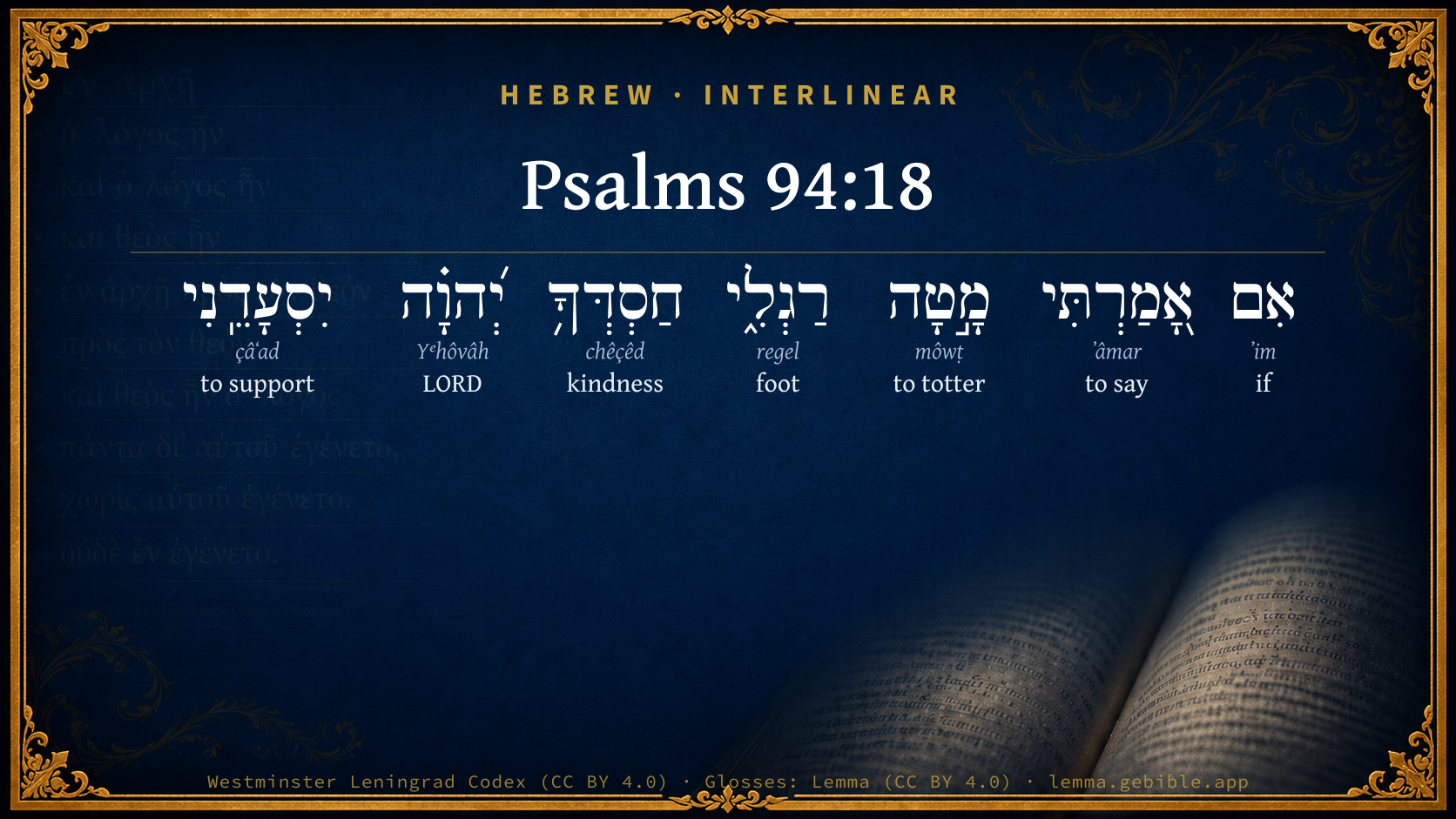
Hebrew (Westminster Leningrad Codex) Psalms 94:18 appears in the Hebrew Old Testament. The text above is from the Westminster Leningrad Codex. Each word links to its Strong’s number, a concise gloss, and parsing drawn from the Open Scriptures Hebrew Bible morphology. Click any word for its full Brown-Driver-Briggs (BDB) entry.
Download image
Cite this verse

Psalms 94:18 (World English Bible). Public Domain. Lemma interlinear Bible study tool, https://lemma.gebible.app/v/psalms/94/18.

Show BibTeX & RIS
BibTeX
RIS
English Translation
When I said, "My foot is slipping!" Your loving kindness, Yahweh, held me up.
World English Bible · Public Domain
Download a study sheet

One document with this verse’s original text, its word-by-word gloss line, the meaning frame, cross-references with their text, attributed commentary, and full source and license credits — printable, and it pastes into notes with its structure intact.

This verse Autodidact and up

Study sheet (.html) Plain text (.txt)

A passage Seminary Student

Up to 50 verses in one chapter. A passage sheet keeps up to 6 commentary sources and 12 cross-references per verse, in the order this page ranks them, and says so on the sheet whenever that leaves anything out. Ask for a single verse and you get the Autodidact verse sheet above.

Everything on this page stays free to read, with no account — the sheet is a download of what is already on screen, not access to it.

Want to remove ads? Support Godless Engineer
Compare translations 3

The same verse in 3 English versions, stacked beneath the original-language interlinear above. Click any original word for its lexicon entry.

Each is an independent rendering of the whole verse — the interlinear is not word-aligned to these translations.

Highlighted words mark where these versions differ — a whole-verse word diff, not a word-by-word alignment.

  • World English Bible Public Domain
    When I said, "My foot is slipping!" Your loving kindness, Yahweh, held me up.
  • King James Version Public Domain
    When I said, My foot slippeth; thy mercy, O LORD, held me up.
  • unfoldingWord Literal Text CC BY-SA 4.0
    When I said, “My foot is slipping,” Your covenant faithfulness, Yahweh, supported me.

unfoldingWord Literal Text — © unfoldingWord, licensed CC BY-SA 4.0. Word-aligned USFM3 via Door43 (git.door43.org/unfoldingWord/en_ult).

Versions to compare (up to 4)

3 of 4 selected

Show all 18 translations

Every available English version of this verse, each an independent rendering of the whole verse.

  • World English Bible Public Domain
    When I said, "My foot is slipping!" Your loving kindness, Yahweh, held me up.
  • Berean Standard Bible Public Domain
    If I say, “My foot is slipping,” Your loving devotion, O LORD, supports me.
  • Majority Standard Bible Public Domain
    If I say, “My foot is slipping,” Your loving devotion, O LORD, supports me.
  • King James Version Public Domain
    When I said, My foot slippeth; thy mercy, O LORD, held me up.
  • American Standard Version (1901) Public Domain
    When I said, My foot slippeth; Thy lovingkindness, O Jehovah, held me up.
  • Revised Version (1885) Public Domain
    When I said, My foot slippeth; thy mercy, O LORD, held me up.
  • Geneva Bible (1599) Public Domain
    When I said, My foote slideth, thy mercy, O Lord, stayed me.
  • Douay-Rheims (1899) Public Domain
    If I said: My foot is moved: thy mercy, O Lord, assisted me.
  • Young's Literal Translation Public Domain
    If I have said, `My foot hath slipped,' Thy kindness, O Jehovah, supporteth me.
  • Literal Standard Version CC BY-SA 4.0
    If I have said, “My foot has slipped,” || Your kindness, O YHWH, supports me.
  • Unlocked Literal Bible CC BY-SA 4.0
    When I said, “My foot is slipping,” Your covenant faithfulness, Yahweh, held me up.
  • unfoldingWord Literal Text CC BY-SA 4.0
    When I said, “My foot is slipping,” Your covenant faithfulness, Yahweh, supported me.
  • Darby Bible Public Domain
    When I said, My foot slippeth, thy loving-kindness, O Jehovah, held me up.
  • World Messianic Bible Public Domain
    When I said, “My foot is slipping!” Your loving kindness, LORD, held me up.
  • Webster's Bible Public Domain
    When I said, My foot slippeth; thy mercy, O LORD, held me up.
  • Free Bible Version CC BY-SA 4.0
    I shouted out, “My foot's slipping!” and your trustworthy love, Lord, kept me from falling.
  • Bible in Basic English Public Domain
    If I say, My foot is slipping; your mercy, O Lord, is my support.
  • JPS Tanakh (1917) Public Domain
    If I say: 'My foot slippeth', Thy mercy, O LORD, holdeth me up.

Literal Standard Version (2020), Covenant Press — licensed CC BY-SA 4.0. Text via the HelloAO Bible API (eBible.org). Unlocked Literal Bible (unfoldingWord) — licensed CC BY-SA 4.0. Text via the HelloAO Bible API (eBible.org). unfoldingWord Literal Text — © unfoldingWord, licensed CC BY-SA 4.0. Word-aligned USFM3 via Door43 (git.door43.org/unfoldingWord/en_ult). Free Bible Version, Dr. Jonathan Gallagher — licensed CC BY-SA 4.0. Text via the HelloAO Bible API (eBible.org).

Word by word

More ways to search: Search by grammar → Find every occurrence → Compare this word →

Practice this passage: Drill this verse → Learn its vocabulary →

About this verse

These counts appear in no published source. They are computed here, from the morphology-tagged text and Lemma’s own curated glosses. What Lemma adds →

7
words
7
distinct lemmas
Wisdom
section

Notable vocabulary

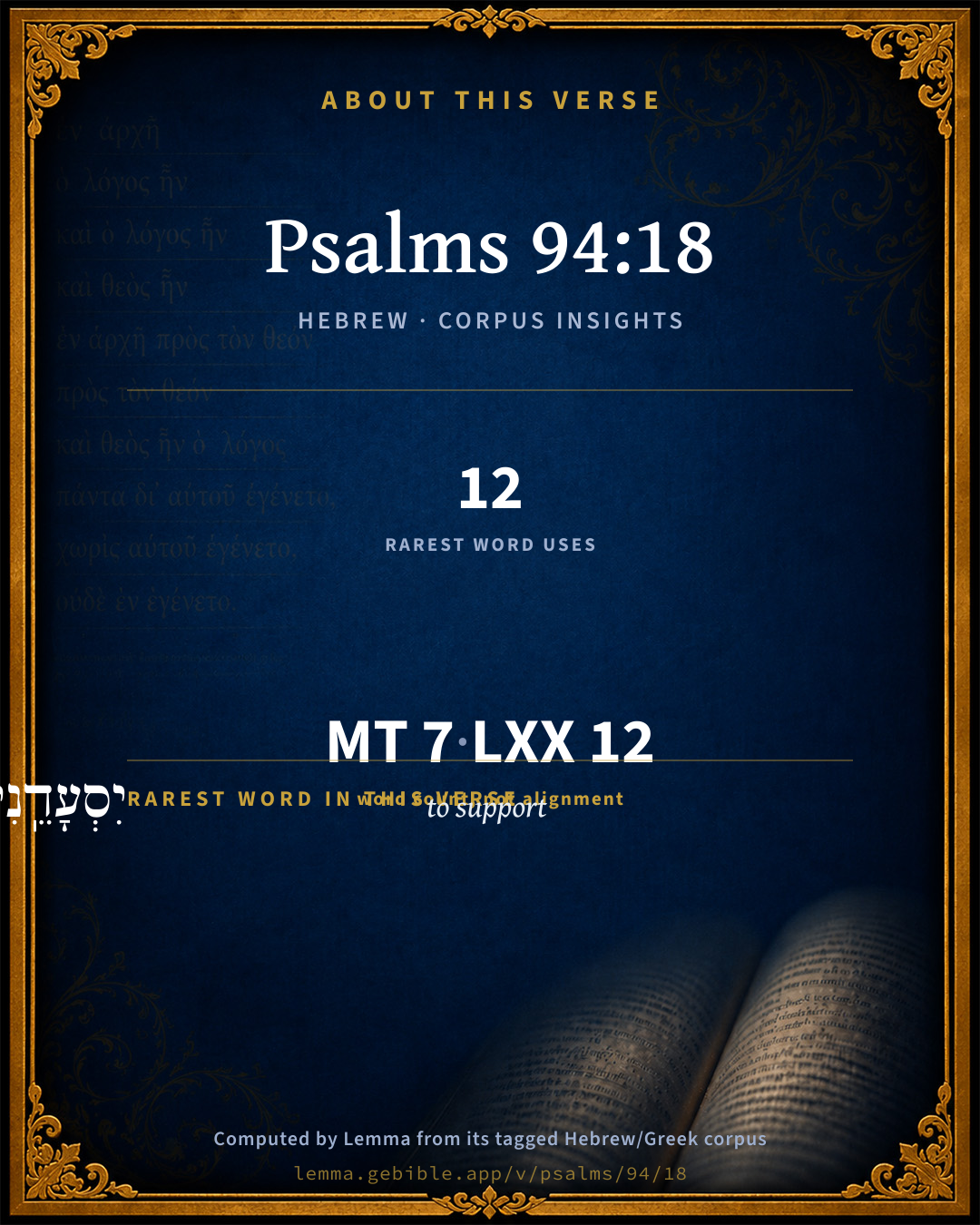
The rarest word here is יִסְעָדֵֽנִי to support H5582 — appearing just 12 times in the whole Hebrew Bible.

Shared distinctive vocabulary

יִסְעָדֵֽנִי to support H5582 occurs in 12 verses of the Hebrew Bible. Also found in:

Grammatical profile

  • 3 verbs
  • 3 nouns
  • 1 conjunction

Verb forms

  • אָ֭מַרְתִּי Qal · Perfect
  • מָ֣טָה Qal · Perfect
  • יִסְעָדֵֽנִי Qal · Imperfect

Hebrew & Septuagint length

In English translation the verse runs 14 words from the Hebrew and 8 from the Septuagint (LXX English) — closely comparable.

A rough comparison of the two English renderings, which tokenize alike — not a word-level alignment.

Word counts can differ between the Hebrew and the Greek without any difference in meaning — e.g. the Hebrew direct-object marker אֵת has no separate Greek word, and Greek often adds the article ὁ.

In the original languages it is 7 Hebrew tokens and 12 Greek tokens — but the two are counted differently (Hebrew bundles its prefixes and suffixes into one token; the Greek is in lemma form), so that isn’t a like-for-like length.

Cross-references

10

Topical passages linked to Psalms 94:18 in the Treasury of Scripture Knowledge — connected by theme and wording, ordered by reader-vote popularity; previews shown in the World English Bible.

  • Psalms 121:3 He will not allow your foot to be moved. He who keeps you will not slumber.
  • Isaiah 41:10 Don't you be afraid, for I am with you; don't be dismayed, for I am your God; I will strengthen you; yes, I will help you; yes, I will uphold you with the right hand of my righteousness.
  • Psalms 119:116–117 Uphold me according to your word, that I may live. Let me not be ashamed of my hope.
  • Psalms 37:23–24 A man's goings are established by Yahweh. He delights in his way.
  • Psalms 38:16 For I said, "Don't let them gloat over me, Or exalt themselves over me when my foot slips."
  • Psalms 17:5 My steps have held fast to your paths, My feet have not slipped.
  • Luke 22:32 but I prayed for you, that your faith wouldn't fail. You, when once you have turned again, establish your brothers."
  • 1 Samuel 2:9 He will keep the feet of his holy ones; But the wicked shall be put to silence in darkness; For by strength shall no man prevail.
  • Psalms 73:2 But as for me, my feet were almost gone. My steps had nearly slipped.
  • 1 Peter 1:5 who by the power of God are guarded through faith for a salvation ready to be revealed in the last time.

Cross-references courtesy of OpenBible.info (CC BY 4.0).

Hebrew and Greek witnesses Masoretic Hebrew ↔ Greek Septuagint

The same verse in the two great witnesses to the Old Testament, shown verse-for-verse.

You’re reading Greek Psalm 93 (Hebrew Psalm 94). The Septuagint counts the superscription, so verse numbers can differ from the Hebrew — chapter-level alignment, not verse-by-verse. Numbering follows Rahlfs.

These are two independent witnesses, not word-aligned to each other, and the Septuagint is shown in lemma (dictionary) form.

Hebrew Psalms 94:18 Masoretic · Westminster Leningrad Codex

אִם אָ֭מַרְתִּי מָ֣טָה רַגְלִ֑י חַסְדְּךָ֥ יְ֝הוָ֗ה יִסְעָדֵֽנִי

When I said, "My foot is slipping!" Your loving kindness, Yahweh, held me up.

World English Bible · Public Domain

Greek LXX Greek Psalm 93:18 Septuagint · lemma form

εἰ λέγω σαλεύω ὁ πούς ἐγώ ὁ ἔλεος σύ κύριος βοηθέω ἐγώ

If I said, My foot has been moved;

LXX2012 (modern English Septuagint) · Public Domain

Hebrew: Westminster Leningrad Codex (CC BY 4.0). Greek: Septuagint (public domain); English from LXX2012 (modern English Septuagint) (Public Domain). How the Septuagint differs from the Hebrew →

Commentary

Notes on Psalms 94:18 from classic Christian and Jewish commentators (each source and its license shown beneath its notes). The classic Christian expositions comment on the surrounding passage and are grouped to its opening verse, so a note may address several verses; the Jewish commentaries on the Tanakh (Rashi and others) are per-verse, so they appear only where the commentator wrote on this verse.

Lemma curates 59 commentaries, every one of them public domain or Creative Commons licensed, each selected and text-cleaned for this edition rather than reprinted as found. About our sources →

Trapp's Complete Commentary

John Trapp

Psa 94:18 When I said, My foot slippeth; thy mercy, O LORD, held me up.

Ver. 18. When I said, My foot slippeth] I stand on a precipice, and shall be down, Hypotyposis est.

Thy mercy, O Lord, held me] I have subsisted merely by a miracle of thy mercy, by a prop of thine extraordinary pity and patience.

John Trapp, A Commentary or Exposition upon All the Books of the Old and New Testament (1647–1656) — public domain. Text from a community e-Sword module.

The Biblical Illustrator

Joseph S. Exell

Psa_94:18

When I said, My foot slippeth; Thy mercy, O Lord, held me up.

A common incident of the journey

The soul in peril can seldom say much, but that which is said is generally expressive. Take, for example, these words: they imply faith in the presence of One able to help--abhorrence of the sin to which ha is tempted--and confidence in His willingness to save. This experience is a common one. All of us are, at some time, found in slippery places.

I. Some slippery places, We are the more exposed to falling when we are brought into circumstances of--

1. Poverty and want. Christ was tempted when He hungered.

2. Of annoyance and vexation. Moses smote the rock in anger.

3. Of dejection and perplexity (Psa_73:2-3).

4. Of sore bereavement and trial (Job).

II. Some things concerning the traveller, rendering these the more perilous.

1. The absence of the staff, or negligence in its use. Learn the promises and use them.

2. The foot ill-shod.

3. Drowsiness. Watch and pray, that, etc.

4. Carelessness.

5. The lantern untrimmed or insecure, so that it goes out or burns dimly.

III. The sure means for preservation. We have simply to cry to the Deliverer. The secret of a secure and blessed life is constant ejaculatory prayer. The moment danger is oven anticipated, to ask for timely assistance. (R. A. Griffin.)

Upheld by Divine mercy

Not often has the voice of man pointed the way and brought sinners to Christ with so much of picturesque and sweet persuasiveness as did that of Dr. Bonar. What could be finer than this eccentric way of stating the Gospel: Suppose that I, a sinner, be walking along yon golden street, passing by one angel after another. I can hear them say, as I pass through their ranks, A sinner! a crimson sinner! Should my feet totter? Should my eye grow dim? No; I can say to them, Yes, a sinner--a crimson sinner--but a sinner brought near by a forsaken Saviour, and now a sinner who has boldness to enter into the Holiest through the blood of Christ.

The Biblical Illustrator, edited by Joseph S. Exell (c. 1880s–1900s) — public domain. Text from a community e-Sword module.

Joseph Benson's Commentary

Psa 94:18. When I said, My foot slippeth — I am now upon the point of falling into mischief and utter destruction; thy mercy, O Lord, held me up — A merciful, gracious, and powerful hand was immediately stretched out to support my steps, and establish my goings. Observe, reader, we are beholden, not only to God’s power but to his pity, for spiritual supports, and we are then prepared to receive those supports, when we are sensible of our own weakness and inability to stand by our own strength, and come to God to acknowledge it, and to tell him how our foot slippeth.

Joseph Benson's Commentary on the Old and New Testaments (1811–1818) — public domain. Text from a community e-Sword module.

J. A. Alexander on Psalms

Joseph Addison Alexander

18. (Psa 94:18) If I say, My foot slips, thy mercy, 0 Jehovah, holds me up. If at any time my hope of safety from the Lord's protection yields to fear, his grace sustains and reinvigorates it. The preterites in the Hebrew of the first clause imply that such lapses or temptations have occurred in his ex perience, when his foot seemed to have swerved or slipped already; while the future at the close represents the act of sustentation as one which he expects to be continued or renewed hereafter.

Joseph Addison Alexander, The Psalms Translated and Explained (1850) — public domain. Text from a community e-Sword module.

Tyndale Open Study Notes

Tyndale Open Resources

94:18-19 The psalmist’s experience of slipping contrasts with God’s promise to stand with him (94:12-13; see 15:5; 93:1).

Tyndale Open Study Notes — © Tyndale Open Resources, licensed CC BY-SA 4.0. Text via the HelloAO Bible API.

Geneva Bible (1599)

Geneva Bible translators

When I thought there was no way but death.

Geneva Bible (1599) marginal notes — public domain. Text via Bolls.life.

Adam Clarke's Commentary

Verse 18. When I said, My foot slippeth] When I found myself so weak and my enemy so strong, that I got first off my guard, and then off my centre of gravity, and my fall appeared inevitable, -

Thy mercy, O Lord, held me up.] יסעדני yisadeni, propped me. It is a metaphor taken from any thing falling, that is propped, shored up, or buttressed. How often does the mercy of God thus prevent the ruin of weak believers, and of those who have been unfaithful!

Adam Clarke's Commentary on the Bible (1810–1826) — public domain. Text from a community e-Sword/MySword module.

John Calvin's Commentaries

18. If I said, My foot has fallen What is said in this verse confirms the preceding statement. The more to commend God’s kindness and power, he declares that it was no common danger from which he had been rescued, but in a manner from present death. The import of the language is, that death stared him so full in view, that he despaired of himself; as Paul speaks of having had the message of death in himself, when his condition was desperate, and he had given up hope of life, (2 Corinthians 1:9.) The fact of the Psalmist having been delivered after he had considered death certain, made the Divine interposition the more conspicuous. If we understand him as speaking of temporal death only in the expression, My foot has fallen — there is nothing unaccountable in the circumstance of his having despaired, as God often prolongs the life of his people in the world, when they had lost hope, and were preparing for their departure. Possibly, however, the Psalmist only means that this was the language of sense; and this is the more probable, because we have already seen that he never ceased praying to God — a proof that he had still some hope. The next verse affords still further proof, for there he tells us that his afflictions were always mixed with some comfort. By thoughts, he means anxious and perplexing cares, which would have overwhelmed him had not consolation been communicated to him from above. We learn this truth from the passage, That God interposes in behalf of his people, with a due regard to the magnitude of their trials and distresses, and at the very moment which is necessary, enlarging them in their straits, as we find stated in other places. The heavier our calamities grow, we should hope that Divine grace will only be the more powerfully manifested in comforting us under them, (Psalm 4:1; 118:5,) But should we through weakness of the flesh be vexed and tormented by anxious cares, we must be satisfied with the remedy which the Psalmist here speaks of in such high terms. Believers are conscious of two very different states of mind. On the one hand, they are afflicted and distressed with various fears and anxieties; on the other, there is a secret joy communicated to them from above, and this in accommodation to their necessity, so as to preserve them from being swallowed up by any complication or force of calamity which may assail them.

John Calvin's Commentaries (1540-1563) — public domain. Text from the Calvin Translation Society English edition (1840s-50s) via the Christian Classics Ethereal Library (ccel.org). Calvin's coverage is partial (roughly two-thirds of the Bible); uncommented books and verses are honest gaps, never fabricated. The 19th-century editor's footnotes and remarks are omitted so the notes are faithfully Calvin's own voice.

The Cambridge Bible for Schools and Colleges

gen. ed. J. J. S. Perowne

18. The A.V. misses the picturesqueness of the tenses. When I said, My foot hath slipped, thy lovingkindness, Jehovah, was supporting me. I gave myself up for lost, but the right hand of love had hold of me all the time. Cp. Psa_38:16; Psa_18:35.

The Cambridge Bible for Schools and Colleges (gen. ed. J. J. S. Perowne; Cambridge University Press, 1878–1918) — public domain. Text from a community e-Sword module.

John Gill's Exposition

When I said, my foot slippeth,.... There is no ground for me to stand upon; all is over with me; there is no hope nor help for me; I am just falling into ruin and destruction: such will be the desperate case of the church, at the time before referred to:

thy mercy, O Lord, held me up; the extremity of his people is the Lord's opportunity; then is his set time to arise, and have mercy on them; then mercy steps in, lays a solid ground and foundation for hope, and holds up in its arms a sinking people, and revives a dying cause.

John Gill's Exposition of the Whole Bible (1746–1763) — public domain (CC PDM 1.0). Text via the HelloAO Bible API.

Albert Barnes' Notes on the Bible

When I said, My foot slippeth - I can no longer stand. My strength is gone; and I must sink into the grave. The original here is, “If I say, My foot slippeth,” etc. The statement is general; that if at any time he had been, or should be, in such circumstances, then God would interpose. The general remark, however, is founded on his interposition on this particular occasion. His aid was then so marked and timely, that he felt that he could make the declaration general in regard to his whole life - to all circumstances in which he would ever be placed.

Thy mercy, O Lord, held me up - By thy merciful interposition thou didst keep me from falling. It was strength put forth as the expression of “mercy;” not strength to which he had any claim. How often in life may we say this of ourselves, that when just ready to sink; when our strength was almost gone; when a little severer pressure would have brought us to the grave, God by his mercy and his power interposed and saved us! Every such act of mercy - every new interposition in this manner - is a new gift of life, and lays us under obligation as if we had been just created, for it is just so much more of life given us by God.

Albert Barnes' Notes on the Bible (1834–1885) — public domain. Text from a community e-Sword/MySword module.

Matthew Poole's English Annotations

My foot slippeth; I am now upon the point of falling into mischief and utter destruction.

Matthew Poole's English Annotations on the Holy Bible (1683–1685) — public domain. Text from a community e-Sword/MySword module.

The Treasury of David

Charles H. Spurgeon

Ver. 18. When I said, My foot slippeth is slipping even now: I perceived my danger, and cried out in horror, and then, at the very moment of my extremity, came the needed help,

thy mercy, O LORD, held me up. Often enough is this the case, we feel our weakness, and see our danger, and in fear and trembling we cry out. At such times nothing can help us but mercy;we can make no appeal to any fancied merit, for we feel that it is our inbred sin which makes our feet so ready to fail us; our joy is that mercy endureth for ever, and is always at hand to pluck us out of the danger, and hold us up, where else we should fall to our destruction. Ten thousand times has this verse been true in relation to some of us, and especially to the writer of this comment. The danger was imminent, it was upon us, we were going; the peril was apparent, we saw it, and were aghast at the sight; our own heart was failing, and we concluded that it was all over with us; but then came the almighty interposition: we did not fail, we were held up by an unseen hand, the devices of the enemy were frustrated, and we sang for joy. O faithful Keeper of our souls, be thou extolled for ever and ever. We will bless the Lord at all times, his praise shall continually be in our mouths.

Ver. 18. The blessedness of the confession of weakness.

1. The confession.

2. The succour.

3. The time.

4. The acknowledgment. C.A.D.

Psalms 94:19*

Charles H. Spurgeon's The Treasury of David (1869–1885) — public domain. Psalms only. Text from a community e-Sword/MySword module.

The Pulpit Commentary

When I said, My foot slippeth; thy mercy, O Lord, held me up. Another respect in which the godly, even though suffering affliction, are blessed. God upholds their tottering feet, and, when they are in danger, keeps them from falling.

The Pulpit Commentary (1880–1919), ed. H.D.M. Spence-Jones & Joseph S. Exell — public domain. Text from a community e-Sword module.

Lesson kit

Teaching starters — assembled from the data on this page, not authored interpretation. Every prompt links to the verse data it draws on. Edit before teaching.

Psalms, in the Wisdom, opens this verse with 7 words (7 distinct Hebrew lemmas). Its most distinctive word is çâʻad (“to support”). A historical commentator’s framing appears above. Read the whole chapter for the surrounding context.

Discussion questions

  1. How does “to support” (çâʻad) shape what this verse is saying?
  2. Genesis 18:5 shares the word «to support» with this verse. How do the two illuminate each other?
  3. These translations render this verse differently. What is at stake in choosing one wording over another?
  4. The verb «אָ֭מַרְתִּי» is Qal Perfect. How does its form color the action?
  5. Reading how Trapp's Complete Commentary and The Biblical Illustrator read this verse, where do the two commentators agree and where do they part?

Things to notice

Reading settings

Reading text

Shown beneath each verse's original-language words.

Old Testament
Old Testament edition

Read the OT as the Masoretic Hebrew (MT) or the Greek Septuagint (LXX).

English shown for the Greek Septuagint (in the Hebrew ↔ Greek comparison).

Comparing translations? Open the Compare panel on any verse page to stack up to four side by side.