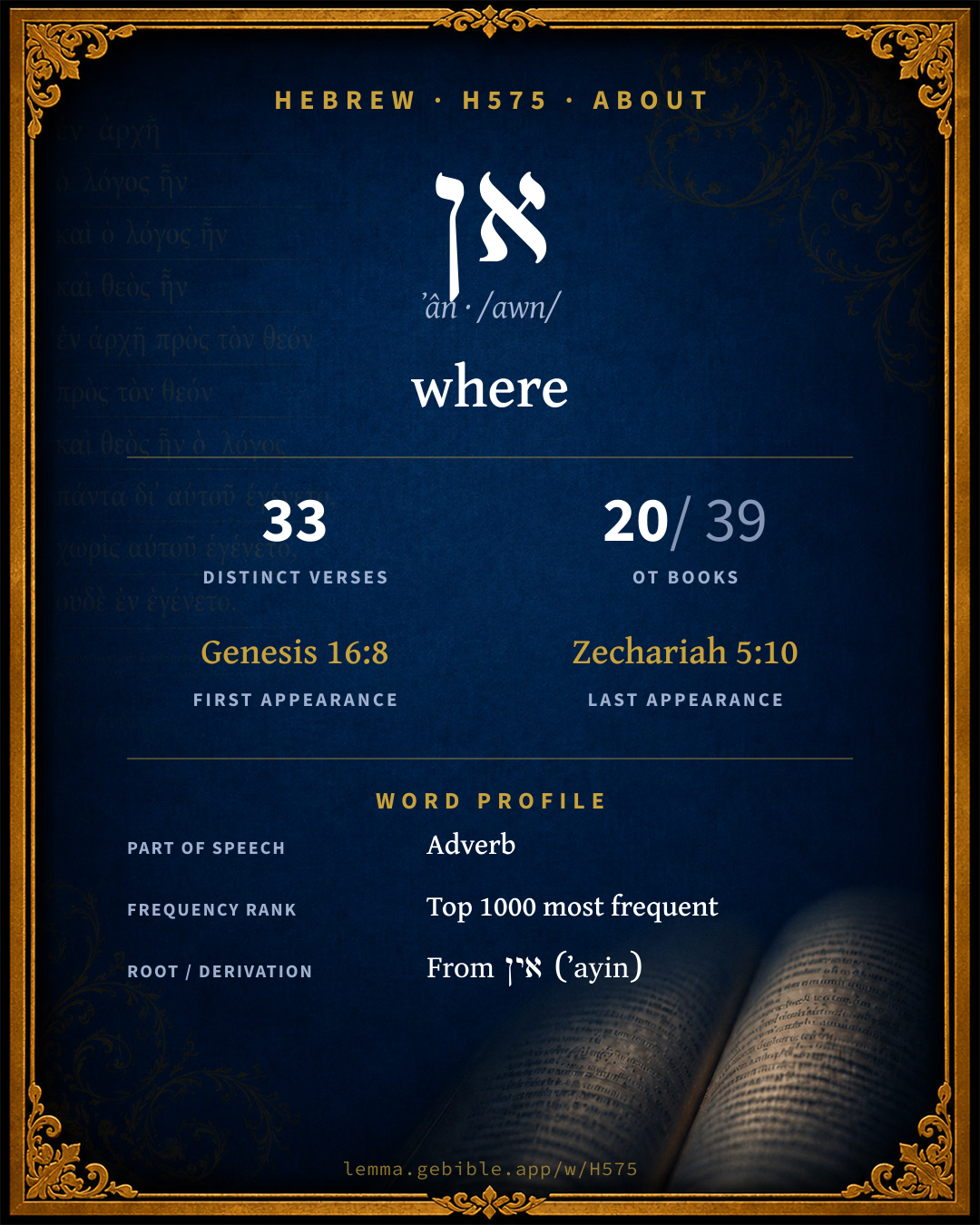
אָן
where
‘where’ is one of 2 main senses fuller range ↓
Full lexicon entry — Brown-Driver-Briggs (BDB)
From Brown-Driver-Briggs (BDB)
Where this word appears
Grammar key — what these labels mean
Part of speech
- Adverb
- A word that modifies a verb, adjective, or other adverb.
- Particle
- A short function word — article, negation, interrogative, the sign of the direct object, and the like.
Grammatical forms
- Adverb 32 times (74%)
- Particle, Interrogative 10 times (23%)
- Particle, Negative 1 time (2%)
Parsed forms decoded from the imported morphology (morphhb / Westminster Leningrad Codex — WLC text public domain, morphhb tagging CC BY 4.0), counted across 43 parsed occurrences — not distinct verses.
Every verse where H575 appears — 33 distinct verses across 20 books. Click any verse to open its interlinear word-by-word view. Verse text shown in the World English Bible for context — . Each verse’s Hebrew form is shown with its reference; the English is not keyword-highlighted, since the data carries no word-level English alignment. Use “Compare translations” on any verse to read it across multiple English versions. This concordance covers the Hebrew Bible; Septuagint (Greek Old Testament) occurrences are not indexed here.
Genesis 3 verses
- Genesis 16:8 וְ/אָ֣נָה conj + ptcl inter He said, "Hagar, Sarai's handmaid, where did you come from? Where are you going?" She said, "I am fleeing from the face of my mistress Sarai."
- Genesis 32:17 וְ/אָ֣נָה conj + ptcl inter He commanded the foremost, saying, "When Esau, my brother, meets you, and asks you, saying, 'Whose are you? Where are you going? Whose are these before you?'
- Genesis 37:30 אָ֥נָה adv He returned to his brothers, and said, "The child is no more; and I, where will I go?"
Exodus 1 verse
Numbers 1 verse
Deuteronomy 1 verse
Joshua 2 verses
- Joshua 2:5 אָ֥נָה adv and it happened about the time of the shutting of the gate, when it was dark, that the men went out; where the men went I don't know: pursue after them quickly; for you will overtake them.
- Joshua 18:3 אָ֨נָה֙ adv Joshua said to the children of Israel, How long are you slack to go in to possess the land, which Yahweh, the God of your fathers, has given you?
Judges 1 verse
Ruth 1 verse
1 Samuel 1 verse
2 Samuel 2 verses
- 2 Samuel 2:1 אָ֥נָה adv It happened after this, that David inquired of Yahweh, saying, Shall I go up into any of the cities of Judah? Yahweh said to him, Go up. David said, Where shall I go up? He said, To Hebron.
- 2 Samuel 13:13 אָ֤נָה adv I, where shall I carry my shame? and as for you, you will be as one of the fools in Israel. Now therefore, please speak to the king; for he will not withhold me from you.
1 Kings 2 verses
- 1 Kings 2:36 אָ֥נֶה וָ/אָֽנָה adv conj + ptcl inter The king sent and called for Shimei, and said to him, Build yourself a house in Jerusalem, and dwell there, and don't go forth from there any where.
- 1 Kings 2:42 אָ֣נֶה וָ/אָ֔נָה adv conj + ptcl inter The king sent and called for Shimei, and said to him, Didn't I adjure you by Yahweh, and protest to you, saying, Know for certain, that on the day you go out, and walk abroad any where, you shall surely die? and you said to me, The saying that I have heard is good.
2 Kings 2 verses
- 2 Kings 5:25 מ/אן מֵ/אַ֖יִן אָ֥נֶה וָ/אָֽנָה prep + ptcl inter prep + ptcl neg adv conj + ptcl inter But he went in, and stood before his master. Elisha said to him, Whence come you, Gehazi? He said, Your servant went no where.
- 2 Kings 6:6 אָ֣נָה adv The man of God said, Where fell it? He shown him the place. He cut down a stick, and cast it in there, and made the iron to swim.
Nehemiah 1 verse
Job 3 verses
Psalms 4 verses
- Psalms 13:1 אָ֣נָה אָ֓נָה adv adv How long, Yahweh? Will you forget me forever? How long will you hide your face from me?
- Psalms 13:2 אָ֨נָה אָ֓נָה adv adv How long shall I take counsel in my soul, Having sorrow in my heart every day? How long shall my enemy triumph over me?
- Psalms 62:3 אָ֤נָה adv How long will you assault a man, Would all of you throw him down, Like a leaning wall, like a tottering fence?
- Psalms 139:7 אָ֭נָ֥ה וְ֝/אָ֗נָה adv conj + ptcl inter Where could I go from your Spirit? Or where could I flee from your presence?
Song of Solomon 1 verse
Isaiah 1 verse
Jeremiah 2 verses
- Jeremiah 15:2 אָ֣נָה adv It shall happen, when they tell you, Where shall we go forth? then you shall tell them, Thus says Yahweh: Such as are for death, to death; and such as are for the sword, to the sword; and such as are for the famine, to the famine; and such as are for captivity, to captivity.
- Jeremiah 47:6 אָ֖נָה adv You sword of Yahweh, how long will it be before you be quiet? put up yourself into your scabbard; rest, and be still.
Ezekiel 1 verse
Habakkuk 1 verse
Zechariah 2 verses
About this entry
At a glance — auto-summarized from this page’s data, not written by a person. Every figure links to its source below. This summary describes the numbers; it doesn’t interpret them.
At its core, אן (ʼân) means “where.” First canonically at Genesis 16:8, it enters the text early. With 33 verses in 20 books, it is a moderately common word in the Hebrew Bible. Catalogued under 2 senses, its meaning is not single-sense. From the same root come אין and אי. Each statement above links to its evidence; the full detail follows below.
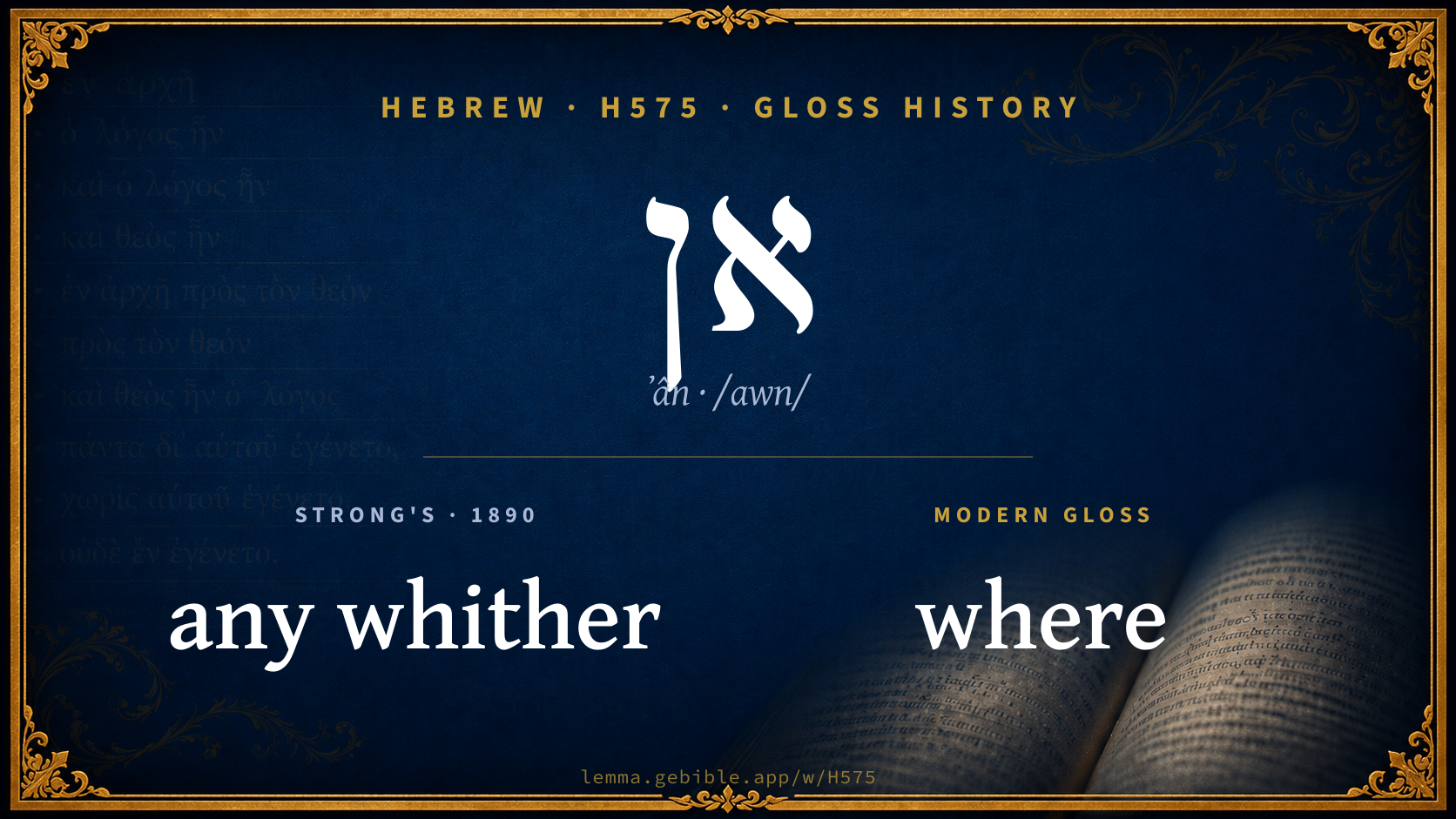
Gloss history
Strong's 1890 vs modern scholarship
About this word
Strong's H575 catalogs a Hebrew word from the Hebrew Old Testament.
These counts are not copied from any lexicon or concordance. They are computed here, from the morphology-tagged Hebrew Old Testament. What Lemma adds →
- 33
- distinct verses
- The word appears in 33 distinct verses.
- 20 / 39
- OT books
- The word appears in 20 of 39 Old Testament books.
- #837
- by frequency
- Top 1000 most frequent Hebrew words (rank 837 of 8,640 Hebrew words by occurrence).
View all 33 occurrences in the concordance →
By section of the Old Testament
By traditional corpus
Conventional, traditional groupings — biblical authorship is debated, so this is a traditional corpus grouping, not an authorship claim. Each share is this word’s portion of its verses in that division of the Hebrew canon. Each figure is a share of the word’s 33 distinct verses.
- Prophets (Nevi'im) 17 verses · 52%
- Writings (Ketuvim) 10 verses · 30%
- Torah (Pentateuch) 6 verses · 18%
How translations render this word
Counts come from each version’s own published word-to-Strong’s tagging or interlinear alignment — an approximate guide to how each version renders this word, not a word-level alignment the data otherwise carries. Because each total is that version’s own tagged count, the per-version totals vary from one another and need not match the appearance or distinct-verse counts above. These counts may also differ from a printed concordance because Lemma counts each distinctly tagged rendering and does not collapse phrase taggings into a single head-word total. This is a fixed set of word-tagged versions (KJV, ASV, BSB, ULT) and does not change with the reading translation you choose elsewhere. Each version’s license is shown beside its name below (and on Sources).
BDB lists this Strong’s number as 2 distinct words (homographs). Each count above pools all of them and is not split by sense — see the Senses section below. A low-frequency rendering may belong to a different one of those words, not the primary meaning.
- King James Version†: Whither 2×
- American Standard Version†: Whither 2×
- Berean Standard Bible†: Where 18×, Way 2×
- unfoldingWord Literal Text†: Where 23×, When 8×, Long 4×
King James Version Public Domain
Renders H575 across 8† tagged occurrences — most commonly:
Plus 6 renderings that appear only once — usually multi-word phrases or single function words the recovered tagging swept in, not distinct renderings.
American Standard Version Public Domain
Renders H575 across 8† tagged occurrences — most commonly:
Plus 6 renderings that appear only once — usually multi-word phrases or single function words the recovered tagging swept in, not distinct renderings.
Berean Standard Bible Public Domain
Renders H575 across 26† tagged occurrences — most commonly:
Plus 6 renderings that appear only once — usually multi-word phrases or single function words the recovered tagging swept in, not distinct renderings. Not rendered by a distinct English word in 16 further occurrences.
unfoldingWord Literal Text CC BY-SA 4.0
Renders H575 across 43† tagged occurrences — most commonly:
Plus 6 renderings that appear only once — usually multi-word phrases or single function words the recovered tagging swept in, not distinct renderings.
Senses in BDB
The 2 senses BDB distinguishes for this word, in lexicon order (not ranked by frequency or importance). The full entry — with sub-senses — is in the Lexicon Entry tab.
- where?, whither? (of place)
- when?, until when?, how long? (of time)
Word origin
adv. (contracted from I. אַיִן) where? or whither? 1 S 10:14 (cf. 27:10 𝔖 𝔗, v. sub אַל ad fin.); only besides in †מֵאָן whence? 2 K 5:25 Kt (Qr מֵאַיִן); †עַד־אָן of time to what point? how long? Jb 8:2. With ה locale: אָ֫נָה (a) whither? Gn 16:8; 32:18 2 S 2:1; 13:13 2 K 6:6 ψ 139:7(×2) + 9 textual; in indirect sentence Jos 2:5 Ne 2:16; (b) pregnantly †Ru 2:19 Is 10:3; (c) in the phrase אָ֫נֶה וָאָ֫נָה any whither †1 K 2:36, 42 2 K 5:25; (d) of time, עַד־אָ֫נָה how long? †Ex 16:28 Nu 14:11(×2) (c. לֹא) Jos 18:3 Je 47:6 (sq. לֹא) Hb 1:2 ψ 13:2(×2), 3(×2); 62:4 Jb 18:2; 19:2 (less common than the syn. עַד מָתַי).
— Brown-Driver-Briggs (Oxford 1906, public domain), digitized via Sefaria, supplemented by the OpenScriptures HebrewLexicon (CC BY 4.0). See Sources.
Derived from אין (ʼayin) (H370) — where.
Jastrow Dictionary
A second Hebrew/Aramaic lexicon for comparison, covering Aramaic and post-biblical (Talmudic, Targumic, Midrashic) usage that the biblical-Hebrew BDB does not. Matched by lemma rather than by Strong’s number, so a lemma may carry more than one Jastrow headword (shown separately below), and the entries cover usage well beyond the Bible.
אִין II
- 1. if, whether. Targ. Ps. VII, 4; a. e. [Apocopated: אִי q. v.]—אין תימר (h. אם תאמר) if thou wilt say (argue). Y. Macc. II, 31ᵈ bot.; a. fr.—אין כיני (h. אם כן היא) if this is (be) the case. Y. Naz. VI, 54ᵈ bot.—Lam. R. introd. end אן את יתיב וכ׳ if thou remainest here, or &c. Koh. R. to X, 5 אן אתת ענתה וכ׳ if the (my dying) time comes first, what of it? and if &c.
- 2. adv. of interrogation, introducing the alternative, or. Targ. Job VI, 6; a. e.
אֶן
- if, v. אִין.
אָן
- (b. h.) where? לְאָן whither. Ab. III, 1.
אָן ²
- ; (interrog.) where? Targ. Gen. IV, 9; a. e.—Y. Yoma VIII, 44ᵈ bot. אן מן הדה (read … מן אן) wherefrom this? i.e. where is your authority? Y. Yeb. XII, 12ᵈ bot. ההן סבא לְאָן ליך of what use is this old man to thee?; a. e.—(relat.) where, wherever. Lev. R. s. 27 beg. א׳ את יהיב וכ׳ (Yalk. Ps. 727 הן) wherever thou givest, thou givest abundantly.
A Dictionary of the Targumim, the Talmud Babli and Yerushalmi, and the Midrashic Literature (Marcus Jastrow; London, Luzac, 1903) — Public Domain. Digitized via Sefaria. Digitized via Sefaria. Full attribution on Sources.
Forms in the corpus
The 24 distinct written forms H575 takes in the Hebrew Bible, most frequent first — each parse links to that state’s occurrences in the concordance. Hebrew forms include their vowel points and cantillation, so a single lemma takes many written forms.
| Form | Parsing | Example | Uses |
|---|---|---|---|
| אָ֥נָה | Adverb | Genesis 37:30 | 5 |
| אָ֣נָה | Adverb | 2 Kings 6:6 | 4 |
| וְ/אָ֣נָה | Particle, Interrogative | Genesis 16:8 | 3 |
| אָ֖נָה | Adverb | Ezekiel 21:16 | 3 |
| אָ֤נָה | Adverb | 2 Samuel 13:13 | 3 |
| אָ֨נָה֙ | Adverb | Exodus 16:28 | 3 |
| אָ֓נָה | Adverb | Psalms 13:1 | 2 |
| אָ֚נָה | Adverb | Song of Solomon 6:1 | 2 |
| אָ֥נֶה | Adverb | 1 Kings 2:36 | 2 |
| וָ/אָֽנָה | Particle, Interrogative | 1 Kings 2:36 | 2 |
| אָ֛נָה | Adverb | Zechariah 5:10 | 1 |
| אָ֣ן | Particle, Interrogative | 1 Samuel 10:14 | 1 |
| אָ֣נֶה | Adverb | 1 Kings 2:42 | 1 |
| אָ֥ן | Particle, Interrogative | Job 8:2 | 1 |
| אָ֧נָה | Adverb | Habakkuk 1:2 | 1 |
| אָ֨נָה | Adverb | Psalms 13:2 | 1 |
| אָ֭נָ֥ה | Adverb | Psalms 139:7 | 1 |
| אָ֭נָה | Adverb | Job 19:2 | 1 |
| אָנָ֣ה | Adverb | Deuteronomy 1:28 | 1 |
| וְ/אָ֥נָה | Particle, Interrogative | Isaiah 10:3 | 1 |
| וְ֝/אָ֗נָה | Particle, Interrogative | Psalms 139:7 | 1 |
| וָ/אָ֔נָה | Particle, Interrogative | 1 Kings 2:42 | 1 |
| מ/אן | Particle, Interrogative | 2 Kings 5:25 | 1 |
| מֵ/אַ֖יִן | Particle, Negative | 2 Kings 5:25 | 1 |
Same root — word family
Other BDB entries built from the same root as H575, grouped by Strong’s listed origin. These share a root / origin per the lexicon — not necessarily a shared meaning. Each links to that word’s own entry.
Derives from
Shares the same root
Compare all same-root words → They share a root, not necessarily a meaning.
Septuagint verse parallels
This word appears in 32 verses that also exist in the Greek Old Testament (Septuagint), out of the 33 Hebrew verses it occurs in. You can read those verses in Greek by switching the Old Testament edition to the Septuagint.
Read these verses in the Septuagint
- Genesis 16:8
- Exodus 16:28
- Numbers 14:11
- Deuteronomy 1:28
- Joshua 2:5
- Judges 19:17
- Ruth 2:19
- 1 Samuel 10:14
- 2 Samuel 2:1
- 1 Kings 2:36
- 2 Kings 5:25
- Job 8:2
This is a verse-level parallel only — the same verses exist in both the Hebrew and Greek Old Testaments. No word-level Hebrew↔Greek correspondence is claimed: the data carries no such alignment, so no Greek word is shown as this Hebrew word’s translation. Coverage is not total — the Septuagint omits the deuterocanon and renumbers the Psalms, so some Hebrew verses have no direct Greek parallel.