Jeremiah 33:7

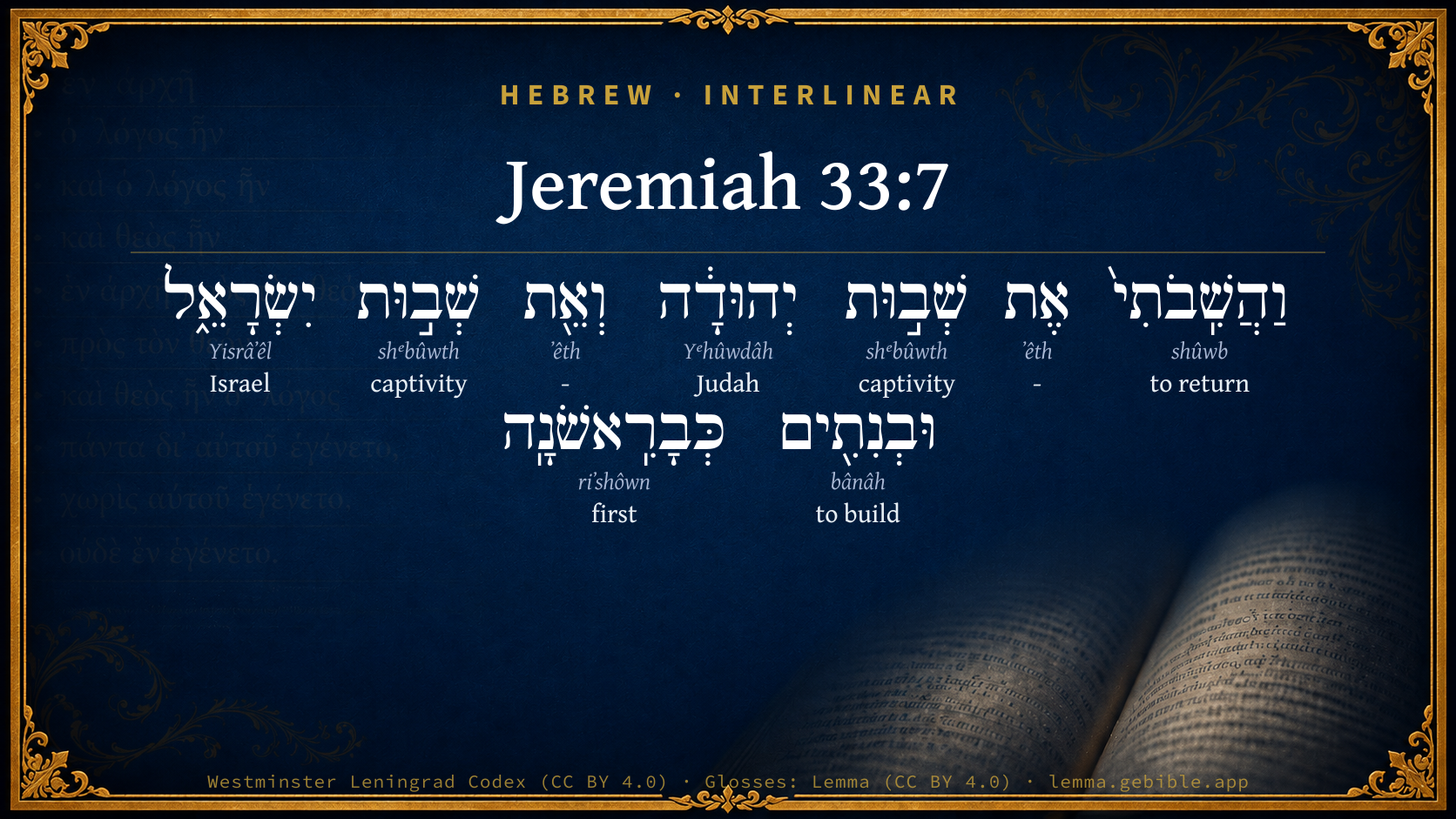
Hebrew (Westminster Leningrad Codex) Jeremiah 33:7 appears in the Hebrew Old Testament. The text above is from the Westminster Leningrad Codex. Each word links to its Strong’s number, a concise gloss, and parsing drawn from the Open Scriptures Hebrew Bible morphology. Click any word for its full Brown-Driver-Briggs (BDB) entry.
Download image
Cite this verse

Jeremiah 33:7 (World English Bible). Public Domain. Lemma interlinear Bible study tool, https://lemma.gebible.app/v/jeremiah/33/7.

Show BibTeX & RIS
BibTeX
RIS
English Translation
I will cause the captivity of Judah and the captivity of Israel to return, and will build them, as at the first.
World English Bible · Public Domain
Download a study sheet

One document with this verse’s original text, its word-by-word gloss line, the meaning frame, cross-references with their text, attributed commentary, and full source and license credits — printable, and it pastes into notes with its structure intact.

This verse Autodidact and up

Study sheet (.html) Plain text (.txt)

A passage Seminary Student

Up to 50 verses in one chapter. A passage sheet keeps up to 6 commentary sources and 12 cross-references per verse, in the order this page ranks them, and says so on the sheet whenever that leaves anything out. Ask for a single verse and you get the Autodidact verse sheet above.

Everything on this page stays free to read, with no account — the sheet is a download of what is already on screen, not access to it.

Want to remove ads? Support Godless Engineer
Compare translations 3

The same verse in 3 English versions, stacked beneath the original-language interlinear above. Click any original word for its lexicon entry.

Each is an independent rendering of the whole verse — the interlinear is not word-aligned to these translations.

Highlighted words mark where these versions differ — a whole-verse word diff, not a word-by-word alignment.

  • World English Bible Public Domain
    I will cause the captivity of Judah and the captivity of Israel to return, and will build them, as at the first.
  • King James Version Public Domain
    And I will cause the captivity of Judah and the captivity of Israel to return, and will build them, as at the first.
  • unfoldingWord Literal Text CC BY-SA 4.0
    For I will bring back the fortunes of Judah and Israel; I will build them up as in the beginning.

unfoldingWord Literal Text — © unfoldingWord, licensed CC BY-SA 4.0. Word-aligned USFM3 via Door43 (git.door43.org/unfoldingWord/en_ult).

Versions to compare (up to 4)

3 of 4 selected

Show all 18 translations

Every available English version of this verse, each an independent rendering of the whole verse.

  • World English Bible Public Domain
    I will cause the captivity of Judah and the captivity of Israel to return, and will build them, as at the first.
  • Berean Standard Bible Public Domain
    I will restore Judah and Israel from captivity and will rebuild them as in former times.
  • Majority Standard Bible Public Domain
    I will restore Judah and Israel from captivity and will rebuild them as in former times.
  • King James Version Public Domain
    And I will cause the captivity of Judah and the captivity of Israel to return, and will build them, as at the first.
  • American Standard Version (1901) Public Domain
    And I will cause the captivity of Judah and the captivity of Israel to return, and will build them, as at the first.
  • Revised Version (1885) Public Domain
    And I will cause the captivity of Judah and the captivity of Israel to return, and will build them, as at the first.
  • Geneva Bible (1599) Public Domain
    And I wil cause the captiuitie of Iudah and the captiuitie of Israel to returne, and will build them as at the first.
  • Douay-Rheims (1899) Public Domain
    And I will bring back the captivity of Juda, and the captivity of Jerusalem: and I will build them as from the beginning.
  • Young's Literal Translation Public Domain
    And I have turned back the captivity of Judah, And the captivity of Israel, And I have built them as at the first,
  • Literal Standard Version CC BY-SA 4.0
    And I have turned back the captivity of Judah, || And the captivity of Israel, || And I have built them as at the first,
  • Unlocked Literal Bible CC BY-SA 4.0
    For I will bring back the fortunes of Judah and Israel; I will build them up as in the beginning.
  • unfoldingWord Literal Text CC BY-SA 4.0
    For I will bring back the fortunes of Judah and Israel; I will build them up as in the beginning.
  • Darby Bible Public Domain
    And I will turn the captivity of Judah and the captivity of Israel, and will build them, as at the beginning.
  • World Messianic Bible Public Domain
    I will restore the fortunes of Judah and Israel, and will build them as at the first.
  • Webster's Bible Public Domain
    And I will cause the captivity of Judah and the captivity of Israel to return, and will build them, as at the first.
  • Free Bible Version CC BY-SA 4.0
    I will bring Judah and Israel back from exile and will make them as strong as before.
  • Bible in Basic English Public Domain
    And I will let the fate of Judah and of Israel be changed, building them up as at first.
  • JPS Tanakh (1917) Public Domain
    And I will cause the captivity of Judah and the captivity of Israel to return, and will build them, as at the first.

Literal Standard Version (2020), Covenant Press — licensed CC BY-SA 4.0. Text via the HelloAO Bible API (eBible.org). Unlocked Literal Bible (unfoldingWord) — licensed CC BY-SA 4.0. Text via the HelloAO Bible API (eBible.org). unfoldingWord Literal Text — © unfoldingWord, licensed CC BY-SA 4.0. Word-aligned USFM3 via Door43 (git.door43.org/unfoldingWord/en_ult). Free Bible Version, Dr. Jonathan Gallagher — licensed CC BY-SA 4.0. Text via the HelloAO Bible API (eBible.org).

Word by word

More ways to search: Search by grammar → Find every occurrence → Compare this word →

Practice this passage: Drill this verse → Learn its vocabulary →

About this verse

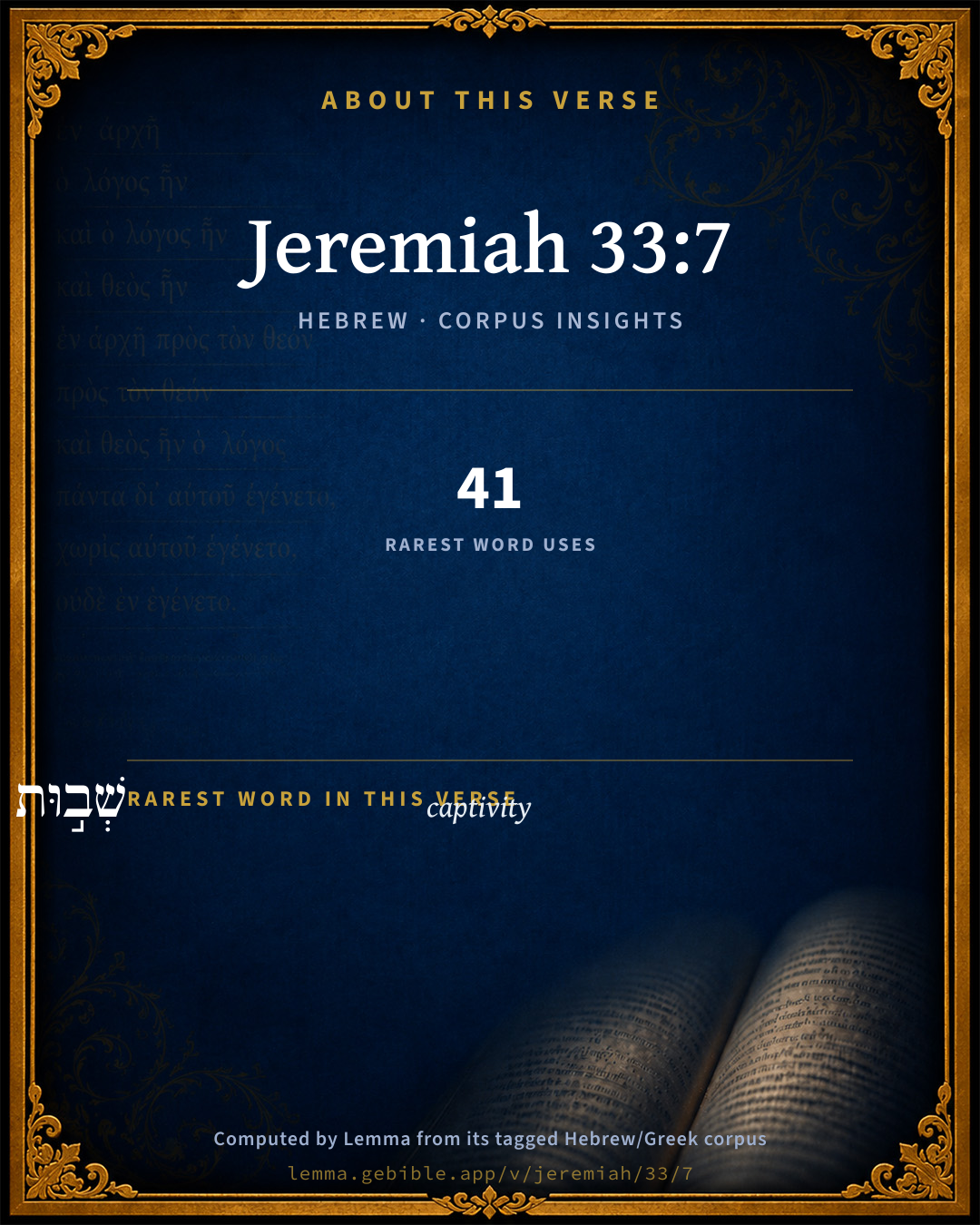
These counts appear in no published source. They are computed here, from the morphology-tagged text and Lemma’s own curated glosses. What Lemma adds →

9
words
7
distinct lemmas
Prophets
section

Shared distinctive vocabulary

שְׁב֣וּת captivity H7622 occurs in 26 verses of the Hebrew Bible. Also found in:

Grammatical profile

  • 2 verbs
  • 4 nouns
  • 1 adjective
  • 2 particles

Verb forms

  • וַהֲשִֽׁבֹתִי֙ Hiphil · Sequential Perfect
  • וּבְנִתִ֖ים Qal · Sequential Perfect

Repetition

A word recurs within this verse — often emphatic in Hebrew:

  • שְׁב֣וּת captivity H7622 ×2

Cross-references

23

Topical passages linked to Jeremiah 33:7 in the Treasury of Scripture Knowledge — connected by theme and wording, ordered by reader-vote popularity; previews shown in the World English Bible.

  • Isaiah 1:26 I will restore your judges as at the first, And your counselors as at the beginning. Afterward you shall be called 'The city of righteousness, A faithful town.'
  • Jeremiah 30:3 For, behold, the days come, says Yahweh, that I will turn again the captivity of my people Israel and Judah, says Yahweh; and I will cause them to return to the land that I gave to their fathers, and they shall possess it.
  • Amos 9:14–15 I will bring back the captivity of my people Israel, And they will rebuild the ruined cities, and inhabit them; and they will plant vineyards, and drink wine from them. They shall also make gardens, And eat the fruit of them.
  • Jeremiah 29:14 I will be found by you, says Yahweh, and I will turn again your captivity, and I will gather you from all the nations, and from all the places where I have driven you, says Yahweh; and I will bring you again to the place from where I caused you to be carried away captive.
  • Jeremiah 31:4 Again will I build you, and you shall be built, O virgin of Israel: again shall you be adorned with your tambourines, and shall go forth in the dances of those who make merry.
  • Jeremiah 32:44 Men shall buy fields for money, and subscribe the deeds, and seal them, and call witnesses, in the land of Benjamin, and in the places about Jerusalem, and in the cities of Judah, and in the cities of the hill-country, and in the cities of the lowland, and in the cities of the South: for I will cause their captivity to return, says Yahweh.
  • Psalms 85:1 Yahweh, you have been favorable to your land. You have restored the fortunes of Jacob.
  • Psalms 126:4 Restore our fortunes again, Yahweh, Like the streams in the Negev.
  • Jeremiah 23:3 I will gather the remnant of my flock out of all the countries where I have driven them, and will bring them again to their folds; and they shall be fruitful and multiply.
  • Jeremiah 24:6 For I will set my eyes on them for good, and I will bring them again to this land: and I will build them, and not pull them down; and I will plant them, and not pluck them up.
  • Jeremiah 30:18 Thus says Yahweh: Behold, I will turn again the captivity of Jacob's tents, and have compassion on his dwelling-places; and the city shall be built on its own hill, and the palace shall be inhabited after its own manner.
  • Jeremiah 30:20 Their children also shall be as before, and their congregation shall be established before me; and I will punish all who oppress them.
  • Jeremiah 31:28 It shall happen that, like as I have watched over them to pluck up and to break down and to overthrow and to destroy and to afflict, so will I watch over them to build and to plant, says Yahweh.
  • Jeremiah 33:26 then will I also cast away the seed of Jacob, and of David my servant, so that I will not take of his seed to be rulers over the seed of Abraham, Isaac, and Jacob: for I will cause their captivity to return, and will have mercy on them.
  • Jeremiah 42:10 If you will still abide in this land, then will I build you, and not pull you down, and I will plant you, and not pluck you up; for I repent me of the evil that I have done to you.
  • Psalms 14:7 Oh that the salvation of Israel would come out of Zion! When Yahweh restores the fortunes of his people, Then Jacob shall rejoice, and Israel shall be glad.
  • Psalms 126:1 When Yahweh brought back those who returned to Zion, We were like those who dream.
  • Jeremiah 33:11 the voice of joy and the voice of gladness, the voice of the bridegroom and the voice of the bride, the voice of those who say, Give thanks to Yahweh of Hosts, for Yahweh is good, for his loving kindness endures forever; [and of them] who bring [sacrifices of] thanksgiving into the house of Yahweh. For I will cause the captivity of the land to return as at the first, says Yahweh.
  • Hosea 2:15 I will give her vineyards from there, And the valley of Achor for a door of hope; And she will respond there, As in the days of her youth, And as in the day when she came up out of the land of Egypt.
  • Micah 7:14–15 Shepherd your people with your staff, The flock of your heritage, Who dwell by themselves in a forest, In the midst of fertile pasture land, let them feed; In Bashan and Gilead, as in the days of old.
  • Zephaniah 3:20 At that time will I bring you in, and at that time will I gather you; for I will give you honor and praise among all the peoples of the earth, when I bring back your captivity before your eyes, says Yahweh.
  • Zechariah 1:17 "Proclaim further, saying, 'Thus says Yahweh of Hosts: "My cities will again overflow with prosperity, and Yahweh will again comfort Zion, and will again choose Jerusalem."'"
  • Isaiah 11:12–16 He will set up an ensign for the nations, and will assemble the outcasts of Israel, and gather together the dispersed of Judah from the four corners of the earth.

Cross-references courtesy of OpenBible.info (CC BY 4.0).

Hebrew and Greek witnesses Masoretic Hebrew ↔ Greek Septuagint

The same verse in the two great witnesses to the Old Testament, shown verse-for-verse.

These are two independent witnesses, not word-aligned to each other, and the Septuagint is shown in lemma (dictionary) form.

Hebrew Jeremiah 33:7 Masoretic · Westminster Leningrad Codex

וַהֲשִֽׁבֹתִי֙ אֶת שְׁב֣וּת יְהוּדָ֔ה וְאֵ֖ת שְׁב֣וּת יִשְׂרָאֵ֑ל וּבְנִתִ֖ים כְּבָרִֽאשֹׁנָֽה

I will cause the captivity of Judah and the captivity of Israel to return, and will build them, as at the first.

World English Bible · Public Domain

Greek LXX Structure differs

In the Septuagint, Jeremiah is about an eighth shorter than the Hebrew and arranges its material differently — the Oracles Against the Nations (Hebrew chapters 46–51) appear in the middle of the Greek book, after 25:13. Because the chapter and verse boundaries do not line up, a verse-for-verse comparison with the Hebrew is not shown.

A verse-for-verse comparison isn’t shown here because the chapters and verses don’t line up. Switch to the LXX edition with the MT / LXX toggle above to read the Greek directly.

Hebrew: Westminster Leningrad Codex (CC BY 4.0). Greek: Septuagint (public domain); English from a public-domain English Septuagint. How the Septuagint differs from the Hebrew →

Targum (Aramaic paraphrase)

1

The Targum is the ancient Jewish Aramaic paraphrase of the Hebrew Scriptures — an interpretive translation, not the Hebrew text itself. Onkelos (literal) and Pseudo-Jonathan (expansive) render the Torah, and Jonathan the Prophets. Coverage is partial: where no permissively-licensed English translation exists for a verse, only the Aramaic is shown. This is verse-level text, not a word-by-word alignment to the Hebrew.

  1. Targum Jonathan Prophets (Joshua–Malachi)
    וַאֲתֵיב יַת גָלוּת יְהוּדָה וְיַת גָלוּת יִשְׂרָאֵל וַאֲקַיְמִינוּן כִּדְבְקַדְמֵיתָא:

    (no public-domain English translation for this verse)

    Targum Jonathan — Aramaic: “Mikraot Gedolot” (public domain). English: “Sefaria Community Translation” (CC0 1.0 (public-domain dedication)); “London "Chaldee Paraphrase," 1871” (public domain). Text via Sefaria.

Commentary

Notes on Jeremiah 33:7 from classic Christian and Jewish commentators (each source and its license shown beneath its notes). The classic Christian expositions comment on the surrounding passage and are grouped to its opening verse, so a note may address several verses; the Jewish commentaries on the Tanakh (Rashi and others) are per-verse, so they appear only where the commentator wrote on this verse.

Lemma curates 59 commentaries, every one of them public domain or Creative Commons licensed, each selected and text-cleaned for this edition rather than reprinted as found. About our sources →

Trapp's Complete Commentary

John Trapp

Jer 33:7 And I will cause the captivity of Judah and the captivity of Israel to return, and will build them, as at the first.

Ver. 7. And I will cause the captivity of Judah.] As Jer 24:5; Jer 30:3; Jer 32:44. They shall be as if I had not cast them off, and I will hear them. {Zec 10:6}

John Trapp, A Commentary or Exposition upon All the Books of the Old and New Testament (1647–1656) — public domain. Text from a community e-Sword module.

Jamieson, Fausset & Brown

Robert Jamieson, A. R. Fausset & David Brown

cause . . . to return--that is, reverse (Jer 33:11; Jer 32:44). The specification, both of "Judah" and "Israel," can only apply fully to the future restoration.

as at the first-- (Isa 1:26).

Jamieson, Fausset & Brown — Commentary Critical and Explanatory on the Whole Bible (1871) — public domain (CC PDM 1.0). Text via the HelloAO Bible API.

Adam Clarke's Commentary

Verse 7. The captivity of Judah and the captivity of Israel] This must respect the latter times, for the ten tribes did not return with the Jews at the termination of the seventy years.

Adam Clarke's Commentary on the Bible (1810–1826) — public domain. Text from a community e-Sword/MySword module.

John Calvin's Commentaries

By the word building, God means that they would return to their own country for this end — that they might remain secure in it. And this promise was very needful, since the Jews were on every side surrounded by enemies; for all their neighbors had united together against them, and were most hostile, so that they never ceased to create new troubles. For this reason mention is made of building, as though the Prophet had said, that the prosperity of the city would be lasting, for it would be so founded, that it would not fall or totter at any kind of assault.

But he promises deliverance, not only to the tribe of Judah, but also to the whole kingdom of Israel. Though very few returned, yet God offered the benefit which he had promised to all in common: and then, as it has been often said, this promise is to be extended to the coming of Christ. For God confined not his favor to those few years in which liberty was granted to the Jews, when they returned from their exile in Babylon; but included the eternal salvation which remained for them, of whiclx the prelude was their return. Let us now proceed, —

John Calvin's Commentaries (1540-1563) — public domain. Text from the Calvin Translation Society English edition (1840s-50s) via the Christian Classics Ethereal Library (ccel.org). Calvin's coverage is partial (roughly two-thirds of the Bible); uncommented books and verses are honest gaps, never fabricated. The 19th-century editor's footnotes and remarks are omitted so the notes are faithfully Calvin's own voice.

Ellicott's Commentary for English Readers

(7, 8) I . . . will build . . . I will cleanse . . . I will pardon . . .—The vision of the return of the exiles and of a restored city, prominent in Jer_31:38-40, is not allowed to overshadow the yet more glorious vision of spiritual blessings of purity and pardon.

A Bible Commentary for English Readers, edited by Charles John Ellicott (1878–1897) — public domain. Text from a community e-Sword module.

The Cambridge Bible for Schools and Colleges

gen. ed. J. J. S. Perowne

7. as at the first] as in former times (those of the undivided kingdom).

The Cambridge Bible for Schools and Colleges (gen. ed. J. J. S. Perowne; Cambridge University Press, 1878–1918) — public domain. Text from a community e-Sword module.

John Gill's Exposition

And I will cause the captivity of Judah and the captivity of Israel to return,.... Mention being made of the return of the captivity of Israel, or the ten tribes, as well as that of Judah, shows that this prophecy does not relate to the return of the Jews from their seventy years' captivity in Babylon; but is to be understood spiritually, of a release of the mystical and spiritual Israel of God from the captivity of sin, Satan, and the law, by the Messiah:

and will build them as at the first; in the latter day, as at the beginning or first times of the Gospel; when the temple of the Lord was built by Christ, as the chief master builder, and by his apostles under him, upon himself, the foundation of the apostles and prophets; he being the corner stone of it, whereby it became a habitation for God through the Spirit. Since that time, by means of heretics and false teachers, and especially by the man of sin, the tabernacle of David, or church of Christ, is greatly fallen into ruin, and needs rebuilding and repairing; and this will be done; and then it will be a beautiful structure, as at the first, or as it was in the times of the apostles; see Act 15:16.

John Gill's Exposition of the Whole Bible (1746–1763) — public domain (CC PDM 1.0). Text via the HelloAO Bible API.

Albert Barnes' Notes on the Bible

At the first - i. e., before their sins had provoked God to anger.

Albert Barnes' Notes on the Bible (1834–1885) — public domain. Text from a community e-Sword/MySword module.

Matthew Poole's English Annotations

In this verse the latter part is expounded by the former: the restoring of them is called building them, in opposition to the throwing them down, by the mounts mentioned Jer 33:4; unless by building be to be understood not laying the foundation of their new state, but the further prospering of them in that state.

Matthew Poole's English Annotations on the Holy Bible (1683–1685) — public domain. Text from a community e-Sword/MySword module.

Whedon's Commentary on the Bible

Daniel D. Whedon

7. Cause… to return — I will reverse it, and restore the old freedom and prosperity.

Daniel D. Whedon (gen. ed.), Commentary on the Old and New Testaments (1874–1909) — public domain. Text from a community e-Sword module.

The Pulpit Commentary

I will cause the captivity... to return. (see on Jer_29:14) Will build them. (see on Jer_31:14)

The Pulpit Commentary (1880–1919), ed. H.D.M. Spence-Jones & Joseph S. Exell — public domain. Text from a community e-Sword module.

Keil & Delitzsch

C. F. Keil & F. Delitzsch

The attainment of this prosperity consists in the change of the wretchedness and misery of Judah and Israel (the whole covenant people) into permanent happiness, and their being built up - i.e., the firm establishment of their civil prosperity through the secure possession and enjoyment of the good things of the land - as in the beginning, i.e., the time previous to the rending of the state through the falling away of the people into idolatry; cf. Isa 1:26; Kg1 13:6. For השׁיב את see Jer 32:44.

Keil & Delitzsch — Biblical Commentary on the Old Testament (1861–1891) — public domain (CC PDM 1.0). Text via the HelloAO Bible API. (Old Testament only.)

Lesson kit

Teaching starters — assembled from the data on this page, not authored interpretation. Every prompt links to the verse data it draws on. Edit before teaching.

Jeremiah, in the Prophets, opens this verse with 9 words (7 distinct Hebrew lemmas). Its most distinctive word is shᵉbûwth (“captivity”). A historical commentator’s framing appears above. Read the whole chapter for the surrounding context.

Discussion questions

  1. What does “captivity” (shᵉbûwth) contribute to the verse as a whole?
  2. Deuteronomy 30:3 shares the word «captivity» with this verse. How do the two illuminate each other?
  3. “captivity” occurs 2× in this one verse. What is the effect of the repetition?
  4. These translations render this verse differently. What is at stake in choosing one wording over another?
  5. The verb «וַהֲשִֽׁבֹתִי֙» is Hiphil Sequential Perfect. How does its form color the action?
  6. Reading how Trapp's Complete Commentary and Jamieson, Fausset & Brown read this verse, where do the two commentators agree and where do they part?

Things to notice

  • These translations choose different wording for 9 words in this verse.
  • “captivity” occurs 2× in this single verse.
  • 7 distinct Hebrew lemmas span 9 words in this verse.

Reading settings

Reading text

Shown beneath each verse's original-language words.

Old Testament
Old Testament edition

Read the OT as the Masoretic Hebrew (MT) or the Greek Septuagint (LXX).

English shown for the Greek Septuagint (in the Hebrew ↔ Greek comparison).

Comparing translations? Open the Compare panel on any verse page to stack up to four side by side.