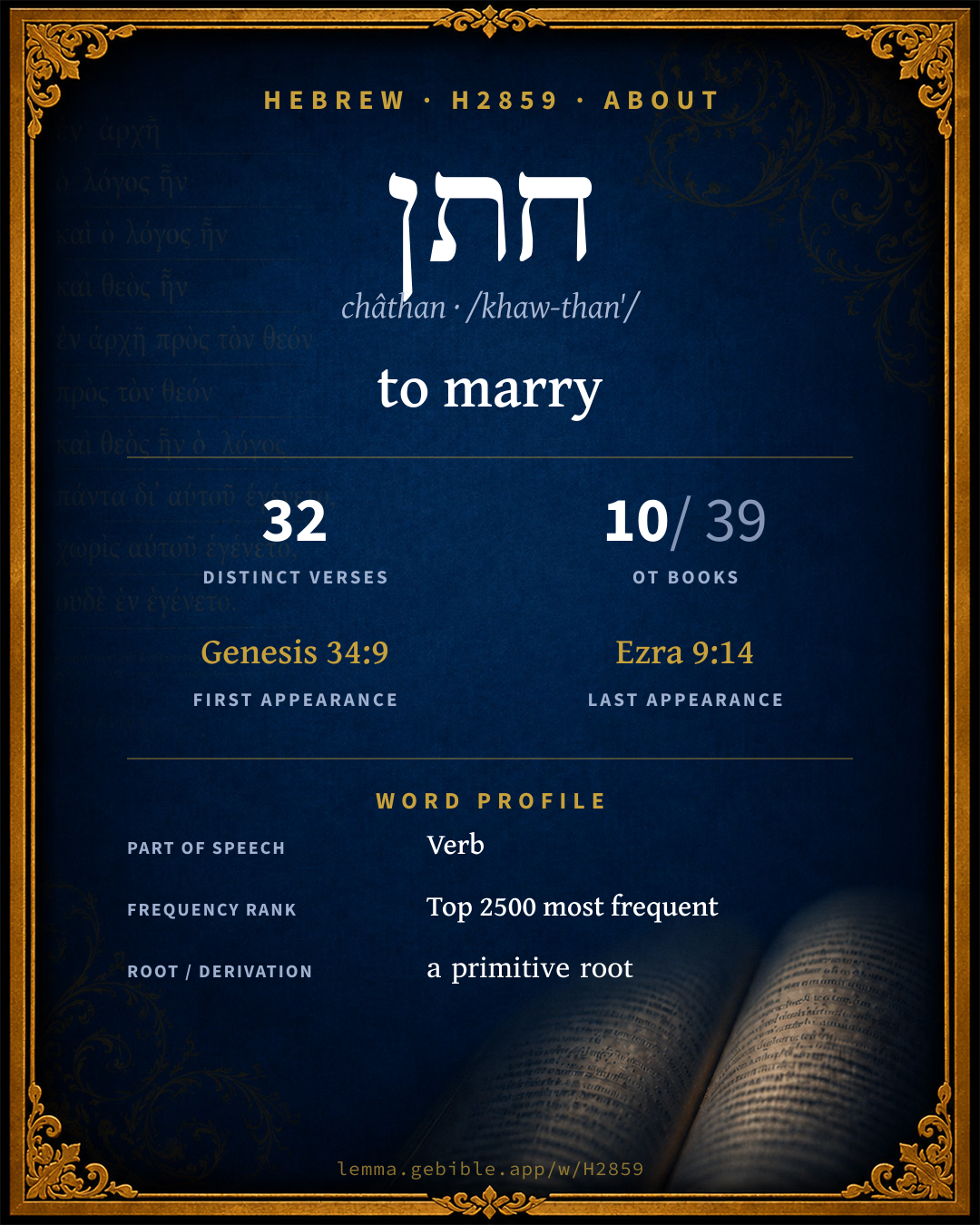
חתן
to marry
‘to marry’ is one of 3 main senses fuller range ↓
Full lexicon entry — Brown-Driver-Briggs (BDB)
From Brown-Driver-Briggs (BDB)
Where this word appears
See every Qal verb in the Hebrew Bible →
Grammar key — what these labels mean
Part of speech
- Verb
- An action or state-of-being word.
Stem
- Qal
- The basic, simple active stem — the plain form of the verb (“he wrote”).
- Hithpael
- The reflexive or reciprocal stem (the subject acts on itself).
Form
- Participle Active
- A verbal adjective expressing ongoing or characteristic action (“writing / one who writes”).
- Sequential Imperfect
- An imperfect with prefixed waw — the standard past-narrative form (waw-consecutive imperfect).
- Infinitive Construct
- A bound verbal noun, frequently with prepositions (“to write / in writing”).
- Sequential Perfect
- A perfect with prefixed waw continuing a preceding imperfect or command (waw-consecutive perfect).
- Imperative
- A direct command (“write!”).
- Imperfect
- An incomplete, ongoing, or future action (“he will / would write”).
- Perfect
- A completed action or state — Hebrew marks aspect (completeness) more than strict tense (“he wrote”).
State
- Construct
- A noun bound to a following noun in a possessive / “of” relationship (the construct chain).
Person
- 3rd Person
- The one spoken about (“he / she / it / they”).
- 2nd Person
- The one addressed (“you”).
Gender
- Masculine
- Grammatically masculine.
- Feminine
- Grammatically feminine.
Number
- Singular
- One.
- Plural
- More than one (in Hebrew, generally three or more).
Grammatical forms 9 distinct
- Verb, Qal, Participle Active, Masculine, Singular, Construct 21 times (64%)
- Verb, Hithpael, Infinitive Construct 4 times (12%)
- Verb, Hithpael, Sequential Imperfect, 3rd Person, Masculine, Singular 2 times (6%)
- Verb, Hithpael, Sequential Perfect, 2nd Person, Masculine, Plural 1 time (3%)
- Verb, Hithpael, Imperative, 2nd Person, Masculine, Plural 1 time (3%)
- Verb, Qal, Participle Active, Feminine, Singular, Construct 1 time (3%)
- Verb, Hithpael, Imperfect, 2nd Person, Masculine, Singular 1 time (3%)
- Verb, Hithpael, Perfect, 2nd Person, Masculine, Singular 1 time (3%)
+1 more form (1 occurrence)
Parsed forms decoded from the imported morphology (morphhb / Westminster Leningrad Codex — WLC text public domain, morphhb tagging CC BY 4.0), counted across 33 parsed occurrences — not distinct verses.
Every verse where H2859 appears — 32 distinct verses across 10 books. Click any verse to open its interlinear word-by-word view. Verse text shown in the World English Bible for context — . Each verse’s Hebrew form is shown with its reference; the English is not keyword-highlighted, since the data carries no word-level English alignment. Use “Compare translations” on any verse to read it across multiple English versions. This concordance covers the Hebrew Bible; Septuagint (Greek Old Testament) occurrences are not indexed here.
Genesis 1 verse
Exodus 14 verses
- Exodus 3:1 חֹתְנ֖/וֹ Qal ptcp.act ms cs + sfx pers 3ms Now Moses was keeping the flock of Jethro, his father-in-law, the priest of Midian, and he led the flock to the back of the wilderness, and came to God's mountain, to Horeb.
- Exodus 4:18 חֹֽתְנ֗/וֹ Qal ptcp.act ms cs + sfx pers 3ms Moses went and returned to Jethro his father-in-law, and said to him, "Please let me go and return to my brothers who are in Egypt, and see whether they are still alive." Jethro said to Moses, "Go in peace."
- Exodus 18:1 חֹתֵ֣ן Qal ptcp.act ms cs Now Jethro, the priest of Midian, Moses' father-in-law, heard of all that God had done for Moses, and for Israel his people, how that Yahweh had brought Israel out of Egypt.
- Exodus 18:2 חֹתֵ֣ן Qal ptcp.act ms cs Jethro, Moses' father-in-law, received Zipporah, Moses' wife, after he had sent her away,
- Exodus 18:5 חֹתֵ֥ן Qal ptcp.act ms cs Jethro, Moses' father-in-law, came with his sons and his wife to Moses into the wilderness where he was encamped, at the Mountain of God.
- Exodus 18:6 חֹתֶנְ/ךָ֥ Qal ptcp.act ms cs + sfx pers 2ms He said to Moses, I, your father-in-law Jethro, have come to you with your wife, and her two sons with her.
- Exodus 18:7 חֹֽתְנ֗/וֹ Qal ptcp.act ms cs + sfx pers 3ms Moses went out to meet his father-in-law, and bowed and kissed him. They asked each other of their welfare, and they came into the tent.
- Exodus 18:8 לְ/חֹ֣תְנ֔/וֹ prep + Qal ptcp.act ms cs + sfx pers 3ms Moses told his father-in-law all that Yahweh had done to Pharaoh and to the Egyptians for Israel's sake, all the hardships that had come on them on the way, and how Yahweh delivered them.
- Exodus 18:12 חֹתֵ֥ן חֹתֵ֥ן Qal ptcp.act ms cs Qal ptcp.act ms cs Jethro, Moses' father-in-law, took a burnt offering and sacrifices for God. Aaron came with all of the elders of Israel, to eat bread with Moses' father-in-law before God.
- Exodus 18:14 חֹתֵ֣ן Qal ptcp.act ms cs When Moses' father-in-law saw all that he did to the people, he said, "What is this thing that you do for the people? Why do you sit alone, and all the people stand around you from morning to evening?"
- Exodus 18:15 לְ/חֹתְנ֑/וֹ prep + Qal ptcp.act ms cs + sfx pers 3ms Moses said to his father-in-law, "Because the people come to me to inquire of God.
- Exodus 18:17 חֹתֵ֥ן Qal ptcp.act ms cs Moses' father-in-law said to him, "The thing that you do is not good.
- Exodus 18:24 חֹתְנ֑/וֹ Qal ptcp.act ms cs + sfx pers 3ms So Moses listened to the voice of his father-in-law, and did all that he had said.
- Exodus 18:27 חֹתְנ֑/וֹ Qal ptcp.act ms cs + sfx pers 3ms Moses let his father-in-law depart, and he went his way into his own land.
Numbers 1 verse
Deuteronomy 2 verses
- Deuteronomy 7:3 תִתְחַתֵּ֖ן Hithpael impf 2ms neither shall you make marriages with them; your daughter you shall not give to his son, nor his daughter shall you take to your son.
- Deuteronomy 27:23 חֹֽתַנְתּ֑/וֹ Qal ptcp.act fs cs + sfx pers 3ms Cursed be he who lies with his mother-in-law. All the people shall say, Amen.
Joshua 1 verse
Judges 5 verses
- Judges 1:16 חֹתֵ֨ן Qal ptcp.act ms cs The children of the Kenite, Moses' brother-in-law, went up out of the city of palm trees with the children of Judah into the wilderness of Judah, which is in the south of Arad; and they went and lived with the people.
- Judges 4:11 חֹתֵ֣ן Qal ptcp.act ms cs Now Heber the Kenite had separated himself from the Kenites, even from the children of Hobab the brother-in-law of Moses, and had pitched his tent as far as the oak in Zaanannim, which is by Kedesh.
- Judges 19:4 חֹֽתְנ/וֹ֙ Qal ptcp.act ms cs + sfx pers 3ms His father-in-law, the young lady's father, retained him; and he abode with him three days: so they ate and drink, and lodged there.
- Judges 19:7 חֹתְנ֔/וֹ Qal ptcp.act ms cs + sfx pers 3ms The man rose up to depart; but his father-in-law urged him, and he lodged there again.
- Judges 19:9 חֹתְנ֣/וֹ Qal ptcp.act ms cs + sfx pers 3ms When the man rose up to depart, he, and his concubine, and his servant, his father-in-law, the young lady's father, said to him, Behold, now the day draws toward evening, please stay all night: behold, the day grows to an end, lodge here, that your heart may be merry; and tomorrow get you early on your way, that you may go home.
1 Samuel 5 verses
- 1 Samuel 18:21 תִּתְחַתֵּ֥ן Hithpael pf 2ms Saul said, I will give her to him, that she may be a snare to him, and that the hand of the Philistines may be against him. Therefore Saul said to David, You shall this day be my son-in-law a second time.
- 1 Samuel 18:22 הִתְחַתֵּ֥ן Hithpael impv 2ms Saul commanded his servants, [saying], Commune with David secretly, and say, Behold, the king has delight in you, and all his servants love you: now therefore be the king's son-in-law.
- 1 Samuel 18:23 הִתְחַתֵּ֣ן Hithpael inf.cs Saul's servants spoke those words in the ears of David. David said, Seems it to you a light thing to be the king's son-in-law, seeing that I am a poor man, and lightly esteemed?
- 1 Samuel 18:26 לְ/הִתְחַתֵּ֖ן prep + Hithpael inf.cs When his servants told David these words, it pleased David well to be the king's son-in-law. The days were not expired;
- 1 Samuel 18:27 לְ/הִתְחַתֵּ֖ן prep + Hithpael inf.cs and David arose and went, he and his men, and killed of the Philistines two hundred men; and David brought their foreskins, and they gave them in full number to the king, that he might be the king's son-in-law. Saul gave him Michal his daughter as wife.
1 Kings 1 verse
2 Chronicles 1 verse
Ezra 1 verse
About this entry
At a glance — auto-summarized from this page’s data, not written by a person. Every figure links to its source below. This summary describes the numbers; it doesn’t interpret them.
חתן (châthan) is a Hebrew verb most often rendered “to marry.” Translators differ — “father in law” in the King James Version, then “father-in-law” (Berean Standard Bible), as the renderings breakdown shows. With 32 verses in 10 books, it is a moderately common word in the Hebrew Bible. It concentrates in Exodus, which alone accounts for 44% of its uses. Not a single-sense word: explore its full sense range. See the sense tree, 32-verse concordance, and the renderings breakdown below.
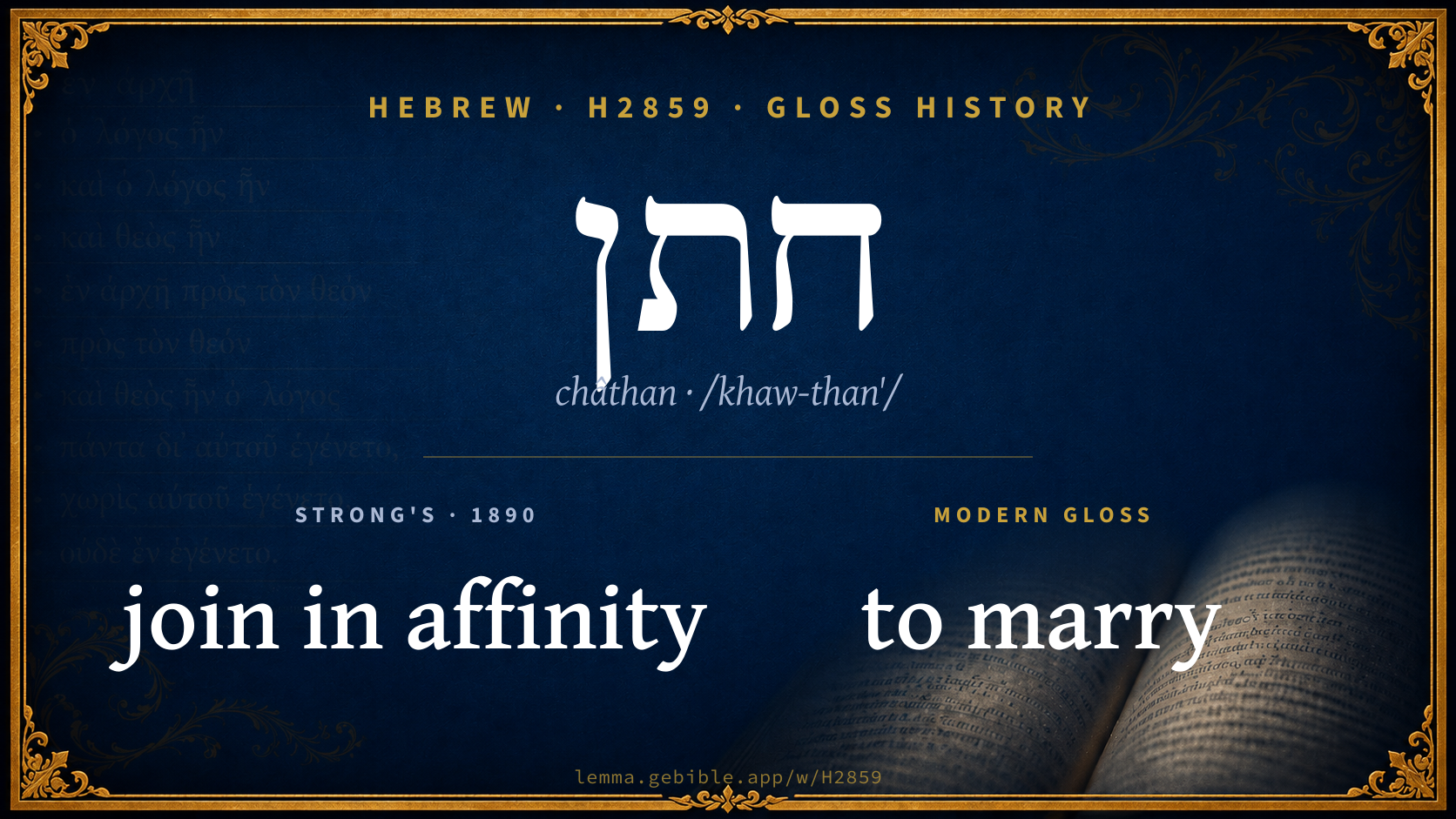
Gloss history
Strong's 1890 vs modern scholarship
About this word
Strong's H2859 catalogs a Hebrew word from the Hebrew Old Testament.
These counts are not copied from any lexicon or concordance. They are computed here, from the morphology-tagged Hebrew Old Testament. What Lemma adds →
- 32
- distinct verses
- The word appears in 32 distinct verses.
- 10 / 39
- OT books
- The word appears in 10 of 39 Old Testament books.
- #1,064
- by frequency
- Top 2500 most frequent Hebrew words (rank 1,064 of 8,640 Hebrew words by occurrence).
View all 32 occurrences in the concordance →
By section of the Old Testament
By traditional corpus
Conventional, traditional groupings — biblical authorship is debated, so this is a traditional corpus grouping, not an authorship claim. Each share is this word’s portion of its verses in that division of the Hebrew canon. Each figure is a share of the word’s 32 distinct verses.
- Torah (Pentateuch) 18 verses · 56%
- Prophets (Nevi'im) 12 verses · 38%
- Writings (Ketuvim) 2 verses · 6%
How translations render this word
Counts come from each version’s own published word-to-Strong’s tagging or interlinear alignment — an approximate guide to how each version renders this word, not a word-level alignment the data otherwise carries. Because each total is that version’s own tagged count, the per-version totals vary from one another and need not match the appearance or distinct-verse counts above. These counts may also differ from a printed concordance because Lemma counts each distinctly tagged rendering and does not collapse phrase taggings into a single head-word total. This is a fixed set of word-tagged versions (KJV, ASV, BSB, ULT) and does not change with the reading translation you choose elsewhere. Each version’s license is shown beside its name below (and on Sources).
- King James Version: Father in law 19×, Son in law 4×
- American Standard Version: Father-in 9×, ' father-in 8×, 's son-in 3×
- Berean Standard Bible: Father-in-law 18×, Son-in-law 3×, Intermarry 2×
- unfoldingWord Literal Text: Father in law 12×, Father in law of 9×, Make himself son in law 2×
King James Version Public Domain
Renders H2859 across 33 tagged occurrences — most commonly:
Plus 10 renderings that appear only once — usually multi-word phrases or single function words the recovered tagging swept in, not distinct renderings.
American Standard Version Public Domain
Renders H2859 across 33 tagged occurrences — most commonly:
Plus 13 renderings that appear only once — usually multi-word phrases or single function words the recovered tagging swept in, not distinct renderings.
Berean Standard Bible Public Domain
Renders H2859 across 32 tagged occurrences — most commonly:
Plus 9 renderings that appear only once — usually multi-word phrases or single function words the recovered tagging swept in, not distinct renderings. Not rendered by a distinct English word in 1 further occurrence.
unfoldingWord Literal Text CC BY-SA 4.0
Renders H2859 across 35 tagged occurrences — most commonly:
Plus 12 renderings that appear only once — usually multi-word phrases or single function words the recovered tagging swept in, not distinct renderings.
Senses in the full BDB
What do BDB’s symbols mean?
BDB uses these scholarly abbreviations:
| Symbol | Meaning |
|---|---|
| 𝔊 | the Septuagint (the ancient Greek translation, LXX) |
| 𝔙 | the Vulgate (the Latin translation) |
| 𝔖 | the Syriac version (the Peshitta) |
| 𝔗 | the Targum (the Aramaic translation) |
| ψ | the Psalms |
| √ | root (the underlying root or stem) |
| ‖ | parallel passage (a synonymous or contrasted parallel) |
| † | the dagger: every passage where the word occurs is cited |
The 2 senses and sub-senses the full Brown-Driver-Briggs lexicon distinguishes for this word, in lexicon order (not ranked by frequency), with BDB’s own verbatim wording and sub-sense lettering. Shown in Hebrew script with BDB’s own scholarly abbreviations. The condensed entry is in the Lexicon Entry tab. See also the Forms in the corpus table below.
- 1. m. wife’s father (Arabic خَاتِنٌ a circumciser, hence father-in-law, with ref. to circumcision performed on young men just before marriage; خَتَنٌ relation on wife’s side; v. WeProl. 1886, 355 Anm. 1; Skizzen iii, 154 StaZAW 1886, 143 Anm. NöZMG 1886, 187; otherwise DlPr 91 LagBN 116)—cstr. חֹתֵן Ex 18:1 + 9 times, חֹתֶנְךָ Ex 18:6, חֹתְנוֹ Ex 3:1 + 9 times;—usually of Moses’ wife’s father Ex 3:1; 4:18; 18:1, 2, 5, 6, 7, 8, 12(×2), 14, 15, 17, 24, 27 (all E), Nu 10:29 (J), Ju 1:16; 4:11; of a Levite Ju 19:4, 7, 9. e.g. Exodus 18:1
- 2. f. wife’s mother, only sf. חֹתַנְתּוֹ Dt 27:23. e.g. Deuteronomy 27:23
Senses from the full Brown-Driver-Briggs lexicon (Brown, Driver, Briggs; Oxford 1906 — public domain), digitized via Sefaria, supplemented by the OpenScriptures HebrewLexicon (CC BY 4.0). Full attribution on Sources.
Word origin
Origin: a primitive root
Jastrow Dictionary
A second Hebrew/Aramaic lexicon for comparison, covering Aramaic and post-biblical (Talmudic, Targumic, Midrashic) usage that the biblical-Hebrew BDB does not. Matched by lemma rather than by Strong’s number, so a lemma may carry more than one Jastrow headword (shown separately below), and the entries cover usage well beyond the Bible.
חָתַן
- cmp. preced.) to tie, connect, to covenant (Assyr. ḫatânu, to protect. Friedr. Del. Proleg. p. 91).
- to become connected, to enter into the family, to intermarry. Snh. 82ᵃ כאלו מִתְחַתֵּן בע"א as if he connected himself with idols. Gen. R. s. 82, beg. שנ׳ ביהודית וכ׳ who married Judith &c. Sifré Deut. 52, a. e. שנ׳ … עם וכ׳ when Solomon married the daughter of Pharaoh; a. fr.
חֲתַן
- Y. Sot. IX, end, 24ᶜ [read:] הוון בעון מִחְתַּנְתֵּיה לנסיותא, they desired to ally him to the Nasi family; Y. Ab. Zar. III, 42ᶜ bot הוון אילין … בעון מהיתנתיה (read: מִיחְתַּ׳) members of the Nasi family desired to take him into the family.
- to become connected. Targ. I Sam. XVIII, 22, sq.; a. fr.—Y. Sabb. XII, 13ᶜ bot. אִיתְחַתְּנוּן וכ׳, v. נְשִׂיאוּתָא.
חָתָן
- preced.) connection, son-in-law; bridegroom; (metaph., with ref. to the covenant of circumcision, v. בְּרִית) the infant fit for circumcision. B. Bath. 98ᵇ ח׳ הדר וכ׳ a son-in-law who lives in the house of his father-in-law. Pes. 113ᵃ הוי זהיר … מחָתְנָהּ הראשון guard thy wife against her former affianced. Y. Ned. III, end, 38ᵇ (ref. to Ex. IV, 24 sq) משה קרוי ח׳ Moses is called the ḥathan … (and she said) חָ׳ דמים מתבקשין ממך (ed. מתבקש) husband, blood (circumcision) is asked of thee; תינוק קרוי ח׳ the infant is called the ḥathan, (and she said) חָ׳ בדמים אתה עומד לי child of the covenant, a high price I pay for thee; Bab. Ned. 32ᵃ; Ex. R. s. 5 חָתְנִי תהיה את וכ׳ thou shalt be my affianced by covenant, thou art given to me &c. Nidd. V, 3 an infant one day old … is לאביו … כח׳ שלם (as regards mourning ceremonies) like a perfect circumcised child to his parents &c.—Ber. II, 5 ח׳ פטור וכ׳ a bride-groom in the first night is exempt &c. Keth. 8ᵃ (in wedding benedictions) משמח ח׳ עם הכלה who causest the bridegroom to rejoice with the bride; a. fr.—Trnsf. (cmp. בַּעֲלָא) the fructifying rain. Ber. 59ᵇ; Taan. 6ᵇ משיצא ח׳ לקראת כלה when the bridegroom goes forth to meet the bride, i.e. when the falling rain-drops meet the water on the ground and bubble; [oth. opin.; when the rivulets formed by the rain meet each other in gutters.].—Pl. חֲתָנִים. Keth. l. c. Ib.ᵇ, v. בְּרָכָה; a. fr.— e.g. Exodus 4:24
A Dictionary of the Targumim, the Talmud Babli and Yerushalmi, and the Midrashic Literature (Marcus Jastrow; London, Luzac, 1903) — Public Domain. Digitized via Sefaria. Digitized via Sefaria. Full attribution on Sources.
Forms in the corpus
The 23 distinct written forms H2859 takes in the Hebrew Bible, most frequent first — each parse links to that stem’s occurrences in the concordance. Hebrew forms include their vowel points and cantillation, so a single lemma takes many written forms.
Same root — word family
Other BDB entries built from the same root as H2859, grouped by Strong’s listed origin. These share a root / origin per the lexicon — not necessarily a shared meaning. Each links to that word’s own entry.
Derived from this word
Compare all same-root words → They share a root, not necessarily a meaning.
Septuagint verse parallels
This word appears in 26 verses that also exist in the Greek Old Testament (Septuagint), out of the 32 Hebrew verses it occurs in. You can read those verses in Greek by switching the Old Testament edition to the Septuagint.
Read these verses in the Septuagint
- Genesis 34:9
- Exodus 3:1
- Numbers 10:29
- Deuteronomy 7:3
- Joshua 23:12
- Judges 1:16
- 2 Chronicles 18:1
- Ezra 9:14
This is a verse-level parallel only — the same verses exist in both the Hebrew and Greek Old Testaments. No word-level Hebrew↔Greek correspondence is claimed: the data carries no such alignment, so no Greek word is shown as this Hebrew word’s translation. Coverage is not total — the Septuagint omits the deuterocanon and renumbers the Psalms, so some Hebrew verses have no direct Greek parallel.