Zechariah 9:17

Hebrew (Westminster Leningrad Codex) Zechariah 9:17 appears in the Hebrew Old Testament. The text above is from the Westminster Leningrad Codex. Each word links to its Strong’s number, a concise gloss, and parsing drawn from the Open Scriptures Hebrew Bible morphology. Click any word for its full Brown-Driver-Briggs (BDB) entry.
Download image
Cite this verse

Zechariah 9:17 (World English Bible). Public Domain. Lemma interlinear Bible study tool, https://lemma.gebible.app/v/zechariah/9/17.

Show BibTeX & RIS
BibTeX
RIS
English Translation
For how great is his goodness, And how great is his beauty! Grain will make the young men flourish, And new wine the virgins.
World English Bible · Public Domain
Download a study sheet

One document with this verse’s original text, its word-by-word gloss line, the meaning frame, cross-references with their text, attributed commentary, and full source and license credits — printable, and it pastes into notes with its structure intact.

This verse Autodidact and up

Study sheet (.html) Plain text (.txt)

A passage Seminary Student

Up to 50 verses in one chapter. A passage sheet keeps up to 6 commentary sources and 12 cross-references per verse, in the order this page ranks them, and says so on the sheet whenever that leaves anything out. Ask for a single verse and you get the Autodidact verse sheet above.

Everything on this page stays free to read, with no account — the sheet is a download of what is already on screen, not access to it.

Want to remove ads? Support Godless Engineer
Compare translations 3

The same verse in 3 English versions, stacked beneath the original-language interlinear above. Click any original word for its lexicon entry.

Each is an independent rendering of the whole verse — the interlinear is not word-aligned to these translations.

Highlighted words mark where these versions differ — a whole-verse word diff, not a word-by-word alignment.

  • World English Bible Public Domain
    For how great is his goodness, And how great is his beauty! Grain will make the young men flourish, And new wine the virgins.
  • King James Version Public Domain
    For how great is his goodness, and how great is his beauty! corn shall make the young men cheerful, and new wine the maids.
  • unfoldingWord Literal Text CC BY-SA 4.0
    How good and how beautiful they will be! The young men will flourish on grain and the virgins on sweet wine!

unfoldingWord Literal Text — © unfoldingWord, licensed CC BY-SA 4.0. Word-aligned USFM3 via Door43 (git.door43.org/unfoldingWord/en_ult).

Versions to compare (up to 4)

3 of 4 selected

Show all 18 translations

Every available English version of this verse, each an independent rendering of the whole verse.

  • World English Bible Public Domain
    For how great is his goodness, And how great is his beauty! Grain will make the young men flourish, And new wine the virgins.
  • Berean Standard Bible Public Domain
    How lovely they will be, and how beautiful! Grain will make the young men flourish, and new wine, the young women.
  • Majority Standard Bible Public Domain
    How lovely they will be, and how beautiful! Grain will make the young men flourish, and new wine, the young women.
  • King James Version Public Domain
    For how great is his goodness, and how great is his beauty! corn shall make the young men cheerful, and new wine the maids.
  • American Standard Version (1901) Public Domain
    For how great is his goodness, and how great is his beauty! grain shall make the young men flourish, and new wine the virgins.
  • Revised Version (1885) Public Domain
    For how great is his goodness, and how great is his beauty! corn shall make the young men flourish, and new wine the maids.
  • Geneva Bible (1599) Public Domain
    For howe great is his goodnesse! and howe great is his beautie! corne shall make the yong men cherefull, and newe wine the maides.
  • Douay-Rheims (1899) Public Domain
    For what is the good thing of him, and what is his beautiful thing, but the corn of the elect, and wine springing forth virgins?
  • Young's Literal Translation Public Domain
    For what His goodness! and what His beauty! Corn the young men, And new wine the virgins -- make fruitful!
  • Literal Standard Version CC BY-SA 4.0
    For what His goodness! And what His beauty! Grain the young men, || And new wine the virgins—make fruitful!
  • Unlocked Literal Bible CC BY-SA 4.0
    How good and how beautiful they will be! The young men will flourish on grain and the virgins on sweet wine!”
  • unfoldingWord Literal Text CC BY-SA 4.0
    How good and how beautiful they will be! The young men will flourish on grain and the virgins on sweet wine!
  • Darby Bible Public Domain
    For how great is his goodness, and how great is his beauty! Corn shall make the young men flourish, and new wine the maidens.
  • World Messianic Bible Public Domain
    For how great is his goodness, and how great is his beauty! Grain will make the young men flourish, and new wine the virgins.
  • Webster's Bible Public Domain
    For how great is his goodness, and how great is his beauty! corn shall make the young men cheerful, and new wine the maids.
  • Free Bible Version CC BY-SA 4.0
    How lovely and beautiful they will be! Young men will grow strong on grain, and young women flourish on the new wine.
  • Bible in Basic English Public Domain
    For how good it is and how beautiful! grain will make the young men strong and new wine the virgins.
  • JPS Tanakh (1917) Public Domain
    For how great is their goodness, and how great is their beauty! Corn shall make the young men flourish, and new wine the maids.

Literal Standard Version (2020), Covenant Press — licensed CC BY-SA 4.0. Text via the HelloAO Bible API (eBible.org). Unlocked Literal Bible (unfoldingWord) — licensed CC BY-SA 4.0. Text via the HelloAO Bible API (eBible.org). unfoldingWord Literal Text — © unfoldingWord, licensed CC BY-SA 4.0. Word-aligned USFM3 via Door43 (git.door43.org/unfoldingWord/en_ult). Free Bible Version, Dr. Jonathan Gallagher — licensed CC BY-SA 4.0. Text via the HelloAO Bible API (eBible.org).

Word by word

More ways to search: Search by grammar → Find every occurrence → Compare this word →

Practice this passage: Drill this verse → Learn its vocabulary →

יְנוֹבֵ֥ב
nûwb
H5107
“to bear fruit”
Verb, Polel, Imperfect, 3rd Person, Masculine, Singular
Part of Speech
Verb
Stem
Polel
Form
Imperfect
Person
3rd Person
Gender
Masculine
Number
Singular
Full BDB Definition

Origin: a primitive root

TWOT: 1318

to bear fruit - (Qal) to bear fruit - (Pilel) to make to flourish (figuratively)
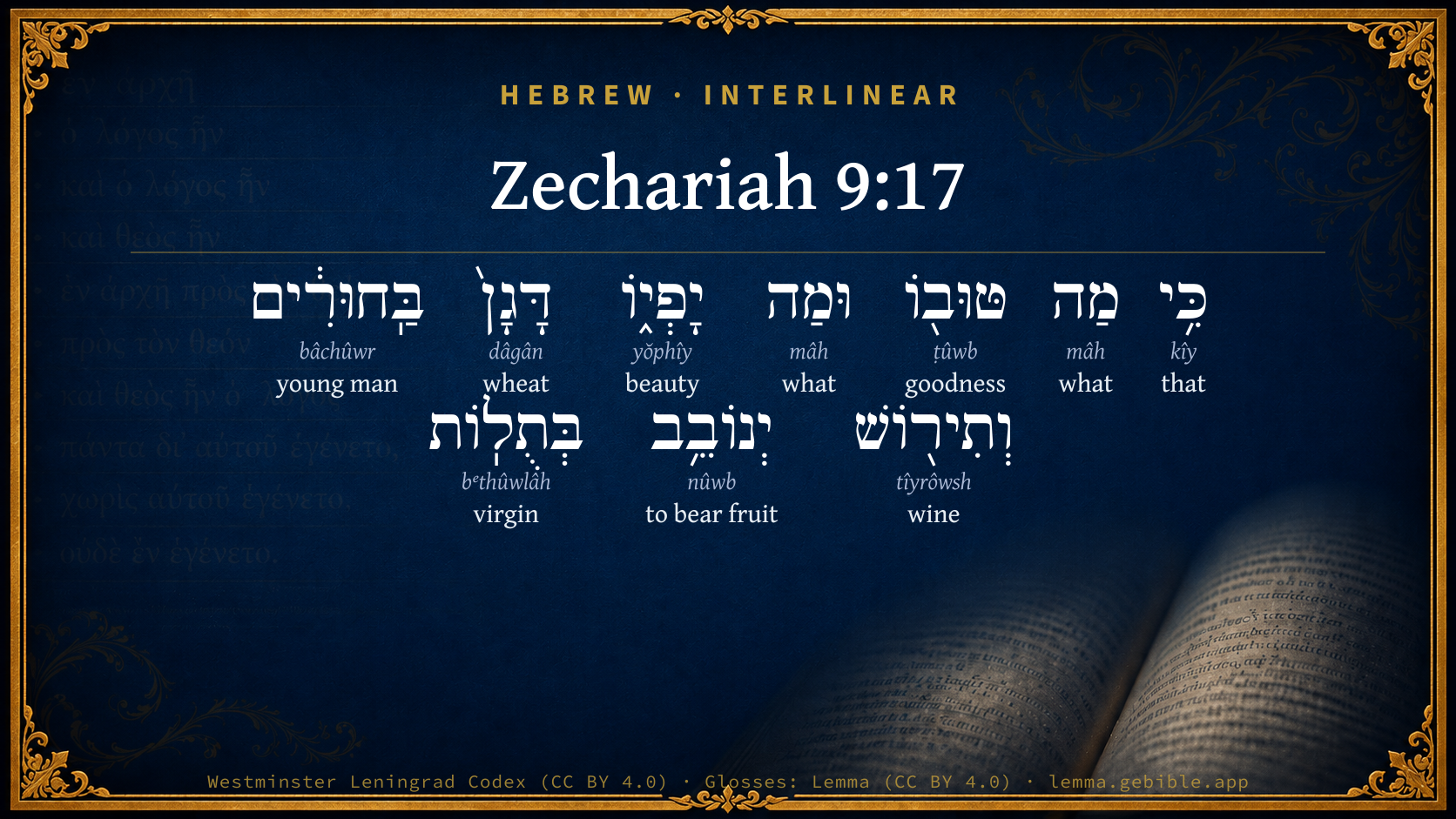
  1. כִּ֥י kîy H3588 “that” Conjunction
  2. מַה mâh H4100 “what” Particle, Interrogative
  3. טּוּב֖וֹ ṭûwb H2898 “goodness · his” Noun, Common, Masculine, Singular, Construct + Suffix, Personal, 3rd Person, Masculine, Singular
  4. וּמַה mâh H4100 “and · what” Conjunction + Particle, Interrogative
  5. יָפְי֑וֹ yŏphîy H3308 “beauty · his” Noun, Common, Masculine, Singular, Construct + Suffix, Personal, 3rd Person, Masculine, Singular
  6. דָּגָן֙ dâgân H1715 “wheat” Noun, Common, Masculine, Singular, Absolute
  7. בַּֽחוּרִ֔ים bâchûwr H970 “young men” Noun, Common, Masculine, Plural, Absolute
  8. וְתִיר֖וֹשׁ tîyrôwsh H8492 “and · wine” Conjunction + Noun, Common, Masculine, Singular, Absolute
  9. בְּתֻלֽוֹת bᵉthûwlâh H1330 “virgins” Noun, Common, Feminine, Plural, Absolute

About this verse

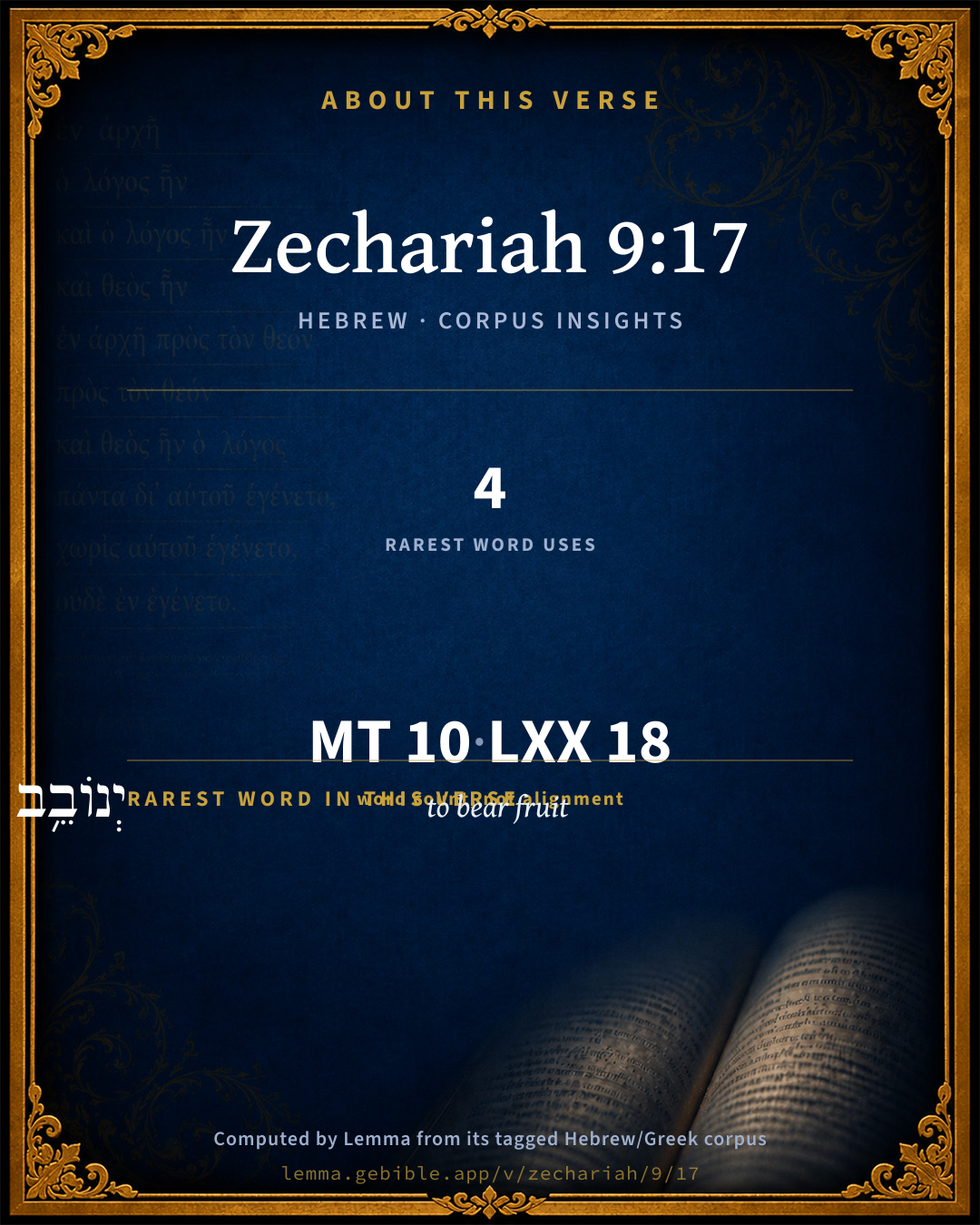
These counts appear in no published source. They are computed here, from the morphology-tagged text and Lemma’s own curated glosses. What Lemma adds →

10
words
9
distinct lemmas
Prophets
section

Notable vocabulary

The rarest word here is יְנוֹבֵ֥ב to bear fruit H5107 — appearing just 4 times in the whole Hebrew Bible.

Shared distinctive vocabulary

יְנוֹבֵ֥ב to bear fruit H5107 occurs in 4 verses of the Hebrew Bible. Also found in:

Grammatical profile

  • 1 verb
  • 6 nouns
  • 1 conjunction
  • 2 particles

Verb forms

  • יְנוֹבֵ֥ב Polel · Imperfect

Repetition

A word recurs within this verse — often emphatic in Hebrew:

Hebrew & Septuagint length

In English translation the verse runs 24 words from the Hebrew and 27 from the Septuagint (LXX English) — closely comparable.

A rough comparison of the two English renderings, which tokenize alike — not a word-level alignment.

Word counts can differ between the Hebrew and the Greek without any difference in meaning — e.g. the Hebrew direct-object marker אֵת has no separate Greek word, and Greek often adds the article ὁ.

In the original languages it is 10 Hebrew tokens and 18 Greek tokens — but the two are counted differently (Hebrew bundles its prefixes and suffixes into one token; the Greek is in lemma form), so that isn’t a like-for-like length.

Cross-references

34

Topical passages linked to Zechariah 9:17 in the Treasury of Scripture Knowledge — connected by theme and wording, ordered by reader-vote popularity; previews shown in the World English Bible.

  • Isaiah 33:17 Your eyes shall see the king in his beauty: they shall see a land that reaches afar.
  • 1 John 4:8–11 He who doesn't love doesn't know God, for God is love.
  • Isaiah 62:8–9 Yahweh has sworn by his right hand, and by the arm of his strength, Surely I will no more give your grain to be food for your enemies; and foreigners shall not drink your new wine, for which you have labored:
  • Exodus 15:11 Who is like you, Yahweh, among the gods? Who is like you, glorious in holiness, Fearful in praises, doing wonders?
  • Psalms 31:19 Oh how great is your goodness, Which you have laid up for those who fear you, Which you have worked for those who take refuge in you, Before the sons of men!
  • Psalms 36:7 How precious is your loving kindness, God! The children of men take refuge under the shadow of your wings.
  • Psalms 45:2 You are the most excellent of the sons of men. Grace has anointed your lips, Therefore God has blessed you forever.
  • Psalms 50:2 Out of Zion, the perfection of beauty, God shines forth.
  • Psalms 90:17 Let the favor of the Lord our God be on us; Establish the work of our hands for us; Yes, establish the work of our hands.
  • Song of Solomon 5:10 My beloved is white and ruddy. The best among ten thousand.
  • Song of Solomon 7:9 Your mouth like the best wine, That goes down smoothly for my beloved, Gliding through the lips of those who are asleep.
  • Titus 3:4–7 But when the kindness of God our Savior and his love toward mankind appeared,
  • Revelation 5:12–14 saying with a loud voice, "Worthy is the Lamb who has been killed to receive the power, wealth, wisdom, strength, honor, glory, and blessing!"
  • John 1:14 The Word became flesh, and lived among us. We saw his glory, such glory as of the one and only Son of the Father, full of grace and truth.
  • John 3:16 For God so loved the world, that he gave his one and only Son, that whoever believes in him should not perish, but have eternal life.
  • Romans 5:8 But God commends his own love toward us, in that while we were yet sinners, Christ died for us.
  • Romans 5:20 The law came in besides, that the trespass might abound; but where sin abounded, grace did abound more exceedingly;
  • 2 Corinthians 4:4–6 in whom the god of this world has blinded the minds of the unbelieving, that the light of the Gospel of the glory of Christ, who is the image of God, should not dawn on them.
  • Ephesians 1:7–8 in whom we have our redemption through his blood, the forgiveness of our trespasses, according to the riches of his grace,
  • Ephesians 2:4–5 But God, being rich in mercy, for his great love with which he loved us,
  • Ephesians 3:18–19 may be strengthened to comprehend with all the saints what is the breadth and length and height and depth,
  • Ephesians 5:18–19 Don't be drunken with wine, in which is dissipation, but be filled with the Spirit,
  • Psalms 86:5 For you, Lord, are good, and ready to forgive; Abundant in loving kindness to all those who call on you.
  • Psalms 86:15 But you, Lord, are a merciful and gracious God, Slow to anger, and abundant in loving kindness and truth.
  • Psalms 145:7 They will utter the memory of your great goodness, And will sing of your righteousness.
  • Isaiah 63:7 I will make mention of the loving kindnesses of Yahweh, [and] the praises of Yahweh, according to all that Yahweh has bestowed on us, and the great goodness toward the house of Israel, which he has bestowed on them according to his mercies, and according to the multitude of his loving kindnesses.
  • Isaiah 63:15 Look down from heaven, and see from the habitation of your holiness and of your glory: where are your zeal and your mighty acts? the yearning of your heart and your compassion is restrained toward me.
  • Isaiah 65:13–14 Therefore thus says the Lord Yahweh, Behold, my servants shall eat, but you shall be hungry; behold, my servants shall drink, but you shall be thirsty; behold, my servants shall rejoice, but you shall be disappointed;
  • Jeremiah 31:12 They shall come and sing in the height of Zion, and shall flow to the goodness of Yahweh, to the grain, and to the new wine, and to the oil, and to the young of the flock and of the herd: and their soul shall be as a watered garden; and they shall not sorrow any more at all.
  • Hosea 2:21–22 It will happen in that day, I will respond," says Yahweh, I will respond to the heavens, And they will respond to the earth;
  • Joel 2:26 You will have plenty to eat, and be satisfied, And will praise the name of Yahweh, your God, Who has dealt wondrously with you; And my people will never again be disappointed.
  • Joel 3:18 It will happen in that day, That the mountains will drop down sweet wine, The hills will flow with milk, All the brooks of Judah will flow with waters; And a fountain will come forth from the house of Yahweh, And will water the valley of Shittim.
  • Amos 8:11–14 Behold, the days come," says the Lord Yahweh, "That I will send a famine in the land, Not a famine of bread, Nor a thirst for water, But of hearing the words of Yahweh.
  • Amos 9:13–14 "Behold, the days come," says Yahweh, "That the plowman shall overtake the reaper, And the one treading grapes him who sows seed; And sweet wine will drip from the mountains, And flow from the hills.

Cross-references courtesy of OpenBible.info (CC BY 4.0).

Hebrew and Greek witnesses Masoretic Hebrew ↔ Greek Septuagint

The same verse in the two great witnesses to the Old Testament, shown verse-for-verse.

These are two independent witnesses, not word-aligned to each other, and the Septuagint is shown in lemma (dictionary) form.

Hebrew Zechariah 9:17 Masoretic · Westminster Leningrad Codex

כִּ֥י מַה טּוּב֖וֹ וּמַה יָפְי֑וֹ דָּגָן֙ בַּֽחוּרִ֔ים וְתִיר֖וֹשׁ יְנוֹבֵ֥ב בְּתֻלֽוֹת

For how great is his goodness, And how great is his beauty! Grain will make the young men flourish, And new wine the virgins.

World English Bible · Public Domain

Greek LXX Zechariah 9:17 Septuagint · lemma form

ὅτι εἰ τις ἀγαθός αὐτός καί εἰ τις καλός παρά αὐτός σῖτος νεανίσκος καί οἶνος εὐωδιάζω εἰς παρθένος

For if he has anything good, and if he has anything fair, the young men shall have corn, and there shall be fragrant wine to the virgins.

LXX2012 (modern English Septuagint) · Public Domain

On this verse, Haydock's Catholic Bible Commentary discusses the Septuagint’s reading. Read the note in Commentary ↓

Hebrew: Westminster Leningrad Codex (CC BY 4.0). Greek: Septuagint (public domain); English from LXX2012 (modern English Septuagint) (Public Domain). How the Septuagint differs from the Hebrew →

Targum (Aramaic paraphrase)

1

The Targum is the ancient Jewish Aramaic paraphrase of the Hebrew Scriptures — an interpretive translation, not the Hebrew text itself. Onkelos (literal) and Pseudo-Jonathan (expansive) render the Torah, and Jonathan the Prophets. Coverage is partial: where no permissively-licensed English translation exists for a verse, only the Aramaic is shown. This is verse-level text, not a word-by-word alignment to the Hebrew.

  1. Targum Jonathan Prophets (Joshua–Malachi)
    אֲרֵי מַה טָב וּמַה יָאֵי אוּלְפַן אוֹרַיְתָא לְנָגוֹדַיָא וְדִין דִקְשׁוֹט מְתַקַן בִּכְנִשְׁתָּא:

    (no public-domain English translation for this verse)

    Targum Jonathan — Aramaic: “Mikraot Gedolot” (public domain). English: “Sefaria Community Translation” (CC0 1.0 (public-domain dedication)); “London "Chaldee Paraphrase," 1871” (public domain). Text via Sefaria.

Commentary

Notes on Zechariah 9:17 from classic Christian and Jewish commentators (each source and its license shown beneath its notes). The classic Christian expositions comment on the surrounding passage and are grouped to its opening verse, so a note may address several verses; the Jewish commentaries on the Tanakh (Rashi and others) are per-verse, so they appear only where the commentator wrote on this verse.

Lemma curates 59 commentaries, every one of them public domain or Creative Commons licensed, each selected and text-cleaned for this edition rather than reprinted as found. About our sources →

Trapp's Complete Commentary

John Trapp

Zec 9:17 For how great [is] his goodness, and how great [is] his beauty! corn shall make the young men cheerful, and new wine the maids.

Ver. 17. For how great is his goodness] He shuts up all with this sweet epiphonema or exclamation, admiring the singular goodness of God to his people in all the former particulars; and yet promising them abundance of outward necessaries, even to an honest affluence; they should have store of corn and wine; so much as should make them succulent and vigorous, full of sap and good humours, provided, that first they content not themselves with the natural use of the creature, but taste how good the Lord is, and next, that they put this promise into suit by their prayers, as Zec 10:1.

John Trapp, A Commentary or Exposition upon All the Books of the Old and New Testament (1647–1656) — public domain. Text from a community e-Sword module.

The Biblical Illustrator

Joseph S. Exell

Zec_9:17

For how great is His goodness, and how great is His beauty!

Gods goodness and beauty

There is no subject of contemplation more delightful to a serious mind than the goodness of the Lord. The prophet had been, in the preceding verses, describing the appearance of Christ as King of Zion, as just, and having salvation. He had been speaking of the blood of the covenant, by which the prisoners of Divine justice are delivered, and invited to turn to the stronghold. He had described the salvation which God should work out for His people by the Messiah, when they should be as the precious stones of a crown, lifted up on high, and God would save and favour them as His jewels and peculiar treasure. The prophets heart was so affected with the prospect of this mercy that he breaks out into the joyful acclamation, How great is His goodness! Learn that the Divine goodness in our redemption and salvation claims our admira tion and our praise. Here too we see the beauty of the Lord. How amicably His perfections shine in the dispensation of the Gospel; so that all who attend to it with serious minds will see and adore them. Here we observe mercy and truth meeting together, righteousness and peace greeting each other. Here, at the Holy Sacrament, we see the King of Zion, the image of the invisible God, in all His beauty, and He appears fairer than the children of men, and altogether amiable and lovely. Here also we see the goodness of the Lord; with what peculiar lustre this perfection of the Divine nature shines in our redemption by Jesus Christ. That goodness appears great if we consider how universally it extends: even to all mankind. Jesus is a propitiation for the sins of the whole world. If we consider the objects of it; mean and miserable mortals, whose goodness cannot extend to Him. This goodness is to terminate in perfect and everlasting glory and felicity. The fountain of all our comforts and hopes is Divine goodness. The streams are plenteous, and various. They enrich, delight, and satisfy the soul, and they flow forever. (Job Orton.)

The glory of Christ

This is manifested throughout all the Holy Scriptures. This is attested both by the Apostles and by our Lord Himself (Act_10:43; Luk_24:27; Joh_5:39). In the New Testament He shines like the sun in an unclouded atmosphere. In the Old, though generally veiled, He often bursts forth as from behind a cloud with astonishing beauty and splendour. Nor could the prophet himself forbear exclaiming with wonder and admiration, How great is His goodness! etc.

I. The goodness of our Lord. In the context He is set forth as the God of providence and of grace. And in order to behold His goodness we must view Him in both respects.

1. As the God of providence. As all things were created, so are they upheld and governed by Him. To Him we owe the preservation of our corporeal and intellectual powers. We are continually fed by His bounty, and protected by His arm. The meanest creature in the universe has abundant reason to adore Him--His own people in particular may discern unnumbered instances of His goodness in His dispensations towards them. His most afflictive as well as His more pleasing dispensations afford them much occasion for gratitude and thanksgiving (Psa_119:75).

2. As a God of grace. Jesus is the one fountain of spiritual blessings to His Church (Eph_1:22). Neither prophets nor apostles had any grace but from Him (Joh_1:16). To Him must we ascribe every good disposition that is in our hearts (Php_2:13; Heb_12:2). What reason, then, have His faithful followers to bless His name! With what gratitude should they acknowledge His continued kindness! Though they have often turned back from Him, He has not cast them off. Yea, rather, He has healed their backslidings and loved them freely. Surely every blessing they receive and every victory they gain should fill them with admiring thoughts of His goodness (2Co_2:14). If we have just conceptions of His goodness we shall be more able to behold--

II. His beauty. The world beholds no beauty nor comeliness in the face of Jesus. But the saints of old saw His glory as the glory of the only-begotten of the Father. This we also may see if we survey Him--

1. In this Divine character. We cannot by searching find out the Almighty to perfection. Little do we know of the greatness of His majesty, or the thunder of His power (Job_26:14). We cannot comprehend His unsearchable wisdom, His unspotted holiness, His inviolable truth and faithfulness. His glory is more than the feeble language of mortality can express.

2. In His human character Here we look at Him, as the Jews at Moses when his face was veiled. And can contemplate Him more easily because He shines with a less radiant lustre. But principally must we view Him during the course of His ministry. What marvellous compassion did He manifest to the souls and bodies of men! Not one applied to Him for bodily or spiritual health without obtaining his request. And when many were hardened in their sins He wept over them (Luk_19:41). His zeal for God was ardent and unremitted. His meekness, patience, fortitude were altogether invincible. Whatever was amiable and excellent in man abounded in Him (Psa_45:2). Nor, though continually tried in the hottest furnace, was there found in Him the smallest imperfection or alloy (Joh_14:30).

3. In His mediatorial character. With what readiness did He become a surety for sinful man (Psa_40:7-8). What astonishing condescension did He manifest in uniting Himself to our nature! How cheerfully did He go forth to meet the sufferings that were appointed for Him. His obedience unto death was the fruit of His love and the price of our redemption. How beautiful is He now in the eyes of those who behold His glory! And how will He be admired and glorified by all in the last day! Satan must have blinded us, indeed, if we be yet insensible to His charms (2Co_4:4). If we be true believers, He cannot but be precious to our souls (1Pe_2:7). (J. Benson.)

How great is His beauty--

The secret of beauty

The last words of Charles Kingsley were, How beautiful is God! Zechariah was thinking of the glory about to be given to Israel, about the prosperity soon to abound in the land, and he knows that it is all the good gift of God, so he cries, How great is His goodness! How great is His beauty! Corn shall make the young men cheerful, and new wine the maids. Wise men who have thought about the nature of God have always said that there must be three perfect things in God. There must be perfect truth, perfect goodness, and perfect beauty. By remembering this you may always tell the difference between true and false ideas about God. Every man and every child who worships a God about whom he has hard, cruel thoughts, although a Christian in name, gives only heathen worship to the Most High. All through the Bible God has been teaching men that He is beautiful. The Jews were taught to make their worship beautiful. At last Christ came. He did not seem to bring beauty down to man at once. The word beauty is never mentioned in the New Testament. But this was because Christ wanted men to look deeper for beauty than on the face and form. The beauty which Christ brought was beauty of the soul, of the heart, of the life, spiritual beauty which will never fade away with age, will never wither or decay. Here in our flowers today can we not try to see the beauty of God? They teach that His beauty is perfect in little things as well as in great. The tiniest flower is as perfect as the large. And the beauty is not for mere show, but for comfort and use. How often a flower teaches people about God! I have read of a poor sinful woman pressing a white flower to her heart in an agony of tears, because it came to her like the voice of God, telling of His wish for her to be pure and bright. We would like to reveal God to those around us. If so, let us be Gods flowers. Aim at three things in order that we may accomplish this our high task.

1. Let us have the beauty of worship.

2. Beauty of worship must lead to beauty of life.

3. All this will grow into beauty of character.

This is the beauty that lasts forever. To get this will take time. All the best things take time. (H. H. Gowen.)

Beauty

One by one the various traits of Divine excellence came before the mind of the prophet, and at last he, as it were, generalised them; and the whole vision struck him as one of extreme beauty. The wisdom of God, His justice, His purity, His truth, His love,--all of these, in quality, in quantity, and in harmony, form a symmetric whole, which deserves, if anything deserves it, the epithet beautiful, and meets the highest conception, and overreaches the highest aspiration which the human heart has for the element of beauty. Is beauty, then, a reality in the higher spiritual life? Is there in the inward, invisible, and truly spiritual life that which answers to our idea of sensuous beauty? Or is it figurative? I hold that beauty is first spiritual, and afterwards natural and material. I hold that it was Divine; that it inhered in the nature of God, and the nature of spiritual existence. Examine the relation of beauty to moral qualities. As God has created the world, beauty is not a kind of seasoning scattered upon the weightier realities. Men think that the beauty of this natural world is a kind of decoration. Perfectness and beauty are identical. Maturity, whether it be of fruit, or flower, or what not, works by stages towards beauty in the material globe. So that beauty is not an accident. Still less is it the trimming which God gave to the perfected work. It is the Divine idea of a mode of creation. As the human mind is cultivated, it becomes more and more sensitive to this quality. The less culture men have, the further they are from the admiration of beauty; that is to say, the less comprehensive is their admiration. When the human mind develops and grows toward its perfection, it grows toward the sense of beauty. But moral qualities come under this law, just as much as physical qualities do. Fulness, fineness, and harmony--there is the formula. In nature it is called quantity, symmetry: and the equivalent of this in moral elements is fulness, fineness, harmony. Whatever elements the mind produces when it acts so as to give fulness, fineness, and harmonious proportions to the product, are beautiful. That is to say, they produce the sense of beauty in those that look upon them, and tend universally to do it. Right things are commanded in the Bible, but it is not enough that we should be just, conscientious, true, amiable, or benevolent. There is to be fulness in each of these elements, and there is to be harmony among all of them. And here is the formula fulfilled which goes to make social and moral affections beautiful. It would seem enough to say to men, Be kind, be generous, be benevolent; but no, Let love be without dissimulation. God loves a cheerful giver. Give without grudging one to another. These are the elements that go to make beneficence; that free it from wrinkles; that give it largeness and generosity. The growth toward ripeness in moral experience is analogous to development in physical nature,--that is toward beautifulness. Just in proportion as any one of our better feelings becomes predominant over the others, men feel that character is growing lovely, attractive, admirable. And these are only step stone words that bring you to the last one, beautiful. There is nothing so beautiful in this world as beauty of character. Applications--

1. All the world recognises beauty in the lower grade of qualities. It is the higher moral experience that men lack a knowledge of Devotion is more beautiful than passion. The love of God in the soul is far more beautiful than any love of man can be. The qualities of religion to which we are called are supreme, not alone in importance, but in art even. They are essentially and intrinsically more admirable, more noble, more beautiful than all the lower experiences.

2. How great is the variety of spiritual things in the Christian life! and how few things are gained! How many persons are there that are beautiful in temper? How many whose good nature is anything more than the mere product of good health? How little is the Church beautiful in its grace!

3. The unbeautifulness of Christian life is sadly shown in me popular impression with regard to religion. Men mostly feel that religion is something that may be obligatory, but that there is nothing attractive about it. The true idea is, that a man who goes into a Christian experience, goes into a larger liberty, and goes into a larger joy.

4. Christians should at least be as sensible to spiritual beauty as to physical. All men should love beauty in common things.

5. God is bringing all good men toward that realm, and that indescribable experience which is hinted at in the words of Scripture. The work which is going on in us, we do not ourselves at all appreciate. (Henry Ward Beecher.)

.

The Biblical Illustrator, edited by Joseph S. Exell (c. 1880s–1900s) — public domain. Text from a community e-Sword module.

Joseph Benson's Commentary

Zec 9:17. How great is his goodness — Infinite goodness is the fountain of all the good done for his people. And how great is his beauty — How wonderful is the beauty of divine providence in Israel’s deliverance and salvation. Corn shall make the young men cheerful — Plentiful harvests shall make the young men cheerful in sowing, reaping, and partaking of the fruits thereof. And new wine the maids — There shall be such plenty of wine that all, young and old, shall be cheered with it. Or rather, new wine is put here for the grapes which make it, as bread is frequently put for bread- corn, and then the sense will be, that the young men, employed in bringing in the harvest, should rejoice at seeing the great plenty of it, and the young women, occupied in gathering the grapes, should be as cheerful on account of the plenty of the vintage: or that, by the divine blessing, both those who reaped the corn, and those who gathered in the vintage, should thrive and be happy in their respective occupations.

Joseph Benson's Commentary on the Old and New Testaments (1811–1818) — public domain. Text from a community e-Sword module.

Tyndale Open Study Notes

Tyndale Open Resources

9:17 abundant grain . . . new wine: Agricultural prosperity was a tangible sign of God’s blessing (see Joel 2:19; Amos 9:13; cp. Hag 1:11).

Tyndale Open Study Notes — © Tyndale Open Resources, licensed CC BY-SA 4.0. Text via the HelloAO Bible API.

Jamieson, Fausset & Brown

Robert Jamieson, A. R. Fausset & David Brown

his goodness . . . his beauty--the goodness and beauty which Jehovah-Messiah bestows on His people. Not as MAURER thinks, the goodness, &c., of His land or His people (Psa 31:19; Jer 31:12).

make . . . cheerful--literally, "make it grow."

new wine the maids--supply, "shall make . . . to grow." Corn and wine abundant indicate peace and plenty. The new wine gladdening the maids is peculiar to this passage. It confutes those who interdict the use of wine as food. The Jews, heretofore straitened in provisions through pressure of the foe, shall now have abundance to cheer, not merely the old, but even the youths and maidens [CALVIN].

Call to prayer to Jehovah, as contrasted with the idol-worship which had brought judgments on the princes and people. Blessings promised in answer to prayer: (1) rulers of themselves; (2) conquest of their enemies; (3) restoration and establishment of both Israel and Judah in their own land in lasting peace and piety.

Next: Zechariah Chapter 10

Jamieson, Fausset & Brown — Commentary Critical and Explanatory on the Whole Bible (1871) — public domain (CC PDM 1.0). Text via the HelloAO Bible API.

Adam Clarke's Commentary

Verse 17. How great is his goodness] In himself and towards them.

And how great is his beauty!] His comeliness, holiness, and purity, put in and upon them.

Corn shall make the young men cheerful] They shall be gladdened and strengthened by plenty of food; and they shall speak aloud of God's mercies in their harvest home.

And new wine the maids.] Who shall prepare the wine from an abundant vintage.

Adam Clarke's Commentary on the Bible (1810–1826) — public domain. Text from a community e-Sword/MySword module.

John Calvin's Commentaries

The Prophet here exclaims at the incredible kindness of God, that the Jews might learn to raise up their thoughts above the world, as they were to look for that felicity which he had before mentioned. We then see that by this exclamation a fuller confirmation is given to what had been said by the Prophet, as though his words were, — “No one ought to judge of God’s favor, of which I have spoken, according to his own doings, or conduct, or experience; but on the contrary, every one of you ought to be filled with amazement at God’s incredible kindness, and at his incredible beauty.” But by the last word he understands the brightness or splendor, which appears in all God’s favors and gifts.

He then concludes by saying, that the abundance of corn and wine would be so great, that young men and young women would eat and drink together, and be fully satisfied. Here a frivolous question may be asked, whether Zechariah allowed the use of wine to young women. But he speaks not here, as I have said before, of God’s blessing, as though it were an incentive to luxury; but what he means is, that the abundance of provisions would be so great as to be fully sufficient, not only for the old, but also for young men and young women. We know that when there is but a small supply of wine, it ought by right of age to be reserved for the old, but when wine so overflows that young men and young women may freely drink of it, it is a proof of great abundance. This then is simply the meaning of the Prophet: but something more shall be said tomorrow on the subject.

John Calvin's Commentaries (1540-1563) — public domain. Text from the Calvin Translation Society English edition (1840s-50s) via the Christian Classics Ethereal Library (ccel.org). Calvin's coverage is partial (roughly two-thirds of the Bible); uncommented books and verses are honest gaps, never fabricated. The 19th-century editor's footnotes and remarks are omitted so the notes are faithfully Calvin's own voice.

Ellicott's Commentary for English Readers

(17) Goodness.—Better, goodliness (Hos_10:11).

His means Israel’s. (Comp. Num_24:5.)

Make . . . cheerful.—Better, make to grow numerously. For the idea, comp. Psa_72:16, and see also Zec_8:5; and for the fulfilment, the reference there to Maccabees.

A Bible Commentary for English Readers, edited by Charles John Ellicott (1878–1897) — public domain. Text from a community e-Sword module.

The Cambridge Bible for Schools and Colleges

gen. ed. J. J. S. Perowne

17. his goodness … his beauty] i.e. either Israel’s (their prosperity, R. V. margin), as thus delivered and honoured by God (comp. Hos_14:6), or God’s, the exclamation being drawn from the prophet by the consideration of the great things he had been commissioned to make known. “The goodness and the beauty are the goodness and beauty of God, whose great doings had been his theme before.” Pusey, who quotes Osirius: “The prophet, borne out of himself by the consideration of the Divine goodness, stands amazed while he contemplates the beauty and Deity of Christ: he bursts out with unwonted admiration! How great is His goodness, who to guard His flock shall come down on earth to lay down His life for the salvation of His sheep! How great His beauty, who is the brightness of the glory and the Image of the Father, and comprises in His Godhead the measure of all order and beauty!”

The Cambridge Bible for Schools and Colleges (gen. ed. J. J. S. Perowne; Cambridge University Press, 1878–1918) — public domain. Text from a community e-Sword module.

John Gill's Exposition

For how great is his goodness?.... Not of the land of Judea, as Kimchi; nor of the doctrine of the law, as the Targum; nor of the people of the Jews; but of the Messiah: and designs not his essential nor his providential goodness; but his goodness as Mediator, which he has in his heart, and has shown unto his people, in being their surety, and becoming their Saviour; in assuming their nature; bearing their sins, and obeying and suffering in their room and stead: and also that which he has in his hands for them, and communicates to them; his fulness of grace; all those spiritual blessings that are in him; the large measures of grace given at conversion; and the numerous instances of his goodness afterwards; yea, it includes glory, as well as grace:

and how great is his beauty? not as God, nor as man, but as Mediator; as beheld in the covenant and promises; in the Gospel and in the truths and in the ordinances of it:

corn shall make the young men cheerful, and new wine the maids; by "young men" are meant the same as in Jo1 2:14 believers in Christ, who are lively, warm, and zealous for Christ, his cause and interest; who are active, diligent, and industrious in the discharge of duty; and are strong in Christ, and in his grace; and particularly in the grace of faith, and quit themselves like men: and by "maids" or "virgins" are meant the same; so called because of their chaste adherence to Christ; for their beauty, comeliness, and attire; and for their purity of divine worship and conversation: and the Gospel is intended by "corn" and "new wine"; which is compared to "corn", in opposition to the chaff of human doctrines; and because it contains Christ the bread of life, and is nourishing and comfortable: and to "new wine", not because it is a novel doctrine, for it is the everlasting Gospel ordained before the world was; but because, under the Gospel dispensation, to which this prophecy refers, it is newly and more clearly revealed; See Gill on Zac 9:15. The effect of which is, that it makes saints "cheerful", fills them with joy and spiritual mirth; for it is a joyful sound: or, "shall make fruitful" (d); it causes them to grow and increase, and makes them fruitful in every good word and work: or, "shall make them speak" eloquently (e); or cause them to put forth the fruit of their lips, in giving thanks to God for the abundance of grace bestowed upon them: or, "shall" make "them sing" (f), as others; in psalms, hymns, and spiritual songs. This new wine may be interpreted of the gifts and graces bestowed in great plenty on the day of Pentecost, both on sons and daughters, on servants and handmaids, whereby they prophesied, and saw visions, Act 2:16 see Eph 5:18.

(d) "germinare faciet", Montanus; "progerminare faciet", Burkius; "foecundabit", Castalio; "dicitur de virginibus spiritualibus, quae sunt fructus multi evangelii", Zech. ix. 17. Stockius, p. 654. (e) "Facundas faciet", Junius & Tremellius, Piscator, Tarnovius. (f) "Cantare faciet", Pagninus, Drusius; so Ben Melech.

Next: Zechariah Chapter 10

John Gill's Exposition of the Whole Bible (1746–1763) — public domain (CC PDM 1.0). Text via the HelloAO Bible API.

Albert Barnes' Notes on the Bible

For how great is His goodness - For it is unutterable! As the Psalmist said, “O Lord, our Lord, how excellent is Thy Name in all the earth!” Psa 8:1, and Jacob, “How awful is this place!” Gen 28:17, and the Psalmist, “How awful are Thy doings!” The goodness and the beauty are the goodness and beauty of God, whose great doings had been his theme throughout before. Of the goodness the sacred writers often speak , since of this we have extremest need. And this He showed to Moses, “I will cause all My goodness to pass before thy face” Exo 33:19. Of this we know somewhat personally in this life; for beside the surpassing. amazingness of it in the work of our redemption, we are surrounded by it, immersed in it, as in a fathomless, shoreless ocean of infinite love, which finds entrance into our souls, whenever we bar it not out.

Goodness is that attribute of God, whereby He loveth to communicate to all, who can or will receive it, all good; yea, Himself , “who is the fullness and universality of good, Creator of all good, not in one way, not in one kind of goodness only, but absolutely, without beginning, without limit, without measure, save that whereby without measurement He possesseth and embraceth all excellence, all perfection, all blessedness, all good.” This Good His Goodness bestoweth on all and each, according to the capacity of each to receive it, nor is there any limit to His giving, save His creature’s capacity of receiving, which also is a good gift from Him. “From Him all things sweet derive their sweetness; all things fair, their beauty; all things bright, their splendor; all things that live, their life; all things sentient, their sense; all that move, their vigor; all intelligences, their knowledge; all things perfect, their perfection; all things in any wise good, their goodness.”

The beauty of God - Belongs rather to the beatific vision. Yet David speaks of the Beauty of Christ, “Thou art exceeding fairer then the children of men” Psa 45:2; and Isaiah says, “Thine eyes shall behold the King in His beauty” Isa 33:17. But the Beauty of God “eye hath not seen nor ear heard nor can heart of man conceive.” Here, on earth, created beauty can, at least when suddenly seen, hold the frame motionless, pierce the soul, glue the heart to it, entrance the affections. Light from heaven kindles into beauty our dullest material substances; the soul in grace diffuses beauty over the dullest human countenance; the soul, ere it has passed from the body, has been known to catch, through the half-opened portals, such brilliancy of light, that the eye even for some time after death has retained a brightness, beyond anything of earth . “The earth’s form of beauty is a sort of voice of the dumb earth. Doth not, on considering the beauty of this universe, its very form answer thee with one voice, ‘Not I made myself, but God?’” Poets have said:

“Old friends ... shall lovelier be,

As more of heaven in each we see,”

(Christian Year. Morning Hymn.)

Or,

“When he saw,

“ - God within him light his face.”

(Tennyson, In memoriam. T. has “The God.”)

And Holy Scripture tells us that when Stephen, “full of faith and of the Holy Spirit,” was about to speak of Jesus to the council which arraigned him, “all that sat in the council, looking steadfastly at him, saw his face as it had been the face of an angel” Act 6:5, Act 6:15. It has been said, that if we could see a soul in grace, its beauty would so pierce us, that we should die. But the natural beauty of the soul transcends all corporeal beauty which so attracts us; the natural beauty of the last angel surpasseth all natural beauty of soul. If we could ascend from the most beautiful form, which the soul could here imagine, to the least glorious body of the beatified, on and on through the countless thousands of glorious bodies, compared wherewith heaven would be dark and the sun lose its shining; and yet more from the most beautiful deified soul, as visible here, to the beauty of the disembodied soul, whose image would scarce be recognized, because , “the bodily eyes gleamed with angelic radiancy;” yea, let the God-enlightened soul go on and on, through all those choirs of the heavenly hierarchies, clad with the raiment of Divinity, from choir to choir, from hierarchy to hierarchy, admiring the order and beauty and harmony of the house of God; yea, let it, aided by divine grace and light, ascend even higher, and reach the bound and term of all created beauty, yet it must know that the divine power and wisdom could create other creatures, far more perfect and beautiful than all which He hath hitherto created.

Nay, let the highest of all the Seraphs sum in one all the beauty by nature and grace and glory of all creatures, yet could it not be satisfied with that beauty, but must, because it was not satisfied with it, conceive some higher beauty. Were God immediately, at every moment to create that higher beauty at its wish, it could still conceive something beyond; for, not being God, its beauty could not satisfy its conception. So let him still, and in hundred thousand, hundred thousand, thousand years with swiftest flight of understanding multiply continually those degrees of beauty, so that each fresh degree should ever double that preceding, and the divine power should, with like swiftness, concur in creating that beauty, as in the beginning He said, “let there be light and there was light;” after all those millions of years, he would be again. at the beginning, and there would be no comparison between it and the divine beauty of Jesus Christ, God and Man. For it is the bliss of the finite not to reach the Infinite . That city of the blest which is lightened by the glory of God, and the Lamb is the light thereof, sees It, enabled by God, as created eye can see It, and is held fast to God in one jubilant exstacy of everlasting love.

“The prophet, borne out of himself by consideration of the divine goodness, stands amazed, while he contemplates the beauty and Deity of Christ: he bursts out with unaccustomed admiration! How great is His goodness, who, to guard His flock, shall come down on earth to lay down His life for the salvation of His sheep! How great His beauty, who is the ““brightnesss of the glory and the Image of the Father,” and comprises in His Godhead the measure of all order and beauty! With what firm might does He strengthen, with what joy does He overwhelm the souls which gaze most frequently on His beauty, and gives largely and bountifully that corn, by whose strength the youths are made strong. He supplieth abundantly the wine, whereby the virgins, on fire with His love, are exhilarated and beautified. But both are necessary, that the strength of the strong should be upheld by the “bread from heaven,” and that sound and uncorrupt minds, melted with the sweetness of love, should be recreated with wine, that is, the sweetness of the Holy Spirit, and be borne aloft with great joy, in the midst of extreme toils. For all who keep holily the faith of Christ, may be called “youths,” for their unconquered strength, and virgins for their purity and integrity of soul. For all these that heavenly bread is prepared, that their strength be not weakened, and the wine is inpoured, that they be not only refreshed, but may live in utmost sweetness.”

Albert Barnes' Notes on the Bible (1834–1885) — public domain. Text from a community e-Sword/MySword module.

Haydock's Catholic Bible Commentary

The corn, &c. His most excellent gift is the blessed Eucharist, called here the corn, that is, the bread of the elect, and the wine springing forth virgins, that is, maketh virgins to bud, or spring forth as it were like flowers among thorns, because it has a wonderful efficacy to give and preserve purity. (Challoner) --- It enables the weak to despise all things for the sake of virtue, and makes them fruitful and eloquent, as the original implies. (Calmet) --- Septuagint, "a fragrant wine for virgins." (Haydock) --- Christ is the grain of wheat, which dying, brings forth much fruit, (John xii.) and "of this wheat that bread is made which came from heaven," John vi. (St. Jerome) (Worthington) --- "How shall not they have joy, who being inebriated with the cup of our Saviour, are made virgins?" This was partly verified in the days of the Machabees, to whom plenty was granted. (St. Jerome) (Haydock) --- Those who partake worthily of the blessed Eucharist, become strong and pure. (Menochius) --- Protestants, "corn shall make the young men cheerful, (marginal note: grow, or speak) and new wine the maids." (Haydock)

George Leo Haydock (1774–1849), Haydock's Catholic Family Bible and Commentary, 1859 edition — public domain. Excludes Psalms (Douay-Rheims chapter numbering differs from Protestant) and Deuterocanonical books (Catholic canon only).

Matthew Poole's English Annotations

For how great is his goodness! infinite goodness is the fountain of all that good done for this people; the prophet admires it, and suggests what is fit to be done by those that come and view those stones set up for trophies.

How great is his beauty! how wonderful the beauty of Divine Providence in all the great effects of it in Israel’s deliverance and salvation!

Corn shall make the young men cheerful; plentiful harvests shall make the young men cheerful in sowing, reaping, labouring in harvest work, as well as in eating the knits thereof.

And new wine the maids; such plenty of wine, that all, young and old, shall be cheered with it.

And now these are the sweet fruits of temporal salvation, but the fruits of spiritual, shadowed out by these, are much more glorious, refreshing, and worth our praise and wonder.

Matthew Poole's English Annotations on the Holy Bible (1683–1685) — public domain. Text from a community e-Sword/MySword module.

The Pulpit Commentary

His goodness. The goodness, i.e. the prosperity, of Israel or the land. Revised Version margin, "their prosperity." If the affix "his" is referred to Jehovah, the nouns "goodness" and "beauty" must be taken, not as his attributes, but as gifts bestowed by him, the prosperity and beauty which he confers. But it is more suitable to the context to consider the reference to be to the people, who in the next clause are divided into young men and maidens, and to take the "goodness," or goodliness, as appertaining more especially to the former, and the "beauty" to the latter. His beauty. (comp. Eze_16:14) (For the Messianic interpretation, Psa_45:2 Isa_33:17) Corn...new wine. This is an expression often found to denote great abundance and prosperity. The two are distributed poetically between the youths and maidens. (see Deu_33:28 Psa_72:16 Jer_31:12, 13Jo 2:18, 19) Make...cheerful; literally, make sprout. It probably refers to the increase of population occurring in times of plenty. This outward prosperity is a symbol of God"s favour and the uprightness of the people. In these things, too, we may see adumbrated the spiritual blessings of the gospel, which are, as corn and wine, to strengthen and refresh the soul.

The Pulpit Commentary (1880–1919), ed. H.D.M. Spence-Jones & Joseph S. Exell — public domain. Text from a community e-Sword module.

John Wesley's Explanatory Notes

His goodness - Infinite goodness is the fountain of all the good done for this people. His beauty - How wonderful the beauty of Divine Providence in Israel's deliverance and salvation? Corn - Plentiful harvests shall make the young men chearful in sowing, reaping, and eating the fruits thereof. New wine - There shall be such plenty of wine, that all, young and old, shall be cheared with it.

John Wesley, Explanatory Notes Upon the Whole Bible (1754–1765) — public domain. Text via the GEBible commentary corpus.

Rashi

Rabbi Shlomo Yitzchaki (Rashi)

For how How great is the goodness laid out for that generation.

Corn... young men Which gives strength to young men.

and new wine Which causes maids to speak in song and joy. Others interpret יְנוֹבֵב [as that] which will be fruitful and grow in virgin soil, which is superior wine.

Rashi on the Tanakh — English translations: “The Judaica Press complete Tanach with Rashi, translated by A. J. Rosenberg” (CC BY 4.0); “Pentateuch with Rashi's commentary by M. Rosenbaum and A.M. Silbermann, 1929-1934” (public domain); “The Metsudah Tanach series, Lakewood, N.J” (CC BY 4.0); and “The Book of Joshua, Metsudah Publications, 1997” (CC BY 4.0). Text via Sefaria.

Lesson kit

Teaching starters — assembled from the data on this page, not authored interpretation. Every prompt links to the verse data it draws on. Edit before teaching.

Zechariah, in the Prophets, opens this verse with 10 words (9 distinct Hebrew lemmas). Its most distinctive word is nûwb (“to bear fruit”). A historical commentator’s framing appears above. Read the whole chapter for the surrounding context.

Discussion questions

  1. The word nûwb carries the sense “to bear fruit.” How does it shape the verse?
  2. Psalms 62:10 shares the word «to bear fruit» with this verse. How do the two illuminate each other?
  3. “what” occurs 2× in this one verse. What is the effect of the repetition?
  4. These translations render this verse differently; the difference is in the English rendering, not the original. What questions does that raise?
  5. The verb «יְנוֹבֵ֥ב» is Polel Imperfect. How does its form color the action?
  6. Reading how Trapp's Complete Commentary and The Biblical Illustrator read this verse, where do the two commentators agree and where do they part?

Things to notice

Reading settings

Reading text

Shown beneath each verse's original-language words.

Old Testament
Old Testament edition

Read the OT as the Masoretic Hebrew (MT) or the Greek Septuagint (LXX).

English shown for the Greek Septuagint (in the Hebrew ↔ Greek comparison).

Comparing translations? Open the Compare panel on any verse page to stack up to four side by side.