
Psalms 54:2

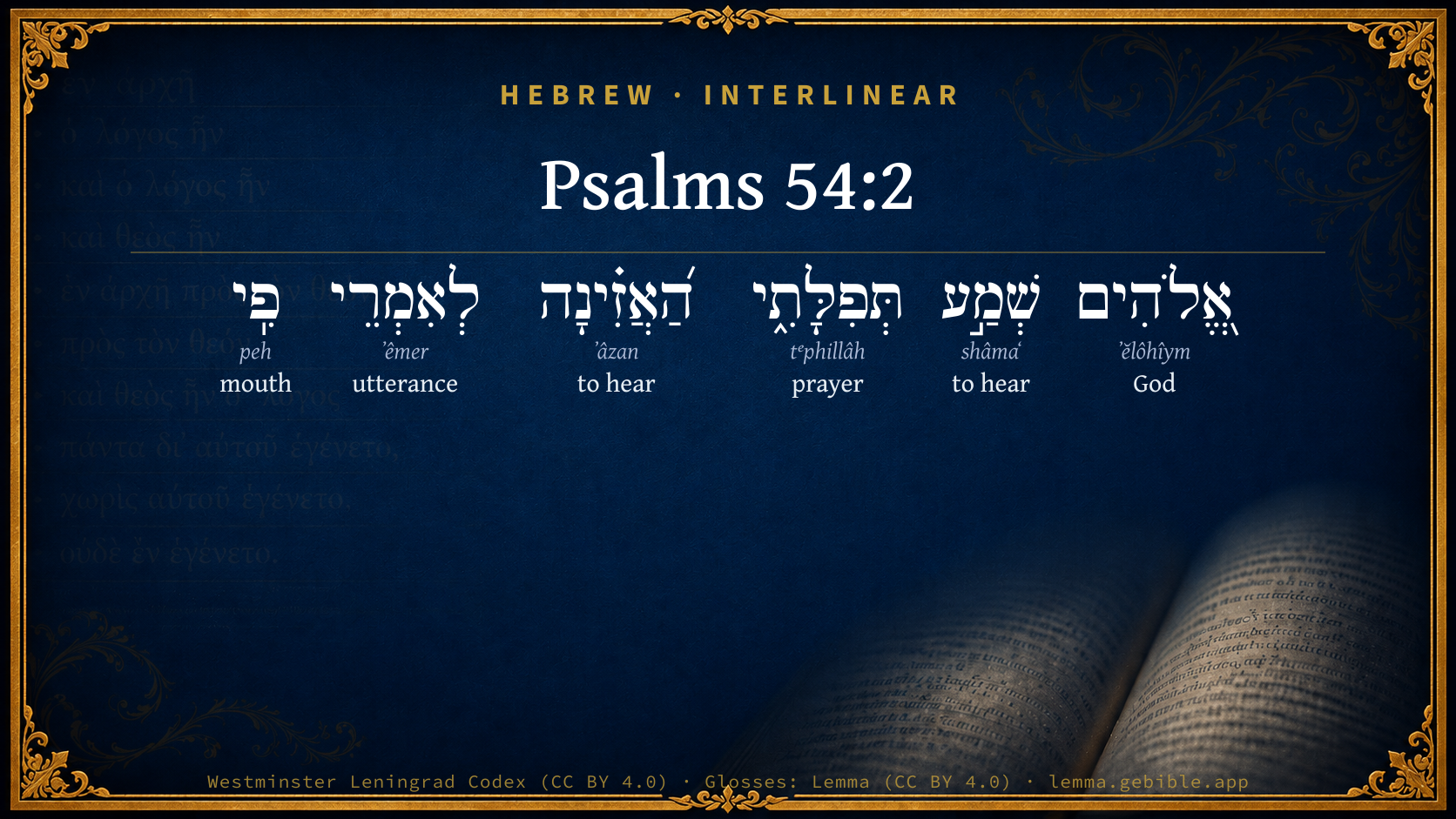
Hebrew (Westminster Leningrad Codex) Psalms 54:2 appears in the Hebrew Old Testament. The text above is from the Westminster Leningrad Codex. Each word links to its Strong’s number, a concise gloss, and parsing drawn from the Open Scriptures Hebrew Bible morphology. Click any word for its full Brown-Driver-Briggs (BDB) entry.
Download image
Cite this verse

Psalms 54:2 (World English Bible). Public Domain. Lemma interlinear Bible study tool, https://lemma.gebible.app/v/psalms/54/2.

Show BibTeX & RIS
BibTeX
RIS
English Translation
Hear my prayer, God. Listen to the words of my mouth.
World English Bible · Public Domain
Download a study sheet

One document with this verse’s original text, its word-by-word gloss line, the meaning frame, cross-references with their text, attributed commentary, and full source and license credits — printable, and it pastes into notes with its structure intact.

This verse Autodidact and up

Study sheet (.html) Plain text (.txt)

A passage Seminary Student

Up to 50 verses in one chapter. A passage sheet keeps up to 6 commentary sources and 12 cross-references per verse, in the order this page ranks them, and says so on the sheet whenever that leaves anything out. Ask for a single verse and you get the Autodidact verse sheet above.

Everything on this page stays free to read, with no account — the sheet is a download of what is already on screen, not access to it.

Want to remove ads? Support Godless Engineer
Compare translations 3

The same verse in 3 English versions, stacked beneath the original-language interlinear above. Click any original word for its lexicon entry.

Each is an independent rendering of the whole verse — the interlinear is not word-aligned to these translations.

Highlighted words mark where these versions differ — a whole-verse word diff, not a word-by-word alignment.

  • World English Bible Public Domain
    Hear my prayer, God. Listen to the words of my mouth.
  • King James Version Public Domain
    Hear my prayer, O God; give ear to the words of my mouth.
  • unfoldingWord Literal Text CC BY-SA 4.0
    Hear my prayer, God; listen to the words of my mouth.

unfoldingWord Literal Text — © unfoldingWord, licensed CC BY-SA 4.0. Word-aligned USFM3 via Door43 (git.door43.org/unfoldingWord/en_ult).

Versions to compare (up to 4)

3 of 4 selected

Show all 17 translations

Every available English version of this verse, each an independent rendering of the whole verse.

  • World English Bible Public Domain
    Hear my prayer, God. Listen to the words of my mouth.
  • Berean Standard Bible Public Domain
    Hear my prayer, O God; listen to the words of my mouth.
  • Majority Standard Bible Public Domain
    Hear my prayer, O God; listen to the words of my mouth.
  • King James Version Public Domain
    Hear my prayer, O God; give ear to the words of my mouth.
  • American Standard Version (1901) Public Domain
    Hear my prayer, O God; Give ear to the words of my mouth.
  • Revised Version (1885) Public Domain
    Hear my prayer, O God; give ear to the words of my mouth.
  • Geneva Bible (1599) Public Domain
    O God, heare my prayer: hearken vnto the wordes of my mouth.
  • Douay-Rheims (1899) Public Domain
    When the men of Ziph had come and said to Saul: Is not David hidden with us?
  • Young's Literal Translation Public Domain
    O God, hear my prayer, Give ear to the sayings of my mouth,
  • Literal Standard Version CC BY-SA 4.0
    O God, hear my prayer, || Give ear to the sayings of my mouth,
  • Unlocked Literal Bible CC BY-SA 4.0
    Hear my prayer, God; give ear to the words of my mouth.
  • unfoldingWord Literal Text CC BY-SA 4.0
    Hear my prayer, God; listen to the words of my mouth.
  • Darby Bible Public Domain
    O God, hear my prayer; give ear to the words of my mouth.
  • World Messianic Bible Public Domain
    Hear my prayer, God. Listen to the words of my mouth.
  • Free Bible Version CC BY-SA 4.0
    God, please hear my prayer; listen to what I'm saying.
  • Bible in Basic English Public Domain
    Let my prayer come before you, O God; give ear to the words of my mouth.
  • JPS Tanakh (1917) Public Domain
    (54-4) O God, hear my prayer; give ear to the words of my mouth.

Literal Standard Version (2020), Covenant Press — licensed CC BY-SA 4.0. Text via the HelloAO Bible API (eBible.org). Unlocked Literal Bible (unfoldingWord) — licensed CC BY-SA 4.0. Text via the HelloAO Bible API (eBible.org). unfoldingWord Literal Text — © unfoldingWord, licensed CC BY-SA 4.0. Word-aligned USFM3 via Door43 (git.door43.org/unfoldingWord/en_ult). Free Bible Version, Dr. Jonathan Gallagher — licensed CC BY-SA 4.0. Text via the HelloAO Bible API (eBible.org).

Word by word

More ways to search: Search by grammar → Find every occurrence → Compare this word →

Practice this passage: Drill this verse → Learn its vocabulary →

About this verse

These counts appear in no published source. They are computed here, from the morphology-tagged text and Lemma’s own curated glosses. What Lemma adds →

6
words
6
distinct lemmas
Wisdom
section

Shared distinctive vocabulary

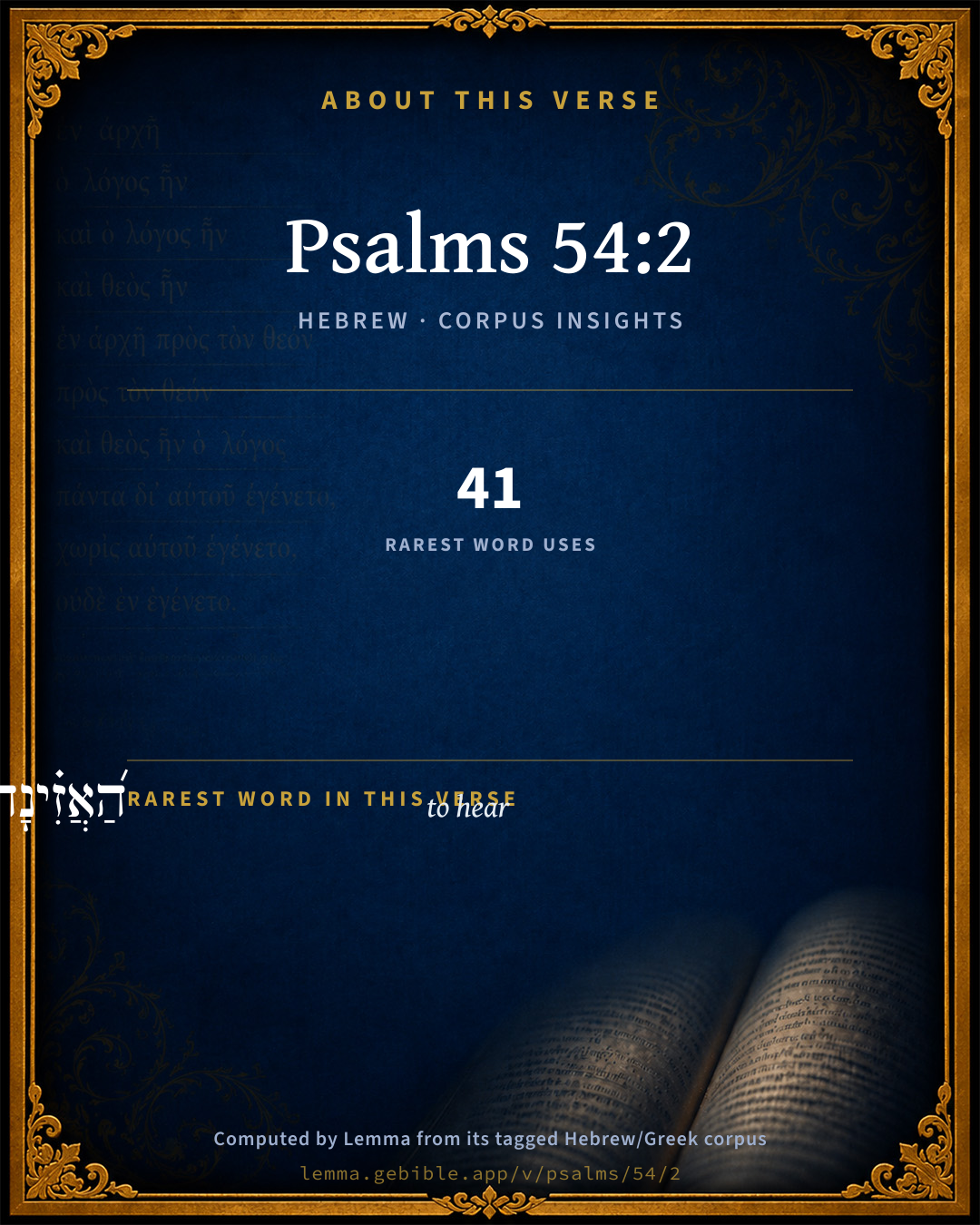
הַ֝אֲזִ֗ינָה to hear H238 occurs in 41 verses of the Hebrew Bible. Also found in:

Grammatical profile

  • 2 verbs
  • 4 nouns

Verb forms

  • שְׁמַ֣ע Qal · Imperative
  • הַ֝אֲזִ֗ינָה Hiphil · Imperative

Hebrew & Septuagint length

In English translation the verse runs 11 words from the Hebrew and 12 from the Septuagint (LXX English) — closely comparable.

A rough comparison of the two English renderings, which tokenize alike — not a word-level alignment.

Word counts can differ between the Hebrew and the Greek without any difference in meaning — e.g. the Hebrew direct-object marker אֵת has no separate Greek word, and Greek often adds the article ὁ.

Cross-references

5

Topical passages linked to Psalms 54:2 in the Treasury of Scripture Knowledge — connected by theme and wording, ordered by reader-vote popularity; previews shown in the World English Bible.

  • Psalms 130:2 Lord, hear my voice. Let your ears be attentive to the voice of my petitions.
  • Psalms 13:3 Behold, and answer me, Yahweh, my God. Give light to my eyes, lest I sleep in death;
  • Psalms 143:7 Hurry to answer me, Yahweh. My spirit fails. Don't hide your face from me, So that I don't become like those who go down into the pit.
  • Psalms 5:1–3 Give ear to my words, Yahweh. Consider my meditation.
  • Psalms 55:1–2 Listen to my prayer, God. Don't hide yourself from my supplication.

Cross-references courtesy of OpenBible.info (CC BY 4.0).

Hebrew and Greek witnesses Masoretic Hebrew ↔ Greek Septuagint

The same verse in the two great witnesses to the Old Testament, shown verse-for-verse.

You’re reading Greek Psalm 53 (Hebrew Psalm 54). The Septuagint counts the superscription, so verse numbers can differ from the Hebrew — chapter-level alignment, not verse-by-verse. Numbering follows Rahlfs.

These are two independent witnesses, not word-aligned to each other, and the Septuagint is shown in lemma (dictionary) form.

Hebrew Psalms 54:2 Masoretic · Westminster Leningrad Codex

אֱ֭לֹהִים שְׁמַ֣ע תְּפִלָּתִ֑י הַ֝אֲזִ֗ינָה לְאִמְרֵי פִֽי

Hear my prayer, God. Listen to the words of my mouth.

World English Bible · Public Domain

Greek LXX Greek Psalm 53:2 Septuagint · lemma form

ἐν ὁ ἔρχομαι ὁ ζιφαίος καί εἶπον ὁ σαουλ οὐ ἰδού δαυίδ κρύπτω παρά ἐγώ

O God, hear my prayer; listen to the words of my mouth.

LXX2012 (modern English Septuagint) · Public Domain

Hebrew: Westminster Leningrad Codex (CC BY 4.0). Greek: Septuagint (public domain); English from LXX2012 (modern English Septuagint) (Public Domain). How the Septuagint differs from the Hebrew →

Commentary

Notes on Psalms 54:2 from classic Christian and Jewish commentators (each source and its license shown beneath its notes). The classic Christian expositions comment on the surrounding passage and are grouped to its opening verse, so a note may address several verses; the Jewish commentaries on the Tanakh (Rashi and others) are per-verse, so they appear only where the commentator wrote on this verse.

Lemma curates 59 commentaries, every one of them public domain or Creative Commons licensed, each selected and text-cleaned for this edition rather than reprinted as found. About our sources →

Trapp's Complete Commentary

John Trapp

Psa 54:2 Hear my prayer, O God; give ear to the words of my mouth.

Ver. 2. Hear my prayer, O God] He runs to God by most earnest prayer, for our instance and instruction in like case; for we must prepare for the like trials, nec de cruce disputandum est otiose et velut in umbra, &c.

John Trapp, A Commentary or Exposition upon All the Books of the Old and New Testament (1647–1656) — public domain. Text from a community e-Sword module.

J. A. Alexander on Psalms

Joseph Addison Alexander

2. In the coming of the Ziphites, and they said to Saul, (Is) not David hiding himself with us? The verse gives the historical occasion of the composition, in the same form as in the titles of Psalms 51 and Psalms 52. Such an occurrence is twice recorded in the history, 1Sa 23:19; 1Sa 26:1. The verbal coincidence is greater in the first case. The words of the Ziphites seem to have been remembered on account of some peculiarity in the expression, perhaps the use of the reflexive participle, which remains unchanged in all three places, the earliest of which is probably the one before us. The interrogation implies surprise that Saul should be ignorant of what was so notorious. Hiding himself, now engaged in doing so, not merely wont to do so, or already hidden. With us, among us, or in our land, i.e. the wilderness or pasture ground of Ziph (1Sa 23:14-15), in or near which was a town of the same name (Jos 15:55, 2Ch 11:8), the ruins of which are thought to be still visible, not far from what the natives call Tell Ziph, or the Hill of Ziph. (Robinson's Palestine, II. 191.)

4. (Psa 54:2). O God, hear my prayer, give ear to the sayings of my mouth. See above, on Psa 4:1, Psa 5:1.

Joseph Addison Alexander, The Psalms Translated and Explained (1850) — public domain. Text from a community e-Sword module.

Jamieson, Fausset & Brown

Robert Jamieson, A. R. Fausset & David Brown

(Compare Psa 4:1; Psa 5:1).

Jamieson, Fausset & Brown — Commentary Critical and Explanatory on the Whole Bible (1871) — public domain (CC PDM 1.0). Text via the HelloAO Bible API.

Adam Clarke's Commentary

Verse 2. Hear my prayer] In his straits he had recourse to God; for from him alone, for the reasons alleged above, his deliverance must proceed.

Adam Clarke's Commentary on the Bible (1810–1826) — public domain. Text from a community e-Sword/MySword module.

John Calvin's Commentaries

2. Hear my prayer, O God! The language is expressive of his earnestness. He was led to this fervor of supplication by the extremity of his present circumstances, which is alluded to in the following verse, where he complains of being surrounded by men fierce, barbarous, and unrestrained by a sense of religion. There was no necessity for his informing God of a fact which was already known to him; but he disburdens his own heart by venting the cause of his fear and disquietude. By calling his enemies strangers, he seems to refer to their barbarity, whether he applied the name to the Ziphites only, or, in general, to the whole army of Saul. Others consider him, in this term, to advert to their degeneracy as children of Abraham; and it is true that the Jews are repeatedly stigmatised by the prophets under this form of expression, when they had cast themselves out of the Church of God by their profligacy or impiety. But in this passage it seems to be used in a different sense. As even enemies are accustomed, in some measure, to respect the ties of kindred and relationship, David would point out to us the monstrous inhumanity of the men who now surrounded him, by the fact that they assaulted him as strangers, as persons who had never known him, or as if he had been born in some distant part of the world. He calls them, also, terrible ones, not mighty, or powerful ones, as some have rendered the word; for that falls short of the meaning intended by David, which was, that they were divested of all humanity, and ready to rush upon him like wild beasts. Hence the fear with which he resorted to the protection of God. He adds, that they sought after his soul, to denote that nothing would content their insatiable cruelty but his life. And the better to express the unbridled nature of their fury, he tells us that they had no respect to God. The only thing which could be supposed, in the circumstances, to act as a restraint upon their minds, was the consideration of there being a judge in heaven to whom they were amenable for their conduct; and being insensible to this, what moderation could be expected of them?

John Calvin's Commentaries (1540-1563) — public domain. Text from the Calvin Translation Society English edition (1840s-50s) via the Christian Classics Ethereal Library (ccel.org). Calvin's coverage is partial (roughly two-thirds of the Bible); uncommented books and verses are honest gaps, never fabricated. The 19th-century editor's footnotes and remarks are omitted so the notes are faithfully Calvin's own voice.

John Gill's Exposition

Hear my prayer, O God,.... The psalmist first puts up his petitions, and then desires to be heard; his distress, and the fervency of his spirit, not suffering him to observe order;

give ear to the words of my mouth; for the prayer which was conceived in his mind, and inwrought there by the Spirit of God, was expressed vocally.

John Gill's Exposition of the Whole Bible (1746–1763) — public domain (CC PDM 1.0). Text via the HelloAO Bible API.

Albert Barnes' Notes on the Bible

Hear my prayer, O God - My earnest cry for deliverance from the designs of those who would betray me.

Give ear to the words of my mouth - Incline thine ear to me, as one does who wishes to hear. See the notes at Psa 17:6.

Albert Barnes' Notes on the Bible (1834–1885) — public domain. Text from a community e-Sword/MySword module.

The Treasury of David

Charles H. Spurgeon

Ver. 2. Hear my prayer, O God. This has ever been the defence of saints. As long as God hath an open ear we cannot be shut up in trouble. All other weapons may be useless, but all prayer is evermore available. No enemy can spike this gun.

Give ear to the words of my mouth. Vocal prayer helps the supplicant, and we keep our minds more fully awake when we can use our tongues as well as our hearts. But what is prayer if God hear not? It is all one whether we babble nonsense or plead arguments if our God grant us not a hearing. When his case had become dangerous, David could not afford to pray out of mere custom, he must succeed in his pleadings, or become the prey of his adversary.

Ver. 2. (second clause). Let the words of my mouth with which I have defended my cause, be pleasing and acceptable to thee. For in this way can prayers and words of the mouth be correctly distinguished, unless any one should wish simply to understand by them prayers uttered by the mouth; but, as I have said, the phrase is more emphatic. Hermann Venema, 1697-1787.

Ver. 2. Our main concern in prayer.

I. What is meant by God's hearing prayer.

II. How we may know that he has done so.

III. What is to be done when this is doubtful.

IV. What is due to him when the hearing is given.

Psalms 54:3*

Charles H. Spurgeon's The Treasury of David (1869–1885) — public domain. Psalms only. Text from a community e-Sword/MySword module.

The Pulpit Commentary

Hear my prayer, O God; give ear to the words of my mouth. . (comp. Psa_39:12 Psa_55:1)

The Pulpit Commentary (1880–1919), ed. H.D.M. Spence-Jones & Joseph S. Exell — public domain. Text from a community e-Sword module.

Lesson kit

Teaching starters — assembled from the data on this page, not authored interpretation. Every prompt links to the verse data it draws on. Edit before teaching.

Psalms, in the Wisdom, opens this verse with 6 words (6 distinct Hebrew lemmas). Its most distinctive word is ʼâzan (“to hear”). A historical commentator’s framing appears above. Read the whole chapter for the surrounding context.

Discussion questions

  1. The word ʼâzan carries the sense “to hear.” How does it shape the verse?
  2. How does Genesis 4:23, which shares the word «to hear», read alongside this verse?
  3. These translations render this verse differently. What is at stake in choosing one wording over another?
  4. «שְׁמַ֣ע» is a Qal Imperative verb. How does that grammatical form shape the action described?
  5. Compare how Trapp's Complete Commentary and J. A. Alexander on Psalms read this verse. Where do they agree or differ?

Things to notice

Reading settings

Reading text

Shown beneath each verse's original-language words.

Old Testament
Old Testament edition

Read the OT as the Masoretic Hebrew (MT) or the Greek Septuagint (LXX).

English shown for the Greek Septuagint (in the Hebrew ↔ Greek comparison).

Comparing translations? Open the Compare panel on any verse page to stack up to four side by side.