
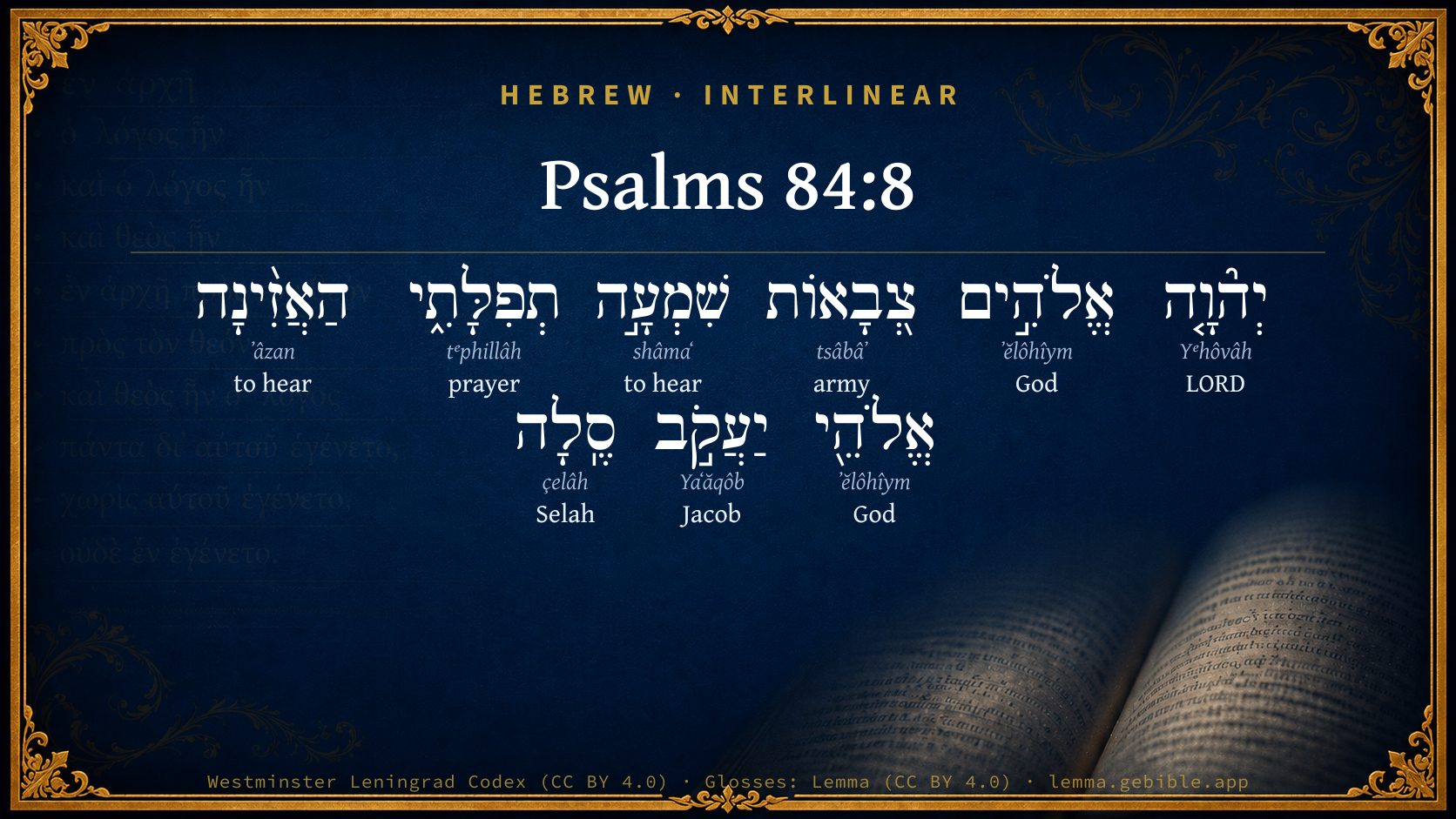
Psalms 84:8

Hebrew (Westminster Leningrad Codex) Psalms 84:8 appears in the Hebrew Old Testament. The text above is from the Westminster Leningrad Codex. Each word links to its Strong’s number, a concise gloss, and parsing drawn from the Open Scriptures Hebrew Bible morphology. Click any word for its full Brown-Driver-Briggs (BDB) entry.
Download image
Cite this verse

Psalms 84:8 (World English Bible). Public Domain. Lemma interlinear Bible study tool, https://lemma.gebible.app/v/psalms/84/8.

Show BibTeX & RIS
BibTeX
RIS
English Translation
Yahweh, God of hosts, hear my prayer. Listen, God of Jacob. Selah.
World English Bible · Public Domain
Download a study sheet

One document with this verse’s original text, its word-by-word gloss line, the meaning frame, cross-references with their text, attributed commentary, and full source and license credits — printable, and it pastes into notes with its structure intact.

This verse Autodidact and up

Study sheet (.html) Plain text (.txt)

A passage Seminary Student

Up to 50 verses in one chapter. A passage sheet keeps up to 6 commentary sources and 12 cross-references per verse, in the order this page ranks them, and says so on the sheet whenever that leaves anything out. Ask for a single verse and you get the Autodidact verse sheet above.

Everything on this page stays free to read, with no account — the sheet is a download of what is already on screen, not access to it.

Want to remove ads? Support Godless Engineer
Compare translations 3

The same verse in 3 English versions, stacked beneath the original-language interlinear above. Click any original word for its lexicon entry.

Each is an independent rendering of the whole verse — the interlinear is not word-aligned to these translations.

Highlighted words mark where these versions differ — a whole-verse word diff, not a word-by-word alignment.

  • World English Bible Public Domain
    Yahweh, God of hosts, hear my prayer. Listen, God of Jacob. Selah.
  • King James Version Public Domain
    O LORD God of hosts, hear my prayer: give ear, O God of Jacob. Selah.
  • unfoldingWord Literal Text CC BY-SA 4.0
    Yahweh, God of armies, hear my prayer; listen, God of Jacob. Selah

unfoldingWord Literal Text — © unfoldingWord, licensed CC BY-SA 4.0. Word-aligned USFM3 via Door43 (git.door43.org/unfoldingWord/en_ult).

Versions to compare (up to 4)

3 of 4 selected

Show all 18 translations

Every available English version of this verse, each an independent rendering of the whole verse.

  • World English Bible Public Domain
    Yahweh, God of hosts, hear my prayer. Listen, God of Jacob. Selah.
  • Berean Standard Bible Public Domain
    O LORD God of Hosts, hear my prayer; give ear, O God of Jacob. Selah
  • Majority Standard Bible Public Domain
    O LORD God of Hosts, hear my prayer; give ear, O God of Jacob. Selah
  • King James Version Public Domain
    O LORD God of hosts, hear my prayer: give ear, O God of Jacob. Selah.
  • American Standard Version (1901) Public Domain
    O Jehovah God of hosts, hear my prayer; Give ear, O God of Jacob. Selah
  • Revised Version (1885) Public Domain
    O LORD God of hosts, hear my prayer: give ear, O God of Jacob. Selah
  • Geneva Bible (1599) Public Domain
    O Lord God of hostes, heare my prayer: hearken, O God of Iaakob. Selah.
  • Douay-Rheims (1899) Public Domain
    For the lawgiver shall give a blessing, they shall go from virtue to virtue: the God of gods shall be seen in Sion.
  • Young's Literal Translation Public Domain
    O Jehovah, God of Hosts, hear my prayer, Give ear, O God of Jacob. Selah.
  • Literal Standard Version CC BY-SA 4.0
    O YHWH, God of Hosts, hear my prayer, || Give ear, O God of Jacob. Selah.
  • Unlocked Literal Bible CC BY-SA 4.0
    Yahweh God of hosts, hear my prayer; God of Jacob, listen to what I am saying! Selah
  • unfoldingWord Literal Text CC BY-SA 4.0
    Yahweh, God of armies, hear my prayer; listen, God of Jacob. Selah
  • Darby Bible Public Domain
    Jehovah, God of hosts, hear my prayer; give ear, O God of Jacob. Selah.
  • World Messianic Bible Public Domain
    LORD, God of Hosts, hear my prayer. Listen, God of Jacob. Selah.
  • Webster's Bible Public Domain
    \\84:7\\They go from strength to strength, every one of them in Zion appeareth before God.
  • Free Bible Version CC BY-SA 4.0
    Lord God Almighty, please hear my prayer; please listen, God of Jacob. Selah.
  • Bible in Basic English Public Domain
    O Lord God of armies, let my prayer come to you: give ear, O God of Jacob. (Selah.)
  • JPS Tanakh (1917) Public Domain
    (84-9) O LORD God of hosts, hear my prayer; give ear, O God of Jacob. Selah

Literal Standard Version (2020), Covenant Press — licensed CC BY-SA 4.0. Text via the HelloAO Bible API (eBible.org). Unlocked Literal Bible (unfoldingWord) — licensed CC BY-SA 4.0. Text via the HelloAO Bible API (eBible.org). unfoldingWord Literal Text — © unfoldingWord, licensed CC BY-SA 4.0. Word-aligned USFM3 via Door43 (git.door43.org/unfoldingWord/en_ult). Free Bible Version, Dr. Jonathan Gallagher — licensed CC BY-SA 4.0. Text via the HelloAO Bible API (eBible.org).

Word by word

More ways to search: Search by grammar → Find every occurrence → Compare this word →

Practice this passage: Drill this verse → Learn its vocabulary →

About this verse

These counts appear in no published source. They are computed here, from the morphology-tagged text and Lemma’s own curated glosses. What Lemma adds →

9
words
8
distinct lemmas
Wisdom
section

Shared distinctive vocabulary

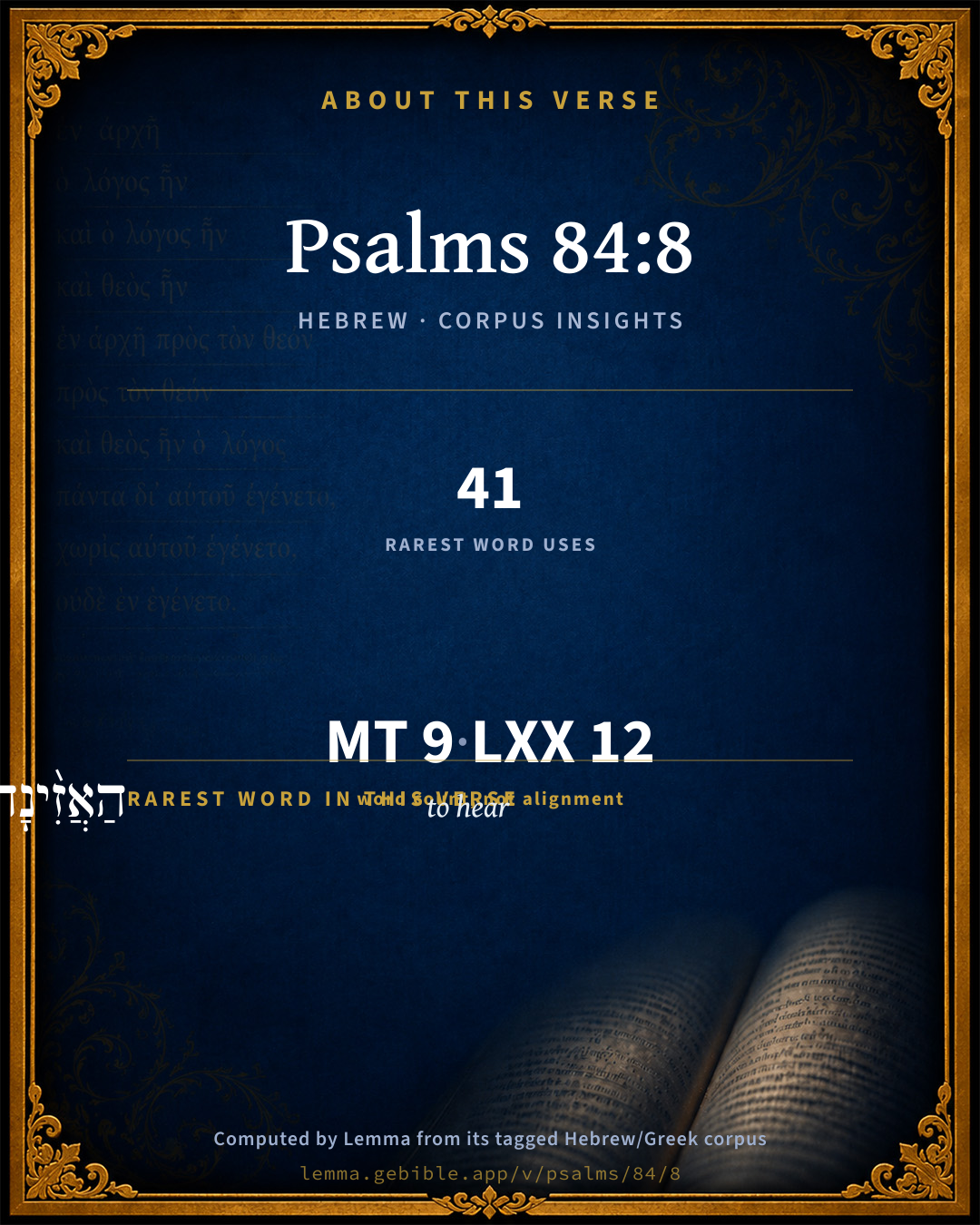
הַאֲזִ֨ינָה to hear H238 occurs in 41 verses of the Hebrew Bible. Also found in:

Grammatical profile

  • 2 verbs
  • 6 nouns
  • 1 particle

Verb forms

  • שִׁמְעָ֣ה Qal · Imperative
  • הַאֲזִ֨ינָה Hiphil · Imperative

Repetition

A word recurs within this verse — often emphatic in Hebrew:

  • אֱלֹהִ֣ים God H430 ×2

Hebrew & Septuagint length

In English translation the verse runs 12 words from the Hebrew and 14 from the Septuagint (LXX English) — closely comparable.

A rough comparison of the two English renderings, which tokenize alike — not a word-level alignment.

Word counts can differ between the Hebrew and the Greek without any difference in meaning — e.g. the Hebrew direct-object marker אֵת has no separate Greek word, and Greek often adds the article ὁ.

In the original languages it is 9 Hebrew tokens and 12 Greek tokens — but the two are counted differently (Hebrew bundles its prefixes and suffixes into one token; the Greek is in lemma form), so that isn’t a like-for-like length.

Hebrew and Greek witnesses Masoretic Hebrew ↔ Greek Septuagint

The same verse in the two great witnesses to the Old Testament, shown verse-for-verse.

You’re reading Greek Psalm 83 (Hebrew Psalm 84). The Septuagint counts the superscription, so verse numbers can differ from the Hebrew — chapter-level alignment, not verse-by-verse. Numbering follows Rahlfs.

These are two independent witnesses, not word-aligned to each other, and the Septuagint is shown in lemma (dictionary) form.

Hebrew Psalms 84:8 Masoretic · Westminster Leningrad Codex

יְה֘וָ֤ה אֱלֹהִ֣ים צְ֭בָאוֹת שִׁמְעָ֣ה תְפִלָּתִ֑י הַאֲזִ֨ינָה אֱלֹהֵ֖י יַעֲקֹ֣ב סֶֽלָה

Yahweh, God of hosts, hear my prayer. Listen, God of Jacob. Selah.

World English Bible · Public Domain

Greek LXX Greek Psalm 83:8 Septuagint · lemma form

πορεύομαι ἐκ δύναμις εἰς δύναμις ὁράω ὁ θεός ὁ θεός ἐν σιων

O Lord God of hosts, hear my prayer: listen, O God of Jacob. Pause.

LXX2012 (modern English Septuagint) · Public Domain

Hebrew: Westminster Leningrad Codex (CC BY 4.0). Greek: Septuagint (public domain); English from LXX2012 (modern English Septuagint) (Public Domain). How the Septuagint differs from the Hebrew →

Commentary

Notes on Psalms 84:8 from classic Christian and Jewish commentators (each source and its license shown beneath its notes). The classic Christian expositions comment on the surrounding passage and are grouped to its opening verse, so a note may address several verses; the Jewish commentaries on the Tanakh (Rashi and others) are per-verse, so they appear only where the commentator wrote on this verse.

Lemma curates 59 commentaries, every one of them public domain or Creative Commons licensed, each selected and text-cleaned for this edition rather than reprinted as found. About our sources →

Matthew Henry's Commentary

Here, I. The psalmist prays for audience and acceptance with God, not mentioning particularly what he desired God would do for him. He needed to say no more when he had professed such an affectionate esteem for the ordinances of God, which now he was restrained and banished from. All his desire was, in that profession, plainly before God, and his longing, his groaning, was not hidden from him; therefore he prays (Psa 84:8, Psa 84:9) only that God would hear his prayer and give ear, that he would behold his condition, behold his good affection, and look upon his face, which way it was set, and how his countenance discovered the longing desire he had towards God's courts. He calls himself (as many think) God's anointed, for David was anointed by him and anointed for him. In this petition, 1. He has an eye to God under several of his glorious titles - as the Lord God of hosts, who has all the creatures at his command, and therefore has all power both in heaven and in earth, - as the God of Jacob, a God in covenant with his own people, a God who never said to the praying seed of Jacob, Seek you me in vain, - and as God our shield, who takes his people under his special protection, pursuant to his covenant with Abraham their father. Gen 15:1, Fear not, Abraham, I am thy shield. When David could not be hidden in the secret of God's tabernacle (Psa 27:5), being at a distance from it, yet he hoped to find God his shield ready to him wherever he was. 2. He has an eye to the Mediator; for of him I rather understand those words, Look upon the face of thy Messiah, thy anointed one, for of his anointing David spoke, Psa 45:7. In all our addresses to God we must desire that he would look upon the face of Christ, accept us for his sake, and be well-pleased with us in him. We must look with an eye of faith, and then God will with an eye of favour look upon the face of the anointed, who does show his face when we without him dare not show ours.

II. He pleads his love to God's ordinances and his dependence upon God himself.

1. God's courts were his choice, Psa 84:10. A very great regard he had for holy ordinances: he valued them above any thing else, and he expresses his value for them, (1.) By preferring the time of God's worship before all other time: A day spent in thy courts, in attending on the services of religion, wholly abstracted from all secular affairs, is better than a thousand, not than a thousand in thy courts, but any where else in this world, though in the midst of all the delights of the children of men. Better than a thousand, he does not say days, you may supply it with years, with ages, if you will, and yet David will set his hand to it. "A day in thy courts, a sabbath day, a holy day, a feast-day, though but one day, would be very welcome to me; nay" (as some of the rabbin paraphrase it), "though I were to die for it the next day, yet that would be more sweet than years spent in the business and pleasure of this world. One of these days shall with its pleasure chase a thousand, and two put ten thousand to flight, to shame, as not worthy to be compared." (2.) By preferring the place of worship before any other place: I would rather be a door-keeper, rather be in the meanest place and office, in the house of my God, than dwell in state, as master, in the tents of wickedness. Observe, He calls even the tabernacle a house, for the presence of God in it made even those curtains more stately than a palace and more strong than a castle. It is the house of my God; the covenant-interest he had in God as his God was the sweet string on which he loved dearly to be harping; those, and those only, who can, upon good ground, call God theirs, delight in the courts of his house. I would rather be a porter in God's house than a prince in those tents where wickedness reigns, rather lie at the threshold (so the word is); that was the beggar's place (Act 3:2): "no matter" (says David), "let that be my place rather than none." The Pharisees loved synagogues well enough, provided they might have the uppermost seats there (Mat 23:6), that they might make a figure. Holy David is not solicitous about that; if he may but be admitted to the threshold, he will say, Master, it is good to be here. Some read it, I would rather be fixed to a post in the house of my God than live at liberty in the tents of wickedness, alluding to the law concerning servants, who, if they would not go out free, were to have their ear bored to the door-post, Exo 21:5, Exo 21:6. David loved his master and loved his work so well that he desired to be tied to this service for ever, to be more free to it, but never to go out free from it, preferring bonds to duty far before the greatest liberty to sin. Such a superlative delight have holy hearts in holy duties; no satisfaction in their account comparable to that in communion with God.

2. God himself was his hope, and joy, and all. Therefore he loved the house of his God, because his expectation was from his God, and there he used to communicate himself, Psa 84:11. See, (1.) What God is, and will be, to his people: The Lord God is a sun and shield. We are here in darkness, but, if God be our God, he will be to us a sun, to enlighten and enliven us, to guide and direct us. We are here in danger, but he will be to us a shield to secure us from the fiery darts that fly thickly about us. With his favour he will compass us as with a shield. Let us therefore always walk in the light of the Lord, and never throw ourselves out of his protection, and we shall find him a sun to supply us with all good and a shield to shelter us from all evil. (2.) What he does, and will, bestow upon them: The Lord will give grace and glory. Grace signifies both the good-will of God towards us and the good work of God in us; glory signifies both the honour which he now puts upon us, in giving us the adoption of sons, and that which he has prepared for us in the inheritance of sons. God will give them grace in this world as a preparation for glory, and glory in the other world as the perfection of grace; both are God's gift, his free gift. And as, on the one hand, wherever God gives grace he will give glory (for grace is glory begun, and is an earnest of it), so, on the other hand, he will give glory hereafter to none to whom he does not give grace now, or who receive his grace in vain. And if God will give grace and glory, which are the two great things that concur to make us happy in both worlds, we may be sure that no good thing will be withheld from those that walk uprightly. It is the character of all good people that they walk uprightly, that they worship God in spirit and in truth, and have their conversation in the world in simplicity and godly sincerity; and such may be sure that God will withhold no good thing from them, that is requisite to their comfortable passage through this world. Make sure grace and glory, and other things shall be added. This is a comprehensive promise, and is such an assurance of the present comfort of the saints that, whatever they desire, and think they need, they may be sure that either Infinite Wisdom sees it is not good for them or Infinite Goodness will give it to them in due time. Let it be our care to walk uprightly, and then let us trust God to give us every thing that is good for us.

Lastly, He pronounces those blessed who put their confidence in God, as he did, Psa 84:12. Those are blessed who have the liberty of ordinances and the privileges of God's house. But, though we should be debarred from them, yet we are not therefore debarred from blessedness if we trust in God. If we cannot go to the house of the Lord, we may go by faith to the Lord of the house, and in him we shall be happy and may be easy.

Matthew Henry's Commentary on the Whole Bible (1708–1710) — public domain (CC PDM 1.0). Text via the HelloAO Bible API.

Trapp's Complete Commentary

John Trapp

Psa 84:8 O LORD God of hosts, hear my prayer: give ear, O God of Jacob. Selah.

Ver. 8. O Lord God of hosts, hear my prayer] Satisfy my yearnings, pantings, and inquietations of mind after the liberty of thy sanctuary, Psa 84:2. These very desires he calleth prayers.

John Trapp, A Commentary or Exposition upon All the Books of the Old and New Testament (1647–1656) — public domain. Text from a community e-Sword module.

Joseph Benson's Commentary

Psa 84:8-9. O Lord God of hosts — Who canst easily remove and subdue those enemies who banish and keep me from the place of thy worship; hear my prayer — In restoring me to thy house and service; which is my chief desire, Psa 84:2-3. Behold, O God our shield — Look graciously upon me, O thou that takest thy people under thy peculiar protection, pursuant to thy covenant with Abraham our father, and who hast hitherto been our defence against the most powerful enemies; and look upon the face of thine anointed — Upon me, who, though a vile sinner, am thine anointed king. Or, by God’s anointed, he may mean Christ, whose proper name is the Messiah, or, the anointed One. So the sense may be, Lord, I deserve not one kind look from thee, because, by my great wickedness, I have procured thy just displeasure and this banishment; but look upon thy Christ, whose coming and meritorious passion, though future to us, are present to thee, and for his sake look upon me.

Joseph Benson's Commentary on the Old and New Testaments (1811–1818) — public domain. Text from a community e-Sword module.

J. A. Alexander on Psalms

Joseph Addison Alexander

9. (Psa 84:8) Jehovah, God, (Lord of) Hosts, hear my prayer; give ear, O God of Jacob! Selah. Here begins the second part of the psalm, containing the petition founded on the preceding view of the happiness arising from communion with God. The names applied to him suggest, as usual, the grounds of the petition, namely, his eternity, self-existence, sovereignty, and covenant relation to his people.

Joseph Addison Alexander, The Psalms Translated and Explained (1850) — public domain. Text from a community e-Sword module.

Adam Clarke's Commentary

Verse 8. Hear my prayer] Let us be restored to thy sanctuary, and to thy worship.

Adam Clarke's Commentary on the Bible (1810–1826) — public domain. Text from a community e-Sword/MySword module.

John Calvin's Commentaries

8 O Jehovah, God of Hosts! hear my prayer. David, instead of acting like worldly men, who foolishly and unprofitably distress and torment themselves by inwardly cherishing their desires, very wisely directs his wishes and prayers to God. From this it is also evident, that he was not accustomed to indulge in ostentatious boasting, as is the case with many hypocrites, who present to outward appearance a wonderful ardor of zeal, while yet the omniscient eye of God sees nothing but coldness in their hearts. In the first place, he supplicates in general, that God would vouchsafe to hear him. He next anticipates a temptation which might very readily arise from his being at present apparently cut off from the Church, and wards it off, by associating and ranking himself with all true believers, under the protection of God. Had he not been a member of the Church, he could not have said generally, and as it were in the person of all its members, Our shield. Having made this statement, he uses language still more expressive of high privilege, adducing the royal anointing with which God had honored him by the hand of Samuel, 1 Samuel 16:12. These words, Look upon the face of thy anointed, are very emphatic, and yet many interpreters pass over them very frigidly. He encourages himself in the hope of obtaining the favor of God, from the consideration that he had been anointed king in compliance with a divine command. Knowing, however, that his kingdom was merely a shadow and type of something more illustrious, there is no doubt, that in uttering these words, the object which he aspired after was, to obtain the divine favor through the intervention of the Mediator of whom he was a type. I am personally unworthy, as if he had said, that thou shouldest restore me, but the anointing by which thou hast made me a type of the only Redeemer will secure this blessing for me. We are thus taught, that the only way in which God becomes reconciled to us is through the mediation of Christ, whose presence scatters and dissipates all the dark clouds of our sins.

John Calvin's Commentaries (1540-1563) — public domain. Text from the Calvin Translation Society English edition (1840s-50s) via the Christian Classics Ethereal Library (ccel.org). Calvin's coverage is partial (roughly two-thirds of the Bible); uncommented books and verses are honest gaps, never fabricated. The 19th-century editor's footnotes and remarks are omitted so the notes are faithfully Calvin's own voice.

The Cambridge Bible for Schools and Colleges

gen. ed. J. J. S. Perowne

8. A prayer for favourable audience, uttered apparently by the Psalmist as the leader of the pilgrims on their arrival in the Temple.

The Cambridge Bible for Schools and Colleges (gen. ed. J. J. S. Perowne; Cambridge University Press, 1878–1918) — public domain. Text from a community e-Sword module.

John Gill's Exposition

Behold, O God our shield,.... Which may be considered either as the character of God, who is addressed, who was David's shield, and the shield of his people, to protect and defend them from their enemies, and is the shield of all the saints; this favour encompasses them as a shield, and his truth is their shield and buckler; his veracity and faithfulness, in keeping covenant and promises; and so is his power, by which they are kept unto salvation; see Psa 3:3, or else it belongs to other persons and things the psalmist desires God would behold, in agreement with the following clause. Jarchi interprets it of the house of the sanctuary, as a shield unto them; much better Aben Ezra of the king their protector; and makes the sense of the petition to be, that God would save our king; it is best to apply it to Christ, afterwards called a sun and shield; see on Psa 84:11, and to whom the following clause belongs:

and look upon the face of thine anointed; meaning either himself, David, the anointed of the God of Jacob, who was anointed with oil, in a literal sense, king of Israel, by the appointment and order of the Lord himself; and his request is, that God would look upon his outward state and condition, which was a distressed and an afflicted one, with an eye of pity and compassion, he being deprived of sanctuary worship and service, and of the presence of God there; see Psa 132:1 or rather he has a view to the Messiah, the Lord's Christ, or Anointed, the anointed Prophet, Priest, and King, anointed with the oil of gladness, the grace of the Spirit, without measure; and so the sense is, that though he and his petitions were unworthy of notice, yet he entreats that God would look upon his Son the Messiah, and for his sake hear and answer him; look upon his person, and accept him in him, the Beloved; upon his future obedience and righteousness, and impute it to him; upon his sufferings, and death he was to endure, to save him from his sins; upon his blood to be shed for the remission of them, as he had looked upon the blood of the passover, upon the doorposts of the Israelites, and saved them when he destroyed the firstborn of Egypt; and upon his sacrifice, which is of a sweet smelling savour; and upon his fulness, for the supply of his wants. Kimchi takes it to be a prayer for the speedy coming of the Messiah.

John Gill's Exposition of the Whole Bible (1746–1763) — public domain (CC PDM 1.0). Text via the HelloAO Bible API.

Albert Barnes' Notes on the Bible

O Lord God of hosts - See the notes at Psa 84:1. God is appealed to here as a God of power; as a God who is able to accomplish all his purposes, and to impart every needed blessing.

Hear my prayer - A prayer of the psalmist that he might also have a place among the servants of God in their worship, Psa 84:2. To this earnestness of prayer he is excited by the view which he had of the blessedness of those who went with songs up to Zion. His soul longs to be among them; from the sight of them his prayer is the more fervent that he may partake of their blessedness and joy.

Give ear, O God of Jacob - With whom Jacob wrestled in prayer, and prevailed. Gen 32:24-30. On the phrase, “give ear,” see the notes at Psa 5:1.

Albert Barnes' Notes on the Bible (1834–1885) — public domain. Text from a community e-Sword/MySword module.

Matthew Poole's English Annotations

O Lord God of hosts, who canst easily remove and subdue those enemies of mine who banish and keep me from the place of thy worship,

hear my prayer, in restoring me to thy house and service; which is my chief desire, Psa 84:2,3.

Matthew Poole's English Annotations on the Holy Bible (1683–1685) — public domain. Text from a community e-Sword/MySword module.

The Treasury of David

Charles H. Spurgeon

Ver. 8. O Lord God of hosts, hear my prayer. Give me to go up to thy house, or if I may not do so, yet let my cry be heard. Thou listenest to the united supplications of thy saints, but do not shut out my solitary petition, unworthy though I be.

Give ear, O God of Jacob. Though Jehovah of hosts, thou art also the covenant God of solitary pleaders like Jacob; regard thou, then, my plaintive supplication. I wrestle here alone with thee, while the company of thy people have gone on before me to happier scenes, and I beseech thee bless me; for I am resolved to hold thee till thou speak the word of grace into my soul. The repetition of the request for an answer to his prayer denotes his eagerness for a blessing. What a mercy it is that if we cannot gather with the saints, we can still speak to their Master.

Selah. A pause was needed after a cry so vehement, a prayer so earnest.

Ver. 8. There are two distinct thoughts of great practical value to the Christian, in this short prayer. There is the sense of divine majesty, and the consciousness of divine relationship. As Lord of hosts, he is almighty in power; as the God of Jacob, he is infinite in mercy and goodness to his people. Things New and Old.

Ver. 8. There is,

I. Progression. They go;

(1) The people of God cannot remain stationary;

(2) They must not recede;

(3) They should always be advancing.

II. Invigoration. From strength to strength.

(1) From one ordinance to another;

(2) from one duty to another;

(3) from one grace to another;

(4) from one degree of grace to another. Add faith

to faith, virtue to virtue, knowledge to

knowledge, etc.

III. Completion. Every one of them, etc. G. R.

Ver. 8.

I. Prayer is not confined to the Sanctuary. David, in

his banishment, says, Hear my prayer.

II. Help is not confined to the Sanctuary. The Lord of

hosts is "here, "as well as in his tabernacle. See

Ps 84:1.

III. Grace is not confined to the Sanctuary. Here, too,

in the wilderness is the covenanting God, the God of

Jacob. G. R.

Ver. 8. Pleas for answers to prayer in the titles here used.

I. He is JEHOVAH, the living, all wise, all powerful,

faithful, gracious, and immutable God.

II. He is God of hosts, having abundant agencies under

his control; he can send angels, restrain devils,

actuate good men, overrule bad men, and govern all

other agents.

III. He is the God of Jacob, of chosen Jacob, as seen in

Jacob's dream; God of Jacob in his banishment, in his

wrestling (and so a God overcome by prayer), God

pardoning Jacob's sins, God preserving Jacob and his

seed after him.

Psalms 84:9*

Charles H. Spurgeon's The Treasury of David (1869–1885) — public domain. Psalms only. Text from a community e-Sword/MySword module.

The Pulpit Commentary

O Lord God of hosts, hear my prayer. The prayer of ver. 9. Give ear, O God of Jacob. (comp. Psa_20:1 Psa_46:7, 11 75:9 76:6 81:1, 4, etc.)

The Pulpit Commentary (1880–1919), ed. H.D.M. Spence-Jones & Joseph S. Exell — public domain. Text from a community e-Sword module.

Rashi

Rabbi Shlomo Yitzchaki (Rashi)

They go from host to host Those mentioned above, who dwell in Your house, in whose heart are the highways.

from host to host From the study-hall to the synagogue, and their host and army will appear to the Holy One, blessed be He, in Zion.

Rashi on the Tanakh — English translations: “The Judaica Press complete Tanach with Rashi, translated by A. J. Rosenberg” (CC BY 4.0); “Pentateuch with Rashi's commentary by M. Rosenbaum and A.M. Silbermann, 1929-1934” (public domain); “The Metsudah Tanach series, Lakewood, N.J” (CC BY 4.0); and “The Book of Joshua, Metsudah Publications, 1997” (CC BY 4.0). Text via Sefaria.

Lesson kit

Teaching starters — assembled from the data on this page, not authored interpretation. Every prompt links to the verse data it draws on. Edit before teaching.

Psalms, in the Wisdom, opens this verse with 9 words (8 distinct Hebrew lemmas). Its most distinctive word is ʼâzan (“to hear”). A historical commentator’s framing appears above. Read the whole chapter for the surrounding context.

Discussion questions

  1. What does “to hear” (ʼâzan) contribute to the verse as a whole?
  2. Genesis 4:23 shares the word «to hear» with this verse. How do the two illuminate each other?
  3. “God” occurs 2× in this one verse. What is the effect of the repetition?
  4. These translations render this verse differently. What is at stake in choosing one wording over another?
  5. The verb «שִׁמְעָ֣ה» is Qal Imperative. How does its form color the action?
  6. Reading how Matthew Henry's Commentary and Trapp's Complete Commentary read this verse, where do the two commentators agree and where do they part?

Things to notice

Reading settings

Reading text

Shown beneath each verse's original-language words.

Old Testament
Old Testament edition

Read the OT as the Masoretic Hebrew (MT) or the Greek Septuagint (LXX).

English shown for the Greek Septuagint (in the Hebrew ↔ Greek comparison).

Comparing translations? Open the Compare panel on any verse page to stack up to four side by side.