
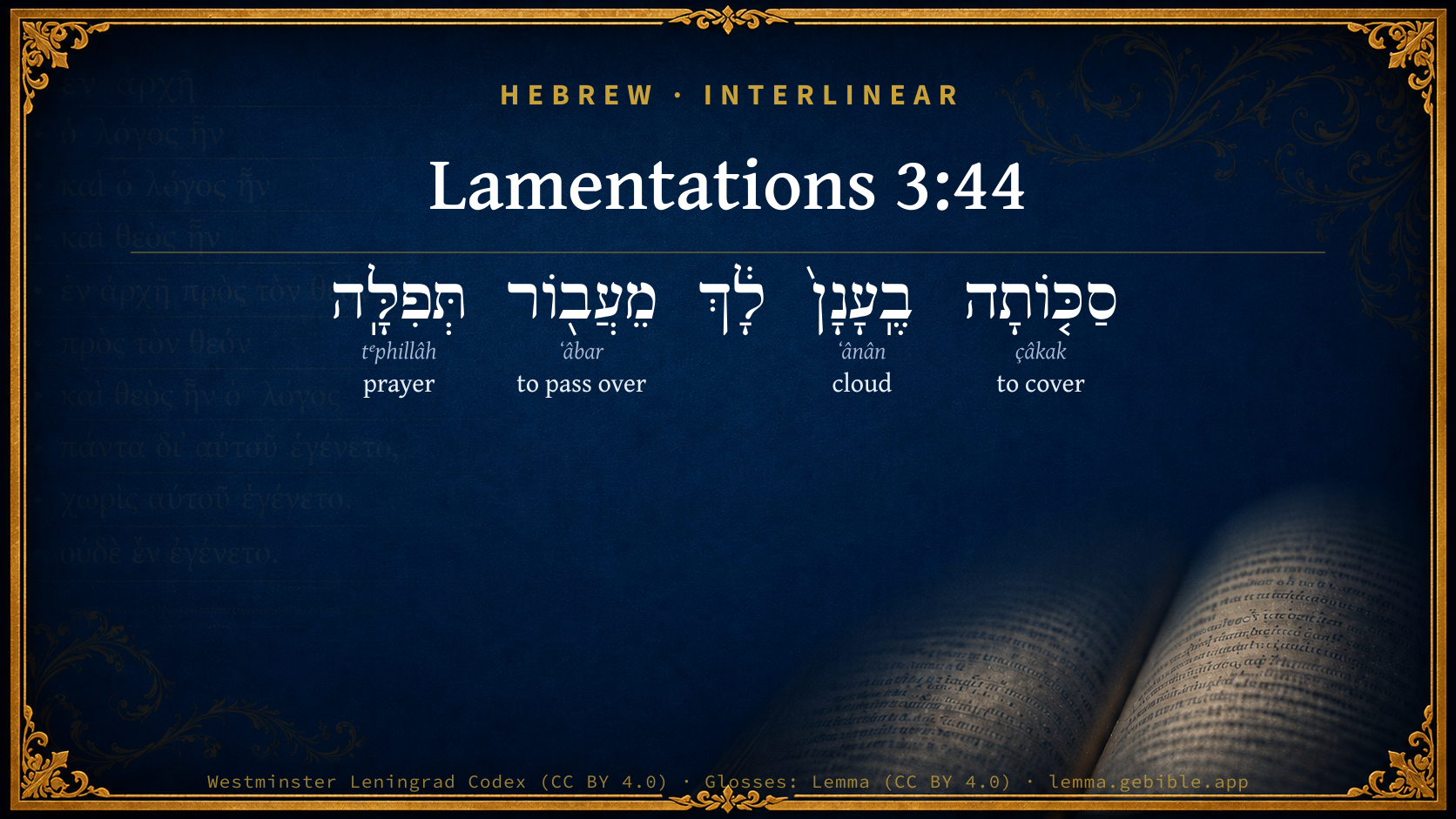
Lamentations 3:44

Hebrew (Westminster Leningrad Codex) Lamentations 3:44 appears in the Hebrew Old Testament. The text above is from the Westminster Leningrad Codex. Each word links to its Strong’s number, a concise gloss, and parsing drawn from the Open Scriptures Hebrew Bible morphology. Click any word for its full Brown-Driver-Briggs (BDB) entry.
Download image
Cite this verse

Lamentations 3:44 (World English Bible). Public Domain. Lemma interlinear Bible study tool, https://lemma.gebible.app/v/lamentations/3/44.

Show BibTeX & RIS
BibTeX
RIS
English Translation
You have covered yourself with a cloud, so that no prayer can pass through.
World English Bible · Public Domain
Download a study sheet

One document with this verse’s original text, its word-by-word gloss line, the meaning frame, cross-references with their text, attributed commentary, and full source and license credits — printable, and it pastes into notes with its structure intact.

This verse Autodidact and up

Study sheet (.html) Plain text (.txt)

A passage Seminary Student

Up to 50 verses in one chapter. A passage sheet keeps up to 6 commentary sources and 12 cross-references per verse, in the order this page ranks them, and says so on the sheet whenever that leaves anything out. Ask for a single verse and you get the Autodidact verse sheet above.

Everything on this page stays free to read, with no account — the sheet is a download of what is already on screen, not access to it.

Want to remove ads? Support Godless Engineer
Compare translations 3

The same verse in 3 English versions, stacked beneath the original-language interlinear above. Click any original word for its lexicon entry.

Each is an independent rendering of the whole verse — the interlinear is not word-aligned to these translations.

Highlighted words mark where these versions differ — a whole-verse word diff, not a word-by-word alignment.

  • World English Bible Public Domain
    You have covered yourself with a cloud, so that no prayer can pass through.
  • King James Version Public Domain
    Thou hast covered thyself with a cloud, that our prayer should not pass through.
  • unfoldingWord Literal Text CC BY-SA 4.0
    You covered yourself in a cloud, from a prayer passing through.

unfoldingWord Literal Text — © unfoldingWord, licensed CC BY-SA 4.0. Word-aligned USFM3 via Door43 (git.door43.org/unfoldingWord/en_ult).

Versions to compare (up to 4)

3 of 4 selected

Show all 18 translations

Every available English version of this verse, each an independent rendering of the whole verse.

  • World English Bible Public Domain
    You have covered yourself with a cloud, so that no prayer can pass through.
  • Berean Standard Bible Public Domain
    You have covered Yourself with a cloud that no prayer can pass through.
  • Majority Standard Bible Public Domain
    You have covered Yourself with a cloud that no prayer can pass through.
  • King James Version Public Domain
    Thou hast covered thyself with a cloud, that our prayer should not pass through.
  • American Standard Version (1901) Public Domain
    Thou hast covered thyself with a cloud, so that no prayer can pass through.
  • Revised Version (1885) Public Domain
    Thou hast covered thyself with a cloud, that our prayer should not pass through.
  • Geneva Bible (1599) Public Domain
    Thou hast couered thy selfe with a cloude, that our prayer should not passe through.
  • Douay-Rheims (1899) Public Domain
    Samech. Thou hast set a cloud before thee, that our prayer may not pass through.
  • Young's Literal Translation Public Domain
    Thou hast covered Thyself with a cloud, So that prayer doth not pass through.
  • Literal Standard Version CC BY-SA 4.0
    You have covered Yourself with a cloud, || So that prayer does not pass through.
  • Unlocked Literal Bible CC BY-SA 4.0
    You have covered yourself with a cloud so that no prayer can pass through.
  • unfoldingWord Literal Text CC BY-SA 4.0
    You covered yourself in a cloud, from a prayer passing through.
  • Darby Bible Public Domain
    Thou hast covered thyself with a cloud, that prayer should not pass through.
  • World Messianic Bible Public Domain
    You have covered yourself with a cloud, so that no prayer can pass through.
  • Webster's Bible Public Domain
    Thou hast covered thyself with a cloud, that our prayer should not pass through.
  • Free Bible Version CC BY-SA 4.0
    You have wrapped yourself with a cloud that no prayer can penetrate.
  • Bible in Basic English Public Domain
    Covering yourself with a cloud, so that prayer may not get through.
  • JPS Tanakh (1917) Public Domain
    Thou hast covered Thyself with a cloud, so that no prayer can pass through.

Literal Standard Version (2020), Covenant Press — licensed CC BY-SA 4.0. Text via the HelloAO Bible API (eBible.org). Unlocked Literal Bible (unfoldingWord) — licensed CC BY-SA 4.0. Text via the HelloAO Bible API (eBible.org). unfoldingWord Literal Text — © unfoldingWord, licensed CC BY-SA 4.0. Word-aligned USFM3 via Door43 (git.door43.org/unfoldingWord/en_ult). Free Bible Version, Dr. Jonathan Gallagher — licensed CC BY-SA 4.0. Text via the HelloAO Bible API (eBible.org).

Word by word

More ways to search: Search by grammar → Find every occurrence → Compare this word →

Practice this passage: Drill this verse → Learn its vocabulary →

סַכּ֤וֹתָה
çâkak
H5526
“to cover”
Verb, Qal, Perfect, 2nd Person, Masculine, Singular
Part of Speech
Verb
Stem
Qal
Form
Perfect
Person
2nd Person
Gender
Masculine
Number
Singular
Full BDB Definition

Origin: a primitive root

TWOT: 1475 , 1492 , 2259 , 2260

(Qal) to hedge, fence about, shut in - to block, overshadow, screen, stop the approach, shut off, cover - (Qal) - to screen, cover - to cover oneself - protector (participle) - (Hiphil) - to screen, cover - to cover, defecate (euphemism) - (Qal) to cover, lay over - to weave together - (Qal) to weave together - (Pilpel) to weave, weave together
  1. בֶֽעָנָן֙ ʻânân H6051 “in/at the · cloud” Preposition, Determined + Noun, Common, Masculine, Singular, Absolute
  2. מֵעֲב֖וֹר ʻâbar H5674 “from · to pass over” Preposition + Verb, Qal, Infinitive Construct
  3. תְּפִלָּֽה tᵉphillâh H8605 “prayer” Noun, Common, Feminine, Singular, Absolute

About this verse

These counts appear in no published source. They are computed here, from the morphology-tagged text and Lemma’s own curated glosses. What Lemma adds →

5
words
4
distinct lemmas
Prophets
section

Notable vocabulary

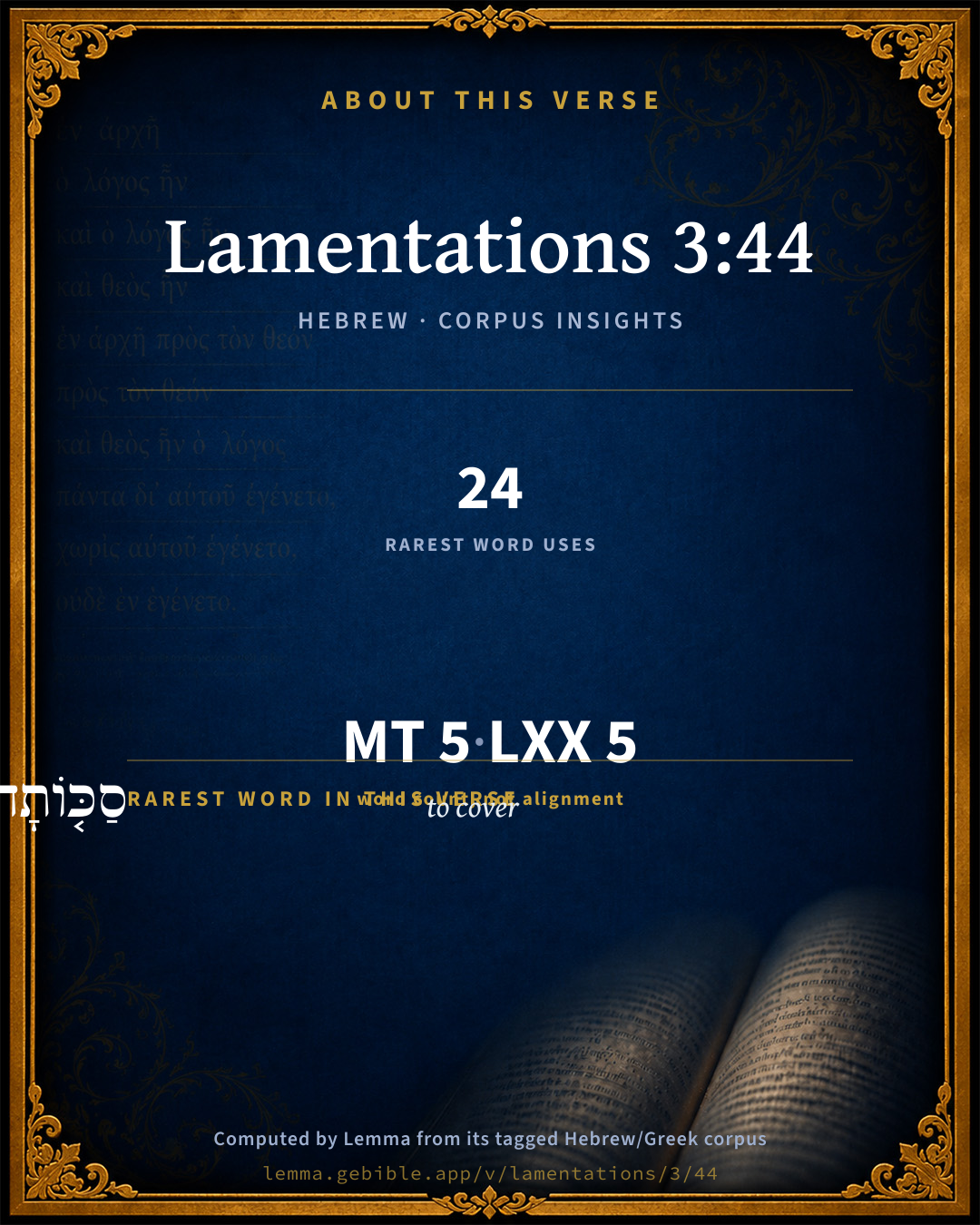
The rarest word here is סַכּ֤וֹתָה to cover H5526 — appearing just 24 times in the whole Hebrew Bible.

Shared distinctive vocabulary

סַכּ֤וֹתָה to cover H5526 occurs in 24 verses of the Hebrew Bible. Also found in:

Grammatical profile

  • 2 verbs
  • 2 nouns
  • 1 preposition

Verb forms

  • סַכּ֤וֹתָה Qal · Perfect
  • מֵעֲב֖וֹר Qal · Infinitive Construct

Hebrew & Septuagint length

In English translation the verse runs 14 words from the Hebrew and 15 from the Septuagint (LXX English) — closely comparable.

A rough comparison of the two English renderings, which tokenize alike — not a word-level alignment.

Word counts can differ between the Hebrew and the Greek without any difference in meaning — e.g. the Hebrew direct-object marker אֵת has no separate Greek word, and Greek often adds the article ὁ.

In the original languages it is 5 Hebrew tokens and 5 Greek tokens — but the two are counted differently (Hebrew bundles its prefixes and suffixes into one token; the Greek is in lemma form), so that isn’t a like-for-like length.

Cross-references

6

Topical passages linked to Lamentations 3:44 in the Treasury of Scripture Knowledge — connected by theme and wording, ordered by reader-vote popularity; previews shown in the World English Bible.

  • Lamentations 3:8 Yes, when I cry, and call for help, he shuts out my prayer.
  • Zechariah 7:13 It has come to pass that, as he called, and they refused to listen, so they will call, and I will not listen," said Yahweh of Hosts;
  • Psalms 97:2 Clouds and darkness are around him. Righteousness and justice are the foundation of his throne.
  • Jeremiah 15:1 Then said Yahweh to me, Though Moses and Samuel stood before me, yet my mind would not be toward this people: cast them out of my sight, and let them go forth.
  • Jeremiah 14:11 Yahweh said to me, Don't pray for this people for [their] good.
  • Psalms 80:4 Yahweh God of hosts, How long will you be angry against the prayer of your people?

Cross-references courtesy of OpenBible.info (CC BY 4.0).

Hebrew and Greek witnesses Masoretic Hebrew ↔ Greek Septuagint

The same verse in the two great witnesses to the Old Testament, shown verse-for-verse.

These are two independent witnesses, not word-aligned to each other, and the Septuagint is shown in lemma (dictionary) form.

Hebrew Lamentations 3:44 Masoretic · Westminster Leningrad Codex

סַכּ֤וֹתָה בֶֽעָנָן֙ לָ֔ךְ מֵעֲב֖וֹר תְּפִלָּֽה

You have covered yourself with a cloud, so that no prayer can pass through.

World English Bible · Public Domain

Greek LXX Lamentations 3:44 Septuagint · lemma form

ἐπισκεπάζω νεφέλη σεαυτοῦ εἵνεκεν προσευχή

You have veiled yourself with a cloud because of prayer, that I might be blind,

LXX2012 (modern English Septuagint) · Public Domain

Hebrew: Westminster Leningrad Codex (CC BY 4.0). Greek: Septuagint (public domain); English from LXX2012 (modern English Septuagint) (Public Domain). How the Septuagint differs from the Hebrew →

Commentary

Notes on Lamentations 3:44 from classic Christian and Jewish commentators (each source and its license shown beneath its notes). The classic Christian expositions comment on the surrounding passage and are grouped to its opening verse, so a note may address several verses; the Jewish commentaries on the Tanakh (Rashi and others) are per-verse, so they appear only where the commentator wrote on this verse.

Lemma curates 59 commentaries, every one of them public domain or Creative Commons licensed, each selected and text-cleaned for this edition rather than reprinted as found. About our sources →

Trapp's Complete Commentary

John Trapp

Lam 3:44 Thou hast covered thyself with a cloud, that [our] prayer should not pass through.

Ver. 44. Thou hast covered thyself with a cloud.] Hid thy face from us, and secreted thyself as a judge doth when he hath passed sentence upon a malefactor, that he may not be solicited to reverse it.

That our prayers should not pass through.] The veil of the temple was of no debarring matter, but thin and pervious, that the incense might easily pass through it into the Holy of holies: but now it was otherwise; God had set a bar between him and his people.

John Trapp, A Commentary or Exposition upon All the Books of the Old and New Testament (1647–1656) — public domain. Text from a community e-Sword module.

Jamieson, Fausset & Brown

Robert Jamieson, A. R. Fausset & David Brown

(Lam 3:8). The "cloud" is our sins, and God's wrath because of them (Isa 44:22; Isa 59:2).

Jamieson, Fausset & Brown — Commentary Critical and Explanatory on the Whole Bible (1871) — public domain (CC PDM 1.0). Text via the HelloAO Bible API.

John Calvin's Commentaries

The Prophet confirms the same thing, but the words are different. He again repeats the word to cover; but, that the metaphor might be clearer and more fully explained, he says, with a cloud. He simply intimates, that a cloud interposed, that God might more unrestrainedly punish the Jews, as they had deserved. Isaiah speaks somewhat otherwise, but for the same purpose:

“The hand of God,” he says, “is not shortened, nor are his ears more deaf; but your sins have interposed a distance between you and God.” (Isaiah 59:1, 2.)

There is no doubt but that Isaiah meant the same thing as our Prophet, even that God’s nature never changes; and, therefore, that when he seems to rage against his people, the cause ought to be ascribed to their sins, because God ever remains like himself. We know what is said in the Psalms,

“Thou art God who hearest prayer.” (Psalm 65:3.)

God, then, is always ready to hear his people, and he also possesses power sufficient to help them; but the distance arises from our sins. And so the Prophet now says that a cloud interposed.

Nearly the same sentence is found in the third chapter, as we have seen; for there the Prophet said, in the name of the whole people, that they had become separated from God, but that it was a separation, not because God had changed his purpose, but because the people had, in a manner, rejected his favor. Thou hast, then, he says, covered thyself with a cloud, that is, thou hast made for thyself a covering, that prayer may not pass through. This seems, indeed, very strange, because God advances to meet all the miserable, and promises to hear their prayers: what, then, can this mean, that a cloud interposed that prayer might not go through to him? even that the Jews did not pray aright, and that they had closed up against themselves every access by which God could admit them. In short, the faithful do not here contend with God, as though they had been deceived by his promises, but confess that they were unworthy to pray to God, and they also acknowledge that they did not pray aright. And according to this sense they say, that they were hindered, as though a cloud interposed, so that their prayer could not ascend to God. It follows, —

John Calvin's Commentaries (1540-1563) — public domain. Text from the Calvin Translation Society English edition (1840s-50s) via the Christian Classics Ethereal Library (ccel.org). Calvin's coverage is partial (roughly two-thirds of the Bible); uncommented books and verses are honest gaps, never fabricated. The 19th-century editor's footnotes and remarks are omitted so the notes are faithfully Calvin's own voice.

The Cambridge Bible for Schools and Colleges

gen. ed. J. J. S. Perowne

44. That Jehovah is veiled by darkness from human eyes is a thought which frequently meets us. See 1Ki_8:12; Psa_97:2; Isa_45:15.

The Cambridge Bible for Schools and Colleges (gen. ed. J. J. S. Perowne; Cambridge University Press, 1878–1918) — public domain. Text from a community e-Sword module.

John Gill's Exposition

Mine eye trickleth down, and ceaseth not,.... From weeping, as the Targum: the prophet was continually weeping; the distresses of his people were always uppermost in his mind; and which so affected him, that it drew tears from his eyes, which constantly trickled down his cheeks:

without any intermission; or, "without intermissions" (n); there were no stops or pauses in his grief, and in the expressions of it: or it may be rendered, "because there were no intermissions" (o); that is, of the miseries of his people; so Jarchi,

"because there were no changes and passing away;''

that is of evils; and to the same purpose the Targum,

"because there is none that intermits my distress, and speaks comforts to me.''

(n) "a non intermissionibus", Montanus, Calvin; "sine intervallis", Cocceius. (o) "Eo quod nullae sunt intermissiones", Junius & Tremellius, Piscator, Tigurine version.

John Gill's Exposition of the Whole Bible (1746–1763) — public domain (CC PDM 1.0). Text via the HelloAO Bible API.

Haydock's Catholic Bible Commentary

Cloud. Isaias lix. 2., and Ecclesiasticus xxxv. 21. These expressions are admirable.

George Leo Haydock (1774–1849), Haydock's Catholic Family Bible and Commentary, 1859 edition — public domain. Excludes Psalms (Douay-Rheims chapter numbering differs from Protestant) and Deuterocanonical books (Catholic canon only).

Matthew Poole's English Annotations

God had covered them with wrath, overwhelming them with afflictions. so as they had no way to escape; and whereas in this distress they had nothing else to do but only to apply themselves to God, he had hid his face from them, so as they could get no comfortable sight of him; he was as one covered with a cloud, that could not be discerned through that opacous body. What is meant by this cloud, whether his fixed resolution to punish them, or his fresh remembrance of their sins, or his just will to be revenged on them, seems too curiously inquired. The phrase is a metaphor, and signifies no more than that God would not hear their prayers in their distress.

Matthew Poole's English Annotations on the Holy Bible (1683–1685) — public domain. Text from a community e-Sword/MySword module.

Whedon's Commentary on the Bible

Daniel D. Whedon

44. That our prayer should not pass through — The cloud conceals God in the more benignant and paternal aspects of his character, and, what is more alarming and discouraging, renders him impervious to prayer.

Daniel D. Whedon (gen. ed.), Commentary on the Old and New Testaments (1874–1909) — public domain. Text from a community e-Sword module.

The Pulpit Commentary

That our prayer should not pass through. So Isa_58:4, "Ye do not so fast at this time as to make your voice to be heard on Psa_55:1, "Hide not. thyself from my supplication.

God covering himself with a cloud.

There are dark hours when God not only seems to be hidden from view, but to be so wrapped in thick clouds that even our prayers cannot penetrate to him. Let us consider when and how far this is really the case.

I SOMETIMES IT IS ONLY APPARENT. We lose heart and confidence. Discouraged and saddened, we cease to believe that God is listening to our cry. We can never see God nor hear any audible response to our cry and must always pray in faith; and therefore when faith fails we are ready to say that God does not hear us. We should remember that God"s attention is not confined to the evidences of it that he may afford to us. He may hear us without telling us that he does, or he may simply delay the response for good and wise reasons. Let us, therefore, beware of the folly of judging of God"s actions by our own passing moods.

II SOMETIMES IT IS REAL, BUT MERCIFUL. God does not always accept our prayers even when he is regarding us favourably.

1. He may be trying our faith. It may be better for us that our faith should be tested and strengthened than that we should have the particular thing we desire.

2. We may be asking unwisely. Perhaps the greatest unkindness would be to answer our foolish prayer according to our wish. The mother must turn a deaf ear to the cry of her child for a poisonous fruit. It is hard thus to refuse. Nothing tries love more severely. It is a proof of the great love of God that he is firm in thus apparently treating us with indifference when all the while his heart yearns to comfort us.

III SOMETIMES IT IS BOTH REAL AND WRATHFUL. God will not always hearken to prayer. There are circumstances that raise great banks of clouds between our souls and Heaven such as the most vehement petition cannot pierce.

1. Unrepented sin. If we have sinned ever so heavily and confess our iniquity, heaven is open to hear the faintest sigh of penitence. But against impenitence it is firm as brass.

2. Self-will. So long as we are praying, rebelliously demanding our own way and not submitting to God"s will, no prayer of ours can reach his throne in heaven. We may dare to lay our wish before God in humility, but yet in frank expression of it. Nevertheless, it can only be entertained by God when we add in spirit, if not in words, "Not my will, but thine, be done." Thus may we cry to the void and have back only the mocking echo of our foolish prayer. We may send urgent requests towards heaven, and they will only lose themselves in the thick, black clouds of Divine disfavour which come between us and God. It is hopeful, however, for a soul to know this. When we see the cloud we are halfway towards the removal of it.

IV IT IS THE WORK OF CHRIST TO DISSIPATE THE CLOUD THAT SHUTS OUR PRAYER OUT FROM GOD.

1. He permits us to pray in his Name, with his authority, and pleading his merit.

2. He teaches us to pray in the right spirit of penitence, submission, and faith.

The Pulpit Commentary (1880–1919), ed. H.D.M. Spence-Jones & Joseph S. Exell — public domain. Text from a community e-Sword module.

unfoldingWord translationNotes

Door43 World Missions Community

Connecting Statement:

The prayer that began in Lamentations 3:42 continues.

You have covered yourself with a cloud so that no prayer can pass through

This represents God refusing to listen to the people's prayer. AT: "You refuse to listen to our prayers. It is as though you put a cloud between us and you so that our prayers cannot get to you" (See: Metaphor)

You have made us like filthy scum and refuse among the nations

The people of Israel are compared to filthy scum and refuse. Possible meanings are 1) God has caused the nations to think of his people as worthless. AT: "You have made the nations think of us as scum and garbage" or 2) God's forcing his people to live among the nations is like throwing them away as garbage. AT: "You have thrown us away like filthy garbage among the nations" (See: Simile)

panic and pitfall have come upon us, ruin and destruction

The abstract nouns "panic," "pitfall," "ruin" and "destruction" can be expressed with verbs. AT: "we are panicking. We are trapped, and we are being ruined and destroyed" or "we are terrified and trapped. We are being completely destroyed" (See: Abstract Nouns)

pitfall

This refers to falling into a pit. Here it represents being trapped in any way.

have come upon us

"have happened to us"

ruin and destruction

These two words share similar meanings and refer to the destruction of Jerusalem. AT: "total destruction" (See: Doublet)

translationWords

pray

people group

adversary

mock

fear

pit

desolate

unfoldingWord translationNotes — © Distant Shores Media and the Door43 World Missions Community, licensed CC BY-SA 4.0. Source: git.door43.org/Door43/en_tn.

Lesson kit

Teaching starters — assembled from the data on this page, not authored interpretation. Every prompt links to the verse data it draws on. Edit before teaching.

Lamentations, in the Prophets, opens this verse with 5 words (4 distinct Hebrew lemmas). Its most distinctive word is çâkak (“to cover”). A historical commentator’s framing appears above. Read the whole chapter for the surrounding context.

Discussion questions

  1. How does “to cover” (çâkak) shape what this verse is saying?
  2. Exodus 25:20 shares the word «to cover» with this verse. How do the two illuminate each other?
  3. The translations on this page render this verse differently — a whole-verse word diff, not a word-by-word alignment. What might account for the different wordings?
  4. The verb «סַכּ֤וֹתָה» is Qal Perfect. How does its form color the action?
  5. Reading how Trapp's Complete Commentary and Jamieson, Fausset & Brown read this verse, where do the two commentators agree and where do they part?

Things to notice

Reading settings

Reading text

Shown beneath each verse's original-language words.

Old Testament
Old Testament edition

Read the OT as the Masoretic Hebrew (MT) or the Greek Septuagint (LXX).

English shown for the Greek Septuagint (in the Hebrew ↔ Greek comparison).

Comparing translations? Open the Compare panel on any verse page to stack up to four side by side.