
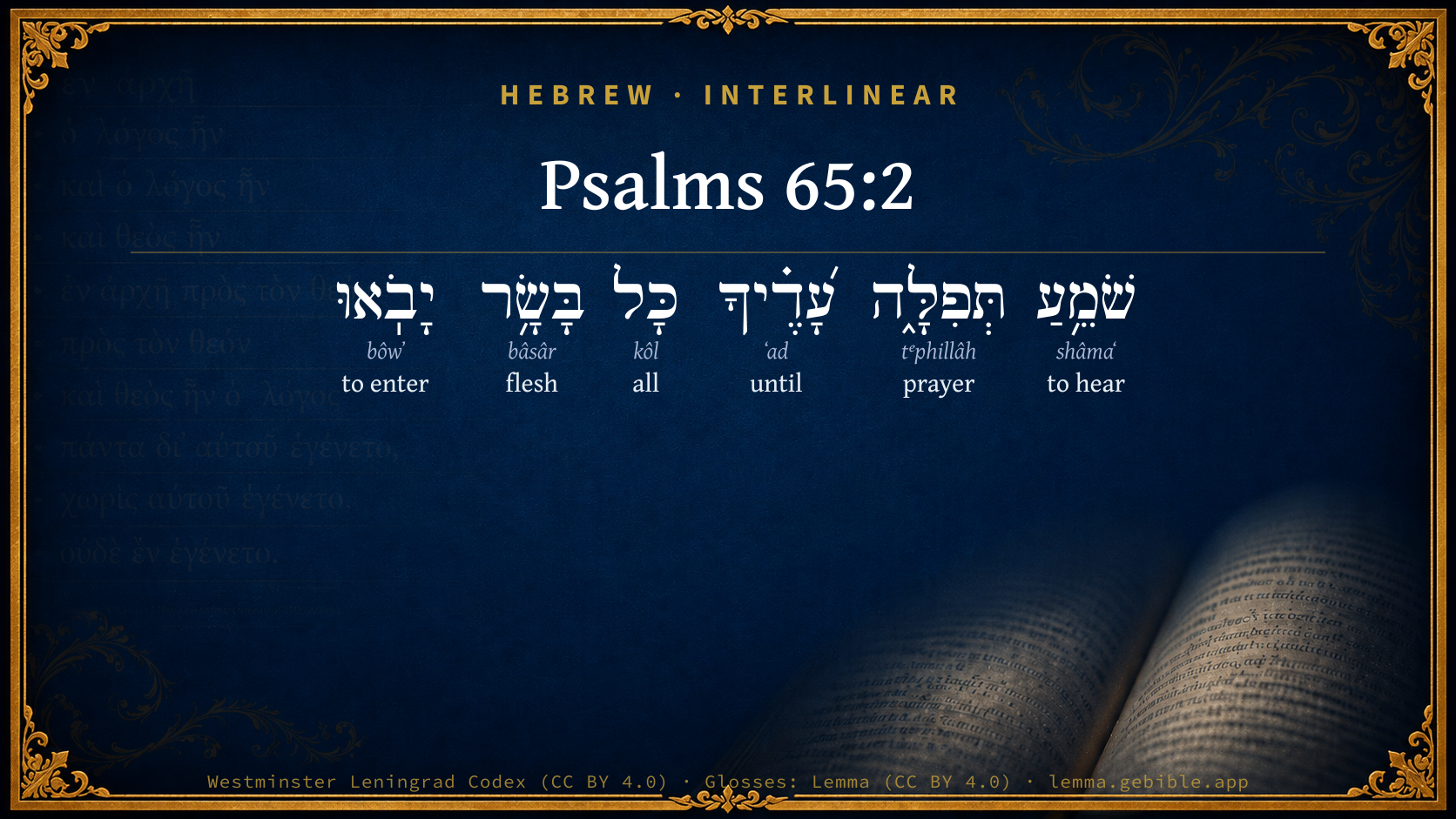
Psalms 65:2

Hebrew (Westminster Leningrad Codex) Psalms 65:2 appears in the Hebrew Old Testament. The text above is from the Westminster Leningrad Codex. Each word links to its Strong’s number, a concise gloss, and parsing drawn from the Open Scriptures Hebrew Bible morphology. Click any word for its full Brown-Driver-Briggs (BDB) entry.
Download image
Cite this verse

Psalms 65:2 (World English Bible). Public Domain. Lemma interlinear Bible study tool, https://lemma.gebible.app/v/psalms/65/2.

Show BibTeX & RIS
BibTeX
RIS
English Translation
You who hear prayer, To you all men will come.
World English Bible · Public Domain
Download a study sheet

One document with this verse’s original text, its word-by-word gloss line, the meaning frame, cross-references with their text, attributed commentary, and full source and license credits — printable, and it pastes into notes with its structure intact.

This verse Autodidact and up

Study sheet (.html) Plain text (.txt)

A passage Seminary Student

Up to 50 verses in one chapter. A passage sheet keeps up to 6 commentary sources and 12 cross-references per verse, in the order this page ranks them, and says so on the sheet whenever that leaves anything out. Ask for a single verse and you get the Autodidact verse sheet above.

Everything on this page stays free to read, with no account — the sheet is a download of what is already on screen, not access to it.

Want to remove ads? Support Godless Engineer
Compare translations 3

The same verse in 3 English versions, stacked beneath the original-language interlinear above. Click any original word for its lexicon entry.

Each is an independent rendering of the whole verse — the interlinear is not word-aligned to these translations.

Highlighted words mark where these versions differ — a whole-verse word diff, not a word-by-word alignment.

  • World English Bible Public Domain
    You who hear prayer, To you all men will come.
  • King James Version Public Domain
    O thou that hearest prayer, unto thee shall all flesh come.
  • unfoldingWord Literal Text CC BY-SA 4.0
    Hearer of prayer, to you all flesh will come.

unfoldingWord Literal Text — © unfoldingWord, licensed CC BY-SA 4.0. Word-aligned USFM3 via Door43 (git.door43.org/unfoldingWord/en_ult).

Versions to compare (up to 4)

3 of 4 selected

Show all 18 translations

Every available English version of this verse, each an independent rendering of the whole verse.

  • World English Bible Public Domain
    You who hear prayer, To you all men will come.
  • Berean Standard Bible Public Domain
    O You who listen to prayer, all people will come to You.
  • Majority Standard Bible Public Domain
    O You who listen to prayer, all people will come to You.
  • King James Version Public Domain
    O thou that hearest prayer, unto thee shall all flesh come.
  • American Standard Version (1901) Public Domain
    O thou that hearest prayer, Unto thee shall all flesh come.
  • Revised Version (1885) Public Domain
    O thou that hearest prayer, unto thee shall all flesh come.
  • Geneva Bible (1599) Public Domain
    Because thou hearest the prayer, vnto thee shall all flesh come.
  • Douay-Rheims (1899) Public Domain
    A Hymn, O God, becometh thee in Sion: and a vow shall be paid to thee in Jerusalem.
  • Young's Literal Translation Public Domain
    Hearer of prayer, to Thee all flesh cometh.
  • Literal Standard Version CC BY-SA 4.0
    Hearer of prayer, all flesh comes to You.
  • Unlocked Literal Bible CC BY-SA 4.0
    You who hear prayer, to you all flesh will come.
  • unfoldingWord Literal Text CC BY-SA 4.0
    Hearer of prayer, to you all flesh will come.
  • Darby Bible Public Domain
    O thou that hearest prayer, unto thee shall all flesh come.
  • World Messianic Bible Public Domain
    You who hear prayer, all men will come to you.
  • Webster's Bible Public Domain
    \\65:1\\To the chief Musician, A Psalm and Song of David. Praise waiteth for thee, O God, in Zion: and to thee shall the vow be performed.
  • Free Bible Version CC BY-SA 4.0
    You hear our prayers; everyone comes to you.
  • Bible in Basic English Public Domain
    To you, O hearer of prayer, let the words of all flesh come.
  • JPS Tanakh (1917) Public Domain
    (65-3) O Thou that hearest prayer, unto Thee doth all flesh come.

Literal Standard Version (2020), Covenant Press — licensed CC BY-SA 4.0. Text via the HelloAO Bible API (eBible.org). Unlocked Literal Bible (unfoldingWord) — licensed CC BY-SA 4.0. Text via the HelloAO Bible API (eBible.org). unfoldingWord Literal Text — © unfoldingWord, licensed CC BY-SA 4.0. Word-aligned USFM3 via Door43 (git.door43.org/unfoldingWord/en_ult). Free Bible Version, Dr. Jonathan Gallagher — licensed CC BY-SA 4.0. Text via the HelloAO Bible API (eBible.org).

Word by word

More ways to search: Search by grammar → Find every occurrence → Compare this word →

Practice this passage: Drill this verse → Learn its vocabulary →

About this verse

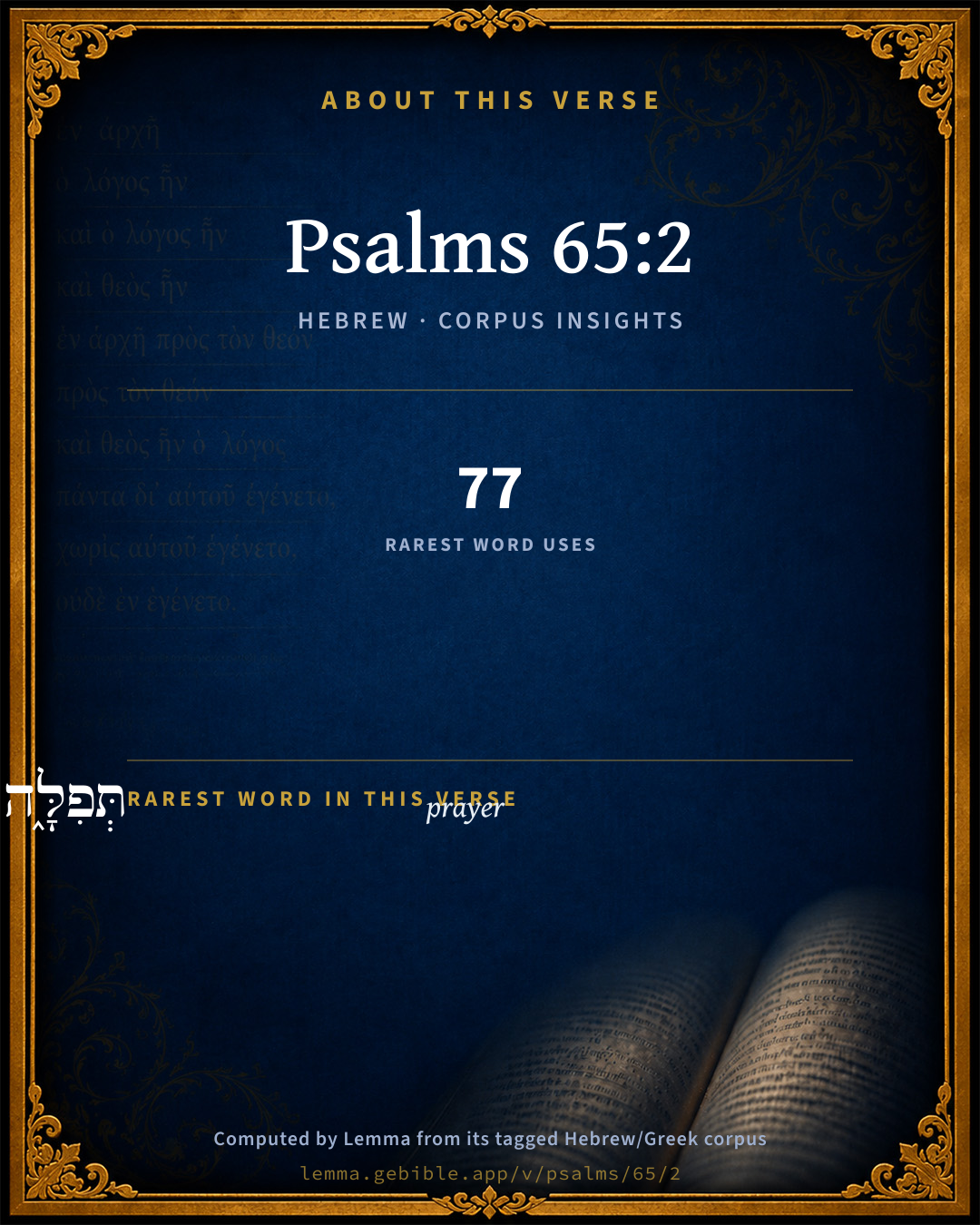
These counts appear in no published source. They are computed here, from the morphology-tagged text and Lemma’s own curated glosses. What Lemma adds →

6
words
6
distinct lemmas
Wisdom
section

Grammatical profile

  • 2 verbs
  • 3 nouns
  • 1 preposition

Verb forms

  • שֹׁמֵ֥עַ Qal · Participle Active
  • יָבֹֽאוּ Qal · Imperfect

Hebrew & Septuagint length

In English translation the verse runs 10 words from the Hebrew and 9 from the Septuagint (LXX English) — closely comparable.

A rough comparison of the two English renderings, which tokenize alike — not a word-level alignment.

Word counts can differ between the Hebrew and the Greek without any difference in meaning — e.g. the Hebrew direct-object marker אֵת has no separate Greek word, and Greek often adds the article ὁ.

Cross-references

19

Topical passages linked to Psalms 65:2 in the Treasury of Scripture Knowledge — connected by theme and wording, ordered by reader-vote popularity; previews shown in the World English Bible.

  • Jeremiah 29:12–13 You shall call on me, and you shall go and pray to me, and I will listen to you.
  • Isaiah 65:24 It shall happen that, before they call, I will answer; and while they are yet speaking, I will hear.
  • Isaiah 66:23 It shall happen, that from one new moon to another, and from one Sabbath to another, shall all flesh come to worship before me, says Yahweh.
  • 1 John 5:14–15 This is the boldness which we have toward him, that, if we ask anything according to his will, he listens to us.
  • Psalms 66:19 But most assuredly, God has listened. He has heard the voice of my prayer.
  • Psalms 86:9 All nations you have made will come and worship before you, Lord. They shall glorify your name.
  • Psalms 145:18–19 Yahweh is near to all those who call on him, To all who call on him in truth.
  • Acts 10:31 and said, 'Cornelius, your prayer is heard, and your gifts to the needy are remembered in the sight of God.
  • Luke 11:9–10 "I tell you, keep asking, and it will be given you. Keep seeking, and you will find. Keep knocking, and it will be opened to you.
  • Daniel 9:17–19 Now therefore, our God, listen to the prayer of your servant, and to his petitions, and cause your face to shine on your sanctuary that is desolate, for the Lord's sake.
  • 2 Chronicles 33:13 He prayed to him; and he was entreated of him, and heard his supplication, and brought him again to Jerusalem into his kingdom. Then Manasseh knew that Yahweh he was God.
  • Psalms 66:4 All the earth will worship you, And will sing to you; They will sing to your name." Selah.
  • 1 Kings 18:37 Hear me, Yahweh, hear me, that this people may know that you, Yahweh, are God, and [that] you have turned their heart back again.
  • Psalms 102:17 He has responded to the prayer of the destitute, And has not despised their prayer.
  • Isaiah 49:6 yes, he says, It is too light a thing that you should be my servant to raise up the tribes of Jacob, and to restore the preserved of Israel: I will also give you for a light to the Gentiles, that you may be my salvation to the end of the earth.
  • John 12:32 And I, if I am lifted up from the earth, will draw all people to myself."
  • 1 Kings 18:29 It was so, when midday was past, that they prophesied until the time of the offering of the [evening] offering; but there was neither voice, nor any to answer, nor any who regarded.
  • Psalms 22:27 All the ends of the earth shall remember and turn to Yahweh. All the relatives of the nations shall worship before you.
  • Revelation 11:15 The seventh angel sounded, and great voices in heaven followed, saying, "The kingdom of the world has become the Kingdom of our Lord, and of his Christ. He will reign forever and ever!"

Cross-references courtesy of OpenBible.info (CC BY 4.0).

Hebrew and Greek witnesses Masoretic Hebrew ↔ Greek Septuagint

The same verse in the two great witnesses to the Old Testament, shown verse-for-verse.

You’re reading Greek Psalm 64 (Hebrew Psalm 65). The Septuagint counts the superscription, so verse numbers can differ from the Hebrew — chapter-level alignment, not verse-by-verse. Numbering follows Rahlfs.

These are two independent witnesses, not word-aligned to each other, and the Septuagint is shown in lemma (dictionary) form.

Hebrew Psalms 65:2 Masoretic · Westminster Leningrad Codex

שֹׁמֵ֥עַ תְּפִלָּ֑ה עָ֝דֶ֗יךָ כָּל בָּשָׂ֥ר יָבֹֽאוּ

You who hear prayer, To you all men will come.

World English Bible · Public Domain

Greek LXX Greek Psalm 64:2 Septuagint · lemma form

σύ πρέπω ὕμνος ὁ θεός ἐν σιων καί σύ ἀποδίδωμι εὐχή ἐν ἰερουσαλήμ

Hear my prayer; to you all flesh shall come.

LXX2012 (modern English Septuagint) · Public Domain

Hebrew: Westminster Leningrad Codex (CC BY 4.0). Greek: Septuagint (public domain); English from LXX2012 (modern English Septuagint) (Public Domain). How the Septuagint differs from the Hebrew →

Commentary

Notes on Psalms 65:2 from classic Christian and Jewish commentators (each source and its license shown beneath its notes). The classic Christian expositions comment on the surrounding passage and are grouped to its opening verse, so a note may address several verses; the Jewish commentaries on the Tanakh (Rashi and others) are per-verse, so they appear only where the commentator wrote on this verse.

Lemma curates 59 commentaries, every one of them public domain or Creative Commons licensed, each selected and text-cleaned for this edition rather than reprinted as found. About our sources →

Trapp's Complete Commentary

John Trapp

Psa 65:2 O thou that hearest prayer, unto thee shall all flesh come.

Ver. 2. O thou that hearest prayer] And art thereby known to be the true God, 1Ki 18:38-39, and no such dull deity as the heathens worshipped, Isa 45:16; Isa 45:19 Mic 7:17-18. O happy we that have to deal with such a prayer hearing, sin pardoning God! Psa 65:3. Basil compareth prayer to a chain, the one end whereof is linked to God’s ear, and the other to man’s tongue.

Flectitur iratus voce rogante Deus.

Unto thee shall all flesh come] And well they may, since he keepeth open house; his mercy doors are ever wide open, as were the doors of the Aediles, or city chamberlains in Rome, that all who had occasion of complaint might have free access unto them at any time. A good housekeeper is seldom without company. Why ply we not the throne of grace upon such encouragement? Why, since we are not straitened in God, are we straitened in our own bowels? Why make we not ourselves happy by asking, since we may have but what we will of God, even all that heaven and his grace can afford us?

John Trapp, A Commentary or Exposition upon All the Books of the Old and New Testament (1647–1656) — public domain. Text from a community e-Sword module.

The Biblical Illustrator

Joseph S. Exell

Psa_65:2

O Thou that hearest prayer, unto Thee shall all flesh come.

Gods hearing of prayer

What avails prayer if it be not heard? But the text comforts us by the title it ascribes to God, and by the effect that the belief of it shall have upon all flesh. God in Christ is the hearer of prayer.

I. Wherein Gods hearing of prayer lies. This involves--

1. His accepting of our prayer (Psa_141:2). But some prayer God hates (Pro_28:9).

2. His granting the request (Psa_20:1; Psa_20:4; Mat_15:28).

3. His answering of prayer (Psa_102:2). Prayer heard in heaven comes back like the dove with the olive branch of peace in her mouth.

II. The import of Gods being the hearer of prayer. It imports--

1. God in Christ is accessible to poor sinners (2Co_5:19).

2. He is a sin-pardoning God (Exo_34:6-7).

3. He is an all-sufficient God.

4. Bountiful and compassionate (Psa_86:5).

5. Omnipresent and omniscient, and--

6. Of infinite power.

III. What prayers they are that God hears.

1. Those of His own children.

2. Such as are agreeable to His will (1Jn_5:14).

3. Made by the aid of the Holy Spirit. None else are acceptable. And--

4. Prayers offered to God through Christ.

IV. Consider more particularly this doctrine.

1. The instinct of prayer in all Gods people shows that He will hear prayer.

2. And so does the intercession of Christ (Rom_8:34).

3. Promises (Mat_7:7; Isa_65:24; Psa_145:19).

4. Invitations to prayer (Son_2:14; Hos_5:1-15. ult.; Psa_50:15; Isa_41:17).

5. The gracious nature of God (Exo_22:27).

6. The experiences of the saints in all ages.

7. The present ease and relief which prayer gives (Psa_138:8; 1Sa_1:18; Mic_7:7).

V. In what manner God hears prayer.

1. A thing prayed for may be obtained and yet the prayer be not accepted (Psa_78:29; Psa_34:1-22; Psa_35:1-28; Psa_36:1-12; Psa_37:1-40; Psa_38:1-22). So that a thing prayed for may be given in downright wrath (Hos_13:11). Or in uncovenanted condescension. As Ahab (1Ki_21:29; also Hos_11:3).

2. Whether answers come in the way of grace or not may be discerned. They do not when there is a wilfulness and unhumbledness of spirit in asking (1Sa_8:19). Or when mens lusts are strengthened and fed by them when received (Psa_78:29-30). Or when men ask on the ground of their necessity more than on the intercession of Christ. The heart loves the gift more than the giver. But a prayer may be accepted and yet not granted. So was it with our Lord (Mat_26:39). And David (2Ch_6:8-9). And such prayers are ever submissive to Gods will (Mat_26:39); they contain in the denial of them an unseen greater mercy; and even aim at the glory of God. And though unanswered we may know they are accepted when the heart is brought to meek submission (Psa_22:2-3); and we are supported under the denial, as our Lord was (Luk_22:42-43; Psa_138:3). And helped to go back to God with new petitions in faith and hope of hearing (2Sa_12:20). Let us remember that delay is not denial. Abraham prayed for an heir, yet fifteen years passed before the answer came (Gen_15:3-4; Gen_17:25; Exo_2:23-24; Dan_9:23). There is a difference between the granting of a petition and our knowing that it is granted. They may come together, as in Mat_15:28. But, as with Abraham, they may not. The hearing and granting of prayer is an object of faith; the answer, of sense and feeling (1Jn_5:14-15; Mat_15:28). But the two are generally at a distance from one another. And the reason of this is manifold.

1. To keep us at the throne of grace (Pro_15:8; Son_2:14).

2. To try our graces (Jam_1:12; Job_27:10; Luk_18:7). God delights in our faith.

3. To prepare and fit us for the answer (Psa_10:17).

4. That we may have them at the fittest time, and when they will do us most good (Joh_11:14-15; Joh_2:4). (T. Boston, D. D.)

Encouragements to prayer

I. From its nature.

1. It is a spiritual thing; not any mere outward form, but the soul seeing the invisible, grasping the intangible and linking itself by sacred affinities with things eternal.

2. Consider also its dignity, it holds correspondence with the court of heaven.

3. And how important. For how unspeakably great is our need, and we can only gain supply for them as we seek it from God.

II. From the plighted faithfulness of the Divine character to hear and answer it. How, in face of all Gods promises to hear us, can we doubt the success of our prayers? Objections against prayer lie equally against all human endeavour. God will give good things to them that ask Him, but only He can say what things are good. They may be such as we deem anything but good. Many have been laid on beds of languishing to save them from a bed of everlasting burnings. And when the time for the blessings we ask for may be, we cannot know, nor fix the rate of their progress towards us.

III. The suggesting and controlling influence of the Holy Spirit in the act of devotion.

IV. The co-operating intercessions of our ascended Saviour, and the security we have in the use of His all-prevailing name. Oh! could the recording angel give you back an exact copy even of this mornings prayers--a copy in which all the thoughts which passed through your mind while in the act of devotion should be translated into words,--how shocked would ye be at the intermixture of piety and profaneness, of reverent expressions and solemn trifling, with which ye insulted the majesty and provoked the patience of the holiest and best of beings. Wherefore was it, then, that ye were not consumed? Oh! it was that Jesus, touched with a feeling of our infirmities, stood in the gap between us.

V. The reflective benefit which, apart from direct answers to our prayers, comes to our souls. If a man do not move God he is sure to move himself. (Daniel Moore, M. A.)

The answerableness and the inevitableness of prayer

I. The answerableness of prayer. Hearing, here, means answering. He hears millions of prayers He never answers. The grand reason is, that the prayers are selfish.

1. The mind in this state looks upon Gods universe in new aspects.

2. Turns all events to new accounts.

II. The inevitableness of prayer. Unto Thee shall all flesh come. Flesh here means mankind. As all waters must find their way into the ocean, so all souls must find their way to God, sooner or later. Two things necessitate this.

1. Internal instincts. In all sentient existences there would seem at times to be something like an instinct of prayer.

2. External circumstances necessitate prayer. Men suppress the instinct, and sometimes make it well-nigh numb as death. But in the presence of a great danger, a great sorrow, a great grief, it bounds into earnest life. (Homilist.)

On prayer

1. The nature of prayer supposes, in the first place, that we have a just sense of our own wants and miseries, and of our dependence on God for relief. We live in a world where everything around us is dark and uncertain. When we look back on the past, we must remember that there we have met with much disappointment and vanity. When we look forward to the future, all is unknown. We are liable there to many dangers which we cannot foresee; and to many which we foresee approaching, yet know not how to defend ourselves against them. We know that we are the subjects of a supreme righteous Governor, to whom we are accountable for our conduct. How soon the call for our removal may be given, none of us know. Who amongst us can say, that he is perfectly ready to appear before his Creator and Judge, and to give an account to Him for all the actions of his life?

2. Thus it appears that there is a just foundation for prayer, in all its parts, naturally laid in the present circumstances of man, and in the relation in which he stands to God.

(1) With regard to temporal blessings, though men may lay a restraint upon themselves in the expressions which they utter in prayer, yet it is much to be suspected that the inward wishes of their hearts for such blessings are often the most fervent of any. To wish and pray for the advantages of life is not forbidden. Our Saviour hath so far countenanced it, as to command us to pray that God would give us our daily bread.

(2) With regard to spiritual mercies, we are unquestionably allowed to be more fervent and explicit in our requests at the throne of grace. God can never be displeased in hearing us implore from Him those graces and endowments of the soul, that beautify us in His sight, that are good for all men, good at all times, indeed, the only certain and immutable goods.

(3) Intercessions for the welfare of others form a material part of prayer. When we bow our knee to the common Father, let it be like affectionate members of His family, desiring the prosperity of all our brethren.

3. In order that prayer may produce its proper effect, there are certain qualifications necessarily belonging to it, which come next to be considered.

(1) One of the first and chief of these is seriousness, or an attentive and solemn frame of mind, in opposition to thoughts that wander, and to words that drop forth unmeaning from the lips.

(2) To seriousness, we must join affection in prayer; I mean that devotion of the heart which is inspired by gratitude and love, in distinction from forced prayer, or what is unwillingly preferred from servile fear, or mere regard to decency.

(3) Faith is another qualification required. We acknowledge our guilt; we disclaim all trust in our own righteousness; and implore grace from God on account of what His Son has done and suffered for us.

4. Having thus pointed out the chief qualifications of prayer, it remains that I show the importance and advantages of it.

(1) Prayer is one of the most powerful means of recalling our minds from the vanities of life to serious thoughts; to a proper sense of God and our duty; and to all the high objects with which we are intimately connected as rational and immortal beings.

(2) Prayer is useful, not only as a corrective of our natural levity and forgetfulness of God, but as an actual exercise of the best affections of our nature, which are thereby confirmed and strengthened. It implies the highest sentiments of reverence and adoration, of love and gratitude to God, of trust in His mercy, and of faith in our blessed Redeemer, all animating the heart.

(3) Prayer is important, not only as a means of high improvement in religion, but as an instrument of consolation and relief under the distresses of life. (H. Blair, D. D.)

The prayer-hearing God

God not only hears prayer, but glories in so doing. He derives His fame, His character from it. For, think how constantly, readily and certainly He hears prayer. Hence, the psalmist declares, Unto Thee shall all flesh come. It speaks not of God on the judgment-but on the mercy-seat; all shall seek unto Him. Let us then make known God as the prayer-hearing God, and let us, more and more, come to Him ourselves. (W. Jay.)

The Biblical Illustrator, edited by Joseph S. Exell (c. 1880s–1900s) — public domain. Text from a community e-Sword module.

Joseph Benson's Commentary

Psa 65:2-3. O thou that hearest prayer — That usest and delightest to hear and answer the prayers of thy people in Zion; which he justly mentions as one of the chiefest of God’s favours vouchsafed to his church; unto thee shall all flesh come — Men of all sorts and nations, who were allured by this and other singular benefits, to unite themselves to the Jewish Church, according to Solomon’s prediction, 1Ki 8:41-43. Or, rather, this may be considered as a tacit prediction of the conversion of the Gentiles, namely, that on account of God’s mercy in hearing the prayers of his people, all mankind, out of every nation, should come and make their supplications before him in his church, when called by his gospel. And the chief subject of the prayers made by all flesh to God being the forgiveness of sin, in order to this it is here confessed, Iniquities prevail against me — My iniquities are so many and so great, that on account of them thou mightest justly reject my prayers, and destroy my person; they are a burden too heavy for me; but thou shalt purge them away — This is another glorious privilege granted to thy people, that, in answer to their prayers, thou dost graciously pardon and take away their sins.

Joseph Benson's Commentary on the Old and New Testaments (1811–1818) — public domain. Text from a community e-Sword module.

J. A. Alexander on Psalms

Joseph Addison Alexander

3. (Psa 65:2). Hearer of prayer, up to thee shall all flesh come. The first word in Hebrew is a participle, hearing, thou who habitually hearest prayer. This is mentioned as one of the divine characters or attributes. Up to thee, even to thee, implying actual arrival, and therefore a stronger expression than unto thee. All flesh sometimes means all animals; all living creatures. (Gen 6:17; Gen 6:19), but is here used in its narrower sense of all mankind (Gen 6:3; Gen 6:12). To thee they shall come, i.e. must come, for the supply of their necessities, the forgiveness of their sins, and in short, for every good and perfect gift (Jas 1:17), both of a temporal and spiritual nature.

Joseph Addison Alexander, The Psalms Translated and Explained (1850) — public domain. Text from a community e-Sword module.

Tyndale Open Study Notes

Tyndale Open Resources

65:2 All of us means all humans.

Tyndale Open Study Notes — © Tyndale Open Resources, licensed CC BY-SA 4.0. Text via the HelloAO Bible API.

Geneva Bible (1599)

Geneva Bible translators

Not only the Jews but also the Gentiles in the kingdom of Christ.

Geneva Bible (1599) marginal notes — public domain. Text via Bolls.life.

Jamieson, Fausset & Brown

Robert Jamieson, A. R. Fausset & David Brown

All are encouraged to pray by God's readiness to hear.

Jamieson, Fausset & Brown — Commentary Critical and Explanatory on the Whole Bible (1871) — public domain (CC PDM 1.0). Text via the HelloAO Bible API.

Adam Clarke's Commentary

Verse 2. Unto thee shall all flesh come.] All human beings should pray to God; and from him alone the sufficient portion of human spirits is to be derived. It is supposed to be a prediction of the calling of the Gentiles to the faith of the Gospel of Christ. A minister, immensely corpulent, began his address to God in the pulpit with these words: "O thou that hearest prayer, unto thee shall all flesh come!" and most unluckily laid a strong emphasis on ALL FLESH. The coincidence was ominous; and I need not say, the people were not edified, for the effect was ludicrous. I mention this fact, which fell under my own notice, to warn those who minister in righteousness to avoid expressions which may be capable, from a similar circumstance, of a ludicrous application. I have known many good men who, to their no small grief, have been encumbered with a preternatural load of muscles; an evil to be deprecated and deplored.

Adam Clarke's Commentary on the Bible (1810–1826) — public domain. Text from a community e-Sword/MySword module.

Ellicott's Commentary for English Readers

(2) Unto thee shall all flesh come.—This has usually, and most truly, been taken as prophetic of the extension of the true religion to the Gentiles. But we must not let what was, in the Divine providence, a fulfilment of the psalmist’s words, hide their intention as it was conscious to himself. The psalm shows us the exclusiveness of Hebrew belief, and, at the same time, the nobler and grander feelings which are from time to time found struggling against it. The peculiar privilege of Israel has been stated in the first verse. Silent, yet confident, waiting for Jehovah’s blessing, and then exultant praise for it (Tehillah). In this the other nations have no part; but all flesh may approach Jehovah in prayer (Tephillah). (Compare Psa_65:5.)

A Bible Commentary for English Readers, edited by Charles John Ellicott (1878–1897) — public domain. Text from a community e-Sword module.

The Cambridge Bible for Schools and Colleges

gen. ed. J. J. S. Perowne

2. O thou that hearest prayer] God is thus addressed, because He has given His people cause for the present thanksgiving by hearing their prayers. But the words are more than a reference to a particular answer to prayer. They proclaim that it is His inalienable attribute, His ‘nature and property,’ to hear and answer prayer.

unto thee shall all flesh come] At first sight the context seems to limit ‘all flesh’ to Israel, contemplated in its weakness and frailty as needing the strength of God (Joe_2:28). But it seems more consonant to the spirit of this and the two following Psalms to take it in the wider sense of all mankind. Already the Psalmist beholds the Temple becoming a house of prayer for all nations (Mar_11:17). It is no larger hope than was entertained by Isaiah and Micah (Isa_2:2 ff; Mic_4:1 ff) if not by some earlier prophet whom they both quote. Cp. Jer_16:19; Isa_45:24; Isa_66:23; Psa_22:27; Psa_86:9; Psa_94:10.

The Cambridge Bible for Schools and Colleges (gen. ed. J. J. S. Perowne; Cambridge University Press, 1878–1918) — public domain. Text from a community e-Sword module.

John Gill's Exposition

O thou that hearest prayer,.... So as to answer it sooner or later, in one way or another, and always in the fittest time, and in the best way; so as to fulfil the requests and supply the wants of men, so far as may be for their good, and God's glory; which is a proof of the omnipresence, omniscience, and all sufficiency of God; who can hear the prayers of his people in all places at the same time, and knows all their persons and wants, and what is most proper for them, and can and does supply all their needs, and causes all grace to abound towards them; and it also shows his wondrous grace and condescension, to listen to the cries and regard the prayers of the poor and destitute;

unto thee shall all flesh come; being encouraged by the above character of him. All sorts of persons may come to him; men of all nations, of every rank and degree, condition and circumstance; there is no bar unto nor bounds about the throne of grace; the way to it lies open through the Mediator; and all sensible sinners shall and do come thither, though they are but "flesh", frail and mortal, corrupt and sinful creatures, and know themselves to be so; and they that come aright come through Christ, the new and living way, in his name, and in the faith of him, and of being heard for his sake, and under the gracious influences of the spirit of grace and supplication: it may be considered as a prophecy of the calling of the Gentiles, and of their calling upon God through Christ, and of their coming to God in his house, which was to be, and is, an house of prayer to all people, Isa 56:7.

John Gill's Exposition of the Whole Bible (1746–1763) — public domain (CC PDM 1.0). Text via the HelloAO Bible API.

Albert Barnes' Notes on the Bible

O thou that hearest prayer - Who hast revealed thyself as a God hearing prayer - one of the leading characteristics of whose nature it is that thou dost hear prayer. Literally, “Hearer of prayer, to thee shall all flesh come.” Nothing as applied even to God is more sublime and beautiful than the appellative “Hearer of prayer.” Nothing in his attributes is of more interest and importance to man. Nothing more indicates his condescension and goodness; nothing so much encourages us in the endeavor to overcome our sins, to do good, to save our souls, and to save the souls of others. Dark and dismal would this world be, if God did not hear prayer; gloomy, inexpressibly gloomy, would be the prospects of man, if he had not the assurance that God is a prayer-hearing God - if he might not come to God at all times with the assurance that it is his very nature to hear prayer, and that his ear is ever open to the cries of the guilty, the suffering, the sad, the troubled, the dying.

Unto thee shall all flesh come - That is, all people - for the word is here used evidently to denote mankind. The idea is, that there is no other resource for man, no other help, no other refuge, but the God that hears prayer. No other being can meet his actual needs; and those needs are to be met only in connection with prayer. All people are permitted to come thus to God; all have need of his favor; all must perish unless, in answer to prayer, he interposes and saves the soul. It is also true that the period will arrive on earth when all flesh - all people - will come to God and worship him; when, instead of the scattered few who now approach him, all nations, all the dwellers on continents and islands, will worship him; will look to him in trouble; will acknowledge him as God; will supplicate his favor.

Albert Barnes' Notes on the Bible (1834–1885) — public domain. Text from a community e-Sword/MySword module.

Matthew Poole's English Annotations

That hearest prayer; that usest and delightest to hear and answer the prayers of thy people in Zion; which he justly mentions as one of the chiefest of God’s favours and privileges vouchsafed to his church.

All flesh, i.e. men of all sorts and nations, who were allured by this and other singular benefits to join themselves to the Jewish church, according to Solomon’s prediction, 1Ki 8:41-43. Withal this may be a tacit prophecy of the conversion of the Gentiles.

Matthew Poole's English Annotations on the Holy Bible (1683–1685) — public domain. Text from a community e-Sword/MySword module.

The Treasury of David

Charles H. Spurgeon

Ver. 2. O thou that hearest prayer. This is thy name, thy nature, thy glory. God not only has heard, but is now hearing prayer, and always must hear prayer, since he is an immutable being and never changes in his attributes. What a delightful title for the God and Father of our Lord Jesus Christ! Every right and sincere prayer is as surely heard as it is offered. Here the psalmist brings in the personal pronoun thou, and we beg the reader to notice how often "thou, ""thee, "and "thy, "occur in this hymn; David evidently believed in a personal God, and did not adore a mere idea or abstraction.

Unto thee shall all flesh come. This shall encourage men of all nations to become suppliants to the one and only God, who proves his Deity by answering those who seek his face. Flesh they are, and therefore weak; frail and sinful, they need to pray; and thou art such a God as they need, for thou art touched with compassion, and dost condescend to hear the cries of poor flesh and blood. Many come to thee now in humble faith, and are filled with good, but more shall be drawn to thee by the attractiveness of thy love, and at length the whole earth shall bow at thy feet. To come to God is the life of true religion; we come weeping in conversion, hoping in supplication, rejoicing in praise, and delighting in service. False gods must in due time lose their deluded votaries, for man when enlightened will not be longer be fooled; but each one who tries the true God is encouraged by his own success to persuade others also, and so the kingdom of God comes to men, and men come to it.

Ver. 2. O thou that hearest prayer, etc. This is one of his titles of honour, he is a God that hears prayer; and it is as truly ascribed to him as mercy or justice. He hears all prayer, therefore, unto thee shall all flesh come. He never rejects any that deserves the name of prayer, how weak, how unworthy soever the petitioner be. All flesh! And will he (may faith say) reject mine only? Ro 10:12, "He is rich unto all that call upon him; " Ps 86:5, "Thou art plenteous in mercy to all that call upon thee; "Heb 11:6, "A rewarder of them that diligently seek him." This must be believed as certainly as we believe that God is. As sure as God is the true God, so sure is it that none who sought him diligently departed from him without a reward. He rewards all seekers, for indefinita in materia necessaria aequipollet universali. And if all, why not me? You may as well doubt that he is God, as doubt that he will not reward, not hear prayer; so Jas 1:5, "If any of you lack wisdom, let him ask of God, that giveth to all men liberally, and upbraideth not; and it shall be given him." David Clarkson.

Ver. 2. O thou that hearest prayer, unto thee shall all flesh come. What avails prayer, if it be not heard? But God's people need not lay it aside on that score. Our text bears two things with respect to that matter.

1. A comfortable title ascribed to God, with the unanimous consent of all the sons of Zion, who are all praying persons: O thou that hearest prayer. He speaks to God in Zion, or Zion's God, that is in New Testament language, to God in Christ. An absolute God thundereth on sinners from Sinai, there can be no comfortable intercourse betwixt God and them, by the law: but in Zion, from the mercyseat, in Christ, he is the hearer of prayer; they give in their supplications, and he graciously hears them. Such faith of it they have, that praise waits there for the prayer hearing God.

2. The effect of the savour of this title of God, spread abroad in the world: Unto thee shall all flesh come: not only Jews, but Gentiles. The poor Gentiles who have long in vain implored the aid of their idols, hearing and believing that God is the hearer of prayer, will flock to him, and present their petitions. They will throng in about his door, where by the gospel they understand beggars are so well served. They will come in even unto thee, Hebrew. They will come in even to thy seat, thy throne of grace, even unto thyself through the Mediator... That God is the hearer of prayer, and will hear the prayers of his people, is evident from these considerations:

First. The supernatural instinct of praying that is found in all that are born of God, Ga 4:6. It is as natural for them to fall a praying when the grace of God has touched their hearts, as for children when they are born into the world to cry, or to desire the breasts. Zec 12:10, compared with Ac 9:11, where in the account that is given of Paul, at his conversion, it is particularly noticed, "Behold, he prayeth." Hence the whole saving change on a soul comes under the character of this instinct. Jer 3:4, 19.

Secondly. The intercession of Christ, Ro 8:34. It is a great part of the work of Christ's intercession to present the prayers of his people before his Father, Re 8:4, to take their causes in hand, contained in their supplications. 1Jo 2:1.

Thirdly. The promises of the covenant, whereby God's faithfulness is impawned for the hearing of prayer, as Mt 7:7: see also Isa 65:24.

Fourthly. The many encouragements given in the Word to the people of God, to come with their cases unto the Lord by prayer. He invites them to his throne of grace with their petitions for supply of their needs. So 2:14. He sends afflictions to press them to come. Ho 5:15. He gives them ground of hope of success, Ps 50:15, whatever extremity their case is brought to. Isa 41:17. He shows them that however long he may delay their trial, yet praying and not fainting shall be successful at length. Lu 18:8.

Fifthly. The gracious nature of God, with the endearing relations he stands in to his people. Ex 22:27. He wants not power and ability to fulfil the holy desires of his people; he is gracious, and will withhold no good from them that they really need. He has the bowels of a father to pity them, the bowels of a mother to her sucking child. He has a most tender sympathy with them in all their afflictions, the touches on them are as on the apple of his eye; and he never refuses them a request, but for their good. Ro 8:28.

Sixthly. The experiences which the saints of all ages have had of the answer of prayer. The faith of it brings them to God at conversion, as the text intimates: and they that believe cannot be disappointed. Lastly. The present ease and relief that prayer sometimes gives to the saints, while yet the full answer of prayer is not come. Ps 138:3. Thomas Boston (1676-1732).

Ver. 2. O thou that hearest prayer. Observe

1. That God is called the hearer of prayers, since he hears, without distinction of persons, the prayers of every one poured forth with piety, not only of the Jews, but also of the Gentiles; as in Ac 10:34-35... It follows, therefore, as a necessary consequence, that all flesh should come to him.

2. To come to God, is not indeed simply tantamount to saying, to draw near to God, to adore, call upon, and worship him, but to come to Zion for the purpose of adoring God; for it was just now said, that God must be praised in Zion, and to this the phrase, to come to God, must be referred. On this account also la is not used, but de, whose proper force is right up to God, or to the place of the habitation of God to render adoration to God. Hermann Venema.

Ver. 2. To thee shall all flesh come. To Christ "all flesh comes, "that is

(1.) every sinner and carnal man. He himself says, Mt 9:13

"I came not to call the righteous, but sinners."

The Grecian priest in olden times, when approaching to

receive the sacrifice, used to exclaim, Who comes

there? and the reply was, Many and good. But

God received publicans and sinners, and invites them

to his banquet, and eateth with them; but for the

purpose of delivering them from sin. "All flesh

shall see the salvation of God." (2.) All flesh may be taken for the whole flesh, the

whole body; all the senses and members of the body

shall come to God that they may pay him tribute as

their King. Thomas Le Blanc.

Ver. 2. All flesh. By flesh is meant man in his weakness and need. J. J. Stewart Perowne.

Ver. 2. (first clause). The hearing and granting of prayer is the Lord's property, his usual practice, his pleasure, his nature, and his glory. David Dickson.

Psalms 65:3*

Charles H. Spurgeon's The Treasury of David (1869–1885) — public domain. Psalms only. Text from a community e-Sword/MySword module.

Whedon's Commentary on the Bible

Daniel D. Whedon

2. Thou that hearest prayer—A recognition of deity which gratitude dictates and experience attests. See introduction.

Unto thee shall all flesh come— “All flesh” is a term denoting all nations and varieties of mankind. They shall yet come, in guilt and in trouble, to the one only God for deliverance. They shall yet confess him in prayer and hymns of praise.

Isa_66:23. An anticipation of Messiah’s universal reign.

Daniel D. Whedon (gen. ed.), Commentary on the Old and New Testaments (1874–1909) — public domain. Text from a community e-Sword module.

The Pulpit Commentary

O thou that hearest prayer. A necessary and inalienable attribute of God. Calvin rightly observes on the passage: "God can no more divest himself of his attribute of hearing prayer than of being." Unto thee shall all flesh come. "All flesh" might certainly, in a psalmist"s mouth, mean no more than "all Israel" (so Ewald and Hitzig). But the context (especially in vers. 5 and 8) shows that in this psalm the writer is universalist in his ideas, and embraces all mankind in his hopes and aspirations. (comp. Psa_22:27, 28 86:9 Isa_66:23 Jer_16:19 Joe_2:28)

The privilege and duty of prayer.

"Thou that hearest prayer" All practical religion rests on this fact that God hears prayer. A God who could not or would not hear prayer, an almighty Creator with whom we could hold no converse, would not be God to us. We could not say, "O God, thou art my God!" There would be no impiety in the question, "What profit shall we have if we pray unto him?" The Epicureans, who taught that there are gods, but that they do not concern themselves with human affairs, were practically atheists. Prayer is the one conscious link (there are many unconscious) between the seen and the unseen worlds. A prayerless life is a godless life shut up, imprisoned in the narrow sphere of "things seen" and temporal A prayerful life transcends these barriers, takes hold on "things unseen" and eternal; walks with God; endures as seeing him who is invisible.

I THE GLORIOUS CERTAINTY OF THE FACT THAT GOD HEARS PRAYER. By hearing prayer is meant in Scripture taking account of our requests and answering them. (1Jn_5:14, 1Jn_5:15) This involves all that is most glorious in God"s revealed attributes. His infinite knowledge, which not the most timid or rapid desire, or speechless lifting up of any heart, escapes. His wisdom to discern whether, when, how, to grant our requests. Foreknowledge for long preparation may have been needful, though the prayer be uttered and granted in a moment. Righteousness, to grant no petition, however fervent, which it would not be right to grant. Love to take fatherly interest in our childish ways, small needs, and often ignorant and impatient desires; and to care for our best welfare. And almighty power to carry out all that wisdom, righteousness, and love direct, and to make "all things work together," etc. (Rom_8:28) The certainty that God hears prayer rests on his faithfulness and the promises which fill the Bible; on the commands which lay on us the duty as well as confer the privilege of prayer; on the examples, still more abundant in Scripture than these commands and promises of prayer answered (including our Saviour"s own example); on the daily experience of God"s Church. If any truth in the scope of human knowledge rests on a firm foundation of experience, it is this.

II THE TRANSCENDENT PRIVILEGE AND BLESSING OF PRAYER. It would be a great thing were we permitted (as the Romish creed teaches) to invoke the aid and counsel of angels and glorified saints. But we pass through their shining ranks and come with boldness to the very throne of God. (Heb_10:19 Heb_4:16) Whatever help angels can render will be given under orders from their Lord and ours. (Heb_2:14 1Pe_3:22) We measure blessings often by their loss. Let us imagine this privilege of prayer withdrawn or limited. Suppose a day in each week (a sort of anti-sabbath) on which prayer was forbidden or hut one in a month or year. Who would choose that day for any enterprise? Who would not fear to die on such a day? When its cheerless dawn broke we should say, "Would God it were evening!" and when midnight chimed we should thank God the lips of prayer were again unsealed. Or a region of earth where prayer was forbidden; if men cried to God, they were warned it would be vain. Let its valleys teem with plenty, its hills with precious ore, climate and scenery he the finest in the world, would you care would you dare to dwell in that accursed spot? Or if there were one human being to whom God"s voice had said, "Ask not; for thou shalt not receive I" with what horror we should look at this outlaw from Divine mercy I how giddy would be for him heights of prosperity I how cheerless the dark days of trouble! how dreadful the hour of death the plunge into an unknown eternity! And yet there are those (perhaps here) for whom every day is a day without prayer; from whose home no voice of prayer ascends; self-exiled from God!

III THE CORRESPONDING DUTY. "Men ought always to pray". (Luk_18:1) "This is the will of God". (1Th_5:17, 1Th_5:18) Prayer is one of the great laws of God"s moral government. He has ordained that we should ask in order to receive. (Luk_11:9, Luk_11:10) This is the reply to all those plausible objections to prayer drawn from God"s superior and infinite wisdom, the unchangeableness of his laws, the unreasonableness of thinking that our will can bend his, and so forth. Plausible; but nugatory in the face of the fact that God has commanded us to pray. He has given us his only begotten Son as our Intercessor; his Holy Spirit, to teach us how to pray; has pledged his word to hear prayer; and daily and hourly answers the prayers of his children. To regard prayer only as a duty is fatal to life, freedom, joy in prayer. It would lead to mechanical formalism. But duty is, after all, the backbone of life. You do not feel at all times in a right frame of mind for prayer. If you had no guide but feeling, you would say, "Another time will be more suitable." Or when pressed and hurried, you would say, "I must attend to urgent duties; and leave the enjoyment and refreshment of prayer to a time of leisure." But duty stands guard at the door. (Mat_6:6) And as in other cases, it brings its own reward. Perhaps at the very time when you have set yourself to pray with a cold heart, because you know you ought to pray and must, you have come from your chamber with beaming countenance, ready to say with Jacob Gen_28:16, Gen_28:17. This applies to public and social, as well as private, prayer.

The Pulpit Commentary (1880–1919), ed. H.D.M. Spence-Jones & Joseph S. Exell — public domain. Text from a community e-Sword module.

Rashi

Rabbi Shlomo Yitzchaki (Rashi)

Silence is praise to You Silence is praise to You; because there is no end to Your praise, the more one praises, the more one detracts.

O God in Zion God, Who dwells in Zion. [I found the following: make glorious His praise Not effusion, but silence is praise. It appears that דמיה means “praise God with awe,” with the expression “praise Ya-h.” The name consisting of two letters is translated (Exod. 15:2) as, the fear of God, for “My strength and my praise is God (י-ה).” Also (Exod. 17:16), “For a hand is on the throne of God (י-ה).” And the expression (above 2:11): “and rejoice with quaking” resembles this. Shem Ephraim comments: It appears to me that Rashi should read as follows: Make glorious, etc. But silence to God is praise, and its interpretation is: Praise Him with awe, etc.” The intention is that the word דמיה is divided into two words. For it was difficult for him to understand why it should appear that one is to recite any praise of the Holy One, blessed be He. Therefore he says, “Make glorious His praise,” but not excessively, for that is equivalent to detracting. Therefore he says, “To You is silence (דום),” meaning that silence is fitting, but י-ה is praise, i.e., with the name consisting of two letters. His statement that the expression, “rejoice with quaking” resembles this, should read: “Worship the Lord with awe and rejoice with quaking.” His intention is that both verses mean that one may worship the Lord with awe; that is, one may worship the Holy One, blessed be He, with the name י-ה. Otherwise, worship with love is superior. It is also possible that the reading, “and it appears that, etc.” is a copyist’s error. It should read instead: “But be silent and praise Him with the name י-ה, in the expression Hallelujah. But this needs study. Later I found (below 68:5) that Rashi writes something similar. There, for him to write that the expression “and rejoice with quaking” resembles this is more appropriate, because there it says: “and rejoice before Him.” Compare. Therefore, it appears to me that this entire statement was erroneously copied here.) The gloss belongs below 66:2.] Another explanation: To You is silence praise, O God, in Zion That You were silent and still concerning Your enemies’ deeds in Zion is praise to You, for You are able to take revenge, yet You are slow to anger.

Rashi on the Tanakh — English translations: “The Judaica Press complete Tanach with Rashi, translated by A. J. Rosenberg” (CC BY 4.0); “Pentateuch with Rashi's commentary by M. Rosenbaum and A.M. Silbermann, 1929-1934” (public domain); “The Metsudah Tanach series, Lakewood, N.J” (CC BY 4.0); and “The Book of Joshua, Metsudah Publications, 1997” (CC BY 4.0). Text via Sefaria.

Lesson kit

Teaching starters — assembled from the data on this page, not authored interpretation. Every prompt links to the verse data it draws on. Edit before teaching.

Psalms, in the Wisdom, opens this verse with 6 words (6 distinct Hebrew lemmas). Its most distinctive word is tᵉphillâh (“prayer”). A historical commentator’s framing appears above. Read the whole chapter for the surrounding context.

Discussion questions

  1. What does “prayer” (tᵉphillâh) contribute to the verse as a whole?
  2. How does Jeremiah 29:12–13, which shares this passage’s theme, read alongside this verse?
  3. These translations render this verse differently. What is at stake in choosing one wording over another?
  4. «שֹׁמֵ֥עַ» is a Qal Participle Active verb. How does that grammatical form shape the action described?
  5. Compare how Trapp's Complete Commentary and The Biblical Illustrator read this verse. Where do they agree or differ?

Things to notice

Reading settings

Reading text

Shown beneath each verse's original-language words.

Old Testament
Old Testament edition

Read the OT as the Masoretic Hebrew (MT) or the Greek Septuagint (LXX).

English shown for the Greek Septuagint (in the Hebrew ↔ Greek comparison).

Comparing translations? Open the Compare panel on any verse page to stack up to four side by side.