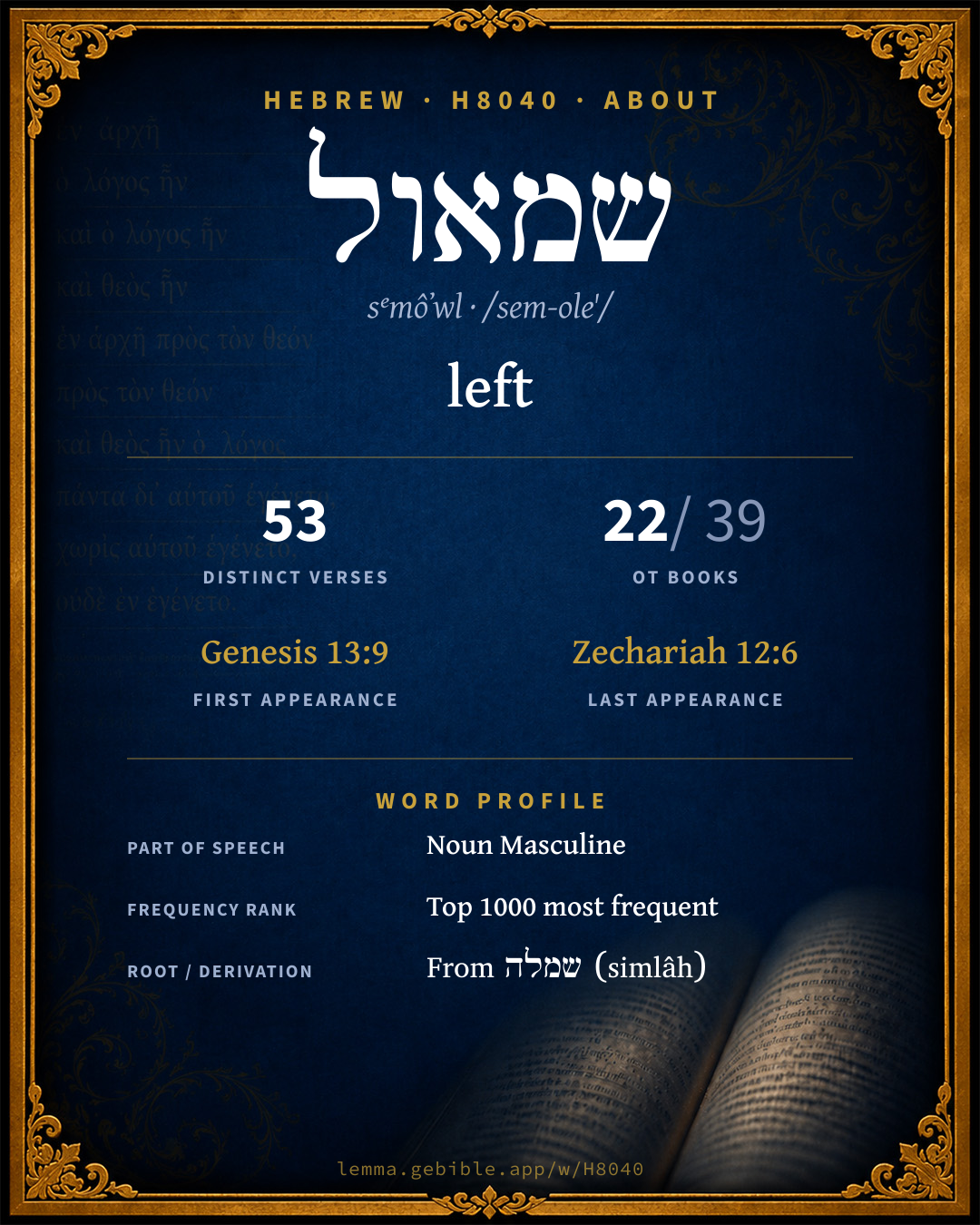
שְׂמֹאל
left
also: the left hand, the left side fuller range ↓
Full lexicon entry — Brown-Driver-Briggs (BDB)
From Brown-Driver-Briggs (BDB)
Where this word appears
See every Absolute-state word in the Hebrew Bible →
Grammar key — what these labels mean
Part of speech
- Noun
- A naming word — a person, place, thing, or idea.
Noun type
- Common
- A common noun — a general class of person, place, or thing (“king,” “city,” “water”), not a specific name.
State
- Absolute
- The independent form of a noun, not bound to a following word.
- Construct
- A noun bound to a following noun in a possessive / “of” relationship (the construct chain).
Gender
- Masculine
- Grammatically masculine.
Number
- Singular
- One.
Grammatical forms
- Noun, Common, Masculine, Singular, Absolute 29 times (54%)
- Noun, Common, Masculine, Singular, Construct 24 times (44%)
- Adjective, Adjective, Masculine, Singular, Absolute 1 time (2%)
Parsed forms decoded from the imported morphology (morphhb / Westminster Leningrad Codex — WLC text public domain, morphhb tagging CC BY 4.0), counted across 54 parsed occurrences — not distinct verses.
Every verse where H8040 appears — 53 distinct verses across 22 books. Click any verse to open its interlinear word-by-word view. Verse text shown in the World English Bible for context — . Each verse’s Hebrew form is shown with its reference; the English is not keyword-highlighted, since the data carries no word-level English alignment. Use “Compare translations” on any verse to read it across multiple English versions. This concordance covers the Hebrew Bible; Septuagint (Greek Old Testament) occurrences are not indexed here.
Genesis 5 verses
- Genesis 13:9 הַ/שְּׂמֹ֣אל ptcl def.art + n c ms Isn't the whole land before you? Please separate yourself from me. If you go to the left hand, then I will go to the right. Or if you go to the right hand, then I will go to the left."
- Genesis 14:15 מִ/שְּׂמֹ֖אל prep + n c ms He divided himself against them by night, he and his servants, and struck them, and pursued them to Hobah, which is on the left hand of Damascus.
- Genesis 24:49 שְׂמֹֽאל n c ms Now if you will deal kindly and truly with my master, tell me. If not, tell me. That I may turn to the right hand, or to the left."
- Genesis 48:13 מִ/שְּׂמֹ֣אל בִ/שְׂמֹאל֖/וֹ prep + n c ms cs prep + n c ms cs + sfx pers 3ms Joseph took them both, Ephraim in his right hand toward Israel's left hand, and Manasseh in his left hand toward Israel's right hand, and brought them near to him.
- Genesis 48:14 שְׂמֹאל֖/וֹ n c ms cs + sfx pers 3ms Israel stretched out his right hand, and laid it on Ephraim's head, who was the younger, and his left hand on Manasseh's head, guiding his hands knowingly, for Manasseh was the firstborn.
Exodus 2 verses
- Exodus 14:22 וּ/מִ/שְּׂמֹאלָֽ/ם conj + prep + n c ms cs + sfx pers 3mp The children of Israel went into the midst of the sea on the dry ground, and the waters were a wall to them on their right hand, and on their left.
- Exodus 14:29 וּ/מִ/שְּׂמֹאלָֽ/ם conj + prep + n c ms cs + sfx pers 3mp But the children of Israel walked on dry land in the midst of the sea, and the waters were a wall to them on their right hand, and on their left.
Numbers 2 verses
- Numbers 20:17 וּ/שְׂמֹ֔אול conj + n c ms Please let us pass through your land: we will not pass through field or through vineyard, neither will we drink of the water of the wells: we will go along the king's highway; we will not turn aside to the right hand nor to the left, until we have passed your border.
- Numbers 22:26 וּ/שְׂמֹֽאול conj + n c ms The angel of Yahweh went further, and stood in a narrow place, where was no way to turn either to the right hand or to the left.
Deuteronomy 5 verses
- Deuteronomy 2:27 וּ/שְׂמֹֽאול conj + n c ms Let me pass through your land: I will go along by the highway, I will turn neither to the right hand nor to the left.
- Deuteronomy 5:32 וּ/שְׂמֹֽאל conj + n c ms You shall observe to do therefore as Yahweh your God has commanded you: you shall not turn aside to the right hand or to the left.
- Deuteronomy 17:11 וּ/שְׂמֹֽאל conj + n c ms according to the tenor of the law which they shall teach you, and according to the judgment which they shall tell you, you shall do; you shall not turn aside from the sentence which they shall show you, to the right hand, nor to the left.
- Deuteronomy 17:20 וּ/שְׂמֹ֑אול conj + n c ms that his heart not be lifted up above his brothers, and that he not turn aside from the commandment, to the right hand, or to the left: to the end that he may prolong his days in his kingdom, he and his children, in the midst of Israel.
- Deuteronomy 28:14 וּ/שְׂמֹ֑אול conj + n c ms and shall not turn aside from any of the words which I command you this day, to the right hand, or to the left, to go after other gods to serve them.
Joshua 3 verses
- Joshua 1:7 וּ/שְׂמֹ֑אול conj + n c ms Only be strong and very courageous, to observe to do according to all the law, which Moses my servant commanded you: don't turn from it to the right hand or to the left, that you may have good success wherever you go.
- Joshua 19:27 מִ/שְּׂמֹֽאל prep + n c ms and it turned toward the sunrise to Beth Dagon, and reached to Zebulun, and to the valley of Iphtah El northward to Beth Emek and Neiel; and it went out to Cabul on the left hand,
- Joshua 23:6 וּ/שְׂמֹֽאול conj + n c ms Therefore be you very courageous to keep and to do all that is written in the book of the law of Moses, that you not turn aside from it to the right hand or to the left;
Judges 3 verses
- Judges 3:21 שְׂמֹאל֔/וֹ n c ms cs + sfx pers 3ms Ehud put forth his left hand, and took the sword from his right thigh, and thrust it into his body:
- Judges 7:20 שְׂמאוֹלָ/ם֙ n c ms cs + sfx pers 3mp The three companies blew the trumpets, and broke the pitchers, and held the torches in their left hands, and the trumpets in their right hands with which to blow; and they cried, The sword of Yahweh and of Gideon.
- Judges 16:29 בִּ/שְׂמֹאלֽ/וֹ prep + n c ms cs + sfx pers 3ms Samson took hold of the two middle pillars on which the house rested, and leaned on them, the one with his right hand, and the other with his left.
1 Samuel 1 verse
2 Samuel 3 verses
- 2 Samuel 2:19 הַ/שְּׂמֹ֔אול ptcl def.art + n c ms Asahel pursued after Abner; and in going he didn't turn to the right hand nor to the left from following Abner.
- 2 Samuel 2:21 שְׂמֹאלֶ֔/ךָ n c ms cs + sfx pers 2ms Abner said to him, Turn you aside to your right hand or to your left, and lay you hold on one of the young men, and take you his armor. But Asahel would not turn aside from following him.
- 2 Samuel 16:6 וּ/מִ/שְּׂמֹאלֽ/וֹ conj + prep + n c ms cs + sfx pers 3ms He cast stones at David, and at all the servants of king David: and all the people and all the mighty men were on his right hand and on his left.
1 Kings 3 verses
- 1 Kings 7:39 מִ/שְּׂמֹאל֑/וֹ prep + n c ms cs + sfx pers 3ms He set the bases, five on the right side of the house, and five on the left side of the house: and he set the sea on the right side of the house eastward, toward the south.
- 1 Kings 7:49 מִ/שְּׂמֹ֛אול prep + n c ms and the lampstands, five on the right side, and five on the left, before the oracle, of pure gold; and the flowers, and the lamps, and the tongs, of gold;
- 1 Kings 22:19 וּ/מִ/שְּׂמֹאלֽ/וֹ conj + prep + n c ms cs + sfx pers 3ms [Micaiah] said, Therefore hear you the word of Yahweh: I saw Yahweh sitting on his throne, and all the host of heaven standing by him on his right hand and on his left.
2 Kings 2 verses
- 2 Kings 22:2 וּ/שְׂמֹֽאול conj + n c ms He did that which was right in the eyes of Yahweh, and walked in all the way of David his father, and didn't turn aside to the right hand or to the left.
- 2 Kings 23:8 שְׂמֹ֥אול n c ms He brought all the priests out of the cities of Judah, and defiled the high places where the priests had burned incense, from Geba to Beersheba; and he broke down the high places of the gates that were at the entrance of the gate of Joshua the governor of the city, which were on a man's left hand at the gate of the city.
1 Chronicles 1 verse
2 Chronicles 6 verses
- 2 Chronicles 3:17 הַ/שְּׂמָאלִ֖י ptcl def.art + Adjective Adjective ms He set up the pillars before the temple, one on the right hand, and the other on the left; and called the name of that on the right hand Jachin, and the name of that on the left Boaz.
- 2 Chronicles 4:6 מִ/שְּׂמֹאול֙ prep + n c ms He made also ten basins, and put five on the right hand, and five on the left, to wash in them; such things as belonged to the burnt-offering they washed in them; but the sea was for the priests to wash in.
- 2 Chronicles 4:7 מִ/שְּׂמֹֽאול prep + n c ms He made the ten lampstands of gold according to the ordinance concerning them; and he set them in the temple, five on the right hand, and five on the left.
- 2 Chronicles 4:8 מִ/שְּׂמֹ֑אול prep + n c ms He made also ten tables, and placed them in the temple, five on the right side, and five on the left. He made one hundred basins of gold.
- 2 Chronicles 18:18 וּ/שְׂמֹאלֽ/וֹ conj + n c ms cs + sfx pers 3ms [Micaiah] said, Therefore hear you the word of Yahweh: I saw Yahweh sitting on his throne, and all the host of heaven standing on his right hand and on his left.
- 2 Chronicles 34:2 וּ/שְׂמֹֽאול conj + n c ms He did that which was right in the eyes of Yahweh, and walked in the ways of David his father, and didn't turn aside to the right hand or to the left.
Nehemiah 1 verse
Job 1 verse
Proverbs 2 verses
Ecclesiastes 1 verse
Song of Solomon 2 verses
Isaiah 2 verses
- Isaiah 9:20 שְׂמֹ֖אול n c ms One shall snatch on the right hand, and be hungry; and he shall eat on the left hand, and they shall not be satisfied: they shall eat every man the flesh of his own arm:
- Isaiah 54:3 וּ/שְׂמֹ֖אול conj + n c ms For you shall spread aboard on the right hand and on the left; and your seed shall possess the nations, and make the desolate cities to be inhabited.
Ezekiel 3 verses
- Ezekiel 1:10 מֵֽ/הַ/שְּׂמֹ֖אול prep + ptcl def.art + n c ms As for the likeness of their faces, they had the face of a man; and they four had the face of a lion on the right side; and they four had the face of an ox on the left side; they four had also the face of an eagle.
- Ezekiel 16:46 שְׂמֹאולֵ֑/ךְ n c ms cs + sfx pers 2fs Your elder sister is Samaria, who dwells at your left hand, she and her daughters; and your younger sister, who dwells at your right hand, is Sodom and her daughters.
- Ezekiel 39:3 שְׂמֹאולֶ֑/ךָ n c ms cs + sfx pers 2ms and I will strike your bow out of your left hand, and will cause your arrows to fall out of your right hand.
Daniel 1 verse
Jonah 1 verse
Zechariah 3 verses
- Zechariah 4:3 שְׂמֹאלָֽ/הּ n c ms cs + sfx pers 3fs and two olive trees by it, one on the right side of the bowl, and the other on the left side of it."
- Zechariah 4:11 שְׂמֹאולָֽ/הּ n c ms cs + sfx pers 3fs Then I asked him, "What are these two olive trees on the right side of the lampstand and on the left side of it?"
- Zechariah 12:6 שְׂמֹ֛אול n c ms In that day I will make the chieftains of Judah like a pan of fire among wood, and like a flaming torch among sheaves; and they will devour all the surrounding peoples, on the right hand and on the left; and Jerusalem will yet again dwell in their own place, even in Jerusalem.
About this entry
At a glance — auto-summarized from this page’s data, not written by a person. Every figure links to its source below. This summary describes the numbers; it doesn’t interpret them.
שמאול — transliterated sᵉmôʼwl — is a Hebrew noun carrying the sense “left.” It also covers “the left hand” and “the left side”, alongside “left” — see its full sense range. Spanning 53 verses in 22 books, it ranks among the moderately common words of the Hebrew Bible. Debuting at Genesis 13:9, it then recurs through the corpus. From the same root come שמלה, שלמה and שמאל. Each statement above links to its evidence; the full detail follows below.
Gloss history
Strong's 1890 vs modern scholarship
About this word
Strong's H8040 catalogs a Hebrew word from the Hebrew Old Testament.
These counts are not copied from any lexicon or concordance. They are computed here, from the morphology-tagged Hebrew Old Testament. What Lemma adds →
- 53
- distinct verses
- The word appears in 53 distinct verses.
- 22 / 39
- OT books
- The word appears in 22 of 39 Old Testament books.
- #696
- by frequency
- Top 1000 most frequent Hebrew words (rank 696 of 8,640 Hebrew words by occurrence).
View all 53 occurrences in the concordance →
Most concentrated in
- 2 Chronicles 6 verses 11%
- Genesis 5 verses 9%
- Deuteronomy 5 verses 9%
By section of the Old Testament
By traditional corpus
Conventional, traditional groupings — biblical authorship is debated, so this is a traditional corpus grouping, not an authorship claim. Each share is this word’s portion of its verses in that division of the Hebrew canon. Each figure is a share of the word’s 53 distinct verses.
- Prophets (Nevi'im) 24 verses · 45%
- Writings (Ketuvim) 15 verses · 28%
- Torah (Pentateuch) 14 verses · 26%
How translations render this word
Counts come from each version’s own published word-to-Strong’s tagging or interlinear alignment — an approximate guide to how each version renders this word, not a word-level alignment the data otherwise carries. Because each total is that version’s own tagged count, the per-version totals vary from one another and need not match the appearance or distinct-verse counts above. These counts may also differ from a printed concordance because Lemma counts each distinctly tagged rendering and does not collapse phrase taggings into a single head-word total. This is a fixed set of word-tagged versions (KJV, ASV, BSB, ULT) and does not change with the reading translation you choose elsewhere. Each version’s license is shown beside its name below (and on Sources).
- King James Version: Left 27×, Left hand 14×, Or to the left 8×
- American Standard Version: Left 22×, Left hand 13×, Or to the left 9×
- Berean Standard Bible: Left 21×, Or to the left 13×, North 8×
- unfoldingWord Literal Text: Left 30×, Or left 10×, Left hand 5×
King James Version Public Domain
Renders H8040 across 54 tagged occurrences — most commonly:
Plus 5 renderings that appear only once — usually multi-word phrases or single function words the recovered tagging swept in, not distinct renderings.
American Standard Version Public Domain
Renders H8040 across 54 tagged occurrences — most commonly:
Plus 6 renderings that appear only once — usually multi-word phrases or single function words the recovered tagging swept in, not distinct renderings.
Berean Standard Bible Public Domain
Renders H8040 across 53 tagged occurrences — most commonly:
Plus 4 renderings that appear only once — usually multi-word phrases or single function words the recovered tagging swept in, not distinct renderings. Not rendered by a distinct English word in 1 further occurrence.
unfoldingWord Literal Text CC BY-SA 4.0
Renders H8040 across 57 tagged occurrences — most commonly:
Plus 8 renderings that appear only once — usually multi-word phrases or single function words the recovered tagging swept in, not distinct renderings.
Senses in the full BDB
What do BDB’s symbols mean?
BDB uses these scholarly abbreviations:
| Symbol | Meaning |
|---|---|
| 𝔊 | the Septuagint (the ancient Greek translation, LXX) |
| 𝔙 | the Vulgate (the Latin translation) |
| 𝔖 | the Syriac version (the Peshitta) |
| 𝔗 | the Targum (the Aramaic translation) |
| ψ | the Psalms |
| √ | root (the underlying root or stem) |
| ‖ | parallel passage (a synonymous or contrasted parallel) |
| † | the dagger: every passage where the word occurs is cited |
The 3 senses and sub-senses the full Brown-Driver-Briggs lexicon distinguishes for this word, in lexicon order (not ranked by frequency), with BDB’s own verbatim wording and sub-sense lettering. Shown in Hebrew script with BDB’s own scholarly abbreviations. The condensed entry is in the Lexicon Entry tab. See also the Forms in the corpus table below.
- 1. left, region on the left, Gn 13:9 (J); on the left is עַל־שׂ׳ 2 K 23:8; Ez 16:46; Zc 4:3, 11, עַל־הַשּׂ׳ 1 Ch 6:29 cf. 2 Ch 18:18, also מִשּׂ׳ (a sinistra) Ex 14:22, 29 (P), 2 S 16:6 + 7 times + מֵהַשּׂ׳ 2 Ch 3:17; Ez 1:10, לִשׂ׳; Ec 10:2, שׂ׳ alone Jb 23:9; toward the left is עַל־שׂ׳ Gn 24:49 (J), 2 S 2:21; Zc 12:6, עַל־הַשּׂ׳ 2 S 2:19, שׂ׳ alone 1 S 6:12; Is 9:20 + 13 times e.g. Genesis 13:9
- 2. יַד־שׂ׳ left hand, Ju 3:21; 7:20, so שׂ׳ alone Gn 48:13(×2), 14 (E), Ju 16:29; Ez 39:3; Jon 4:11; Pr 3:16; Dn 12:7; Ct 2:6; 8:3. e.g. Judges 3:21
- 3. = north (on left of one facing east, cf. אָתוֹר d, יָמִין 4, קֶדֶם 1 b) Gn 14:15; Jos 19:27 (P); cf. Ez 16:46. e.g. Genesis 14:15
Senses from the full Brown-Driver-Briggs lexicon (Brown, Driver, Briggs; Oxford 1906 — public domain), digitized via Sefaria, supplemented by the OpenScriptures HebrewLexicon (CC BY 4.0). Full attribution on Sources.
Word origin
(Baer Jos 1:7)54 n.[m.] the left (NH id.; Assyrian šumêlu; Arabic شِمَالٌ (also شَمَالٌ and شَأْمَلٌ, شَامَلٌ north wind); Old Aramaic שמאל, Palm. (sf.) סמלך; Syriac ܣܶܡܳܠܴܐ; √ dub., שאם + ל Nö M 128 HomA. u. A. i. (1892), 21 Köii. 1. 143, 405; (v. also Thes DietrWortforschung 234), cf. Arabic شأم be unlucky, شَأْمَةٌ left, شَأَم, شَام north; Sab. שאם north, unlucky DHMEpigr. Denkm. 29; Epigr. Denkm. Ar. Nos. 6. 7; other views in Sta§ 299 LagBN 116);—שְׂמֹאל abs. Gn 13:9 +, cstr. 48:13; 2 K 23:8; שְׂמֹאול abs. Nu 20:17 +; sf. שְׂמֹאלֶ֑ךָ 2 S 2:21, שְׂמֹאלוֹ Gn 48:13 +, etc.;—opp. יָמִין except Gn 14:15; Ju 19:27; 2 K 23:8;—
— Brown-Driver-Briggs (Oxford 1906, public domain), digitized via Sefaria, supplemented by the OpenScriptures HebrewLexicon (CC BY 4.0). See Sources.
Derived from שמלה (simlâh) (H8071) — garment.
Forms in the corpus
The 42 distinct written forms H8040 takes in the Hebrew Bible, most frequent first — each parse links to that state’s occurrences in the concordance. Hebrew forms include their vowel points and cantillation, so a single lemma takes many written forms.
Same root — word family
Other BDB entries built from the same root as H8040, grouped by Strong’s listed origin. These share a root / origin per the lexicon — not necessarily a shared meaning. Each links to that word’s own entry.
Derives from
Shares the same root
Derived from this word
Proper names from this root
People and places named from this root — a name, not an additional meaning of the word.
Compare all same-root words → Showing 4 of 6 — not the complete family. 1 of the same-root words is a proper name (a person or place). They share a root, not necessarily a meaning.
Septuagint verse parallels
This word appears in 52 verses that also exist in the Greek Old Testament (Septuagint), out of the 53 Hebrew verses it occurs in. You can read those verses in Greek by switching the Old Testament edition to the Septuagint.
Read these verses in the Septuagint
- Genesis 13:9
- Exodus 14:22
- Numbers 20:17
- Deuteronomy 2:27
- Joshua 1:7
- Judges 3:21
- 1 Samuel 6:12
- 2 Samuel 2:19
- 1 Kings 7:39
- 2 Kings 22:2
- 1 Chronicles 6:44
- 2 Chronicles 3:17
This is a verse-level parallel only — the same verses exist in both the Hebrew and Greek Old Testaments. No word-level Hebrew↔Greek correspondence is claimed: the data carries no such alignment, so no Greek word is shown as this Hebrew word’s translation. Coverage is not total — the Septuagint omits the deuterocanon and renumbers the Psalms, so some Hebrew verses have no direct Greek parallel.