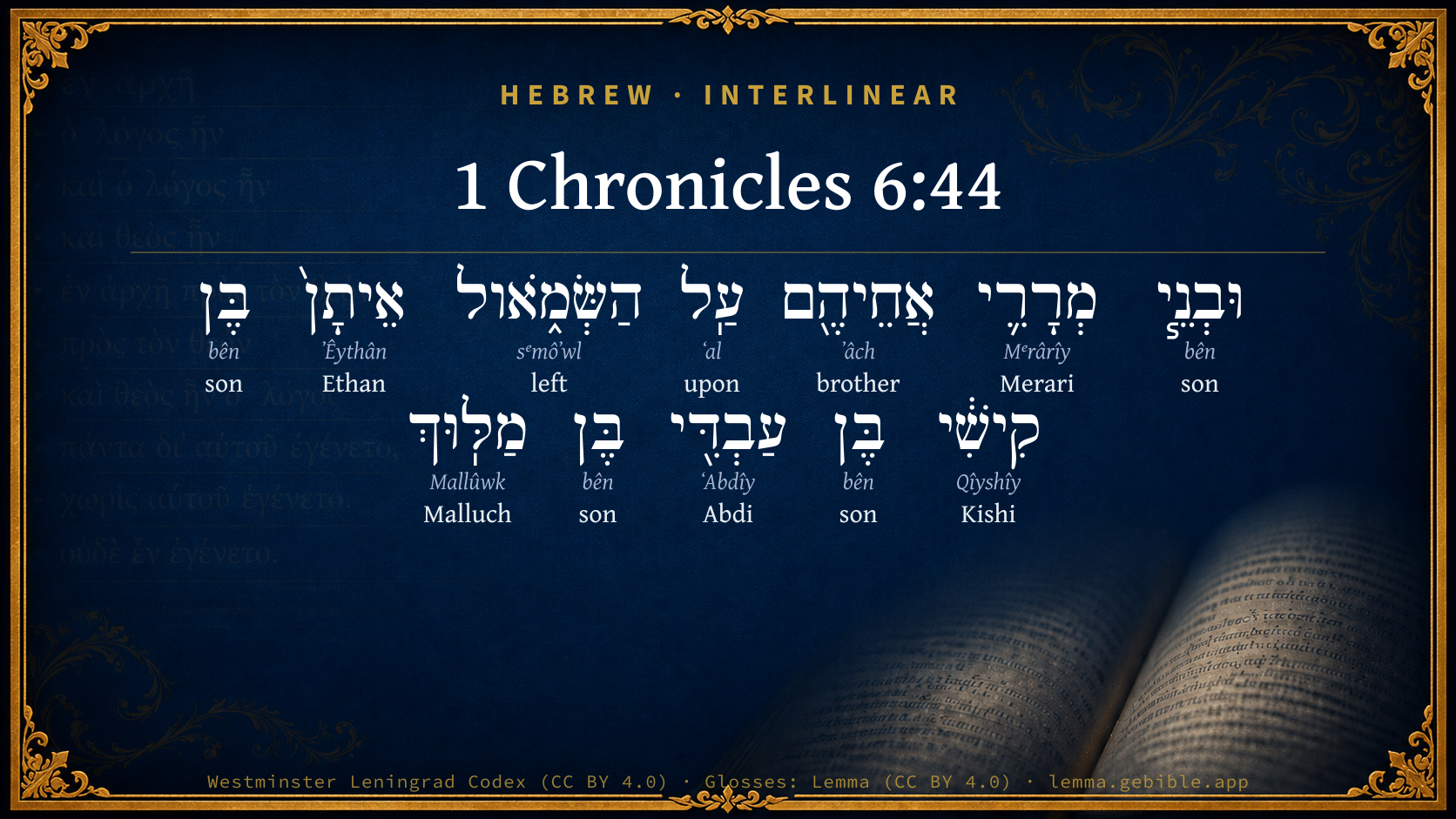
1 Chronicles 6:44

Hebrew (Westminster Leningrad Codex) 1 Chronicles 6:44 appears in the Hebrew Old Testament. The text above is from the Westminster Leningrad Codex. Each word links to its Strong’s number, a concise gloss, and parsing drawn from the Open Scriptures Hebrew Bible morphology. Click any word for its full Brown-Driver-Briggs (BDB) entry.
Download image
Cite this verse

1 Chronicles 6:44 (World English Bible). Public Domain. Lemma interlinear Bible study tool, https://lemma.gebible.app/v/1-chronicles/6/44.

Show BibTeX & RIS
BibTeX
RIS
English Translation
On the left hand their brothers the sons of Merari: Ethan the son of Kishi, the son of Abdi, the son of Malluch,
World English Bible · Public Domain
Highlights
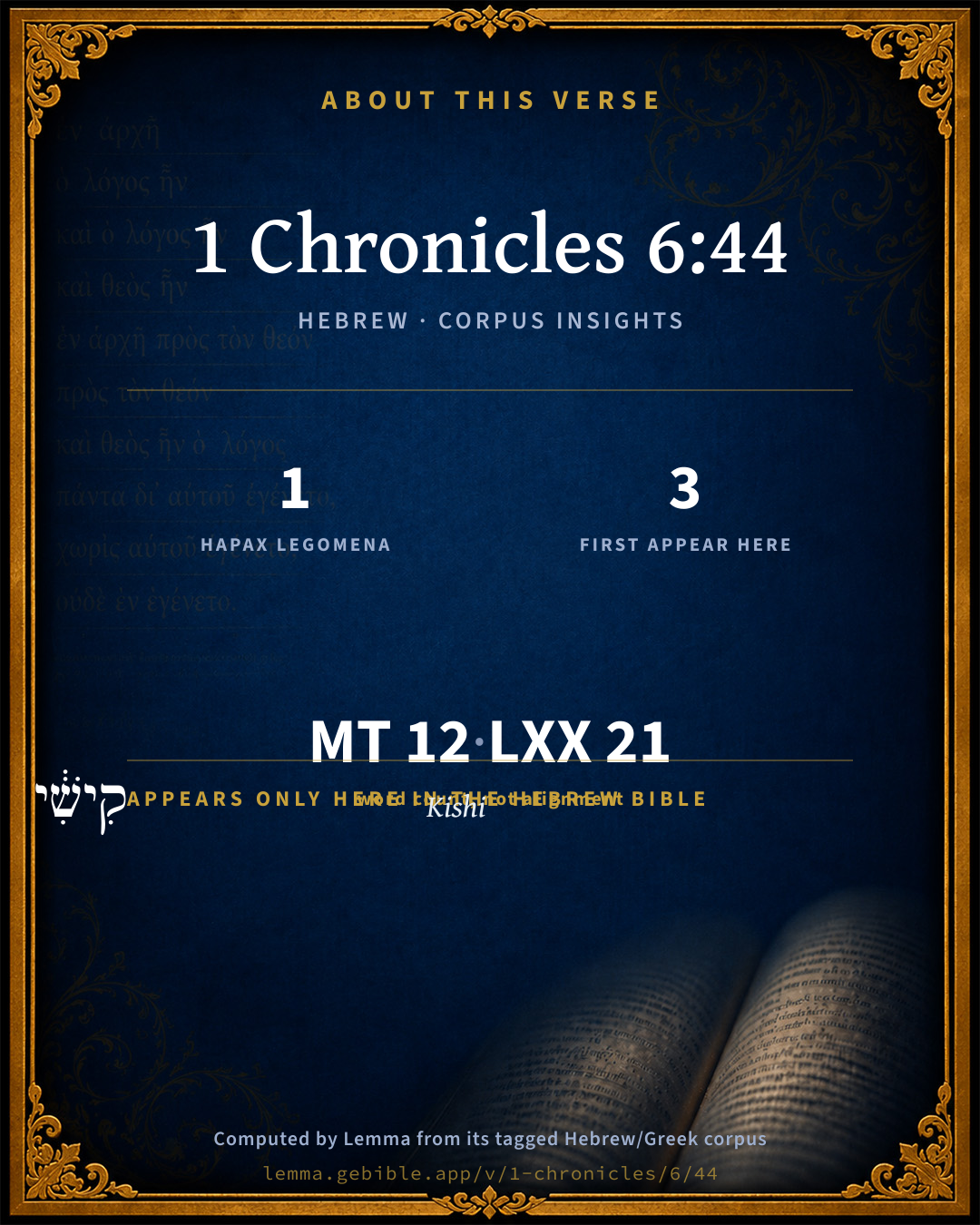
  • 1 hapax legomenon — only here in the Hebrew Bible
  • 3 first appearances in the Hebrew Bible
Full analysis ↓
Download a study sheet

One document with this verse’s original text, its word-by-word gloss line, the meaning frame, cross-references with their text, attributed commentary, and full source and license credits — printable, and it pastes into notes with its structure intact.

This verse Autodidact and up

Study sheet (.html) Plain text (.txt)

A passage Seminary Student

Up to 50 verses in one chapter. A passage sheet keeps up to 6 commentary sources and 12 cross-references per verse, in the order this page ranks them, and says so on the sheet whenever that leaves anything out. Ask for a single verse and you get the Autodidact verse sheet above.

Everything on this page stays free to read, with no account — the sheet is a download of what is already on screen, not access to it.

Want to remove ads? Support Godless Engineer
Compare translations 3

The same verse in 3 English versions, stacked beneath the original-language interlinear above. Click any original word for its lexicon entry.

Each is an independent rendering of the whole verse — the interlinear is not word-aligned to these translations.

Highlighted words mark where these versions differ — a whole-verse word diff, not a word-by-word alignment.

  • World English Bible Public Domain
    On the left hand their brothers the sons of Merari: Ethan the son of Kishi, the son of Abdi, the son of Malluch,
  • King James Version Public Domain
    And their brethren the sons of Merari stood on the left hand: Ethan the son of Kishi, the son of Abdi, the son of Malluch,
  • unfoldingWord Literal Text CC BY-SA 4.0
    And the sons of Merari, their brothers, on the left: Ethan, the son of Kishi, the son of Abdi, the son of Malluk,

unfoldingWord Literal Text — © unfoldingWord, licensed CC BY-SA 4.0. Word-aligned USFM3 via Door43 (git.door43.org/unfoldingWord/en_ult).

Versions to compare (up to 4)

3 of 4 selected

Show all 18 translations

Every available English version of this verse, each an independent rendering of the whole verse.

  • World English Bible Public Domain
    On the left hand their brothers the sons of Merari: Ethan the son of Kishi, the son of Abdi, the son of Malluch,
  • Berean Standard Bible Public Domain
    On the left were their kinsmen, the sons of Merari: Ethan the son of Kishi, the son of Abdi, the son of Malluch,
  • Majority Standard Bible Public Domain
    On the left were their kinsmen, the sons of Merari: Ethan the son of Kishi, the son of Abdi, the son of Malluch,
  • King James Version Public Domain
    And their brethren the sons of Merari stood on the left hand: Ethan the son of Kishi, the son of Abdi, the son of Malluch,
  • American Standard Version (1901) Public Domain
    And on the left hand their brethren the sons of Merari: Ethan the son of Kishi, the son of Abdi, the son of Malluch,
  • Revised Version (1885) Public Domain
    And on the left hand their brethren the sons of Merari: Ethan the son of Kishi, the son of Abdi, the son of Malluch;
  • Geneva Bible (1599) Public Domain
    And their brethren the sonnes of Merari were on the left hand, euen Ethan the sonne of Kishi, the sonne of Abdi, the sonne of Malluch,
  • Douay-Rheims (1899) Public Domain
    And the sons of Merari their brethren, on the left hand, Ethan the son of Cusi, the son of Abdi, the son of Meloch,
  • Young's Literal Translation Public Domain
    And sons of Merari, their brethren, `are' on the left. Ethan son of Kishi, son of Abdi, son of Malluch,
  • Literal Standard Version CC BY-SA 4.0
    And sons of Merari, their brothers, on the left: Ethan son of Kishi, son of Abdi, son of Malluch,
  • Unlocked Literal Bible CC BY-SA 4.0
    At Heman's left hand were his colleagues the sons of Merari. They included Ethan son of Kishi. Kishi was the son of Abdi. Abdi was the son of Malluk.
  • unfoldingWord Literal Text CC BY-SA 4.0
    And the sons of Merari, their brothers, on the left: Ethan, the son of Kishi, the son of Abdi, the son of Malluk,
  • Darby Bible Public Domain
    And their brethren the sons of Merari were on the left hand: Ethan the son of Kishi, the son of Abdi, the son of Malluch,
  • World Messianic Bible Public Domain
    On the left hand their brothers the sons of Merari: Ethan the son of Kishi, the son of Abdi, the son of Malluch,
  • Webster's Bible Public Domain
    And their brethren the sons of Merari stood on the left hand: Ethan the son of Kishi, the son of Abdi, the son of Malluch,
  • Free Bible Version CC BY-SA 4.0
    To Heman's left served sons of Merari: Ethan son of Kishi, the son of Abdi, the son of Malluch,
  • Bible in Basic English Public Domain
    And on the left their brothers, the sons of Merari: Ethan, the son of Kishi, the son of Abdi, the son of Malluch,
  • JPS Tanakh (1917) Public Domain
    (6-29) And on the left hand their brethren the sons of Merari: Ethan the son of Kishi, the son of Abdi, the son of Malluch;

Literal Standard Version (2020), Covenant Press — licensed CC BY-SA 4.0. Text via the HelloAO Bible API (eBible.org). Unlocked Literal Bible (unfoldingWord) — licensed CC BY-SA 4.0. Text via the HelloAO Bible API (eBible.org). unfoldingWord Literal Text — © unfoldingWord, licensed CC BY-SA 4.0. Word-aligned USFM3 via Door43 (git.door43.org/unfoldingWord/en_ult). Free Bible Version, Dr. Jonathan Gallagher — licensed CC BY-SA 4.0. Text via the HelloAO Bible API (eBible.org).

Word by word

More ways to search: Search by grammar → Find every occurrence → Compare this word →

Practice this passage: Drill this verse → Learn its vocabulary →

About this verse

These counts appear in no published source. They are computed here, from the morphology-tagged text and Lemma’s own curated glosses. What Lemma adds →

12
words
9
distinct lemmas
Historical
section

Notable vocabulary

1 hapax legomenon — a word that appears only here in the entire Hebrew Bible:

  • קִישִׁ֔י Kishi H7029

First appearance in Scripture

These words make their first canonical appearance in the Hebrew Bible here:

  • קִישִׁ֔י Kishi H7029
  • עַבְדִּ֖י Abdi H5660
  • מַלּֽוּךְ Malluch H4409

Shared distinctive vocabulary

עַבְדִּ֖י Abdi H5660 occurs in 3 verses of the Hebrew Bible. Also found in:

Grammatical profile

  • 11 nouns
  • 1 preposition

Repetition

A word recurs within this verse — often emphatic in Hebrew:

  • וּבְנֵ֧י son H1121 ×4

Hebrew & Septuagint length

In English translation the verse runs 23 words from the Hebrew and 24 from the Septuagint (LXX English) — closely comparable.

A rough comparison of the two English renderings, which tokenize alike — not a word-level alignment.

Word counts can differ between the Hebrew and the Greek without any difference in meaning — e.g. the Hebrew direct-object marker אֵת has no separate Greek word, and Greek often adds the article ὁ.

In the original languages it is 12 Hebrew tokens and 21 Greek tokens — but the two are counted differently (Hebrew bundles its prefixes and suffixes into one token; the Greek is in lemma form), so that isn’t a like-for-like length.

Cross-references

5

Topical passages linked to 1 Chronicles 6:44 in the Treasury of Scripture Knowledge — connected by theme and wording, ordered by reader-vote popularity; previews shown in the World English Bible.

  • 1 Chronicles 15:17 So the Levites appointed Heman the son of Joel; and of his brothers, Asaph the son of Berechiah; and of the sons of Merari their brothers, Ethan the son of Kushaiah;
  • 1 Chronicles 25:1 Moreover, David and the captains of the host set apart for the service certain of the sons of Asaph, and of Heman, and of Jeduthun, who should prophesy with harps, with psalteries, and with cymbals: and the number of those who did the work according to their service was:
  • 1 Chronicles 25:3 Of Jeduthun; the sons of Jeduthun: Gedaliah, and Zeri, and Jeshaiah, Hashabiah, and Mattithiah, six, under the hands of their father Jeduthun with the harp, who prophesied in giving thanks and praising Yahweh.
  • 1 Chronicles 25:6 All these were under the hands of their father for song in the house of Yahweh, with cymbals, psalteries, and harps, for the service of the house of God; Asaph, Jeduthun, and Heman being under the order of the king.
  • Psalms 89:1 I will sing of the loving kindness of Yahweh forever. With my mouth, I will make known your faithfulness to all generations.

Cross-references courtesy of OpenBible.info (CC BY 4.0).

Hebrew and Greek witnesses Masoretic Hebrew ↔ Greek Septuagint

The same verse in the two great witnesses to the Old Testament, shown verse-for-verse.

These are two independent witnesses, not word-aligned to each other, and the Septuagint is shown in lemma (dictionary) form.

Hebrew 1 Chronicles 6:44 Masoretic · Westminster Leningrad Codex

וּבְנֵ֧י מְרָרִ֛י אֲחֵיהֶ֖ם עַֽל הַשְּׂמֹ֑אול אֵיתָן֙ בֶּן קִישִׁ֔י בֶּן עַבְדִּ֖י בֶּן מַלּֽוּךְ

On the left hand their brothers the sons of Merari: Ethan the son of Kishi, the son of Abdi, the son of Malluch,

World English Bible · Public Domain

Greek LXX 1 Chronicles 6:44 Septuagint · lemma form

καί ὁ ασαν καί ὁ περισπόριον αὐτός καί ὁ ατταν καί ὁ περισπόριον αὐτός καί ὁ βασαμυς καί ὁ περισπόριον αὐτός

And the sons of Merari their brethren on the left hand: Aetham the son of Kisa, the son of Abai, the son of Maloch,

LXX2012 (modern English Septuagint) · Public Domain

Hebrew: Westminster Leningrad Codex (CC BY 4.0). Greek: Septuagint (public domain); English from LXX2012 (modern English Septuagint) (Public Domain). How the Septuagint differs from the Hebrew →

Commentary

Notes on 1 Chronicles 6:44 from classic Christian and Jewish commentators (each source and its license shown beneath its notes). The classic Christian expositions comment on the surrounding passage and are grouped to its opening verse, so a note may address several verses; the Jewish commentaries on the Tanakh (Rashi and others) are per-verse, so they appear only where the commentator wrote on this verse.

Lemma curates 59 commentaries, every one of them public domain or Creative Commons licensed, each selected and text-cleaned for this edition rather than reprinted as found. About our sources →

Joseph Benson's Commentary

1Ch 6:44. The sons of Merari stood on the left hand — The children of the next son of Levi are here mentioned, who had the lowest place assigned them, because they were of the youngest family. So there were three principal singers, who were masters and governors of the whole choir: Heman, descended from Koath, was the prime, who, together with his sons, stood in the middle: Asaph, descended from Gershom, with his sons, stood on his right hand: and Ethan, (called also Jeduthun, 1Ch 9:16; 2Ch 35:15, and in the title of divers Psalms,) descended from Merari, on the left.

Joseph Benson's Commentary on the Old and New Testaments (1811–1818) — public domain. Text from a community e-Sword module.

Ellicott's Commentary for English Readers

(44-47) The pedigree of Ethan the Merarite, traced back through twelve names to Levi. Ethan is no doubt the same as Jeduthun, 1Ch_25:1; 2Ch_35:15.

(44) And their brethren the sons of Merari.—We should say their comrades or kinsmen (see Note on 1Ch_6:39). “Brethren,” or “brothers,” is the natural style for the members of a guild, whether religious like the monastic bodies, or commercial like the city companies of London, or benevolent like the Freemasons. The plural pronoun refers to the two preceding guilds of Heman and Asaph. The Ethanites stood on the left of the Hemanites in the sanctuary, as the Asaphites stood on their right, and this arrangement was hereditary.

Kishi is a contraction of Kushaiah, like Zabdi of Zebadiah.

(47) Son of Manli, the son of Mushi.—In 1Ch_6:19 Mahli and Mushi appear as two sons of Merari; so also at Lev. 3:20. Mahli son of Mushi here must be nephew of the Mahli of those two passages, if the genealogical form is in each case to be understood literally. It is difficult on a first inspection to perceive any connection between the present list and that of the Merarites in 1Ch_6:29-30. The series there is:

Mahli, Libni, Shimei, Uzza, Shimea, Haggiah, and Asaiah.

Here we have:

Mushi, Mahli, Shamer, Bani, Amzi, Hilkiah, Amaziah, Hashabiah, Malluch, Abdi, Kishi, and Ethan.

Now it is quite possible that both lines spring from Mushi son of Merari. We have only to suppose that the name of Mushi has either dropped out or been omitted by design in 1Ch_6:29. In that case, of course, Mahli in each line becomes identical. Next we remark that Libni in Hebrew adds but one letter (1) to Bani; and these two may be variants of the same name. The second line is again more complete than the first, as it supplies Shamer (Shemer) between Mahli and Bani-Libni. Further. Uzzi and Amzi express the same idea—that of strength—and may therefore indicate identity of person. The names Shimei and Shimeah are perhaps inadvertent duplicates of each other; which may also be the case with Amzi and Amaziah in the second series. Haggiah perhaps answers to Hilkiah.

Thus it may be right to regard this pedigree of Ethan as related to the Merarite line of 1Ch_6:29-30, in the same way as those of Heman and Asaph are related to the first drafts of the Kohathite and Gershonite lines of descent, although the connection is not so evident in the present instance, owing perhaps to corruption of the text.

1Ch_6:48-49 constitute the transition from the pedigrees of the three Levitical choir-masters to the line of the sons of Aaron—Eleazar, which is here repeated from Aaron to Ahimaaz. The form of the list is, however, different. Instead of “Eleazar begat Phinehas,” it runs “Phinehas his son” &c. It is more likely that the chronicler found this list already connected with what follows in the source which he used for this section, than that he merely chose to repeat part of what he had already given under a slightly altered form.

A Bible Commentary for English Readers, edited by Charles John Ellicott (1878–1897) — public domain. Text from a community e-Sword module.

John Gill's Exposition

Now these are their dwelling places,.... The dwelling places of the priests and Levites, assigned and given to them in the several tribes of Israel; and the account of them agrees with that in Jos 21:1 with some few variations of names of places, which have been there observed: see the notes there; only in Ch1 6:57 two cities are omitted, Juttah and Gibeon, through want of care in transcribing, since they are said to be "thirteen", as they should be, whereas eleven only are mentioned. The Jews say (h), the cities of the suburbs (those here mentioned) ceased from the time the first temple was destroyed; and yet Ezra, who lived after the captivity, and the building the second temple, here gives a very particular account of them; the suburbs belonging to every city, which he particularly mentions, were 2000 cubits, both to the cities of refuge, and the rest, Num 35:5 Hebron, the first city mentioned in the next verse, was a city of refuge, and had suburbs of such a space; and it is remarkable, that some of the temples with the Heathens, which were asylums, or places of refuge, had the space of 2000 paces assigned them for the same sanctity and privilege (i).

(h) T. Bab. Sotah, fol. 48. 2. (i) Tacit. Annal. l. 3. c. 62.

Next: 1 Chronicles Chapter 7

John Gill's Exposition of the Whole Bible (1746–1763) — public domain (CC PDM 1.0). Text via the HelloAO Bible API.

Haydock's Catholic Bible Commentary

Ethan is also called Idithun (chap. xxv. 1, 8.[6.?]) in the Psalms. (Calmet)

George Leo Haydock (1774–1849), Haydock's Catholic Family Bible and Commentary, 1859 edition — public domain. Excludes Psalms (Douay-Rheims chapter numbering differs from Protestant) and Deuterocanonical books (Catholic canon only).

Matthew Poole's English Annotations

Ethan, called also Jeduthun, 1Ch 9:16, 2Ch 35:15, and in the titles of divers psalms.

Matthew Poole's English Annotations on the Holy Bible (1683–1685) — public domain. Text from a community e-Sword/MySword module.

The Pulpit Commentary

Ethan. This passage and 1Ch_15:19 are the leading passages for this name Ethan. But in succeeding references (and they are not a few) to the three chief leaders of song, the name appears as Jeduthun; unless, as seems scarcely credible, two different persons are designated. The occasion and significance of the alteration of the name are not stated, however, and elude detection so far. In 2Ch_35:15 the title of "king"s seer" (hzOj) is added to the name Jeduthun, which is variously spelt (Wtyiry WtWdty Wtduy). This arrangement of chief singers, one from each of the three branches of Levi"s family, lasted unbroken to Josiah"s reign; (2Ch_35:13) and the representatives of Jeduthun, at all events, are mentioned in the time of Nehemiah. (Neh_11:17, Neh_11:18) Kishi. The most frequent form of this name is Kish (vyqi, equivalent to the Vulgate Cis), if, indeed, the form of this verse and that of, 1Ch_15:17, Kushaiah (WhyvWq) are not merely the fruit of a corrupt text.

The Pulpit Commentary (1880–1919), ed. H.D.M. Spence-Jones & Joseph S. Exell — public domain. Text from a community e-Sword module.

John Wesley's Explanatory Notes

Ethan - Called also Jeduthun, chap. ix, 16; 2 Chron. xxxv, 15, and in the titles of divers psalms.

John Wesley, Explanatory Notes Upon the Whole Bible (1754–1765) — public domain. Text via the GEBible commentary corpus.

Keil & Delitzsch

C. F. Keil & F. Delitzsch

Now these are their dwelling places,.... The dwelling places of the priests and Levites, assigned and given to them in the several tribes of Israel; and the account of them agrees with that in Jos 21:1 with some few variations of names of places, which have been there observed: see the notes there; only in Ch1 6:57 two cities are omitted, Juttah and Gibeon, through want of care in transcribing, since they are said to be "thirteen", as they should be, whereas eleven only are mentioned. The Jews say (h), the cities of the suburbs (those here mentioned) ceased from the time the first temple was destroyed; and yet Ezra, who lived after the captivity, and the building the second temple, here gives a very particular account of them; the suburbs belonging to every city, which he particularly mentions, were 2000 cubits, both to the cities of refuge, and the rest, Num 35:5 Hebron, the first city mentioned in the next verse, was a city of refuge, and had suburbs of such a space; and it is remarkable, that some of the temples with the Heathens, which were asylums, or places of refuge, had the space of 2000 paces assigned them for the same sanctity and privilege (i).

(h) T. Bab. Sotah, fol. 48. 2. (i) Tacit. Annal. l. 3. c. 62.

Next: 1 Chronicles Chapter 7

Keil & Delitzsch — Biblical Commentary on the Old Testament (1861–1891) — public domain (CC PDM 1.0). Text via the HelloAO Bible API. (Old Testament only.)

unfoldingWord translationNotes

Door43 World Missions Community

General Information:

See: How to Translate Names

At Heman's left hand

"Standing on Heman's left side"

his colleagues

"his fellow workers"

Heman ... Ethan

See how you translated these men's names in 1 Chronicles 2:6.

Kishi ... Abdi ... Malluk ... Hashabiah ... Amaziah ... Hilkiah ... Amzi ... Bani ... Shemer

These are the names of men. (See: How to Translate Names)

Mahli ... Mushi

See how you translated these men's names in 1 Chronicles 6:19.

Merari

See how you translated the name of this man in 1 Chronicles 6:1.

translationWords

son

Levi

unfoldingWord translationNotes — © Distant Shores Media and the Door43 World Missions Community, licensed CC BY-SA 4.0. Source: git.door43.org/Door43/en_tn.

Lesson kit

Teaching starters — assembled from the data on this page, not authored interpretation. Every prompt links to the verse data it draws on. Edit before teaching.

1 Chronicles, in the Historical, opens this verse with 12 words (9 distinct Hebrew lemmas). Its most distinctive word is Qîyshîy (“Kishi”). A historical commentator’s framing appears above. Read the whole chapter for the surrounding context.

Discussion questions

  1. What does “Kishi” (Qîyshîy) contribute to the verse as a whole?
  2. 1 word here appears nowhere else in the Hebrew Bible. Why might the author reach for such rare wording?
  3. 3 words make their first appearance in Scripture here. What does this debut establish?
  4. How does 2 Chronicles 29:12, which shares the word «Abdi», read alongside this verse?
  5. What does the repetition of “son” (4× in this one verse) do in this verse?
  6. These translations render this verse differently; the difference is in the English rendering, not the original. What questions does that raise?
  7. Compare how Joseph Benson's Commentary and Ellicott's Commentary for English Readers read this verse. Where do they agree or differ?

Things to notice

  • 1 word in this verse appears nowhere else in the Hebrew Bible.
  • 3 words make their first canonical appearance in Scripture here.
  • This verse counts 12 Hebrew ↔ 21 Greek words.
  • These translations choose different wording for 6 words in this verse.
  • “son” occurs 4× in this single verse.

Reading settings

Reading text

Shown beneath each verse's original-language words.

Old Testament
Old Testament edition

Read the OT as the Masoretic Hebrew (MT) or the Greek Septuagint (LXX).

English shown for the Greek Septuagint (in the Hebrew ↔ Greek comparison).

Comparing translations? Open the Compare panel on any verse page to stack up to four side by side.