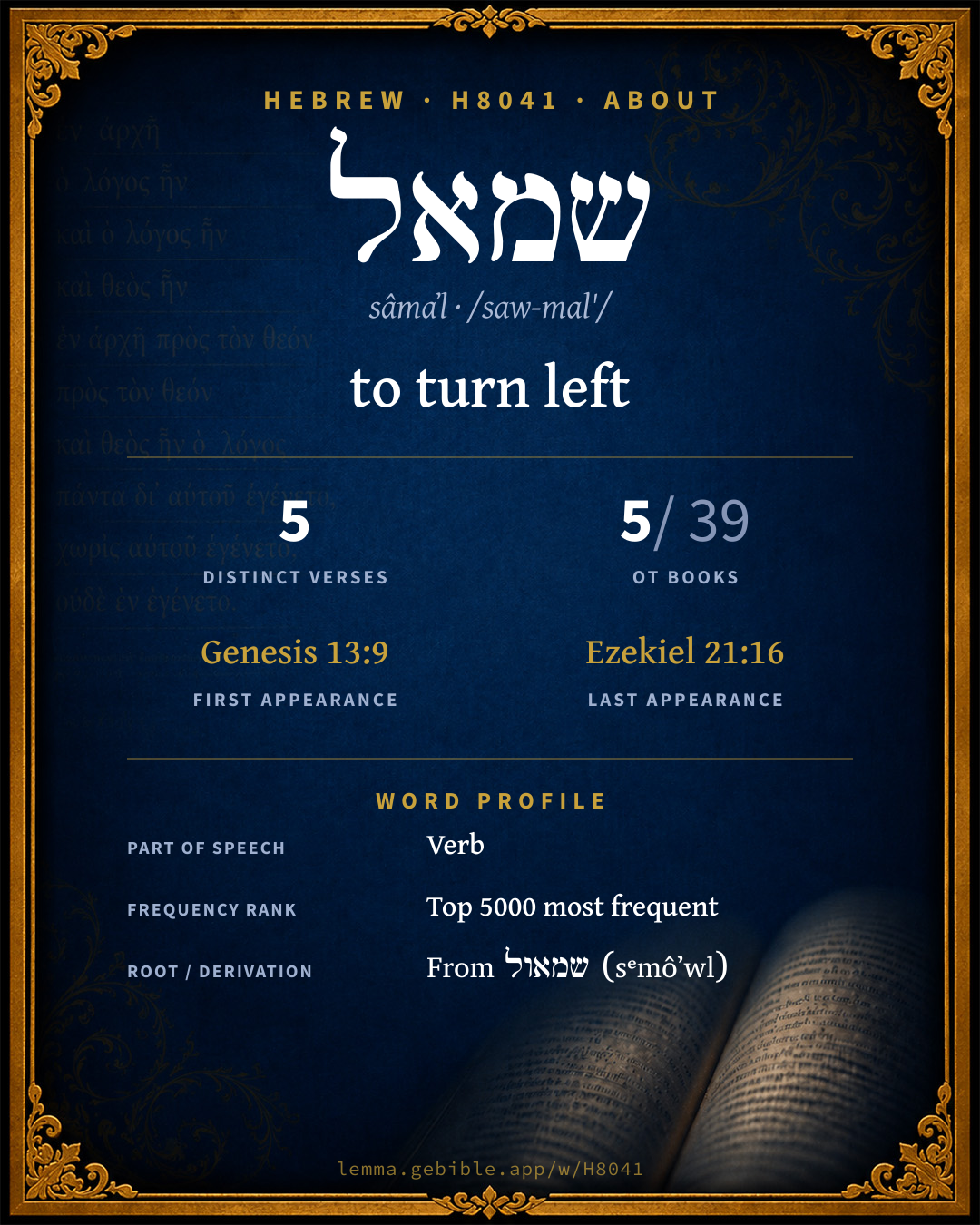
שִׂמְאֵל
to turn left
‘to turn left’ is one of 4 main senses fuller range ↓
Full lexicon entry — Brown-Driver-Briggs (BDB)
From Brown-Driver-Briggs (BDB)
Where this word appears
Grammar key — what these labels mean
Part of speech
- Verb
- An action or state-of-being word.
Stem
- Hiphil
- The causative active stem (“he caused / brought about”).
Form
- Infinitive Construct
- A bound verbal noun, frequently with prepositions (“to write / in writing”).
- Cohortative
- A first-person volitional form expressing wish or resolve (“let me / let us write”).
- Participle Active
- A verbal adjective expressing ongoing or characteristic action (“writing / one who writes”).
- Imperfect
- An incomplete, ongoing, or future action (“he will / would write”).
- Imperative
- A direct command (“write!”).
State
- Absolute
- The independent form of a noun, not bound to a following word.
Person
- 1st Person
- The speaker (“I / we”).
- 2nd Person
- The one addressed (“you”).
Gender
- Common
- Either gender — not distinguished for this form.
- Masculine
- Grammatically masculine.
- Feminine
- Grammatically feminine.
Number
- Singular
- One.
- Plural
- More than one (in Hebrew, generally three or more).
Grammatical forms
- Verb, Hiphil, Infinitive Construct 1 time (20%)
- Verb, Hiphil, Cohortative, 1st Person, Common, Singular 1 time (20%)
- Verb, Hiphil, Participle Active, Masculine, Plural, Absolute 1 time (20%)
- Verb, Hiphil, Imperfect, 2nd Person, Masculine, Plural 1 time (20%)
- Verb, Hiphil, Imperative, 2nd Person, Feminine, Singular 1 time (20%)
Parsed forms decoded from the imported morphology (morphhb / Westminster Leningrad Codex — WLC text public domain, morphhb tagging CC BY 4.0), counted across 5 parsed occurrences — not distinct verses.
Every verse where H8041 appears — 5 distinct verses across 5 books. Click any verse to open its interlinear word-by-word view. Verse text shown in the World English Bible for context — . Each verse’s Hebrew form is shown with its reference; the English is not keyword-highlighted, since the data carries no word-level English alignment. Use “Compare translations” on any verse to read it across multiple English versions. This concordance covers the Hebrew Bible; Septuagint (Greek Old Testament) occurrences are not indexed here.
Genesis 1 verse
2 Samuel 1 verse
1 Chronicles 1 verse
Isaiah 1 verse
Ezekiel 1 verse
About this entry
At a glance — auto-summarized from this page’s data, not written by a person. Every figure links to its source below. This summary describes the numbers; it doesn’t interpret them.
“to turn left” is the headline sense of the Hebrew verb שמאל (sâmaʼl). With only 5 verses it sits in the long tail of Hebrew Bible vocabulary. First canonically at Genesis 13:9, it enters the text early. Carrying more than one sense, it rewards its full sense range. It shares a root with שמאול and שמאלי. Each statement above links to its evidence; the full detail follows below.
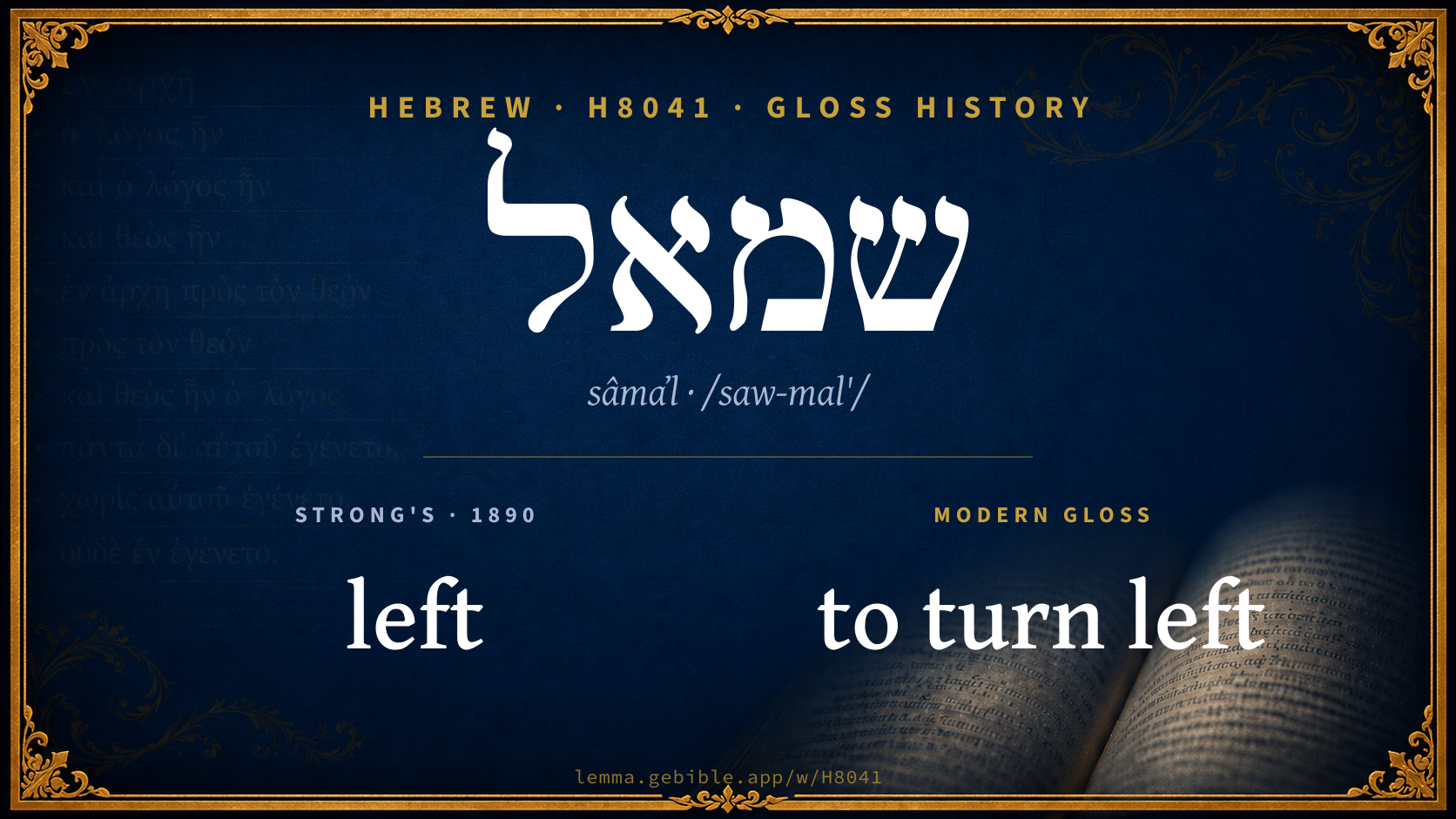
Gloss history
Strong's 1890 vs modern scholarship
About this word
Strong's H8041 catalogs a Hebrew word from the Hebrew Old Testament.
These counts are not copied from any lexicon or concordance. They are computed here, from the morphology-tagged Hebrew Old Testament. What Lemma adds →
- 5
- distinct verses
- The word appears in 5 distinct verses.
- 5 / 39
- OT books
- The word appears in 5 of 39 Old Testament books.
- #3,337
- by frequency
- Top 5000 most frequent Hebrew words (rank 3,337 of 8,640 Hebrew words by occurrence).
View all 5 occurrences in the concordance →
Most concentrated in
- Genesis 1 verse 20%
- 2 Samuel 1 verse 20%
- 1 Chronicles 1 verse 20%
By section of the Old Testament
By traditional corpus
Conventional, traditional groupings — biblical authorship is debated, so this is a traditional corpus grouping, not an authorship claim. Each share is this word’s portion of its verses in that division of the Hebrew canon. Each figure is a share of the word’s 5 distinct verses.
- Prophets (Nevi'im) 3 verses · 60%
- Torah (Pentateuch) 1 verse · 20%
- Writings (Ketuvim) 1 verse · 20%
How translations render this word
Counts come from each version’s own published word-to-Strong’s tagging or interlinear alignment — an approximate guide to how each version renders this word, not a word-level alignment the data otherwise carries. Because each total is that version’s own tagged count, the per-version totals vary from one another and need not match the appearance or distinct-verse counts above. These counts may also differ from a printed concordance because Lemma counts each distinctly tagged rendering and does not collapse phrase taggings into a single head-word total. This is a fixed set of word-tagged versions (KJV, ASV, BSB, ULT) and does not change with the reading translation you choose elsewhere. Each version’s license is shown beside its name below (and on Sources).
- King James Version: I will go to the left 1×, Left 1×, Or on the left 1×
- American Standard Version: I will go to the left 1×, Left 1×, Or to the left 1×
- Berean Standard Bible: Left 2×, Or to the left 2×
- unfoldingWord Literal Text: Being left handed 1×, I will go left 1×, Or turning to the left 1×
King James Version Public Domain
Renders H8041 across 5 tagged occurrences — most commonly:
American Standard Version Public Domain
Renders H8041 across 5 tagged occurrences — most commonly:
Berean Standard Bible Public Domain
Renders H8041 across 5 tagged occurrences — most commonly:
Plus 1 rendering that appears only once — usually multi-word phrases or single function words the recovered tagging swept in, not distinct renderings.
unfoldingWord Literal Text CC BY-SA 4.0
Renders H8041 across 5 tagged occurrences — most commonly:
Senses in the full BDB
What do BDB’s symbols mean?
BDB uses these scholarly abbreviations:
| Symbol | Meaning |
|---|---|
| 𝔊 | the Septuagint (the ancient Greek translation, LXX) |
| 𝔙 | the Vulgate (the Latin translation) |
| 𝔖 | the Syriac version (the Peshitta) |
| 𝔗 | the Targum (the Aramaic translation) |
| ψ | the Psalms |
| √ | root (the underlying root or stem) |
| ‖ | parallel passage (a synonymous or contrasted parallel) |
| † | the dagger: every passage where the word occurs is cited |
The 3 senses and sub-senses the full Brown-Driver-Briggs lexicon distinguishes for this word, in lexicon order (not ranked by frequency), with BDB’s own verbatim wording and sub-sense lettering. Shown in Hebrew script with BDB’s own scholarly abbreviations. The condensed entry is in the Lexicon Entry tab. See also the Forms in the corpus table below.
- 1. left, region on the left, Gn 13:9 (J); on the left is עַל־שׂ׳ 2 K 23:8; Ez 16:46; Zc 4:3, 11, עַל־הַשּׂ׳ 1 Ch 6:29 cf. 2 Ch 18:18, also מִשּׂ׳ (a sinistra) Ex 14:22, 29 (P), 2 S 16:6 + 7 times + מֵהַשּׂ׳ 2 Ch 3:17; Ez 1:10, לִשׂ׳; Ec 10:2, שׂ׳ alone Jb 23:9; toward the left is עַל־שׂ׳ Gn 24:49 (J), 2 S 2:21; Zc 12:6, עַל־הַשּׂ׳ 2 S 2:19, שׂ׳ alone 1 S 6:12; Is 9:20 + 13 times e.g. Genesis 13:9
- 2. יַד־שׂ׳ left hand, Ju 3:21; 7:20, so שׂ׳ alone Gn 48:13(×2), 14 (E), Ju 16:29; Ez 39:3; Jon 4:11; Pr 3:16; Dn 12:7; Ct 2:6; 8:3. e.g. Judges 3:21
- 3. = north (on left of one facing east, cf. אָתוֹר d, יָמִין 4, קֶדֶם 1 b) Gn 14:15; Jos 19:27 (P); cf. Ez 16:46. e.g. Genesis 14:15
Senses from the full Brown-Driver-Briggs lexicon (Brown, Driver, Briggs; Oxford 1906 — public domain), digitized via Sefaria, supplemented by the OpenScriptures HebrewLexicon (CC BY 4.0). Full attribution on Sources.
Word origin
(Baer Jos 1:7)54 n.[m.] the left (NH id.; Assyrian šumêlu; Arabic شِمَالٌ (also شَمَالٌ and شَأْمَلٌ, شَامَلٌ north wind); Old Aramaic שמאל, Palm. (sf.) סמלך; Syriac ܣܶܡܳܠܴܐ; √ dub., שאם + ל Nö M 128 HomA. u. A. i. (1892), 21 Köii. 1. 143, 405; (v. also Thes DietrWortforschung 234), cf. Arabic شأم be unlucky, شَأْمَةٌ left, شَأَم, شَام north; Sab. שאם north, unlucky DHMEpigr. Denkm. 29; Epigr. Denkm. Ar. Nos. 6. 7; other views in Sta§ 299 LagBN 116);—שְׂמֹאל abs. Gn 13:9 +, cstr. 48:13; 2 K 23:8; שְׂמֹאול abs. Nu 20:17 +; sf. שְׂמֹאלֶ֑ךָ 2 S 2:21, שְׂמֹאלוֹ Gn 48:13 +, etc.;—opp. יָמִין except Gn 14:15; Ju 19:27; 2 K 23:8;—
— Brown-Driver-Briggs (Oxford 1906, public domain), digitized via Sefaria, supplemented by the OpenScriptures HebrewLexicon (CC BY 4.0). See Sources.
Derived from שמאול (sᵉmôʼwl) (H8040) — left.
Jastrow Dictionary
A second Hebrew/Aramaic lexicon for comparison, covering Aramaic and post-biblical (Talmudic, Targumic, Midrashic) usage that the biblical-Hebrew BDB does not. Matched by lemma rather than by Strong’s number, so a lemma may carry more than one Jastrow headword (shown separately below), and the entries cover usage well beyond the Bible.
שְׂמֹאל
- c. (b. h.) left side, left hand. Yoma IV, 1 הסגן … מִשְּׂמאֹלוֹ the Sagan to his right, and the chief of the priests’ division to his left. Ib. אם של שם עלה בשמאלו if the lot marked ‘unto the Lord’ came up in his left hand; הגבה שְׂמֹאלְךָ raise thy right hand. Ib. V, 1 מהלך לשמאלו walks to the left. Snh. 107ᵇ, v. דָּחָה. Sifré Deut. 154 (ref. to Deut. XVII, 11) אפי׳ … על ש׳ שהוא ימין וכ׳ even if they show it before thy eyes that left is right and right is left, listen to them; a. v. fr. e.g. Deuteronomy 17:11
שמאל
- , Hif. הִשְׂמְאִיל (b. h.) to go to the left; to be on the left side, go wrong. Sabb. 63ᵃ למַשְׂמְאִילִים בה to those who make the wrong use of it, v. יָמַן. Ib. 88ᵇ למשמאילים בה (Ms. M. דלא איימין ליה, v. וְמַן). Cant. R. to I, 9 אלו … ואלו משמאילים those (pleading in favor of the accused) stand to the right, and those (against the accused) to the left; a. e.
שמאל ²
- , Af. אַשְׂמְאִיל ch. same. Koh. R. to X, 2 (ref. to Gen. XIII, 9) (Abraham said,) אפי׳ את מחצף אנא מַשְׂמְאִיל לך even if thou shalt act irreverently (towards me), I shall show thee the left side (that thou art wrong). Ib. הוה אמר … אַשְׂמְאִיל ליה וכ׳ he said to one of his household, show him the left side, and he showed him a cutting movement in that direction, v. קְטִיף e.g. Genesis 13:9
A Dictionary of the Targumim, the Talmud Babli and Yerushalmi, and the Midrashic Literature (Marcus Jastrow; London, Luzac, 1903) — Public Domain. Digitized via Sefaria. Digitized via Sefaria. Full attribution on Sources.
Forms in the corpus
The 5 distinct written forms H8041 takes in the Hebrew Bible, most frequent first — each parse links to that stem’s occurrences in the concordance. Hebrew forms include their vowel points and cantillation, so a single lemma takes many written forms.
| Form | Parsing | Example | Uses |
|---|---|---|---|
| הַשְׂמִ֑ילִי | Verb, Hiphil, Imperative, 2nd Person, Feminine, Singular | Ezekiel 21:16 | 1 |
| וְ/אַשְׂמְאִֽילָה | Verb, Hiphil, Cohortative, 1st Person, Common, Singular | Genesis 13:9 | 1 |
| וּ/לְ/הַשְׂמִ֗יל | Verb, Hiphil, Infinitive Construct | 2 Samuel 14:19 | 1 |
| וּ/מַשְׂמִאלִים֙ | Verb, Hiphil, Participle Active, Masculine, Plural, Absolute | 1 Chronicles 12:2 | 1 |
| תַשְׂמְאִֽילוּ | Verb, Hiphil, Imperfect, 2nd Person, Masculine, Plural | Isaiah 30:21 | 1 |
Same root — word family
Other BDB entries built from the same root as H8041, grouped by Strong’s listed origin. These share a root / origin per the lexicon — not necessarily a shared meaning. Each links to that word’s own entry.
Derives from
Shares the same root
Compare all same-root words → They share a root, not necessarily a meaning.
Septuagint verse parallels
This word appears in 5 verses that also exist in the Greek Old Testament (Septuagint), out of the 5 Hebrew verses it occurs in. You can read those verses in Greek by switching the Old Testament edition to the Septuagint.
Read these verses in the Septuagint
This is a verse-level parallel only — the same verses exist in both the Hebrew and Greek Old Testaments. No word-level Hebrew↔Greek correspondence is claimed: the data carries no such alignment, so no Greek word is shown as this Hebrew word’s translation. Coverage is not total — the Septuagint omits the deuterocanon and renumbers the Psalms, so some Hebrew verses have no direct Greek parallel.