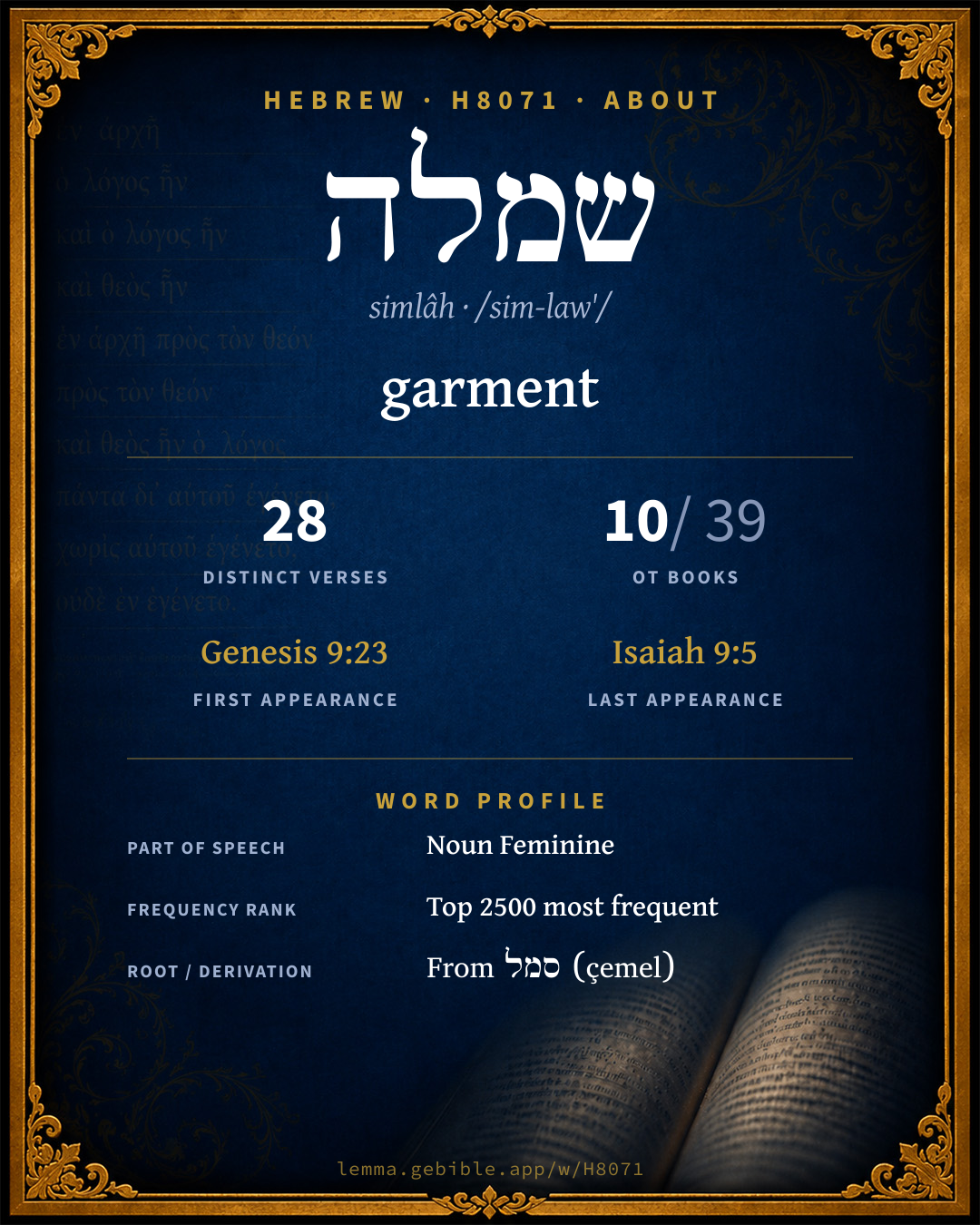
שִׂמְלָה
garment
Full lexicon entry — Brown-Driver-Briggs (BDB)
From Brown-Driver-Briggs (BDB)
Where this word appears
See every Construct-state word in the Hebrew Bible →
Grammar key — what these labels mean
Part of speech
- Noun
- A naming word — a person, place, thing, or idea.
Noun type
- Common
- A common noun — a general class of person, place, or thing (“king,” “city,” “water”), not a specific name.
State
- Construct
- A noun bound to a following noun in a possessive / “of” relationship (the construct chain).
- Absolute
- The independent form of a noun, not bound to a following word.
Gender
- Feminine
- Grammatically feminine.
Number
- Plural
- More than one (in Hebrew, generally three or more).
- Singular
- One.
Grammatical forms
- Noun, Common, Feminine, Plural, Construct 10 times (32%)
- Noun, Common, Feminine, Singular, Absolute 9 times (29%)
- Noun, Common, Feminine, Singular, Construct 8 times (26%)
- Noun, Common, Feminine, Plural, Absolute 4 times (13%)
Parsed forms decoded from the imported morphology (morphhb / Westminster Leningrad Codex — WLC text public domain, morphhb tagging CC BY 4.0), counted across 31 parsed occurrences — not distinct verses.
Every verse where H8071 appears — 28 distinct verses across 10 books. Click any verse to open its interlinear word-by-word view. Verse text shown in the World English Bible for context — . Each verse’s Hebrew form is shown with its reference; the English is not keyword-highlighted, since the data carries no word-level English alignment. Use “Compare translations” on any verse to read it across multiple English versions. This concordance covers the Hebrew Bible; Septuagint (Greek Old Testament) occurrences are not indexed here.
Genesis 6 verses
- Genesis 9:23 הַ/שִּׂמְלָ֗ה ptcl def.art + n c fs Shem and Japheth took a garment, and laid it on both their shoulders, went in backwards, and covered the nakedness of their father. Their faces were backwards, and they didn't see their father's nakedness.
- Genesis 35:2 שִׂמְלֹתֵי/כֶֽם n c fp cs + sfx pers 2mp Then Jacob said to his household, and to all who were with him, "Put away the foreign gods that are among you, purify yourselves, change your garments.
- Genesis 37:34 שִׂמְלֹתָ֔י/ו n c fp cs + sfx pers 3ms Jacob tore his clothes, and put sackcloth on his loins, and mourned for his son many days.
- Genesis 41:14 שִׂמְלֹתָ֔י/ו n c fp cs + sfx pers 3ms Then Pharaoh sent and called Joseph, and they brought him hastily out of the dungeon. He shaved himself, changed his clothing, and came in to Pharaoh.
- Genesis 44:13 שִׂמְלֹתָ֑/ם n c fp cs + sfx pers 3mp Then they tore their clothes, and loaded every man his donkey, and returned to the city.
- Genesis 45:22 שְׂמָלֹ֑ת שְׂמָלֹֽת n c fp n c fp To all of them he gave each man changes of clothing, but to Benjamin he gave three hundred pieces of silver and five changes of clothing.
Exodus 6 verses
- Exodus 3:22 וּ/שְׂמָלֹ֑ת conj + n c fp But every woman shall ask of her neighbor, and of her who visits her house, jewels of silver, jewels of gold, and clothing; and you shall put them on your sons, and on your daughters. You shall despoil the Egyptians.
- Exodus 12:34 בְּ/שִׂמְלֹתָ֖/ם prep + n c fp cs + sfx pers 3mp The people took their dough before it was leavened, their kneading-troughs being bound up in their clothes on their shoulders.
- Exodus 12:35 וּ/שְׂמָלֹֽת conj + n c fp The children of Israel did according to the word of Moses; and they asked of the Egyptians jewels of silver, and jewels of gold, and clothing.
- Exodus 19:10 שִׂמְלֹתָֽ/ם n c fp cs + sfx pers 3mp Yahweh said to Moses, "Go to the people, and sanctify them today and tomorrow, and let them wash their garments,
- Exodus 19:14 שִׂמְלֹתָֽ/ם n c fp cs + sfx pers 3mp Moses went down from the mountain to the people, and sanctified the people; and they washed their clothes.
- Exodus 22:27 שִׂמְלָת֖/וֹ n c fs cs + sfx pers 3ms for that is his only covering, it is his garment for his skin. What would he sleep in? It will happen, when he cries to me, that I will hear, for I am gracious.
Deuteronomy 6 verses
- Deuteronomy 8:4 שִׂמְלָ֨תְ/ךָ֜ n c fs cs + sfx pers 2ms Your clothing didn't grow old on you, neither did your foot swell, these forty years.
- Deuteronomy 10:18 וְ/שִׂמְלָֽה conj + n c fs He does execute justice for the fatherless and widow, and loves the foreigner, in giving him food and clothing.
- Deuteronomy 21:13 שִׂמְלַ֨ת n c fs cs and she shall put the clothing of her captivity from off her, and shall remain in your house, and bewail her father and her mother a full month: and after that you shall go in to her, and be her husband, and she shall be your wife.
- Deuteronomy 22:3 לְ/שִׂמְלָת/וֹ֒ prep + n c fs cs + sfx pers 3ms So shall you do with his donkey; and so shall you do with his garment; and so shall you do with every lost thing of your brother's, which he has lost, and you have found: you may not hide yourself.
- Deuteronomy 22:5 שִׂמְלַ֣ת n c fs cs A woman shall not wear men's clothing, neither shall a man put on women's clothing; for whoever does these things is an abomination to Yahweh your God.
- Deuteronomy 22:17 הַ/שִּׂמְלָ֔ה ptcl def.art + n c fs and, behold, he has laid shameful things [to her charge], saying, I didn't find in your daughter the tokens of virginity; and yet these are the tokens of my daughter's virginity. They shall spread the garment before the elders of the city.
Joshua 1 verse
Judges 1 verse
Ruth 1 verse
1 Samuel 1 verse
2 Samuel 1 verse
Proverbs 1 verse
Isaiah 4 verses
- Isaiah 3:6 שִׂמְלָ֣ה n c fs Indeed a man shall take hold of his brother in the house of his father, saying, "You have clothing, you be our ruler, And let this ruin be under your hand."
- Isaiah 3:7 שִׂמְלָ֑ה n c fs In that day he will cry out, saying, I will not be a healer; For in my house is neither bread nor clothing. You shall not make me ruler of the people.
- Isaiah 4:1 וְ/שִׂמְלָתֵ֖/נוּ conj + n c fs cs + sfx pers 1cp Seven women shall take hold of one man in that day, saying, "We will eat our own bread, and wear our own clothing: only let us be called by your name. Take away our reproach."
- Isaiah 9:5 וְ/שִׂמְלָ֖ה conj + n c fs For all the armor of the armed man in the tumult, and the garments rolled in blood, shall be for burning, for fuel of fire.
About this entry
At a glance — auto-summarized from this page’s data, not written by a person. Every figure links to its source below. This summary describes the numbers; it doesn’t interpret them.
שמלה — transliterated simlâh — is a Hebrew noun carrying the sense “garment.” Debuting at Genesis 9:23, it then recurs through the corpus. Spanning 28 verses in 10 books, it ranks among the moderately common words of the Hebrew Bible. From the same root come סמל, שלמה and שמאול. See the sense tree, 28-verse concordance, and the renderings breakdown below.
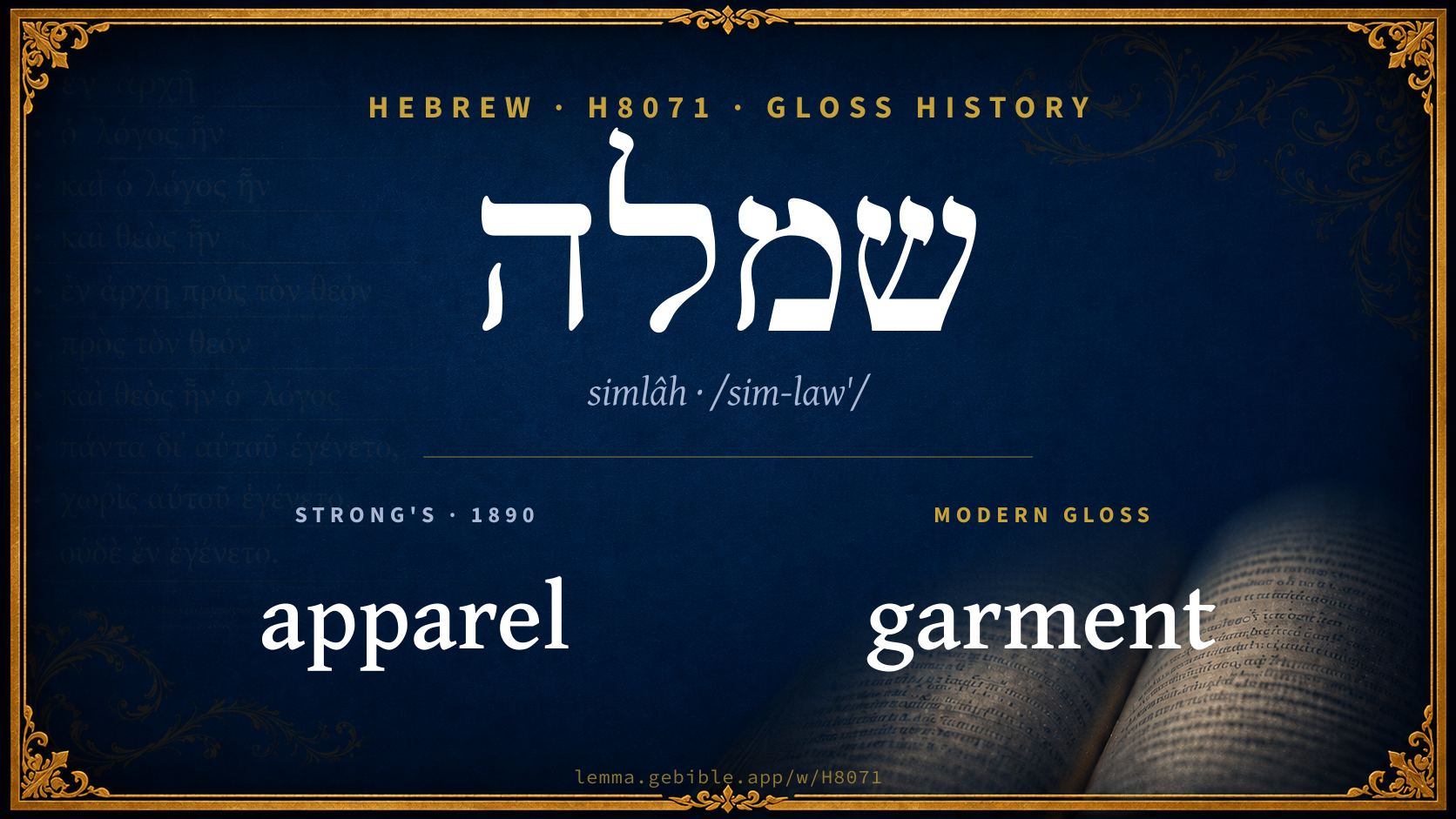
Gloss history
Strong's 1890 vs modern scholarship
About this word
Strong's H8071 catalogs a Hebrew word from the Hebrew Old Testament.
These counts are not copied from any lexicon or concordance. They are computed here, from the morphology-tagged Hebrew Old Testament. What Lemma adds →
- 28
- distinct verses
- The word appears in 28 distinct verses.
- 10 / 39
- OT books
- The word appears in 10 of 39 Old Testament books.
- #1,120
- by frequency
- Top 2500 most frequent Hebrew words (rank 1,120 of 8,640 Hebrew words by occurrence).
View all 28 occurrences in the concordance →
Most concentrated in
- Genesis 6 verses 21%
- Exodus 6 verses 21%
- Deuteronomy 6 verses 21%
By section of the Old Testament
By traditional corpus
Conventional, traditional groupings — biblical authorship is debated, so this is a traditional corpus grouping, not an authorship claim. Each share is this word’s portion of its verses in that division of the Hebrew canon. Each figure is a share of the word’s 28 distinct verses.
- Torah (Pentateuch) 18 verses · 64%
- Prophets (Nevi'im) 8 verses · 29%
- Writings (Ketuvim) 2 verses · 7%
How translations render this word
Counts come from each version’s own published word-to-Strong’s tagging or interlinear alignment — an approximate guide to how each version renders this word, not a word-level alignment the data otherwise carries. Because each total is that version’s own tagged count, the per-version totals vary from one another and need not match the appearance or distinct-verse counts above. These counts may also differ from a printed concordance because Lemma counts each distinctly tagged rendering and does not collapse phrase taggings into a single head-word total. This is a fixed set of word-tagged versions (KJV, ASV, BSB, ULT) and does not change with the reading translation you choose elsewhere. Each version’s license is shown beside its name below (and on Sources).
- King James Version: Raiment 10×, Clothes 6×, Garment 4×
- American Standard Version: Raiment 7×, Garment 4×, Garments 4×
- Berean Standard Bible: Clothes 8×, Clothing 7×, Garment 3×
- unfoldingWord Literal Text: Clothes 8×, Clothing 7×, Cloak 6×
King James Version Public Domain
Renders H8071 across 29 tagged occurrences — most commonly:
Plus 5 renderings that appear only once — usually multi-word phrases or single function words the recovered tagging swept in, not distinct renderings.
American Standard Version Public Domain
Renders H8071 across 29 tagged occurrences — most commonly:
Plus 11 renderings that appear only once — usually multi-word phrases or single function words the recovered tagging swept in, not distinct renderings.
Berean Standard Bible Public Domain
Renders H8071 across 28 tagged occurrences — most commonly:
Plus 4 renderings that appear only once — usually multi-word phrases or single function words the recovered tagging swept in, not distinct renderings. Not rendered by a distinct English word in 1 further occurrence.
unfoldingWord Literal Text CC BY-SA 4.0
Renders H8071 across 31 tagged occurrences — most commonly:
Plus 7 renderings that appear only once — usually multi-word phrases or single function words the recovered tagging swept in, not distinct renderings.
Senses in BDB
The 1 sense BDB distinguishes for this word, in lexicon order (not ranked by frequency or importance). The full entry — with sub-senses — is in the Lexicon Entry tab.
- wrapper, mantle, covering garment, garments, clothes, raiment, a cloth
Word origin
n.f. wrapper, mantle;—abs. שׂ׳ Gn 9:23 +, cstr. שִׂמְלַת Dt 21:13; 22:5; sf. שִׂמְלָֽתְךָ Dt 8:4, etc.; pl. שְׂמָלֹת Gn 45:22(×2) +, sf. שִׂמְלֹתָם 44:13 +, etc.;—wrapper, mantle (of man or [Ru 3:3 +] woman), usually square piece of cloth worn as outer garment (v. MackieHast.DB i. 625; BenzEncy. Bib. iii. 2932), Gn 35:2 Ex 22:26 (both E), Dt 8:4; 10:18; 21:13; 22:3; Is 3:6, 7; 9:4; 2 S 12:20 Kt, Ru 3:3 Kt (Qr in both pl.); as covering in sleep Gn 9:23 (J; cf. Ex 22:26), bed-covering Dt 22:17; covering or receptacle for articles Ex 12:34 (E), Ju 8:25 1 S 21:10, cf. Pr 30:4; more gen. garment, Dt 22:5, clothes (pl.) Gn 37:34; 44:13 (J), 41:14 Ex 19:10, 14 (all E), Jos 7:6 (JE), Is 4:1; as costly gifts Gn 45:22(×2) Ex 3:22; 12:35 (all E).
— Brown-Driver-Briggs (Oxford 1906, public domain), digitized via Sefaria, supplemented by the OpenScriptures HebrewLexicon (CC BY 4.0). See Sources.
Derived from סמל (çemel) (H5566) — idol.
Jastrow Dictionary
A second Hebrew/Aramaic lexicon for comparison, covering Aramaic and post-biblical (Talmudic, Targumic, Midrashic) usage that the biblical-Hebrew BDB does not. Matched by lemma rather than by Strong’s number, so a lemma may carry more than one Jastrow headword (shown separately below), and the entries cover usage well beyond the Bible.
שִׂמְלָה
- (b. h.) sheet, cover, garment. B. Mets. II, 5 (27ᵃ) (ref. to שלמה, Ex. XXII, 8) אף הש׳ היתה בכלל וכ׳ the case of the garment would have been included (as אֲבֵדָה), and why is it specified? מה ש׳ מיוחדת וכ׳ as the garment is individual property and can be identified by certain marks &c. Mekh. Mishp., s. 13, v. חָוַר; Sifré Deut. 237. Keth. 46ᵃ (ref. to Deut. XXII, 17), v. בָּרַר. Ib. ש׳ ממש it means the sheet in its real sense. Ib. פרשו מה ששָ֗ם̇ לָ֗הּ֗ they spread (the refutation of) what he charged her with. Midr. Till. to Ps. XIX מה הש׳ הזאת what is this sheet (curtain) made of?; Yalk. ib. 672 מה היא הש׳ זו. Ḥag. 14ᵃ (ref. to Is. III, 6) [read:] דברים … מתכסין בהם כש׳ ישנן וכ׳ (v. Rabb. D. S. a. l.) things with which people cover themselves as with a garment (faith in divine protection, differ. in Rashi) are in thy possession; Sabb. 119ᵇ; Yalk. Is. 261; Yalk. Jer. 275; a. e.—Midr. Sam. ch. XX שמלתם, read: שבול׳, v. שִׁיבּוֹלֶת.]—V. שַׂלְמָה. e.g. Exodus 22:8
A Dictionary of the Targumim, the Talmud Babli and Yerushalmi, and the Midrashic Literature (Marcus Jastrow; London, Luzac, 1903) — Public Domain. Digitized via Sefaria. Digitized via Sefaria. Full attribution on Sources.
Forms in the corpus
The 27 distinct written forms H8071 takes in the Hebrew Bible, most frequent first — each parse links to that state’s occurrences in the concordance. Hebrew forms include their vowel points and cantillation, so a single lemma takes many written forms.
Same root — word family
Other BDB entries built from the same root as H8071, grouped by Strong’s listed origin. These share a root / origin per the lexicon — not necessarily a shared meaning. Each links to that word’s own entry.
Derives from
Derived from this word
Proper names from this root
People and places named from this root — a name, not an additional meaning of the word.
Compare all same-root words → Showing 4 of 5 — not the complete family. 1 of the same-root words is a proper name (a person or place). They share a root, not necessarily a meaning.
Septuagint verse parallels
This word appears in 28 verses that also exist in the Greek Old Testament (Septuagint), out of the 28 Hebrew verses it occurs in. You can read those verses in Greek by switching the Old Testament edition to the Septuagint.
Read these verses in the Septuagint
- Genesis 9:23
- Exodus 3:22
- Deuteronomy 8:4
- Joshua 7:6
- Judges 8:25
- Ruth 3:3
- 1 Samuel 21:9
- 2 Samuel 12:20
- Proverbs 30:4
- Isaiah 3:6
This is a verse-level parallel only — the same verses exist in both the Hebrew and Greek Old Testaments. No word-level Hebrew↔Greek correspondence is claimed: the data carries no such alignment, so no Greek word is shown as this Hebrew word’s translation. Coverage is not total — the Septuagint omits the deuterocanon and renumbers the Psalms, so some Hebrew verses have no direct Greek parallel.