
Zechariah 4:3

Hebrew (Westminster Leningrad Codex) Zechariah 4:3 appears in the Hebrew Old Testament. The text above is from the Westminster Leningrad Codex. Each word links to its Strong’s number, a concise gloss, and parsing drawn from the Open Scriptures Hebrew Bible morphology. Click any word for its full Brown-Driver-Briggs (BDB) entry.
Download image
Cite this verse

Zechariah 4:3 (World English Bible). Public Domain. Lemma interlinear Bible study tool, https://lemma.gebible.app/v/zechariah/4/3.

Show BibTeX & RIS
BibTeX
RIS
English Translation
and two olive trees by it, one on the right side of the bowl, and the other on the left side of it."
World English Bible · Public Domain
Download a study sheet

One document with this verse’s original text, its word-by-word gloss line, the meaning frame, cross-references with their text, attributed commentary, and full source and license credits — printable, and it pastes into notes with its structure intact.

This verse Autodidact and up

Study sheet (.html) Plain text (.txt)

A passage Seminary Student

Up to 50 verses in one chapter. A passage sheet keeps up to 6 commentary sources and 12 cross-references per verse, in the order this page ranks them, and says so on the sheet whenever that leaves anything out. Ask for a single verse and you get the Autodidact verse sheet above.

Everything on this page stays free to read, with no account — the sheet is a download of what is already on screen, not access to it.

Want to remove ads? Support Godless Engineer
Compare translations 3

The same verse in 3 English versions, stacked beneath the original-language interlinear above. Click any original word for its lexicon entry.

Each is an independent rendering of the whole verse — the interlinear is not word-aligned to these translations.

Highlighted words mark where these versions differ — a whole-verse word diff, not a word-by-word alignment.

  • World English Bible Public Domain
    and two olive trees by it, one on the right side of the bowl, and the other on the left side of it."
  • King James Version Public Domain
    And two olive trees by it, one upon the right side of the bowl, and the other upon the left side thereof.
  • unfoldingWord Literal Text CC BY-SA 4.0
    And two olive trees beside it, one on the right of the bowl and one on its left.”

unfoldingWord Literal Text — © unfoldingWord, licensed CC BY-SA 4.0. Word-aligned USFM3 via Door43 (git.door43.org/unfoldingWord/en_ult).

Versions to compare (up to 4)

3 of 4 selected

Show all 18 translations

Every available English version of this verse, each an independent rendering of the whole verse.

  • World English Bible Public Domain
    and two olive trees by it, one on the right side of the bowl, and the other on the left side of it."
  • Berean Standard Bible Public Domain
    There are also two olive trees beside it, one on the right side of the bowl and the other on its left.”
  • Majority Standard Bible Public Domain
    There are also two olive trees beside it, one on the right side of the bowl and the other on its left.”
  • King James Version Public Domain
    And two olive trees by it, one upon the right side of the bowl, and the other upon the left side thereof.
  • American Standard Version (1901) Public Domain
    and two olive-trees by it, one upon the right side of the bowl, and the other upon the left side thereof.
  • Revised Version (1885) Public Domain
    and two olive trees by it, one upon the right side of the bowl, and the other upon the left side thereof.
  • Geneva Bible (1599) Public Domain
    And two oliue trees ouer it, one vpon the right side of the bowle, and the other vpon the left side thereof.
  • Douay-Rheims (1899) Public Domain
    And two olive trees over it: one upon the right side of the lamp, and the other upon the left side thereof.
  • Young's Literal Translation Public Domain
    and two olive-trees `are' by it, one on the right of the bowl, and one on its left.'
  • Literal Standard Version CC BY-SA 4.0
    and two olive-trees [are] by it, one on the right of the bowl and one on its left.”
  • Unlocked Literal Bible CC BY-SA 4.0
    Two olive trees are by it, one on the right side of the bowl and the other on the left side.”
  • unfoldingWord Literal Text CC BY-SA 4.0
    And two olive trees beside it, one on the right of the bowl and one on its left.”
  • Darby Bible Public Domain
    and two olive-trees beside it, one on the right of the bowl, and the other on the left of it.
  • World Messianic Bible Public Domain
    and two olive trees by it, one on the right side of the bowl, and the other on the left side of it.”
  • Webster's Bible Public Domain
    And two olive-trees by it, one upon the right side of the bowl, and the other upon the left side.
  • Free Bible Version CC BY-SA 4.0
    I also see olive trees, one to the right and one to the left of the bowl.”
  • Bible in Basic English Public Domain
    And two olive-trees by it, one on the right side of the cup and one on the left.
  • JPS Tanakh (1917) Public Domain
    and two olive-trees by it, one upon the right side of the bowl, and the other upon the left side thereof.'

Literal Standard Version (2020), Covenant Press — licensed CC BY-SA 4.0. Text via the HelloAO Bible API (eBible.org). Unlocked Literal Bible (unfoldingWord) — licensed CC BY-SA 4.0. Text via the HelloAO Bible API (eBible.org). unfoldingWord Literal Text — © unfoldingWord, licensed CC BY-SA 4.0. Word-aligned USFM3 via Door43 (git.door43.org/unfoldingWord/en_ult). Free Bible Version, Dr. Jonathan Gallagher — licensed CC BY-SA 4.0. Text via the HelloAO Bible API (eBible.org).

Word by word

More ways to search: Search by grammar → Find every occurrence → Compare this word →

Practice this passage: Drill this verse → Learn its vocabulary →

הַגֻּלָּ֔ה
gullâh
H1543
“the · bowl”
Particle, Definite Article + Noun, Common, Feminine, Singular, Absolute
Part of Speech
Particle + Noun
Type
Common
Gender
Feminine
Number
Singular
State
Absolute
Full BDB Definition

Origin: from H1556

TWOT: 353c

bowl, spring, basin - basin - bowl - of a lamp - of bowl shaped portion of capitals of pillars of the temple
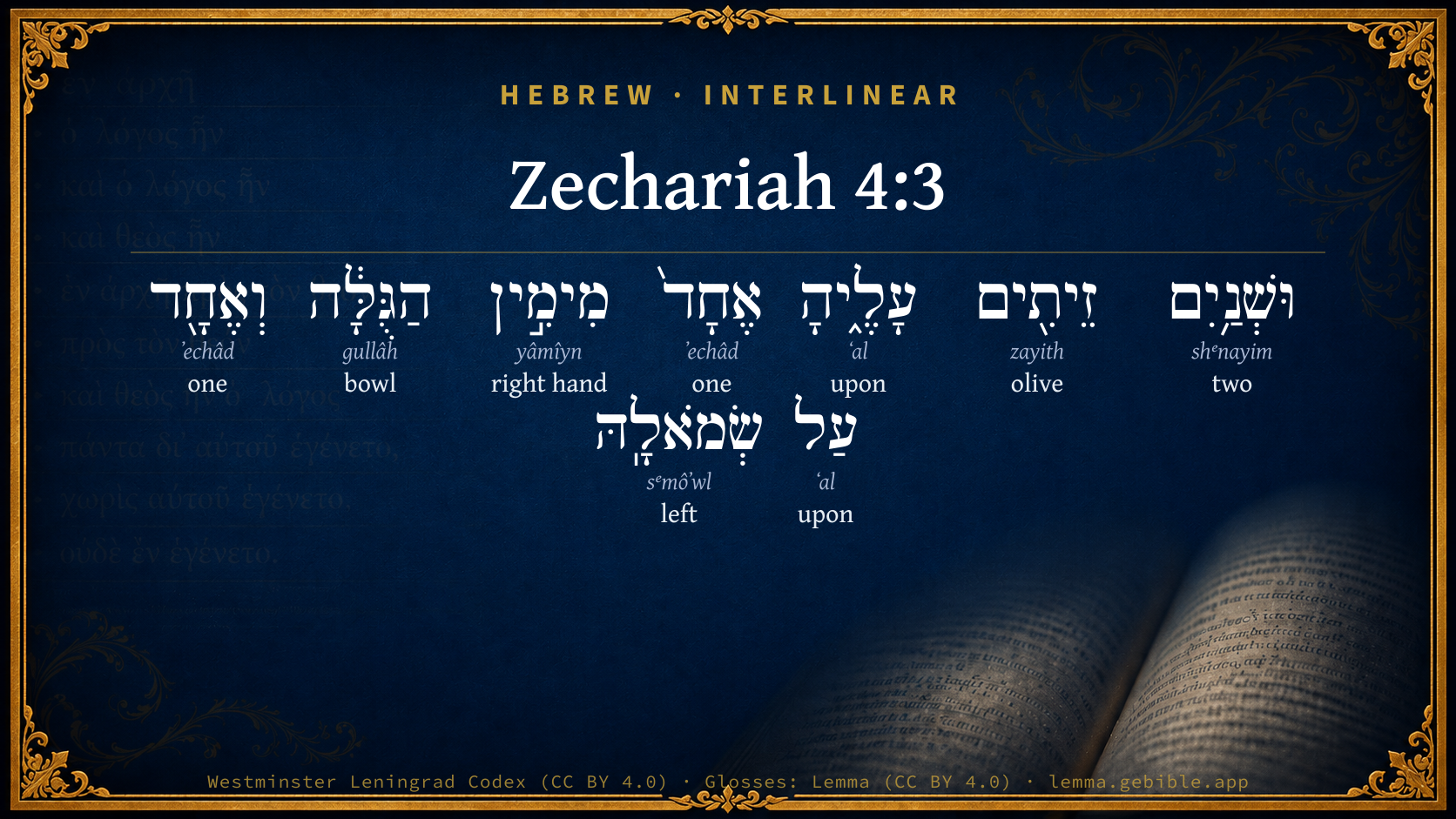
  1. וּשְׁנַ֥יִם shᵉnayim H8147 “and · two” Conjunction + Adjective, Cardinal number, Masculine, Dual, Absolute
  2. זֵיתִ֖ים zayith H2132 “olives” Noun, Common, Masculine, Plural, Absolute
  3. עָלֶ֑יהָ ʻal H5921 “upon · her” Preposition + Suffix, Personal, 3rd Person, Feminine, Singular
  4. אֶחָד֙ ʼechâd H259 “one” Adjective, Cardinal number, Masculine, Singular, Absolute
  5. מִימִ֣ין yâmîyn H3225 “from · right hand of” Preposition + Noun, Common, Feminine, Singular, Construct
  6. וְאֶחָ֖ד ʼechâd H259 “and · one” Conjunction + Adjective, Cardinal number, Masculine, Singular, Absolute
  7. עַל ʻal H5921 “upon” Preposition
  8. שְׂמֹאלָֽהּ sᵉmôʼwl H8040 “left · her” Noun, Common, Masculine, Singular, Construct + Suffix, Personal, 3rd Person, Feminine, Singular

About this verse

These counts appear in no published source. They are computed here, from the morphology-tagged text and Lemma’s own curated glosses. What Lemma adds →

9
words
7
distinct lemmas
Prophets
section

Notable vocabulary

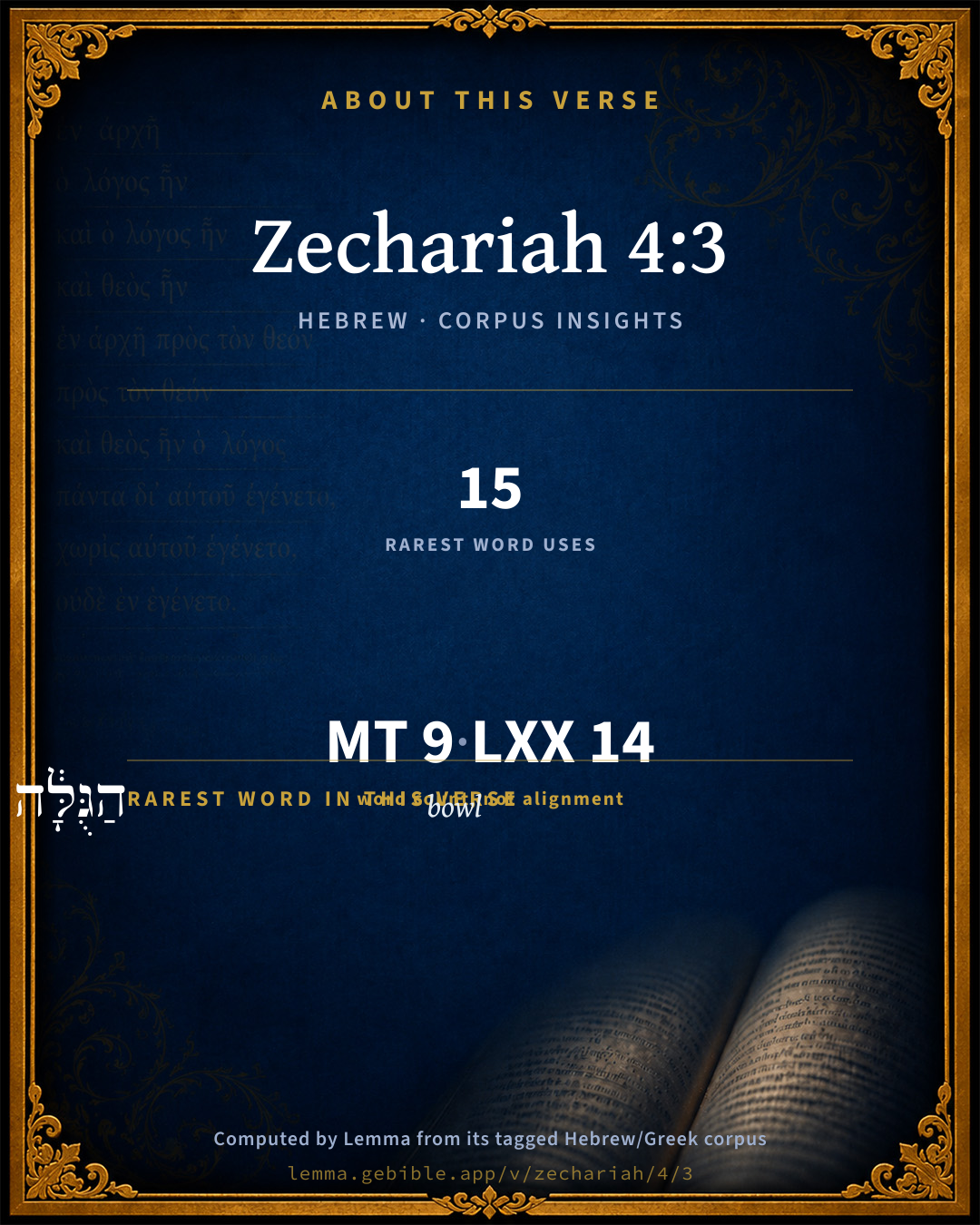
The rarest word here is הַגֻּלָּ֔ה bowl H1543 — appearing just 15 times in the whole Hebrew Bible.

Shared distinctive vocabulary

הַגֻּלָּ֔ה bowl H1543 occurs in 9 verses of the Hebrew Bible. Also found in:

Grammatical profile

  • 4 nouns
  • 3 adjectives
  • 2 prepositions

Repetition

Words recur within this verse — often emphatic in Hebrew:

  • עָלֶ֑יהָ upon H5921 ×2
  • אֶחָד֙ one H259 ×2

Hebrew & Septuagint length

In English translation the verse runs 23 words from the Hebrew and 17 from the Septuagint (LXX English) — closely comparable.

A rough comparison of the two English renderings, which tokenize alike — not a word-level alignment.

Word counts can differ between the Hebrew and the Greek without any difference in meaning — e.g. the Hebrew direct-object marker אֵת has no separate Greek word, and Greek often adds the article ὁ.

In the original languages it is 9 Hebrew tokens and 14 Greek tokens — but the two are counted differently (Hebrew bundles its prefixes and suffixes into one token; the Greek is in lemma form), so that isn’t a like-for-like length.

Cross-references

6

Topical passages linked to Zechariah 4:3 in the Treasury of Scripture Knowledge — connected by theme and wording, ordered by reader-vote popularity; previews shown in the World English Bible.

  • Revelation 11:4 These are the two olive trees and the two lampstands, standing before the Lord of the earth.
  • Zechariah 4:14 Then he said, "These are the two anointed ones who stand by the Lord of the whole earth."
  • Romans 11:17 But if some of the branches were broken off, and you, being a wild olive, were grafted in among them, and became partaker with them of the root and of the richness of the olive tree;
  • Zechariah 4:11–12 Then I asked him, "What are these two olive trees on the right side of the lampstand and on the left side of it?"
  • Judges 9:9 But the olive tree said to them, Should I leave my fatness, with which by me they honor God and man, and go to wave back and forth over the trees?
  • Romans 11:24 For if you were cut out of that which is by nature a wild olive tree, and were grafted contrary to nature into a good olive tree, how much more will these, which are the natural branches, be grafted into their own olive tree?

Cross-references courtesy of OpenBible.info (CC BY 4.0).

Hebrew and Greek witnesses Masoretic Hebrew ↔ Greek Septuagint

The same verse in the two great witnesses to the Old Testament, shown verse-for-verse.

These are two independent witnesses, not word-aligned to each other, and the Septuagint is shown in lemma (dictionary) form.

Hebrew Zechariah 4:3 Masoretic · Westminster Leningrad Codex

וּשְׁנַ֥יִם זֵיתִ֖ים עָלֶ֑יהָ אֶחָד֙ מִימִ֣ין הַגֻּלָּ֔ה וְאֶחָ֖ד עַל שְׂמֹאלָֽהּ

and two olive trees by it, one on the right side of the bowl, and the other on the left side of it."

World English Bible · Public Domain

Greek LXX Zechariah 4:3 Septuagint · lemma form

καί δύο ἐλαία ἐπάνω αὐτός εἷς ἐκ δεξιός ὁ λαμπάδιον καί εἷς ἐκ εὐώνυμος

and two olive-trees above it, one on the right of the bowl, and one on the left.

LXX2012 (modern English Septuagint) · Public Domain

Hebrew: Westminster Leningrad Codex (CC BY 4.0). Greek: Septuagint (public domain); English from LXX2012 (modern English Septuagint) (Public Domain). How the Septuagint differs from the Hebrew →

Targum (Aramaic paraphrase)

1

The Targum is the ancient Jewish Aramaic paraphrase of the Hebrew Scriptures — an interpretive translation, not the Hebrew text itself. Onkelos (literal) and Pseudo-Jonathan (expansive) render the Torah, and Jonathan the Prophets. Coverage is partial: where no permissively-licensed English translation exists for a verse, only the Aramaic is shown. This is verse-level text, not a word-by-word alignment to the Hebrew.

  1. Targum Jonathan Prophets (Joshua–Malachi)
    וְתַרְתֵּין זֵיתִין דַעֲלָהּ חַד מִימִין גּוּלְתָא וְחַד עַל סְמָלְתָה:

    (no public-domain English translation for this verse)

    Targum Jonathan — Aramaic: “Mikraot Gedolot” (public domain). English: “Sefaria Community Translation” (CC0 1.0 (public-domain dedication)); “London "Chaldee Paraphrase," 1871” (public domain). Text via Sefaria.

Commentary

Notes on Zechariah 4:3 from classic Christian and Jewish commentators (each source and its license shown beneath its notes). The classic Christian expositions comment on the surrounding passage and are grouped to its opening verse, so a note may address several verses; the Jewish commentaries on the Tanakh (Rashi and others) are per-verse, so they appear only where the commentator wrote on this verse.

Lemma curates 59 commentaries, every one of them public domain or Creative Commons licensed, each selected and text-cleaned for this edition rather than reprinted as found. About our sources →

Trapp's Complete Commentary

John Trapp

Zec 4:3 And two olive trees by it, one upon the right [side] of the bowl, and the other upon the left [side] thereof.

Ver. 3. And two olive trees by it] The two chief branches whereof through the two golden pipes empty the golden oil out of themselves, Zec 4:12, that is, the Spirit of grace infuseth all precious graces (much more precious than gold that perisheth, though it be tried in the fire) into the Church. Hence grace is called the fruits of the Spirit, Gal 5:22, yea, Spirit, Gal 5:25. Danaeus’s note here is, though from these two olive trees there was continual oil poured into that burning candlestick that it should never dry up or be put out, yet are not these olives said to be pressed by any man, which notwithstanding, among us, must needs after an ordinary manner be done, that the oil may flow or run from them. Neither is this oil said to flow, nor with toil and labour to be carried from one part or place into another, that there may be always oil for the candlestick; but there stand these olive trees growing, and dropping down oil into the bowl, and this of themselves, without the help or service of any men or oil mills; to show, saith another interpreter, that God’s grace only is sufficient for his Church, to repair and maintain the same without all other means, against all opposition of man; and this is the scope of this vision.

John Trapp, A Commentary or Exposition upon All the Books of the Old and New Testament (1647–1656) — public domain. Text from a community e-Sword module.

Jamieson, Fausset & Brown

Robert Jamieson, A. R. Fausset & David Brown

two olive trees--supplying oil to the bowl. The Holy Ghost, who fills with His fulness Messiah (the anointed: the "bowl"), from whom flow supplies of grace to the Church.

by it--literally, "upon it," that is, growing so as somewhat to overtop it. For the explanation of the "two" see Zac 4:12, Zac 4:14.

Jamieson, Fausset & Brown — Commentary Critical and Explanatory on the Whole Bible (1871) — public domain (CC PDM 1.0). Text via the HelloAO Bible API.

John Calvin's Commentaries

We must now then enquire the meaning of the vision. Many understand by the candlestick the Church; and this may be allowed. At the same time I think that God here simply testified to the Jews, that in having commanded them to set up a candlestick, he did not appoint an empty, or a deceptive, but a real symbol. God no doubt represented by the lamps the graces, or the various gifts of his Spirit; yet the idea of a sevenfold grace is a mere fancy; for God did not intend to confine to that number the gifts of the Holy Spirit, the variety of which is manifold, even almost infinite. Hence the number seven designates perfection, according to the common usage of Scripture. God then intended by placing the candlestick in the midst of the temple, to show that the grace of his Spirit always shines in his Church, not of one kind only, but so that there was nothing wanting as to its perfection. Some think that teachers are represented by the lamps; but as I have already said, it is better to take a simple view of the meaning than refinedly to philosophise on the subject. There is indeed no doubt but that God pours forth his graces to illuminate his Church by his ministers; this we find by experience; but what I have stated is sufficient that God never forsakes his Church, but illuminates it with the gifts of his Spirit; while yet the variety of these gifts is set forth by the seven lamps. This is one thing.

John Calvin's Commentaries (1540-1563) — public domain. Text from the Calvin Translation Society English edition (1840s-50s) via the Christian Classics Ethereal Library (ccel.org). Calvin's coverage is partial (roughly two-thirds of the Bible); uncommented books and verses are honest gaps, never fabricated. The 19th-century editor's footnotes and remarks are omitted so the notes are faithfully Calvin's own voice.

The Cambridge Bible for Schools and Colleges

gen. ed. J. J. S. Perowne

3. two olive trees] We learn afterwards (Zec_4:11-12) that each of these had a fruit-bearing “branch,” which “emptied itself” (its oil) by a golden tube into the oil-bowl of the candlestick. Human agency is again set aside. The berries become oil without the aid of man.

The Cambridge Bible for Schools and Colleges (gen. ed. J. J. S. Perowne; Cambridge University Press, 1878–1918) — public domain. Text from a community e-Sword module.

John Gill's Exposition

And the two olive trees by it,.... Which are explained in; see Gill on Zac 4:14,

one upon the right side of the bowl, and the other upon the left side thereof; in Zac 4:11 they are said to be on the right and left sides of the bowl or candlestick, which is the same; for the situation of them was alike, with respect to the one and the other: according to Fortunatus Scacchus, these two olive trees did not arise out of the earth, and the top of the candlestick; but out of the base of the candlestick, one on the right hand of the bowl, which hung in the middle of the candlestick; and the other on the left (o), of which he has given the figure.

(o) Ibid. (Sacer. Elaeochrism, Myrothec. l. 1.) c. 12. p. 62.

John Gill's Exposition of the Whole Bible (1746–1763) — public domain (CC PDM 1.0). Text via the HelloAO Bible API.

Matthew Poole's English Annotations

Two olive trees; some say branches; better trees, which, well rooted, will continue, and perpetually supply the bowls, and that will supply the lamps.

One; not more, or fewer than two.

Upon the right side of the bowl, and the other upon the left side thereof; so placed that the candlestick stood between them, and each tree stood at distance from the candlestick, on the right and left hand thereof, that they might distil their oil into the bason or bowl: all which is an emblem of the church, both what it is made of, pure gold; what made for, to be light in the world; to shine as lamps that continually burn, maintained with pure oil, distilled from the olive trees, not pressed out by man, but continually, freely, and abundantly dropping or flowing from these olive trees.

Matthew Poole's English Annotations on the Holy Bible (1683–1685) — public domain. Text from a community e-Sword/MySword module.

The Pulpit Commentary

Two olive trees. These, as explained in ver. 12, discharged the oil from their fruit-bearing branches into conduits which led to the central reservoir. Without man"s agency the oil is separated from the berry and keeps the lamps constantly supplied. (comp. Rev_2:4)

The Pulpit Commentary (1880–1919), ed. H.D.M. Spence-Jones & Joseph S. Exell — public domain. Text from a community e-Sword module.

John Wesley's Explanatory Notes

Two olive-trees by it - All which is an emblem of the church, made of pure gold; to be a light in the world; to shine as lamps that continually burn, maintained with pure oil, distilled from the olive-trees, not pressed out by man, but continually, abundantly, and freely flowing from God.

John Wesley, Explanatory Notes Upon the Whole Bible (1754–1765) — public domain. Text via the GEBible commentary corpus.

Rashi

Rabbi Shlomo Yitzchaki (Rashi)

And [there were] two olive trees near it Beside it were two trees upon which olives were growing.

one on the right of the bowl, one on the its left, etc. Here [the prophet] does not explain about the two golden vats mentioned below in the chapter, which are the sorts of bowls or vats of the oil press. [These vats] stand beside the olive trees. The olives beat themselves into the vats and are heated there as [if] in a vat or pit where olives are generally packed. There they are pressed in the oil press, and the oil falls into the vats, and from the vats into the bowl, and from the bowl into the tubes, and from the tubes into the lamps. The tubes and the lamps number forty-nine, an allusion to the light, for in the future the light of the sun will be sevenfold the light of the seven days forty-nine times the light of a day of Creation.

Rashi on the Tanakh — English translations: “The Judaica Press complete Tanach with Rashi, translated by A. J. Rosenberg” (CC BY 4.0); “Pentateuch with Rashi's commentary by M. Rosenbaum and A.M. Silbermann, 1929-1934” (public domain); “The Metsudah Tanach series, Lakewood, N.J” (CC BY 4.0); and “The Book of Joshua, Metsudah Publications, 1997” (CC BY 4.0). Text via Sefaria.

Lesson kit

Teaching starters — assembled from the data on this page, not authored interpretation. Every prompt links to the verse data it draws on. Edit before teaching.

Zechariah, in the Prophets, opens this verse with 9 words (7 distinct Hebrew lemmas). Its most distinctive word is gullâh (“bowl”). A historical commentator’s framing appears above. Read the whole chapter for the surrounding context.

Discussion questions

  1. What does “bowl” (gullâh) contribute to the verse as a whole?
  2. Joshua 15:19 shares the word «bowl» with this verse. How do the two illuminate each other?
  3. “upon” occurs 2× in this one verse. What is the effect of the repetition?
  4. These translations render this verse differently. What is at stake in choosing one wording over another?
  5. Reading how Trapp's Complete Commentary and Jamieson, Fausset & Brown read this verse, where do the two commentators agree and where do they part?

Things to notice

Reading settings

Reading text

Shown beneath each verse's original-language words.

Old Testament
Old Testament edition

Read the OT as the Masoretic Hebrew (MT) or the Greek Septuagint (LXX).

English shown for the Greek Septuagint (in the Hebrew ↔ Greek comparison).

Comparing translations? Open the Compare panel on any verse page to stack up to four side by side.