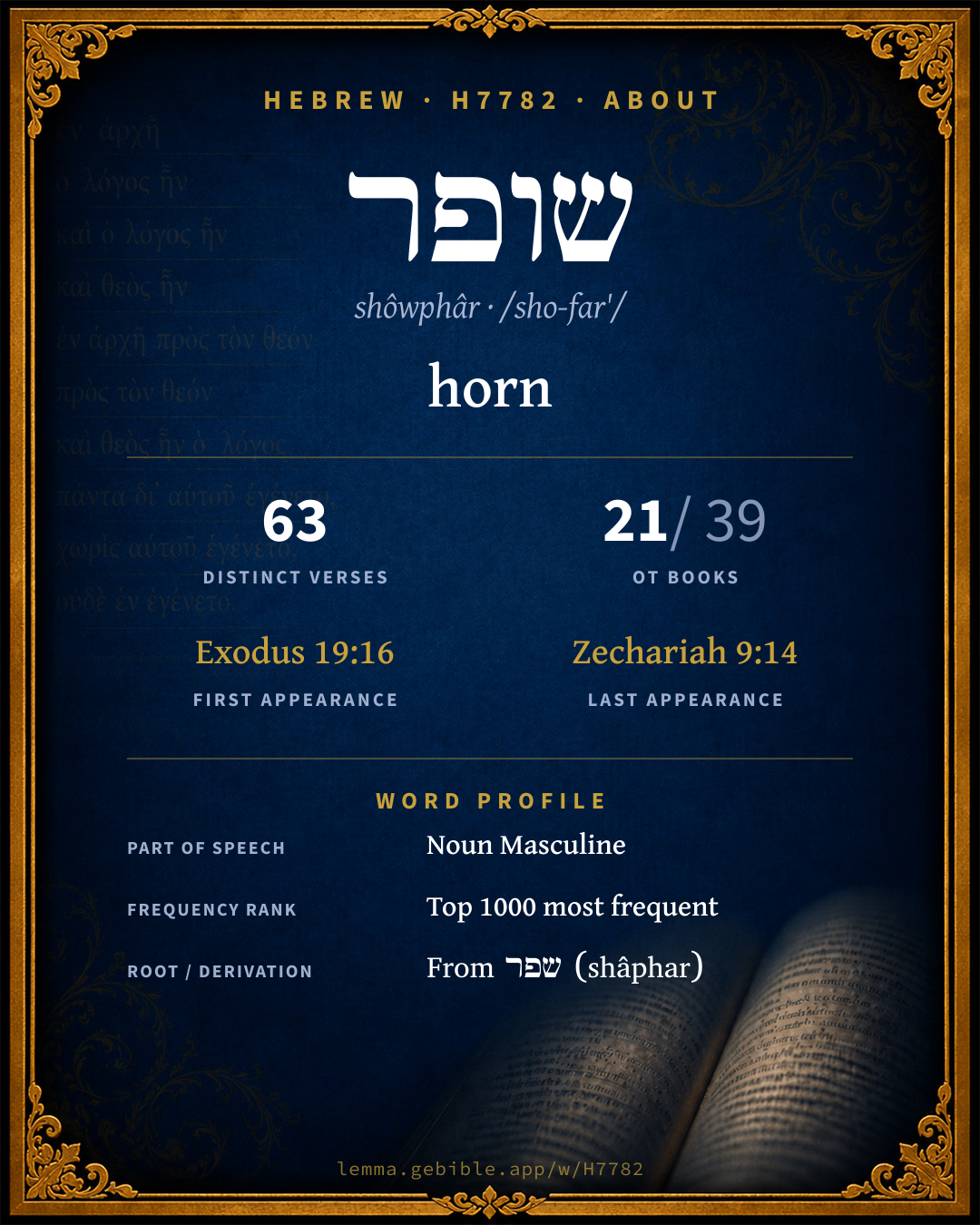
שֹׁפָר
horn
Full lexicon entry — Brown-Driver-Briggs (BDB)
From Brown-Driver-Briggs (BDB)
Where this word appears
See every Absolute-state word in the Hebrew Bible →
Grammar key — what these labels mean
Part of speech
- Noun
- A naming word — a person, place, thing, or idea.
Noun type
- Common
- A common noun — a general class of person, place, or thing (“king,” “city,” “water”), not a specific name.
State
- Absolute
- The independent form of a noun, not bound to a following word.
- Construct
- A noun bound to a following noun in a possessive / “of” relationship (the construct chain).
Gender
- Masculine
- Grammatically masculine.
Number
- Singular
- One.
- Plural
- More than one (in Hebrew, generally three or more).
Grammatical forms
- Noun, Common, Masculine, Singular, Absolute 51 times (71%)
- Noun, Common, Masculine, Plural, Absolute 15 times (21%)
- Noun, Common, Masculine, Plural, Construct 5 times (7%)
- Noun, Common, Masculine, Singular, Construct 1 time (1%)
Parsed forms decoded from the imported morphology (morphhb / Westminster Leningrad Codex — WLC text public domain, morphhb tagging CC BY 4.0), counted across 72 parsed occurrences — not distinct verses.
Every verse where H7782 appears — 63 distinct verses across 21 books. Click any verse to open its interlinear word-by-word view. Verse text shown in the World English Bible for context — . Each verse’s Hebrew form is shown with its reference; the English is not keyword-highlighted, since the data carries no word-level English alignment. Use “Compare translations” on any verse to read it across multiple English versions. This concordance covers the Hebrew Bible; Septuagint (Greek Old Testament) occurrences are not indexed here.
Exodus 3 verses
- Exodus 19:16 שֹׁפָ֖ר n c ms It happened on the third day, when it was morning, that there were thunders and lightnings, and a thick cloud on the mountain, and the sound of an exceedingly loud trumpet; and all the people who were in the camp trembled.
- Exodus 19:19 הַ/שּׁוֹפָ֔ר ptcl def.art + n c ms When the sound of the trumpet grew louder and louder, Moses spoke, and God answered him by a voice.
- Exodus 20:18 הַ/שֹּׁפָ֔ר ptcl def.art + n c ms All the people perceived the thunderings, the lightnings, the sound of the trumpet, and the mountain smoking. When the people saw it, they trembled, and stayed at a distance.
Leviticus 1 verse
Joshua 8 verses
- Joshua 6:4 שׁוֹפְר֤וֹת בַּ/שּׁוֹפָרֽוֹת n c mp cs prep det + n c mp Seven priests shall bear seven trumpets of rams' horns before the ark: and the seventh day you shall compass the city seven times, and the priests shall blow the trumpets.
- Joshua 6:5 הַ/שּׁוֹפָ֔ר ptcl def.art + n c ms It shall be that when they make a long blast with the ram's horn, and when you hear the sound of the trumpet, all the people shall shout with a great shout; and the wall of the city shall fall down flat, and the people shall go up every man straight before him.
- Joshua 6:6 שֽׁוֹפְרוֹת֙ n c mp cs Joshua the son of Nun called the priests, and said to them, Take up the ark of the covenant, and let seven priests bear seven trumpets of rams' horns before the ark of Yahweh.
- Joshua 6:8 שׁוֹפְר֤וֹת בַּ/שּֽׁוֹפָר֑וֹת n c mp cs prep det + n c mp It was so, that when Joshua had spoken to the people, the seven priests bearing the seven trumpets of rams' horns before Yahweh passed on, and blew the trumpets: and the ark of the covenant of Yahweh followed them.
- Joshua 6:9 הַ/שּֽׁוֹפָר֑וֹת בַּ/שּׁוֹפָרֽוֹת ptcl def.art + n c mp prep det + n c mp The armed men went before the priests who blew the trumpets, and the rearward went after the ark, [the priests] blowing the trumpets as they went.
- Joshua 6:13 שׁוֹפְר֜וֹת בַּ/שּׁוֹפָר֑וֹת בַּ/שּׁוֹפָרֽוֹת n c mp cs prep det + n c mp prep det + n c mp The seven priests bearing the seven trumpets of rams' horns before the ark of Yahweh went on continually, and blew the trumpets: and the armed men went before them; and the rearward came after the ark of Yahweh, [the priests] blowing the trumpets as they went.
- Joshua 6:16 בַּ/שּׁוֹפָר֑וֹת prep det + n c mp It happened at the seventh time, when the priests blew the trumpets, Joshua said to the people, Shout; for Yahweh has given you the city.
- Joshua 6:20 בַּ/שֹּֽׁפָר֑וֹת הַ/שּׁוֹפָ֗ר prep det + n c mp ptcl def.art + n c ms So the people shouted, and [the priests] blew the trumpets; and it happened, when the people heard the sound of the trumpet, that the people shouted with a great shout, and the wall fell down flat, so that the people went up into the city, every man straight before him, and they took the city.
Judges 8 verses
- Judges 3:27 בַּ/שּׁוֹפָ֖ר prep det + n c ms It happened, when he had come, that he blew a trumpet in the hill-country of Ephraim; and the children of Israel went down with him from the hill-country, and he before them.
- Judges 6:34 בַּ/שּׁוֹפָ֔ר prep det + n c ms But the Spirit of Yahweh came on Gideon; and he blew a trumpet; and Abiezer was gathered together after him.
- Judges 7:8 שׁוֹפְרֹֽתֵי/הֶ֗ם n c mp cs + sfx pers 3mp So the people took food in their hand, and their trumpets; and he sent all the men of Israel every man to his tent, but retained the three hundred men: and the camp of Midian was beneath him in the valley.
- Judges 7:16 שׁוֹפָר֤וֹת n c mp He divided the three hundred men into three companies, and he put into the hands of all of them trumpets, and empty pitchers, with torches within the pitchers.
- Judges 7:18 בַּ/שּׁוֹפָ֔ר בַּ/שּׁוֹפָר֜וֹת prep det + n c ms prep det + n c mp When I blow the trumpet, I and all who are with me, then blow you the trumpets also on every side of all the camp, and say, For Yahweh and for Gideon.
- Judges 7:19 בַּ/שּׁ֣וֹפָר֔וֹת prep det + n c mp So Gideon, and the hundred men who were with him, came to the outermost part of the camp in the beginning of the middle watch, when they had but newly set the watch: and they blew the trumpets, and broke in pieces the pitchers that were in their hands.
- Judges 7:20 בַּ/שּֽׁוֹפָרוֹת֮ הַ/שּׁוֹפָר֖וֹת prep det + n c mp ptcl def.art + n c mp The three companies blew the trumpets, and broke the pitchers, and held the torches in their left hands, and the trumpets in their right hands with which to blow; and they cried, The sword of Yahweh and of Gideon.
- Judges 7:22 הַ/שּׁוֹפָרוֹת֒ ptcl def.art + n c mp They blew the three hundred trumpets, and Yahweh set every man's sword against his fellow, and against all the host; and the host fled as far as Beth-shittah toward Zererah, as far as the border of Abel Meholah, by Tabbath.
1 Samuel 1 verse
2 Samuel 6 verses
- 2 Samuel 2:28 בַּ/שּׁוֹפָ֔ר prep det + n c ms So Joab blew the trumpet; and all the people stood still, and pursued after Israel no more, neither fought they any more.
- 2 Samuel 6:15 שׁוֹפָֽר n c ms So David and all the house of Israel brought up the ark of Yahweh with shouting, and with the sound of the trumpet.
- 2 Samuel 15:10 הַ/שֹּׁפָ֔ר ptcl def.art + n c ms But Absalom sent spies throughout all the tribes of Israel, saying, As soon as you hear the sound of the trumpet, then you shall say, Absalom is king in Hebron.
- 2 Samuel 18:16 בַּ/שֹּׁפָ֔ר prep det + n c ms Joab blew the trumpet, and the people returned from pursuing after Israel; for Joab held back the people.
- 2 Samuel 20:1 בַּ/שֹּׁפָ֗ר prep det + n c ms There happened to be there a base fellow, whose name was Sheba, the son of Bichri, a Benjamite: and he blew the trumpet, and said, We have no portion in David, neither have we inheritance in the son of Jesse: every man to his tents, Israel.
- 2 Samuel 20:22 בַּ/שּׁוֹפָ֔ר prep det + n c ms Then the woman went to all the people in her wisdom. They cut off the head of Sheba the son of Bichri, and threw it out to Joab. He blew the trumpet, and they were dispersed from the city, every man to his tent. Joab returned to Jerusalem to the king.
1 Kings 3 verses
- 1 Kings 1:34 בַּ/שּׁוֹפָ֔ר prep det + n c ms and let Zadok the priest and Nathan the prophet anoint him there king over Israel; and blow you the trumpet, and say, [Long] live king Solomon.
- 1 Kings 1:39 בַּ/שּׁוֹפָ֔ר prep det + n c ms Zadok the priest took the horn of oil out of the Tent, and anointed Solomon. They blew the trumpet; and all the people said, [Long] live king Solomon.
- 1 Kings 1:41 הַ/שּׁוֹפָ֔ר ptcl def.art + n c ms Adonijah and all the guests who were with him heard it as they had made an end of eating. When Joab heard the sound of the trumpet, he said, Why is this noise of the city being in an uproar?
2 Kings 1 verse
1 Chronicles 1 verse
2 Chronicles 1 verse
Nehemiah 2 verses
- Nehemiah 4:18 בַּ/שּׁוֹפָ֖ר prep det + n c ms and the builders, everyone had his sword girded by his side, and so built. He who sounded the trumpet was by me.
- Nehemiah 4:20 הַ/שּׁוֹפָ֔ר ptcl def.art + n c ms in whatever place you hear the sound of the trumpet, resort you there to us; our God will fight for us.
Job 2 verses
Psalms 4 verses
- Psalms 47:5 שׁוֹפָֽר n c ms God has gone up with a shout, Yahweh with the sound of a trumpet.
- Psalms 81:3 שׁוֹפָ֑ר n c ms Blow the trumpet at the New Moon, At the full moon, on our feast day.
- Psalms 98:6 שׁוֹפָ֑ר n c ms With trumpets and sound of the ram's horn, Make a joyful noise before the King, Yahweh.
- Psalms 150:3 שׁוֹפָ֑ר n c ms Praise him with the sounding of the trumpet! Praise him with harp and lyre!
Isaiah 3 verses
- Isaiah 18:3 שׁוֹפָ֖ר n c ms All you inhabitants of the world, and you dwellers on the earth, when an ensign is lifted up on the mountains, look; and when the trumpet is blown, listen.
- Isaiah 27:13 בְּ/שׁוֹפָ֣ר prep + n c ms It shall happen in that day, that a great trumpet shall be blown; and they shall come who were ready to perish in the land of Assyria, and those who were outcasts in the land of Egypt; and they shall worship Yahweh in the holy mountain at Jerusalem.
- Isaiah 58:1 כַּ/שּׁוֹפָ֖ר prep det + n c ms Cry aloud, don't spare, lift up your voice like a trumpet, and declare to my people their disobedience, and to the house of Jacob their sins.
Jeremiah 7 verses
- Jeremiah 4:5 שׁוֹפָ֖ר n c ms Declare you in Judah, and publish in Jerusalem; and say, Blow you the trumpet in the land: cry aloud and say, Assemble yourselves, and let us go into the fortified cities.
- Jeremiah 4:19 שׁוֹפָר֙ n c ms My anguish, my anguish! I am pained at my very heart; my heart is disquieted in me; I can't hold my peace; because you have heard, O my soul, the sound of the trumpet, the alarm of war.
- Jeremiah 4:21 שׁוֹפָֽר n c ms How long shall I see the standard, and hear the sound of the trumpet?
- Jeremiah 6:1 שׁוֹפָ֔ר n c ms Flee for safety, you children of Benjamin, out of the midst of Jerusalem, and blow the trumpet in Tekoa, and raise up a signal on Beth Haccherem; for evil looks forth from the north, and a great destruction.
- Jeremiah 6:17 שׁוֹפָ֑ר n c ms I set watchmen over you, [saying], Listen to the sound of the trumpet; but they said, We will not listen.
- Jeremiah 42:14 שׁוֹפָ֖ר n c ms saying, No; but we will go into the land of Egypt, where we shall see no war, nor hear the sound of the trumpet, nor have hunger of bread; and there will we dwell:
- Jeremiah 51:27 שׁוֹפָ֤ר n c ms Set up a standard in the land, blow the trumpet among the nations, prepare the nations against her, call together against her the kingdoms of Ararat, Minni, and Ashkenaz: appoint a marshal against her; cause the horses to come up as the rough canker-worm.
Ezekiel 4 verses
- Ezekiel 33:3 בַּ/שּׁוֹפָ֖ר prep det + n c ms if, when he sees the sword come on the land, he blow the trumpet, and warn the people;
- Ezekiel 33:4 הַ/שּׁוֹפָר֙ ptcl def.art + n c ms then whoever hears the sound of the trumpet, and doesn't take warning, if the sword come, and take him away, his blood shall be on his own head.
- Ezekiel 33:5 הַ/שּׁוֹפָ֤ר ptcl def.art + n c ms He heard the sound of the trumpet, and didn't take warning; his blood shall be on him; whereas if he had taken warning, he would have delivered his soul.
- Ezekiel 33:6 בַּ/שּׁוֹפָר֙ prep det + n c ms But if the watchman sees the sword come, and doesn't blow the trumpet, and the people aren't warned, and the sword comes, and take any person from among them; he is taken away in his iniquity, but his blood will I require at the watchman's hand.
Hosea 2 verses
- Hosea 5:8 שׁוֹפָר֙ n c ms "Blow the cornet in Gibeah, And the trumpet in Ramah! Sound a battle cry at Beth Aven, behind you, Benjamin!
- Hosea 8:1 שֹׁפָ֔ר n c ms "Put the trumpet to your lips! Something like an eagle is over Yahweh's house, Because they have broken my covenant, And rebelled against my law.
Joel 2 verses
Amos 2 verses
- Amos 2:2 שׁוֹפָֽר n c ms But I will send a fire on Moab, And it will devour the palaces of Kerioth; And Moab will die with tumult, with shouting, and with the sound of the trumpet;
- Amos 3:6 שׁוֹפָר֙ n c ms Does the trumpet alarm sound in a city, Without the people being afraid? Does evil happen to a city, And Yahweh hasn't done it?
Zephaniah 1 verse
Zechariah 1 verse
About this entry
At a glance — auto-summarized from this page’s data, not written by a person. Every figure links to its source below. This summary describes the numbers; it doesn’t interpret them.
שופר — transliterated shôwphâr — is a Hebrew noun carrying the sense “horn.” Its English rendering has broadened — “trumpet” classically, “ram’s horn” (Berean Standard Bible) and “shofar” (unfoldingWord Literal Text) in modern versions; see the renderings breakdown. Spanning 63 verses in 21 books, it ranks among the moderately common words of the Hebrew Bible. Its earliest occurrence is Exodus 19:16. Sharing its root, it stands alongside שפר, שפר and שפר. See the sense tree, 63-verse concordance, and the renderings breakdown below.
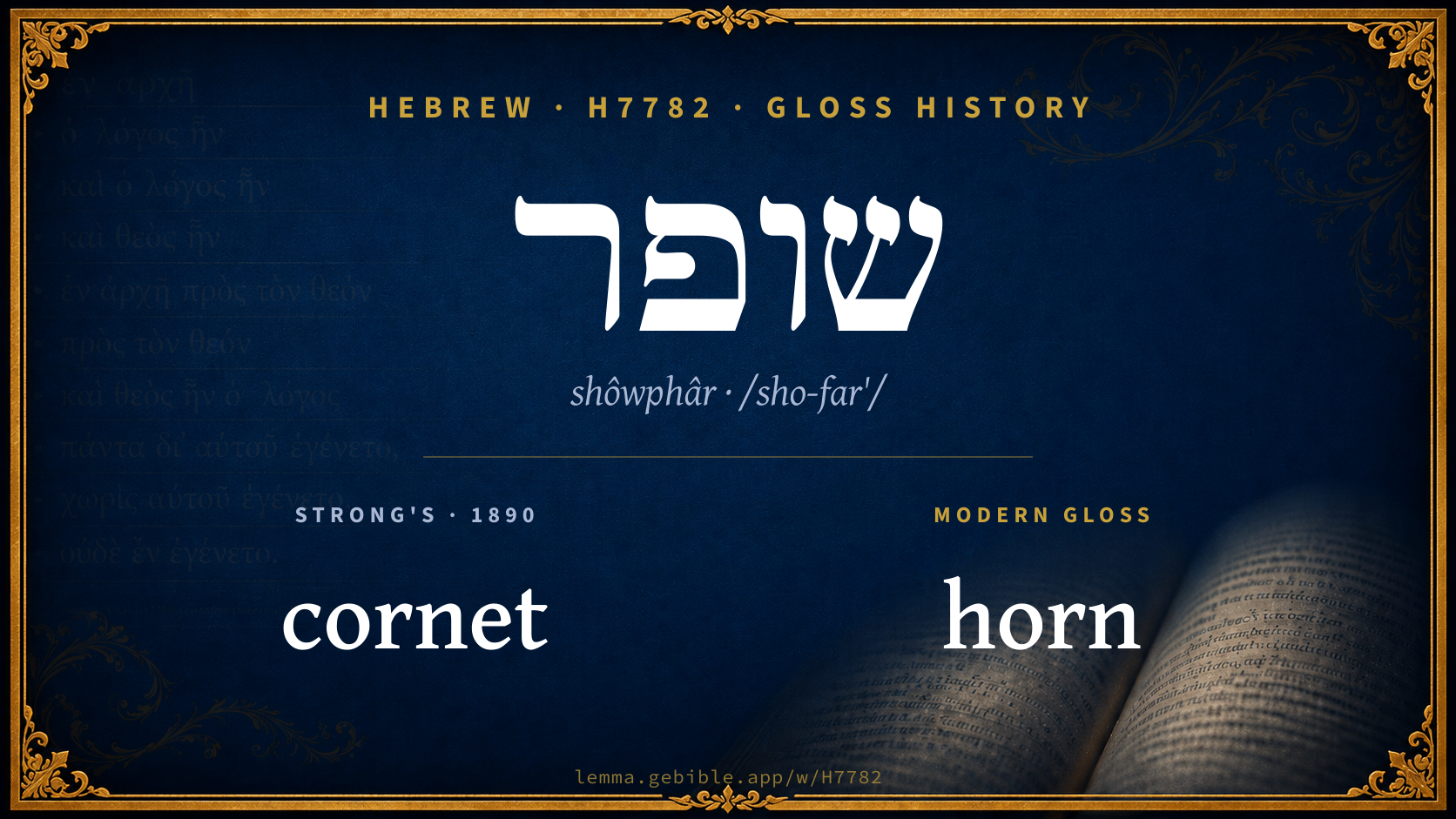
Gloss history
Strong's 1890 vs modern scholarship
About this word
Strong's H7782 catalogs a Hebrew word from the Hebrew Old Testament.
These counts are not copied from any lexicon or concordance. They are computed here, from the morphology-tagged Hebrew Old Testament. What Lemma adds →
- 63
- distinct verses
- The word appears in 63 distinct verses.
- 21 / 39
- OT books
- The word appears in 21 of 39 Old Testament books.
- #550
- by frequency
- Top 1000 most frequent Hebrew words (rank 550 of 8,640 Hebrew words by occurrence).
View all 63 occurrences in the concordance →
By section of the Old Testament
By traditional corpus
Conventional, traditional groupings — biblical authorship is debated, so this is a traditional corpus grouping, not an authorship claim. Each share is this word’s portion of its verses in that division of the Hebrew canon. Each figure is a share of the word’s 63 distinct verses.
- Prophets (Nevi'im) 49 verses · 78%
- Writings (Ketuvim) 10 verses · 16%
- Torah (Pentateuch) 4 verses · 6%
How translations render this word
Counts come from each version’s own published word-to-Strong’s tagging or interlinear alignment — an approximate guide to how each version renders this word, not a word-level alignment the data otherwise carries. Because each total is that version’s own tagged count, the per-version totals vary from one another and need not match the appearance or distinct-verse counts above. These counts may also differ from a printed concordance because Lemma counts each distinctly tagged rendering and does not collapse phrase taggings into a single head-word total. This is a fixed set of word-tagged versions (KJV, ASV, BSB, ULT) and does not change with the reading translation you choose elsewhere. Each version’s license is shown beside its name below (and on Sources).
- King James Version: Trumpet 40×, Trumpets 19×, Cornet 2×
- American Standard Version: Trumpet 41×, Trumpets 17×, Ye the trumpet 3×
- Berean Standard Bible: Ram’s horn 34×, Horn 13×, Horns 12×
- unfoldingWord Literal Text: Shofar 27×, Horn 15×, Shofars 15×
King James Version Public Domain
Renders H7782 across 72 tagged occurrences — most commonly:
Plus 9 renderings that appear only once — usually multi-word phrases or single function words the recovered tagging swept in, not distinct renderings.
American Standard Version Public Domain
Renders H7782 across 72 tagged occurrences — most commonly:
Plus 9 renderings that appear only once — usually multi-word phrases or single function words the recovered tagging swept in, not distinct renderings.
Berean Standard Bible Public Domain
Renders H7782 across 65 tagged occurrences — most commonly:
Plus 1 rendering that appears only once — usually multi-word phrases or single function words the recovered tagging swept in, not distinct renderings. Not rendered by a distinct English word in 3 further occurrences.
unfoldingWord Literal Text CC BY-SA 4.0
Renders H7782 across 73 tagged occurrences — most commonly:
Plus 5 renderings that appear only once — usually multi-word phrases or single function words the recovered tagging swept in, not distinct renderings.
Senses in BDB
The 1 sense BDB distinguishes for this word, in lexicon order (not ranked by frequency or importance). The full entry — with sub-senses — is in the Lexicon Entry tab.
- horn, ram's horn
Word origin
שֹׁפָר, שׁוֹפָר 72 n.m. horn, for blowing
— Brown-Driver-Briggs (Oxford 1906, public domain), digitized via Sefaria, supplemented by the OpenScriptures HebrewLexicon (CC BY 4.0). See Sources.
Derived from שפר (shâphar) (H8231) — to be beautiful.
Jastrow Dictionary
A second Hebrew/Aramaic lexicon for comparison, covering Aramaic and post-biblical (Talmudic, Targumic, Midrashic) usage that the biblical-Hebrew BDB does not. Matched by lemma rather than by Strong’s number, so a lemma may carry more than one Jastrow headword (shown separately below), and the entries cover usage well beyond the Bible.
שֹׁופָר
- [rounded; cmp. שְׁפוֹפֶרֶת,]
- 1. horn, trumpet, Shofar, contrad. to חצצרות. R. Hash. III, 3 ש׳ של ראש השנה וכ׳ the horn for the New Year’s Day (used in the Temple) was from a mountain-goat, straight, and its mouthpiece was inlaid with gold. Ib. ש׳ מאריך וכ׳ the tone of the shofar was prolonged, that of the accompanying trumpets short. Ib. 4. Lev. R. s. 29; a. v. fr.—Pl. שֹׁופָרוֹת. R. Hash. III, 2, v. קֶרֶן. Lev. R. l. c. ובר"ה נוטלין שֹׁופְרוֹתֵיהֶן וכ׳ and on New Year’s Day they take up their Shofars and blow before the Lord, and he rises from the throne of justice to that of mercy &c.; ib. שֹׁופָרֵיהֶן; a. fr.—Esp. שופרות (also שופר) shofaroth, that section of the Musaf service of the New Year’s Day which treats of the shofar (of the Revelation). R. Hash. IV, 5 ש׳ ותוקע the reader recites shofaroth and blows. Ib. 6 אין פוחתין … מעשרה ש׳ you must cite no less than ten Biblical verses referring to the shofar. Ib. (32ᵃ) אין מזכירין מלכיות זכרונות וש׳ של פורענות Ms. M. (ed. זכרון מלכות ושופר) you must not cite verses referring to rulership, memorials, and shofar which allude to evil dispensations; a. e.
- 2. horn-shaped box in the Temple to receive the money for sacrifices which are supplied by the Temple authorities. Tosef. Shek. III, 2 ונותן לש׳ and puts the money into the proper box. Ib. ש׳ של נדבה box for free-will offerings. Ib. 3 ש׳ לקינים box for bird offerings; a. fr.—Pl. as ab. Shek. VI, 1; Tosef. ib. III, 1; a. fr.
A Dictionary of the Targumim, the Talmud Babli and Yerushalmi, and the Midrashic Literature (Marcus Jastrow; London, Luzac, 1903) — Public Domain. Digitized via Sefaria. Digitized via Sefaria. Full attribution on Sources.
Forms in the corpus
The 41 distinct written forms H7782 takes in the Hebrew Bible, most frequent first — each parse links to that state’s occurrences in the concordance. Hebrew forms include their vowel points and cantillation, so a single lemma takes many written forms.
Same root — word family
Other BDB entries built from the same root as H7782, grouped by Strong’s listed origin. These share a root / origin per the lexicon — not necessarily a shared meaning. Each links to that word’s own entry.
Derives from
Shares the same root
- שפר shᵉphar H8232 to be fair
- שפר shepher H8233 beauty
- שפרה shiphrâh H8235 fairness
- שפרור shaphrûwr H8237 canopy
- שפרפר shᵉpharphar H8238 dawn
Proper names from this root
People and places named from this root — a name, not an additional meaning of the word.
Compare all same-root words → Showing 4 of 8 — not the complete family. 1 of the same-root words is a proper name (a person or place). They share a root, not necessarily a meaning.
Septuagint verse parallels
This word appears in 60 verses that also exist in the Greek Old Testament (Septuagint), out of the 63 Hebrew verses it occurs in. You can read those verses in Greek by switching the Old Testament edition to the Septuagint.
Read these verses in the Septuagint
- Exodus 19:16
- Leviticus 25:9
- Joshua 6:5
- Judges 3:27
- 1 Samuel 13:3
- 2 Samuel 2:28
- 1 Kings 1:34
- 2 Kings 9:13
- 1 Chronicles 15:28
- 2 Chronicles 15:14
- Job 39:24
- Psalms 47:5
This is a verse-level parallel only — the same verses exist in both the Hebrew and Greek Old Testaments. No word-level Hebrew↔Greek correspondence is claimed: the data carries no such alignment, so no Greek word is shown as this Hebrew word’s translation. Coverage is not total — the Septuagint omits the deuterocanon and renumbers the Psalms, so some Hebrew verses have no direct Greek parallel.