
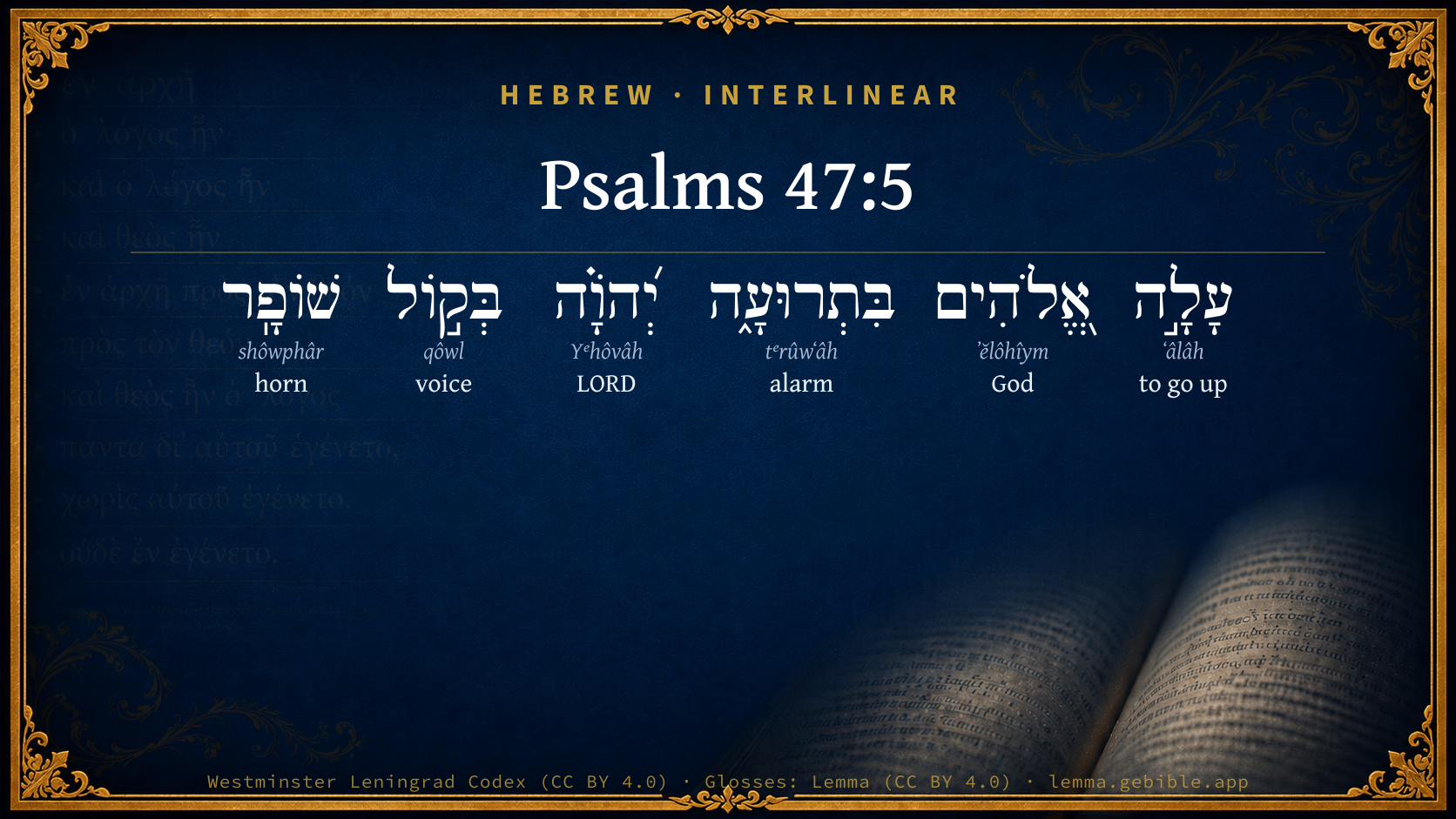
Psalms 47:5

Hebrew (Westminster Leningrad Codex) Psalms 47:5 appears in the Hebrew Old Testament. The text above is from the Westminster Leningrad Codex. Each word links to its Strong’s number, a concise gloss, and parsing drawn from the Open Scriptures Hebrew Bible morphology. Click any word for its full Brown-Driver-Briggs (BDB) entry.
Download image
Cite this verse

Psalms 47:5 (World English Bible). Public Domain. Lemma interlinear Bible study tool, https://lemma.gebible.app/v/psalms/47/5.

Show BibTeX & RIS
BibTeX
RIS
English Translation
God has gone up with a shout, Yahweh with the sound of a trumpet.
World English Bible · Public Domain
Download a study sheet

One document with this verse’s original text, its word-by-word gloss line, the meaning frame, cross-references with their text, attributed commentary, and full source and license credits — printable, and it pastes into notes with its structure intact.

This verse Autodidact and up

Study sheet (.html) Plain text (.txt)

A passage Seminary Student

Up to 50 verses in one chapter. A passage sheet keeps up to 6 commentary sources and 12 cross-references per verse, in the order this page ranks them, and says so on the sheet whenever that leaves anything out. Ask for a single verse and you get the Autodidact verse sheet above.

Everything on this page stays free to read, with no account — the sheet is a download of what is already on screen, not access to it.

Want to remove ads? Support Godless Engineer
Compare translations 3

The same verse in 3 English versions, stacked beneath the original-language interlinear above. Click any original word for its lexicon entry.

Each is an independent rendering of the whole verse — the interlinear is not word-aligned to these translations.

Highlighted words mark where these versions differ — a whole-verse word diff, not a word-by-word alignment.

  • World English Bible Public Domain
    God has gone up with a shout, Yahweh with the sound of a trumpet.
  • King James Version Public Domain
    God is gone up with a shout, the LORD with the sound of a trumpet.
  • unfoldingWord Literal Text CC BY-SA 4.0
    God has gone up with a shout, Yahweh with the sound of a shofar.

unfoldingWord Literal Text — © unfoldingWord, licensed CC BY-SA 4.0. Word-aligned USFM3 via Door43 (git.door43.org/unfoldingWord/en_ult).

Versions to compare (up to 4)

3 of 4 selected

Show all 18 translations

Every available English version of this verse, each an independent rendering of the whole verse.

  • World English Bible Public Domain
    God has gone up with a shout, Yahweh with the sound of a trumpet.
  • Berean Standard Bible Public Domain
    God has ascended amid shouts of joy, the LORD with the sound of the horn.
  • Majority Standard Bible Public Domain
    God has ascended amid shouts of joy, the LORD with the sound of the horn.
  • King James Version Public Domain
    God is gone up with a shout, the LORD with the sound of a trumpet.
  • American Standard Version (1901) Public Domain
    God is gone up with a shout, Jehovah with the sound of a trumpet.
  • Revised Version (1885) Public Domain
    God is gone up with a shout, the LORD with the sound of a trumpet.
  • Geneva Bible (1599) Public Domain
    God is gone vp with triumph, euen the Lord, with the sound of the trumpet.
  • Douay-Rheims (1899) Public Domain
    He hath chosen for us his inheritance the beauty of Jacob which he hath loved.
  • Young's Literal Translation Public Domain
    God hath gone up with a shout, Jehovah with the sound of a trumpet.
  • Literal Standard Version CC BY-SA 4.0
    God has gone up with a shout, || YHWH with the sound of a horn.
  • Unlocked Literal Bible CC BY-SA 4.0
    God has gone up with a shout, Yahweh with the sound of a trumpet.
  • unfoldingWord Literal Text CC BY-SA 4.0
    God has gone up with a shout, Yahweh with the sound of a shofar.
  • Darby Bible Public Domain
    God is gone up amid shouting, Jehovah amid the sound of the trumpet.
  • World Messianic Bible Public Domain
    God has gone up with a shout, the LORD with the sound of a shofar.
  • Webster's Bible Public Domain
    \\47:4\\He shall choose our inheritance for us, the excellence of Jacob whom he loved. Selah.
  • Free Bible Version CC BY-SA 4.0
    God ascends his throne with a great shout, the Lord is accompanied by the sound of the trumpet.
  • Bible in Basic English Public Domain
    God has gone up with a glad cry, the Lord with the sound of the horn.
  • JPS Tanakh (1917) Public Domain
    (47-6) God is gone up amidst shouting, the LORD amidst the sound of the horn.

Literal Standard Version (2020), Covenant Press — licensed CC BY-SA 4.0. Text via the HelloAO Bible API (eBible.org). Unlocked Literal Bible (unfoldingWord) — licensed CC BY-SA 4.0. Text via the HelloAO Bible API (eBible.org). unfoldingWord Literal Text — © unfoldingWord, licensed CC BY-SA 4.0. Word-aligned USFM3 via Door43 (git.door43.org/unfoldingWord/en_ult). Free Bible Version, Dr. Jonathan Gallagher — licensed CC BY-SA 4.0. Text via the HelloAO Bible API (eBible.org).

Word by word

More ways to search: Search by grammar → Find every occurrence → Compare this word →

Practice this passage: Drill this verse → Learn its vocabulary →

About this verse

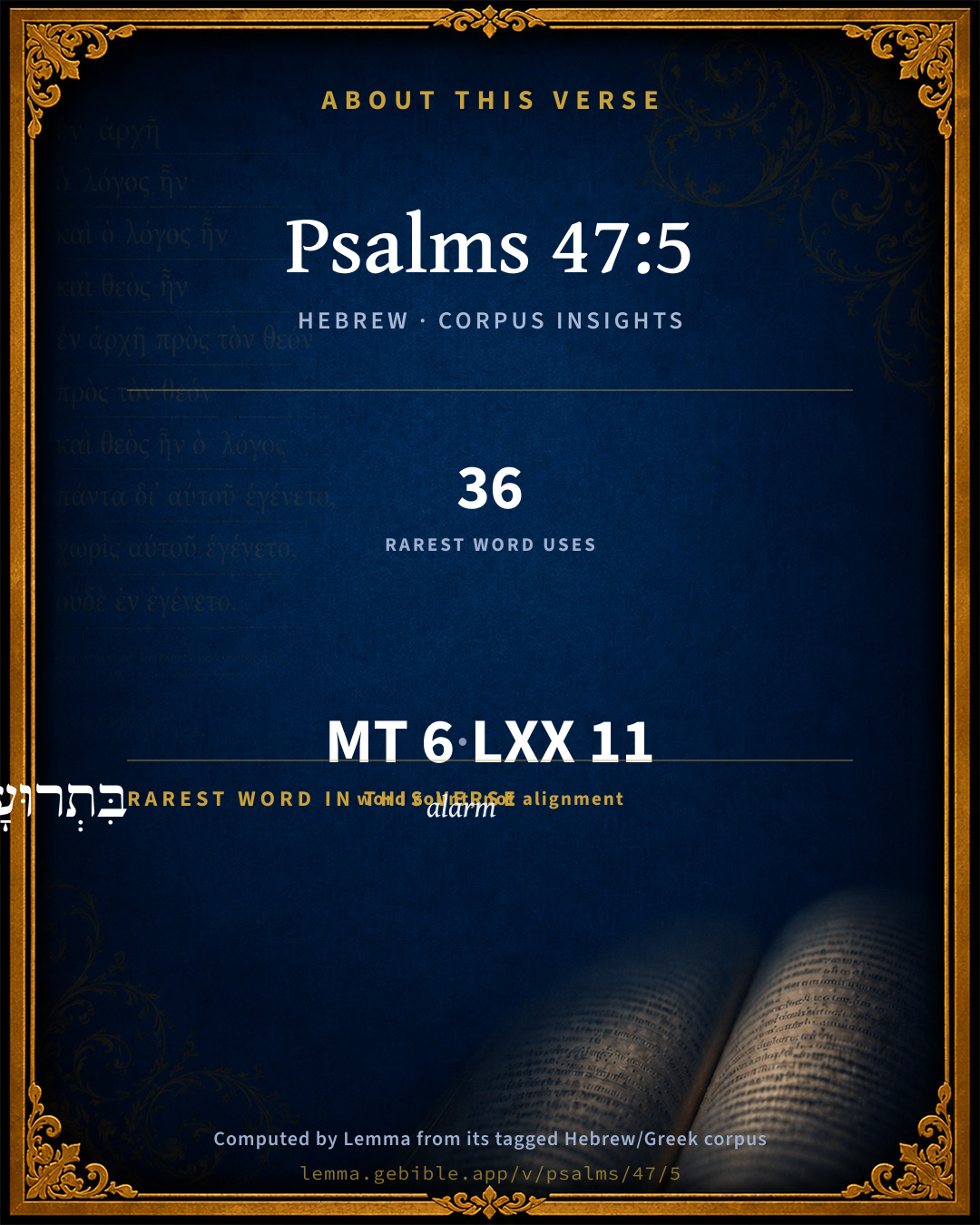
These counts appear in no published source. They are computed here, from the morphology-tagged text and Lemma’s own curated glosses. What Lemma adds →

6
words
6
distinct lemmas
Wisdom
section

Shared distinctive vocabulary

בִּתְרוּעָ֑ה alarm H8643 occurs in 33 verses of the Hebrew Bible. Also found in:

Grammatical profile

  • 1 verb
  • 5 nouns

Verb forms

  • עָלָ֣ה Qal · Perfect

Hebrew & Septuagint length

In English translation the verse runs 14 words from the Hebrew and 15 from the Septuagint (LXX English) — closely comparable.

A rough comparison of the two English renderings, which tokenize alike — not a word-level alignment.

Word counts can differ between the Hebrew and the Greek without any difference in meaning — e.g. the Hebrew direct-object marker אֵת has no separate Greek word, and Greek often adds the article ὁ.

In the original languages it is 6 Hebrew tokens and 11 Greek tokens — but the two are counted differently (Hebrew bundles its prefixes and suffixes into one token; the Greek is in lemma form), so that isn’t a like-for-like length.

Cross-references

23

Topical passages linked to Psalms 47:5 in the Treasury of Scripture Knowledge — connected by theme and wording, ordered by reader-vote popularity; previews shown in the World English Bible.

  • Psalms 68:33 To him who rides on the heaven of heavens, which are of old; Behold, he utters his voice, a mighty voice.
  • Psalms 24:7–10 Lift up your heads, you gates; Be lifted up, you everlasting doors: The King of glory will come in.
  • 1 Corinthians 15:52 in a moment, in the twinkling of an eye, at the last trumpet. For the trumpet will sound, and the dead will be raised incorruptible, and we will be changed.
  • 1 Thessalonians 4:16 For the Lord himself will descend from heaven with a shout, with the voice of the archangel, and with God's trumpet. The dead in Christ will rise first,
  • Numbers 10:1–10 Yahweh spoke to Moses, saying,
  • Numbers 23:21 He has not saw iniquity in Jacob; Neither has he seen perverseness in Israel: Yahweh his God is with him, The shout of a king is among them.
  • Joshua 6:5 It shall be that when they make a long blast with the ram's horn, and when you hear the sound of the trumpet, all the people shall shout with a great shout; and the wall of the city shall fall down flat, and the people shall go up every man straight before him.
  • 2 Samuel 6:15 So David and all the house of Israel brought up the ark of Yahweh with shouting, and with the sound of the trumpet.
  • Psalms 68:24–25 They have seen your processions, God, Even the processions of my God, my King, into the sanctuary.
  • Psalms 78:65 Then the Lord awakened as one out of sleep, Like a mighty man who shouts by reason of wine.
  • Psalms 150:3 Praise him with the sounding of the trumpet! Praise him with harp and lyre!
  • Revelation 8:6–13 The seven angels who had the seven trumpets prepared themselves to sound.
  • Revelation 11:15 The seventh angel sounded, and great voices in heaven followed, saying, "The kingdom of the world has become the Kingdom of our Lord, and of his Christ. He will reign forever and ever!"
  • 1 Chronicles 15:24 Shebaniah, and Joshaphat, and Nethanel, and Amasai, and Zechariah, and Benaiah, and Eliezer, the priests, did blow the trumpets before the ark of God: and Obed-edom and Jehiah were doorkeepers for the ark.
  • 1 Chronicles 15:28 Thus all Israel brought up the ark of the covenant of Yahweh with shouting, and with sound of the cornet, and with trumpets, and with cymbals, sounding aloud with psalteries and harps.
  • 1 Chronicles 16:42 and with them Heman and Jeduthun [with] trumpets and cymbals for those that should sound aloud, and [with] instruments for the songs of God; and the sons of Jeduthun to be at the gate.
  • Psalms 68:17–19 The chariots of God are tens of thousands and thousands of thousands. The Lord is among them, from Sinai, into the sanctuary.
  • Psalms 81:3 Blow the trumpet at the New Moon, At the full moon, on our feast day.
  • Psalms 98:6 With trumpets and sound of the ram's horn, Make a joyful noise before the King, Yahweh.
  • Luke 24:51–53 It happened, while he blessed them, that he withdrew from them, and was carried up into heaven.
  • Acts 1:5–11 For John indeed baptized in water, but you will be baptized in the Holy Spirit not many days from now."
  • 1 Timothy 3:16 Without controversy, the mystery of godliness is great: God was revealed in the flesh, Justified in the spirit, Seen by angels, Preached among the nations, Believed on in the world, And received up in glory.
  • Ephesians 4:8–10 Therefore he says, "When he ascended on high, he led captivity captive, and gave gifts to men."

Cross-references courtesy of OpenBible.info (CC BY 4.0).

Hebrew and Greek witnesses Masoretic Hebrew ↔ Greek Septuagint

The same verse in the two great witnesses to the Old Testament, shown verse-for-verse.

You’re reading Greek Psalm 46 (Hebrew Psalm 47). The Septuagint counts the superscription, so verse numbers can differ from the Hebrew — chapter-level alignment, not verse-by-verse. Numbering follows Rahlfs.

These are two independent witnesses, not word-aligned to each other, and the Septuagint is shown in lemma (dictionary) form.

Hebrew Psalms 47:5 Masoretic · Westminster Leningrad Codex

עָלָ֣ה אֱ֭לֹהִים בִּתְרוּעָ֑ה יְ֝הֹוָ֗ה בְּק֣וֹל שׁוֹפָֽר

God has gone up with a shout, Yahweh with the sound of a trumpet.

World English Bible · Public Domain

Greek LXX Greek Psalm 46:5 Septuagint · lemma form

ἐκλέγω ἐγώ ὁ κληρονομία αὐτός ὁ καλλονή ἰακώβ ὅς ἀγαπάω διάψαλμα

God is gone up with a shout, the Lord with a sound of a trumpet.

LXX2012 (modern English Septuagint) · Public Domain

On this verse, Whedon's Commentary on the Bible discusses the Septuagint’s reading. Read the note in Commentary ↓

Hebrew: Westminster Leningrad Codex (CC BY 4.0). Greek: Septuagint (public domain); English from LXX2012 (modern English Septuagint) (Public Domain). How the Septuagint differs from the Hebrew →

Commentary

Notes on Psalms 47:5 from classic Christian and Jewish commentators (each source and its license shown beneath its notes). The classic Christian expositions comment on the surrounding passage and are grouped to its opening verse, so a note may address several verses; the Jewish commentaries on the Tanakh (Rashi and others) are per-verse, so they appear only where the commentator wrote on this verse.

Lemma curates 59 commentaries, every one of them public domain or Creative Commons licensed, each selected and text-cleaned for this edition rather than reprinted as found. About our sources →

Matthew Henry's Commentary

We are here most earnestly pressed to praise God, and to sing his praises; so backward are we to this duty that we have need to be urged to it by precept upon precept, and line upon line; so we are here (Psa 47:6): Sing praises to God, and again, Sing praises, Sing praises to our King, and again, Sing praises. This intimates that it is a very necessary and excellent duty, that it is a duty we ought to be frequent and abundant in; we may sing praises again and again in the same words, and it is no vain repetition if it be done with new affections. Should not a people praise their God? Dan 5:4. Should not subjects praise their king? God is our God, our King, and therefore we must praise him; we must sing his praises, as those that are pleased with them and that are not ashamed of them. But here is a needful rule subjoined (Psa 47:7): Sing you praises with understanding, with Maschil. 1. "Intelligently; as those that do yourselves understand why and for what reasons you praise God and what is the meaning of the service." This is the gospel-rule (Co1 14:15), to sing with the spirit and with the understanding also; it is only with the heart that we make melody to the Lord, Eph 5:19. It is not an acceptable service if it be not a reasonable service. 2. "Instructively, as those that desire to make others understand God's glorious perfections, and to teach them to praise him." Three things are mentioned in these verses as just matter for our praises, and each of them will admit of a double sense: -

I. We must praise God going up (Psa 47:5): God has gone up with a shout, which may refer, 1. To the carrying up of the ark to the hill of Zion, which was done with great solemnity, David himself dancing before it, the priests, it is likely, blowing the trumpets, and the people following with their loud huzzas. The ark being the instituted token of God's special presence with them, when that was brought up by warrant from him he might be said to go up. The emerging of God's ordinances out of obscurity, in order to the more public and solemn administration of them, is a great favour to any people, which they have reason to rejoice in and give thanks for. 2. To the ascension of our Lord Jesus into heaven, when he had finished his work on earth, Act 1:9. Then God went up with a shout, the shout of a King, of a conqueror, as one who, having spoiled principalities and powers, then led captivity captive, Psa 68:18. He went up as a Mediator, typified by the ark and the mercy-seat over it, and was brought as the ark was into the most holy place, into heaven itself; see Heb 9:24. We read not of a shout, or of the sound of a trumpet, at the ascension of Christ, but they were the inhabitants of the upper world, those sons of God, that then shouted for joy, Job 38:7. He shall come again in the same manner as he went (Act 1:11) and we are sure that he shall come again with a shout and the sound of a trumpet.

II. We must praise God reigning, Psa 47:7. 8. God is not only our King, and therefore we owe our homage to him, but he is King of all the earth (Psa 47:7), over all the kings of the earth, and therefore in every place the incense of praise is to be offered up to him. Now this may be understood, 1. Of the kingdom of providence. God, as Creator, and the God of nature, reigns over the heathen, disposes of them and all their affairs, as he pleases, though they know him not, nor have any regard to him: He sits upon the throne of his holiness, which he has prepared in the heavens, and there he rules over all, even over the heathen, serving his own purposes by them and upon them. See here the extent of God's government; all are born within his allegiance; even the heathen that serve other gods are ruled by the true God, our God, whether they will or no. See the equity of his government; it is a throne of holiness, on which he sits, whence he gives warrants, orders, and judgment, in which we are sure there is no iniquity. 2. Of the kingdom of the Messiah. Jesus Christ, who is God, and whose throne is for ever and ever reigns over the heathen; not only he is entrusted with the administration of the providential kingdom, but he shall set up the kingdom of his grace in the Gentile world, and rule in the hearts of multitudes that were bred up in heathenism, Eph 2:12, Eph 2:13. This the apostle speaks of as a great mystery that the Gentiles should be fellow-heirs, Eph 3:6. Christ sits upon the throne of his holiness, his throne in the heavens, where all the administrations of his government are intended to show forth God's holiness and to advance holiness among the children of men.

III. We must praise God as attended and honoured by the princes of the people, Psa 47:9. This may be understood, 1. Of the congress or convention of the states of Israel, the heads and rulers of the several tribes, at the solemn feasts, or to despatch the public business of the nation. It was the honour of Israel that they were the people of the God of Abraham, as they were Abraham's seed and taken into his covenant; and, thanks be to God, this blessing of Abraham has come upon the isles of the Gentiles, Gal 3:14. It was their happiness that they had a settled government, princes of their people, who were the shields of their land. Magistracy is the shield of a nation, and it is a great mercy to any people to have this shield, especially when their princes, their shields, belong unto the Lord, are devoted to his honour, and their power is employed in his service, for then he is greatly exalted. It is likewise the honour of God that, in another sense, the shields of the earth do belong to him; magistracy is his institution, and he serves his own purposes by it in the government of the world, turning the hearts of kings as the rivers of water, which way soever he pleases. It was well with Israel when the princes of their people were gathered together to consult for the public welfare. The unanimous agreement of the great ones of a nation in the things that belong to its peace is a very happy omen, which promises abundance of blessings. 2. It may be applied to the calling of the Gentiles into the church of Christ, and taken as a prophecy that in the days of the Messiah the kings of the earth and their people should join themselves to the church, and bring their glory and power into the New Jerusalem, that they should all become the people of the God of Abraham, to whom it was promised that he should be the father of many nations. The volunteers of the people (so it may be read); it is the same word that is used in Psa 110:3, Thy people shall be willing; for those that are gathered to Christ are not forced, but made freely willing, to be his. When the shields of the earth, the ensigns of royal dignity ( Kg1 14:27, Kg1 14:28,), are surrendered to the Lord Jesus, as the keys of a city are presented to the conqueror or sovereign, when princes use their power for the advancement of the interests of religion, then Christ is greatly exalted.

Matthew Henry's Commentary on the Whole Bible (1708–1710) — public domain (CC PDM 1.0). Text via the HelloAO Bible API.

Trapp's Complete Commentary

John Trapp

Psa 47:5 God is gone up with a shout, the LORD with the sound of a trumpet.

Ver. 5. God is gone up with a shout] The ark is here called God, as also Psa 132:5, and the face of God, Psa 105:4; because from the ark, in the midst of the cherubims, God spake to his people, and they by looking towards it had a sure symbol of the divine presence. The bringing of it up with pomp and solemnity into Mount Sion was a type of Christ’s wonderful ascension into heaven, triumphing over all his and our enemies, Col 2:15 Eph 4:8, and joyfully entertained by saints and angels in heaven. The Jews, ever apt to work themselves (as one saith of them) into the fool’s paradise of a sublime dotage, understand this passage of the future reduction of the ark into the sanctuary, where it was once; and for the which they most earnestly pray still, as Buxtorf writeth (De Synag. Jud c. 13).

With the sound of a trumpet] Concrepantibus tubis; and in like sort he shall return, Act 1:11 1Th 4:16.

John Trapp, A Commentary or Exposition upon All the Books of the Old and New Testament (1647–1656) — public domain. Text from a community e-Sword module.

The Biblical Illustrator

Joseph S. Exell

Psa_47:5

God is gone up with a shout.

The solemnity of Christs Ascension to the throne of glory

I. Prove the truth of this doctrine--that Christ is gone up, or ascended.

1. This was typified under the Old Testament by the ark, which continued in a wandering, uncertain condition, as to the place of its abode, till it was taken up to Mount Zion and fixed in the holy of holies.

2. This was foretold by the prophet (Psa_110:1).

3. This is evident from the testimony of famous witnesses (Act_1:11; Act_7:55-56).

4. This is confirmed from many texts of Scripture (Heb_1:3; Heb_4:14; Heb_8:1; Heb_12:2).

5. This appears from the glorious fruits and consequences of His actual accession to the throne of glory, which have appeared in the open view of all mankind.

II. Show what is imported in this expression of his going up.

1. His voluntary humiliation (Joh_3:13).

2. His incarnation, or assumption of mans nature.

3. That He had ended or finished the work or service for which He came down into this lower world.

4. His resurrection from the dead, whereby He was justified as the Head and Surety of an elect world, and declared to be the Son of God with power, according to the Spirit of holiness.

5. That the gates of glory, which had been shut, were again opened by the death and satisfaction of Christ.

6. That God the Father is perfectly well pleased with the person and undertaking of our glorious Redeemer; for, if He had not been well pleased, how could He give Him such a solemn reception after His work was done?

7. That when Christ ascended, after finishing our redemption, He was received into heaven with the universal applause and admiration of the triumphant company.

III. Speak of the solemnity of Christs ascension.

1. The place from whence He went up. This world, where He had met with such bad entertainment.

2. Whither He is gone up. He is gone up into the third heavens, where no unclean thing can enter; and the heavens are to contain Him till the time of the restitution of all things.

3. To whom He is gone up (Joh_20:17). Oh! what an infinite satisfaction would it be to Him to return to His Father, to be possessed of that glory that He had with Him before the world was!

4. Through what region, and through whose territories he went up.

5. His levee or retinue that attended Him when He went up. This seems to be pointed at (Psa_68:17).

6. The spoils and trophies He carried along with Him when He went up.

(1) The head of the old serpent.

(2) The keys of the grave (Rev_1:18).

(3) The debt bond that we were owing to justice, retired and cancelled (Col_2:14).

(4) The broken law repaired, yea, magnified and made honourable by His obedience unto death.

(5) The keys of the house of David, i.e. an absolute dominion, sovereignty and headship over His Church, and over all creatures for the Churchs sake (Isa_22:22).

7. With respect to the solemnity of Christs ascension, we may consider that He went up with a shout. Who were they that gave the shout? We read of nothing but a deep and silent gazing after Him as He went up from this lower world (Act_1:9-11); where, then, was the shouting? In the Church triumphant, among an innumerable company of angels, and the spirits of just man made perfect: these sons of God shouted for joy when they saw their glorious Head of redemption and confirmation coming in personally among them. What kind of shouts were among that triumphant company when the Lord Jesus went up to His throne and kingdom?

(1) A shout of approbation.

(2) A shout of joy and gladness (Rev_19:7).

(3) A shout of praise and gratitude (Rev_5:9).

(4) A shout of admiration and adoration among the triumphant company.

(5) A shout of victory and triumph among the heavenly crowd.

IV. Show what there is in the ascension of Christ that affords such ground of triumph.

1. God is gone up with a shout, as our forerunner, to open the way to glory, and to make a report of what was done in the days of His humiliation upon this earth (Heb_6:20).

2. He has gone up as a victorious general to receive a triumph after the battle.

3. He is gone up as a bridegroom to prepare a lodging for His bride, and to make suitable provision for her against the day of the consummation of the marriage (Joh_14:2-3).

4. God is gone up with a shout in our nature, as the great high priest of our profession (Heb_4:14; Heb_9:12; Heb_10:21-22).

5. God is gone up in our nature as our Advocate with the Father (1Jn_2:1).

6. God is gone up as our exalted King.

7. He is gone up to Mount Zion above, as the great Shepherd, to look after His sheep that are wandering in the wilderness.

8. He is gone up as our glorious Representative to take possession of the inheritance of eternal life, until his fellow-heirs, all believers whom He represents, follow Him.

V. Uses.

1. Of information.

(1) See hence that the ignominy of the Cross of Christ is fully wiped away.

(2) See hence that none need to think themselves dishonoured by suffering the hardest things for His sake.

(3) See hence how little reason believers have to be disquieted because of the confusions of this lower world; even though heaven and earth were mingling, and seas roaring. Why, God is gone up with a shout: He governs the world for the Churchs sake, and therefore nothing can go wrong, no weapon formed against Zion shall prosper.

(4) See hence the parallel or similitude between Christs ascension and His coming to judgment.

2. Of trials.

(1) Have you received His Spirit? He is a holy Spirit, a praying Spirit, a Spirit of life and liberty, a public Spirit in a time of defection; when the house of Christ is turned into a den of thieves, the zeal of His house will eat you up.

(2) Your hearts will be frequently mounting up on high after Him, as upon eagles wings.

3. Of consolation.

(1) Thou shall follow Him ere long.

(2) Thou shall not want the gifts, graces and influences of the Spirit to bear you up, and to carry you through in the work and service that He has for you upon earth.

(3) Here is comfort under all the glooms and frowns of men in the world for owning Christ, His cause, His kingdom, His truths, His ways and people.

(4) Here is comfort against the fear of the roaring lion, who goes about seeking whom he may devour.

(5):Here is comfort; all the angels in heaven are upon thy side, believer, all the armies of heaven are ready to fight the quarrel of His Church.

(6) Here is comfort; death is disarmed of its sting, and can do no hurt. Why, Christ carried the sting of death, and the armour of this king of terrors with Him when He went up with a shout. I have the keys of hell and of death.

(7) Here is comfort; thy life is well secured, believer. Why, it is hid in Him who is gone up with a shout (Col_3:3).

(8) Here is comfort, that all providential dispensations in the world are working together for thy good.

4. Of exhortation.

(1) Behold Him with the eye of faith upon the throne.

(2) Lift up the everlasting doors of your hearts, that this King of glory may come in.

(3) Come with boldness unto the throne of grace.

(4) Let all the world, angels, men and devils, reverence Him and do Him homage.

(5) See that you have a due regard to the laws and liberties of His house, and the interests of His glory and kingdom.

(6) Is He gone up with a shout? Then let us never be ashamed of Him before men, for He is our credit and ornament; He is not ashamed to confess us before His Father, and before His angels.

(7) Let us join in the solemnity of His exaltation, for it is not yet ended. They that shouted when He went first up to heaven from Mount Olivet are shouting for joy to this day, and therefore let us join in the concert. (E. Erskine.)

The Biblical Illustrator, edited by Joseph S. Exell (c. 1880s–1900s) — public domain. Text from a community e-Sword module.

Joseph Benson's Commentary

Psa 47:5. God is gone up with a shout — This is meant literally of the ark, wherein God was present, which went or was carried up to the hill of Zion, where the tabernacle was erected for it, and afterward to the hill of Moriah into the temple, which solemnities were accompanied with the shouts and acclamations of the people, and with the sound of trumpets; but mystically, it is to be understood of Christ’s ascension into heaven, as may be gathered by comparing this with Eph 4:8, where the like words, uttered concerning the ark upon the same occasion, Psa 68:18, are directly applied to Christ’s ascension.

Joseph Benson's Commentary on the Old and New Testaments (1811–1818) — public domain. Text from a community e-Sword module.

J. A. Alexander on Psalms

Joseph Addison Alexander

6. (Psa 47:5). God has gone up with shouting, Jehovah with, sound of trumpet. He is here described as returning to heaven after the conquest of his enemies and the rescue of his people, as in Psa 7:8 (7), he does the same, after sitting in judgment on the nations, and asserting the right of his own people. See Psa 68:19 (18), and compare Gen 17:22, Jdg 13:20. The shouting and sound of the trumpet represents the ascension as a public and triumphant one. The ideal scene is typical of the actual ascension of our Saviour. See below, on Psa 68:19 (18).

Joseph Addison Alexander, The Psalms Translated and Explained (1850) — public domain. Text from a community e-Sword module.

Tyndale Open Study Notes

Tyndale Open Resources

47:5-6 The psalmist portrays the Lord as returning to heaven, having accomplished his victories. For a portrayal of his descent, see 18:9-16.

47:5 trumpets: Or rams’ horns (see 81:3). At times, rams’ horns were sounded in celebration (98:5-6; 2 Kgs 11:14; 1 Chr 15:28).

Tyndale Open Study Notes — © Tyndale Open Resources, licensed CC BY-SA 4.0. Text via the HelloAO Bible API.

Geneva Bible (1599)

Geneva Bible translators

He doth allude unto the trumpets, that were blown at solemn feasts: but he doth further signify the triumph of Christ and his glorious ascension into the heavens.

Geneva Bible (1599) marginal notes — public domain. Text via Bolls.life.

Jamieson, Fausset & Brown

Robert Jamieson, A. R. Fausset & David Brown

God, victorious over His enemies, reascends to heaven, amid the triumphant praises of His people, who celebrate His sovereign dominion. This sovereignty is what the Psalm teaches; hence he adds,

sing . . . praises with understanding--literally, "sing and play an instructive (Psalm)." The whole typifies Christ's ascension (compare Psa 68:18).

Jamieson, Fausset & Brown — Commentary Critical and Explanatory on the Whole Bible (1871) — public domain (CC PDM 1.0). Text via the HelloAO Bible API.

Adam Clarke's Commentary

Verse 5. God is gone up with a shout] Primarily, this may refer to the rejoicing and sounding of trumpets, when the ark was lifted up to be carried on the shoulders of the Levites. But it is generally understood as a prophetic declaration of the ascension of our Lord Jesus Christ; and the shout may refer to the exultation of the evangelists and apostles in preaching Christ crucified, buried, risen from the dead, and ascended to heaven, ever to appear in the presence of God for us. This was the triumph of the apostles; and the conversion of multitudes of souls by this preaching was the triumph of the cross of Christ.

Adam Clarke's Commentary on the Bible (1810–1826) — public domain. Text from a community e-Sword/MySword module.

John Calvin's Commentaries

5. God is gone up with triumph There is here an allusion to the ancient ceremony which was observed under the Law. As the sound of trumpets was wont to be used in solemnising the holy assemblies, the prophet says that God goes up, when the trumpets encourage and stir up the people to magnify and extol his power. When this ceremony was performed in old time, it was just as if a king, making his entrance among his subjects, presented himself to them in magnificent attire and great splendor, by which he gained their admiration and reverence. At the same time, the sacred writer, under that shadowy ceremony, doubtless intended to lead us to consider another kind of going up more triumphant — that of Christ when he “ascended up far above all heavens,” (Ephesians 4:10) and obtained the empire of the whole world, and armed with his celestial power, subdued all pride and loftiness. You must remember what I have adverted to before, that the name Jehovah is here applied to the ark; for although the essence or majesty of God was not shut up in it, nor his power and operation fixed to it, yet it was not a vain and idle symbol of his presence. God had promised that he would dwell in the midst of the people so long as the Jews worshipped him according to the rule which he had prescribed in the Law; and he actually showed that he was truly present with them, and that it was not in vain that he was called upon among them. What is here stated, however, applies more properly to the manifestation of the glory which at length shone forth in the person of Christ. In short, the import of the Psalmist’s language is, When the trumpets sounded among the Jews, according to the appointment of the Law, that was not a mere empty sound which vanished away in the air; for God, who intended the ark of the covenant to be a pledge and token of his presence, truly presided in that assembly. From this the prophet draws an argument for enforcing on the faithful the duty of singing praises to God He argues, that by engaging in this exercise they will not be acting blindly or at random, as the superstitious, who, having no certainty in their false systems of religion, lament and howl in vain before their idols. He shows that the faithful have just ground for celebrating with their mouths and with a cheerful heart the praises of God; since they certainly know that he is as present with them, as if he had visibly established his royal throne among them.

John Calvin's Commentaries (1540-1563) — public domain. Text from the Calvin Translation Society English edition (1840s-50s) via the Christian Classics Ethereal Library (ccel.org). Calvin's coverage is partial (roughly two-thirds of the Bible); uncommented books and verses are honest gaps, never fabricated. The 19th-century editor's footnotes and remarks are omitted so the notes are faithfully Calvin's own voice.

Ellicott's Commentary for English Readers

(5) Is gone up.—Not, as in Gen_17:22, Jdg_13:20, to heaven, but, as in Psalms 24, to the Temple, as is shown by the public acclaim accompanying the ark to its resting-place after victory. (Comp. 2Ch_20:28; Psa_68:17; Amo_2:2.)

A Bible Commentary for English Readers, edited by Charles John Ellicott (1878–1897) — public domain. Text from a community e-Sword module.

The Cambridge Bible for Schools and Colleges

gen. ed. J. J. S. Perowne

5. God is gone up] He must therefore have previously ‘come down.’ God is said to ‘come down’ when He manifests His presence by active interposition in the affairs of the world. (Gen_11:5; Gen_11:7; Isa_31:4; Isa_64:1; Isa_64:3). He is said to ‘go up,’ when, His work over, He as it were returns to heaven (Psa_68:18). The triumphal procession, carrying up (at least in ancient times) the Ark which was the symbol of God’s presence to the Temple which was the symbol of heaven, and celebrating the victory which He had won for them with shouts and blowing of trumpets, was the outward and visible emblem of this ‘ascension,’ and suggests the form of the expression here. Cp. 2Sa_6:15.

5–7. A renewed summons to celebrate Jehovah’s sovereignty.

The Cambridge Bible for Schools and Colleges (gen. ed. J. J. S. Perowne; Cambridge University Press, 1878–1918) — public domain. Text from a community e-Sword module.

John Gill's Exposition

Sing praises to God,.... That is gone up with a shout, Christ Jesus, our ascended Lord and King, as the apostles did at the time of his ascension, Luk 24:52;

sing praises; sing praises unto our King, sing praises: who was then made Lord and Christ, declared King of saints, and crowned with glory and honour; the repetition of the phrase sing praises denotes frequency, constancy, fervency, and great devotion in the performance of this service; and that the ascension of Christ, the occasion of it, is of the greatest moment and importance, and requires it to be performed in such a manner.

John Gill's Exposition of the Whole Bible (1746–1763) — public domain (CC PDM 1.0). Text via the HelloAO Bible API.

Albert Barnes' Notes on the Bible

God is gone up with a shout - That is, he has ascended to heaven, his home and throne, after having secured the victory. He is represented as having come down to aid his people in the war by the overthrow of their enemies, and (having accomplished this) as returning to heaven, accompanied by his hosts, and amidst the shouts of triumph. All this is, of course, poetical, and is not to be regarded as literal in any sense. Compare the notes at Psa 7:7.

The Lord with the sound of a trumpet - Yahweh, accompanied with the notes of victory. All this is designed to denote triumph, and to show that the victory was to be traced solely to God.

Albert Barnes' Notes on the Bible (1834–1885) — public domain. Text from a community e-Sword/MySword module.

Matthew Poole's English Annotations

God is gone up: this is meant literally of the ark, wherein God was present, which went or was carried up to the hill of Zion, where the tabernacle was erected for it, and afterwards to the hill of Moriah into the temple; which solemnity was accompanied with the shouts and acclamations of the people, and with the sound of trumpets: but mystically it respects Christ’s ascension into heaven, as may be gathered by comparing this with Eph 4:8, where the like words uttered concerning the ark upon the same occasion, Psa 68:18, are directly applied to Christ’s ascension.

Matthew Poole's English Annotations on the Holy Bible (1683–1685) — public domain. Text from a community e-Sword/MySword module.

The Treasury of David

Charles H. Spurgeon

Ver. 5. God is gone up with a shout. Faith hears the people already shouting. The command of the first verse is here regarded as a fact. The fight is over, the conqueror ascends to his triumphant chariot, and rides up to the gates of the city which is made resplendent with the joy of his return. The words are fully applicable to the ascension of the Redeemer. We doubt not that angels and glorified spirits welcomed him with acclamations. He came not without song, shall we imagine that he returned in silence? The Lord with the sound of a trumpet. Jesus is Jehovah. The joyful strain of the trumpet betokens the splendour of his triumph. It was meet to welcome one returning from the wars with martial music. Fresh from Bozrah, with his garments all red from the winepress, he ascended, leading captivity captive, and well might the clarion ring out the tidings of Immanuel's victorious return.

Ver. 5. God is gone up with a shout, the Lord with the sound of a trumpet. It is worthy (as Origen suggests) that this mention of the shout, and the voice of the trumpet, serves to connect together past and future events in the history of the church and of the world, and carry our thoughts forward to Christ's coming to judgment. Christopher Wordsworth.

Ver. 5. Thou hast great cause, O my soul, to praise him, and to rejoice before him, especially if thou considerest that Christ ascended not for himself, but also for thee: it is God in our nature that is gone up to heaven: whatever God acted on the person of Christ, that he did as in thy behalf, and he means to act the very same on thee. Christ as a public person ascended up to heaven; thy interest is in this very ascension of Jesus Christ; and therefore dost thou consider thy Head as soaring up? O let every member praise his name; let thy tongue (called thy glory), glory in this, and trumpet out his praise, that in respect of thy duty it may be verified: "Christ is gone up with a shout, the Lord with a sound of a trumpet." Isaac Ambrose.

Ver. 5. The ascension. Its publicity, solemnity, triumph, joy. Who went up. Where he went up. To what he went up. For what purpose. With what result.

Psalms 47:6*

Charles H. Spurgeon's The Treasury of David (1869–1885) — public domain. Psalms only. Text from a community e-Sword/MySword module.

Whedon's Commentary on the Bible

Daniel D. Whedon

5-9. This second strophe continues the strain of praise to Jehovah the King.

God is gone up—More fully, Psa_68:18, “Thou hast ascended on high.” Prophetic of Christ, as quoted by Paul from the Septuagint of the last quoted passage. Eph_4:8. This going “up” of Jehovah is his return to his throne, from whence he had descended for the purpose of executing judgment on the nations. His return is triumphal, as becoming a conqueror. See note on Psa_7:7. Thus by the ancient prophets a Christologic event is often seen through the medium of a Jehovistic act. This verse has led the Church to select this psalm for use on Ascension Day.

Understanding—Hebrew, with a maschil, or causing to understand; that is, a song that shall rehearse the acts of God, for this only could give instruction. On “maschil” see note on title of Psalms 32. God is honoured by having his works understood, not as to their physical or civil relations only, but especially as to their moral and ultimate design. Here the lesson is the universal dominion of God as king over all nations.

Daniel D. Whedon (gen. ed.), Commentary on the Old and New Testaments (1874–1909) — public domain. Text from a community e-Sword module.

The Pulpit Commentary

God is gone up with a shout; the Lord with the sound of a trumpet. As God "comes down" when he interposes for the relief or deliverance of his people, (Psa_144:5) so after the relief or deliverance is effected, he is viewed as "going up returning to his glorious abode, reoccupying his seat in the heaven of heavens, and there remaining until some fresh call is made upon him. If the interposition has been one of a striking and unusual character, if the relief has been great, the deliverance signal, the triumph accorded to his people extraordinary, then he "goes up with a shout amid the exulting cries and loud jubilations of rescued Israel. When the occasion is such as to call for a public manifestation of thanksgiving at the house of God, (2Ch_20:28) then he "goes up" also "with the sound of the trumpet," which was always sounded by the priests on great occasions of festal joy and gladness. (see 2Sa_6:15 2Ki_11:14 1Ch_13:8 1Ch_16:42 2Ch_5:12 2Ch_7:6 2Ch_29:27 Ezr_3:10 Neh_12:35)

The Pulpit Commentary (1880–1919), ed. H.D.M. Spence-Jones & Joseph S. Exell — public domain. Text from a community e-Sword module.

John Wesley's Explanatory Notes

God - This is meant literally of the ark: but mystically of Christ's ascension into heaven, as may be gathered by comparing this with Eph. iv, 8, where the like words uttered concerning the ark upon the same occasion, chap. lxviii, 18, are directly applied to Christ's ascension.

John Wesley, Explanatory Notes Upon the Whole Bible (1754–1765) — public domain. Text via the GEBible commentary corpus.

Rashi

Rabbi Shlomo Yitzchaki (Rashi)

He shall choose...for us and restore us to its midst. Then He will be exalted with the trumpet blast and the sound of the shofar that we will sound before Him over the burnt offerings and the peace offerings, and we will say, “Sing to God, etc.”

Rashi on the Tanakh — English translations: “The Judaica Press complete Tanach with Rashi, translated by A. J. Rosenberg” (CC BY 4.0); “Pentateuch with Rashi's commentary by M. Rosenbaum and A.M. Silbermann, 1929-1934” (public domain); “The Metsudah Tanach series, Lakewood, N.J” (CC BY 4.0); and “The Book of Joshua, Metsudah Publications, 1997” (CC BY 4.0). Text via Sefaria.

Lesson kit

Teaching starters — assembled from the data on this page, not authored interpretation. Every prompt links to the verse data it draws on. Edit before teaching.

Psalms, in the Wisdom, opens this verse with 6 words (6 distinct Hebrew lemmas). Its most distinctive word is tᵉrûwʻâh (“alarm”). A historical commentator’s framing appears above. Read the whole chapter for the surrounding context.

Discussion questions

  1. What does “alarm” (tᵉrûwʻâh) contribute to the verse as a whole?
  2. Leviticus 23:24 shares the word «alarm» with this verse. How do the two illuminate each other?
  3. These translations render this verse differently; the difference is in the English rendering, not the original. What questions does that raise?
  4. The verb «עָלָ֣ה» is Qal Perfect. How does its form color the action?
  5. Reading how Matthew Henry's Commentary and Trapp's Complete Commentary read this verse, where do the two commentators agree and where do they part?

Things to notice

Reading settings

Reading text

Shown beneath each verse's original-language words.

Old Testament
Old Testament edition

Read the OT as the Masoretic Hebrew (MT) or the Greek Septuagint (LXX).

English shown for the Greek Septuagint (in the Hebrew ↔ Greek comparison).

Comparing translations? Open the Compare panel on any verse page to stack up to four side by side.