
Psalms 98:6

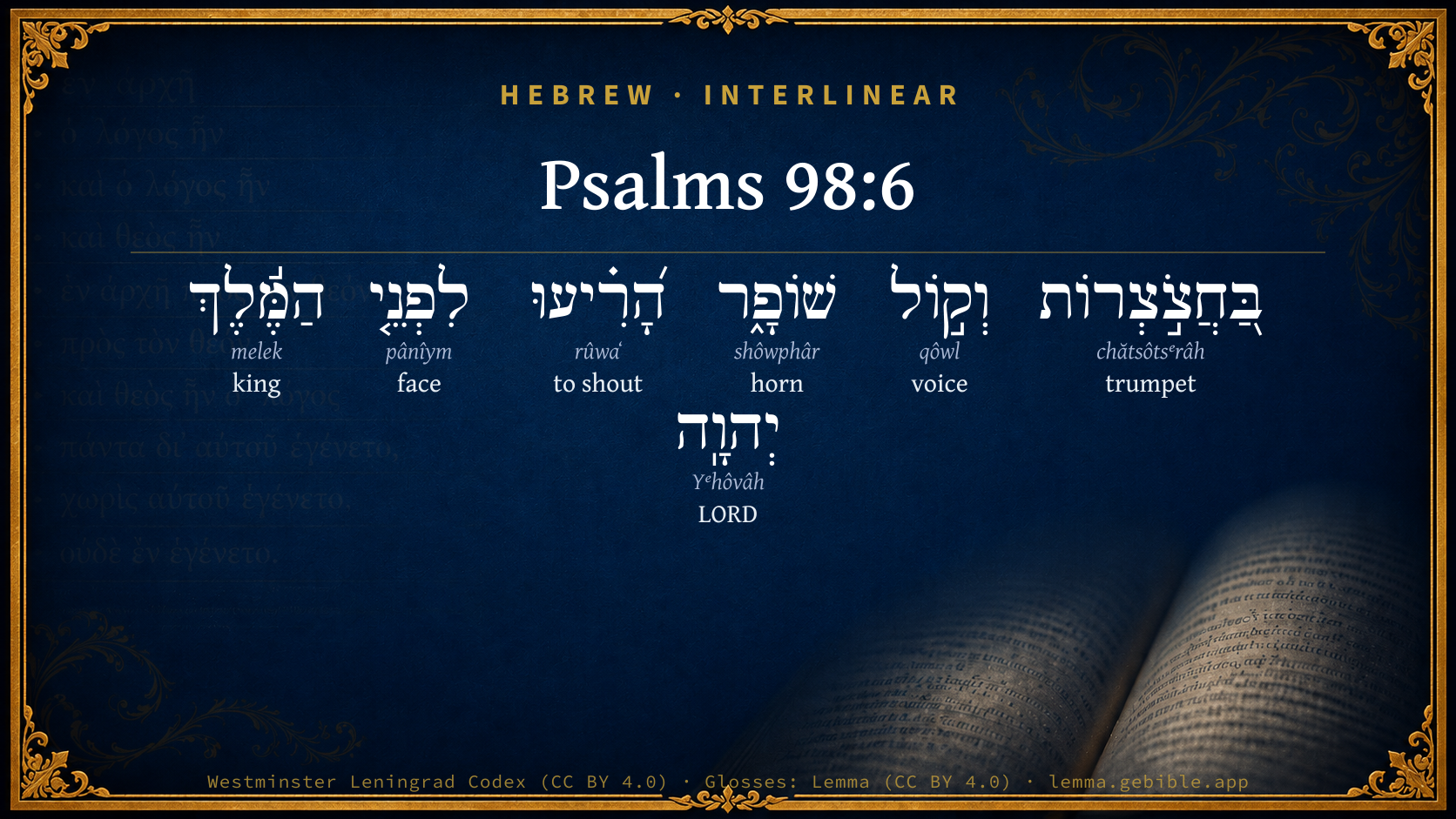
Hebrew (Westminster Leningrad Codex) Psalms 98:6 appears in the Hebrew Old Testament. The text above is from the Westminster Leningrad Codex. Each word links to its Strong’s number, a concise gloss, and parsing drawn from the Open Scriptures Hebrew Bible morphology. Click any word for its full Brown-Driver-Briggs (BDB) entry.
Download image
Cite this verse

Psalms 98:6 (World English Bible). Public Domain. Lemma interlinear Bible study tool, https://lemma.gebible.app/v/psalms/98/6.

Show BibTeX & RIS
BibTeX
RIS
English Translation
With trumpets and sound of the ram's horn, Make a joyful noise before the King, Yahweh.
World English Bible · Public Domain
Download a study sheet

One document with this verse’s original text, its word-by-word gloss line, the meaning frame, cross-references with their text, attributed commentary, and full source and license credits — printable, and it pastes into notes with its structure intact.

This verse Autodidact and up

Study sheet (.html) Plain text (.txt)

A passage Seminary Student

Up to 50 verses in one chapter. A passage sheet keeps up to 6 commentary sources and 12 cross-references per verse, in the order this page ranks them, and says so on the sheet whenever that leaves anything out. Ask for a single verse and you get the Autodidact verse sheet above.

Everything on this page stays free to read, with no account — the sheet is a download of what is already on screen, not access to it.

Want to remove ads? Support Godless Engineer
Compare translations 3

The same verse in 3 English versions, stacked beneath the original-language interlinear above. Click any original word for its lexicon entry.

Each is an independent rendering of the whole verse — the interlinear is not word-aligned to these translations.

Highlighted words mark where these versions differ — a whole-verse word diff, not a word-by-word alignment.

  • World English Bible Public Domain
    With trumpets and sound of the ram's horn, Make a joyful noise before the King, Yahweh.
  • King James Version Public Domain
    With trumpets and sound of cornet make a joyful noise before the LORD, the King.
  • unfoldingWord Literal Text CC BY-SA 4.0
    With trumpets and the sound of the shofar, shout to the face of the King, Yahweh!

unfoldingWord Literal Text — © unfoldingWord, licensed CC BY-SA 4.0. Word-aligned USFM3 via Door43 (git.door43.org/unfoldingWord/en_ult).

Versions to compare (up to 4)

3 of 4 selected

Show all 18 translations

Every available English version of this verse, each an independent rendering of the whole verse.

  • World English Bible Public Domain
    With trumpets and sound of the ram's horn, Make a joyful noise before the King, Yahweh.
  • Berean Standard Bible Public Domain
    With trumpets and the blast of the ram’s horn shout for joy before the LORD, the King.
  • Majority Standard Bible Public Domain
    With trumpets and the blast of the ram’s horn shout for joy before the LORD, the King.
  • King James Version Public Domain
    With trumpets and sound of cornet make a joyful noise before the LORD, the King.
  • American Standard Version (1901) Public Domain
    With trumpets and sound of cornet Make a joyful noise before the King, Jehovah.
  • Revised Version (1885) Public Domain
    With trumpets and sound of cornet make a joyful noise before the King, the LORD.
  • Geneva Bible (1599) Public Domain
    With shalmes and sound of trumpets sing loude before the Lord the King.
  • Douay-Rheims (1899) Public Domain
    with long trumpets, and sound of comet. Make a joyful noise before the Lord our king:
  • Young's Literal Translation Public Domain
    With trumpets, and voice of a cornet, Shout ye before the king Jehovah.
  • Literal Standard Version CC BY-SA 4.0
    With trumpets, and voice of a horn, shout before the King, YHWH.
  • Unlocked Literal Bible CC BY-SA 4.0
    With trumpets and the sound of the horn, make a joyful noise before the King, Yahweh.
  • unfoldingWord Literal Text CC BY-SA 4.0
    With trumpets and the sound of the shofar, shout to the face of the King, Yahweh!
  • Darby Bible Public Domain
    With trumpets and sound of cornet, make a joyful noise before the King, Jehovah.
  • World Messianic Bible Public Domain
    With shofars and sound of the ram’s horn, make a joyful noise before the King, the LORD.
  • Webster's Bible Public Domain
    With trumpets and sound of cornet make a joyful noise before the LORD, the King.
  • Free Bible Version CC BY-SA 4.0
    with trumpets and the sound of the ram's horn sing in happiness before the Lord, the King.
  • Bible in Basic English Public Domain
    With wind instruments and the sound of the horn, make a glad cry before the Lord, the King.
  • JPS Tanakh (1917) Public Domain
    With trumpets and sound of the horn shout ye before the King, the LORD.

Literal Standard Version (2020), Covenant Press — licensed CC BY-SA 4.0. Text via the HelloAO Bible API (eBible.org). Unlocked Literal Bible (unfoldingWord) — licensed CC BY-SA 4.0. Text via the HelloAO Bible API (eBible.org). unfoldingWord Literal Text — © unfoldingWord, licensed CC BY-SA 4.0. Word-aligned USFM3 via Door43 (git.door43.org/unfoldingWord/en_ult). Free Bible Version, Dr. Jonathan Gallagher — licensed CC BY-SA 4.0. Text via the HelloAO Bible API (eBible.org).

Word by word

More ways to search: Search by grammar → Find every occurrence → Compare this word →

Practice this passage: Drill this verse → Learn its vocabulary →

About this verse

These counts appear in no published source. They are computed here, from the morphology-tagged text and Lemma’s own curated glosses. What Lemma adds →

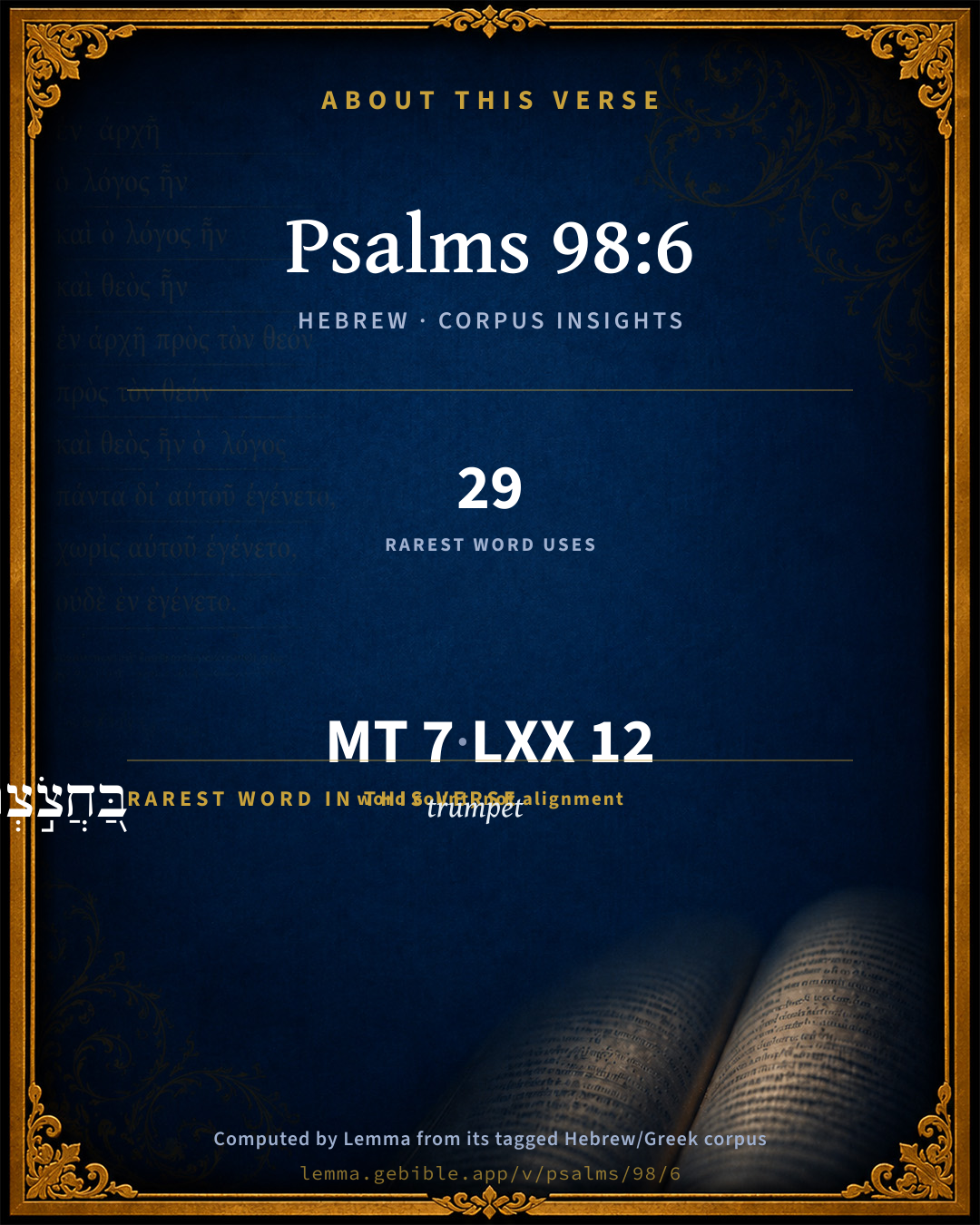
7
words
7
distinct lemmas
Wisdom
section

Shared distinctive vocabulary

בַּ֭חֲצֹ֣צְרוֹת trumpet H2689 occurs in 27 verses of the Hebrew Bible. Also found in:

Grammatical profile

  • 1 verb
  • 6 nouns

Verb forms

  • הָ֝רִ֗יעוּ Hiphil · Imperative

Hebrew & Septuagint length

In English translation the verse runs 16 words from the Hebrew and 22 from the Septuagint (LXX English) — closely comparable.

A rough comparison of the two English renderings, which tokenize alike — not a word-level alignment.

Word counts can differ between the Hebrew and the Greek without any difference in meaning — e.g. the Hebrew direct-object marker אֵת has no separate Greek word, and Greek often adds the article ὁ.

In the original languages it is 7 Hebrew tokens and 12 Greek tokens — but the two are counted differently (Hebrew bundles its prefixes and suffixes into one token; the Greek is in lemma form), so that isn’t a like-for-like length.

Cross-references

9

Topical passages linked to Psalms 98:6 in the Treasury of Scripture Knowledge — connected by theme and wording, ordered by reader-vote popularity; previews shown in the World English Bible.

  • Psalms 81:2–4 Raise a song, and bring here the tambourine, The pleasant lyre with the harp.
  • Revelation 19:16 He has on his garment and on his thigh a name written, "KING OF KINGS, AND LORD OF LORDS."
  • 2 Chronicles 15:14 They swore to Yahweh with a loud voice, and with shouting, and with trumpets, and with cornets.
  • 2 Chronicles 29:27 Hezekiah commanded to offer the burnt offering on the altar. When the burnt offering began, the song of Yahweh began also, and the trumpets, together with the instruments of David king of Israel.
  • Numbers 10:1–10 Yahweh spoke to Moses, saying,
  • 1 Chronicles 15:28 Thus all Israel brought up the ark of the covenant of Yahweh with shouting, and with sound of the cornet, and with trumpets, and with cymbals, sounding aloud with psalteries and harps.
  • 2 Chronicles 5:12–13 also the Levites who were the singers, all of them, even Asaph, Heman, Jeduthun, and their sons and their brothers, arrayed in fine linen, with cymbals and psalteries and harps, stood at the east end of the altar, and with them one hundred twenty priests sounding with trumpets;)
  • Psalms 47:5–7 God has gone up with a shout, Yahweh with the sound of a trumpet.
  • Matthew 25:34 Then the King will tell those on his right hand, 'Come, blessed of my Father, inherit the Kingdom prepared for you from the foundation of the world;

Cross-references courtesy of OpenBible.info (CC BY 4.0).

Hebrew and Greek witnesses Masoretic Hebrew ↔ Greek Septuagint

The same verse in the two great witnesses to the Old Testament, shown verse-for-verse.

You’re reading Greek Psalm 97 (Hebrew Psalm 98). The Septuagint counts the superscription, so verse numbers can differ from the Hebrew — chapter-level alignment, not verse-by-verse. Numbering follows Rahlfs.

These are two independent witnesses, not word-aligned to each other, and the Septuagint is shown in lemma (dictionary) form.

Hebrew Psalms 98:6 Masoretic · Westminster Leningrad Codex

בַּ֭חֲצֹ֣צְרוֹת וְק֣וֹל שׁוֹפָ֑ר הָ֝רִ֗יעוּ לִפְנֵ֤י הַמֶּ֬לֶךְ יְהוָֽה

With trumpets and sound of the ram's horn, Make a joyful noise before the King, Yahweh.

World English Bible · Public Domain

Greek LXX Greek Psalm 97:6 Septuagint · lemma form

ἐν σάλπιγξ ἐλάτη καί φωνή σάλπιγξ κερατίνη ἀλαλάζω ἐνώπιον ὁ βασιλεύς κύριος

With trumpets of metal, and the sound of a trumpet of horn make a joyful noise to the Lord before the king.

LXX2012 (modern English Septuagint) · Public Domain

On this verse, John Gill's Exposition discusses the Septuagint’s reading. Read the note in Commentary ↓

Hebrew: Westminster Leningrad Codex (CC BY 4.0). Greek: Septuagint (public domain); English from LXX2012 (modern English Septuagint) (Public Domain). How the Septuagint differs from the Hebrew →

Commentary

Notes on Psalms 98:6 from classic Christian and Jewish commentators (each source and its license shown beneath its notes). The classic Christian expositions comment on the surrounding passage and are grouped to its opening verse, so a note may address several verses; the Jewish commentaries on the Tanakh (Rashi and others) are per-verse, so they appear only where the commentator wrote on this verse.

Lemma curates 59 commentaries, every one of them public domain or Creative Commons licensed, each selected and text-cleaned for this edition rather than reprinted as found. About our sources →

Trapp's Complete Commentary

John Trapp

Psa 98:6 With trumpets and sound of cornet make a joyful noise before the LORD, the King.

Ver. 6. Make a joyful noise] By the repeating and inculcating of this exhortation is intimated our dulness and backwardness to a business of this nature; the necessity of the duty, and excellency of the mercy that can never be sufficiently celebrated.

John Trapp, A Commentary or Exposition upon All the Books of the Old and New Testament (1647–1656) — public domain. Text from a community e-Sword module.

J. A. Alexander on Psalms

Joseph Addison Alexander

6. (Psa 98:6) With trumpets and sound of cornet, shout before the King, Jehovah! The first noun is supposed to denote the long straight trumpet, the other the cornet or curved horn of ancient music. These are named as the accompaniments of the act described in the other clause, where the verb may therefore have the sense of shouting, which it has most generally in these psalms. The act described is the joyful acclamation at the accession or public recognition of a sovereign. King Jehovah is a combination found in Isa 6:5. Compare Psa 95:3; Psa 96:10; Psa 97:1. The whole is equivalent to saying, hail him who has now become your king

Joseph Addison Alexander, The Psalms Translated and Explained (1850) — public domain. Text from a community e-Sword module.

Tyndale Open Study Notes

Tyndale Open Resources

98:6 The Temple musicians used trumpets to call people together for meetings (cp. 81:3).

Tyndale Open Study Notes — © Tyndale Open Resources, licensed CC BY-SA 4.0. Text via the HelloAO Bible API.

Geneva Bible (1599)

Geneva Bible translators

By this repetition and earnest exhortation to give praises with instruments, and also of the dumb creatures, he signifieth that the world is never able to praise God sufficiently for their deliverance.

Geneva Bible (1599) marginal notes — public domain. Text via Bolls.life.

Adam Clarke's Commentary

Verse 6. With trumpets] חצצרות chatsotseroth. Some kind of tubular instruments, of the form and management of which we know nothing.

And sound of cornet] שופר shophar, the word commonly used for what we call trumpet.

Adam Clarke's Commentary on the Bible (1810–1826) — public domain. Text from a community e-Sword/MySword module.

Ellicott's Commentary for English Readers

(6) Trumpets . . . cornet.—(See Num_10:2; Exo_19:16; and Bible Educator, ii. 231, 232.) This is the only place in the psalm where the chatsotsereh, or “straight trumpet” is mentioned.

A Bible Commentary for English Readers, edited by Charles John Ellicott (1878–1897) — public domain. Text from a community e-Sword module.

The Cambridge Bible for Schools and Colleges

gen. ed. J. J. S. Perowne

6. The ‘trumpet’ was a straight metal tube, like the sacred trumpets represented on the arch of Titus: the ‘cornet’ was originally a ram’s horn, perhaps in later times a metal instrument of the same shape. See the illustrations in Driver’s Joel and Amos in this Series, p. 144.

The Cambridge Bible for Schools and Colleges (gen. ed. J. J. S. Perowne; Cambridge University Press, 1878–1918) — public domain. Text from a community e-Sword module.

John Gill's Exposition

With trumpet and sound of cornet,.... The Septuagint, Vulgate Latin, and Ethiopic versions, render it

with ductile trumpets, such as were made of silver, as the two trumpets for the calling of the assembly, Num 10:2 to which the allusion seems to be here, called "asosra" by Josephus (c) according to the Hebrew language which he says were in length a little less than a cubit, but the pipe narrow, somewhat thicker than a flute, having a sufficient breadth at the mouth to blow with, ending after the manner of a bell. The cornet was a trumpet or pipe, made of horn, from whence it has its name; such were those, made of rams' horns, the priests blew with when they encompassed Jericho, Jos 6:4,

make a joyful noise before the Lord, the King; or rather "before the King, the Lord" (d); before the King, who is Jehovah, who is the King of kings, and Lord of lords; let this shout be made before him, in his presence, and on account of his kingly office, and because of some eminent appearance of his kingdom and glory; see Rev 19:6.

(c) Antique. Jud. l. 3. c. 12. sect. 6. (d) "coram rege Domino", Pagninus, Tigurine version; so Junius & Tremellius, Piscator, Cocceius.

John Gill's Exposition of the Whole Bible (1746–1763) — public domain (CC PDM 1.0). Text via the HelloAO Bible API.

Albert Barnes' Notes on the Bible

With trumpets - The word used here is uniformly rendered “trumpets” in the Scriptures. Num 10:2, Num 10:8-10; Num 31:6; et al. The trumpet was mainly employed for convening a public assembly for worship, or for assembling the hosts for battle. The original word - חצצרה chătsôtserâh - is supposed to have been designed to imitate “the broken pulse-like sound of the trumpet, like the Latin “taratantara.” So the German “trarara,” and the Arabic hadadera. The word used here was given to the long, straight trumpet.

And sound of cornet ... - The word here translated “cornet” is also usually rendered “trumpet,” Exo 19:16, Exo 19:19; Exo 20:18; Lev 25:9; Jos 6:4-6, Jos 6:8-9, Jos 6:13, Jos 6:16, Jos 6:20; et saepe. It is rendered “cornet” in 1Ch 15:28; 2Ch 15:14; Hos 5:8. In the Septuagint and the Latin Vulgate it is here rendered “horn” - the meaning of “cornet.” The name - שׁפר shôphār - is supposed to have been given to this instrument from its clear and shrill sound, like the English name “clarion.” It was either made of horn, or similar to a horn - an instrument curved like a horn. The instrument was in frequent use among the Hebrews.

Albert Barnes' Notes on the Bible (1834–1885) — public domain. Text from a community e-Sword/MySword module.

The Treasury of David

Charles H. Spurgeon

Ver. 6. With trumpets and sound of cornet make a joyful noise. God's worship should be heartily loud. The far resounding trump and horn well symbolise the power which should be put forth in praise.

Before the LORD, the King. On coronation days, and when beloved monarchs ride abroad, the people shout and the trumpets sound till the walls ring again. Shall men be more enthusiastic for their earthly princes than for the divine King? Is there no loyalty left among the subjects of the blessed and only Potentate? King Jehovah is his name; and there is none like it, have we no joyful noise for him? Let but the reigning power of Jesus be felt in the soul and we shall cast aside that chill mutter, drowned by the pealing organ, which is now so commonly the substitute for earnest congregational singing.

Say, if your hearts are tuned to sing,

Is there a subject greater?

Harmony all its strains may bring,

But Jesus' name is sweeter.

Who of his love doth once partake,

He evermore rejoices;

Melody in our hearts we make,

Melody with our voices.

Ver. 6. Trumpets. tlruux, Chatsotseroth:here only in the Psalter. These were the straight trumpets (such as are seen on the Arch of Titus) used by the priests for giving signals. Nu 10:2-10; 1Ch 15:24, 28, etc. The shofar, rmwv (cornet), was the ordinary curved trumpet, cornet, or horn. William Kay.

Ver. 6. Trumpets. The word here used is uniformly rendered trumpets in the Scriptures, Nu 10:2, 8-10 31:6; et al. The trumpet was mainly employed for convening a public assembly for worship, or for assembling the hosts for battle. The original word, xruux chatsotserah, is supposed to have been designed to imitate "the broken pulse like sound of the trumpet, like the Latin, taratantara." So the German trarara, and the Arabic, hadadera. The word here used was given to the long, straight trumpet. Albert Barnes.

Ver. 6. Trumpets. The trumpet served the same purpose, in a religious and civil sense, as bells among Christians, and the voice among Mohammedans. Indeed, it is understood that Mohammed directed the voice to be employed, in order to mark a distinction between his own sect and the Jews with their trumpets and the Christians with their bells. Kitto's Pictorial Bible.

Ver. 6. With trumpets. Origen calls the writings of the evangelists and the apostles trumpets, at whose blast all the structures of idolatry and the dogmas of the philosophers were utterly overthrown. He teaches likewise that by the sound of the trumpets is prefigured the trumpet of the universal judgment, at which the world shall fall in ruin, and whose sound shall be joy to the just, and lamentation to the unjust. Lorinus.

Ver. 6. Before the Lord, the King. Since it is distinctly added before Jehovah the King, and the words, with trumpets and sound of cornet make a joyful noise, are used, there seems to be a reference to that public rejoicing commonly manifested at the coronation of kings, or the celebration of undertakings for the public safety. This idea is not foreign to the present passage, since Jehovah is represented as King and Saviour of the people. Venema.

Ver. 6. Joy a needful ingredient of praise. The Lord as King, an essential idea in adoration. Expression in various ways incumbent upon us, when praising joyfully such a King.

Psalms 98:7*

Charles H. Spurgeon's The Treasury of David (1869–1885) — public domain. Psalms only. Text from a community e-Sword/MySword module.

Whedon's Commentary on the Bible

Daniel D. Whedon

6. Trumpets and… cornet—For “cornet” see note on Psa_81:3. “Trumpets,” here, are the “silver trumpets” which Moses was commanded to make, to be used only by the priests for signals of war, the beginnings of months, festivals, and sacrifices. Num_10:1-10; Num_31:6. At first they were only two, but increased to twenty in the time of Solomon, and employed in the orchestra. 2Ch_5:12

Daniel D. Whedon (gen. ed.), Commentary on the Old and New Testaments (1874–1909) — public domain. Text from a community e-Sword module.

The Pulpit Commentary

With trumpet and sound of cornet; rather, with clarions and voice of trumpet. The chatsotseroth are "the straight trumpets, such as are seen on the Arch of Titus, used by the priests for giving signals" (Kay). The shophar is the ordinary curved or rounded trumpet or horn. Make a joyful noise before the Lord, the King; literally, before the King, Jehovah. (On the use of wind instruments in the temple service, see 1Ch_15:24, 28 2Ch_5:12 Ezr_3:10)

The Pulpit Commentary (1880–1919), ed. H.D.M. Spence-Jones & Joseph S. Exell — public domain. Text from a community e-Sword module.

Lesson kit

Teaching starters — assembled from the data on this page, not authored interpretation. Every prompt links to the verse data it draws on. Edit before teaching.

Psalms, in the Wisdom, opens this verse with 7 words (7 distinct Hebrew lemmas). Its most distinctive word is chătsôtsᵉrâh (“trumpet”). A historical commentator’s framing appears above. Read the whole chapter for the surrounding context.

Discussion questions

  1. How does “trumpet” (chătsôtsᵉrâh) shape what this verse is saying?
  2. How does Numbers 10:2, which shares the word «trumpet», read alongside this verse?
  3. These translations render this verse differently; the difference is in the English rendering, not the original. What questions does that raise?
  4. «הָ֝רִ֗יעוּ» is a Hiphil Imperative verb. How does that grammatical form shape the action described?
  5. Compare how Trapp's Complete Commentary and J. A. Alexander on Psalms read this verse. Where do they agree or differ?

Things to notice

Reading settings

Reading text

Shown beneath each verse's original-language words.

Old Testament
Old Testament edition

Read the OT as the Masoretic Hebrew (MT) or the Greek Septuagint (LXX).

English shown for the Greek Septuagint (in the Hebrew ↔ Greek comparison).

Comparing translations? Open the Compare panel on any verse page to stack up to four side by side.