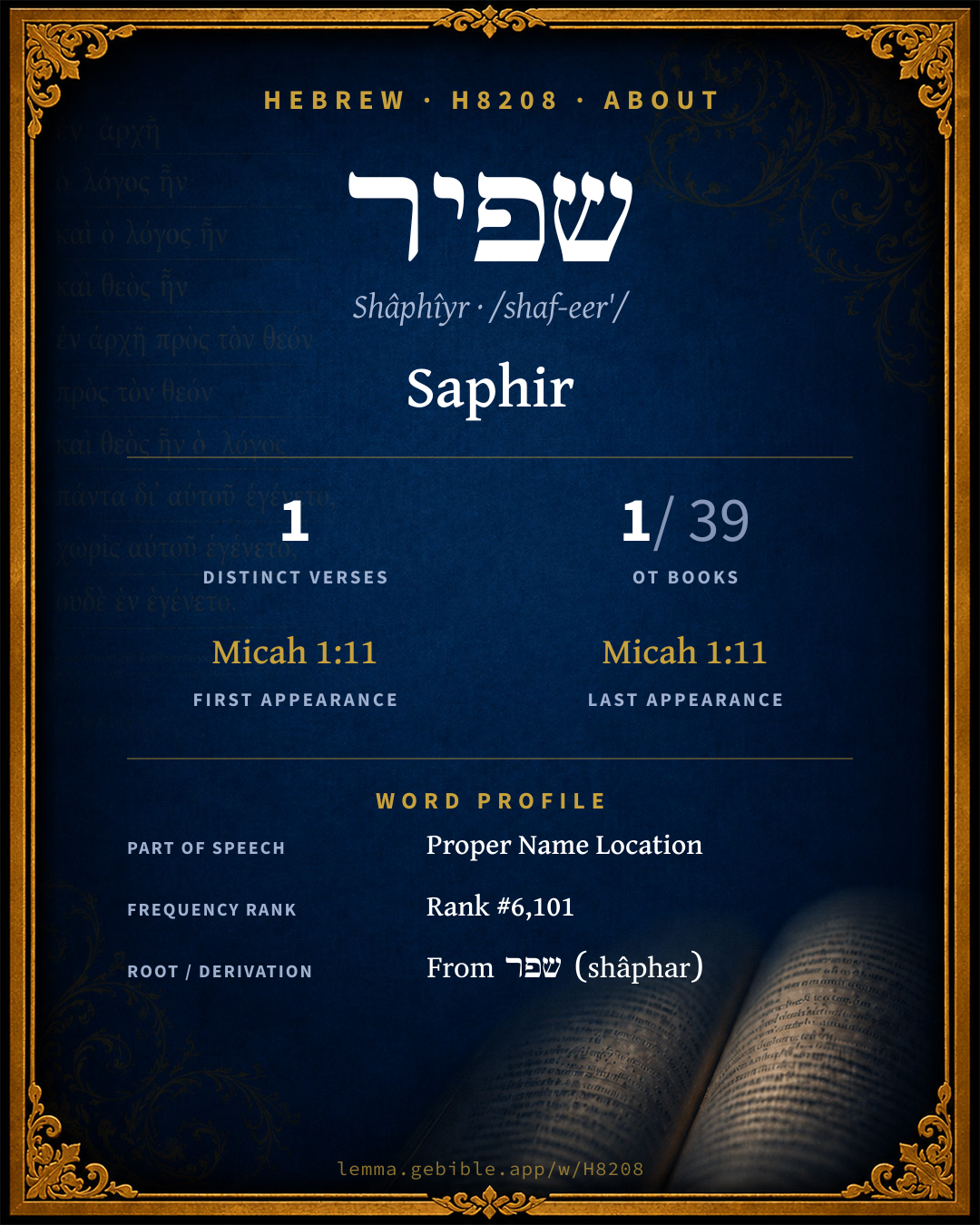
שָׁפִיר
Saphir
BDB lists 2 entries for ‘Saphir’ fuller range ↓
Full lexicon entry — Brown-Driver-Briggs (BDB)
From Brown-Driver-Briggs (BDB)
Where this word appears
Grammar key — what these labels mean
Part of speech
- Noun
- A naming word — a person, place, thing, or idea.
Noun type
- Proper
- A name of a specific person, place, or people (e.g. Abraham, Zion, Israel).
Every verse where H8208 appears — 1 distinct verse across 1 book. Click any verse to open its interlinear word-by-word view. Verse text shown in the World English Bible for context — . Each verse’s Hebrew form is shown with its reference; the English is not keyword-highlighted, since the data carries no word-level English alignment. Use “Compare translations” on any verse to read it across multiple English versions. This concordance covers the Hebrew Bible; Septuagint (Greek Old Testament) occurrences are not indexed here.
Micah 1 verse
About this entry
At a glance — auto-summarized from this page’s data, not written by a person. Every figure links to its source below. This summary describes the numbers; it doesn’t interpret them.
שפיר — transliterated Shâphîyr — is a Hebrew name carrying the sense “Saphir.” A scarce word — 1 verse in all of the Hebrew Bible. More than three-quarters of its appearances fall in Micah. Its lone occurrence is Micah 1:11. Each statement above links to its evidence; the full detail follows below.
Gloss history
Strong's 1890 vs modern scholarship
About this word
Strong's H8208 catalogs a Hebrew word from the Hebrew Old Testament.
These counts are not copied from any lexicon or concordance. They are computed here, from the morphology-tagged Hebrew Old Testament. What Lemma adds →
- 1
- distinct verses
- The word appears in 1 distinct verse.
- 1 / 39
- OT books
- The word appears in 1 of 39 Old Testament books.
- #6,101
- by frequency
- Rank #6,101 (rank 6,101 of 8,640 Hebrew words by occurrence).
View all 1 occurrence in the concordance →
Most concentrated in
- Micah 1 verse 100%
By section of the Old Testament
By traditional corpus
Conventional, traditional groupings — biblical authorship is debated, so this is a traditional corpus grouping, not an authorship claim. Each share is this word’s portion of its verses in that division of the Hebrew canon. Each figure is a share of the word’s 1 distinct verse.
- Prophets (Nevi'im) 1 verse · 100%
How translations render this word
Counts come from each version’s own published word-to-Strong’s tagging or interlinear alignment — an approximate guide to how each version renders this word, not a word-level alignment the data otherwise carries. Because each total is that version’s own tagged count, the per-version totals vary from one another and need not match the appearance or distinct-verse counts above. These counts may also differ from a printed concordance because Lemma counts each distinctly tagged rendering and does not collapse phrase taggings into a single head-word total. This is a fixed set of word-tagged versions (KJV, ASV, BSB, ULT) and does not change with the reading translation you choose elsewhere. Each version’s license is shown beside its name below (and on Sources).
- King James Version: Saphir 1×
- American Standard Version: Shaphir 1×
- Berean Standard Bible: Shaphir 1×
- unfoldingWord Literal Text: Shaphir 1×
King James Version Public Domain
Renders H8208 across 1 tagged occurrence — most commonly:
American Standard Version Public Domain
Renders H8208 across 1 tagged occurrence — most commonly:
Berean Standard Bible Public Domain
Renders H8208 across 1 tagged occurrence — most commonly:
unfoldingWord Literal Text CC BY-SA 4.0
Renders H8208 across 1 tagged occurrence — most commonly:
Senses in BDB
The 2 senses BDB distinguishes for this word, in lexicon order (not ranked by frequency or importance). The full entry — with sub-senses — is in the Lexicon Entry tab.
- Saphir = "fair"
- a place in Judah; site unknown
Word origin
n.pr.loc. in Philist. plain, Mi 1:11 (= שָׁמִיר Jos 15:48?); 𝔊 καλῶς (!).
— Brown-Driver-Briggs (Oxford 1906, public domain), digitized via Sefaria, supplemented by the OpenScriptures HebrewLexicon (CC BY 4.0). See Sources.
Derived from שפר (shâphar) (H8231) — to be beautiful.
Jastrow Dictionary
A second Hebrew/Aramaic lexicon for comparison, covering Aramaic and post-biblical (Talmudic, Targumic, Midrashic) usage that the biblical-Hebrew BDB does not. Matched by lemma rather than by Strong’s number, so a lemma may carry more than one Jastrow headword (shown separately below), and the entries cover usage well beyond the Bible.
שַׁפִּיר
- (שְׁפַר)
- 1. handsome, pleasing; good; cheerful. Targ. I Sam. XVI, 12. Targ. O. Gen. XLVII, 6, (v. שֶׁפֶר ch.); a. fr.—Midr. Till. to Ps. XVI, 6 (in Hebr. dict.) על … נעשה לי ש׳ because I was content with my portion, it became beautiful to me; Yalk. ib. 667 (corr. acc.).—Kidd. 31ᵇ בעינא גברא דש׳ כותך I want a man as handsome as thou art; a. fr.—Pl. שַׁפִּירִין, שַׁפִּירַיָּא, שַׁפִּירֵי. Targ. Deut. VIII, 12. Targ. II Chr. VII, 10; a. fr.—B. Mets. 84ᵃ אנא … מש׳ ירושלם I am one of the survivors of the handsome men of Jerusalem. Ib. בני ש׳ כוותי children as good-looking as I am; a. fr.—Fem. שׁפִּירָא, שַׁפִּירְתָּא, שַׁפִּרְ׳. Targ. Gen. XII, 14. Ib. 11. Targ. O. Num. XII, 1; a. fr.—B. Mets. l. c. דש׳ מינאי who is handsomer than I am; a. e.—Pl. שַׁפִּירָן, שַׁפִּירָתָא. Targ. Gen. VI, 2. Targ. Y. ib. 1. Targ. Job XLII, 15; a. e.
- 2. (adv.) right, well. B. Mets. l. c. אטו … דש׳ קאמינא do I not know that what I say is right? Yoma 29ᵇ מאן קא מותיב ש׳ קא מותיב he who asked that question has asked well. Yeb. 94ᵇ והאי ש׳ נסיב and he married rightly (legally); והא ש׳ נסיב and he married this one lawfully; a. fr.—ש׳ דמי, v. דְּמֵי I.
שְׁפִיר
- (שפר; cmp. שׁוֹפָר 2, a. שְׁפוֹפֶרֶת) membraneous bag, sac of a fœtus; in gen. fœtus. Nidd. III, 3 המפלת ש׳ מלא וכ׳ if a woman discharges a sac full of water &c. Lev. R. s. 14; Y. Nidd. III, 50ᵈ top (ref. to Job XXXVIII, 9) לבושו זה הש׳ וכ׳ ‘its garment’ means the sac, ‘its swaddling band’, the placenta. Ib. ש׳ מרוקם a fœtus having an articulated shape, v. רָשׁוֹן; Bab. Nidd. 25ᵃ ש׳ שאינו מרוקם a shapeless fœtus. Y. Naz. VII, 56ᵇ I have seen עגל כאפון בש׳ the embryo of a calf, of the size of a bean, in a bag; a. fr. e.g. Job 38:9
שְׁפִיר ²
- Targ. Y. Deut. XXVIII, 57.—Nidd. 25ᵇ ההוא ש׳ דאתאי וכ׳ a fœtus was brought before Mar Samuel, and he said, this is forty-one days old; a. e.
A Dictionary of the Targumim, the Talmud Babli and Yerushalmi, and the Midrashic Literature (Marcus Jastrow; London, Luzac, 1903) — Public Domain. Digitized via Sefaria. Digitized via Sefaria. Full attribution on Sources.
Same root — word family
Other BDB entries built from the same root as H8208, grouped by Strong’s listed origin. These share a root / origin per the lexicon — not necessarily a shared meaning. Each links to that word’s own entry.
Derives from
Shares the same root
- שופר shôwphâr H7782 horn
- שפר shᵉphar H8232 to be fair
- שפר shepher H8233 beauty
- שפרה shiphrâh H8235 fairness
- שפרור shaphrûwr H8237 canopy
- שפרפר shᵉpharphar H8238 dawn
Derived from this word
Compare all same-root words → Showing 4 of 9 — not the complete family. They share a root, not necessarily a meaning.
Bible dictionary
Public-domain dictionary articles matched to this entry by name (Saphir). A biblical name can be shared by more than one person or place, so an article may treat several.
Easton's Bible Dictionary · M. G. Easton, 1897
Beautiful, a town of Judah (Micah 1:11), identified with es-Suafir, 5 miles south-east of Ashdod.
Smith's Bible Dictionary · William Smith, 1863
(fair), one of the villages addressed by the prophet Micha, (Micah 1:11) is described by Eusebius and jerome as "in the mountain district between Eleutheropolis and Ascalon," perhaps represented by the village es-Sawafir, seven or eight miles to the northeast of Ascalon.
Hitchcock's Bible Names Dictionary · Roswell D. Hitchcock, 1869
delightful
Classic public-domain reference works; full attribution on Sources.
Septuagint verse parallels
This word appears in 1 verse that also exists in the Greek Old Testament (Septuagint), out of the 1 Hebrew verse it occurs in. You can read those verses in Greek by switching the Old Testament edition to the Septuagint.
Read these verses in the Septuagint
This is a verse-level parallel only — the same verses exist in both the Hebrew and Greek Old Testaments. No word-level Hebrew↔Greek correspondence is claimed: the data carries no such alignment, so no Greek word is shown as this Hebrew word’s translation. Coverage is not total — the Septuagint omits the deuterocanon and renumbers the Psalms, so some Hebrew verses have no direct Greek parallel.