
Jeremiah 6:17

Hebrew (Westminster Leningrad Codex) Jeremiah 6:17 appears in the Hebrew Old Testament. The text above is from the Westminster Leningrad Codex. Each word links to its Strong’s number, a concise gloss, and parsing drawn from the Open Scriptures Hebrew Bible morphology. Click any word for its full Brown-Driver-Briggs (BDB) entry.
Download image
Cite this verse

Jeremiah 6:17 (World English Bible). Public Domain. Lemma interlinear Bible study tool, https://lemma.gebible.app/v/jeremiah/6/17.

Show BibTeX & RIS
BibTeX
RIS
English Translation
I set watchmen over you, [saying], Listen to the sound of the trumpet; but they said, We will not listen.
World English Bible · Public Domain
Download a study sheet

One document with this verse’s original text, its word-by-word gloss line, the meaning frame, cross-references with their text, attributed commentary, and full source and license credits — printable, and it pastes into notes with its structure intact.

This verse Autodidact and up

Study sheet (.html) Plain text (.txt)

A passage Seminary Student

Up to 50 verses in one chapter. A passage sheet keeps up to 6 commentary sources and 12 cross-references per verse, in the order this page ranks them, and says so on the sheet whenever that leaves anything out. Ask for a single verse and you get the Autodidact verse sheet above.

Everything on this page stays free to read, with no account — the sheet is a download of what is already on screen, not access to it.

Want to remove ads? Support Godless Engineer
Compare translations 3

The same verse in 3 English versions, stacked beneath the original-language interlinear above. Click any original word for its lexicon entry.

Each is an independent rendering of the whole verse — the interlinear is not word-aligned to these translations.

Highlighted words mark where these versions differ — a whole-verse word diff, not a word-by-word alignment.

  • World English Bible Public Domain
    I set watchmen over you, [saying], Listen to the sound of the trumpet; but they said, We will not listen.
  • King James Version Public Domain
    Also I set watchmen over you, saying, Hearken to the sound of the trumpet. But they said, We will not hearken.
  • unfoldingWord Literal Text CC BY-SA 4.0
    And I stationed watchmen over you. Pay attention to the sound of the horn! But they said, ‘We shall not pay attention.’

unfoldingWord Literal Text — © unfoldingWord, licensed CC BY-SA 4.0. Word-aligned USFM3 via Door43 (git.door43.org/unfoldingWord/en_ult).

Versions to compare (up to 4)

3 of 4 selected

Show all 18 translations

Every available English version of this verse, each an independent rendering of the whole verse.

  • World English Bible Public Domain
    I set watchmen over you, [saying], Listen to the sound of the trumpet; but they said, We will not listen.
  • Berean Standard Bible Public Domain
    I appointed watchmen over you and said, ‘Listen for the sound of the ram’s horn.’ But they answered, ‘We will not listen!’
  • Majority Standard Bible Public Domain
    I appointed watchmen over you and said, ‘Listen for the sound of the ram’s horn.’ But they answered, ‘We will not listen!’
  • King James Version Public Domain
    Also I set watchmen over you, saying, Hearken to the sound of the trumpet. But they said, We will not hearken.
  • American Standard Version (1901) Public Domain
    And I set watchmen over you, `saying', Hearken to the sound of the trumpet; but they said, We will not hearken.
  • Revised Version (1885) Public Domain
    And I set watchmen over you, saying, Hearken to the sound of the trumpet; but they said, We will not hearken.
  • Geneva Bible (1599) Public Domain
    Also I set watchmen ouer you, which said, Take heede to the sound of the trumpet: but they said, We will not take heede.
  • Douay-Rheims (1899) Public Domain
    And I appointed watchmen over you, saying: Hearken ye to the sound of the trumpet. And they said: We will not hearken.
  • Young's Literal Translation Public Domain
    And I have raised up for you watchmen, Attend ye to the voice of the trumpet. And they say, `We do not attend.'
  • Literal Standard Version CC BY-SA 4.0
    And I have raised up watchmen for you, || Attend to the voice of the horn. And they say, We do not attend.
  • Unlocked Literal Bible CC BY-SA 4.0
    I appointed for you watchmen to listen for the trumpet. But they said, 'We will not listen.'
  • unfoldingWord Literal Text CC BY-SA 4.0
    And I stationed watchmen over you. Pay attention to the sound of the horn! But they said, ‘We shall not pay attention.’
  • Darby Bible Public Domain
    Also I have set watchmen over you: -- Hearken ye to the sound of the trumpet. But they said, We will not hearken.
  • World Messianic Bible Public Domain
    I set watchmen over you, saying, ‘Listen to the sound of the shofar!’ But they said, ‘We will not listen!’
  • Webster's Bible Public Domain
    Also I set watchmen over you, saying, Hearken to the sound of the trumpet. But they said, We will not hearken.
  • Free Bible Version CC BY-SA 4.0
    I put watchmen in charge of you and told you, Make sure you listen for the trumpet call warning you of danger. But you answered, “We won't listen!”
  • Bible in Basic English Public Domain
    And I put watchmen over you, saying, Give attention to the sound of the horn; but they said, We will not give attention.
  • JPS Tanakh (1917) Public Domain
    And I set watchmen over you: 'Attend to the sound of the horn', but they said: 'We will not attend.'

Literal Standard Version (2020), Covenant Press — licensed CC BY-SA 4.0. Text via the HelloAO Bible API (eBible.org). Unlocked Literal Bible (unfoldingWord) — licensed CC BY-SA 4.0. Text via the HelloAO Bible API (eBible.org). unfoldingWord Literal Text — © unfoldingWord, licensed CC BY-SA 4.0. Word-aligned USFM3 via Door43 (git.door43.org/unfoldingWord/en_ult). Free Bible Version, Dr. Jonathan Gallagher — licensed CC BY-SA 4.0. Text via the HelloAO Bible API (eBible.org).

Word by word

More ways to search: Search by grammar → Find every occurrence → Compare this word →

Practice this passage: Drill this verse → Learn its vocabulary →

צֹפִ֔ים
tsâphâh
H6822
“keeping watch”
Verb, Qal, Participle Active, Masculine, Plural, Absolute
Part of Speech
Verb
Stem
Qal
Form
Participle Active
Gender
Masculine
Number
Plural
State
Absolute
Full BDB Definition

Origin: a primitive root

TWOT: 1950

to look out or about, spy, keep watch, observe, watch - (Qal) to keep watch, spy - (Piel) to watch, watch closely
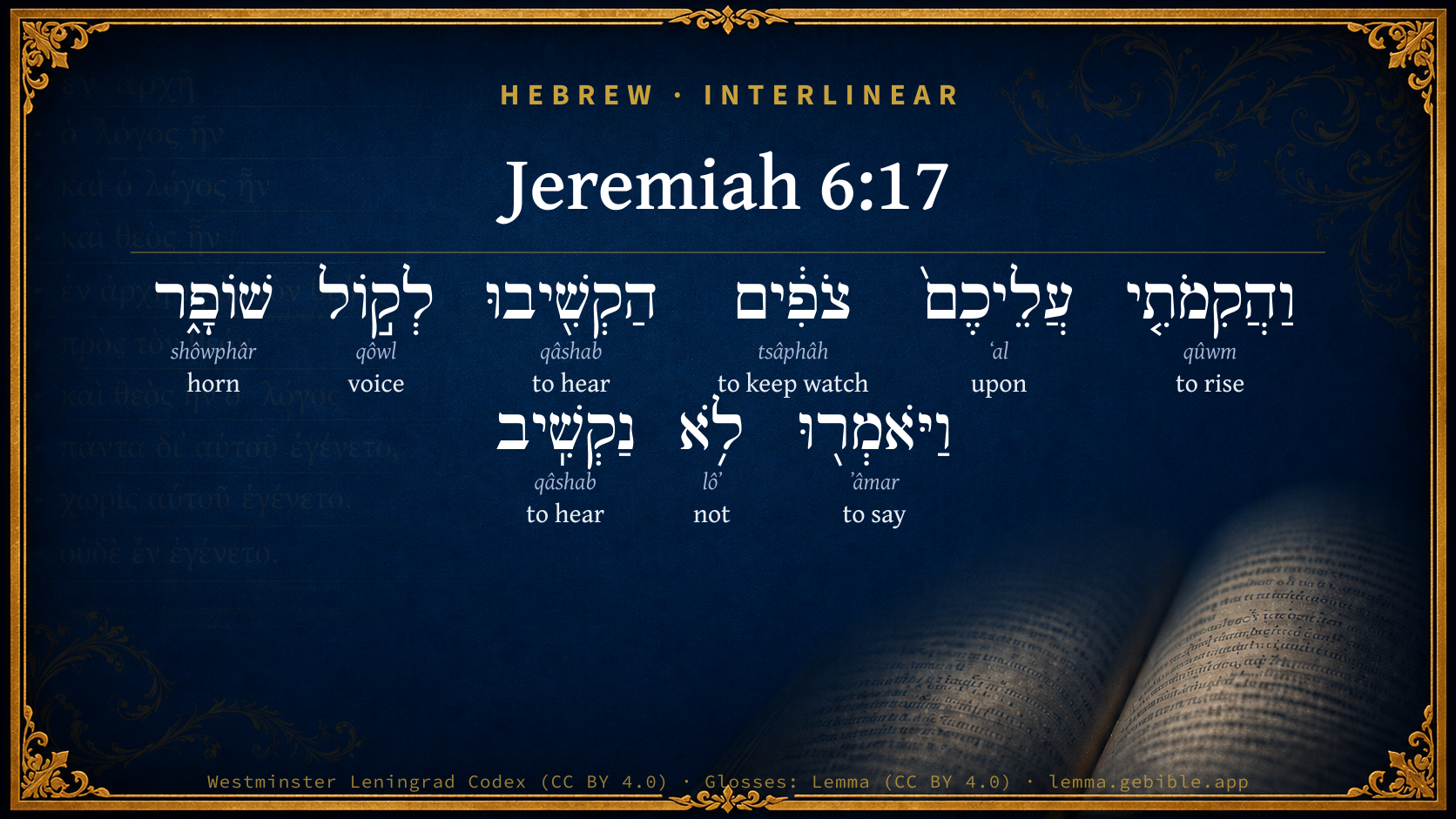
  1. וַהֲקִמֹתִ֤י qûwm H6965 “and · to rise” Conjunction + Verb, Hiphil, Sequential Perfect, 1st Person, Common, Singular
  2. עֲלֵיכֶם֙ ʻal H5921 “upon · you” Preposition + Suffix, Personal, 2nd Person, Masculine, Plural
  3. הַקְשִׁ֖יבוּ qâshab H7181 “hear” Verb, Hiphil, Imperative, 2nd Person, Masculine, Plural
  4. לְק֣וֹל qôwl H6963 “to/for · voice of” Preposition + Noun, Common, Masculine, Singular, Construct
  5. שׁוֹפָ֑ר shôwphâr H7782 “horn” Noun, Common, Masculine, Singular, Absolute
  6. וַיֹּאמְר֖וּ ʼâmar H559 “and · to say” Conjunction + Verb, Qal, Sequential Imperfect, 3rd Person, Masculine, Plural
  7. לֹ֥א lôʼ H3808 “not” Particle, Negative
  8. נַקְשִֽׁיב qâshab H7181 “to hear” Verb, Hiphil, Imperfect, 1st Person, Common, Plural

About this verse

These counts appear in no published source. They are computed here, from the morphology-tagged text and Lemma’s own curated glosses. What Lemma adds →

9
words
8
distinct lemmas
Prophets
section

Shared distinctive vocabulary

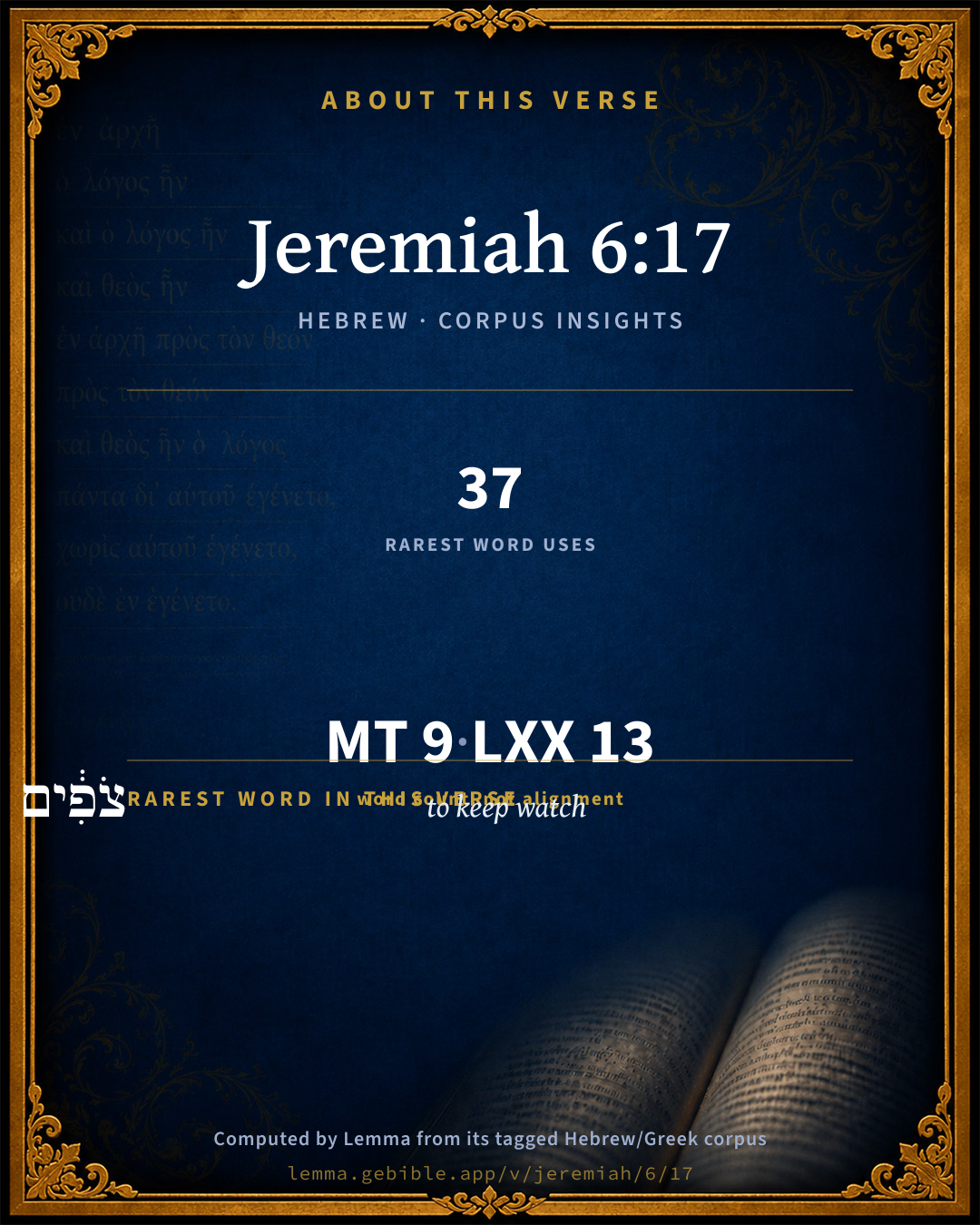
צֹפִ֔ים to keep watch H6822 occurs in 33 verses of the Hebrew Bible. Also found in:

Grammatical profile

  • 5 verbs
  • 2 nouns
  • 1 preposition
  • 1 particle

Verb forms

  • וַהֲקִמֹתִ֤י Hiphil · Sequential Perfect
  • צֹפִ֔ים Qal · Participle Active
  • הַקְשִׁ֖יבוּ Hiphil · Imperative
  • וַיֹּאמְר֖וּ Qal · Sequential Imperfect
  • נַקְשִֽׁיב Hiphil · Imperfect

Repetition

A word recurs within this verse — often emphatic in Hebrew:

  • הַקְשִׁ֖יבוּ to hear H7181 ×2

Hebrew & Septuagint length

In the original languages it is 9 Hebrew tokens and 13 Greek tokens — but the two are counted differently (Hebrew bundles its prefixes and suffixes into one token; the Greek is in lemma form), so that isn’t a like-for-like length.

Cross-references

12

Topical passages linked to Jeremiah 6:17 in the Treasury of Scripture Knowledge — connected by theme and wording, ordered by reader-vote popularity; previews shown in the World English Bible.

  • Jeremiah 25:4 Yahweh has sent to you all his servants the prophets, rising up early and sending them, (but you have not listened, nor inclined your ear to hear),
  • Isaiah 58:1 Cry aloud, don't spare, lift up your voice like a trumpet, and declare to my people their disobedience, and to the house of Jacob their sins.
  • Isaiah 21:11 The burden of Dumah. One calls to me out of Seir, Watchman, what of the night? Watchman, what of the night?
  • Zechariah 7:11 But they refused to listen, and turned their backs, and stopped their ears, that they might not hear.
  • Isaiah 56:10 His watchmen are blind, they are all without knowledge; they are all mute dogs, they can't bark; dreaming, lying down, loving to slumber.
  • Habakkuk 2:1 I will stand at my watch, and set myself on the ramparts, and will look out to see what he will say to me, and what I will answer concerning my complaint.
  • Ezekiel 3:17–21 Son of man, I have made you a watchman to the house of Israel: therefore hear the word at my mouth, and give them warning from me.
  • Ezekiel 33:2–9 Son of man, speak to the children of your people, and tell them, When I bring the sword on a land, and the people of the land take a man from among them, and set him for their watchman;
  • Hosea 8:1 "Put the trumpet to your lips! Something like an eagle is over Yahweh's house, Because they have broken my covenant, And rebelled against my law.
  • Amos 3:6–8 Does the trumpet alarm sound in a city, Without the people being afraid? Does evil happen to a city, And Yahweh hasn't done it?
  • Acts 20:27–31 for I didn't shrink from declaring to you the whole counsel of God.
  • Hebrews 13:17 Obey your leaders and submit to them, for they watch on behalf of your souls, as those who will give account, that they may do this with joy, and not with groaning, for that would be unprofitable for you.

Cross-references courtesy of OpenBible.info (CC BY 4.0).

Hebrew and Greek witnesses Masoretic Hebrew ↔ Greek Septuagint

The same verse in the two great witnesses to the Old Testament, shown verse-for-verse.

These are two independent witnesses, not word-aligned to each other, and the Septuagint is shown in lemma (dictionary) form.

Hebrew Jeremiah 6:17 Masoretic · Westminster Leningrad Codex

וַהֲקִמֹתִ֤י עֲלֵיכֶם֙ צֹפִ֔ים הַקְשִׁ֖יבוּ לְק֣וֹל שׁוֹפָ֑ר וַיֹּאמְר֖וּ לֹ֥א נַקְשִֽׁיב

I set watchmen over you, [saying], Listen to the sound of the trumpet; but they said, We will not listen.

World English Bible · Public Domain

Greek LXX Structure differs

In the Septuagint, Jeremiah is about an eighth shorter than the Hebrew and arranges its material differently — the Oracles Against the Nations (Hebrew chapters 46–51) appear in the middle of the Greek book, after 25:13. Because the chapter and verse boundaries do not line up, a verse-for-verse comparison with the Hebrew is not shown.

A verse-for-verse comparison isn’t shown here because the chapters and verses don’t line up. Switch to the LXX edition with the MT / LXX toggle above to read the Greek directly.

Hebrew: Westminster Leningrad Codex (CC BY 4.0). Greek: Septuagint (public domain); English from a public-domain English Septuagint. How the Septuagint differs from the Hebrew →

Targum (Aramaic paraphrase)

1

The Targum is the ancient Jewish Aramaic paraphrase of the Hebrew Scriptures — an interpretive translation, not the Hebrew text itself. Onkelos (literal) and Pseudo-Jonathan (expansive) render the Torah, and Jonathan the Prophets. Coverage is partial: where no permissively-licensed English translation exists for a verse, only the Aramaic is shown. This is verse-level text, not a word-by-word alignment to the Hebrew.

  1. Targum Jonathan Prophets (Joshua–Malachi)
    וַאֲקֵימִית עֲלֵיכוֹן מַלְפִין קַבִּילוּ לְמִלֵי נְבִיָא וַאֲמָרוּ לָא נְקַבֵּיל:

    (no public-domain English translation for this verse)

    Targum Jonathan — Aramaic: “Mikraot Gedolot” (public domain). English: “Sefaria Community Translation” (CC0 1.0 (public-domain dedication)); “London "Chaldee Paraphrase," 1871” (public domain). Text via Sefaria.

Commentary

Notes on Jeremiah 6:17 from classic Christian and Jewish commentators (each source and its license shown beneath its notes). The classic Christian expositions comment on the surrounding passage and are grouped to its opening verse, so a note may address several verses; the Jewish commentaries on the Tanakh (Rashi and others) are per-verse, so they appear only where the commentator wrote on this verse.

Lemma curates 59 commentaries, every one of them public domain or Creative Commons licensed, each selected and text-cleaned for this edition rather than reprinted as found. About our sources →

Trapp's Complete Commentary

John Trapp

Jer 6:17 Also I set watchmen over you, [saying], Hearken to the sound of the trumpet. But they said, We will not hearken.

Ver. 17. Also I set watchmen over you,] i.e., Priests and prophets to watch for your welfare.

Hearken to the sound of the trumpet.] See on Jer 6:8.

We will not hearken.] See on Jer 6:16.

John Trapp, A Commentary or Exposition upon All the Books of the Old and New Testament (1647–1656) — public domain. Text from a community e-Sword module.

Tyndale Open Study Notes

Tyndale Open Resources

6:17 Prophets were the Lord’s watchmen (25:4; Isa 58:1; Ezek 3:17).

Tyndale Open Study Notes — © Tyndale Open Resources, licensed CC BY-SA 4.0. Text via the HelloAO Bible API.

Geneva Bible (1599)

Geneva Bible translators

Prophets which should warn you of the dangers that were at hand.

Geneva Bible (1599) marginal notes — public domain. Text via Bolls.life.

Jamieson, Fausset & Brown

Robert Jamieson, A. R. Fausset & David Brown

watchmen--prophets, whose duty it was to announce impending calamities, so as to lead the people to repentance (Isa 21:11; Isa 58:1; Eze 3:17; Hab 2:1).

Jamieson, Fausset & Brown — Commentary Critical and Explanatory on the Whole Bible (1871) — public domain (CC PDM 1.0). Text via the HelloAO Bible API.

Adam Clarke's Commentary

Verse 17. I set watchmen] I have sent prophets to warn you.

Adam Clarke's Commentary on the Bible (1810–1826) — public domain. Text from a community e-Sword/MySword module.

John Calvin's Commentaries

This is an explanation of the last verse, yet not simply so; for the Prophet by a similitude aggravates the obstinacy of the people, who were not only deaf to the Prophet’s admonitions, but would not be roused by the sound of the trumpet, nor even attend to it. The sound of the trumpet ought to have penetrated into their minds more than anything else for two reasons, — because it was louder than any voice of man, — and also, because we do not usually hear the trumpet sounding, except when war is at hand, or when there is the fear of war.

We hence see why the Prophet, after having announced his message, mentions the sound of the trumpet; as though he had said, that not only the prophets were despised, while teaching the people, but that the sound of the trumpet, announcing the approach of war, was not attended to by them. The stupidity of the people, and not only their stupidity, but as I have said, their perverseness also, was more fully proved, than if the Prophet had simply said, that they had resolved not to hear. It now follows —

John Calvin's Commentaries (1540-1563) — public domain. Text from the Calvin Translation Society English edition (1840s-50s) via the Christian Classics Ethereal Library (ccel.org). Calvin's coverage is partial (roughly two-thirds of the Bible); uncommented books and verses are honest gaps, never fabricated. The 19th-century editor's footnotes and remarks are omitted so the notes are faithfully Calvin's own voice.

Ellicott's Commentary for English Readers

(17) Watchmen.—i.e., the sentinels of the army, as in 1Sa_14:16, giving the signal in this case, not for advance but for retreat (comp. Jer_6:1, and Amo_3:6). The watchmen are, of course (as in Isa_52:8; Isa_56:10; Eze_3:17; Hab_2:1), the prophets blowing the trumpet of alarm, proclaiming, as in Jer_6:1, the nearness of the invader, and calling on them to flee from the wrath of Jehovah. They call, however, in vain. The people refuse to hearken.

A Bible Commentary for English Readers, edited by Charles John Ellicott (1878–1897) — public domain. Text from a community e-Sword module.

The Cambridge Bible for Schools and Colleges

gen. ed. J. J. S. Perowne

17. I set] “I ever raised up,” Dr. See on Jer_6:16.

watchmen] the prophets; so Eze_3:17; Eze_33:7.

the sound of the trumpet] Cp. Jer_6:1; Amo_3:6.

The Cambridge Bible for Schools and Colleges (gen. ed. J. J. S. Perowne; Cambridge University Press, 1878–1918) — public domain. Text from a community e-Sword module.

John Gill's Exposition

Also I set watchmen over you,.... That is, prophets, as Jarchi; true prophets, as Kimchi; such an one was Ezekiel, Jer 3:17. The Targum interprets it teachers; such were the apostles and first ministers of the Gospel; and all faithful preachers of it, who teach men good doctrine and watch for their souls, give them warning of their danger, and exhort them to flee to Christ for rest and safety; and these are of the Lord's appointing, constituting, and setting in his churches; see Co1 12:28.

Saying, hearken to the sound of the trumpet; to their voice, lifted up like a trumpet, Isa 58:1, to the word preached by them; to the law, which lays before them their sin and danger; and to the Gospel, which is a joyful sound, and gives a certain one, and proclaims peace, pardon, and salvation, by Christ:

but they said, we will not hearken; so the Jews, in the times of Christ and his apostles, turned a deaf ear to their ministry, contradicted and blasphemed the Gospel, and judged themselves unworthy of it, and of eternal life, brought to light by it. Perhaps here it may regard the punishments threatened the Jews by the prophets, which they would not believe were coming upon them, but put away the evil day far from them.

John Gill's Exposition of the Whole Bible (1746–1763) — public domain (CC PDM 1.0). Text via the HelloAO Bible API.

Albert Barnes' Notes on the Bible

Watchmen - The prophets Isa 52:8.

The second of the trumpet - This was the signal for flight Jer 6:1; Amo 3:6. Similarly the prophet’s warning was to move men to escape from God’s judgments.

Albert Barnes' Notes on the Bible (1834–1885) — public domain. Text from a community e-Sword/MySword module.

Haydock's Catholic Bible Commentary

Watchmen. Prophets, Ezechiel iii. 17., and xxxiii. 2.

George Leo Haydock (1774–1849), Haydock's Catholic Family Bible and Commentary, 1859 edition — public domain. Excludes Psalms (Douay-Rheims chapter numbering differs from Protestant) and Deuterocanonical books (Catholic canon only).

Matthew Poole's English Annotations

Watchmen, viz. prophets and messengers, that sought their good, and endeavoured to prevent their miseries by foretelling what was coming upon them, Eze 3:17; 33:7 A metaphor from watchmen, that are usually set upon high places to espy out dangers afar off.

The sound of the trumpet; either the voice of his prophets, which is compared to a trumpet, Isa 58:1, intimating his loud crying upon the account of imminent danger; for men do not use to sound the trumpet till danger be approaching; or the trumpet of that enemy, Jer 4:19,21.

We will not hearken; more of their obstinacy suitable to their carriage, Jer 6:16.

Matthew Poole's English Annotations on the Holy Bible (1683–1685) — public domain. Text from a community e-Sword/MySword module.

The Pulpit Commentary

Also I set; rather, and I kept raising up (the frequentative perfect). Watchmen; i.e. prophets. (Eze_3:17, and part of Isa_52:8 Isa_56:10) Hearken, etc. probably the words of Jehovah. Standing on their high watch-tower, (Hab_2:1) the prophets scrutinize the horizon for the first appearance of danger, and give warning of it by (metaphorically) blowing a trumpet. (so Amo_3:6)

Watchmen.

I THE MISSION OF THE WATCHMEN.

1. They are appointed by God. God raises up prophets, preachers, teachers of righteousness. Unless they have a Divine call they are usurping a position to which they have no right. (Gal_1:1, Gal_1:15) Hence see

(1) the authority of the watchmen;

(2) the merciful kindness of God in providing warning and instruction.

1. They are to observe what goes on around them. The prophets are seers of spiritual truths, observers of events of history in the light of those truths, and thus, as watchmen, able to discern approaching dangers. The Christian teachers must not be wrapped up in abstract truth. They must see the application of this, note the condition and needs of men, discern the "signs of the times." The prophets were political leaders. They discoursed on subjects which in our day would be discussed in the newspaper.

2. They are to blow the trumpet. The seer is to be a prophet. He who knows truth must make it known to others. The watchman must not simply "let his light shine;" he must blow a trumpet, demand attention, compel men to hear. The enemy is at the gate. This is no time for mild disquisitions on military tactics; it is a moment when men must be awaked from their sleep and summoned to arms. The Christian preacher speaks to men who are asleep and in great danger. His duty is not simply to let the truth be known. He must arouse, urge, "compel" men to hear his message.

II THE RECEPTION OF THE MISSION OF THE WATCHERS. The watchman has done his duty in sounding the trumpet. If none will hear, he is free.

1. Men must hearken to the Divine message before they can profit by it. To be warned is not to be saved. If men refuse to accept the truths of Christianity these can do them no good, and they are left free to follow or to neglect them.

2. Men must obey the Divine message before they can profit by it. It is nothing to tremble at the warning of judgment unless we are moved to actions of precaution. Felix trembled, and was none the better for this proof of the powerful effect of the preaching of St. Paul. (Act_24:25)

3. If the Divine message is heard and disregarded, the folly, guilt, and ruin will only be aggravated. The plea of ignorance is gone. Indifference is converted into obstinate rebellion (ver. 19).

The Pulpit Commentary (1880–1919), ed. H.D.M. Spence-Jones & Joseph S. Exell — public domain. Text from a community e-Sword module.

John Wesley's Explanatory Notes

Trumpet - The voice of his prophet, intimating his loud crying upon the account of eminent danger.

John Wesley, Explanatory Notes Upon the Whole Bible (1754–1765) — public domain. Text via the GEBible commentary corpus.

Rashi

Rabbi Shlomo Yitzchaki (Rashi)

And I have stationed lookouts over you That is that they station men on the towers at the time of strife. A man looks and sees. If a troop is approaching the city he sounds a shophar and warns the people to arm and to come on the wall. I too appointed prophets who inform you about the impending retribution to alert yourselves and to mend your ways so that you be saved and that is like the shophar sounded by the lookout. Hearken to the sound of this shophar and arm yourselves.

And I have stationed Heb. והקמותי. This means: I have already stationed for them. And so did Jonathan render: ואקימית, and I stationed. lookouts (Badetes in O.F.).

Rashi on the Tanakh — English translations: “The Judaica Press complete Tanach with Rashi, translated by A. J. Rosenberg” (CC BY 4.0); “Pentateuch with Rashi's commentary by M. Rosenbaum and A.M. Silbermann, 1929-1934” (public domain); “The Metsudah Tanach series, Lakewood, N.J” (CC BY 4.0); and “The Book of Joshua, Metsudah Publications, 1997” (CC BY 4.0). Text via Sefaria.

Lesson kit

Teaching starters — assembled from the data on this page, not authored interpretation. Every prompt links to the verse data it draws on. Edit before teaching.

Jeremiah, in the Prophets, opens this verse with 9 words (8 distinct Hebrew lemmas). Its most distinctive word is tsâphâh (“to keep watch”). A historical commentator’s framing appears above. Read the whole chapter for the surrounding context.

Discussion questions

  1. How does “to keep watch” (tsâphâh) shape what this verse is saying?
  2. How does Genesis 31:49, which shares the word «to keep watch», read alongside this verse?
  3. What does the repetition of “to hear” (2× in this one verse) do in this verse?
  4. These translations render this verse differently. What is at stake in choosing one wording over another?
  5. «וַהֲקִמֹתִ֤י» is a Hiphil Sequential Perfect verb. How does that grammatical form shape the action described?
  6. Compare how Trapp's Complete Commentary and Tyndale Open Study Notes read this verse. Where do they agree or differ?

Things to notice

Reading settings

Reading text

Shown beneath each verse's original-language words.

Old Testament
Old Testament edition

Read the OT as the Masoretic Hebrew (MT) or the Greek Septuagint (LXX).

English shown for the Greek Septuagint (in the Hebrew ↔ Greek comparison).

Comparing translations? Open the Compare panel on any verse page to stack up to four side by side.