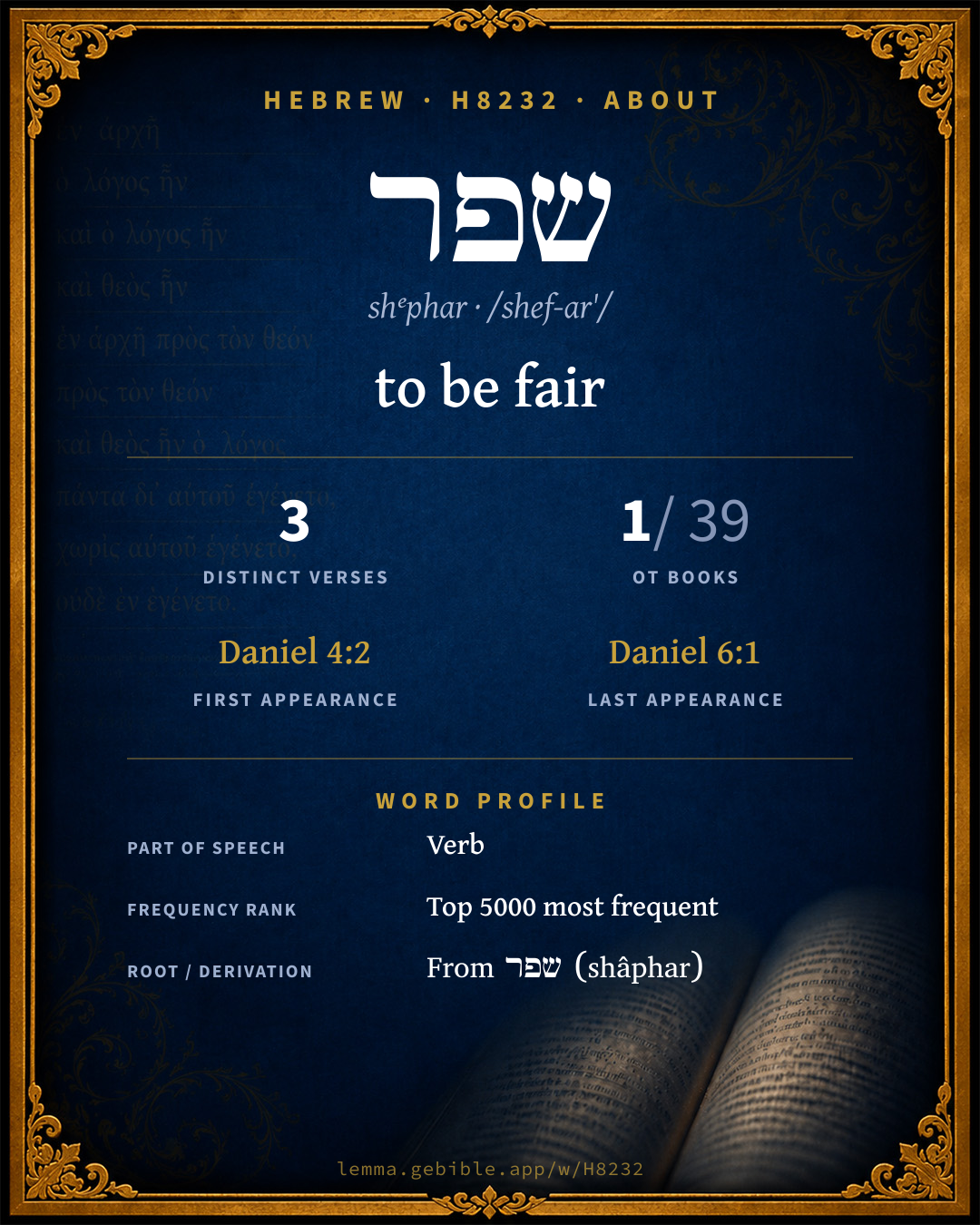
שְׁפַר
to be fair
also: be seemly, seem good, seem pleasing fuller range ↓
Full lexicon entry — Brown-Driver-Briggs (BDB)
From Brown-Driver-Briggs (BDB)
Where this word appears
Grammar key — what these labels mean
Part of speech
- Verb
- An action or state-of-being word.
Stem
- Qal
- The basic, simple active stem — the plain form of the verb (“he wrote”).
Form
- Perfect
- A completed action or state — Hebrew marks aspect (completeness) more than strict tense (“he wrote”).
- Imperfect
- An incomplete, ongoing, or future action (“he will / would write”).
Person
- 3rd Person
- The one spoken about (“he / she / it / they”).
Gender
- Masculine
- Grammatically masculine.
Number
- Singular
- One.
Grammatical forms
- Verb, Qal, Perfect, 3rd Person, Masculine, Singular 2 times (67%)
- Verb, Qal, Imperfect, 3rd Person, Masculine, Singular 1 time (33%)
Parsed forms decoded from the imported morphology (morphhb / Westminster Leningrad Codex — WLC text public domain, morphhb tagging CC BY 4.0), counted across 3 parsed occurrences — not distinct verses.
Every verse where H8232 appears — 3 distinct verses across 1 book. Click any verse to open its interlinear word-by-word view. Verse text shown in the World English Bible for context — . Each verse’s Hebrew form is shown with its reference; the English is not keyword-highlighted, since the data carries no word-level English alignment. Use “Compare translations” on any verse to read it across multiple English versions. This concordance covers the Hebrew Bible; Septuagint (Greek Old Testament) occurrences are not indexed here.
Daniel 3 verses
- Daniel 4:2 שְׁפַ֥ר Qal pf 3ms It has seemed good to me to show the signs and wonders that the Most High God has worked toward me.
- Daniel 4:27 יִשְׁפַּ֣ר Qal impf 3ms Therefore, O king, let my counsel be acceptable to you, and break off your sins by righteousness, and your iniquities by showing mercy to the poor; if there may be a lengthening of your tranquillity.
- Daniel 6:1 שְׁפַר֙ Qal pf 3ms It pleased Darius to set over the kingdom one hundred twenty satraps, who should be throughout the whole kingdom;
About this entry
At a glance — auto-summarized from this page’s data, not written by a person. Every figure links to its source below. This summary describes the numbers; it doesn’t interpret them.
“to be fair” is the headline sense of the Hebrew verb שפר (shᵉphar). It occurs a mere 3 verses across Scripture. More than three-quarters of its appearances fall in Daniel. First canonically at Daniel 4:2, it enters the text early. Not a single-sense word, it carries 2 senses, among them “be seemly”, “seem good”, and “seem pleasing”. See the sense tree, 3-verse concordance, and the renderings breakdown below.
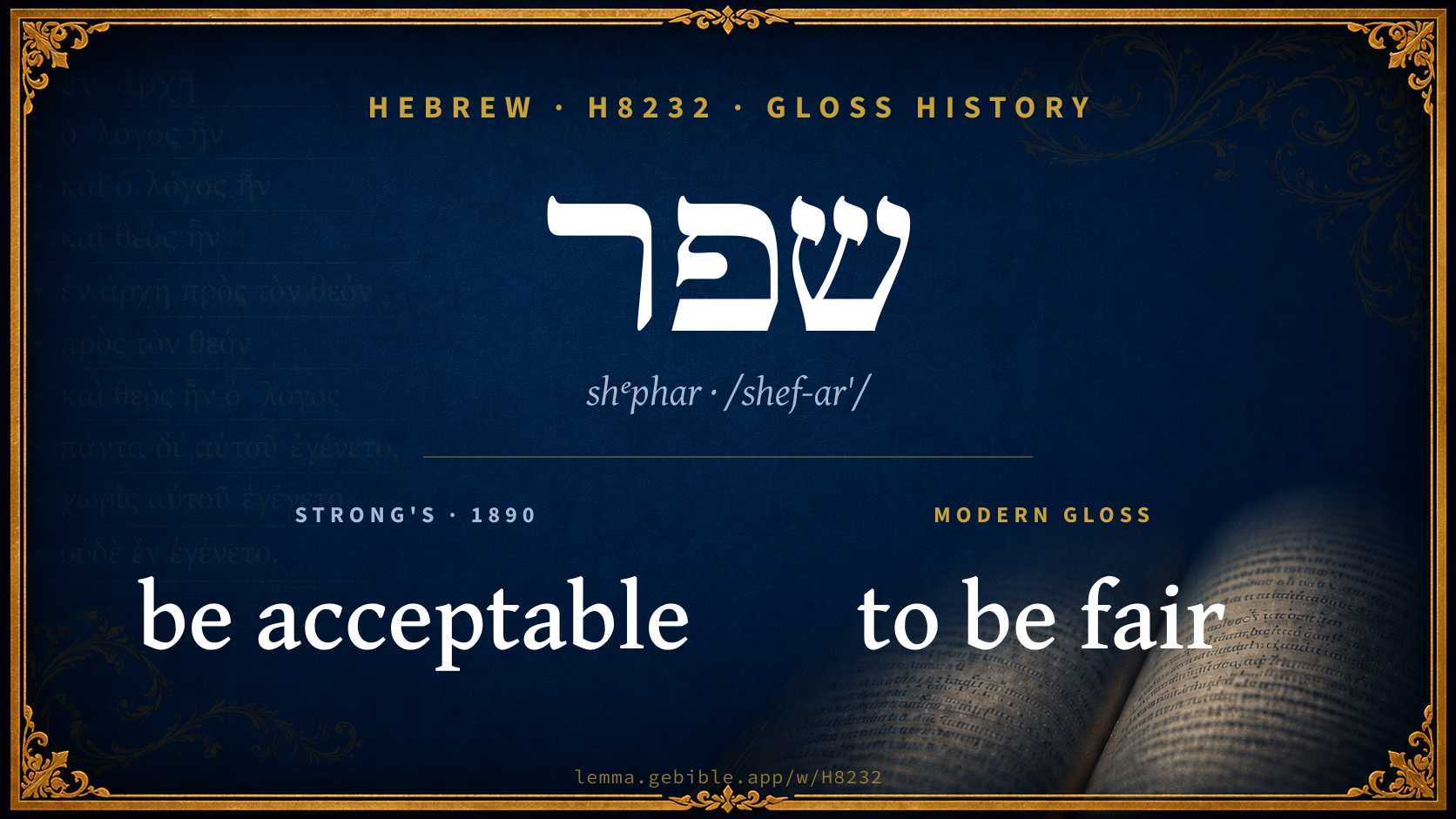
Gloss history
Strong's 1890 vs modern scholarship
About this word
Strong's H8232 catalogs a Hebrew word from the Hebrew Old Testament.
These counts are not copied from any lexicon or concordance. They are computed here, from the morphology-tagged Hebrew Old Testament. What Lemma adds →
- 3
- distinct verses
- The word appears in 3 distinct verses.
- 1 / 39
- OT books
- The word appears in 1 of 39 Old Testament books.
- #4,179
- by frequency
- Top 5000 most frequent Hebrew words (rank 4,179 of 8,640 Hebrew words by occurrence).
View all 3 occurrences in the concordance →
Most concentrated in
- Daniel 3 verses 100%
By section of the Old Testament
By traditional corpus
Conventional, traditional groupings — biblical authorship is debated, so this is a traditional corpus grouping, not an authorship claim. Each share is this word’s portion of its verses in that division of the Hebrew canon. Each figure is a share of the word’s 3 distinct verses.
- Writings (Ketuvim) 3 verses · 100%
How translations render this word
Counts come from each version’s own published word-to-Strong’s tagging or interlinear alignment — an approximate guide to how each version renders this word, not a word-level alignment the data otherwise carries. Because each total is that version’s own tagged count, the per-version totals vary from one another and need not match the appearance or distinct-verse counts above. These counts may also differ from a printed concordance because Lemma counts each distinctly tagged rendering and does not collapse phrase taggings into a single head-word total. This is a fixed set of word-tagged versions (KJV, ASV, BSB, ULT) and does not change with the reading translation you choose elsewhere. Each version’s license is shown beside its name below (and on Sources).
- King James Version: Be acceptable 1×, Good 1×
- American Standard Version: Be acceptable 1×, Good 1×
- Berean Standard Bible: Be pleasing 1×, I am pleased 1×, Now it 1×
- unfoldingWord Literal Text: Be acceptable 1×, Has seemed good 1×, Let 1×
King James Version Public Domain
Renders H8232 across 2 tagged occurrences — most commonly:
Not rendered by a distinct English word in 1 further occurrence.
American Standard Version Public Domain
Renders H8232 across 2 tagged occurrences — most commonly:
Berean Standard Bible Public Domain
Renders H8232 across 3 tagged occurrences — most commonly:
unfoldingWord Literal Text CC BY-SA 4.0
Renders H8232 across 4 tagged occurrences — most commonly:
Senses in BDB
The 2 senses BDB distinguishes for this word, in lexicon order (not ranked by frequency or importance). The full entry — with sub-senses — is in the Lexicon Entry tab.
- to be fair, be seemly, seem good, seem pleasing
- (Peal) to seem good, be acceptable
Word origin
שְׁפַר vb. be fair, seemly
— Brown-Driver-Briggs (Oxford 1906, public domain), digitized via Sefaria, supplemented by the OpenScriptures HebrewLexicon (CC BY 4.0). See Sources.
Derived from שפר (shâphar) (H8231) — to be beautiful.
Jastrow Dictionary
A second Hebrew/Aramaic lexicon for comparison, covering Aramaic and post-biblical (Talmudic, Targumic, Midrashic) usage that the biblical-Hebrew BDB does not. Matched by lemma rather than by Strong’s number, so a lemma may carry more than one Jastrow headword (shown separately below), and the entries cover usage well beyond the Bible.
שָׁפַר
- (b. h.) to be smooth, rounded; to be pleasing, good, cheerful. Ex. R. s. 1 (play on שִׁפְרָה) ששָׁפְרוּ מעשיה וכ׳ her deeds were pleasing before God.
- to cleanse, make pleasing; to conciliate, harmonize. Sot. 11ᵇ; Ex. R. l. c. the Lord sent an angel from on high ומנקה אותם ומְשַׁפֵּר אותם … שׁמְשַׁפֶּרֶת וכ׳ (not ומשפיר) who cleansed them and made them good-looking, like a midwife that cleanses an infant. Ib. שהיתה משפרת על וכ׳ she smoothed over her daughter’s words, and pacified (the king) for her. Gen. R. s. 98 (ref. to אמרי שפר, Gen. XLIX, 21) אמרי שופר שהן משַׁפְּרִין אמרין וכ׳ words of the Shofar, for they harmonize the words that were given with sounding the Shofar &c. (the Torah). Ib. ורץ … ושי׳ על ידו (not ידן) Naphtali ran like a hind and brought the document (of the purchase of the cave of Machpelah) from Egypt, and through it he pacified (the Hittites). Gen. R. s. 99, end (ref. to Gen. l. c.) [read:] והם מכבדין … ומשפרין דבריהם they offer kings their fruits and speak pleasing words; Tanḥ. Vayḥi 13 ומשמירין (corr. acc.). Lev. R. s. 29 (ref. to Ps. LXXXI, 4 שופר) בחדש הזה שַׁפְּרוּ מעשיכם in this month (Tishri) cleanse your deeds; אם שִׁפַּרְתֶּם וכ׳ if you cleanse your deeds, I will &c.; a. e. e.g. Genesis 49:21
- to be made neat-looking, be adorned. Y. Sabb. X, end, 12ᵈ העושה … לִישָּׁפֵר who makes a strap (for an animal) … to be adorned with it; Tosef. Kel. B. Bath. IV, 13 לשַׁפֵּר (Pi.).
שְׁפַר
- Targ. Gen. XXXIV, 18. Targ. Ps. LXIX, 32. Targ. Esth. I, 10; a. fr.—Snh. 11ᵇ ושַׁפְרָא מילתא באנפיי וכ׳ and the thing was pleasing in my sight and &c.; Y. ib. I, 18ᵈ top; Y. Maas. Sh. V, 56ᶜ top. Ker. 5ᵇ אי שמין וש׳ וכ׳ if it (the cock) gets fat and well-looking, he may know that he will succeed; a. e.
- to cleanse, make handsome, pleasant. Targ. Y. Gen. IX, 27 (h. text יפת). Targ. Prov. XV, 2. Ib. XVII, 22 (Ms. מְשַׁפֵּיר Pa.); a. e.—Y. Maasr. I, 49ᵃ bot. יַשְׁפַּר אפוי וכ׳, v. כַּרְיָא I. Y. Taan. I, 64ᵇ bot. מַשְׁפַּר תייטרון cleaning the theatre; a. e.
- to make one’s self fair, adorn one’s self. Targ. Jer. II, 33.
שֶׁפֶר
- preced.) beauty, splendor, pleasantness. Num. R. s. 1411 בירכו באמרי ש׳ … שְׁפָרִים he blessed him with speeches of beauty, for his words were pleasing. Midr. Till. to Ps. XVI, 6 שכרן של מצות שְׁפָרוֹ עלי (not מצוה) (naḥălath means) the reward of good deeds; its splendor rests on me; a. e.
שֶׁפֶר ²
- ; constr. שְׁפַר, the best of, choice of. Targ. Y. Gen. XLVII, 6 בית שְׁ׳ ארעא (O. בדשַׁפִּיר בא׳). Targ. Deut. XII, 11; a. fr.—שְׁ׳ ארג, v. אָרָג.—B. Mets. 14ᵃ שבח ש׳ וכ׳, v. שִׁעְבּוּד.—שְׁ׳ נונא, v. נוּן.
שָׁפָר
- (preced. wds.) beautiful, pleasing. — Pl. שְׁפָרִים. Num. R. s. 1411, v. שׁפֶר.
A Dictionary of the Targumim, the Talmud Babli and Yerushalmi, and the Midrashic Literature (Marcus Jastrow; London, Luzac, 1903) — Public Domain. Digitized via Sefaria. Digitized via Sefaria. Full attribution on Sources.
Forms in the corpus
The 3 distinct written forms H8232 takes in the Hebrew Bible, most frequent first — each parse links to that stem’s occurrences in the concordance. Hebrew forms include their vowel points and cantillation, so a single lemma takes many written forms.
| Form | Parsing | Example | Uses |
|---|---|---|---|
| יִשְׁפַּ֣ר | Verb, Qal, Imperfect, 3rd Person, Masculine, Singular | Daniel 4:27 | 1 |
| שְׁפַ֥ר | Verb, Qal, Perfect, 3rd Person, Masculine, Singular | Daniel 4:2 | 1 |
| שְׁפַר֙ | Verb, Qal, Perfect, 3rd Person, Masculine, Singular | Daniel 6:1 | 1 |
Same root — word family
Other BDB entries built from the same root as H8232, grouped by Strong’s listed origin. These share a root / origin per the lexicon — not necessarily a shared meaning. Each links to that word’s own entry.
Derives from
Shares the same root
- שופר shôwphâr H7782 horn
- שפר shepher H8233 beauty
- שפרה shiphrâh H8235 fairness
- שפרור shaphrûwr H8237 canopy
- שפרפר shᵉpharphar H8238 dawn
Proper names from this root
People and places named from this root — a name, not an additional meaning of the word.
Compare all same-root words → Showing 4 of 8 — not the complete family. 1 of the same-root words is a proper name (a person or place). They share a root, not necessarily a meaning.
Septuagint verse parallels
This word appears in 3 verses that also exist in the Greek Old Testament (Septuagint), out of the 3 Hebrew verses it occurs in. You can read those verses in Greek by switching the Old Testament edition to the Septuagint.
Read these verses in the Septuagint
This is a verse-level parallel only — the same verses exist in both the Hebrew and Greek Old Testaments. No word-level Hebrew↔Greek correspondence is claimed: the data carries no such alignment, so no Greek word is shown as this Hebrew word’s translation. Coverage is not total — the Septuagint omits the deuterocanon and renumbers the Psalms, so some Hebrew verses have no direct Greek parallel.