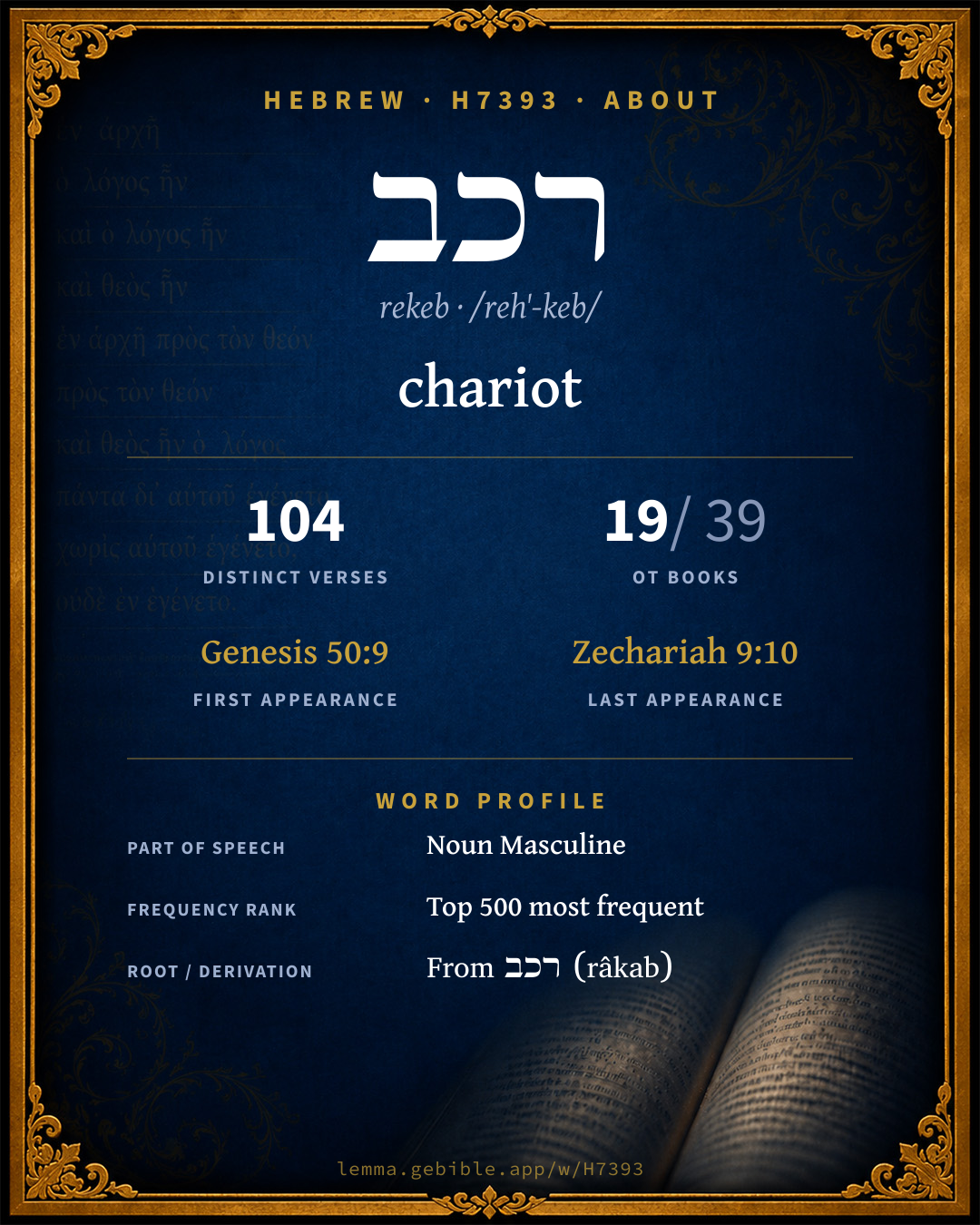
רֶ֫כֶב
chariot
also: a team, chariotry, mill-stone, riders fuller range ↓
Full lexicon entry — Brown-Driver-Briggs (BDB)
From Brown-Driver-Briggs (BDB)
Where this word appears
See every Absolute-state word in the Hebrew Bible →
Grammar key — what these labels mean
Part of speech
- Noun
- A naming word — a person, place, thing, or idea.
Noun type
- Common
- A common noun — a general class of person, place, or thing (“king,” “city,” “water”), not a specific name.
State
- Absolute
- The independent form of a noun, not bound to a following word.
- Construct
- A noun bound to a following noun in a possessive / “of” relationship (the construct chain).
Gender
- Masculine
- Grammatically masculine.
Number
- Singular
- One.
- Plural
- More than one (in Hebrew, generally three or more).
1 verse where H7393 appears in the Construct state in the Book of Nahum. Filtered view — show all forms. Click any verse to open its interlinear word-by-word view. Verse text shown in the World English Bible for context — . Each verse’s Hebrew form is shown with its reference; the English is not keyword-highlighted, since the data carries no word-level English alignment. Use “Compare translations” on any verse to read it across multiple English versions. This concordance covers the Hebrew Bible; Septuagint (Greek Old Testament) occurrences are not indexed here.
Nahum
About this entry
At a glance — auto-summarized from this page’s data, not written by a person. Every figure links to its source below. This summary describes the numbers; it doesn’t interpret them.
רכב — transliterated rekeb — is a Hebrew noun carrying the sense “chariot.” It also covers “a team”, “chariotry”, and “mill-stone”, alongside “chariot” — see its full sense range. It appears 104 verses across 19 books of the Hebrew Bible, among its common vocabulary. Debuting at Genesis 50:9, it then recurs through the corpus. Related forms include רכב, ארכבה and מרכב. See the sense tree, 104-verse concordance, and the renderings breakdown below.
Gloss history
Strong's 1890 vs modern scholarship
About this word
Strong's H7393 catalogs a Hebrew word from the Hebrew Old Testament.
These counts are not copied from any lexicon or concordance. They are computed here, from the morphology-tagged Hebrew Old Testament. What Lemma adds →
- 104
- distinct verses
- The word appears in 104 distinct verses.
- 19 / 39
- OT books
- The word appears in 19 of 39 Old Testament books.
- #360
- by frequency
- Top 500 most frequent Hebrew words (rank 360 of 8,640 Hebrew words by occurrence).
View all 104 occurrences in the concordance →
Most concentrated in
- 2 Kings 17 verses 16%
- 1 Kings 13 verses 13%
- 2 Chronicles 11 verses 11%
By section of the Old Testament
By traditional corpus
Conventional, traditional groupings — biblical authorship is debated, so this is a traditional corpus grouping, not an authorship claim. Each share is this word’s portion of its verses in that division of the Hebrew canon. Each figure is a share of the word’s 104 distinct verses.
- Prophets (Nevi'im) 71 verses · 68%
- Writings (Ketuvim) 20 verses · 19%
- Torah (Pentateuch) 13 verses · 13%
How translations render this word
Counts come from each version’s own published word-to-Strong’s tagging or interlinear alignment — an approximate guide to how each version renders this word, not a word-level alignment the data otherwise carries. Because each total is that version’s own tagged count, the per-version totals vary from one another and need not match the appearance or distinct-verse counts above. These counts may also differ from a printed concordance because Lemma counts each distinctly tagged rendering and does not collapse phrase taggings into a single head-word total. This is a fixed set of word-tagged versions (KJV, ASV, BSB, ULT) and does not change with the reading translation you choose elsewhere. Each version’s license is shown beside its name below (and on Sources).
- King James Version: Chariots 72×, Chariot 23×, All his chariots 3×
- American Standard Version: Chariots 68×, Chariot 16×, All his chariots 4×
- Berean Standard Bible: Chariots 77×, Chariot 23×, Riders 4×
- unfoldingWord Literal Text: Chariots 43×, Chariot 27×, Chariotry 20×
King James Version Public Domain
Renders H7393 across 119 tagged occurrences — most commonly:
Plus 15 renderings that appear only once — usually multi-word phrases or single function words the recovered tagging swept in, not distinct renderings. Not rendered by a distinct English word in 1 further occurrence.
American Standard Version Public Domain
Renders H7393 across 119 tagged occurrences — most commonly:
Plus 20 renderings that appear only once — usually multi-word phrases or single function words the recovered tagging swept in, not distinct renderings.
Berean Standard Bible Public Domain
Renders H7393 across 116 tagged occurrences — most commonly:
Plus 7 renderings that appear only once — usually multi-word phrases or single function words the recovered tagging swept in, not distinct renderings. Not rendered by a distinct English word in 4 further occurrences.
unfoldingWord Literal Text CC BY-SA 4.0
Renders H7393 across 118 tagged occurrences — most commonly:
Plus 8 renderings that appear only once — usually multi-word phrases or single function words the recovered tagging swept in, not distinct renderings.
Senses in the full BDB
What do BDB’s symbols mean?
BDB uses these scholarly abbreviations:
| Symbol | Meaning |
|---|---|
| 𝔊 | the Septuagint (the ancient Greek translation, LXX) |
| 𝔙 | the Vulgate (the Latin translation) |
| 𝔖 | the Syriac version (the Peshitta) |
| 𝔗 | the Targum (the Aramaic translation) |
| ψ | the Psalms |
| √ | root (the underlying root or stem) |
| ‖ | parallel passage (a synonymous or contrasted parallel) |
| † | the dagger: every passage where the word occurs is cited |
The 4 senses and sub-senses the full Brown-Driver-Briggs lexicon distinguishes for this word, in lexicon order (not ranked by frequency), with BDB’s own verbatim wording and sub-sense lettering. Shown in Hebrew script with BDB’s own scholarly abbreviations. The condensed entry is in the Lexicon Entry tab. See also the Forms in the corpus table below.
- 1. 109 coll. chariotry, chariots [sometimes of specific no. 2 K 13:7; 2 S 8:4; Ex 14:7 etc.; often + פָּרָשִׁים, סוּס(ים)]. especially war-chariots: in Egypt Ex 14:7 (J), Jos 24:6 (E) +; early Canaan Jos 11:4; Ju 4:7, 13; 5:28 (not sg.; ‖ מַרְכְּבוֹתָיו) +, called ר׳ בַּרְזֶל (i.e. iron-bound, or studded, cf. GFM Ju 1, 19 and reff.), †Jos 17:16, 18; Ju 1:19; 4:3, 13†; Philist., according to 1 S 13:5; 2 S 1:6; Aramaic 8:4; 10:18 +; Judah and Israel (from David’s time, cf. 8:4) 1 K 9:19, 22; 10:26 +, read also בְּרִכְבְּךָ Ho 10:13 (for בְּדַרְכְּךָ) 𝔊A We Now GASm; Assyria 2 K 19:23 = Is 37:24; Na 2:4, 5, 14 (to be burnt; made mainly of wood); Babyl. Je 47:3 (on title v 1, see Gf Gie), 50:37; 51:21 Ez 23:24 +, etc.; for dignity and display 1 K 1:5; 2 K 5:9; Je 17:25; 22:4; Is 66:20, cf. Gn 50:9 (J), (cf. also 1 K 9:19, 22; 10:26, etc.); fig. of Elijah, ר׳ יִשְׂרָאֵל וּפָרָשָׁיו 2 K 2:12, of Elisha 13:14; רֶכֶב אֵשׁ 2 K 2:11 chariotry of fire (at Elijah’s translation); ר׳ אֵל ψ 68:18 chariots of Ēl, i.e. his heavenly host, cf. vision 2 K 6:17, and also 7:6; ר׳ meton. for chariot-horses 2 S 8:4 = 1 Ch 18:4. e.g. 2 Kings 13:7
- 2. of single chariot 1 K 22:35, 38; 2 K 9:21(×2), 24; 10:16; 2 Ch 35:24, prob. also Ex 14:6; pl. רִכְבֵי פַרְעֹה Ct 1:9. e.g. 1 Kings 22:35
- 3. upper millstone (as riding on the lower) Dt 24:6; Ju 9:53; 2 S 11:21. e.g. Deuteronomy 24:6
- 4. appar. = riders (coll.), troop (of riders): שְׁנֵי רֶכֶב סוּסִים 2 K 7:14 perhaps רֹכְבֵי, cf. 𝔊 and 2 K 9:16 Bur. two riders of horses, horsemen or two chariots drawn by horses (?); in foll. text dub.: ר׳ צֶמֶד פָּרָשִׁים ר׳ חֲמוֹר ר׳ גָּמָל Is 21:7 riders, viz. a pair of horsemen, ass-riders, camel-riders; cf. ר׳ אִישׁ צֶמֶד פָּרָשִׁים v 9 i.e. men riding, a pair of horsemen; בְּר׳ אָדָם פָּרָשִׁים 22:6 with riders (consisting of) men, horsemen, but use of אָדָם very improb.; attractive is with chariotry of (drawn by) steeds (א׳ as gloss) Du CheHpt Di-Kit but פ׳ hardly steeds here (cf. פ׳ horsemen, v 7); read perhaps simply בְּר׳ וּפ׳. e.g. 2 Kings 7:14
Senses from the full Brown-Driver-Briggs lexicon (Brown, Driver, Briggs; Oxford 1906 — public domain), digitized via Sefaria, supplemented by the OpenScriptures HebrewLexicon (CC BY 4.0). Full attribution on Sources.
Word origin
n.m. 2 K 13, 7 [even Na 2:5, where read מַרְאֵיהֶם (for -הֶן) We Now AlbrZAW xvi (1896), 90] chariotry, chariot, mill-stone; appar. also riders (cf. LagBN151);—abs. ר׳ Gn 50:9 +, רָ֑כֶב 2 S 8:4 +; cstr. רֶכֶב Ex 14:9 +; sf. רִכְבִּי Ju 4:7 +, רִכְבּוֹ 2 K 5:9 +, רִכְבָּהּ Na 2:14; pl. cstr. רִכְבֵי Ct 1:9;—Ho 10:13 v. infr.;—
— Brown-Driver-Briggs (Oxford 1906, public domain), digitized via Sefaria, supplemented by the OpenScriptures HebrewLexicon (CC BY 4.0). See Sources.
Derived from רכב (râkab) (H7392) — to ride.
Jastrow Dictionary
A second Hebrew/Aramaic lexicon for comparison, covering Aramaic and post-biblical (Talmudic, Targumic, Midrashic) usage that the biblical-Hebrew BDB does not. Matched by lemma rather than by Strong’s number, so a lemma may carry more than one Jastrow headword (shown separately below), and the entries cover usage well beyond the Bible.
רָכב
- (b. h.) [to be joined,] to ride. B. Mets. I, 2 היו רוֹכְבִין … אחד רוֹכֵב וכ׳ if two persons (each claiming to be the finder of an object) were riding …, or one was riding and one leading. Ḥag. I, 1; Y. ib. I, 76ᵃ top כל שאינו יכול לִרְכּוֹב וכ׳ a child too young to be carried on his father’s shoulder. Ber. 56ᵇ רְכָבוֹ if he dreamt that he rode on him. Gen. R. s. 75 רוֹכְבֵי סוסים riders on horses; a. fr.—Part. pass. רָכוּב; f. רְכוּבָה &c. riding. Ex. R. s. 26 תינוק שהיה ר׳ על וכ׳ a child that was riding on his father’s shoulder. Y. B. Mets. I, beg. 7ᵈ אשה … ר׳ וכ׳ if a woman rides on a beast led by two men; a. fr.—[Pesik. Vayhi, p. 4ᵃ רכובים, read דב׳, v. דָּבַב II.]
- 1. to cause to ride, put on. Snh. 91ᵇ, a. e. ה׳ חיגר על וכ׳ he made the lame ride on the blind man. Ib. בא והַרְכִּיבֵנִי come and carry me on thy back; a. fr.—Part. pass. מוּרְכָּב. Ib. 52ᵇ I remember when I was a child ומ׳ על כתיפו וכ׳ and rode on my father’s shoulder &c.; (Tosef. ib. IX, 11 רכוב); a. e.
- 2. to join, combine. Tosef. Sabb. XII (XIII), 14 המַרְכִּיב קנה וכ׳ if one inserts the branch of a candlestick; (Sabb. 47ᵃ המחזיר). Y. ib. XII, beg. 13ᶜ המרכיב מיטה וכ׳ he who sets up a folding couch; a. e.—Esp. to inoculate, engraft. Shebi. II, 6 אין … ואין מַרְכִּיבִין וכ׳ we must not plant, nor sink a vine, nor engraft before the Sabbatical year &c. Pes. IV, 8; a. fr.—Part. pass. as ab. Y. B. Bath. IV, end, 14ᵈ החרוב המ׳ a newly inoculated carob tree; a. e.
רְכַב
- Targ. O. Gen. XXIV, 61. Targ. Lev. XV, 9.—Part. רָכֵיב, רָכֵב; part. pass. רְכִיב, f. רְכִיבָא; pl. רְכִיבִין, רָכְבִּין; רְכִיבָן, רָכְבָּן. Targ. Y. Gen. l. c. Targ. Num. XXII, 22. Targ. I Sam. XXV, 20. Targ. Jud. X, 4; a. fr.—Koh. R. to I, 8 ועלון יתיה ר׳ חמרא וכ׳ and they brought him riding on an ass on the Sabbath. Gen. R. s. 65. Ber. 56ᵇ דר׳ הוא לתורא when he dreamt that he was riding on an ox; דר׳ תורא לדידיה that the ox was riding on him; a. fr.
- 1. to cause to ride. Targ. Gen. XLI, 43. Targ. Esth. VI, 9; a. fr.—Gen. R. l. c. חמי סוסא דאַרְכְּבִי … דאַרְכְּבָךְ מרך see the horse on which my master makes me ride, and see the horse (the gallows) on which thy master (the Lord) makes thee ride. Y. Kidd. I, 60ᶜ bot., a. e. אַרְכְּבֵיה וכ׳, v. בַּרְקָא II; a. fr.
- 2. to let gender; to inoculate. Targ. O. Lev. XIX, 19.—Y. Yeb. XV, 15ᵃ top אילין … דלא צריכין מַרְכְּבָא the Babylonian palms which require no inoculation.
רַכָּב
- preced.) rider. Mekh. B’shall., Shir., s. 2 (ref. to Ex. XV, 1) הסוס קשור ברַכָּבוֹ ורכבו בסוס וכ׳ the horse was tied to his rider, and the rider to his horse; Yalk. Ex. 243. e.g. Exodus 15:1
רֶכֶב
- preced.)
- 1. wagon, chariot; (collect. noun) chariots. Ex. R. s. 22 על רִכְבּוֹ ועל פרשיו over his (Pharaoh’s) chariots and over his horsemen; a. e.
- 2. upper millstone. B. Mets. IX, 13, v. רֵחַיִים. B. Bath. II, 1 מרחיקין … מן הר׳ you must keep the mill removed (from the neighbor’s wall) three handbreadths counting from the lower millstone, which makes four from the upper millstone; a. e.
- 3. branch for inoculation, set. Tosef. Kil. I, 10 אין מרכיבין זתים בר׳ תמרה you must not inoculate olive trees with a shoot of a palm; Y. ib. I, 27ᵇ
A Dictionary of the Targumim, the Talmud Babli and Yerushalmi, and the Midrashic Literature (Marcus Jastrow; London, Luzac, 1903) — Public Domain. Digitized via Sefaria. Digitized via Sefaria. Full attribution on Sources.
Forms in the corpus
The 56 distinct written forms H7393 takes in the Hebrew Bible, most frequent first — each parse links to that state’s occurrences in the concordance. Hebrew forms include their vowel points and cantillation, so a single lemma takes many written forms.
Same root — word family
Other BDB entries built from the same root as H7393, grouped by Strong’s listed origin. These share a root / origin per the lexicon — not necessarily a shared meaning. Each links to that word’s own entry.
Derives from
Shares the same root
- ארכבה ʼarkubâh H755 knee
- מרכב merkâb H4817 chariot
- רכב rakkâb H7395 horseman
- רכוב rᵉkûwb H7398 chariot
Derived from this word
Proper names from this root
People and places named from this root — a name, not an additional meaning of the word.
Compare all same-root words → Showing 4 of 8 — not the complete family. 1 of the same-root words is a proper name (a person or place). They share a root, not necessarily a meaning.
Septuagint verse parallels
This word appears in 100 verses that also exist in the Greek Old Testament (Septuagint), out of the 104 Hebrew verses it occurs in. You can read those verses in Greek by switching the Old Testament edition to the Septuagint.
Read these verses in the Septuagint
- Genesis 50:9
- Exodus 14:6
- Deuteronomy 11:4
- Joshua 11:4
- Judges 1:19
- 1 Samuel 8:12
- 2 Samuel 1:6
- 1 Kings 1:5
- 2 Kings 2:11
- 1 Chronicles 18:4
- 2 Chronicles 1:14
- Psalms 20:7
This is a verse-level parallel only — the same verses exist in both the Hebrew and Greek Old Testaments. No word-level Hebrew↔Greek correspondence is claimed: the data carries no such alignment, so no Greek word is shown as this Hebrew word’s translation. Coverage is not total — the Septuagint omits the deuterocanon and renumbers the Psalms, so some Hebrew verses have no direct Greek parallel.