
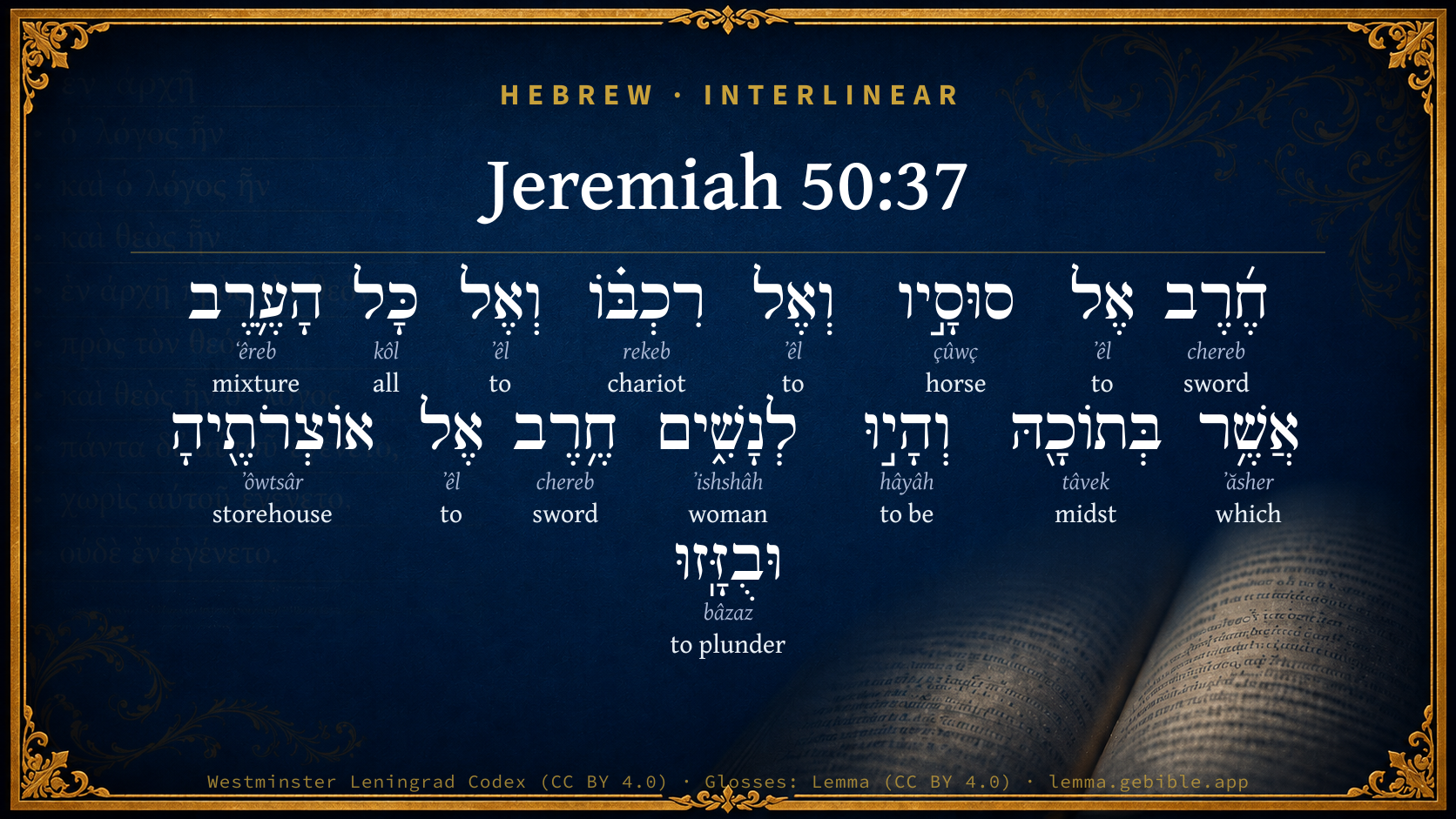
Jeremiah 50:37

Hebrew (Westminster Leningrad Codex) Jeremiah 50:37 appears in the Hebrew Old Testament. The text above is from the Westminster Leningrad Codex. Each word links to its Strong’s number, a concise gloss, and parsing drawn from the Open Scriptures Hebrew Bible morphology. Click any word for its full Brown-Driver-Briggs (BDB) entry.
Download image
Cite this verse

Jeremiah 50:37 (World English Bible). Public Domain. Lemma interlinear Bible study tool, https://lemma.gebible.app/v/jeremiah/50/37.

Show BibTeX & RIS
BibTeX
RIS
English Translation
A sword is on their horses, and on their chariots, and on all the mixed people who are in the midst of her; and they shall become as women: a sword is on her treasures, and they shall be robbed.
World English Bible · Public Domain
Download a study sheet

One document with this verse’s original text, its word-by-word gloss line, the meaning frame, cross-references with their text, attributed commentary, and full source and license credits — printable, and it pastes into notes with its structure intact.

This verse Autodidact and up

Study sheet (.html) Plain text (.txt)

A passage Seminary Student

Up to 50 verses in one chapter. A passage sheet keeps up to 6 commentary sources and 12 cross-references per verse, in the order this page ranks them, and says so on the sheet whenever that leaves anything out. Ask for a single verse and you get the Autodidact verse sheet above.

Everything on this page stays free to read, with no account — the sheet is a download of what is already on screen, not access to it.

Want to remove ads? Support Godless Engineer
Compare translations 3

The same verse in 3 English versions, stacked beneath the original-language interlinear above. Click any original word for its lexicon entry.

Each is an independent rendering of the whole verse — the interlinear is not word-aligned to these translations.

Highlighted words mark where these versions differ — a whole-verse word diff, not a word-by-word alignment.

  • World English Bible Public Domain
    A sword is on their horses, and on their chariots, and on all the mixed people who are in the midst of her; and they shall become as women: a sword is on her treasures, and they shall be robbed.
  • King James Version Public Domain
    A sword is upon their horses, and upon their chariots, and upon all the mingled people that are in the midst of her; and they shall become as women: a sword is upon her treasures; and they shall be robbed.
  • unfoldingWord Literal Text CC BY-SA 4.0
    A sword is coming against their horses, their chariots and all of the people who are in the midst of Babylon, so they will become like women. A sword is coming against her storerooms, and they will be plundered.

unfoldingWord Literal Text — © unfoldingWord, licensed CC BY-SA 4.0. Word-aligned USFM3 via Door43 (git.door43.org/unfoldingWord/en_ult).

Versions to compare (up to 4)

3 of 4 selected

Show all 18 translations

Every available English version of this verse, each an independent rendering of the whole verse.

  • World English Bible Public Domain
    A sword is on their horses, and on their chariots, and on all the mixed people who are in the midst of her; and they shall become as women: a sword is on her treasures, and they shall be robbed.
  • Berean Standard Bible Public Domain
    A sword is against her horses and chariots and against all the foreigners in her midst, and they will become like women. A sword is against her treasuries, and they will be plundered.
  • Majority Standard Bible Public Domain
    A sword is against her horses and chariots and against all the foreigners in her midst, and they will become like women. A sword is against her treasuries, and they will be plundered.
  • King James Version Public Domain
    A sword is upon their horses, and upon their chariots, and upon all the mingled people that are in the midst of her; and they shall become as women: a sword is upon her treasures; and they shall be robbed.
  • American Standard Version (1901) Public Domain
    A sword is upon their horses, and upon their chariots, and upon all the mingled people that are in the midst of her; and they shall become as women: a sword is upon her treasures, and they shall be robbed.
  • Revised Version (1885) Public Domain
    A sword is upon their horse, and upon their chariots, and upon all the mingled people that are in the midst of her, and they shall become as women: a sword is upon her treasures, and they shall be robbed.
  • Geneva Bible (1599) Public Domain
    A sworde is vpon their horses and vpon their charets, and vpon all the multitude that are in the middes of her, and they shall be like women: a sworde is vpon her treasures, and they shall be spoyled.
  • Douay-Rheims (1899) Public Domain
    A sword upon their horses, and upon their chariots, and upon all the people that are in the midst of her: and they shall become as women: a sword upon her treasures, and they shall be made a spoil.
  • Young's Literal Translation Public Domain
    A sword `is' on his horses and on his chariot, And on all the rabble who `are' in her midst, And they have become women; A sword `is' on her treasuries, And they have been spoiled;
  • Literal Standard Version CC BY-SA 4.0
    A sword [is] on his horses and on his chariot, || And on all the rabble who [are] in her midst, || And they have become women; A sword [is] on her treasuries, || And they have been spoiled;
  • Unlocked Literal Bible CC BY-SA 4.0
    A sword is coming against their horses, their chariots and all of the people who are in the midst of Babylon, so they will become like women. A sword is coming against her storerooms, and they will be plundered.
  • unfoldingWord Literal Text CC BY-SA 4.0
    A sword is coming against their horses, their chariots and all of the people who are in the midst of Babylon, so they will become like women. A sword is coming against her storerooms, and they will be plundered.
  • Darby Bible Public Domain
    the sword is upon their horses, and upon their chariots, and upon all the mingled people that are in the midst of her, and they shall become as women; the sword is upon her treasures, and they shall be robbed:
  • World Messianic Bible Public Domain
    A sword is on their horses, on their chariots, and on all the mixed people who are in the middle of her; and they will become as women. A sword is on her treasures, and they will be robbed.
  • Webster's Bible Public Domain
    A sword is upon their horses, and upon their chariots, and upon all the mingled people that are in the midst of her; and they shall become as women: a sword is upon her treasures; and they shall be robbed.
  • Free Bible Version CC BY-SA 4.0
    A sword is raised to attack her horses and chariots, along with all the foreign soldiers with her, and they will become like frightened women. A sword is raised to attack her stores of treasure, and they will be plundered.
  • Bible in Basic English Public Domain
    A sword is on all the mixed people in her, and they will become like women: a sword is on her store-houses, and they will be taken by her attackers.
  • JPS Tanakh (1917) Public Domain
    A sword is upon their horses, and upon their chariots, and upon all the mingled people that are in the midst of her, and they shall become as women; a sword is upon her treasures, and they shall be robbed.

Literal Standard Version (2020), Covenant Press — licensed CC BY-SA 4.0. Text via the HelloAO Bible API (eBible.org). Unlocked Literal Bible (unfoldingWord) — licensed CC BY-SA 4.0. Text via the HelloAO Bible API (eBible.org). unfoldingWord Literal Text — © unfoldingWord, licensed CC BY-SA 4.0. Word-aligned USFM3 via Door43 (git.door43.org/unfoldingWord/en_ult). Free Bible Version, Dr. Jonathan Gallagher — licensed CC BY-SA 4.0. Text via the HelloAO Bible API (eBible.org).

Word by word

More ways to search: Search by grammar → Find every occurrence → Compare this word →

Practice this passage: Drill this verse → Learn its vocabulary →

הָעֶ֛רֶב
ʻêreb
H6154
“the · mixture”
Particle, Definite Article + Noun, Common, Masculine, Singular, Absolute
Part of Speech
Particle + Noun
Type
Common
Gender
Masculine
Number
Singular
State
Absolute
Full BDB Definition

Origin: from H6148

TWOT: 1685a , 1685b

woof - as mixed, interwoven - knitted material - mixture, mixed people, mixed company
  1. חֶ֜רֶב chereb H2719 “sword” Noun, Common, Feminine, Singular, Absolute
  2. אֶל ʼêl H413 “to” Preposition
  3. סוּסָ֣יו çûwç H5483 “horses · his” Noun, Common, Masculine, Plural, Construct + Suffix, Personal, 3rd Person, Masculine, Singular
  4. וְאֶל ʼêl H413 “and · to” Conjunction + Preposition
  5. רִכְבּ֗וֹ rekeb H7393 “chariot · his” Noun, Common, Masculine, Singular, Construct + Suffix, Personal, 3rd Person, Masculine, Singular
  6. וְאֶל ʼêl H413 “and · to” Conjunction + Preposition
  7. כָּל kôl H3605 “all of” Noun, Common, Masculine, Singular, Construct
  8. אֲשֶׁ֥ר ʼăsher H834 “which” Particle, Relative
  9. בְּתוֹכָ֖הּ tâvek H8432 “in/at · midst · her” Preposition + Noun, Common, Masculine, Singular, Construct + Suffix, Personal, 3rd Person, Feminine, Singular
  10. וְהָי֣וּ hâyâh H1961 “and · to be” Conjunction + Verb, Qal, Sequential Perfect, 3rd Person, Common, Plural
  11. לְנָשִׁ֑ים ʼishshâh H802 “to/for · women” Preposition + Noun, Common, Feminine, Plural, Absolute
  12. חֶ֥רֶב chereb H2719 “sword” Noun, Common, Feminine, Singular, Absolute
  13. אֶל ʼêl H413 “to” Preposition
  14. אוֹצְרֹתֶ֖יהָ ʼôwtsâr H214 “storehouses · her” Noun, Common, Masculine, Plural, Construct + Suffix, Personal, 3rd Person, Feminine, Singular
  15. וּבֻזָּֽזוּ bâzaz H962 “and · to plunder” Conjunction + Verb, Pual, Sequential Perfect, 3rd Person, Common, Plural

About this verse

These counts appear in no published source. They are computed here, from the morphology-tagged text and Lemma’s own curated glosses. What Lemma adds →

16
words
12
distinct lemmas
Prophets
section

Notable vocabulary

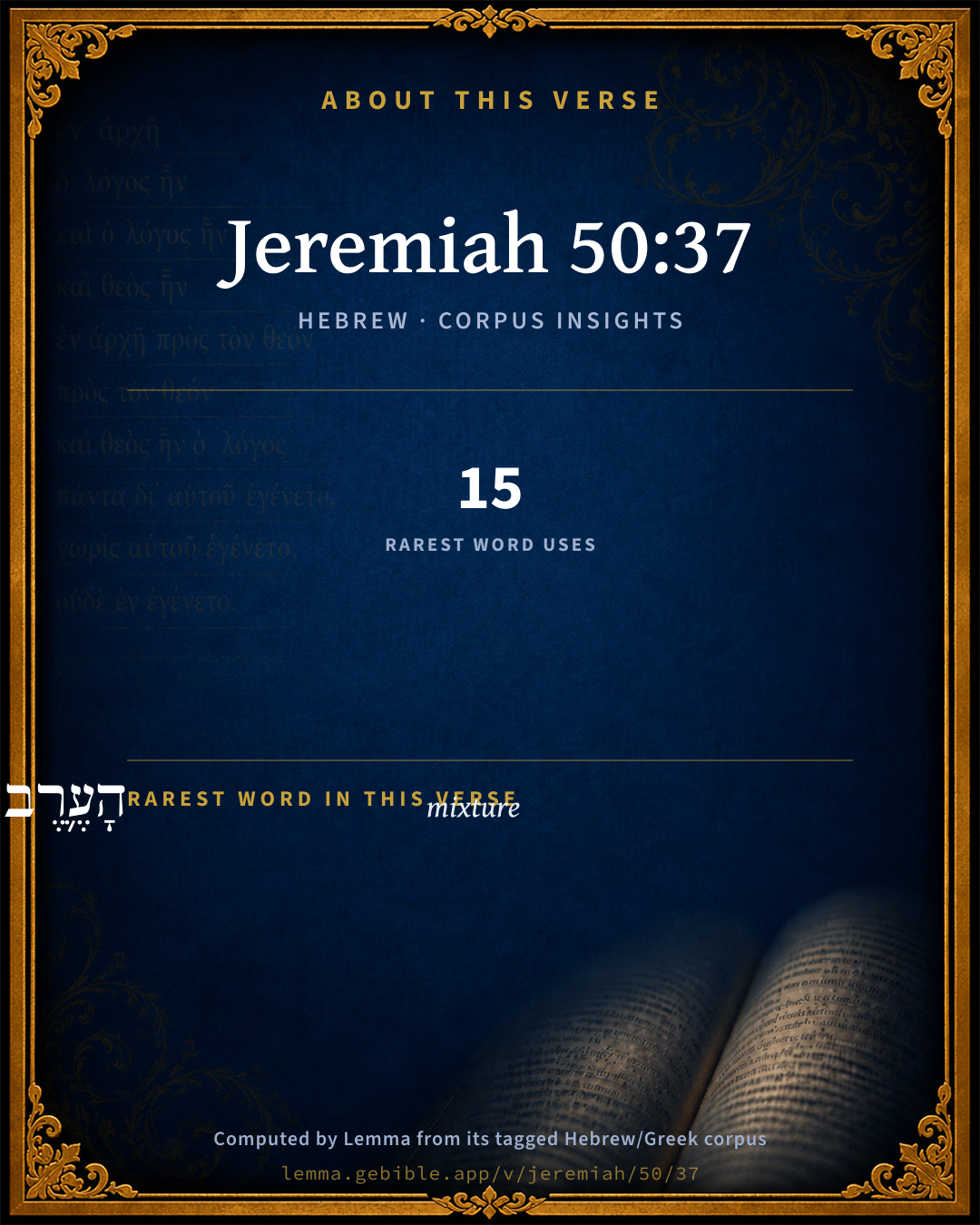
The rarest word here is הָעֶ֛רֶב mixture H6154 — appearing just 15 times in the whole Hebrew Bible.

Shared distinctive vocabulary

הָעֶ֛רֶב mixture H6154 occurs in 15 verses of the Hebrew Bible. Also found in:

Grammatical profile

  • 2 verbs
  • 9 nouns
  • 4 prepositions
  • 1 particle

Verb forms

  • וְהָי֣וּ Qal · Sequential Perfect
  • וּבֻזָּֽזוּ Pual · Sequential Perfect

Repetition

Words recur within this verse — often emphatic in Hebrew:

  • חֶ֜רֶב sword H2719 ×2
  • אֶל to H413 ×4

Cross-references

17

Topical passages linked to Jeremiah 50:37 in the Treasury of Scripture Knowledge — connected by theme and wording, ordered by reader-vote popularity; previews shown in the World English Bible.

  • Jeremiah 51:30 The mighty men of Babylon have forborne to fight, they remain in their strongholds; their might has failed; they are become as women: her dwelling-places are set on fire; her bars are broken.
  • Nahum 3:13 Behold, your troops in your midst are women. The gates of your land are set wide open to your enemies. The fire has devoured your bars.
  • Jeremiah 25:20 and all the mixed people, and all the kings of the land of the Uz, and all the kings of the Philistines, and Ashkelon, and Gaza, and Ekron, and the remnant of Ashdod;
  • Jeremiah 48:41 Kerioth is taken, and the strongholds are seized, and the heart of the mighty men of Moab at that day shall be as the heart of a woman in her pangs.
  • Jeremiah 51:21 and with you will I break in pieces the horse and his rider;
  • Isaiah 19:16 In that day shall the Egyptians be like women; and they shall tremble and fear because of the shaking of the hand of Yahweh of Hosts, which he shakes over them.
  • Psalms 20:7–8 Some trust in chariots, and some in horses, But we trust the name of Yahweh our God.
  • Isaiah 45:3 and I will give you the treasures of darkness, and hidden riches of secret places, that you may know that it is I, Yahweh, who call you by your name, even the God of Israel.
  • Ezekiel 30:5 Ethiopia, and Put, and Lud, and all the mixed people, and Cub, and the children of the land that is in league, shall fall with them by the sword.
  • Psalms 46:9 He makes wars cease to the end of the earth. He breaks the bow, and shatters the spear. He burns the chariots in the fire.
  • Psalms 76:6 At your rebuke, God of Jacob, Both chariot and horse are cast into a deep sleep.
  • Jeremiah 25:24 and all the kings of Arabia, and all the kings of the mixed people who dwell in the wilderness;
  • Jeremiah 50:26 Come against her from the utmost border; open her store-houses; cast her up as heaps, and destroy her utterly; let nothing of her be left.
  • Ezekiel 39:20 You shall be filled at my table with horses and chariots, with mighty men, and with all men of war, says the Lord Yahweh.
  • Nahum 2:2–4 For Yahweh restores the excellency of Jacob, as the excellency of Israel; for the destroyers have destroyed them, and ruined their vine branches.
  • Nahum 2:13 "Behold, I am against you," says Yahweh of Hosts, "and I will burn her chariots in the smoke, and the sword will devour your young lions; and I will cut off your prey from the earth, and the voice of your messengers will no longer be heard."
  • Haggai 2:22 I will overthrow the throne of kingdoms. I will destroy the strength of the kingdoms of the nations. I will overthrow the chariots, and those who ride in them. The horses and their riders will come down, everyone by the sword of his brother.

Cross-references courtesy of OpenBible.info (CC BY 4.0).

Hebrew and Greek witnesses Masoretic Hebrew ↔ Greek Septuagint

The same verse in the two great witnesses to the Old Testament, shown verse-for-verse.

These are two independent witnesses, not word-aligned to each other, and the Septuagint is shown in lemma (dictionary) form.

Hebrew Jeremiah 50:37 Masoretic · Westminster Leningrad Codex

חֶ֜רֶב אֶל סוּסָ֣יו וְאֶל רִכְבּ֗וֹ וְאֶל כָּל הָעֶ֛רֶב אֲשֶׁ֥ר בְּתוֹכָ֖הּ וְהָי֣וּ לְנָשִׁ֑ים חֶ֥רֶב אֶל אוֹצְרֹתֶ֖יהָ וּבֻזָּֽזוּ

A sword is on their horses, and on their chariots, and on all the mixed people who are in the midst of her; and they shall become as women: a sword is on her treasures, and they shall be robbed.

World English Bible · Public Domain

Greek LXX Structure differs

In the Septuagint, Jeremiah is about an eighth shorter than the Hebrew and arranges its material differently — the Oracles Against the Nations (Hebrew chapters 46–51) appear in the middle of the Greek book, after 25:13. Because the chapter and verse boundaries do not line up, a verse-for-verse comparison with the Hebrew is not shown.

A verse-for-verse comparison isn’t shown here because the chapters and verses don’t line up. Switch to the LXX edition with the MT / LXX toggle above to read the Greek directly.

Hebrew: Westminster Leningrad Codex (CC BY 4.0). Greek: Septuagint (public domain); English from a public-domain English Septuagint. How the Septuagint differs from the Hebrew →

Targum (Aramaic paraphrase)

1

The Targum is the ancient Jewish Aramaic paraphrase of the Hebrew Scriptures — an interpretive translation, not the Hebrew text itself. Onkelos (literal) and Pseudo-Jonathan (expansive) render the Torah, and Jonathan the Prophets. Coverage is partial: where no permissively-licensed English translation exists for a verse, only the Aramaic is shown. This is verse-level text, not a word-by-word alignment to the Hebrew.

  1. Targum Jonathan Prophets (Joshua–Malachi)
    דְקַטְלִין בְּחַרְבָּא יֵיתוּן עַל סוּסְוַתְהוֹן וְעַל רְתִיכֵיהוֹן וְעַל כָל סוּמְכְוָתָא דִי בְּגַוָהּ וִיהוֹן חֲלָשִׁין כִּנְשַׁיָא דְקַטְלִין בְּחַרְבָּא יֵיתוּן עַל בֵּית נִגְזָהָא וְיִתְבְּזִיזוּן:

    (no public-domain English translation for this verse)

    Targum Jonathan — Aramaic: “Mikraot Gedolot” (public domain). English: “Sefaria Community Translation” (CC0 1.0 (public-domain dedication)); “London "Chaldee Paraphrase," 1871” (public domain). Text via Sefaria.

Commentary

Notes on Jeremiah 50:37 from classic Christian and Jewish commentators (each source and its license shown beneath its notes). The classic Christian expositions comment on the surrounding passage and are grouped to its opening verse, so a note may address several verses; the Jewish commentaries on the Tanakh (Rashi and others) are per-verse, so they appear only where the commentator wrote on this verse.

Lemma curates 59 commentaries, every one of them public domain or Creative Commons licensed, each selected and text-cleaned for this edition rather than reprinted as found. About our sources →

Trapp's Complete Commentary

John Trapp

Jer 50:37 A sword [is] upon their horses, and upon their chariots, and upon all the mingled people that [are] in the midst of her; and they shall become as women: a sword [is] upon her treasures; and they shall be robbed.

Ver. 37. A sword is upon their horses.] Upon all their military preparations; whereof see Herodot., lib. i.

They shall become as women.] Elumbes, cowardly and crest fallen.

A sword is upon her treasures.] Which bow inestimable they were, see Strabo, lib. xv., and Plin., lib. xxxiii, cap. 3.

John Trapp, A Commentary or Exposition upon All the Books of the Old and New Testament (1647–1656) — public domain. Text from a community e-Sword module.

Jamieson, Fausset & Brown

Robert Jamieson, A. R. Fausset & David Brown

as women--divested of all manliness (Nah 3:13).

Jamieson, Fausset & Brown — Commentary Critical and Explanatory on the Whole Bible (1871) — public domain (CC PDM 1.0). Text via the HelloAO Bible API.

John Calvin's Commentaries

The Prophet, indeed, changes the gender of the pronouns, and seems to refer to the king; but there is no ambiguity in the meaning, he then declares that the horses as well as the chariots would perish; for the sword would consume all the things used in war. And at the beginning he generally declared that destruction was nigh all the Chaldeans, so he repeats the same now, on all the promiscuous multitude, which is in the midst of Babylon. He says that they would be without courage, for the Lord would dishearten them by terror, as it will be hereafter stated again. Then he joins, and on her treasures, and they shall be a prey to enemies. It follows, —

John Calvin's Commentaries (1540-1563) — public domain. Text from the Calvin Translation Society English edition (1840s-50s) via the Christian Classics Ethereal Library (ccel.org). Calvin's coverage is partial (roughly two-thirds of the Bible); uncommented books and verses are honest gaps, never fabricated. The 19th-century editor's footnotes and remarks are omitted so the notes are faithfully Calvin's own voice.

Ellicott's Commentary for English Readers

(37) And upon all the mingled people . . .—The phrase is the same as in Jer_25:20. Here it is used of the auxiliaries of Babylon, which were probably as numerous, and to a large extent the same, as those of Persia. (See Note on Jer_50:9.) The “treasures” point to the wealth in which Babylon exulted, and which gave to her the epithet of the “Golden City” (Isa_14:4). Even under the Persian monarchy Æschylus uses “gold-abounding” as a normal epithet for it. (Persœ, 53.)

A Bible Commentary for English Readers, edited by Charles John Ellicott (1878–1897) — public domain. Text from a community e-Sword module.

The Cambridge Bible for Schools and Colleges

gen. ed. J. J. S. Perowne

37. the mingled people] foreign mercenary troops. See on Jer_25:20.

The Cambridge Bible for Schools and Colleges (gen. ed. J. J. S. Perowne; Cambridge University Press, 1878–1918) — public domain. Text from a community e-Sword module.

John Gill's Exposition

A sword is upon their horses, and upon their chariots,.... Upon the horsemen, and those that rode in chariots; upon the whole cavalry, which should fall into the enemies' hands, and be cut to pieces; see Rev 19:18;

and upon all the mingled people that are in the midst of her; those of other nations that sojourned in Babylon, or came thither for merchandise; the word having, as Kimchi observes, such a signification; or rather her auxiliaries, troops consisting of other people that were her allies, or in her pay and service:

and they shall become as women; timorous, faint hearted, quite dispirited, unable to act, or defend themselves:

a sword is upon her treasures, and they shall be robbed; or they that slay with the sword, as the Targum, the soldiers, shall seize upon her treasures, and plunder them: thus should she be exhausted of men and money, and become utterly desolate.

John Gill's Exposition of the Whole Bible (1746–1763) — public domain (CC PDM 1.0). Text via the HelloAO Bible API.

Albert Barnes' Notes on the Bible

The mingled people - i. e., the foreigners serving as mercenaries in her army.

Albert Barnes' Notes on the Bible (1834–1885) — public domain. Text from a community e-Sword/MySword module.

Matthew Poole's English Annotations

A sword is upon their horses, and upon their chariots; though they be full of chariots and horses, the enemy shall destroy them. By the mingled people some understand those whom the Babylonians had hired to their assistance from other nations; others, such strangers as lived amongst them; others, a people under the power of the Chaldeans, made up of people of several countries. See Jer 25:20,24; Eze 30:5. They seem to signify a people that were not native Chaldeans, but under their dominion.

They shall become as women; that is, faint-hearted.

A sword is upon her treasures; and they shall be robbed; and though Babylon hath great treasures, yet those shall not secure her, she shall be robbed of them.

Matthew Poole's English Annotations on the Holy Bible (1683–1685) — public domain. Text from a community e-Sword/MySword module.

Whedon's Commentary on the Bible

Daniel D. Whedon

37. They shall become as women — Their wise ones shall become as fools, their soldiers and heroes shall “become as women;” that is, destitute of all warlike qualities.

Daniel D. Whedon (gen. ed.), Commentary on the Old and New Testaments (1874–1909) — public domain. Text from a community e-Sword module.

The Pulpit Commentary

The mingled people; rather, the foreign peoples. Even if in Jer_25:20 the Hebrew erebh is an ethnographical term reminding us of the Assyrian Urbi used of Bedouin tribes, it is clear that no such explanation will suit here. (see on Jer_25:20)

The Pulpit Commentary (1880–1919), ed. H.D.M. Spence-Jones & Joseph S. Exell — public domain. Text from a community e-Sword module.

John Wesley's Explanatory Notes

Horses - Through they be full of chariots and horses, the enemy shall destroy them. Mingled people - People that were not native Chaldeans, but under their dominion.

John Wesley, Explanatory Notes Upon the Whole Bible (1754–1765) — public domain. Text via the GEBible commentary corpus.

Rashi

Rabbi Shlomo Yitzchaki (Rashi)

the allies Heb. הערב. Jonathan renders: סוּמְכותא (garantie in French).

Rashi on the Tanakh — English translations: “The Judaica Press complete Tanach with Rashi, translated by A. J. Rosenberg” (CC BY 4.0); “Pentateuch with Rashi's commentary by M. Rosenbaum and A.M. Silbermann, 1929-1934” (public domain); “The Metsudah Tanach series, Lakewood, N.J” (CC BY 4.0); and “The Book of Joshua, Metsudah Publications, 1997” (CC BY 4.0). Text via Sefaria.

Lesson kit

Teaching starters — assembled from the data on this page, not authored interpretation. Every prompt links to the verse data it draws on. Edit before teaching.

Jeremiah, in the Prophets, opens this verse with 16 words (12 distinct Hebrew lemmas). Its most distinctive word is ʻêreb (“mixture”). A historical commentator’s framing appears above. Read the whole chapter for the surrounding context.

Discussion questions

  1. The word ʻêreb carries the sense “mixture.” How does it shape the verse?
  2. Exodus 12:38 shares the word «mixture» with this verse. How do the two illuminate each other?
  3. “sword” occurs 2× in this one verse. What is the effect of the repetition?
  4. The translations on this page render this verse differently — a whole-verse word diff, not a word-by-word alignment. What might account for the different wordings?
  5. The verb «וְהָי֣וּ» is Qal Sequential Perfect. How does its form color the action?
  6. Reading how Trapp's Complete Commentary and Jamieson, Fausset & Brown read this verse, where do the two commentators agree and where do they part?

Things to notice

Reading settings

Reading text

Shown beneath each verse's original-language words.

Old Testament
Old Testament edition

Read the OT as the Masoretic Hebrew (MT) or the Greek Septuagint (LXX).

English shown for the Greek Septuagint (in the Hebrew ↔ Greek comparison).

Comparing translations? Open the Compare panel on any verse page to stack up to four side by side.