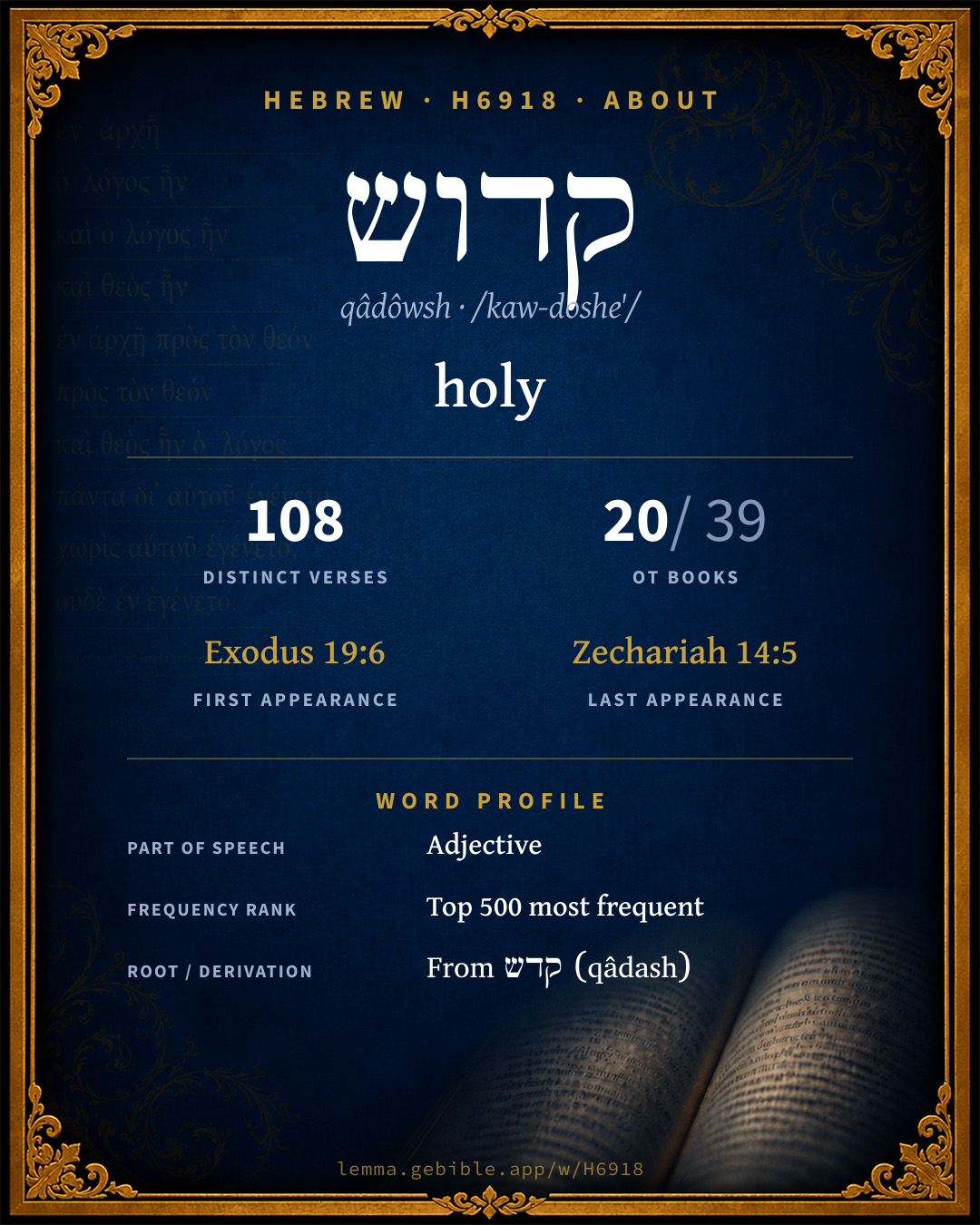
קָדוֹשׁ
holy
Full lexicon entry — Brown-Driver-Briggs (BDB)
From Brown-Driver-Briggs (BDB)
Where this word appears
See every Absolute-state word in the Hebrew Bible →
Grammar key — what these labels mean
Part of speech
- Adjective
- A word that describes or qualifies a noun.
- Noun
- A naming word — a person, place, thing, or idea.
Noun type
- Common
- A common noun — a general class of person, place, or thing (“king,” “city,” “water”), not a specific name.
State
- Absolute
- The independent form of a noun, not bound to a following word.
- Construct
- A noun bound to a following noun in a possessive / “of” relationship (the construct chain).
Gender
- Masculine
- Grammatically masculine.
Number
- Singular
- One.
- Plural
- More than one (in Hebrew, generally three or more).
2 verses where H6918 appears in the Construct state in the Book of Numbers. Filtered view — show all forms. Click any verse to open its interlinear word-by-word view. Verse text shown in the World English Bible for context — . Each verse’s Hebrew form is shown with its reference; the English is not keyword-highlighted, since the data carries no word-level English alignment. Use “Compare translations” on any verse to read it across multiple English versions. This concordance covers the Hebrew Bible; Septuagint (Greek Old Testament) occurrences are not indexed here.
Numbers
- Numbers 18:8 קָדְשֵׁ֣י n c mp cs Yahweh spoke to Aaron, I, behold, I have given you the charge of my heave-offerings, even all the holy things of the children of Israel; to you have I given them by reason of the anointing, and to your sons, as a portion forever.
- Numbers 18:32 קָדְשֵׁ֧י n c mp cs You shall bear no sin by reason of it, when you have heaved from it the best of it: and you shall not profane the holy things of the children of Israel, that you not die.
About this entry
At a glance — auto-summarized from this page’s data, not written by a person. Every figure links to its source below. This summary describes the numbers; it doesn’t interpret them.
At its core, קדוש (qâdôwsh) means “holy.” It first appears in Exodus 19:6. It turns up in 108 verses across 20 books, a common footprint. The word gravitates to Isaiah (31%), then Leviticus and Psalms. It clusters with קדש, מקדש and קדש under a shared root. Each statement above links to its evidence; the full detail follows below.
Gloss history
Strong's 1890 vs modern scholarship
About this word
Strong's H6918 catalogs a Hebrew word from the Hebrew Old Testament.
These counts are not copied from any lexicon or concordance. They are computed here, from the morphology-tagged Hebrew Old Testament. What Lemma adds →
- 108
- distinct verses
- The word appears in 108 distinct verses.
- 20 / 39
- OT books
- The word appears in 20 of 39 Old Testament books.
- #363
- by frequency
- Top 500 most frequent Hebrew words (rank 363 of 8,640 Hebrew words by occurrence).
View all 108 occurrences in the concordance →
By section of the Old Testament
By traditional corpus
Conventional, traditional groupings — biblical authorship is debated, so this is a traditional corpus grouping, not an authorship claim. Each share is this word’s portion of its verses in that division of the Hebrew canon. Each figure is a share of the word’s 108 distinct verses.
- Prophets (Nevi'im) 48 verses · 44%
- Torah (Pentateuch) 33 verses · 31%
- Writings (Ketuvim) 27 verses · 25%
How translations render this word
Counts come from each version’s own published word-to-Strong’s tagging or interlinear alignment — an approximate guide to how each version renders this word, not a word-level alignment the data otherwise carries. Because each total is that version’s own tagged count, the per-version totals vary from one another and need not match the appearance or distinct-verse counts above. These counts may also differ from a printed concordance because Lemma counts each distinctly tagged rendering and does not collapse phrase taggings into a single head-word total. This is a fixed set of word-tagged versions (KJV, ASV, BSB, ULT) and does not change with the reading translation you choose elsewhere. Each version’s license is shown beside its name below (and on Sources).
- King James Version: Holy one 33×, Holy 26×, Is holy 8×
- American Standard Version: Holy one 31×, Holy 22×, Is holy 6×
- Berean Standard Bible: Holy 62×, Holy one 18×, Is holy 13×
- unfoldingWord Literal Text: Holy 67×, One of 20×, Holy one 8×
King James Version Public Domain
Renders H6918 across 116 tagged occurrences — most commonly:
Plus 22 renderings that appear only once — usually multi-word phrases or single function words the recovered tagging swept in, not distinct renderings.
American Standard Version Public Domain
Renders H6918 across 114 tagged occurrences — most commonly:
Plus 42 renderings that appear only once — usually multi-word phrases or single function words the recovered tagging swept in, not distinct renderings.
Berean Standard Bible Public Domain
Renders H6918 across 116 tagged occurrences — most commonly:
Plus 10 renderings that appear only once — usually multi-word phrases or single function words the recovered tagging swept in, not distinct renderings.
unfoldingWord Literal Text CC BY-SA 4.0
Renders H6918 across 156 tagged occurrences — most commonly:
Plus other, less common renderings. Plus 12 renderings that appear only once — usually multi-word phrases or single function words the recovered tagging swept in, not distinct renderings.
9 senses and sub-senses in the full BDB
What do BDB’s symbols mean?
BDB uses these scholarly abbreviations:
| Symbol | Meaning |
|---|---|
| 𝔊 | the Septuagint (the ancient Greek translation, LXX) |
| 𝔙 | the Vulgate (the Latin translation) |
| 𝔖 | the Syriac version (the Peshitta) |
| 𝔗 | the Targum (the Aramaic translation) |
| ψ | the Psalms |
| √ | root (the underlying root or stem) |
| ‖ | parallel passage (a synonymous or contrasted parallel) |
| † | the dagger: every passage where the word occurs is cited |
The 9 senses and sub-senses the full Brown-Driver-Briggs lexicon distinguishes for this word, in lexicon order (not ranked by frequency), with BDB’s own verbatim wording and sub-sense lettering. Shown in Hebrew script with BDB’s own scholarly abbreviations. The condensed entry is in the Lexicon Entry tab. See also the Forms in the corpus table below.
- 1. of God, as separate, apart, and so sacred, holy:
- a. exalted on theophanic throne Is 6:3(×3), ψ 22:4; heavenly throne Is 57:15; in victory 5:16 1 S 2:2 ψ 99:3 (‖ נוֹרָא), v 5, 9; ק׳ וְנוֹרָא שְׁמוֹ 111:9. e.g. Isaiah 6:3
- b. separate from human infirmity, impurity, and sin: Jos 24:19 (E), 1 S 6:20 Hb 1:12; כי קדושׁ אני Lv 11:44, 45; 19:2; 20:26; 21:8 (H); קדושׁ בְּקִרְבְּךָ Ho 11:9; ק׳ בישׂראל Ez 39:7. e.g. Joshua 24:19
- c. קְדוֹשׁ יִשְׂרָאֵל = divine name (originating from trisagion, Is 6:3) Is 1:4; 5:19, 24; 10:20; 12:6; 17:7; 29:19; 30:11, 12, 15; 31:1; Is 2 41:14, 16, 20; 43:3, 14; 45:11; 47:4; 48:17; 49:7; 54:5; 55:5; 60:9, 14 elsewhere only 2 K 19:22 = Is 37:23, Je 50:29; 51:5 ψ 71:22; 78:41; 89:19; ק׳ יעקב Is 29:23, קְדוֹשׁוֹ 10:17; 49:7, קְדוֹשְׁכֶם 43:15; קָדוֹשׁ 40:25 Hb 3:3; Jb 6:10, pl. intens. קד(ו)שׁים Ho 12:1; Pr 9:10; 30:3. e.g. Isaiah 6:3
- 2.
- a. of place, sacred, holy, chambers of priests Ez 42:13, camp of Isr. Dt 23:15, + מָרוֹם of heaven Is 57:15 (but of י׳ Du Ry, and [reading בְּק׳ as holy, ב essent.] Klo Che Marti); in foll. (often defect.) pointing dub., read prob. קֹדֶשׁ 2: מק(ו)ם ק׳ of the court of tabernacle, Ex 29:31 Lv 6:9, 19, 20; 7:6; 10:13; 16:24; 24:9 (P), of Jerusalem Ec 8:10; ק׳ מִשְׁכְּנֵי עליון ψ 46:5; ק׳ הֵיכָלֶ֑ךָ 65:5. e.g. Ezekiel 42:13
- b. persons: priests Lv 21:7, 8; Nu 16:5, 7 (P), Aaron ψ 106:16, Levites 2 Ch 35:3, prophet 2 K 4:9, Nazirite Nu 6:5, 8 (P), Isr. גּוֹי ק׳ Ex 19:6 (E), עם ק׳ Dt 7:6; 14:2, 21; 26:19; 28:9; כָּל־הָעֵדָה Nu 16:3 (P); remnant in Jerus. Is 4:3; קדשׁים sacred Lv 11:44, 45; 19:2; 20:7, 26; 21:6; Nu 15:40; קדשׁים sacred ones, saints Dt 33:3 (song), ψ 16:3; 34:10 Dn 8:24. e.g. Leviticus 21:7
- c. angels, ψ 89:6, 8 Jb 5:1; 15:15; Zc 14:5 Dn 8:13(×2). e.g. Psalms 89:6
- d. מים קדשׁים Nu 5:17 holy water. e.g. Numbers 5:17
- e. time הַיּוֹם ק׳ (לי׳) Ne 8:9, 10, 11; קְדוֹשׁ י׳ Is 58:13, of Sabbath.—(Cf. Biblical Aramaic קַדִּישׁ). e.g. Nehemiah 8:9
Senses from the full Brown-Driver-Briggs lexicon (Brown, Driver, Briggs; Oxford 1906 — public domain), digitized via Sefaria, supplemented by the OpenScriptures HebrewLexicon (CC BY 4.0). Full attribution on Sources.
Word origin
adj. sacred, holy;—abs. ק׳ Ex 19:6 +; קָדשׁ Ex 29:31 +; cstr. קְדוֹשׁ Is 1:4 +; קְדשׁ Is 49:7 + 2 times; sf. קְדשִׁי Hb 1:12; קְדוֹשׁוֹ Is 10:17; 49:7 קְדוֹשְׁכֶם Is 43:15; pl. קְדוֹשִׁים Ho 12:1 + 2 times, קְדשִׁים Lv 11:44 + 16 times; sf. קְדשָׁיו Dt 33:3 ψ 34:10, קְדשָׁו֯ Jb 15:15;—
— Brown-Driver-Briggs (Oxford 1906, public domain), digitized via Sefaria, supplemented by the OpenScriptures HebrewLexicon (CC BY 4.0). See Sources.
Derived from קדש (qâdash) (H6942) — to consecrate.
Jastrow Dictionary
A second Hebrew/Aramaic lexicon for comparison, covering Aramaic and post-biblical (Talmudic, Targumic, Midrashic) usage that the biblical-Hebrew BDB does not. Matched by lemma rather than by Strong’s number, so a lemma may carry more than one Jastrow headword (shown separately below), and the entries cover usage well beyond the Bible.
קָדוֹשׁ
- 1. holy, sacred; holy man, saint. Yeb. 20ᵃ כל המקיים … נקרא ק׳ he who observes the ordinances of the scholars (with regard to marriage laws) is called holy (chaste). Ib. 105ᵇ; Meg. 27ᵇ עם ק׳ the holy assembly, v. פָּסַע; (Snh. 7ᵇ עם קוֹרֶשׁ; Yeb. l. c. also עם קֹדֶשׁ). Lev. R. s. 24 כשם שאני ק׳ כך וכ׳ as I am holy, so be you holy. Y. Sabb. XVI, 15ᶜ bot.; Treat. Sof’rim XVI, 12 הללו אל בקדשו לקְדוֹשׁוֹ לאהרן קְדוֹשׁ ד׳ ‘praise the Lord in his holiness’ (Ps. CL, 1) according to his holy servant, according to (the years of life of) Aaron, the holy servant of the Lord (123 Hallelujahs). Tem. 14ᵇ, a. e. כל הקרב ביום אינו ק׳ אלא ביום וכ׳ whatever must be offered in day-time, becomes sacred (by being put in a sacred vessel) only in day-time &c. Meg. 23ᵇ; Snh. 15ᵃ אדם מי ק׳ is a human being ever sacred (dedicated to be Temple property)? Ber. 10ᵇ (ref. to II Kings IV, 9) הוא ק׳ … אינו ק׳ he (the prophet) is a pure man, but his servant (Gehazi) is not; a. v. fr.—רבינו הק׳ our teacher, the saint, i.e. R. Judah Hannasi. Y. Meg. III, 74ᵃ; a. fr.—הק׳ ברוך הוא (abbrev. הקב"ה, הב"ה, הק"ה) the Holy One, blessed be He, the Lord. Ber. 6ᵇ. Num. R. s. 20; a. v. fr.—Pl. קְדוֹשִׁים. Lev. R. l. c. Sabb. 86ᵃ, a. e. ישראל ק׳ הן the Israelites are a chaste people. Pes. 104ᵃ בנן של ק׳ the descendant of holy men (R. Menaḥem); Ab. Zar. 50ᵃ; a. fr.—פרשת ק׳ the section of the Torah beginning with ḳ’doshim (Lev. XIX). Lev. R. l. c.; a. e.—Fem. קְדוֹשָׁה. Y. Maas. Sh. II, end, 53ᵈ; a. e., v. עֵדָה. e.g. Psalms 150:1
- 2. (v. קְדוּשָּׁה) Ḳadosh, the recitation of Ḳadosh (Is. VI, 3). Treat. Sof’rim l. c. קטן … ק׳ ביוצר (not כיוצא) a minor … must not recite Ḳadosh in the morning prayer (v. יָצַר). Ib. ק׳ של עמידה the Ḳadosh recited in the ‘standing prayer’ (v. עֲמִידָה), the Ḳ’dushshah e.g. Isaiah 6:3
קְדוֹשׁ
- (denom. of preced.)
- 1. to become sanctified, consecrated. Men. 100ᵃ לִיקְדּוֹשׁ, v. פְּסוֹל; Yoma 29ᵇ תִּקְדּוֹשׁ; a. e.
- 2. to be betrothed. Kidd. 12ᵇ תיקדוש וכ׳ let her be betrothed by means of the four Zuz which are wrapped up &c.
קִדּוּשׁ
- , v. sub קִידּ׳
A Dictionary of the Targumim, the Talmud Babli and Yerushalmi, and the Midrashic Literature (Marcus Jastrow; London, Luzac, 1903) — Public Domain. Digitized via Sefaria. Digitized via Sefaria. Full attribution on Sources.
Forms in the corpus
The 58 distinct written forms H6918 takes in the Hebrew Bible, most frequent first — each parse links to that state’s occurrences in the concordance. Hebrew forms include their vowel points and cantillation, so a single lemma takes many written forms.
Same root — word family
Other BDB entries built from the same root as H6918, grouped by Strong’s listed origin. These share a root / origin per the lexicon — not necessarily a shared meaning. Each links to that word’s own entry.
Derives from
Shares the same root
Derived from this word
Proper names from this root
People and places named from this root — a name, not an additional meaning of the word.
Compare all same-root words → Showing 4 of 7 — not the complete family. 1 of the same-root words is a proper name (a person or place). They share a root, not necessarily a meaning.
Septuagint verse parallels
This word appears in 97 verses that also exist in the Greek Old Testament (Septuagint), out of the 108 Hebrew verses it occurs in. You can read those verses in Greek by switching the Old Testament edition to the Septuagint.
Read these verses in the Septuagint
- Exodus 19:6
- Leviticus 6:16
- Numbers 5:17
- Deuteronomy 7:6
- Joshua 24:19
- 1 Samuel 2:2
- 2 Kings 4:9
- 2 Chronicles 35:3
- Job 5:1
- Psalms 16:3
- Proverbs 9:10
- Ecclesiastes 8:10
This is a verse-level parallel only — the same verses exist in both the Hebrew and Greek Old Testaments. No word-level Hebrew↔Greek correspondence is claimed: the data carries no such alignment, so no Greek word is shown as this Hebrew word’s translation. Coverage is not total — the Septuagint omits the deuterocanon and renumbers the Psalms, so some Hebrew verses have no direct Greek parallel.