

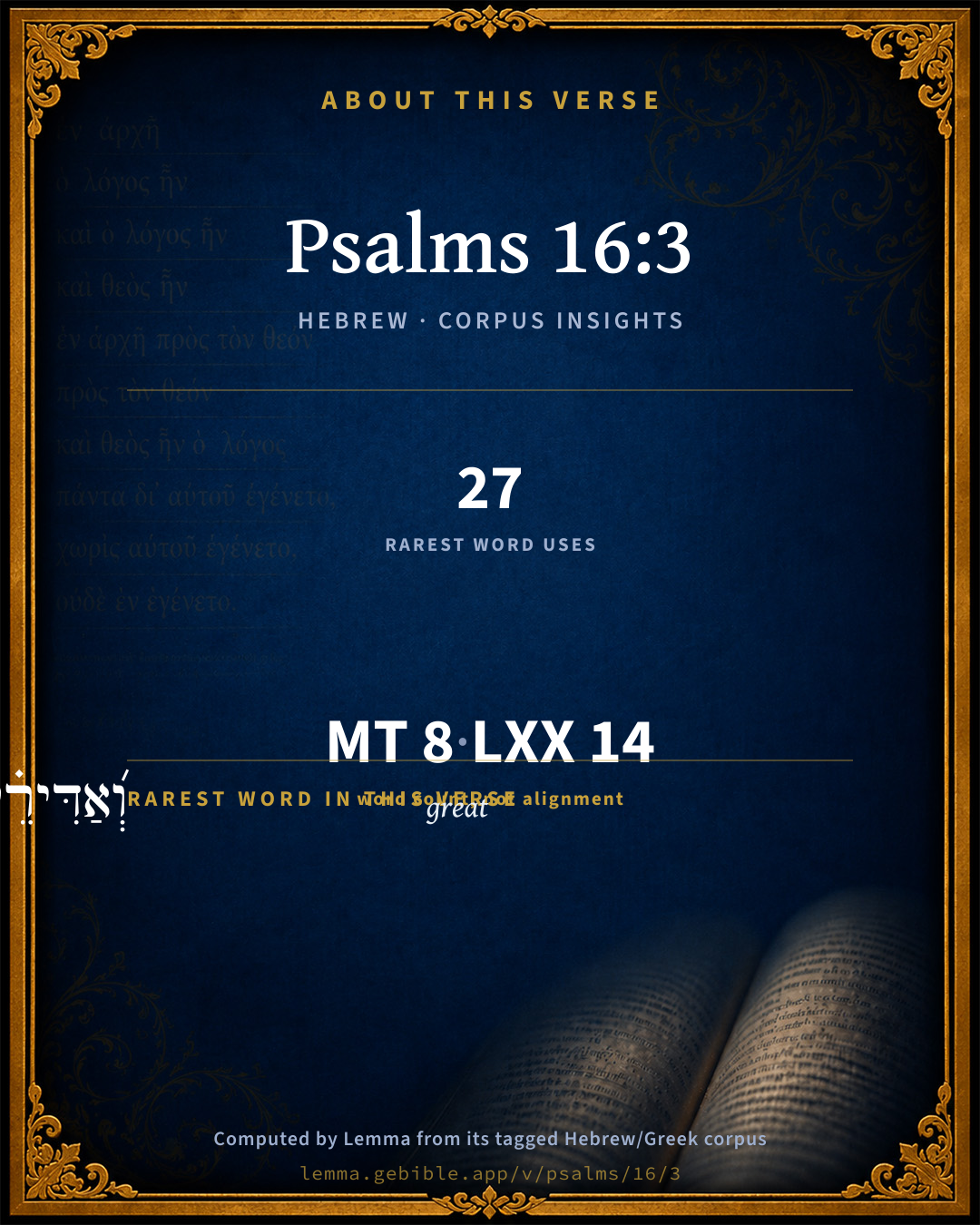
Psalms 16:3

Hebrew (Westminster Leningrad Codex) Psalms 16:3 appears in the Hebrew Old Testament. The text above is from the Westminster Leningrad Codex. Each word links to its Strong’s number, a concise gloss, and parsing drawn from the Open Scriptures Hebrew Bible morphology. Click any word for its full Brown-Driver-Briggs (BDB) entry.
Download image
Cite this verse

Psalms 16:3 (World English Bible). Public Domain. Lemma interlinear Bible study tool, https://lemma.gebible.app/v/psalms/16/3.

Show BibTeX & RIS
BibTeX
RIS
English Translation
As for the saints who are in the earth, They are the excellent ones in whom is all my delight.
World English Bible · Public Domain
Download a study sheet

One document with this verse’s original text, its word-by-word gloss line, the meaning frame, cross-references with their text, attributed commentary, and full source and license credits — printable, and it pastes into notes with its structure intact.

This verse Autodidact and up

Study sheet (.html) Plain text (.txt)

A passage Seminary Student

Up to 50 verses in one chapter. A passage sheet keeps up to 6 commentary sources and 12 cross-references per verse, in the order this page ranks them, and says so on the sheet whenever that leaves anything out. Ask for a single verse and you get the Autodidact verse sheet above.

Everything on this page stays free to read, with no account — the sheet is a download of what is already on screen, not access to it.

Want to remove ads? Support Godless Engineer
Compare translations 3

The same verse in 3 English versions, stacked beneath the original-language interlinear above. Click any original word for its lexicon entry.

Each is an independent rendering of the whole verse — the interlinear is not word-aligned to these translations.

Highlighted words mark where these versions differ — a whole-verse word diff, not a word-by-word alignment.

  • World English Bible Public Domain
    As for the saints who are in the earth, They are the excellent ones in whom is all my delight.
  • King James Version Public Domain
    But to the saints that are in the earth, and to the excellent, in whom is all my delight.
  • unfoldingWord Literal Text CC BY-SA 4.0
    As for the holy who are on the earth, they are the majestic; all my delight is in them.

unfoldingWord Literal Text — © unfoldingWord, licensed CC BY-SA 4.0. Word-aligned USFM3 via Door43 (git.door43.org/unfoldingWord/en_ult).

Versions to compare (up to 4)

3 of 4 selected

Show all 18 translations

Every available English version of this verse, each an independent rendering of the whole verse.

  • World English Bible Public Domain
    As for the saints who are in the earth, They are the excellent ones in whom is all my delight.
  • Berean Standard Bible Public Domain
    As for the saints in the land, they are the excellence in whom all my delight resides.
  • Majority Standard Bible Public Domain
    As for the saints in the land, they are the excellence in whom all my delight resides.
  • King James Version Public Domain
    But to the saints that are in the earth, and to the excellent, in whom is all my delight.
  • American Standard Version (1901) Public Domain
    As for the saints that are in the earth, They are the excellent in whom is all my delight.
  • Revised Version (1885) Public Domain
    As for the saints that are in the earth, they are the excellent in whom is all my delight.
  • Geneva Bible (1599) Public Domain
    But to the Saints that are in the earth, and to the excellent: all my delite is in them.
  • Douay-Rheims (1899) Public Domain
    To the saints, who are in his land, he hath made wonderful all my desires in them.
  • Young's Literal Translation Public Domain
    For the holy ones who `are' in the land, And the honourable, all my delight `is' in them.
  • Literal Standard Version CC BY-SA 4.0
    For the holy ones who [are] in the land, || And the honorable, all my delight [is] in them.
  • Unlocked Literal Bible CC BY-SA 4.0
    As for the holy people who are on the earth, they are noble people; all my delight is in them.
  • unfoldingWord Literal Text CC BY-SA 4.0
    As for the holy who are on the earth, they are the majestic; all my delight is in them.
  • Darby Bible Public Domain
    To the saints that are on the earth, and to the excellent [thou hast said], In them is all my delight.
  • World Messianic Bible Public Domain
    As for the holy ones who are in the earth, they are the excellent ones in whom is all my delight.
  • Webster's Bible Public Domain
    But to the saints that are in the earth, and to the excellent, in whom is all my delight.
  • Free Bible Version CC BY-SA 4.0
    As for the holy people in the land, they are the ones who are truly great. I appreciate them.
  • Bible in Basic English Public Domain
    As for the saints who are in the earth, they are the noble in whom is all my delight.
  • JPS Tanakh (1917) Public Domain
    As for the holy that are in the earth, they are the excellent in whom is all my delight.

Literal Standard Version (2020), Covenant Press — licensed CC BY-SA 4.0. Text via the HelloAO Bible API (eBible.org). Unlocked Literal Bible (unfoldingWord) — licensed CC BY-SA 4.0. Text via the HelloAO Bible API (eBible.org). unfoldingWord Literal Text — © unfoldingWord, licensed CC BY-SA 4.0. Word-aligned USFM3 via Door43 (git.door43.org/unfoldingWord/en_ult). Free Bible Version, Dr. Jonathan Gallagher — licensed CC BY-SA 4.0. Text via the HelloAO Bible API (eBible.org).

Word by word

More ways to search: Search by grammar → Find every occurrence → Compare this word →

Practice this passage: Drill this verse → Learn its vocabulary →

וְ֝אַדִּירֵ֗י
ʼaddîyr
H117
“and · great of”
Conjunction + Adjective, Adjective, Masculine, Plural, Construct
Part of Speech
Conjunction + Adjective
Type
Adjective
Gender
Masculine
Number
Plural
State
Construct
Full BDB Definition

Origin: from H142

TWOT: 28b

great, majestic - of waters of sea - of a tree - of kings, nations, gods - great one, majestic one - of nobles, chieftains, servants
  1. לִ֭קְדוֹשִׁים qâdôwsh H6918 “to/for · holy” Preposition + Adjective, Adjective, Masculine, Plural, Absolute
  2. אֲשֶׁר ʼăsher H834 “which” Particle, Relative
  3. בָּאָ֣רֶץ ʼerets H776 “in/at the · land” Preposition, Determined + Noun, Common, Both, Singular, Absolute
  4. הֵ֑מָּה hêm H1992 “they” Pronoun, Personal, 3rd Person, Masculine, Plural
  5. כָּל kôl H3605 “all of” Noun, Common, Masculine, Singular, Construct
  6. חֶפְצִי chêphets H2656 “delight · my” Noun, Common, Masculine, Singular, Construct + Suffix, Personal, 1st Person, Common, Singular

About this verse

These counts appear in no published source. They are computed here, from the morphology-tagged text and Lemma’s own curated glosses. What Lemma adds →

8
words
7
distinct lemmas
Wisdom
section

Shared distinctive vocabulary

וְ֝אַדִּירֵ֗י great H117 occurs in 25 verses of the Hebrew Bible. Also found in:

Grammatical profile

  • 3 nouns
  • 2 adjectives
  • 1 pronoun
  • 1 preposition
  • 1 particle

Hebrew & Septuagint length

In English translation the verse runs 20 words from the Hebrew and 18 from the Septuagint (LXX English) — closely comparable.

A rough comparison of the two English renderings, which tokenize alike — not a word-level alignment.

Word counts can differ between the Hebrew and the Greek without any difference in meaning — e.g. the Hebrew direct-object marker אֵת has no separate Greek word, and Greek often adds the article ὁ.

In the original languages it is 8 Hebrew tokens and 14 Greek tokens — but the two are counted differently (Hebrew bundles its prefixes and suffixes into one token; the Greek is in lemma form), so that isn’t a like-for-like length.

Cross-references

19

Topical passages linked to Psalms 16:3 in the Treasury of Scripture Knowledge — connected by theme and wording, ordered by reader-vote popularity; previews shown in the World English Bible.

  • Proverbs 12:26 A righteous person is cautious in friendship, But the way of the wicked leads them astray.
  • Proverbs 13:20 One who walks with wise men grows wise, But a companion of fools suffers harm.
  • Hebrews 6:10 For God is not unrighteous, so as to forget your work and the labor of love which you showed toward his name, in that you served the saints, and still do serve them.
  • 2 Chronicles 6:41 Now therefore arise, Yahweh God, into your resting-place, you, and the ark of your strength: let your priests, Yahweh God, be clothed with salvation, and let your saints rejoice in goodness.
  • Malachi 3:17 They shall be mine," says Yahweh of Hosts, "my own possession in the day that I make, and I will spare them, as a man spares his own son who serves him.
  • Acts 9:13 But Ananias answered, "Lord, I have heard from many about this man, how much evil he did to your saints at Jerusalem.
  • Psalms 30:4 Sing praise to Yahweh, you saints of his. Give thanks to his holy name.
  • Psalms 101:6 My eyes will be on the faithful of the land, That they may dwell with me. He who walks in a perfect way, He will serve me.
  • Psalms 116:15 Precious in the sight of Yahweh is the death of his saints.
  • Psalms 119:63 I am a friend of all those who fear you, Of those who observe your precepts.
  • Proverbs 8:31 Rejoicing in his whole world. My delight was with the sons of men.
  • Song of Solomon 4:1–7 Behold, you are beautiful, my love. Behold, you are beautiful. Your eyes are doves behind your veil. Your hair is as a flock of goats, That descend from Mount Gilead.
  • Isaiah 62:4 You shall no more be termed Forsaken; neither shall your land any more be termed Desolate: but you shall be called Hephzibah, and your land Beulah; for Yahweh delights in you, and your land shall be married.
  • Ephesians 5:25–27 Husbands, love your wives, even as Christ also loved the assembly, and gave himself up for it;
  • 1 John 3:14–17 We know that we have passed out of death into life, because we love the brothers. He who doesn't love his brother remains in death.
  • Galatians 6:10 So then, as we have opportunity, let's do what is good toward all men, and especially toward those who are of the household of the faith.
  • Ephesians 1:1 Paul, an apostle of Christ Jesus through the will of God, to the saints who are at Ephesus, and the faithful in Christ Jesus:
  • Titus 3:8 This saying is faithful, and concerning these things I desire that you affirm confidently, so that those who have believed God may be careful to maintain good works. These things are good and profitable to men;
  • Song of Solomon 7:10 I am my beloved's. His desire is toward me.

Cross-references courtesy of OpenBible.info (CC BY 4.0).

Hebrew and Greek witnesses Masoretic Hebrew ↔ Greek Septuagint

The same verse in the two great witnesses to the Old Testament, shown verse-for-verse.

You’re reading Greek Psalm 15 (Hebrew Psalm 16). The Septuagint counts the superscription, so verse numbers can differ from the Hebrew — chapter-level alignment, not verse-by-verse. Numbering follows Rahlfs.

These are two independent witnesses, not word-aligned to each other, and the Septuagint is shown in lemma (dictionary) form.

Hebrew Psalms 16:3 Masoretic · Westminster Leningrad Codex

לִ֭קְדוֹשִׁים אֲשֶׁר בָּאָ֣רֶץ הֵ֑מָּה וְ֝אַדִּירֵ֗י כָּל חֶפְצִי בָֽם

As for the saints who are in the earth, They are the excellent ones in whom is all my delight.

World English Bible · Public Domain

Greek LXX Greek Psalm 15:3 Septuagint · lemma form

ὁ ἅγιος ὁ ἐν ὁ γῆ αὐτός θαυμαστόω πᾶς ὁ θέλημα αὐτός ἐν αὐτός

On behalf of the saints that are in his land, he has magnified all his pleasure in them.

LXX2012 (modern English Septuagint) · Public Domain

On this verse, The Cambridge Bible for Schools and Colleges discusses the Septuagint’s reading. Read the note in Commentary ↓

Hebrew: Westminster Leningrad Codex (CC BY 4.0). Greek: Septuagint (public domain); English from LXX2012 (modern English Septuagint) (Public Domain). How the Septuagint differs from the Hebrew →

Commentary

Notes on Psalms 16:3 from classic Christian and Jewish commentators (each source and its license shown beneath its notes). The classic Christian expositions comment on the surrounding passage and are grouped to its opening verse, so a note may address several verses; the Jewish commentaries on the Tanakh (Rashi and others) are per-verse, so they appear only where the commentator wrote on this verse.

Lemma curates 59 commentaries, every one of them public domain or Creative Commons licensed, each selected and text-cleaned for this edition rather than reprinted as found. About our sources →

The Cambridge Bible for Schools and Colleges

gen. ed. J. J. S. Perowne

3. A difficult verse, the text of which appears to be corrupt.

(1) The best rendering is that of R.V. It is true that it can only be wrung from the Massoretic text by some violence, but an easy emendation removes the grammatical difficulty.

As for the saints [lit. holy ones] that are in the earth [or, land]

They are the excellent [nobles] in whom is all my delight.

From God in heaven the Psalmist turns to men on earth. The true ‘nobles’ (Jdg_5:13) in whose society he delights, are not the wealthy or powerful in the world’s estimation, but ‘the holy’; those in whom Israel’s calling to be ‘a holy nation’ (Exo_19:6) has been actually realised. Cp. Psa_15:4. These he proceeds to contrast with apostates (Psa_16:4). For them nothing but calamity is in store: with them and their worship he will have nothing to do.

(2) We may however (with R.V. marg.) connect Psa_16:3 with Psa_16:2, thus: (I have said) unto [or, of] the saints &c., they are the excellent &c. The general sense will remain the same as in (1).

(3) Combining the two alternatives in R.V. marg., we may connect Psa_16:3 both with Psa_16:2 and with Psa_16:4 thus: (I have said) unto the saints &c., and the excellent in whom is all my delight: their sorrows &c. Secure in his own choice of Jehovah he warns others against the fatal consequences of apostasy, and repudiates the idea of it for himself. In this case it is possible that saints may mean holy by calling, though not necessarily in character; and excellent may mean nobles in rank only.

(4) Taking the second alternative of R.V. marg. only, we may render: As for the saints … and the excellent in whom is all my delight: their sorrows &c. So Ewald, who explains, “This seems most profoundly to distress him, that the very Israelites, who ought to be the saints and pass for such … the noble, princely men, whom he especially so intensely loves, even these begin to betake themselves increasingly to heathenism.” But it is difficult to suppose that he would speak of men who were falling into idolatry in language such as this. (4) may safely be rejected; and (1) is simpler than (2) and (3), and deserves the preference.

(5) Of the host of conjectural emendations it will suffice to mention that of Baethgen, which is based on the LXX: ‘Unto the saints which are in his land doth Jehovah shew honour: all his delight is in them.’ It gives a good contrast to Psa_16:4, but is not convincing.

3, 4. The Psalmist’s society.

The Cambridge Bible for Schools and Colleges (gen. ed. J. J. S. Perowne; Cambridge University Press, 1878–1918) — public domain. Text from a community e-Sword module.

Trapp's Complete Commentary

John Trapp

Psa 16:3 [But] to the saints that [are] in the earth, and [to] the excellent, in whom [is] all my delight.

Ver. 3. But to the saints] The family of faith were, by a specialty, the object of David’s bounty. Socrates, seeing a certain man giving alms to all he met, whether they were good or bad, said, male pereas qui ex gratiis cure sint virgines, facias scorta. David, the better to persuade with God to preserve him safe to the kingdom, promiseth two things: first, that he will cherish and countenance the godly party; secondly, that he will cashier and cast out all kinds of idolatry, and maintain to his utmost the sincere service of God, Psa 16:4.

And to the excellent] Or, noble, glorious, wonderful, magnificent. The saints are princes in all lands, Psa 45:16; of an excellent spirit, Pro 17:27; more excellent than their neighbours, dwell they wheresover, Pro 12:26. They are styled the glory, Isa 4:5, a crown of glory, Isa 62:3, a royal diadem, ibid., a kingdom of priests, Exo 19:6, higher than the kings of the earth, Psa 89:27, greater than the four famous monarchies, Dan 7:18, worthies of whom the world is not worthy, Heb 11:38, fitter to be set as stars in heaven. And surely as stars, though seen sometimes in a puddle or stinking ditch, though they reflect there, yet have they their situation in heaven; so the saints, though here in a low condition, yet are they fixed in the region of happiness.

In whom is all my delight] Heb. Cheptsibam. So the Church is called God’s Hephzibah, Isa 62:4. Next to communion with God the communion of saints is most delectable. It is the very being bound up in the bundle of life, which was the blessing of Abigail upon David. Ipse aspectus viri boni delectat, saith Seneca, the very sight of a good man (morally good) delighted; what, then, of a saint? Ezr 10:3. This the heathen persecutors knew, and, therefore, banished and confined the Christians to isles and mines, where they could not one come at another, as Cyprian observeth.

John Trapp, A Commentary or Exposition upon All the Books of the Old and New Testament (1647–1656) — public domain. Text from a community e-Sword module.

The Biblical Illustrator

Joseph S. Exell

Psa_16:3

All my delight is upon the saints that are in the earth, and upon such as excel in virtue (P..V.).

Divine love for the saints of God

On All Saints Day our mind seems almost to sink beneath the great and holy thoughts which come crowding in upon it, when we think of that vast multitude which no man can number, of all ages, of all nations, of all ranks of life, of all mental and bodily endowments, who, having come out of great tribulation, now rejoice in the presence of Him whom on earth they loved. The Church today is proclaiming the truth of the words of our text. But it is not the Church alone, our Lord Himself shares in this delight. He beholds the beautiful things that He has made; but the King of the heavenly Jerusalem has fairer prospects than these. There is something on earth which He sees and values. The saints for the most part live a hidden life; the world despises their aims, perhaps laughs at their frailties. They pass away, and their names are forgotten, or live only in the memory of the Church, but the Lord makes them the sum and centre of His care and love. He greatly rejoices in the work of His grace, as it displays itself in His elect. Their shortest prayer, their slightest act of self-denial He notices. He gathers them, one by one, out of the ruined mass of humanity, to be jewels in His heavenly diadem. (S. W. Skeffington, M. A.)

The saints ministry to his brethren

Gods goodness should make us merciful to others. It were strange indeed a soul should come out of His tender bosom with a hard uncharitable heart. Some children do not, indeed, take after their earthly parents, as Ciceros son, who had nothing of his father but his name; but Gods children all partake of their heavenly Fathers nature. Philosophy tells us that there is no reaction from the earth to the heavens; they, indeed, shed their influences upon the lower world, which quicken and fructify it, but the earth returns none back to make the sun shine the better. David knew that his goodness extended not unto God, but this made him reach it forth to his brethren. Indeed, God has left His poor saints to receive the rents we owe unto Him for His mercies. An ingenuous guest, though his friend will take nothing for his entertainment, yet, to show his thankfulness, will give something to his servants. (William Gurnall.)

Moral distinctions

Is this an arbitrary and invidious distinction? We read of the saints, and the excellent. Are there, then, some people who are not saints, and some saints who are not excellent? The Bible does not create distinctions. If there were no Bible the earth would still be distributed into qualities, orders, classes, and the like. The Bible proceeds to a finer discrimination. It analyses honesty, it puts wisdom to the test, it searches into the credentials of faithfulness. The Bible asks, What is the motive underlying character? By saints understand separated men. The word saint is simply a moral or spiritual distinction. It involves more than is commonly understood by an honest man, or a good man, or a well-living man. It indicates of necessity a connection with the ineffably holy, the perfect, the Divine. It means, at least, an inspiration eternal, rising towards the eternity inaccessible--that is, the supreme life--that is, the life Divine. The terms saints, excellent are of a universal quality. The reference is to character, not to opinion, nor to varied ways of looking at things which cannot be positively settled. The Psalmist dwells upon the eternal quantity--character, holiness, excellence, pureness; these speak all languages, assume the hues of all climes, and under manifold outward diversity conceal an agreement subtle and indefinable as life itself. (Joseph Parker, D. D.)

The saints of God

Since the seventh century the first day of November has always been dedicated to the memory of All Saints. Such a day suggests thoughts as solemn and as needful as any which could be presented to us. We watch the procession of mankind as it winds through the long centuries of history, and we note its most striking figures. The vast mass consists of a nameless throng. To our eyes mankind is mainly divided into the eminent and the obscure, the known and the unknown. But to the eye of God, to the eyes of all spirits, it may be, the aspect of that procession is very different. To them the inch-high differences of human rank have simply no existence; for them the thistles of human loftiness have no elevation, and the paltry mole hills cast no shadow. For they know but one distinction, that of the evil and the good. We can see, on the whole, that some men have dared to be eminently good, and that others have been conspicuously, infamously bad. With unspeakable relief we turn from them to the saints of God. In them is the healing of the world. Do not think of the mere title saints; it has been given to some, at least, who have no claim to it, and it has been denied to many more who have been consummately worthy of it. On All Souls Day we may think not only of those whom the Church has called saints, but also of the long line of heroes of the faith in olden times who are not called saints--of the patriarchs, of Enoch, Noah, Abraham, Moses, and many more; of brave judges, glorious prophets, patriot warriors, toiling apostles; of the many martyrs who would rather die than live; of hermits who fled from the guilt and turmoil of life; of the missionaries, Paul, Columba, Benedict, Xavier, Schwartz, and a long roll call of others. Of reformers, of wise rulers, of the writers of holy and who walk with Him in white, for they are worthy. If we would comfort our hearts, strengthen good resolutions, and retain that high estimate of human nature which it is such a misfortune to lose, and which so often threatens to succumb, let us in days like these make ourselves acquainted with Christian history and biography as the antidote to the degeneracy of these worldly and evil days. From earths mire and darkness lift up your eyes to this galaxy of great examples. We need something to keep alive our faith in the dignity of man. I, for one, find that something, most of all, in dwelling in the life and sufferings of Christ, and next, in considering the blessed example of those who have followed Him, each bearing his own cross. They will help us by furnishing gleaming instances of pure and possible human goodness; they show us how, by true faith in Christ, men just as weak as we are, tempted as we are, yet did gloriously and conspicuously triumph over sin, the world, the flesh, and the devil, and thereby proved to us that we can do the same. See how the universal idol, selfishness, has been gloriously overcome. Pride, too, has been subdued. St. Thomas, of Aquino, was by far the greatest man of his age. One day at Bologna, a stranger arriving at his monastery asked the prior for someone to help him to get provisions and carry his basket. Tell the first brother you meet, said the prior. St. Thomas was walking in meditation in the cloister, and, not knowing him by sight, the stranger said to him, Your prior bids you to follow me. Without a word the greatest teacher of his age, the Doctor Angelicus--the angel of the schools, as he was called by the affection of his admirers--bowed his head, took the basket, and followed. But he was suffering from lameness, and since he was unable to keep up with the pace, the stranger rebuked him soundly as a lazy, good-for-nothing fellow, who ought to show more zeal in religious obedience. The saint meekly bore the unjust reproaches, and answered never a word. Do you know to whom you are speaking, who you are treating in this rude way? said the indignant citizens of Bologna, who had witnessed the scene. That is Brother Thomas, of Aquino. Brother Thomas, of Aquino? said the stranger, and, immediately throwing., himself upon his knees, he begged to be forgiven. Nay, said St. Thomas, it is I who should ask forgiveness, since I have not been so active as I should have been. And this humility, so rare in little men, was the chief characteristic of this great man. From that disciplined and noble spirit of the first man of his age all pride had been expelled. Give me, O Lord,--this was his daily prayer,--a noble heart which no earthly affection may drag down. What more would we have if, even through so deep a valley of humiliation, there still lies the path to heaven? You see a life spent in brushing clothes, and washing crockery, and sweeping floors, a life which the proud of the earth would have regarded as the very dust beneath their feet, a life spent at a clerks desk, a life spent at a tradesmans counter, a life spent in a labourers hut, may yet be so ennobled by Gods mercy that for the sake of it a king may gladly yield his crown. Thank God there have been and are tens of thousands of holy and faithful, and therefore happy, souls, full of inward peace. Will you be one of their number? (Dean Farrar.)

In whom is all my delight.

The moral force in the world of Gods elect

The history of mankind, whether secular or religious, resolves itself ultimately into the history of a few individuals. For though the masses live, yet it is these few who determine the direction and shape the spirit of the age. The rest die and are forgotten; one epitaph would do for them all, except for two or three out of the million. Another fact, and a sadder one, is that the human race seems to tend downwards. The old Greek proverb says, and truly, the majority are evil. The few only are saints, the few only are heroes. There is bitter truth in Davids saying, All men are liars; and in Carlyles, that the world is peopled by a thousand millions, mostly fools How dreadful then would the condition of the world be were it not for Gods elect few. The deliverance of man has never been wrought by the multitude, but by the individual. See this illustrated in poetry, in philosophy, in art, in science; the leaders are a few, all the rest follow. But art and the rest will not alone save a people. History shows how along with them nations have sunk into the abyss of degradation. So will England, so will every nation, if she refuse the message of God. Of what use would the spangles of art and science be upon the funeral pall of the dying race if death were the end of all? The hope of the world lies in the recognition of, and in obedience to, the Word of God as uttered by His special messengers; and by so listening as to reflect in myriads of gleams, and to reverberate in millions of echoes, the light and the voice of inspiration. In illustration of all this glance at the moral history of the world. What drear darkness in the main prevailed from Adam to Abraham, that great hero of the faith. After him darkness again until Moses. After him till Samuel and the prophetic order. After them till Christ and the apostles. After Him and them the world gradually grew worse; Christianity itself became corrupted till St. Anthony, forsaking all, made his home in the lonely desert, to convince his generation of the infinite value of every human soul. And from his day, now and again, great saints were inspired of God from time to time,--such as Benedict I, Gregory VII, Francis of Assisi, until in the midst of another dark period the lion-hearted Luther shook the world. It is by such men the world has been kept from moral death; such seems to be the method of Gods working. Now let us note some of the lessons of this Divine method.

I. What is the secret, the sole secret of moral power? Who that reads the signs of these times can fail to see how much this age needs that secret? What was it that again and again overcame the world? Was it not faith showing itself by self-sacrifice? See it in Abraham, Moses, Samuel, and all else.

II. That the work of these saints is never permanent. There is infinite pathos in the failures of men and of institutions. Their work has perpetually to be renewed. Abraham died, and ere a century had elapsed his children were slaves. And so with all the rest.

III. Apparent failures were never absolute failures. No good man ever lives in vain. Each saint has his own Calvary. St. Telemachus was butchered in the arena, but because of his death an end was put to gladiatorial games. What a candle did Latimer and Ridley light in England through their martyrdom, and its light glows still. Then let man think, however discouraged he may be at the moral aspect of men, that a holy Christian life can never be in vain. (Dean Farrar.)

The Biblical Illustrator, edited by Joseph S. Exell (c. 1880s–1900s) — public domain. Text from a community e-Sword module.

J. A. Alexander on Psalms

Joseph Addison Alexander

3. (Psa 16:3) To (or with) the saints who (are) in the land, and the nobles in whom (is) all my delight. The construction of the first clause, and its connection with the preceding verse, are very obscure. Some make to synonymous with as to. "As to the saints who are in the land, and the nobles, in them is all my delight." Or, "as to the saints who are in the land, they are the nobles in whom is all my delight." Others understand to the saints and to Jehovah as correlative expressions. "To Jehovah I have said thus; to the saints thus." Or, as the English Bible has it, "My goodness extendeth not to thee, but to the saints," etc. The least violent construction seems to be that which takes the preposition in its usual sense, that of belonging to, as in the phrases, to David, to the chief Musician, and in 1Ki 15:27. The meaning then is that the Psalmist's recognition of Jehovah as The Lord, and as the only source of happiness, is not peculiar to himself, but common to the whole body of the saints or holy ones. This epithet denotes personal character, not as its primary meaning, but as the effect of a peculiar relation to God, as the objects of his choice, set apart from the rest of men for this very purpose; see Exo 19:6, Deu 7:6, Psa 34:10 (9), Dan 7:21; Dan 8:24, 1Pe 2:9. The pre-eminence of these over others, as the fruit of the divine election, is expressed by the word nobles, which, like saints, denotes moral character only in an indirect and secondary manner. The construction in this part of the verse is strongly idiomatic; the literal translation is, the nobles of all my delight in them. Under the old dispensation, the nobles or elect of God had their local habitation in the land of promise. Hence they are here described as the "saints or consecrated ones who are in the land," not in the earth, which would be too indefinite and not so well suited to the context. As thus explained, the whole verse may be paraphrased as follows: "This profession of my trust in God I make, not merely as an individual believer, but as one belonging to the great body of the saints or consecrated ones, the nobles of the human race, not such by any original or natural pre-eminence, but by the sovereign and distinguishing favour of Jehovah, whom they trust as I do, and are therefore the rightful objects of my warmest love."

Joseph Addison Alexander, The Psalms Translated and Explained (1850) — public domain. Text from a community e-Sword module.

Jamieson, Fausset & Brown

Robert Jamieson, A. R. Fausset & David Brown

saints--or, persons consecrated to God, set apart from others to His service.

in the earth--that is, land of Palestine, the residence of God's chosen people--figuratively for the Church.

excellent--or, "nobles," distinguished for moral excellence.

Jamieson, Fausset & Brown — Commentary Critical and Explanatory on the Whole Bible (1871) — public domain (CC PDM 1.0). Text via the HelloAO Bible API.

John Calvin's Commentaries

3. Unto the saints who are on the earth. Almost all are agreed in understanding this place, as if David, after the sentence which we have just now been considering, had added, The only way of serving God aright is to endeavor to do good to his holy servants. And the truth is, that God, as our good deeds cannot extend to him, substitutes the saints in his place, towards whom we are to exercise our charity. When men, therefore, mutually exert themselves in doing good to one another, this is to yield to God right and acceptable service. We ought, doubtless, to extend our charity even to those who are unworthy of it, as our heavenly Father

“maketh his sun to rise on the evil and on the good,” (Matthew 5:45;)

but David justly prefers the saints to others, and places them in a higher rank. This, then, as I have said in the commencement, is the common opinion of almost all interpreters. “Voyla donc (ainsi que j’ay commencement dire) l’opinion commune, quasi de tous.” — Fr.

“D’un accord, et d’une roesroe affection.” — Fr. “With one accord, and with the same affection.”

“Et comme armoiries apparentes.” — Fr.

John Calvin's Commentaries (1540-1563) — public domain. Text from the Calvin Translation Society English edition (1840s-50s) via the Christian Classics Ethereal Library (ccel.org). Calvin's coverage is partial (roughly two-thirds of the Bible); uncommented books and verses are honest gaps, never fabricated. The 19th-century editor's footnotes and remarks are omitted so the notes are faithfully Calvin's own voice.

John Gill's Exposition

But to the saints that are in the earth,.... Who are sanctified or set apart by God the Father in election; whose sins are expiated by the blood of Christ in redemption, and who are sanctified or made holy by the Spirit of God in the effectual calling; and who live a holy life and conversation: these are said to be "in the earth", not to distinguish them from the saints in heaven, to whom the goodness of Christ extends as to them, unless it be to distinguish them from the angels in heaven, who are called saints, Deu 33:2; as Aben Ezra observes; but to point out the place of their abode, scattered up and down in the earth; and to show that love, grace, goodness, and kindness of Christ reaches to them in the present state of things, notwithstanding all their meanness and imperfection in themselves, and their despicableness in the eyes of others; see Joh 13:1;

and to the excellent; the same with the saints, who though reckoned by men the faith of the world, and the offscouring of all things, are in high esteem with Christ; they are "nobles" (o) in his account, as the word is rendered in Jer 30:21; they are princes in all the earth, and these princes are kings; they are made kings and priests unto God by Christ; they wear and live like kings, and have the attendance, power, riches, and glory of kings; they are guarded by angels, they have power with God, they are rich in faith, and heirs of a kingdom;

in whom is all my delight; Christ's delights were with these sons of men before the world was, and have always continued with them; they are his "Hepbzibah" and "Beulah", as in Isa 62:4; hence he became incarnate, and suffered and died for them, and makes application of all the blessings of his grace and goodness to them.

(o) "magnificis", Junius & Tremellius, Piscator, Rivetus; "nobilibus delectationis meae", Gejerus; "ducibus eorum", Cocceius; so Michaelis.

John Gill's Exposition of the Whole Bible (1746–1763) — public domain (CC PDM 1.0). Text via the HelloAO Bible API.

Albert Barnes' Notes on the Bible

But to the saints that are in the earth - This verse also has been very variously rendered. Our translators seem to have understood it, in connection with the previous verse, as meaning that his “goodness,” or piety, was not of so pure and elevated a character that it could in any way extend to God so as to benefit him, but that it “might” be of service to the saints on earth, and that so, by benefiting them, he might show his attachment to God himself. But if the interpretation of the previous verse above proposed be the correct one, then this interpretation cannot be admitted here. This verse is probably to be regarded as a further statement of the evidence of the attachment of the psalmist to God. In the previous verse, according to the interpretation proposed, he states that his happiness - his all was centered in God. He had no hope of anything except in him; none beyond him; none besides him.

In this verse he states, as a further proof of his attachment to him, that he regarded with deep affection the saints of God; that he found his happiness, not in the society of the wicked, but in the friendship of the excellent of the earth. The verse may be thus rendered: “As to the saints in the earth (or in respect to the saints in the earth), and to the excellent, all my delight is in them.” In the former verse he had stated that, as to God, or in respect to God, he had no source of blessing, no hope, no joy, beyond him, or independent of him; in this verse he says that in respect to the saints - the excellent of the earth - all his delight was in them. Thus he was conscious of true attachment to God and to his people. Thus he had what must ever be essentially the evidence of true piety - a feeling that God is all in all, and real love for those who are his; a feeling that there is nothing beyond God, or without God, that can meet the wants of the soul, and a sincere affection for all who are his friends on earth. DeWette has well expressed the sense of the passage, “The holy, who are in the land, and the noble - I have all my pleasure in them.”

In the earth - In the land; or, perhaps, more generally, “on earth.” God was in heaven, and all his hopes there were in him. In respect to those who dwelt on the earth, his delight was with the saints alone.

And to the excellent - The word used here means properly “large, great,” mighty; then it is applied to “nobles, princes, chiefs;” and then to those who excel in moral qualities, in piety, and virtue. This is the idea here, and thus it corresponds with the word “saints” in the former member of the verse. The idea is that he found his pleasure, not in the rich and the great, not in princes and nobles, but in those who were distinguished for virtue and piety. In heaven he had none but God; on earth he found his happiness only in those who were the friends of God.

In whom is all my delight - I find all my happiness in their society and friendship. The true state of my heart is indicated by my love for them. Everywhere, and at all times, love for those who love God, and a disposition to find our happiness in their friendship, will be a characteristic of true piety.

Albert Barnes' Notes on the Bible (1834–1885) — public domain. Text from a community e-Sword/MySword module.

Matthew Poole's English Annotations

But, i.e. but my goodness extendeth, which is easily understood out of the former verse; from which also there may be fetched another supplement; O my soul, thou hast said, to the saints, &c.

To the saints that are in the earth, i.e. to those holy and righteous persons that live upon earth with me; to these only or principally my goodness is extended. Because I cannot reach thee, I endeavour to pay a singular respect, and love, and kindness to all saints for thy sake, whose friends and servants they are, and whose image they bear. This may seem more properly to agree to David than to Christ, whose goodness was principally designed for and imparted to sinners, and did not find men saints, but make them so; nor was it confined to them that lived with him upon the earth, but extended to all the believers of all ages before and after him.

To the excellent, or, the magnificent, or mighty, or honourable, to wit, the saints, as he now called them, whom, because they were mean and despicable in the eyes of the world, he honours with their just titles; and by appropriating them to the saints, he sufficiently intimates that all other men, how great soever, are but ignoble and vile persons, as he had called them, Psa 15:4.

In whom is all my delight, i.e. whose company and conversation is most pleasant and desirable to me. Compare Psa 119:63.

Matthew Poole's English Annotations on the Holy Bible (1683–1685) — public domain. Text from a community e-Sword/MySword module.

The Treasury of David

Charles H. Spurgeon

Ver. 3. But to the saints that are in the earth. These sanctified ones, although still upon the earth, partake of the results of Jesus' mediatorial work, and by his goodness are made what they are. The peculiar people, zealous for good works, and hallowed to sacred service, are arrayed in the Saviour's righteousness and washed in his blood, and so receive of the goodness treasured up in him; these are the persons who are profited by the work of the man Christ Jesus; but that work added nothing to the nature, virtue, or happiness of God, who is blessed for evermore. How much more forcibly is this true of us, poor unworthy servants not fit to be mentioned in comparison with the faithful Son of God! Our hope must ever be that haply some poor child of God may be served by us, for the Great Father can never need our aid. Well may we sing the verses of Dr. Watts:

"Oft have my heart and tongue confessed How empty and how poor I am;

My praise can never make thee blest, Nor add new glories to thy name. Yet, Lord, thy saints on earth may reap Some profit by the good we do; These are the company I keep, These are the choicest friends I know."

Poor believers are God's receivers, and have a warrant from the Crown to receive the revenue of our offerings in the King's name. Saints departed we cannot bless; even prayer for them is of no service; but while they are here we should practically prove our love to them, even as our Master did, for they are

the excellent of the earth. Despite their infirmities, their Lord thinks highly of them, and reckons them to be as nobles among men. The title of "His Excellency" more properly belongs to the meanest saint than to the greatest governor. The true aristocracy are believers in Jesus. They are the only Right Honourables. Stars and garters are poor distinctions compared with the graces of the Spirit. He who knows them best says of them,

in whom is all my delight. They are his Hephzibah and his land Beulah, and before all worlds his delights were with these chosen sons of men. Their own opinion of themselves is far other than their Beloved's opinion of them; they count themselves to be less than nothing, yet he makes much of them, and sets his heart towards them. What wonders the eyes of Divine Love can see where the Hands of Infinite Power have been graciously at work. It was this quick sighted affection which led Jesus to see in us a recompense for all his agony, and sustained him under all his sufferings by the joy of redeeming us from going down into the pit.

Ver. 3. But to the saints that are in the earth, and to the excellent, in whom is all my delight. My brethren, look upon saintship as the greatest excellency to love it. So did Christ. His eye was "upon the excellent ones in the earth; "that is, upon the saints, who were excellent to him; yea, also even when not saints, because God loved them. Isa 43:4. It is strange to hear how men by their speeches will undervalue a saint as such, if without some other outward excellency. For whilst they acknowledge a man a saint, yet in other respects, they will contemn him; "He is a holy man, "they will say, "but he is weak, "etc. But is he a saint? And can there be any such other imperfection or weakness found as shall lay him low in thy thoughts in comparison of other carnal men more excellent? Hath not Christ loved him, bought him, redeemed him? Thomas Goodwin.

Ver. 3. But to the saints. I understand that a man then evinces affection towards God, and towards those who love God, when his soul yearns after themwhen he obliges himself to love them by practically serving and benefiting themacting towards them as he would act towards God himself were he to see him in need of his service, as David says he did. Juan de Valdes, 1550.

Ver. 3. The saints. The Papists could abide no saints but those which are in heaven; which argues that they live in a kingdom of darkness, and err, not knowing the Scriptures, nor the power of God; for if they were but meanly conversant in the Scriptures, in the holy epistles, they should find almost in every epistle mention made of the saints who are thereunto called in Jesus Christ, through whom they are sanctified by the Holy Ghost. And mark, he calleth them excellent. Some think rich men to be excellent, some think learned men to be excellent, some count men in authority so to be, but here we are taught that those men are excellent who are sanctified by God's graces. Richard Greenham.

Ver. 3. By David's language, there were many singular saints in his day: To the saints that are in the earth, and to the excellent, in whom is all my delight. Was it so then, and should it not be so now? We know the New Testament outshines the Old as much as the sun outshines the moon. If we then live in a more glorious dispensation, should we not maintain a more glorious conversation?... "The excellent." Were the sun to give no more delight than a star, you could not believe he was the regent of the day; were he to transmit no more heat than a glow worm, you would question his being the source of elementary heat. Were God to do no more than a creature, where would his Godhead be? Were a man to do no more than a brute, where would his manhood be? Were not a saint to excel a sinner, where would his sanctity be? William Secker.

Ver. 3. Ingo, an ancient king of the Draves, who making a stately feast, appointed his nobles, at that time Pagans, to sit in the hall below, and commanded certain poor Christians to be brought up into his presence chamber, to sit with him at his table, to eat and drink of his kingly cheer, at which many wondering, he said, he accounted Christians, though never so poor, a greater ornament to his table, and more worthy of his company than the greatest peers unconverted to the Christian faith; for when these might be thrust down to hell, those might be his comforts and fellow princes in heaven. Although you see the stars sometimes by reflections in a puddle, in the bottom of a well, or in a stinking ditch, yet the stars have their situation in heaven. So, although you see a godly man in a poor, miserable, low, despised condition, for the things of this world, yet he is fixed in heaven, in the region of heaven: "Who hath raised us up, "saith the apostle, "and made us sit together in heavenly places in Christ Jesus." Charles Bradbury's "Cabinet of Jewels, "1785.

Ver. 3. To sum up all, we must know that we neither do nor can love the godly so well as we should do; but all is well if we would love them better, and do like ourselves the less because we do love them no more, and that this is common or usual with me, then I am right: so that we are to love the godly first because God commands it, because they are good; and in these cases our faith doth work by our love to good men. Next, when I am at the worst, like a sick sheep, I care not for the company of other sheep, but do mope in a corner by myself; but yet I do not delight in the society of goats or dogs, it proves that I have some good blood left in me; it is because for the present I take little or no delight in myself or in my God, that I delight no better in the godly: yet as I love myself for all that, so I may be said to love them for all this. Man indeed is a sociable creature, a company keeper by nature when he is himself; and if we not associate ourselves with the ungodly, though for the present, and care not much to show ourselves amongst the godly, the matter is not much, it is a sin of infirmity, not a fruit of iniquity. The disciples went from Christ, but they turned not to the other side as Judas did, who did forsake his Master, and joined himself to his Master's enemies, but they got together. Some say that Demas did repent (which I think to be the truth), and then he did "embrace this present world, "but for the present fit: put case he did forsake Paul; so did better men than he. Indeed as long as a man hath his delights about him, he will embrace the delights of this present world, or the delights which belong to the world to come; join with Paul, or cleave to the world. In this temptation our stay is, first, that we care not for the company of goats; next, that as we should, so we would, and desire that we may take delight in the company of sheep, to count them the only excellent men in the world, in whom is all our delight. The conclusion is, that to love the saints as saints, is a sound proof of faith; the reason is, for that we cannot master our affections by love, but first we must master our understandings by faith, Richard Capel, 1586-1656.

Ver 2-3. The influence and sphere of goodness. No profit to God, or departed saints or sinners, but to living men. Need of promptness, etc.

Ver. 3. Excellent of the earth. May be translated noble, wonderful, magnificent. They are so in their new birth, nature, clothing, attendance, heritage, etc., etc.

Ver. 3. In whom is all my delight. Why Christians should be objects of our delight. Why we do not delight in them more. Why they do not delight in us. How to make our fellowship more delightful.

Ver. 3. Collection sermon for poor believers.

1. Saints.

2. Saints on the earth.

3. These are excellent.

4. We must delight in them.

5. We must extend our goodness to them.

Matthew Henry.

Psalms 16:4*

Charles H. Spurgeon's The Treasury of David (1869–1885) — public domain. Psalms only. Text from a community e-Sword/MySword module.

Whedon's Commentary on the Bible

Daniel D. Whedon

3. To the saints—Taking the preposition “to” in the sense of belonging to, joining to, the meaning would be, “I have no good beyond thee, belonging as I do to the fellowship of the saints, and the noble, in whom is all my delight.”—Perowne. Or, taking the same particle in the sense of as to, in respect to, read, In respect to the saints who are in the earth, even the noble, or princely, all my delight is in them. Saints are those dedicated to God by covenant and sacrifice.

In the earth—Is purely descriptive and relative. The contrast is with saints “in heaven,” which is often made. See note on Psa_89:6; and compare Eph_3:15; Heb_12:23.

Excellent—A title of rank—noble, princely—synonymous with “saints who are in the earth,” in the previous line. Deu_33:29; Heb_11:25; 1Pe_2:9. He discovers and confesses their rank, though being in the earth they are often imperfect and in reproach.

In whom is all my delight—I delight in them alone. David’s supreme happiness is in God, and, secondarily, in the “saints” as God’s people.

Daniel D. Whedon (gen. ed.), Commentary on the Old and New Testaments (1874–1909) — public domain. Text from a community e-Sword module.

The Pulpit Commentary

But to the saints that are in the earth; rather, it is for the saints. It (i.e. my prosperity) is granted me for the advantage of the saints that are in the land; i.e. of all the true Israelites. "I hold it in trust for them" (Kay). And to (rather, for) the excellent, in whom is all my delight. And, especially, I hold it in trust for "the inner circle of the excellent ones," in whom God takes pleasure, (Psa_147:11) and in whom therefore I also "delight."

The Pulpit Commentary (1880–1919), ed. H.D.M. Spence-Jones & Joseph S. Exell — public domain. Text from a community e-Sword module.

John Wesley's Explanatory Notes

But - I bear a singular respect and love to all saints, for thy sake, whose friends and servants they are, and whose image they bear. This more properly agrees to David, than to Christ, whose goodness was principally designed for, and imparted to sinners.

John Wesley, Explanatory Notes Upon the Whole Bible (1754–1765) — public domain. Text via the GEBible commentary corpus.

Rashi

Rabbi Shlomo Yitzchaki (Rashi)

For the holy ones who are in the earth For the sake of the holy ones who are buried in the earth, who walked before You with sincerity.

and the mighty ones in whom is all my delight They are the mighty ones in whom is all my delight and for whose sake all my necessities are accomplished.

Rashi on the Tanakh — English translations: “The Judaica Press complete Tanach with Rashi, translated by A. J. Rosenberg” (CC BY 4.0); “Pentateuch with Rashi's commentary by M. Rosenbaum and A.M. Silbermann, 1929-1934” (public domain); “The Metsudah Tanach series, Lakewood, N.J” (CC BY 4.0); and “The Book of Joshua, Metsudah Publications, 1997” (CC BY 4.0). Text via Sefaria.

Radak

Rabbi David Kimhi (Radak)

To the holy ones who are in the earth: – The form of expression is like (that of לאישׁ in): “To a man (לאישׁ) as thou art thy wickedness (may reach)” (Job 35:8). And because I love Thee I love those who are holy, and I do good to them.

And excellent ones all my delight is in them: – To those who are most excellent of heart among all the children of men, and better than they – my delight is in them to do them good, because they keep and do Thy commandments. And for this reason he calls them holy and excellent. And, according to the former interpretation, they interpret for the holy ones (לקדושׁים) thus: “I am not worthy of Thy goodness, but for the holy ones Thy goodness is worthy.” In my opinion the words to the holy ones depend upon Thou hast said to the Lord, meaning, after thou hast said to the Lord that He is thy Sovereign Lord, thou shouldest say also to the holy ones which are in the earth that thou wilt humble thyself before them, and yield them superiority over thyself, and learn from their works; and all is with a view to perfection, that thou shouldest learn the love of God. And in this way our sages of blessed memory have said (Babli, Pesahim 22b): “‘Thou shall fear the Lord thy God’ (Deut. 6:13) – i.e. to multiply the disciples of the wise.” And he says, which are in the earth, meaning, Walk in the steps of the holy ones whom thou shalt find in thy way, and learn from their works. In my opinion וְאַדִּירֵי (excellent ones) is not construct, for similar examples are to be found, as שׁקופים חַלּוֹנֵי (windows narrow), (1 Kings 6:4); נעמנים נטעי (pleasant plants) (Is. 17:10); and such like. And the meaning of holy ones and excellent in whom is all my delight is that one should love them and walk in their ways – viz. of the holy ones which are in the earth; the way of the holy ones, the servants of God, I love, but the way of the others, who serve another god, I hate; and I say:

Radak on the Tanakh — English translations: “Sefaria Community Translation” (CC0 1.0 (public-domain dedication)); “Eliyahu Munk, HaChut Hameshulash” (CC BY 4.0); “Rabbi Mike Feuer, Jerusalem Anthology” (CC BY 4.0); and “R. David Kimhi on the first book of Psalms, Translated by R.G. Finch, London, 1919” (public domain). Text via Sefaria.

Lesson kit

Teaching starters — assembled from the data on this page, not authored interpretation. Every prompt links to the verse data it draws on. Edit before teaching.

Psalms, in the Wisdom, opens this verse with 8 words (7 distinct Hebrew lemmas). Its most distinctive word is ʼaddîyr (“great”). A historical commentator’s framing appears above. Read the whole chapter for the surrounding context.

Discussion questions

  1. How does “great” (ʼaddîyr) shape what this verse is saying?
  2. Exodus 15:10 shares the word «great» with this verse. How do the two illuminate each other?
  3. These translations render this verse differently. What is at stake in choosing one wording over another?
  4. Reading how The Cambridge Bible for Schools and Colleges and Trapp's Complete Commentary read this verse, where do the two commentators agree and where do they part?

Things to notice

Reading settings

Reading text

Shown beneath each verse's original-language words.

Old Testament
Old Testament edition

Read the OT as the Masoretic Hebrew (MT) or the Greek Septuagint (LXX).

English shown for the Greek Septuagint (in the Hebrew ↔ Greek comparison).

Comparing translations? Open the Compare panel on any verse page to stack up to four side by side.