Jeremiah 51:5

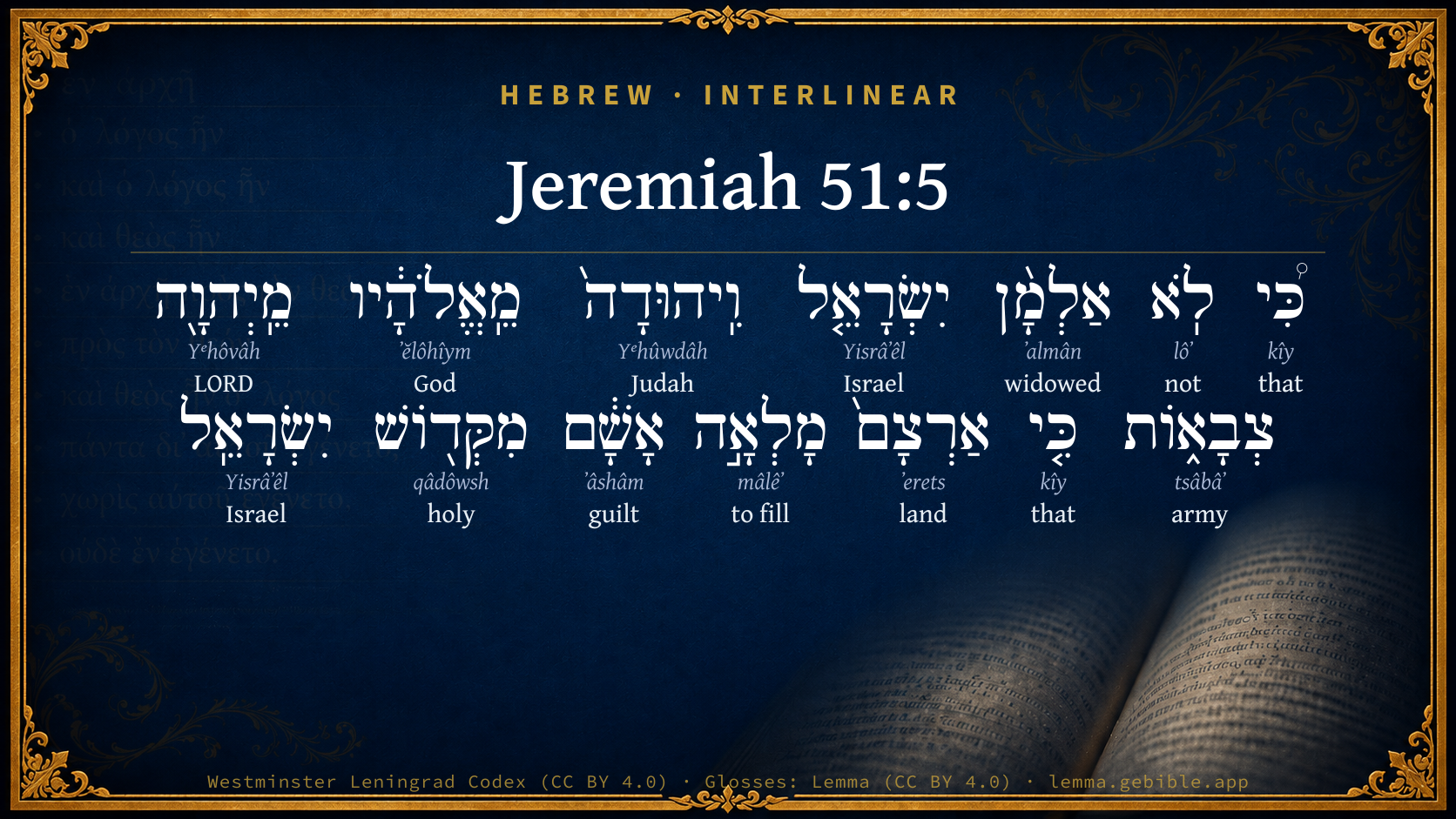
Hebrew (Westminster Leningrad Codex) Jeremiah 51:5 appears in the Hebrew Old Testament. The text above is from the Westminster Leningrad Codex. Each word links to its Strong’s number, a concise gloss, and parsing drawn from the Open Scriptures Hebrew Bible morphology. Click any word for its full Brown-Driver-Briggs (BDB) entry.
Download image
Cite this verse

Jeremiah 51:5 (World English Bible). Public Domain. Lemma interlinear Bible study tool, https://lemma.gebible.app/v/jeremiah/51/5.

Show BibTeX & RIS
BibTeX
RIS
English Translation
For Israel is not forsaken, nor Judah, of his God, of Yahweh of Hosts; though their land is full of guilt against the Holy One of Israel.
World English Bible · Public Domain
Highlights
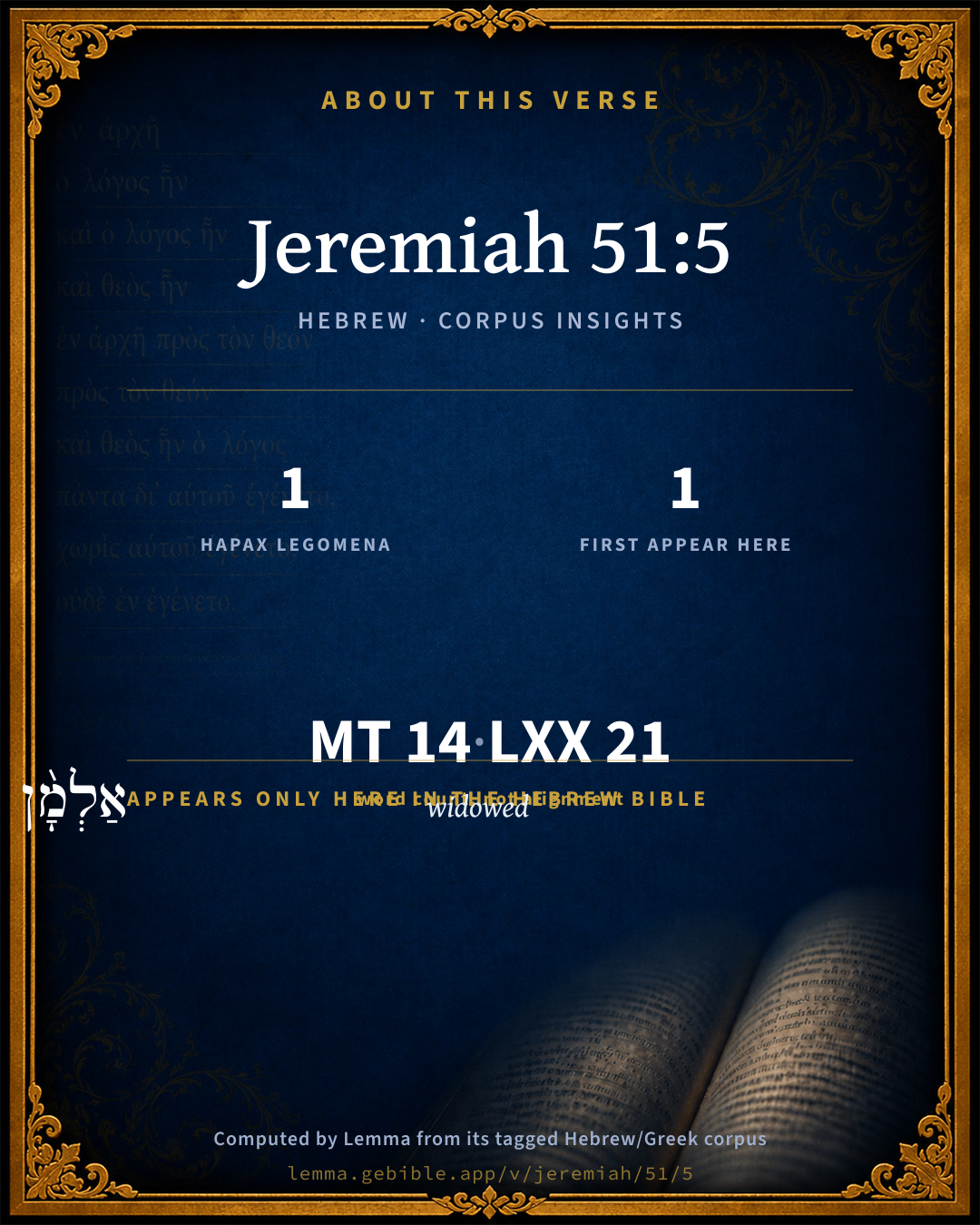
  • 1 hapax legomenon — only here in the Hebrew Bible
  • 1 first appearance in the Hebrew Bible
Full analysis ↓
Download a study sheet

One document with this verse’s original text, its word-by-word gloss line, the meaning frame, cross-references with their text, attributed commentary, and full source and license credits — printable, and it pastes into notes with its structure intact.

This verse Autodidact and up

Study sheet (.html) Plain text (.txt)

A passage Seminary Student

Up to 50 verses in one chapter. A passage sheet keeps up to 6 commentary sources and 12 cross-references per verse, in the order this page ranks them, and says so on the sheet whenever that leaves anything out. Ask for a single verse and you get the Autodidact verse sheet above.

Everything on this page stays free to read, with no account — the sheet is a download of what is already on screen, not access to it.

Want to remove ads? Support Godless Engineer
Compare translations 3

The same verse in 3 English versions, stacked beneath the original-language interlinear above. Click any original word for its lexicon entry.

Each is an independent rendering of the whole verse — the interlinear is not word-aligned to these translations.

Highlighted words mark where these versions differ — a whole-verse word diff, not a word-by-word alignment.

  • World English Bible Public Domain
    For Israel is not forsaken, nor Judah, of his God, of Yahweh of Hosts; though their land is full of guilt against the Holy One of Israel.
  • King James Version Public Domain
    For Israel hath not been forsaken, nor Judah of his God, of the LORD of hosts; though their land was filled with sin against the Holy One of Israel.
  • unfoldingWord Literal Text CC BY-SA 4.0
    For Israel and Judah are not forsaken by their God, by Yahweh of hosts, although their land is filled with offenses committed against the Holy One of Israel.

unfoldingWord Literal Text — © unfoldingWord, licensed CC BY-SA 4.0. Word-aligned USFM3 via Door43 (git.door43.org/unfoldingWord/en_ult).

Versions to compare (up to 4)

3 of 4 selected

Show all 18 translations

Every available English version of this verse, each an independent rendering of the whole verse.

  • World English Bible Public Domain
    For Israel is not forsaken, nor Judah, of his God, of Yahweh of Hosts; though their land is full of guilt against the Holy One of Israel.
  • Berean Standard Bible Public Domain
    For Israel and Judah have not been abandoned by their God, the LORD of Hosts, though their land is full of guilt before the Holy One of Israel.”
  • Majority Standard Bible Public Domain
    For Israel and Judah have not been abandoned by their God, the LORD of Hosts, though their land is full of guilt before the Holy One of Israel.”
  • King James Version Public Domain
    For Israel hath not been forsaken, nor Judah of his God, of the LORD of hosts; though their land was filled with sin against the Holy One of Israel.
  • American Standard Version (1901) Public Domain
    For Israel is not forsaken, nor Judah, of his God, of Jehovah of hosts; though their land is full of guilt against the Holy One of Israel.
  • Revised Version (1885) Public Domain
    For Israel is not forsaken, nor Judah, of his God, of the LORD of hosts; though their land is full of guilt against the Holy One of Israel.
  • Geneva Bible (1599) Public Domain
    For Israel hath bene no widowe, nor Iudah from his God, from the Lord of hostes, though their lande was filled with sinne against the holy one of Israel.
  • Douay-Rheims (1899) Public Domain
    For Israel and Juda have not been forsaken by their God the Lord of hosts: but their land hath been filled with sin against the Holy One of Israel.
  • Young's Literal Translation Public Domain
    For, not forsaken is Israel and Judah, By its God -- by Jehovah of Hosts, For their land hath been full of guilt, Against the Holy One of Israel.
  • Literal Standard Version CC BY-SA 4.0
    For Israel and Judah are not forsaken || By his God—by YHWH of Hosts, || For their land has been full of guilt, || Against the Holy One of Israel.
  • Unlocked Literal Bible CC BY-SA 4.0
    For Israel and Judah are not forsaken by their God, by Yahweh of hosts, although their land is filled with offenses committed against the Holy One of Israel.
  • unfoldingWord Literal Text CC BY-SA 4.0
    For Israel and Judah are not forsaken by their God, by Yahweh of hosts, although their land is filled with offenses committed against the Holy One of Israel.
  • Darby Bible Public Domain
    For Israel is not forsaken, nor Judah of his God, of Jehovah of hosts; for their land is full of guilt against the Holy One of Israel.
  • World Messianic Bible Public Domain
    For Israel is not forsaken, nor Judah, by his God, by the LORD of Hosts; though their land is full of guilt against the Holy One of Israel.
  • Webster's Bible Public Domain
    For Israel hath not been forsaken, nor Judah by his God, by the LORD of hosts; though their land was filled with sin against the Holy One of Israel.
  • Free Bible Version CC BY-SA 4.0
    Israel and Judah have not been deserted by their God, the Lord Almighty, even though they sinned against the Holy One of Israel everywhere in their country.
  • Bible in Basic English Public Domain
    For Israel has not been given up, or Judah, by his God, by the Lord of armies; for their land is full of sin against the Holy One of Israel.
  • JPS Tanakh (1917) Public Domain
    For Israel is not widowed, nor Judah, of his God, of the LORD of hosts; for their land is full of guilt against the Holy One of Israel.

Literal Standard Version (2020), Covenant Press — licensed CC BY-SA 4.0. Text via the HelloAO Bible API (eBible.org). Unlocked Literal Bible (unfoldingWord) — licensed CC BY-SA 4.0. Text via the HelloAO Bible API (eBible.org). unfoldingWord Literal Text — © unfoldingWord, licensed CC BY-SA 4.0. Word-aligned USFM3 via Door43 (git.door43.org/unfoldingWord/en_ult). Free Bible Version, Dr. Jonathan Gallagher — licensed CC BY-SA 4.0. Text via the HelloAO Bible API (eBible.org).

Word by word

More ways to search: Search by grammar → Find every occurrence → Compare this word →

Practice this passage: Drill this verse → Learn its vocabulary →

אַלְמָ֨ן
ʼalmân
H488
“widowed”
Adjective, Adjective, Masculine, Singular, Absolute
Part of Speech
Adjective
Type
Adjective
Gender
Masculine
Number
Singular
State
Absolute
Full BDB Definition

Origin: prolonged from H481 in the sense of bereavement

TWOT: 103

widowed, forsaken, forsaken as a widow
  1. כִּ֠י kîy H3588 “that” Conjunction
  2. לֹֽא lôʼ H3808 “not” Particle, Negative
  3. יִשְׂרָאֵ֤ל Yisrâʼêl H3478 “Israel” Noun, Proper
  4. וִֽיהוּדָה֙ Yᵉhûwdâh H3063 “and · Judah” Conjunction + Noun, Proper
  5. מֵֽאֱלֹהָ֔יו ʼĕlôhîym H430 “from · God(s) · his” Preposition + Noun, Common, Masculine, Plural, Construct + Suffix, Personal, 3rd Person, Masculine, Singular
  6. מֵֽיְהוָ֖ה Yᵉhôvâh H3068 “from · LORD” Preposition + Noun, Proper
  7. צְבָא֑וֹת tsâbâʼ H6635 “armies” Noun, Common, Both, Plural, Absolute
  8. כִּ֤י kîy H3588 “that” Conjunction
  9. אַרְצָם֙ ʼerets H776 “land · their” Noun, Common, Both, Singular, Construct + Suffix, Personal, 3rd Person, Masculine, Plural
  10. מָלְאָ֣ה mâlêʼ H4390 “to fill” Verb, Qal, Perfect, 3rd Person, Feminine, Singular
  11. אָשָׁ֔ם ʼâshâm H817 “guilt” Noun, Common, Masculine, Singular, Absolute
  12. מִקְּד֖וֹשׁ qâdôwsh H6918 “from · holy of” Preposition + Adjective, Adjective, Masculine, Singular, Construct
  13. יִשְׂרָאֵֽל Yisrâʼêl H3478 “Israel” Noun, Proper

About this verse

These counts appear in no published source. They are computed here, from the morphology-tagged text and Lemma’s own curated glosses. What Lemma adds →

14
words
12
distinct lemmas
Prophets
section

Notable vocabulary

1 hapax legomenon — a word that appears only here in the entire Hebrew Bible:

  • אַלְמָ֨ן widowed H488

First appearance in Scripture

This word makes its first canonical appearance in the Hebrew Bible here:

  • אַלְמָ֨ן widowed H488

Shared distinctive vocabulary

אָשָׁ֔ם guilt H817 occurs in 41 verses of the Hebrew Bible. Also found in:

Grammatical profile

  • 1 verb
  • 8 nouns
  • 2 adjectives
  • 2 conjunctions
  • 1 particle

Verb forms

  • מָלְאָ֣ה Qal · Perfect

Repetition

Words recur within this verse — often emphatic in Hebrew:

  • יִשְׂרָאֵ֤ל Israel H3478 ×2
  • כִּ֠י that H3588 ×2

Hebrew & Septuagint length

In the original languages it is 14 Hebrew tokens and 21 Greek tokens — but the two are counted differently (Hebrew bundles its prefixes and suffixes into one token; the Greek is in lemma form), so that isn’t a like-for-like length.

Cross-references

30

Topical passages linked to Jeremiah 51:5 in the Treasury of Scripture Knowledge — connected by theme and wording, ordered by reader-vote popularity; previews shown in the World English Bible.

  • Romans 11:1–2 I ask then, Did God reject his people? May it never be! For I also am an Israelite, a descendant of Abraham, of the tribe of Benjamin.
  • Hosea 4:1 Hear the word of Yahweh, you children of Israel; For Yahweh has a charge against the inhabitants of the land: "Indeed there is no truth, Nor goodness, Nor knowledge of God in the land.
  • Zechariah 12:6 In that day I will make the chieftains of Judah like a pan of fire among wood, and like a flaming torch among sheaves; and they will devour all the surrounding peoples, on the right hand and on the left; and Jerusalem will yet again dwell in their own place, even in Jerusalem.
  • Zechariah 12:8 In that day Yahweh will defend the inhabitants of Jerusalem. He who is feeble among them at that day will be like David, and the house of David will be like God, like the angel of Yahweh before them.
  • 1 Samuel 12:22 For Yahweh will not forsake his people for his great name's sake, because it has pleased Yahweh to make you a people to himself.
  • Ezra 9:9 For we are bondservants; yet our God has not forsaken us in our bondage, but has extended loving kindness to us in the sight of the kings of Persia, to give us a reviving, to set up the house of our God, and to repair the ruins of it, and to give us a wall in Judah and in Jerusalem.
  • Psalms 94:14 For Yahweh won't reject his people, Neither will he forsake his inheritance.
  • Isaiah 44:21 Remember these things, Jacob, and Israel; for you are my servant: I have formed you; you are my servant: Israel, you shall not be forgotten by me.
  • Isaiah 49:14–15 But Zion said, Yahweh has forsaken me, and the Lord has forgotten me.
  • Isaiah 54:3–11 For you shall spread aboard on the right hand and on the left; and your seed shall possess the nations, and make the desolate cities to be inhabited.
  • Isaiah 62:12 They shall call them The holy people, The redeemed of Yahweh: and you shall be called Sought out, A city not forsaken.
  • Jeremiah 16:18 First I will recompense their iniquity and their sin double, because they have polluted my land with the carcasses of their detestable things, and have filled my inheritance with their abominations.
  • Jeremiah 19:4 Because they have forsaken me, and have estranged this place, and have burned incense in it to other gods, that they didn't know, they and their fathers and the kings of Judah; and have filled this place with the blood of innocents,
  • Jeremiah 23:15 Therefore thus says Yahweh of Hosts concerning the prophets: Behold, I will feed them with wormwood, and make them drink the water of gall; for from the prophets of Jerusalem is ungodliness gone forth into all the land.
  • Jeremiah 31:37 Thus says Yahweh: If heaven above can be measured, and the foundations of the earth searched out beneath, then will I also cast off all the seed of Israel for all that they have done, says Yahweh.
  • Jeremiah 33:24–26 Don't you consider what this people has spoken, saying, The two families which Yahweh did choose, he has cast them off? thus do they despise my people, that they should be no more a nation before them.
  • Jeremiah 46:28 Don't be afraid you, O Jacob my servant, says Yahweh; for I am with you: for I will make a full end of all the nations where I have driven you; but I will not make a full end of you, but I will correct you in measure, and will in no way leave you unpunished.
  • Jeremiah 50:4–5 In those days, and in that time, says Yahweh, the children of Israel shall come, they and the children of Judah together; they shall go on their way weeping, and shall seek Yahweh their God.
  • Jeremiah 50:20 In those days, and in that time, says Yahweh, the iniquity of Israel shall be sought for, and there shall be none; and the sins of Judah, and they shall not be found: for I will pardon them whom I leave as a remnant.
  • Ezekiel 8:17 Then he said to me, Have you seen [this], son of man? Is it a light thing to the house of Judah that they commit the abominations which they commit here? for they have filled the land with violence, and have turned again to provoke me to anger: and, behold, they put the branch to their nose.
  • Ezekiel 9:9 Then said he to me, The iniquity of the house of Israel and Judah is exceeding great, and the land is full of blood, and the city full of wrestling [of judgment]: for they say, Yahweh has forsaken the land, and Yahweh doesn't see.
  • Ezekiel 22:24–31 Son of man, tell her, You are a land that is not cleansed, nor rained on in the day of indignation.
  • Hosea 1:10 Yet the number of the children of Israel will be as the sand of the sea, which can't be measured nor numbered; and it will come to pass that, in the place where it was said to them, 'You are not my people,' they will be called 'sons of the living God.'
  • Amos 9:8–9 Behold, the eyes of the Lord Yahweh are on the sinful kingdom, and I will destroy it from off the surface of the earth; except that I will not utterly destroy the house of Jacob," says Yahweh.
  • Micah 7:18 Who is a God like you, who pardons iniquity, And passes over the disobedience of the remnant of his heritage? He doesn't retain his anger forever, Because he delights in loving kindness.
  • Micah 7:20 You will give truth to Jacob, and mercy to Abraham, As you have sworn to our fathers from the days of old.
  • Zephaniah 3:1–4 Woe to her who is rebellious and polluted, the oppressing city!
  • Zechariah 2:12 Yahweh will inherit Judah as his portion in the holy land, and will again choose Jerusalem.
  • 1 Kings 6:13 I will dwell among the children of Israel, and will not forsake my people Israel.
  • 2 Kings 21:16 Moreover Manasseh shed innocent blood very much, until he had filled Jerusalem from one end to another; besides his sin with which he made Judah to sin, in doing that which was evil in the sight of Yahweh.

Cross-references courtesy of OpenBible.info (CC BY 4.0).

Hebrew and Greek witnesses Masoretic Hebrew ↔ Greek Septuagint

The same verse in the two great witnesses to the Old Testament, shown verse-for-verse.

These are two independent witnesses, not word-aligned to each other, and the Septuagint is shown in lemma (dictionary) form.

Hebrew Jeremiah 51:5 Masoretic · Westminster Leningrad Codex

כִּ֠י לֹֽא אַלְמָ֨ן יִשְׂרָאֵ֤ל וִֽיהוּדָה֙ מֵֽאֱלֹהָ֔יו מֵֽיְהוָ֖ה צְבָא֑וֹת כִּ֤י אַרְצָם֙ מָלְאָ֣ה אָשָׁ֔ם מִקְּד֖וֹשׁ יִשְׂרָאֵֽל

For Israel is not forsaken, nor Judah, of his God, of Yahweh of Hosts; though their land is full of guilt against the Holy One of Israel.

World English Bible · Public Domain

Greek LXX Structure differs

In the Septuagint, Jeremiah is about an eighth shorter than the Hebrew and arranges its material differently — the Oracles Against the Nations (Hebrew chapters 46–51) appear in the middle of the Greek book, after 25:13. Because the chapter and verse boundaries do not line up, a verse-for-verse comparison with the Hebrew is not shown.

A verse-for-verse comparison isn’t shown here because the chapters and verses don’t line up. Switch to the LXX edition with the MT / LXX toggle above to read the Greek directly.

Hebrew: Westminster Leningrad Codex (CC BY 4.0). Greek: Septuagint (public domain); English from a public-domain English Septuagint. How the Septuagint differs from the Hebrew →

Targum (Aramaic paraphrase)

1

The Targum is the ancient Jewish Aramaic paraphrase of the Hebrew Scriptures — an interpretive translation, not the Hebrew text itself. Onkelos (literal) and Pseudo-Jonathan (expansive) render the Torah, and Jonathan the Prophets. Coverage is partial: where no permissively-licensed English translation exists for a verse, only the Aramaic is shown. This is verse-level text, not a word-by-word alignment to the Hebrew.

  1. Targum Jonathan Prophets (Joshua–Malachi)
    אֲרֵי לָא שְׁבִיקִין בֵּית יִשְׂרָאֵל וִיהוּדָה מֵאֱלָהָהוֹן מַיָי צְבָאוֹת אֲרֵי אַרְעֲהוֹן אִתְמְלִיאַת חֲיָבֵי קְטוֹל מִמֵימַר קַדִישָׁא דְיִשְׂרָאֵל:

    (no public-domain English translation for this verse)

    Targum Jonathan — Aramaic: “Mikraot Gedolot” (public domain). English: “Sefaria Community Translation” (CC0 1.0 (public-domain dedication)); “London "Chaldee Paraphrase," 1871” (public domain). Text via Sefaria.

Commentary

Notes on Jeremiah 51:5 from classic Christian and Jewish commentators (each source and its license shown beneath its notes). The classic Christian expositions comment on the surrounding passage and are grouped to its opening verse, so a note may address several verses; the Jewish commentaries on the Tanakh (Rashi and others) are per-verse, so they appear only where the commentator wrote on this verse.

Lemma curates 59 commentaries, every one of them public domain or Creative Commons licensed, each selected and text-cleaned for this edition rather than reprinted as found. About our sources →

Trapp's Complete Commentary

John Trapp

Jer 51:5 For Israel [hath] not [been] forsaken, nor Judah of his God, of the LORD of hosts; though their land was filled with sin against the Holy One of Israel.

Ver. 5. For Israel hath not been forsaken.] Heb., Widowed.

Though their land was filled with sin.] Heb., Guilt, or delinquency, or devastation. The Scripture hath been fully made good to us of this nation, while the fulness of sin in us hath not yet abated the fulness of grace in God toward us. See those four gracious yets, Zec 1:17. {See Trapp on "Zec 1:17"}

John Trapp, A Commentary or Exposition upon All the Books of the Old and New Testament (1647–1656) — public domain. Text from a community e-Sword module.

The Biblical Illustrator

Joseph S. Exell

Jer_51:5

For Israel hath not been forsaken, nor Judah of his God.

Israel and Judah not forsaken

You would think, according to the teaching of some, that Christ s members kept lopping off something like the limbs of lobsters, and that new ones were constantly growing. There is nothing in Scripture to warrant such a notion as that. You remember Mr. Bunyans parable of a child who is in a room, and a stranger comes in, and says, Come hither, child, I will cut off thy finger. No, says the child. Yes, but I will; I will take off your little finger. Here is a knife, I will cut off your little finger. No, again says the child, and begins to cry. Oh, but, says the stranger, that is a poor little finger that you have. I will cut it off and I will buy you a gold finger, such a brave gold finger. I will put it on your hand instead of your little finger. Oh, says the child, but it would not be my finger; I cannot lose my little finger. Whereupon Mr. Bunyan says, If Christ could have better people than those He has, He would not make the change, for, saith He, they are not My people; they are not a part of My own living self. So the Lord Jesus would not change you for a golden saint, for one much better than you axe. That new finger would not be what the Father gave him, nor what He bought with His precious blood. Thou shalt not be forgotten of Me, means that God will never cease to love His servants. (C. H. Spurgeon.)

Gods people not forgotten or forsaken

Before the siege of Paris Gustave Dore had nearly finished one of his greatest paintings, one of the finest pictures which has ever been produced. Having to fly from the city, on a sudden, as the Germans were coming up, he hid his picture in a cellar, down under a heap of rubbish. When the siege was over, Dore came back to Paris, and of course when he returned he had forgotten all about his picture, had he not? Not he; he had taken too much trouble with it to forget it. He knew the value of it, and he knew where he had put it. He did not have to go up and down the house and say to the people, Do you know where my picture is? No! he never forgot where he had himself put it, so he found it where it was hidden, brought it out to the light of day, and finished it. Now, in a far higher sense than that, God will have respect unto the works of His own hands. The very bodies of the saints, though they were hidden away for a while in the rubbish of the earth, He will fetch out, and He will complete the works of grace which He has begun upon each one of them. The Lord hath formed us to be His servants, we shall not be forgotten of Him. (C. H. Spurgeon.)

The Biblical Illustrator, edited by Joseph S. Exell (c. 1880s–1900s) — public domain. Text from a community e-Sword module.

Keil & Delitzsch

C. F. Keil & F. Delitzsch

Because of the righteousness of Israel, Babylon is to be irretrievably destroyed. Jer 51:5. "For Israel is not forsaken, nor Judah of his God, of Jahveh of hosts; but their land is full of guilt because of the Holy One of Israel. Jer 51:6. Flee out of the midst of Babylon, and save ye every one his life: do not perish for her iniquity; because it is a time of vengeance for Jahveh; He renders to her what she has committed. Jer 51:7. Babylon [was] a golden cup in the hand of Jahveh, that intoxicated all the earth. Nations have drunk of her wine, therefore nations are mad. Jer 51:8. Babylon has fallen suddenly and been broken: howl over her: take balsam for her pain; perhaps she may be healed. Jer 51:9. 'We have tried to heal Babylon, but she is not healed. Leave her, and let us go each one to his own land; for her judgment reaches unto heaven, and is lifted up to the clouds.' Jer 51:10. Jahveh hath brought forth our righteousnesses; come, and let us declare in Zion the doing of Jahveh our God. Jer 51:11. Sharpen the arrow, fill the shields: Jahveh hath roused the spirit of the kings of Media; for His counsel is against Babylon, to destroy it; because it is the vengeance of Jahveh, the vengeance of His temple. Jer 51:12. Against the walls of Babylon raise a standard; strengthen the watch, set watchmen, prepare the ambushes: for Jahveh hath both devised and done what He spake against the inhabitants of Babylon. Jer 51:13. O thou that dwellest upon many waters, rich in treasures, thine end hath sworn by Himself, 'Surely I have filled thee with men, as [with] the locust; and they shall raise a shout of joy against thee.'"

The offence of Babylon against the Holy One of Israel demands its destruction. In Jer 51:5, two reasons are given for God's determination to destroy Babylon. The Lord is induced to this (1) by His relation to Israel and Judah, whom Babylon will not let go; (2) by the grave offence of Babylon. Israel is לא אלמן, "not widowed," forsaken by his God; i.e., Jahveh, the God of hosts, has not rejected His people for ever, so as not to trouble Himself any more about them; cf. Isa 50:1; Isa 54:4. "Their land" - the land of the Chaldeans - "is full of guilt before the Holy One of Israel," partly through their relation to Israel (Jer 50:21), partly through their idolatry (Isa 50:2, 38). מן does not mean here "on the side of," but "on account of," because they do not acknowledge Jahveh as the Holy One of Israel.

Jer 51:6

In order to escape the punishment that is to fall on the guilt-laden city, the Israelites living in Babylon must flee to save their lives; cf. Jer 50:8, and on the mode of expression, Jer 48:6. "Be not destroyed בּעונהּ, for her iniquity," (בּ of price), not "in her guilt" = punishment for sin (Graf), or "through her guilt" (Ngelsbach). Both of these last two views are against the context; for the idea is, that Israel must flee to save his life, and that he too may not atone for the guilt of Babylon. On the expression, "It is a time of vengeance," etc., cf. Jer 50:15, Isa 34:8. גּמוּל , as in Isa 59:18; Isa 66:6. גּמוּל, prop. accomplishment, actual proof, is used both of human and divine doing and working, of human misdeeds and divine recompense. הוּא is used emphatically.

Jer 51:7-10

Babylon, certainly, in its former power and greatness, was a golden goblet, by means of which Jahveh presented to the nations the wine of His wrath, and intoxicated them; but now it is fallen, and broken without remedy. Isa 21:9 finds an echo in the expression, "Babylon is fallen." The figure of the cup refers us back to Jer 25:15., where, however, it is applied in a different way. The cup is said to be of gold, in order to point out the splendour and glory of Nebuchadnezzar's dominion. "In the hand of Jahveh," i.e., used by Him as His instrument for pouring out His wrath to the nations. But Babylon has suddenly fallen and been broken in pieces. At this point Jeremiah drops the figure of the cup, for a golden cup does not break when it falls. The fall is so terrible, that the nations in Babylon are summoned to participate in the lamentation, and to lend their aid in repairing her injuries. But they answer that their attempts to heal her are fruitless. (On צרי, cf. Jer 46:11 and Jer 8:22.) The terrible and irreparable character of the fall is thus expressed in a dramatic manner. We must neither think of the allies and mercenaries as those who are addressed (Schnurrer, Rosenmller, Maurer, Hitzig), nor merely the Israelites who had been delivered from Babylon (Umbreit). The latter view is opposed by the words which follow, "Let every one go to his own country;" this points to men out of different lands. And the former assumption is opposed by the consideration that not merely the mercenaries, but also the allies are to be viewed as fallen and ruined together with Babylon, and that Babylon, which had subdued all the nations, has no allies, according to the general way in which the prophet views these things. Those addressed are rather the nations that had been vanquished by Babylon and detained in the city, of which Israel was one. Inasmuch as these were the servants of Babylon, and as such bound to pay her service, they are to heal Babylon; and because the attempts to heal her prove fruitless, they are to leave the ruined city. They answer this summons by the resolve, "We will go every one to his own land;" cf. Jer 50:8, Jer 50:16. The motive for this resolution, "for her guilt reaches up to heaven," certainly shows that it is Israelites who are speaking, because it is only they who form their opinions in such a way; but they speak in the name of all the strangers who are in Babylon. משׁפּט is the matter upon which judgment is passed, i.e., the transgression, the guilt, analogous to משׁפּט דּמים, Eze 7:23, and משׁפּט מות , Deu 19:6; Deu 21:22; it does not mean the punishment adjudged, of which we cannot say that it reaches up to heaven. On this expression, cf. Psa 57:11; Psa 108:5. Through the fall of Babylon, the Lord has made manifest the righteousness of Israel; the redeemed ones are to proclaim this in Zion. צדקות does not mean "righteous acts" (Jdg 5:11), but proofs of the righteousness of Israel as opposed to Babylon, which righteousness Babylon, through tyrannical oppression of the people that had been delivered up to it merely for chastisement, has failed to perceive, and which, so long as the Lord did not take His people to Himself again in a visible manner, was hidden from the world; cf. Psa 37:6.

Jer 51:11-12

The instruments which the Lord employs in bringing about the fall of Babylon are the kings of the Medes, i.e., the provincial governors, or heads of the separate provinces into which the Medes in ancient times were divided, until, after revolting from the Assyrians in the year 714 b.c., they put themselves under a common head, in order to assert their independence, and chose Dejokes as their monarch. See Speigel's Ern (1863, S. 308ff.), and Delitzsch on Isa 13:17, who rightly remarks that in Isa 13:17, as well as here, מדי is a general designation for the Aryan tribes of Iran, taken from the most important and influential nation. In Jer 21:2, Isaiah mentions Elam in the first series, along with Media, as a conqueror of Babylon; and the Babylonian kingdom was destroyed by Darius the Mede and Cyrus the Persian. But the Persians are first named in the Old Testament by Ezekiel and Daniel, while the name "Elam" as a province of the Persian kingdom is gradually lost, from the times of Cyrus onwards, in that of the "Persians." The princes of Media are to prepare themselves for besieging and conquering Babylon. הבר (from בּרר), prop. to polish, cleanse from dirt and rust. The arrows are thereby sharpened; cf. Isa 49:2. מלאוּ השּׁלטים is variously explained. The meaning of "shields" is that best established for שּׁלטים (see on Sa2 8:7); while the meaning of "armour equipment," which is defended by Thenius, is neither very suitable for Sa2 8:7 nor for Kg2 11:10 and Sol 4:4. There is no the least foundation for the meaning "quiver," which is assumed merely for this passage. מלאוּ is to be explained in accordance with the analogous expression in Kg2 9:24, מלּא ידו בקשׁת, "he filled his hand with the bow," i.e., seized the bow. "Fill the shields" with your bodies, or with your arms, since we put these among the straps of the shields. Those addressed are the kings of the Medes, whose spirit God has stirred up to make war against Babylon; for it is against her that His mind or plan is directed. As to the expression, "for it is the vengeance of Jahveh," etc., cf. Jer 50:15, Jer 50:28. The attack is to be directed against the walls of Babylon. נס, "standard," is the military sign carried before the army, in order to show them the direction they are to take, and the point of attack. משׁמר "watch," is the force besieging the city; cf. Sa2 11:16. "Make the watch strong," i.e., enclose the city firmly. This is more exactly specified in the following clauses. "Set watches," not as a guard for their own camp (Hitzig), but against the city, in order to maintain a close siege. "Place the ambushes," that they may peep into the city whenever a sally is made by the besieged; cf. Jos 8:14., Jdg 20:33. "For what Jahveh hath determined, He will also perform." גּם־גּם, "as well as:" He has resolved as well as done, i.e., as He has resolved, He also executes.

Jer 51:13

All the supports of the Babylonian power, its strong position on the Euphrates, and its treasures, which furnished the means for erecting strong fortifications, cannot avert the ruin decreed by God. As to the form שׁכנתּי, see on Jer 22:23. It is the city with its inhabitants that is addressed, personified as a virgin or daughter. The many waters on which Babylon dwells are the Euphrates, with the canals, trenches, dykes, and marches which surrounded Babylon, and afforded her a strong protection against hostile attacks, but at the same time contributed to increase the wealth of the country and the capital.

(Note: Duncker, Gesch. d. Alterth. i. S. 846, remarks: "The fertility of the soil of Babylon - the produce of the fields - depended on the inundations of the Euphrates. By means of an extensive system of dykes, canals, and river-walls, Nebuchadnezzar succeeded not only in conducting the water of the Euphrates to every point in the plain of Babylon, but also in averting the formation of marshes and the occurrence of floods (which were not rare), as well as regulating the inundation." The purpose for which these water-works were constructed, was "first of all, irrigation and navigation; but they at the same time afforded strong liens of defence against the foe" (Niebuhr, Gesch. Assyr. u. Bab. S. 219). See details regarding these magnificent works in Duncker, S. 845ff.; Niebuhr, S. 218ff.)

The great riches, however, by which Babylon became רבּת אוצרות, "great in treasures," so that Aeschylus (Pers. 52) calls it Βαβυλῶν ἡ πολύχρυσος, were derived from the enormous spoils which Nebuchadnezzar brought to it, partly from Nineveh, partly from Jerusalem, and from the tribute paid by Syria and the wealthy commercial cities of Phoenicia. "Thine end is come;" cf. Gen 6:13. אמּת בּצעך, "the ell (i.e., the measure) of thy gain," i.e., the limit put to thine unjust gain. The words are connected with "thine end is come" by zeugma. This explanation is simpler than the interpretation adopted by Venema, Eichhorn, and Maurer, from the Vulgate pedalis praecisionis tuae, viz., "the ell of cutting thee off." Bttcher (Proben, S. 289, note m) seeks to vindicate the rendering in the following paraphrase: "The ell at which thou shalt be cut off, like something woven or spun, when it has reached the destined number of ells." According to this view, "ell" would stand for the complete number of the ells determined on; but there is no consideration of the question whether בּצע, "to cut off the thread of life," Isa 38:12, can be applied to a city.

Jer 51:14

The Lord announces destruction to Babylon with a solemn oath. Many take כּי אם in the sense of אם לא in oaths: "truly, certainly." But this use of the expression is neither fully established, nor suitable in this connection. In Sa2 15:21 (the only passage that can be cited in its behalf), the meaning "only" gives good enough sense. Ewald (356, b) wrongly adduces Kg2 5:20 in support of the above meaning, and three lines below he attributes the signification "although" to the passage now before us. Moreover, the asseveration, "Verily I have filled thee with men as with locusts, and they shall sing the Hedad over thee," can have a suitable meaning only if we take "I have filled thee" prophetically, and understand the filling with men as referring to the enemy, when the city has been reduced (Hitzig). But to fill a city with men hardly means quite the same as to put a host of enemies in it. כּי serves merely to introduce the oath, and אם means "although," - as, for instance, in Job 9:15. The meaning is not, "When I filled thee with men, as with locusts, the only result was, that a more abundant wine-pressing could be obtained" (Ngelsbach), for this though is foreign to the context; the meaning rather is, "Even the countless multitudes of men in Babylon will not avail it" (Ewald), will not keep it from ruin. הידד, the song sung at the pressing of wine, is, from the nature of the case, the battle-song; see on Jer 25:30.

Keil & Delitzsch — Biblical Commentary on the Old Testament (1861–1891) — public domain (CC PDM 1.0). Text via the HelloAO Bible API. (Old Testament only.)

Tyndale Open Study Notes

Tyndale Open Resources

51:5 Although the Israelites had committed many sins against the Holy One, he was still their God, and he planned to save them.

Tyndale Open Study Notes — © Tyndale Open Resources, licensed CC BY-SA 4.0. Text via the HelloAO Bible API.

Geneva Bible (1599)

Geneva Bible translators

Though they were forsaken for a time, yet they were not utterly cast off as though their husbands were dead.

Geneva Bible (1599) marginal notes — public domain. Text via Bolls.life.

Jamieson, Fausset & Brown

Robert Jamieson, A. R. Fausset & David Brown

forsaken--as a widow (Hebrew). Israel is not severed from her husband, Jehovah (Isa 54:5-7), by a perpetual divorce.

though . . . sin--though the land of Israel has been filled with sin, that is, with the punishment of their sin, devastation. But, as the Hebrew means "for," or "and therefore," not "though," translate, "and therefore their (the Chaldeans') land has been filled with (the penal consequences of) their sin" [GROTIUS].

Jamieson, Fausset & Brown — Commentary Critical and Explanatory on the Whole Bible (1871) — public domain (CC PDM 1.0). Text via the HelloAO Bible API.

Adam Clarke's Commentary

Verse 5. For Israel hath not been forsaken] God still continued his prophets among them; he had never cast them wholly off. Even in the midst of wrath - highly deserved and inflicted punishment, he has remembered mercy; and is now about to crown what he has done by restoring them to their own land. I conceive אשם asham, which we translate sin, as rather signifying punishment, which meaning it often has.

Adam Clarke's Commentary on the Bible (1810–1826) — public domain. Text from a community e-Sword/MySword module.

John Calvin's Commentaries

The Prophet shows here the cause why God had resolved to treat the Babylonians with so much severity, even because he would be the avenger of his own people. He also obviates a doubt which might have disturbed weak minds, for he seemed to have forsaken his people when he suffered them to be driven into exile. As this was a kind of repudiation, as we have seen elsewhere, the Prophet says now, that Israel had not been wholly widowed, nor Judah, by his God; as though he had said, that the Jews and the Israelites were indeed, for a time, like widows, but this was not to be perpetual. For, as we have said, the divorce was temporary, when God so forsook his Temple and the city, that the miserable people was exposed to plunder. As long, then, as the will of their enemies prevailed, God seemed to have forsaken his people. It is of this widowhood that the Prophet now speaks; but he yet testifies that Israel would not be wholly widowed by Jehovah his God.

He indeed alludes to that spiritual marriage, of which frequent mention is made; for God had, from the beginning, united the Church to himself, as it were, by a marriage-bond; and the people, as it is well known, had been so received into covenant, that there was contracted, as it were, a spiritual marriage. Then the Prophet now says, that they were not widowed; in which he refers to the hope of deliverance; for it could not have been denied but that God had repudiated his people. But he shows that their chastisement would not be perpetual, because God would at length reconcile to himself the people from whom he had been alienated, and would restore them to the ancient condition and honor of a wife. He speaks of both kingdoms.

Then he adds, by Jehovah of hosts By this title he sets forth the power of God, as though he had said, that as God is faithful in his promises, and constantly keeps his covenant, so he is not destitute of power, so as not to be able to save his people and to rescue them, when it pleases him, from death itself. He confirms this truth, when he says, for the land of the Chaldeans is filled with sin on account of the Holy One of Israel, as though he had said, that the land was abominable, because it carried on war against God.: For when he speaks of the Holy One of Israel, he shows that God had such a care for his people that he was prepared, when the suitable time came, to show himself as their avenger. We now perceive what the Prophet means when he says, that Chaldea was filled with sin, even because it provoked God when it thought that the wrong was done only to men. It follows, —

John Calvin's Commentaries (1540-1563) — public domain. Text from the Calvin Translation Society English edition (1840s-50s) via the Christian Classics Ethereal Library (ccel.org). Calvin's coverage is partial (roughly two-thirds of the Bible); uncommented books and verses are honest gaps, never fabricated. The 19th-century editor's footnotes and remarks are omitted so the notes are faithfully Calvin's own voice.

Ellicott's Commentary for English Readers

(5) Israel hath not been forsaken.—Better, widowed. The participle is from the word that commonly represents the idea of widowhood. Judah and Israel, the prophet declares, were not, as men thought, abandoned by their husband Jehovah. He was still their protector. The prophet has in his thoughts at once the image of apparent widowhood, as in Isa_50:1; Isa_54:4-6; Lam_1:1, and the thought that Jehovah is, after all, as the husband ready to forgive (Jer_3:4; Jer_3:14; Jer_3:20; Jer_4:1). The assurance of this returning love does not rest on any plea in extenuation of the nation’s guilt, which the words that follow admit without reserve. For “his” it would be better to read her or their, as keeping up the metaphor.

Against the Holy One of Israel.—On Jeremiah’s use of the name, see Note on Jer_50:29.

A Bible Commentary for English Readers, edited by Charles John Ellicott (1878–1897) — public domain. Text from a community e-Sword module.

The Cambridge Bible for Schools and Colleges

gen. ed. J. J. S. Perowne

5. forsaken] lit. widowed, cp. Isa_54:4. The word is masculine, contrary to the figure (e.g. Jer_2:2) where Israel is the wife, and Jehovah the husband.

though their land, etc.] i.e. in spite of the guilt of the people of Jehovah. The Heb. conjunction, however, is better rendered for, and “their land” understood to be Chaldaea. In that case we should (with Co.) transpose the two parts of the v.

The Cambridge Bible for Schools and Colleges (gen. ed. J. J. S. Perowne; Cambridge University Press, 1878–1918) — public domain. Text from a community e-Sword module.

John Gill's Exposition

For Israel hath not been forsaken, nor Judah of his God,

of the Lord of hosts,.... That is, not totally and finally; for though they might seem to be forsaken, when carried captive by their enemies, yet they were not in such sense as a woman is deprived of her husband when dead, and she is become a widow, as the word (d) used may signify; or when divorced from him; or as children are deprived of their parents, and become orphans; but so it was not with Israel; for thought they were under the frowns of Providence, and the resentment of God they had sinned against, yet the relation between them still subsisted; he was their covenant God and Father, their husband and protector, and who would vindicate them, and avenge them on their enemies:

though their land was filled with sin against the Holy One of Israel; which was the reason why they were carried captive, and so seemed to be forsaken of God; or though their land was filled with punishment, with devastation and destruction, yet nevertheless God would appear for them, and restore that and them unto it; or rather this is to be understood of the land of the Chaldeans, as it is by Jarchi and Kimchi; and be rendered, "for their land is filled with punishment for sin, from", or "by", or "because of the Holy One of Israel" (e); by which it appears, that the people of God were not forsaken by him, and were not without a patron and defender of them; since it was a plain case that the land of the Chaldeans was filled with the punishment of the sword and other calamities by the Holy One of Israel, because of the sins they had committed against him, and the injuries they had done to his people. So the Targum,

"for their land is filled with, (punishment for) the sins of murder, by the word of the Holy One of Israel.''

(d) "viduus, sive viduatus", Vatablus, Calvin, Montanus; "ut vidua", Pagninus; "orbus", Schmidt. (e) "quia terra illorum repleta est delicto, sive reatu, vel poena", Grotius; so some in Gataker. "a Sancto Israelis", Montanus, Schmidt; "propter Sanctum Israelis", Vatablus, Calvin, Cocceius; so Ben Melech.

John Gill's Exposition of the Whole Bible (1746–1763) — public domain (CC PDM 1.0). Text via the HelloAO Bible API.

Haydock's Catholic Bible Commentary

Forsaken, as a widow, viduatus. (Haydock) --- God still considers the nation as his spouse. --- Their land. That of the Chaldeans, (Calmet) or of the Jews. (Theodoret) --- Sin, or punishment.

George Leo Haydock (1774–1849), Haydock's Catholic Family Bible and Commentary, 1859 edition — public domain. Excludes Psalms (Douay-Rheims chapter numbering differs from Protestant) and Deuterocanonical books (Catholic canon only).

Matthew Poole's English Annotations

That is, not, utterly forsaken, for in a sense they were forsaken as to some gradual manifestations of God’s love to them, but Judah and Israel were not left as a widow, or were not divorced from God. The word translated sin signifies a most heinous sinning, or desolation, and the best interpreters judge that sin here signifieth the punishment of sin. God hath not forsaken the Jews utterly, though as they were formerly filled with grievous sins, so they be now filled with grievous judgments because of their sins.

Matthew Poole's English Annotations on the Holy Bible (1683–1685) — public domain. Text from a community e-Sword/MySword module.

The Pulpit Commentary

Vers. 5-14. The covenant between Jehovah and Israel is one reason why Babylon must fall; and Babylon"s own guilt is another. Hence pity is out of place. Here liveth piety where pity ends; Can any man be guilty more than he Whose bias with the doom of God contends? (Dante, "Inferno," 20:28, Cayley.)

Flee, therefore, lest ye be involved in Babylon"s ruin. For Jehovah"s purpose of vengeance cannot be reversed.

Hath not been forsaken. The Hebrew is much more forcible, "is not widowed alluding to the fundamental Old Testament idea of a mystic marriage between God and his people. (comp. Isa_50:1 Isa_54:4-6 Ho 2) Was filled with sin; rather, with guilt (Hebrew, asham).

MILETICS. Ver. 5. "Suffering, but not forsaken.

Israel is not forsaken because she is driven from her home. Babylon is not more favoured because she flourishes for a season as a "golden cup in the Lord"s hand." For the land of the Chaldeans is filled with sin against the Holy One of Israel. Thus the truth is quite contrary to appearances.

I WHEN GOD CHASTISES HIS PEOPLE HE MUST NOT BE THOUGHT TO HAVE FORSAKEN THEM. The chastisement is for their own good. It is, therefore, a proof that God has not neglected them. Instead of being an indication of hatred or indifference, chastisement is a sign of God"s love. Moreover, when his people suffer God is peculiarly near to them. Those captives who hung their harps on the willows by the rivers of Babylon found God more present than he had been to the careless sinful Jews who assembled in the courts of his temple. It is to be remembered that God is near to us when we do not perceive him, and often nearest in those dark hours when bitterness of soul prevents us from having any comforting hope in him.

II THOUGH GOD WILL CHASTISE HIS PEOPLE HE WILL NEVER FORSAKE THEM. This is a further step. Not only is the chastisement no proof of God"s having forsaken his people, but in no case will he forsake them; no such proof can ever be found. True, they may be separated from God and may become "castaways;" but this is only because they forsake him. He is ever true to his side of the covenant. Let us, therefore, be prepared to expect the chastisement, but also be well settled in faith that the far worse trouble, the neglect of our souls by God, can never come.

III OUTWARD CIRCUMSTANCES ARE NO INDICATIONS OF OUR RELATIONS WITH GOD. The great contrast between Israel and Babylon furnishes a striking instance of this truth. It is strange. For one would have thought that the outward and inward life would harmonize. So they will ultimately. Then the "golden cup" will be broken and the suffering child of God exalted to honour. But now the world is in confusion, evil is allowed a certain liberty for the consequent discipline of good, and thus the sufferers may be near to God while the fortunate and happy are far away in sin.

HOMILIES BY A.F. MUIR Ver. 5. Divine love not to be severed from its object.

A marvelous statement. A down-trodden, sinful remnant of his people, who had broken every engagement of his covenant, is still owned and cared for.

I A PROOF OF THE FAITHFULNESS AND LONG SUFFERING MERCY OF GOD.

1. Having entered into covenant relations with Israel, he will not withdraw from them, even although their portion of the agreement has not been kept. He remains faithful, notwithstanding human unfaithfulness. The awful guilt of the elect nation cannot invalidate the obligations God has imposed upon himself. He is ready, therefore, at any moment to fulfil these when the conditions are complied with.

2. But it is rather to be taken as illustrating Divine mercy. The purposes of his love are never laid aside. He devises schemes of salvation when we are yet sinners.

3. Though hidden from human eyes, Divine love works continually and through all things. It was hard for mere men to see the favour of God in such times. Many of the Israelites themselves, doubtless, imagined themselves forsaken. Yet was redemption nearer to them in Babylon than when at Jerusalem they insulted and disobeyed him. "All things work together for good to them that love God," ere.; "Though he slay me, yet will I trust in him". (Job_13:15)

II A REVELATION FULL OF WARNING AND ENCOURAGEMENT.

1. The enemies of the Church are not to presume upon her misfortunes.

2. The Church itself, although cast down and feeble, is to be of good courage, for it is not cast off. Adversity is not forsakenness. "Lo, I am with you alway." There is no room for presumption, for the chastisements of love have greater severities in store for aggravated guilt. But, relying on the grace of God, it may arise and recommence the mission it has forsaken. M.

HOMILIES BY D. YOUNG Ver. 5. Unforsaken Israel.

I AN APPARENT FORSAKING. Israel looked forsaken. It was in exile, in captivity, and under the asserted judgment of Jehovah. We have always, to a certain extent, to accept the appearances of things. God"s presence had been manifested in outward favour and prosperity, and what was more plausible than to say that the withdrawing of the favour and prosperity meant the withdrawing of God himself? But then it is forgotten that God"s presence may be manifested in many ways. Outward prosperity is not essential to signify God"s satisfaction with us. Nor must we infer that, because a backsliding Christian has fallen into trouble and misery, therefore God has forsaken him. The signs of man forsaking God are made very clear, so that there may be all possible incentives to repentance; but if God ever does forsake a man, leaving him utterly to his own folly and recklessness, no sign of it is given to us. There is quite enough already in our own wild fancies to make us desponding and despairing.

II A PLAUSIBLE CAUSE FOR FORSAKING. The land of Israel was filled with sin against the Holy One of Israel. Men think of God as they do of themselves. The patience of the human master soon gets exhausted with the servant who disobeys many commandments and obeys others in the most perfunctory way.

III A REAL CAUSE FOR CLOSE ADHERENCE. That Israel, chosen and beloved of God, fills his land with sin, so far from being a reason for forsaking, is a reason for closer adherence than ever. The shepherd leaves the ninety-nine sheep in safety and goes into the wilderness after the lost one. If only men, brought at last to a sense of their wickedness and recklessness, could see how near God is to them, how ready and able to help, they would be filled with hope. "God is love," and therefore the greater our need the greater his nearness. The real difficulty is that we flee to the succours and solaces of self, and so the nearness of Cod, with all his suitable and ample supplies, is only too easily obscured.

IV A FRESH MANIFESTATION OF THE HOLY ONE OF ISRAEL. Never does God"s holiness so appear as when he is dealing with sinners in the way of long suffering, if perchance they will surrender at last and permit him to restore them to righteousness and peace. Surely God"s holiness shines most in his greatest attribute, and that is love. God is marked off from all created things by his power and his righteousness, but most of all by his transcendent love. Here is the most glorious aspect of his holiness, that, no matter how much men may sin against him, neglect his will, and abuse his world, yet, when they are ready to turn, he is close at hand with everything prepared to receive them. Y.

The Pulpit Commentary (1880–1919), ed. H.D.M. Spence-Jones & Joseph S. Exell — public domain. Text from a community e-Sword module.

John Wesley's Explanatory Notes

Forsaken - Not utterly forsaken.

John Wesley, Explanatory Notes Upon the Whole Bible (1754–1765) — public domain. Text via the GEBible commentary corpus.

unfoldingWord translationNotes

Door43 World Missions Community

Israel and Judah are not forsaken by their God, by Yahweh of hosts

The words "Israel" and "Judah" are metonyms for the people of Israel and Judah. This can be translated in active form. AT: "Yahweh of hosts, the God of the people of Israel and Judah, has not forsaken them" (See: Metonymy and Active or Passive)

their land is filled with offenses committed against the Holy One of Israel

The land in which they live is spoken of as if it were a container and their offenses as if they were solid objects that could fill the container. The abstract noun "offenses" can be translated as a verb. AT: "they have offended the Holy One of Israel everywhere throughout the land" (See: Metaphor and Abstract Nouns)

in her iniquity

Babylon is spoken of as if it were a woman. The word "iniquity" is a metonym for God punishing the people for their iniquity. AT: "when Yahweh punishes Babylon" (See: Metaphor and Metonymy)

will repay all of it to her

Babylon is spoken of as if it were a woman, and the iniquity of the people is spoken of as if Yahweh needed to pay back a debt. The word "her," meaning Babylon, is a metonym for the people of Babylon. AT: "will punish the Babylonians as much as they deserve" (See: Metaphor and Metonymy)

translationWords

Israel

Judah

forsake

God

Yahweh of hosts

Holy One

save

perish

iniquity

avenge

unfoldingWord translationNotes — © Distant Shores Media and the Door43 World Missions Community, licensed CC BY-SA 4.0. Source: git.door43.org/Door43/en_tn.

Rashi

Rabbi Shlomo Yitzchaki (Rashi)

For Israel is not widowed He has not forgotten him to avenge him.

for their land of the Chaldeans.

Rashi on the Tanakh — English translations: “The Judaica Press complete Tanach with Rashi, translated by A. J. Rosenberg” (CC BY 4.0); “Pentateuch with Rashi's commentary by M. Rosenbaum and A.M. Silbermann, 1929-1934” (public domain); “The Metsudah Tanach series, Lakewood, N.J” (CC BY 4.0); and “The Book of Joshua, Metsudah Publications, 1997” (CC BY 4.0). Text via Sefaria.

Lesson kit

Teaching starters — assembled from the data on this page, not authored interpretation. Every prompt links to the verse data it draws on. Edit before teaching.

Jeremiah, in the Prophets, opens this verse with 14 words (12 distinct Hebrew lemmas). Its most distinctive word is ʼalmân (“widowed”). A historical commentator’s framing appears above. Read the whole chapter for the surrounding context.

Discussion questions

  1. How does “widowed” (ʼalmân) shape what this verse is saying?
  2. This verse holds 1 word here found nowhere else in the Hebrew Bible. What might the rare word draw attention to?
  3. The word “widowed” first appears here in Scripture. What is being introduced at this debut?
  4. Genesis 26:10 shares the word «guilt» with this verse. How do the two illuminate each other?
  5. “Israel” occurs 2× in this one verse. What is the effect of the repetition?
  6. The translations on this page render this verse differently — a whole-verse word diff, not a word-by-word alignment. What might account for the different wordings?
  7. The verb «מָלְאָ֣ה» is Qal Perfect. How does its form color the action?
  8. Reading how Trapp's Complete Commentary and The Biblical Illustrator read this verse, where do the two commentators agree and where do they part?

Things to notice

  • 1 word in this verse appears nowhere else in the Hebrew Bible.
  • 1 word makes its first canonical appearance in Scripture here.
  • This verse counts 14 Hebrew ↔ 21 Greek words.
  • These translations choose different wording for 11 words in this verse.
  • “Israel” occurs 2× in this single verse.

Reading settings

Reading text

Shown beneath each verse's original-language words.

Old Testament
Old Testament edition

Read the OT as the Masoretic Hebrew (MT) or the Greek Septuagint (LXX).

English shown for the Greek Septuagint (in the Hebrew ↔ Greek comparison).

Comparing translations? Open the Compare panel on any verse page to stack up to four side by side.