
Isaiah 40:25

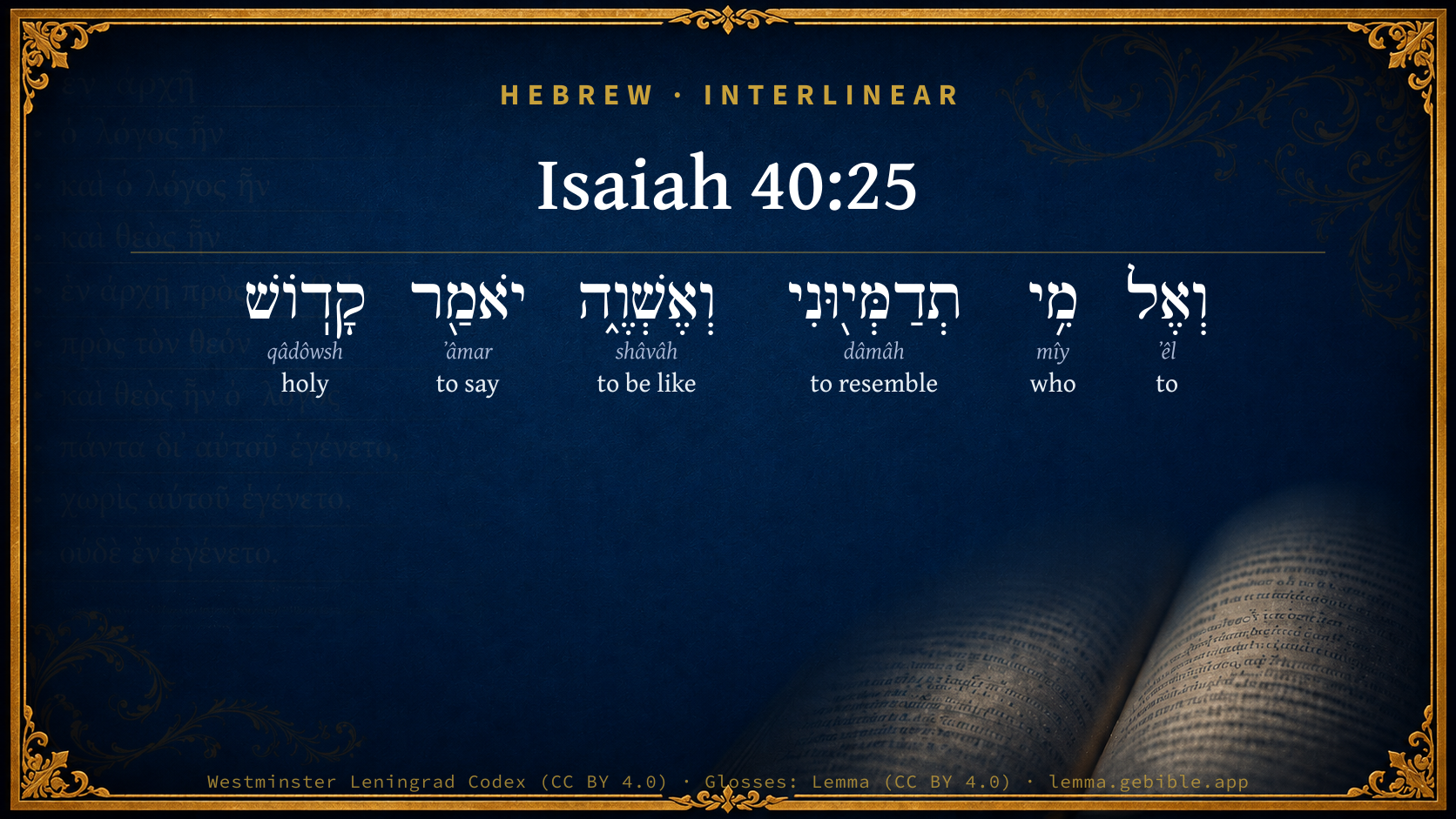
Hebrew (Westminster Leningrad Codex) Isaiah 40:25 appears in the Hebrew Old Testament. The text above is from the Westminster Leningrad Codex. Each word links to its Strong’s number, a concise gloss, and parsing drawn from the Open Scriptures Hebrew Bible morphology. Click any word for its full Brown-Driver-Briggs (BDB) entry.
Download image
Cite this verse

Isaiah 40:25 (World English Bible). Public Domain. Lemma interlinear Bible study tool, https://lemma.gebible.app/v/isaiah/40/25.

Show BibTeX & RIS
BibTeX
RIS
English Translation
To whom then will you liken me, that I should be equal [to him]? says the Holy One.
World English Bible · Public Domain
Download a study sheet

One document with this verse’s original text, its word-by-word gloss line, the meaning frame, cross-references with their text, attributed commentary, and full source and license credits — printable, and it pastes into notes with its structure intact.

This verse Autodidact and up

Study sheet (.html) Plain text (.txt)

A passage Seminary Student

Up to 50 verses in one chapter. A passage sheet keeps up to 6 commentary sources and 12 cross-references per verse, in the order this page ranks them, and says so on the sheet whenever that leaves anything out. Ask for a single verse and you get the Autodidact verse sheet above.

Everything on this page stays free to read, with no account — the sheet is a download of what is already on screen, not access to it.

Want to remove ads? Support Godless Engineer
Compare translations 3

The same verse in 3 English versions, stacked beneath the original-language interlinear above. Click any original word for its lexicon entry.

Each is an independent rendering of the whole verse — the interlinear is not word-aligned to these translations.

Highlighted words mark where these versions differ — a whole-verse word diff, not a word-by-word alignment.

  • World English Bible Public Domain
    To whom then will you liken me, that I should be equal [to him]? says the Holy One.
  • King James Version Public Domain
    To whom then will ye liken me, or shall I be equal? saith the Holy One.
  • unfoldingWord Literal Text CC BY-SA 4.0
    “So to whom will you liken me, that I should be equal?” says the Holy One.

unfoldingWord Literal Text — © unfoldingWord, licensed CC BY-SA 4.0. Word-aligned USFM3 via Door43 (git.door43.org/unfoldingWord/en_ult).

Versions to compare (up to 4)

3 of 4 selected

Show all 18 translations

Every available English version of this verse, each an independent rendering of the whole verse.

  • World English Bible Public Domain
    To whom then will you liken me, that I should be equal [to him]? says the Holy One.
  • Berean Standard Bible Public Domain
    “To whom will you liken Me, or who is My equal?” asks the Holy One.
  • Majority Standard Bible Public Domain
    “To whom will you liken Me, or who is My equal?” asks the Holy One.
  • King James Version Public Domain
    To whom then will ye liken me, or shall I be equal? saith the Holy One.
  • American Standard Version (1901) Public Domain
    To whom then will ye liken me, that I should be equal `to him'? saith the Holy One.
  • Revised Version (1885) Public Domain
    To whom then will ye liken me, that I should be equal to him? saith the Holy One.
  • Geneva Bible (1599) Public Domain
    To whom nowe will ye liken me, that I should be like him, saith the Holy one?
  • Douay-Rheims (1899) Public Domain
    And to whom have ye likened me, or made me equal, saith the Holy One?
  • Young's Literal Translation Public Domain
    And unto whom do ye liken Me, And `am' I equal? saith the Holy One.
  • Literal Standard Version CC BY-SA 4.0
    And to whom do you liken Me, || And [to whom] I equal? Says the Holy One.
  • Unlocked Literal Bible CC BY-SA 4.0
    “To whom then will you compare me, whom do I resemble?” says the Holy One.
  • unfoldingWord Literal Text CC BY-SA 4.0
    “So to whom will you liken me, that I should be equal?” says the Holy One.
  • Darby Bible Public Domain
    To whom then will ye liken me, or shall I be equal? saith the Holy One.
  • World Messianic Bible Public Domain
    “To whom then will you liken me? Who is my equal?” says the Holy One.
  • Webster's Bible Public Domain
    To whom then will ye liken me, or shall I be equaled? saith the Holy One.
  • Free Bible Version CC BY-SA 4.0
    “Who are you going to compare me with? Who is equal to me?” asks the Holy One.
  • Bible in Basic English Public Domain
    Who then seems to you to be my equal? says the Holy One.
  • JPS Tanakh (1917) Public Domain
    To whom then will ye liken Me, that I should be equal? saith the Holy One.

Literal Standard Version (2020), Covenant Press — licensed CC BY-SA 4.0. Text via the HelloAO Bible API (eBible.org). Unlocked Literal Bible (unfoldingWord) — licensed CC BY-SA 4.0. Text via the HelloAO Bible API (eBible.org). unfoldingWord Literal Text — © unfoldingWord, licensed CC BY-SA 4.0. Word-aligned USFM3 via Door43 (git.door43.org/unfoldingWord/en_ult). Free Bible Version, Dr. Jonathan Gallagher — licensed CC BY-SA 4.0. Text via the HelloAO Bible API (eBible.org).

Word by word

More ways to search: Search by grammar → Find every occurrence → Compare this word →

Practice this passage: Drill this verse → Learn its vocabulary →

וְאֶשְׁוֶ֑ה
shâvâh
H7737
“and · to be like”
Conjunction + Verb, Qal, Imperfect, 1st Person, Common, Singular
Part of Speech
Conjunction + Verb
Stem
Qal
Form
Imperfect
Person
1st Person
Gender
Common
Number
Singular
Full BDB Definition

Origin: a primitive root

TWOT: 2342 , 2343

to agree with, be or become like, level, resemble - (Qal) - to be like - equivalent (participle) - to set, place - setting (participle) - (Piel) to level, smooth, still - (Hiphil) to make like - (Nithpael) to be alike - (Piel) to set, place
  1. וְאֶל ʼêl H413 “and · to” Conjunction + Preposition
  2. מִ֥י mîy H4310 “who” Particle, Interrogative
  3. תְדַמְּי֖וּנִי dâmâh H1819 “to resemble · me” Verb, Piel, Imperfect, 2nd Person, Masculine, Plural + Suffix, Personal, 1st Person, Common, Singular
  4. יֹאמַ֖ר ʼâmar H559 “to say” Verb, Qal, Imperfect, 3rd Person, Masculine, Singular
  5. קָדֽוֹשׁ qâdôwsh H6918 “holy” Adjective, Adjective, Masculine, Singular, Absolute

About this verse

These counts appear in no published source. They are computed here, from the morphology-tagged text and Lemma’s own curated glosses. What Lemma adds →

6
words
6
distinct lemmas
Prophets
section

Notable vocabulary

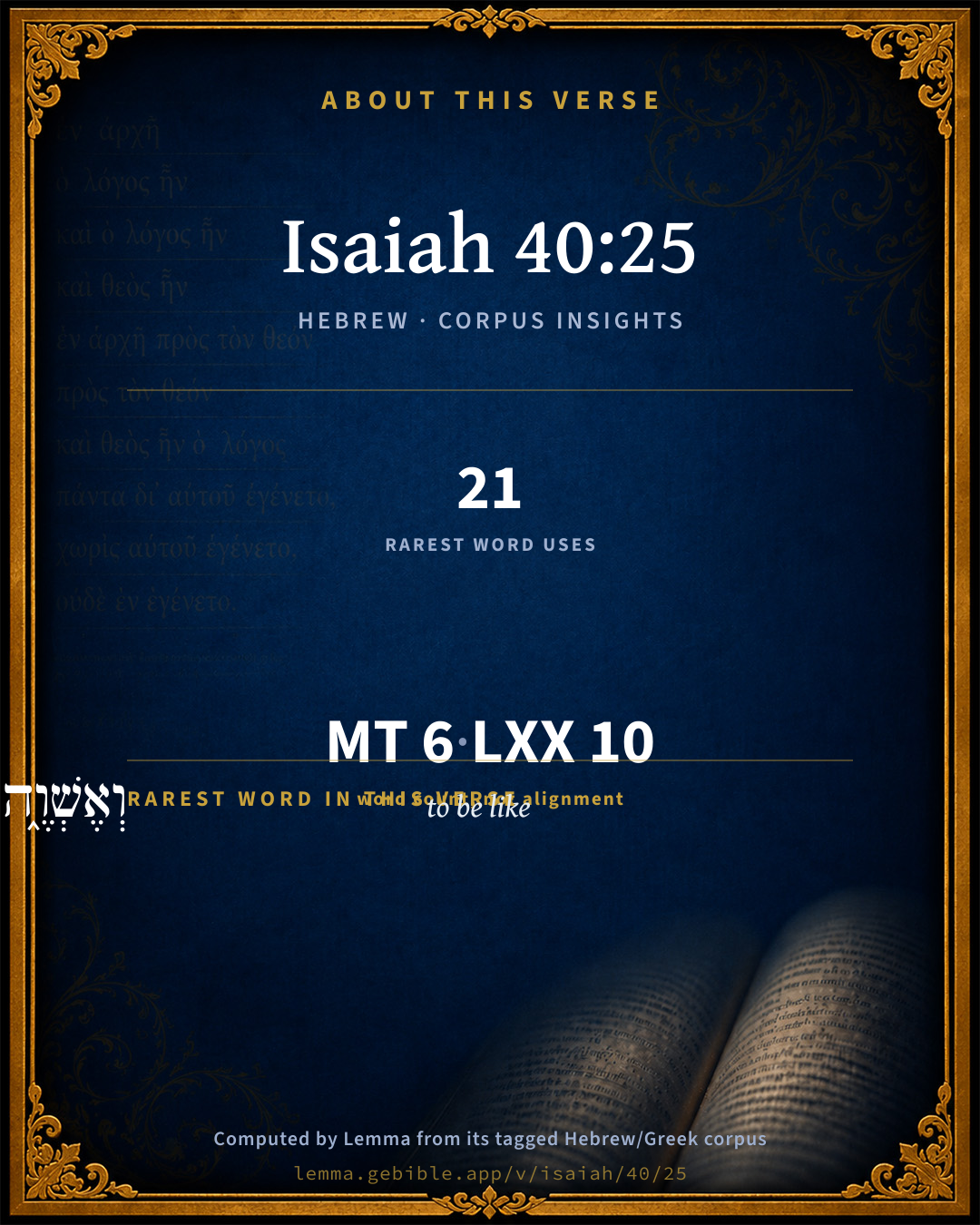
The rarest word here is וְאֶשְׁוֶ֑ה to be like H7737 — appearing just 21 times in the whole Hebrew Bible.

Shared distinctive vocabulary

וְאֶשְׁוֶ֑ה to be like H7737 occurs in 21 verses of the Hebrew Bible. Also found in:

Grammatical profile

  • 3 verbs
  • 1 adjective
  • 1 preposition
  • 1 particle

Verb forms

  • תְדַמְּי֖וּנִי Piel · Imperfect
  • וְאֶשְׁוֶ֑ה Qal · Imperfect
  • יֹאמַ֖ר Qal · Imperfect

Hebrew & Septuagint length

In English translation the verse runs 18 words from the Hebrew and 17 from the Septuagint (LXX English) — closely comparable.

A rough comparison of the two English renderings, which tokenize alike — not a word-level alignment.

Word counts can differ between the Hebrew and the Greek without any difference in meaning — e.g. the Hebrew direct-object marker אֵת has no separate Greek word, and Greek often adds the article ὁ.

In the original languages it is 6 Hebrew tokens and 10 Greek tokens — but the two are counted differently (Hebrew bundles its prefixes and suffixes into one token; the Greek is in lemma form), so that isn’t a like-for-like length.

Cross-references

4

Topical passages linked to Isaiah 40:25 in the Treasury of Scripture Knowledge — connected by theme and wording, ordered by reader-vote popularity; previews shown in the World English Bible.

  • Isaiah 40:18 To whom then will you liken God? or what likeness will you compare to him?
  • Deuteronomy 4:15–18 Take therefore good heed to yourselves; for you saw no manner of form on the day that Yahweh spoke to you in Horeb out of the midst of the fire.
  • Deuteronomy 4:33 Did ever a people hear the voice of God speaking out of the midst of the fire, as you have heard, and live?
  • Deuteronomy 5:8 "You shall not make an engraved image for yourself, [nor] any likeness [of anything] that is in heaven above, or that is in the earth beneath, or that is in the water under the earth:

Cross-references courtesy of OpenBible.info (CC BY 4.0).

Hebrew and Greek witnesses Masoretic Hebrew ↔ Greek Septuagint

The same verse in the two great witnesses to the Old Testament, shown verse-for-verse.

These are two independent witnesses, not word-aligned to each other, and the Septuagint is shown in lemma (dictionary) form.

Hebrew Isaiah 40:25 Masoretic · Westminster Leningrad Codex

וְאֶל מִ֥י תְדַמְּי֖וּנִי וְאֶשְׁוֶ֑ה יֹאמַ֖ר קָדֽוֹשׁ

To whom then will you liken me, that I should be equal [to him]? says the Holy One.

World English Bible · Public Domain

Greek LXX Isaiah 40:25 Septuagint · lemma form

νῦν οὖν τίς ἐγώ ὁμοιόω καί ὑψόω εἶπον ὁ ἅγιος

Now then to whom have you⌃ compared me, that I may be exalted? says the Holy One.

LXX2012 (modern English Septuagint) · Public Domain

Hebrew: Westminster Leningrad Codex (CC BY 4.0). Greek: Septuagint (public domain); English from LXX2012 (modern English Septuagint) (Public Domain). How the Septuagint differs from the Hebrew →

Targum (Aramaic paraphrase)

1

The Targum is the ancient Jewish Aramaic paraphrase of the Hebrew Scriptures — an interpretive translation, not the Hebrew text itself. Onkelos (literal) and Pseudo-Jonathan (expansive) render the Torah, and Jonathan the Prophets. Coverage is partial: where no permissively-licensed English translation exists for a verse, only the Aramaic is shown. This is verse-level text, not a word-by-word alignment to the Hebrew.

  1. Targum Jonathan Prophets (Joshua–Malachi)
    וּלְמַן תְּדַמוּן קֳדָמַי וּתְשַׁווֹן יֵימַר קַדִישָׁא:

    To whom, then, will ye liken me? and to whom will ye equal me? saith the Holy One.

    Targum Jonathan — Aramaic: “Mikraot Gedolot” (public domain). English: “Sefaria Community Translation” (CC0 1.0 (public-domain dedication)); “London "Chaldee Paraphrase," 1871” (public domain). Text via Sefaria.

Commentary

Notes on Isaiah 40:25 from classic Christian and Jewish commentators (each source and its license shown beneath its notes). The classic Christian expositions comment on the surrounding passage and are grouped to its opening verse, so a note may address several verses; the Jewish commentaries on the Tanakh (Rashi and others) are per-verse, so they appear only where the commentator wrote on this verse.

Lemma curates 59 commentaries, every one of them public domain or Creative Commons licensed, each selected and text-cleaned for this edition rather than reprinted as found. About our sources →

Trapp's Complete Commentary

John Trapp

Isa 40:25 To whom then will ye liken me, or shall I be equal? saith the Holy One.

Ver. 25. To whom then will ye liken me?] See Isa 40:18-19.

John Trapp, A Commentary or Exposition upon All the Books of the Old and New Testament (1647–1656) — public domain. Text from a community e-Sword module.

Joseph Benson's Commentary

Isa 40:25-26. To whom then will ye liken me — He repeats what he said Isa 40:18, that he might oblige them to the more serious and frequent consideration of the absurdity of idolatry. Lift up your eyes on high — To the high and starry heaven, as appears from the following words. Who created these things — Which you see on high? The host of heaven, as it follows. That bringeth out their host — That at first brought them out of nothing, and from day to day brings them forth, making them to rise and set in their appointed times; by number — As a general brings forth his army into the field, and there musters them. He calleth them all by names — As a master calleth all the members of his family. For that he is strong — Which work is a certain and evident proof of God’s infinite power; not one faileth — Either to appear when he calls them, or to do the work to which he sends them.

Joseph Benson's Commentary on the Old and New Testaments (1811–1818) — public domain. Text from a community e-Sword module.

Tyndale Open Study Notes

Tyndale Open Resources

40:25 The Holy One is a shortened form of “the Holy One of Israel,” a common designation for God in Isaiah (see also 10:17; 43:15; Ps 22:3).

Tyndale Open Study Notes — © Tyndale Open Resources, licensed CC BY-SA 4.0. Text via the HelloAO Bible API.

Jamieson, Fausset & Brown

Robert Jamieson, A. R. Fausset & David Brown

(Compare Isa 40:18).

Jamieson, Fausset & Brown — Commentary Critical and Explanatory on the Whole Bible (1871) — public domain (CC PDM 1.0). Text via the HelloAO Bible API.

The Cambridge Bible for Schools and Colleges

gen. ed. J. J. S. Perowne

25. To whom then] Exactly as in Isa_40:18, and following a similar idea.

or shall I be equal?] Or, as R.V., “that I should be equal to him?”

the Holy One] Qâdôsh, without the art., almost like a proper name. So Job_6:10; Hab_3:3, and perhaps Psa_22:3.

The Cambridge Bible for Schools and Colleges (gen. ed. J. J. S. Perowne; Cambridge University Press, 1878–1918) — public domain. Text from a community e-Sword module.

John Gill's Exposition

To whom then will ye liken me, or shall I be equal, saith the Holy One? Or be upon a level with? since the greatest of men on earth are brought to nothing by him, and are no more: this is repeated from Isa 40:18 and supported with fresh strength of argument, to show that there is nothing whatever, that is a fit likeness and similitude, by which to represent the Lord.

and supported with fresh strength of argument, to show that there is nothing whatever, that is a fit likeness and similitude, by which to represent the Lord.

Isaiah 40:26

isa 40:26

isa 40:26

isa 40:26Lift up your eyes on high,.... From the earth, and the inhabitants of it, even those of the greatest power and influence in it, to the heavens above, those that are visible to the eye:

and behold who hath created these things; that are seen in the heavens, the sun, moon, and stars; consider the Creator of them, what a glorious Being he must be; what power he must be possessed of; what dazzling light he must dwell in; what glory and majesty he must be clothed with; and how infinitely transcending all mortal creatures he must be:

that bringeth out their host by number; not only into being, at the first creation of them, but at every proper season; causing the sun to rise every morning, the stars to appear at night, and the moon in its revolution; as a general brings forth his army, marshals it in order, musters it, and takes the number of his soldiers:

he calleth them all by names; suitable to their position and influence; he knows the proper names of them all, which no astrologer can pretend unto; and this is such knowledge as no general of an army has; for though the stars are innumerable to men, the names of most unknown, they are all known to him that made them, Psa 147:4,

by the greatness of his might, for that he is strong in power not one faileth; through the omnipotence of God, not only the sun and moon, the great luminaries, are continued in being, and constantly observe their order; but even every star keeps its place, or performs its course, and retains its influence, and in every instance obeys the commands of its Creator; never fails of appearing at his order, and of doing what he appoints it should. Kimchi gives the sense thus, that according to the virtue and efficacy that there is in every star, so is its name; and because of the strength and power that is in everyone of them, they remain unchangeably and unalterably the same as when they were first created; which not only holds true of the sun and moon, but of the stars lesser and greater. The Targum is,

"because of the multitude of strength, and the power of might, not one is hindered from its order;''

wherefore, as there is no likeness on earth, so none in heaven, with which the Lord is to be likened, or to which he can be equalled. This may respect not the might and power of the Lord, in supporting and maintaining these creatures in their being and usefulness; but the strength and power of the mightiest creatures, to hinder their influence and service: for the words may be rendered, "through the multitude of strength", or anyone being "strong in power, not one indeed fails (d)"; or is wanting, that is, through the strength or power of the mightiest creatures, angels or men, the hosts of heaven cannot be stopped in their course, or hindered in their work appointed to do, or be deprived of their being.

(d) "prae multitudine virium, et robore virtutis, ut ne unum quidem deesset", Tigurine version.

John Gill's Exposition of the Whole Bible (1746–1763) — public domain (CC PDM 1.0). Text via the HelloAO Bible API.

Albert Barnes' Notes on the Bible

To whom then will ye liken me? - (See Isa 40:18) The prophet having thus set forth the majesty and glory of God, asks now with great emphasis, what could be an adequate and proper representation of such a God. And if God was such a Being, how great was the folly of idolatry, and how vain all their confidence in the gods which their own hands had made.

Albert Barnes' Notes on the Bible (1834–1885) — public domain. Text from a community e-Sword/MySword module.

Matthew Poole's English Annotations

He repeateth what he said Isa 40:18, that he might oblige them to the more serious and frequent consideration of the absurdity of the idolatry.

Matthew Poole's English Annotations on the Holy Bible (1683–1685) — public domain. Text from a community e-Sword/MySword module.

Whedon's Commentary on the Bible

Daniel D. Whedon

25, 26. To whom… shall I be equal — As compared with miserable idols? The prophet calls for answer. To whom, of all they know, will they now compare the great Jehovah?

Saith the Holy One — A new epithet, perhaps a new attribute, occurs here. Holiness also exalts Jehovah. Job_15:18. He bids them look into starry space, and challenges creator-ship above his own. There is no reply to that challenge from idol worshippers. No one who, besides creating, can know, command, and dispose of all things, is able to be brought forth as competitor with Jehovah. And this Almighty One is likewise the Holy One, the Holy One of Israel. Inference: Let no half-doubter, then, among exiles in Babylon, fear the ability and willingness of such a God to convey and restore his people to Zion.

Daniel D. Whedon (gen. ed.), Commentary on the Old and New Testaments (1874–1909) — public domain. Text from a community e-Sword module.

The Pulpit Commentary

To whom then, etc.? This is a summary, to conclude the section (vers. 19-24), as ver. 18 concludes the preceding one. If God is paramount over idols (vers. 19, 20) and over nature (ver. 22) and over humanity (vers. 23, 24), to whom can he be likened? Is he not altogether unique and incomparable? Saith the Holy One. (comp. Isa_57:15) Isaiah"s special designation of God, at once pregnant and almost peculiar (see the comment on Isa_1:4), is "the Holy One of Israel." This is, here and Isa_57:15, abbreviated.

The Pulpit Commentary (1880–1919), ed. H.D.M. Spence-Jones & Joseph S. Exell — public domain. Text from a community e-Sword module.

Keil & Delitzsch

C. F. Keil & F. Delitzsch

The thought of Isa 40:18 now recurs like a refrain, a conclusion being appended to the premises by means of ו, as was the case there. "And to whom will ye compare me, to whom I can be equal? saith the Holy One." Not haqqâdōsh, because a poetical or oratorical style omits the article wherever it can be dispensed with. The Holy One asks this, and can ask it, because as such He is also exalted above the whole world (Job 15:15; Job 25:5).

Keil & Delitzsch — Biblical Commentary on the Old Testament (1861–1891) — public domain (CC PDM 1.0). Text via the HelloAO Bible API. (Old Testament only.)

J. A. Alexander on Isaiah

Joseph Addison Alexander

“And (now) to whom will ye liken me, and (to whom) shall I be equal? saith the holy One.” He winds up His argument by coming back to the triumphant challenge of v. 18.

Joseph Addison Alexander, The Prophecies of Isaiah (1846–1847; New York: Scribner, 1870–1878) — public domain. Text from a community e-Sword module.

unfoldingWord translationNotes

Door43 World Missions Community

To whom then will you compare me, whom do I resemble?

Yahweh uses two similar rhetorical questions to emphasize that there is no one like him. AT: "There is no one to whom you can compare me. There is no one whom I resemble." (See: Rhetorical Question and Parallelism)

Who has created all these stars?

This is a leading question that anticipates the answer, Yahweh. AT: "Yahweh has created all these stars!" (See: Rhetorical Question)

He leads out their formations

Here the word "formations" refers to military formations. The prophet speaks of the stars as if they were soldiers whom Yahweh commands to appear. (See: Metaphor)

By the greatness of his might and by the strength of his power

The phrases "the greatness of his might" and "the strength of his power" form a doublet that emphasizes Yahweh's power. AT: "By his great might and powerful strength" (See: Doublet)

not one is missing

This negative statement emphasizes the positive. AT: "every one is present" (See: Litotes)

translationWords

Holy One

heaven

create

call

name

might

power

unfoldingWord translationNotes — © Distant Shores Media and the Door43 World Missions Community, licensed CC BY-SA 4.0. Source: git.door43.org/Door43/en_tn.

Ibn Ezra

Rabbi Abraham ibn Ezra

To whom then will you liken me, etc. The prophet addresses the idolatrous people, saying, Are there men more honoured by you than princes and judges? and yet you see that God destroys them in a moment.

ואשוה That I be equal to him.

The holy. God is too holy to be compared with one of His creatures, much less with the products of His creatures.

Ibn Ezra on the Tanakh — English translations: “Sefaria Community Translation” (CC0 1.0 (public-domain dedication)); “Yalkut, Sifsei Chachomim Chumash, Metsudah Publications, 2009” (CC BY 4.0); and “Commentary of Ibn Ezra on Isaiah - trans. by M. Friedlander, 1873” (public domain). Text via Sefaria.

Lesson kit

Teaching starters — assembled from the data on this page, not authored interpretation. Every prompt links to the verse data it draws on. Edit before teaching.

Isaiah, in the Prophets, opens this verse with 6 words (6 distinct Hebrew lemmas). Its most distinctive word is shâvâh (“to be like”). A historical commentator’s framing appears above. Read the whole chapter for the surrounding context.

Discussion questions

  1. How does “to be like” (shâvâh) shape what this verse is saying?
  2. 2 Samuel 22:34 shares the word «to be like» with this verse. How do the two illuminate each other?
  3. These translations render this verse differently. What is at stake in choosing one wording over another?
  4. The verb «תְדַמְּי֖וּנִי» is Piel Imperfect. How does its form color the action?
  5. Reading how Trapp's Complete Commentary and Joseph Benson's Commentary read this verse, where do the two commentators agree and where do they part?

Things to notice

Reading settings

Reading text

Shown beneath each verse's original-language words.

Old Testament
Old Testament edition

Read the OT as the Masoretic Hebrew (MT) or the Greek Septuagint (LXX).

English shown for the Greek Septuagint (in the Hebrew ↔ Greek comparison).

Comparing translations? Open the Compare panel on any verse page to stack up to four side by side.