
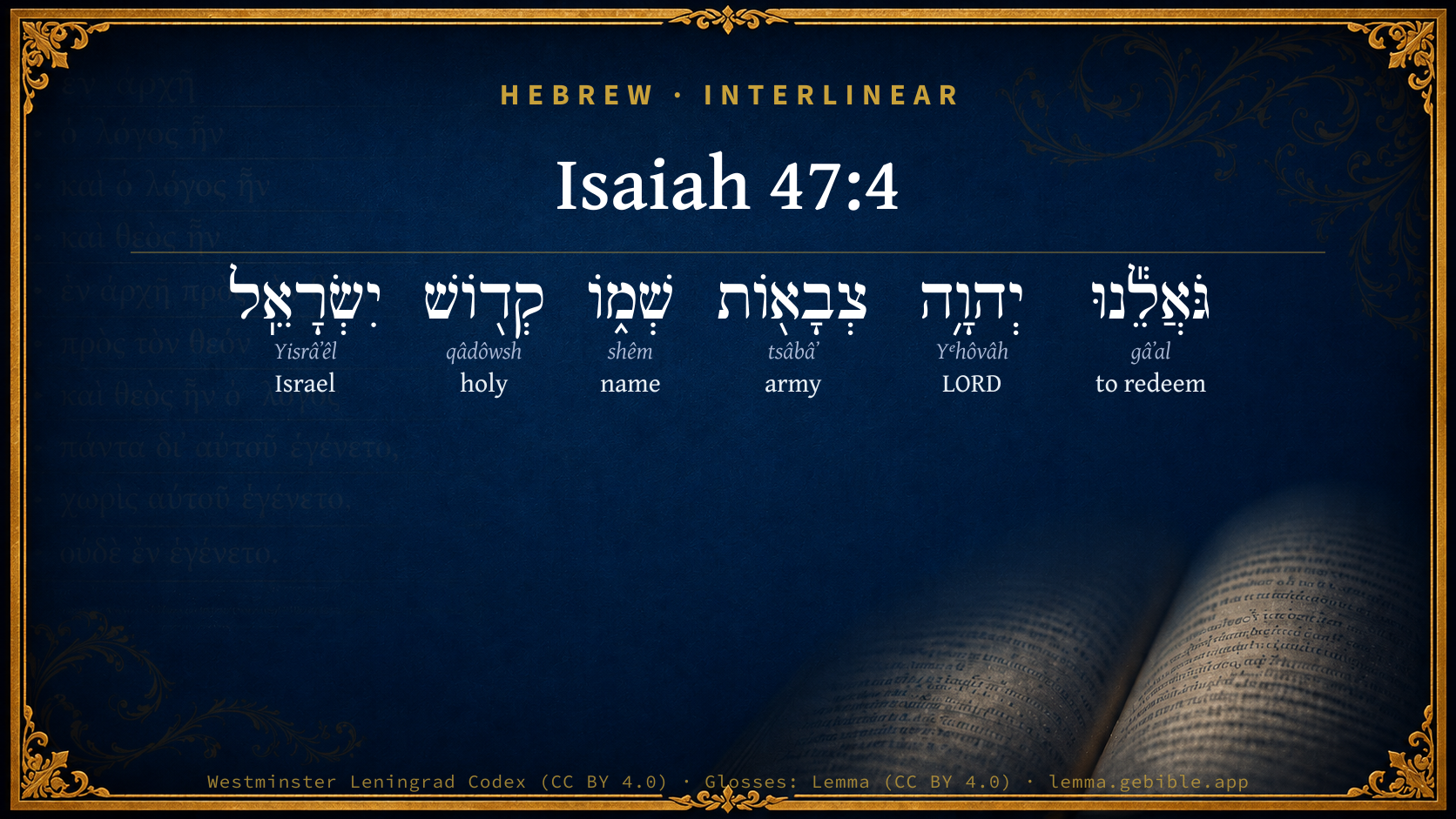
Isaiah 47:4

Hebrew (Westminster Leningrad Codex) Isaiah 47:4 appears in the Hebrew Old Testament. The text above is from the Westminster Leningrad Codex. Each word links to its Strong’s number, a concise gloss, and parsing drawn from the Open Scriptures Hebrew Bible morphology. Click any word for its full Brown-Driver-Briggs (BDB) entry.
Download image
Cite this verse

Isaiah 47:4 (World English Bible). Public Domain. Lemma interlinear Bible study tool, https://lemma.gebible.app/v/isaiah/47/4.

Show BibTeX & RIS
BibTeX
RIS
English Translation
Our Redeemer, Yahweh of hosts is his name, the Holy One of Israel.
World English Bible · Public Domain
Download a study sheet

One document with this verse’s original text, its word-by-word gloss line, the meaning frame, cross-references with their text, attributed commentary, and full source and license credits — printable, and it pastes into notes with its structure intact.

This verse Autodidact and up

Study sheet (.html) Plain text (.txt)

A passage Seminary Student

Up to 50 verses in one chapter. A passage sheet keeps up to 6 commentary sources and 12 cross-references per verse, in the order this page ranks them, and says so on the sheet whenever that leaves anything out. Ask for a single verse and you get the Autodidact verse sheet above.

Everything on this page stays free to read, with no account — the sheet is a download of what is already on screen, not access to it.

Want to remove ads? Support Godless Engineer
Compare translations 3

The same verse in 3 English versions, stacked beneath the original-language interlinear above. Click any original word for its lexicon entry.

Each is an independent rendering of the whole verse — the interlinear is not word-aligned to these translations.

Highlighted words mark where these versions differ — a whole-verse word diff, not a word-by-word alignment.

  • World English Bible Public Domain
    Our Redeemer, Yahweh of hosts is his name, the Holy One of Israel.
  • King James Version Public Domain
    As for our redeemer, the LORD of hosts is his name, the Holy One of Israel.
  • unfoldingWord Literal Text CC BY-SA 4.0
    Our Redeemer, Yahweh of Armies his name, the Holy One of Israel. q1

unfoldingWord Literal Text — © unfoldingWord, licensed CC BY-SA 4.0. Word-aligned USFM3 via Door43 (git.door43.org/unfoldingWord/en_ult).

Versions to compare (up to 4)

3 of 4 selected

Show all 18 translations

Every available English version of this verse, each an independent rendering of the whole verse.

  • World English Bible Public Domain
    Our Redeemer, Yahweh of hosts is his name, the Holy One of Israel.
  • Berean Standard Bible Public Domain
    Our Redeemer—the LORD of Hosts is His name—is the Holy One of Israel.
  • Majority Standard Bible Public Domain
    Our Redeemer—the LORD of Hosts is His name—is the Holy One of Israel.
  • King James Version Public Domain
    As for our redeemer, the LORD of hosts is his name, the Holy One of Israel.
  • American Standard Version (1901) Public Domain
    Our Redeemer, Jehovah of hosts is his name, the Holy One of Israel.
  • Revised Version (1885) Public Domain
    Our redeemer, the LORD of hosts is his name, the Holy One of Israel.
  • Geneva Bible (1599) Public Domain
    Our redeemer, the Lord of hostes is his Name, the holy one of Israel.
  • Douay-Rheims (1899) Public Domain
    Our redeemer, the Lord of hosts is his name, the Holy One of Israel.
  • Young's Literal Translation Public Domain
    Our redeemer `is' Jehovah of Hosts, His name `is' the Holy One of Israel.
  • Literal Standard Version CC BY-SA 4.0
    Our redeemer [is] YHWH of Hosts, || His Name [is] the Holy One of Israel.
  • Unlocked Literal Bible CC BY-SA 4.0
    Our Redeemer, Yahweh of hosts is his name, the Holy One of Israel.
  • unfoldingWord Literal Text CC BY-SA 4.0
    Our Redeemer, Yahweh of Armies his name, the Holy One of Israel. q1
  • Darby Bible Public Domain
    Our Redeemer, Jehovah of hosts is his name, the Holy One of Israel....
  • World Messianic Bible Public Domain
    Our Redeemer, the LORD of Hosts is his name, is the Holy One of Israel.
  • Webster's Bible Public Domain
    As for our Redeemer, the LORD of hosts is his name, the Holy One of Israel.
  • Free Bible Version CC BY-SA 4.0
    Our Redeemer—his name is the Lord Almighty—is the Holy One of Israel.
  • Bible in Basic English Public Domain
    Says the Lord who takes up our cause; the Lord of armies is his name, the Holy One of Israel.
  • JPS Tanakh (1917) Public Domain
    Our Redeemer, the LORD of hosts is His name, The Holy One of Israel.

Literal Standard Version (2020), Covenant Press — licensed CC BY-SA 4.0. Text via the HelloAO Bible API (eBible.org). Unlocked Literal Bible (unfoldingWord) — licensed CC BY-SA 4.0. Text via the HelloAO Bible API (eBible.org). unfoldingWord Literal Text — © unfoldingWord, licensed CC BY-SA 4.0. Word-aligned USFM3 via Door43 (git.door43.org/unfoldingWord/en_ult). Free Bible Version, Dr. Jonathan Gallagher — licensed CC BY-SA 4.0. Text via the HelloAO Bible API (eBible.org).

Word by word

More ways to search: Search by grammar → Find every occurrence → Compare this word →

Practice this passage: Drill this verse → Learn its vocabulary →

גֹּאֲלֵ֕נוּ
gâʼal
H1350
“redeeming · us”
Verb, Qal, Participle Active, Masculine, Singular, Construct + Suffix, Personal, 1st Person, Common, Plural
Part of Speech
Verb
Stem
Qal
Form
Participle Active
Gender
Masculine
Number
Singular
State
Construct
Full BDB Definition

Origin: a primitive root

TWOT: 300

to redeem, act as kinsman-redeemer, avenge, revenge, ransom, do the part of a kinsman - (Qal) - to act as kinsman, do the part of next of kin, act as kinsman-redeemer - by marrying brother's widow to beget a child for him, to redeem from slavery, to redeem land, to exact vengeance - to redeem (by payment) - to redeem (with God as subject) - individuals from death - Israel from Egyptian bondage - Israel from exile - (Niphal) - to redeem oneself - to be redeemed
  1. יְהוָ֥ה Yᵉhôvâh H3068 “LORD” Noun, Proper
  2. צְבָא֖וֹת tsâbâʼ H6635 “armies” Noun, Common, Both, Plural, Absolute
  3. שְׁמ֑וֹ shêm H8034 “name · his” Noun, Common, Masculine, Singular, Construct + Suffix, Personal, 3rd Person, Masculine, Singular
  4. קְד֖וֹשׁ qâdôwsh H6918 “holy of” Adjective, Adjective, Masculine, Singular, Construct
  5. יִשְׂרָאֵֽל Yisrâʼêl H3478 “Israel” Noun, Proper

About this verse

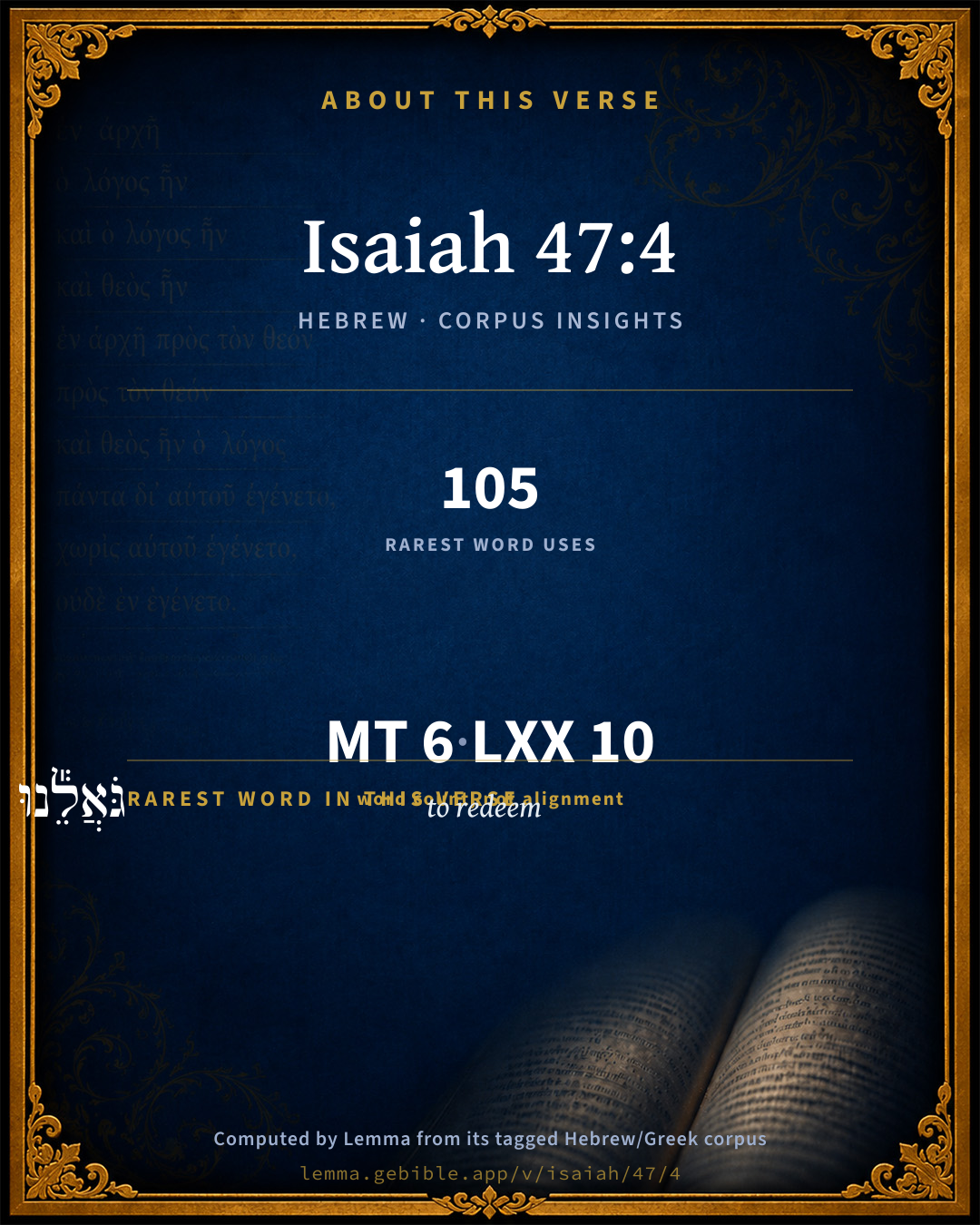
These counts appear in no published source. They are computed here, from the morphology-tagged text and Lemma’s own curated glosses. What Lemma adds →

6
words
6
distinct lemmas
Prophets
section

Grammatical profile

  • 1 verb
  • 4 nouns
  • 1 adjective

Verb forms

  • גֹּאֲלֵ֕נוּ Qal · Participle Active

Hebrew & Septuagint length

In English translation the verse runs 13 words from the Hebrew and 15 from the Septuagint (LXX English) — closely comparable.

A rough comparison of the two English renderings, which tokenize alike — not a word-level alignment.

Word counts can differ between the Hebrew and the Greek without any difference in meaning — e.g. the Hebrew direct-object marker אֵת has no separate Greek word, and Greek often adds the article ὁ.

In the original languages it is 6 Hebrew tokens and 10 Greek tokens — but the two are counted differently (Hebrew bundles its prefixes and suffixes into one token; the Greek is in lemma form), so that isn’t a like-for-like length.

Cross-references

8

Topical passages linked to Isaiah 47:4 in the Treasury of Scripture Knowledge — connected by theme and wording, ordered by reader-vote popularity; previews shown in the World English Bible.

  • Isaiah 44:6 Thus says Yahweh, the King of Israel, and his Redeemer, Yahweh of Hosts: I am the first, and I am the last; and besides me there is no God.
  • Isaiah 41:14 Don't be afraid, you worm Jacob, and you men of Israel; I will help you, says Yahweh, and your Redeemer is the Holy One of Israel.
  • Isaiah 43:14 Thus says Yahweh, your Redeemer, the Holy One of Israel: For your sake I have sent to Babylon, and I will bring down all of them as fugitives, even the Chaldeans, in the ships of their rejoicing.
  • Isaiah 49:26 I will feed those who oppress you with their own flesh; and they shall be drunken with their own blood, as with sweet wine: and all flesh shall know that I, Yahweh, am your Savior, and your Redeemer, the Mighty One of Jacob.
  • Jeremiah 50:33–34 Thus says Yahweh of hosts: The children of Israel and the children of Judah are oppressed together; and all who took them captive hold them fast; they refuse to let them go.
  • Isaiah 43:3 For I am Yahweh your God, the Holy One of Israel, your Savior; I have given Egypt as your ransom, Ethiopia and Seba in your place.
  • Isaiah 54:5 For your Maker is your husband; Yahweh of Hosts is his name: and the Holy One of Israel is your Redeemer; the God of the whole earth shall he be called.
  • Jeremiah 31:11 For Yahweh has ransomed Jacob, and redeemed him from the hand of him who was stronger than he.

Cross-references courtesy of OpenBible.info (CC BY 4.0).

Hebrew and Greek witnesses Masoretic Hebrew ↔ Greek Septuagint

The same verse in the two great witnesses to the Old Testament, shown verse-for-verse.

These are two independent witnesses, not word-aligned to each other, and the Septuagint is shown in lemma (dictionary) form.

Hebrew Isaiah 47:4 Masoretic · Westminster Leningrad Codex

גֹּאֲלֵ֕נוּ יְהוָ֥ה צְבָא֖וֹת שְׁמ֑וֹ קְד֖וֹשׁ יִשְׂרָאֵֽל

Our Redeemer, Yahweh of hosts is his name, the Holy One of Israel.

World English Bible · Public Domain

Greek LXX Isaiah 47:4 Septuagint · lemma form

εἶπον ὁ ῥύομαι σύ κύριος σαβαωθ ὄνομα αὐτός ἅγιος ἰσραήλ

Your deliverer is the Lord of hosts, the Holy One of Israel is his name.

LXX2012 (modern English Septuagint) · Public Domain

Hebrew: Westminster Leningrad Codex (CC BY 4.0). Greek: Septuagint (public domain); English from LXX2012 (modern English Septuagint) (Public Domain). How the Septuagint differs from the Hebrew →

Targum (Aramaic paraphrase)

1

The Targum is the ancient Jewish Aramaic paraphrase of the Hebrew Scriptures — an interpretive translation, not the Hebrew text itself. Onkelos (literal) and Pseudo-Jonathan (expansive) render the Torah, and Jonathan the Prophets. Coverage is partial: where no permissively-licensed English translation exists for a verse, only the Aramaic is shown. This is verse-level text, not a word-by-word alignment to the Hebrew.

  1. Targum Jonathan Prophets (Joshua–Malachi)
    פָּרְקָנָא יְיָ צְבָאוֹת שְׁמֵהּ קַדִישָׁא דְיִשְׂרָאֵל:

    As for our Redeemer, the Lord of hosts is His name, the Holy One of Israel.

    Targum Jonathan — Aramaic: “Mikraot Gedolot” (public domain). English: “Sefaria Community Translation” (CC0 1.0 (public-domain dedication)); “London "Chaldee Paraphrase," 1871” (public domain). Text via Sefaria.

Commentary

Notes on Isaiah 47:4 from classic Christian and Jewish commentators (each source and its license shown beneath its notes). The classic Christian expositions comment on the surrounding passage and are grouped to its opening verse, so a note may address several verses; the Jewish commentaries on the Tanakh (Rashi and others) are per-verse, so they appear only where the commentator wrote on this verse.

Lemma curates 59 commentaries, every one of them public domain or Creative Commons licensed, each selected and text-cleaned for this edition rather than reprinted as found. About our sources →

Trapp's Complete Commentary

John Trapp

Isa 47:4 [As for] our redeemer, the LORD of hosts [is] his name, the Holy One of Israel.

Ver. 4. As for our Redeemer, &c.] This comes in by way of parenthesis, for the comfort of God’s poor people.

John Trapp, A Commentary or Exposition upon All the Books of the Old and New Testament (1647–1656) — public domain. Text from a community e-Sword module.

Joseph Benson's Commentary

Isa 47:4. As for our Redeemer, &c. — The words, as for, not being in the Hebrew text, Bishop Lowth translates this verse, “Our Avenger, Jehovah God of hosts, the Holy One of Israel, is his name.” And he observes, “Here a chorus breaks in upon the midst of the subject, with a change of construction as well as sentiment, from the longer to the shorter kind of verse; after which, the former subject and style are resumed.” The passage seems to be inserted in the midst of this prophecy against Babylon, as Jacob inserts a like passage in the midst of his blessings and prophecies concerning his sons, Gen 49:18. It gives the reason why the judgment, here denounced, should be certainly inflicted, because he who had undertaken it was the Lord of hosts, and therefore able to effect it; and the Holy One, and the Redeemer of Israel, whom the Babylonians had cruelly oppressed, whose quarrel God would avenge upon them, and whom he had determined and promised to deliver out of their hands. If the words be considered as a pathetical exclamation, or acclamation of God’s people, they thereby ascribe to God, as their God and Redeemer, this wonderful work of breaking the staff of their oppressors: and they make their boast of, and celebrate him for, this glorious deliverance.

Joseph Benson's Commentary on the Old and New Testaments (1811–1818) — public domain. Text from a community e-Sword module.

Geneva Bible (1599)

Geneva Bible translators

The Israelites shall confess that the Lord doeth this for his Church’s sake.

Geneva Bible (1599) marginal notes — public domain. Text via Bolls.life.

Jamieson, Fausset & Brown

Robert Jamieson, A. R. Fausset & David Brown

As for--rather supply, "Thus saith our Redeemer" [MAURER]. LOWTH supposes this verse to be the exclamation of a chorus breaking in with praises, "Our Redeemer! Jehovah of hosts," &c. (Jer 50:34).

Jamieson, Fausset & Brown — Commentary Critical and Explanatory on the Whole Bible (1871) — public domain (CC PDM 1.0). Text via the HelloAO Bible API.

Adam Clarke's Commentary

Verse 4. Our Redeemer - "Our Avenger"] Here a chorus breaks in upon the midst of the subject, with a change of construction, as well as sentiment, from the longer to the shorter kind of verse, for one distich only; after which the former subject and style are resumed. See Clarke on Isa 45:16.

Adam Clarke's Commentary on the Bible (1810–1826) — public domain. Text from a community e-Sword/MySword module.

Ellicott's Commentary for English Readers

(4) As for our redeemer . . .—The verse comes in somewhat abruptly, but may be viewed (unless we suppose it to have been originally a marginal addition, which has found its way into the text) as Israel’s song of praise, as it looks on the overthrow of Babylon. As such it finds a parallel in the overthrow of the mystical Babylon in Rev_18:20.

Sit thou silent.—Another contrast between the stir of the rejoicing city and the stillness of its later desolation. “The lady” (we might almost say, the empress) “of kingdoms” was reduced to the loneliness of widowhood.

A Bible Commentary for English Readers, edited by Charles John Ellicott (1878–1897) — public domain. Text from a community e-Sword module.

The Cambridge Bible for Schools and Colleges

gen. ed. J. J. S. Perowne

4. The verse as it stands interrupts the continuity of the poem, especially in the view of those who hold that the speaker is throughout Jehovah. Lowth and others regard it as the response of a chorus of Israelites to the words of God in Isa_47:3, while Dillmann and others unhesitatingly pronounce it to be an interpolation. But all reasonable objections are removed if we supply the word “saith” as in two Greek codices. Combining this with the other suggestion of Oort mentioned above, the last distich of the strophe reads thus:—

I will take vengeance and will not be entreated,—saith our Redeemer;

Jehovah of Hosts is His name,—the Holy One of Israel.

The Cambridge Bible for Schools and Colleges (gen. ed. J. J. S. Perowne; Cambridge University Press, 1878–1918) — public domain. Text from a community e-Sword module.

John Gill's Exposition

As for our Redeemer,.... Or, "saith our Redeemer", as it may be supplied (e): or, "our Redeemer" will do this; inflict this punishment on Babylon, even he who has undertook our cause, and will deliver us from the Babylonish yoke, and return us to our land: these are the words of the Lord's people, expressing their faith in the things foretold of Babylon, and in their own deliverance:

the Lord of hosts is his name; and therefore able to redeem his people, and destroy his enemies, being the Lord of armies above and below, and having all at his command:

the Holy One of Israel; the sanctifier of them, their covenant God, and therefore will save them, and destroy their enemies, being hateful to him, because unholy and impure.

(e) "Inquit viudex noster", Junius & Tremellius; "hoc dicit", Piscator.

John Gill's Exposition of the Whole Bible (1746–1763) — public domain (CC PDM 1.0). Text via the HelloAO Bible API.

Albert Barnes' Notes on the Bible

As for our Redeemer - This verse stands absolutely, and is not connected with the preceding or the following. It seems to be an expression of admiration, or of grateful surprise, by which the prophet saw Yahweh as the Redeemer of his people. He saw, in vision, Babylon humbled, and, full of the subject, he breaks out into an expression of grateful surprise and rejoicing. ‘O! our Redeemer! it is the work of our Saviour, the Holy One of Israel! How great is his power! How faithful is he! How manifestly is he revealed! Babylon is destroyed. Her idols could not save her. Her destruction has been accomplished by him who is the Redeemer of his people, and the Holy One of Israel.’ Lowth regards this verse as the language of a chorus that breaks in upon the midst of the subject, celebrating the praises of God. The subject is resumed in the next verse.

Albert Barnes' Notes on the Bible (1834–1885) — public domain. Text from a community e-Sword/MySword module.

Matthew Poole's English Annotations

According to this version, the prophet inserteth this passage in the midst of this prophecy against Babylon, as Jacob inserteth a like passage in the midst of his blessings and prophecies concerning his children, Gen 49:18. And this may be here interposed, either,

1. As the reason why the judgment here denounced should be certainly inflicted, because he who had undertaken it was the

Lord of hosts, and therefore able to effect it, and

the Holy One, and the Redeemer of Israel, whom the Babylonians had cruelly oppressed, whose quarrel God would avenge upon them, and whom he had determined and promised to deliver out of their hands. Or,

2. As a pathetical exclamation or acclamation of God’s people for this wonderful work of breaking the staff of their oppressors, which they here ascribe to God, as he is their God and Redeemer, whom they here make their boast of, and whom they celebrate for this glorious deliverance. But because these words, as for, are not in the Hebrew text, and therefore another word may be as conveniently supplied, this verse may be, and is by some learned interpreters, otherwise rendered, and joined with the foregoing words thus, I will take vengeance, and I will not meet thee as a man, saith our Redeemer, whose name is the Lord of Hosts, the Holy One of Israel. For the word saith or saying is frequently understood, and therefore supplied by translators, as 1Ki 20:34; Psa 27:8; 105:15, and in this very prophecy, as Isa 5:9; 45:14, and elsewhere.

Matthew Poole's English Annotations on the Holy Bible (1683–1685) — public domain. Text from a community e-Sword/MySword module.

Whedon's Commentary on the Bible

Daniel D. Whedon

4. As for our Redeemer, the Lord of hosts is his name — This appears to be antiphonal, that is, the breaking in of a chorus of voices. So Lowth and Gesenius. If Isaiah be the author, which there seems abundant reason to believe, these last twenty-seven chapters were not recited in public, but in the presence only of the prophets in the college at Jerusalem, of which Isaiah was probably the head. This accounts for the strophical character of all this poetry.

Daniel D. Whedon (gen. ed.), Commentary on the Old and New Testaments (1874–1909) — public domain. Text from a community e-Sword module.

The Pulpit Commentary

As for our Redeemer, etc. Mr. Cheyne suspects, with some reason, that this is "the marginal note of a sympathetic scribe, which has made its way by accident into the text." It is certainly quite unlike anything else in the song, which would artistically be improved by its removal. If, however, it be retained, we must regard it as a parenthetic ejaculation of the Jewish Church on hearing the first strophe of the song the Church contrasting itself with Babylon, which has no one to stand up for it, whereas it has as "Redeemer the Lord of hosts, the Holy One of Israel."

The Pulpit Commentary (1880–1919), ed. H.D.M. Spence-Jones & Joseph S. Exell — public domain. Text from a community e-Sword module.

J. A. Alexander on Isaiah

Joseph Addison Alexander

“Our Redeemer (or as for our Redeemer), Jehovah of Hosts (is) His name, the Holy One of Israel.” The downfall of Babylon was but a proof that the Deliverer of Israel was a sovereign and eternal being, and yet bound to his own people in the strongest and tenderest covenant relation. Thus understood, the verse does not even interrupt the sense, but makes it the clearer, by recalling to the reader’s mind the great end for which the event took place and for which it is here predicted. This is a distinct link in the chain of the prophetic argument, by which the fall of Babylon is brought into connection and subordination to the proof of God’s supremacy as shown in the protection and salvation of his people That the Prophet speaks here in his own person, is but a single instance of a general usage; characteristic of the whole composition, in which God is spoken of, spoken to, or introduced as speaking, in constant alternation, yet without confusion or the slightest obscuration of the general meaning.

Joseph Addison Alexander, The Prophecies of Isaiah (1846–1847; New York: Scribner, 1870–1878) — public domain. Text from a community e-Sword module.

Scofield Reference Notes

C. I. Scofield

redeemed

Heb. "goel," Redemp. (Kinsman type). (See Scofield "Isa 59:20").

The Scofield Reference Bible (1917 edition), notes by C. I. Scofield — public domain. Text from a community e-Sword module.

Rashi

Rabbi Shlomo Yitzchaki (Rashi)

Our redeemer, the Lord of Hosts is His name The prophet states: All this the Lord of Hosts does, to redeem us from there.

Rashi on the Tanakh — English translations: “The Judaica Press complete Tanach with Rashi, translated by A. J. Rosenberg” (CC BY 4.0); “Pentateuch with Rashi's commentary by M. Rosenbaum and A.M. Silbermann, 1929-1934” (public domain); “The Metsudah Tanach series, Lakewood, N.J” (CC BY 4.0); and “The Book of Joshua, Metsudah Publications, 1997” (CC BY 4.0). Text via Sefaria.

Ibn Ezra

Rabbi Abraham ibn Ezra

Our redeemer, etc. Then the Israelites will say, this is our redeemer, etc.

Ibn Ezra on the Tanakh — English translations: “Sefaria Community Translation” (CC0 1.0 (public-domain dedication)); “Yalkut, Sifsei Chachomim Chumash, Metsudah Publications, 2009” (CC BY 4.0); and “Commentary of Ibn Ezra on Isaiah - trans. by M. Friedlander, 1873” (public domain). Text via Sefaria.

Lesson kit

Teaching starters — assembled from the data on this page, not authored interpretation. Every prompt links to the verse data it draws on. Edit before teaching.

Isaiah, in the Prophets, opens this verse with 6 words (6 distinct Hebrew lemmas). Its most distinctive word is gâʼal (“to redeem”). A historical commentator’s framing appears above. Read the whole chapter for the surrounding context.

Discussion questions

  1. How does “to redeem” (gâʼal) shape what this verse is saying?
  2. Isaiah 44:6 shares this passage’s theme. How do the two illuminate each other?
  3. These translations render this verse differently; the difference is in the English rendering, not the original. What questions does that raise?
  4. The verb «גֹּאֲלֵ֕נוּ» is Qal Participle Active. How does its form color the action?
  5. Reading how Trapp's Complete Commentary and Joseph Benson's Commentary read this verse, where do the two commentators agree and where do they part?

Things to notice

Reading settings

Reading text

Shown beneath each verse's original-language words.

Old Testament
Old Testament edition

Read the OT as the Masoretic Hebrew (MT) or the Greek Septuagint (LXX).

English shown for the Greek Septuagint (in the Hebrew ↔ Greek comparison).

Comparing translations? Open the Compare panel on any verse page to stack up to four side by side.