
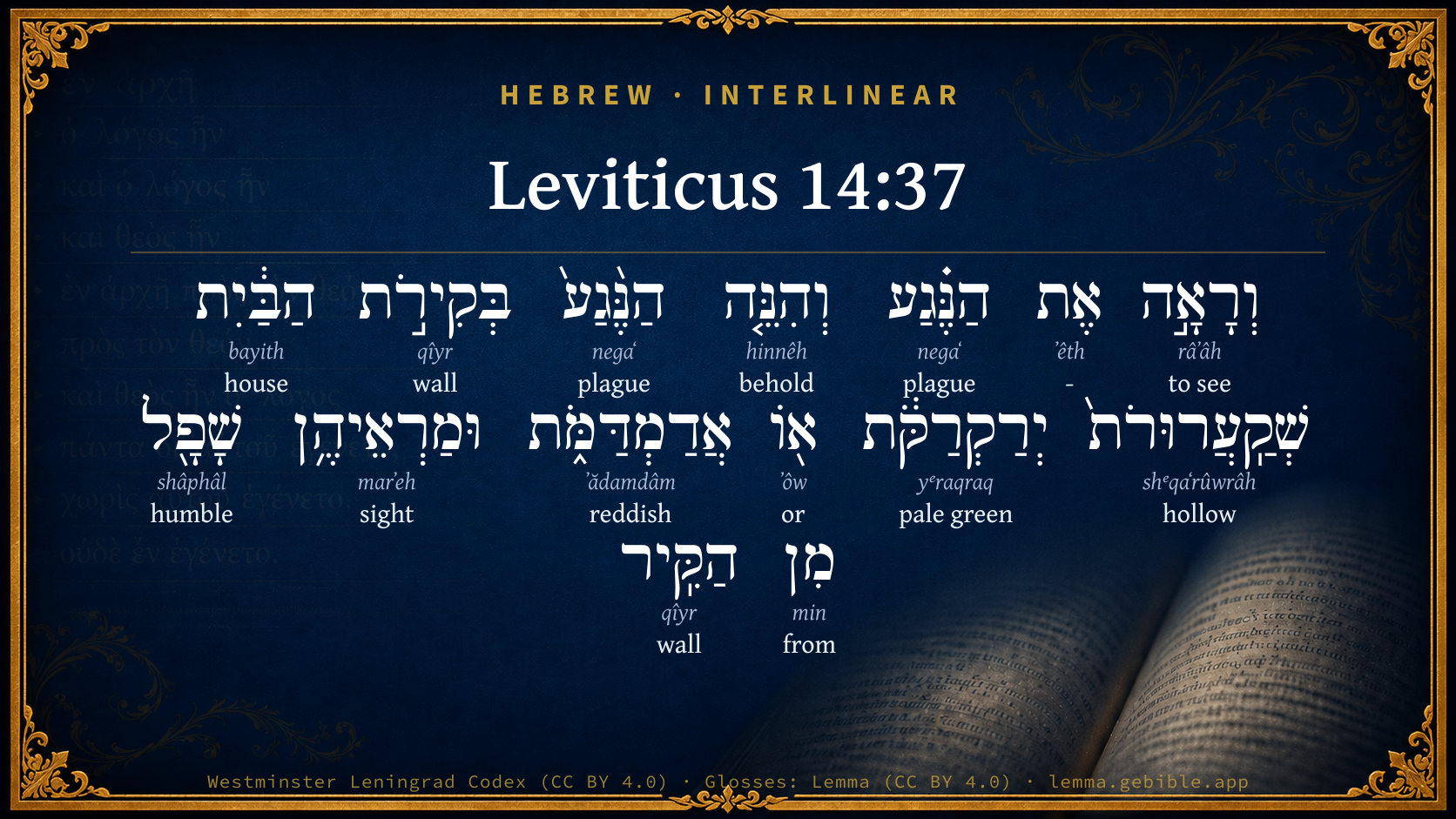
Leviticus 14:37

Hebrew (Westminster Leningrad Codex) Leviticus 14:37 appears in the Hebrew Old Testament. The text above is from the Westminster Leningrad Codex. Each word links to its Strong’s number, a concise gloss, and parsing drawn from the Open Scriptures Hebrew Bible morphology. Click any word for its full Brown-Driver-Briggs (BDB) entry.
Download image
Cite this verse

Leviticus 14:37 (World English Bible). Public Domain. Lemma interlinear Bible study tool, https://lemma.gebible.app/v/leviticus/14/37.

Show BibTeX & RIS
BibTeX
RIS
English Translation
He shall examine the plague; and, behold, if the plague is in the walls of the house with hollow streaks, greenish or reddish, and it appears to be deeper than the wall;
World English Bible · Public Domain
Highlights
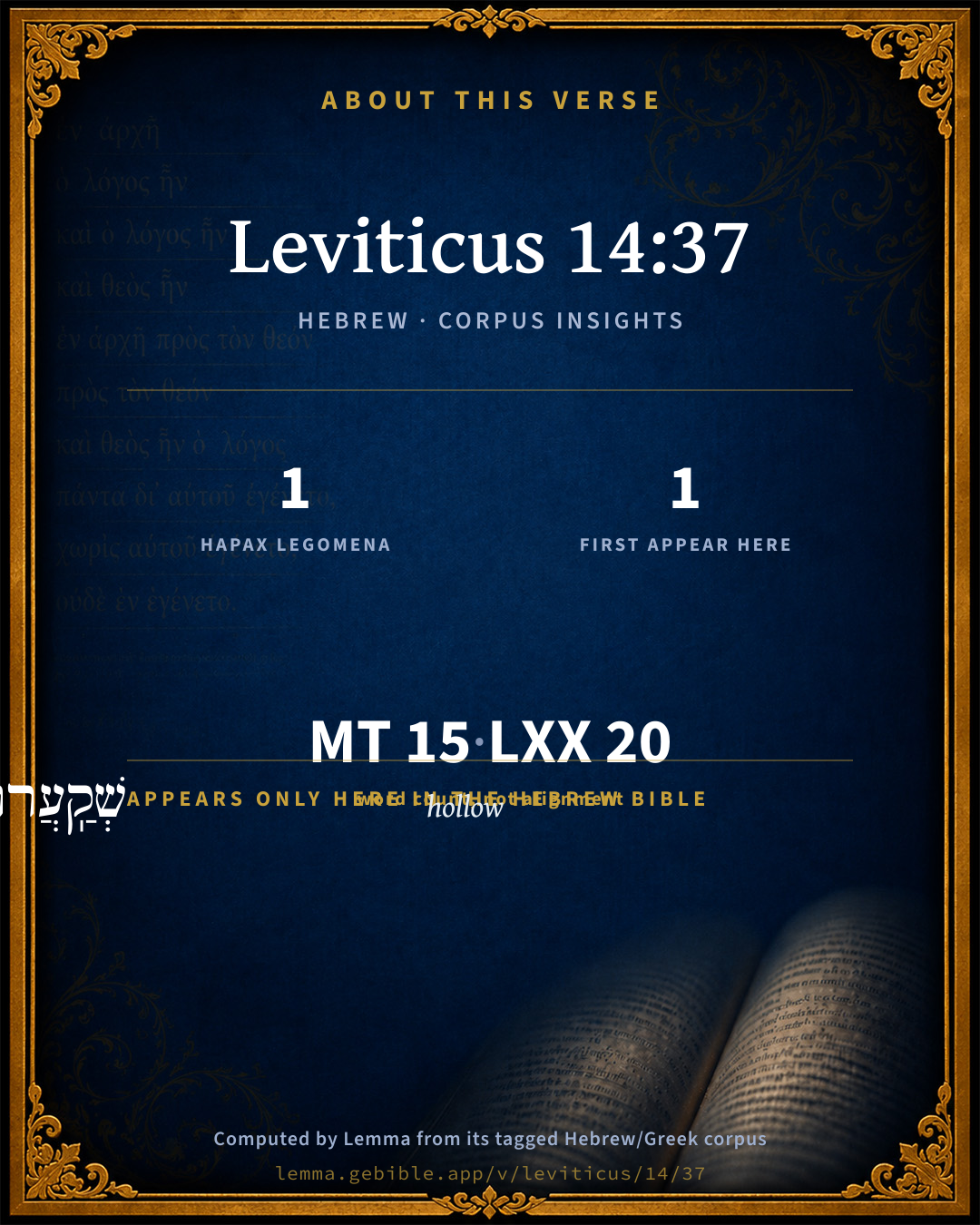
  • 1 hapax legomenon — only here in the Hebrew Bible
  • 1 first appearance in the Hebrew Bible
Full analysis ↓
Download a study sheet

One document with this verse’s original text, its word-by-word gloss line, the meaning frame, cross-references with their text, attributed commentary, and full source and license credits — printable, and it pastes into notes with its structure intact.

This verse Autodidact and up

Study sheet (.html) Plain text (.txt)

A passage Seminary Student

Up to 50 verses in one chapter. A passage sheet keeps up to 6 commentary sources and 12 cross-references per verse, in the order this page ranks them, and says so on the sheet whenever that leaves anything out. Ask for a single verse and you get the Autodidact verse sheet above.

Everything on this page stays free to read, with no account — the sheet is a download of what is already on screen, not access to it.

Want to remove ads? Support Godless Engineer
Compare translations 3

The same verse in 3 English versions, stacked beneath the original-language interlinear above. Click any original word for its lexicon entry.

Each is an independent rendering of the whole verse — the interlinear is not word-aligned to these translations.

Highlighted words mark where these versions differ — a whole-verse word diff, not a word-by-word alignment.

  • World English Bible Public Domain
    He shall examine the plague; and, behold, if the plague is in the walls of the house with hollow streaks, greenish or reddish, and it appears to be deeper than the wall;
  • King James Version Public Domain
    And he shall look on the plague, and, behold, if the plague be in the walls of the house with hollow streaks, greenish or reddish, which in sight are lower than the wall;
  • unfoldingWord Literal Text CC BY-SA 4.0
    And he shall see the infection and behold, the infection in the walls of the house greenish or reddish eruptions, and their appearance deeper than the wall.

unfoldingWord Literal Text — © unfoldingWord, licensed CC BY-SA 4.0. Word-aligned USFM3 via Door43 (git.door43.org/unfoldingWord/en_ult).

Versions to compare (up to 4)

3 of 4 selected

Show all 18 translations

Every available English version of this verse, each an independent rendering of the whole verse.

  • World English Bible Public Domain
    He shall examine the plague; and, behold, if the plague is in the walls of the house with hollow streaks, greenish or reddish, and it appears to be deeper than the wall;
  • Berean Standard Bible Public Domain
    He is to examine the house, and if the mildew on the walls consists of green or red depressions that appear to be beneath the surface of the wall,
  • Majority Standard Bible Public Domain
    He is to examine the house, and if the mildew on the walls consists of green or red depressions that appear to be beneath the surface of the wall,
  • King James Version Public Domain
    And he shall look on the plague, and, behold, if the plague be in the walls of the house with hollow streaks, greenish or reddish, which in sight are lower than the wall;
  • American Standard Version (1901) Public Domain
    and he shall look on the plague; and, behold, if the plague be in the walls of the house with hollow streaks, greenish or reddish, and the appearance thereof be lower than the wall;
  • Revised Version (1885) Public Domain
    and he shall look on the plague, and, behold, if the plague be in the walls of the house with hollow strakes, greenish or reddish, and the appearance thereof be lower than the wall;
  • Geneva Bible (1599) Public Domain
    And hee shall marke the plague: and if the plague be in the walles of the house, and that there be deepe spots, greenish or reddish, which seeme to be lower then the wall,
  • Douay-Rheims (1899) Public Domain
    And if he see in the walls thereof as it were little dints, disfigured with paleness or redness, and lower than all the rest,
  • Young's Literal Translation Public Domain
    and he hath seen the plague, and lo, the plague `is' in the walls of the house, hollow strakes, very green or very red, and their appearance `is' lower than the wall,
  • Literal Standard Version CC BY-SA 4.0
    and he has seen the plague, and behold, the plague [is] in the walls of the house, hollow streaks, greenish or reddish, and their appearance [is] lower than the wall,
  • Unlocked Literal Bible CC BY-SA 4.0
    He must examine the mildew to see if it is in the house walls, and to see whether it appears greenish or reddish in the depressions in the wall's surface.
  • unfoldingWord Literal Text CC BY-SA 4.0
    And he shall see the infection and behold, the infection in the walls of the house greenish or reddish eruptions, and their appearance deeper than the wall.
  • Darby Bible Public Domain
    And when he looketh on the plague, and behold, the plague is in the walls of the house, greenish or reddish hollows, and their look is deeper than the surface of the wall,
  • World Messianic Bible Public Domain
    He shall examine the plague; and behold, if the plague is in the walls of the house with hollow streaks, greenish or reddish, and it appears to be deeper than the wall,
  • Webster's Bible Public Domain
    And he shall look on the plague, and behold, if the plague is in the walls of the house, with hollow streaks, greenish, or reddish, which in sight are lower than the wall;
  • Free Bible Version CC BY-SA 4.0
    He will examine the house and see if the mold on the walls is made up of green or red indentations that go under the surface,
  • Bible in Basic English Public Domain
    And if he sees that the walls of the house are marked with hollows of green and red, and if it seems to go deeper than the face of the wall;
  • JPS Tanakh (1917) Public Domain
    And he shall look on the plague, and, behold, if the plague be in the walls of the house with hollow streaks, greenish or reddish, and the appearance thereof be lower than the wall;

Literal Standard Version (2020), Covenant Press — licensed CC BY-SA 4.0. Text via the HelloAO Bible API (eBible.org). Unlocked Literal Bible (unfoldingWord) — licensed CC BY-SA 4.0. Text via the HelloAO Bible API (eBible.org). unfoldingWord Literal Text — © unfoldingWord, licensed CC BY-SA 4.0. Word-aligned USFM3 via Door43 (git.door43.org/unfoldingWord/en_ult). Free Bible Version, Dr. Jonathan Gallagher — licensed CC BY-SA 4.0. Text via the HelloAO Bible API (eBible.org).

Word by word

More ways to search: Search by grammar → Find every occurrence → Compare this word →

Practice this passage: Drill this verse → Learn its vocabulary →

שְׁקַֽעֲרוּרֹת֙
shᵉqaʻrûwrâh
H8258
“hollows”
Noun, Common, Feminine, Plural, Absolute
Part of Speech
Noun
Type
Common
Gender
Feminine
Number
Plural
State
Absolute
Full BDB Definition

Origin: from H8257

TWOT: 2047b

depression, hollow
  1. וְרָאָ֣ה râʼâh H7200 “and · to see” Conjunction + Verb, Qal, Sequential Perfect, 3rd Person, Masculine, Singular
  2. אֶת ʼêth H853 “-” Particle, Direct Object
  3. הַנֶּ֗גַע negaʻ H5061 “the · plague” Particle, Definite Article + Noun, Common, Masculine, Singular, Absolute
  4. וְהִנֵּ֤ה hinnêh H2009 “and · behold” Conjunction + Particle, Demonstrative
  5. הַנֶּ֨גַע֙ negaʻ H5061 “the · plague” Particle, Definite Article + Noun, Common, Masculine, Singular, Absolute
  6. בְּקִירֹ֣ת qîyr H7023 “in/at · walls of” Preposition + Noun, Common, Masculine, Plural, Construct
  7. הַבַּ֔יִת bayith H1004 “the · house” Particle, Definite Article + Noun, Common, Masculine, Singular, Absolute
  8. יְרַקְרַקֹּ֔ת yᵉraqraq H3422 “pale green” Adjective, Adjective, Feminine, Plural, Absolute
  9. א֖וֹ ʼôw H176 “or” Conjunction
  10. אֲדַמְדַּמֹּ֑ת ʼădamdâm H125 “reddish” Adjective, Adjective, Feminine, Plural, Absolute
  11. וּמַרְאֵיהֶ֥ן marʼeh H4758 “and · sights · their” Conjunction + Noun, Common, Masculine, Plural, Construct + Suffix, Personal, 3rd Person, Feminine, Plural
  12. שָׁפָ֖ל shâphâl H8217 “humble” Adjective, Adjective, Masculine, Singular, Absolute
  13. מִן min H4480 “from” Preposition
  14. הַקִּֽיר qîyr H7023 “the · wall” Particle, Definite Article + Noun, Common, Masculine, Singular, Absolute

About this verse

These counts appear in no published source. They are computed here, from the morphology-tagged text and Lemma’s own curated glosses. What Lemma adds →

15
words
13
distinct lemmas
Pentateuch
section

Notable vocabulary

1 hapax legomenon — a word that appears only here in the entire Hebrew Bible:

  • שְׁקַֽעֲרוּרֹת֙ hollow H8258

First appearance in Scripture

This word makes its first canonical appearance in the Hebrew Bible here:

  • שְׁקַֽעֲרוּרֹת֙ hollow H8258

Shared distinctive vocabulary

יְרַקְרַקֹּ֔ת pale green H3422 occurs in 3 verses of the Hebrew Bible. Also found in:

Grammatical profile

  • 1 verb
  • 7 nouns
  • 3 adjectives
  • 1 preposition
  • 1 conjunction
  • 2 particles

Verb forms

  • וְרָאָ֣ה Qal · Sequential Perfect

Repetition

Words recur within this verse — often emphatic in Hebrew:

  • הַנֶּ֗גַע plague H5061 ×2
  • בְּקִירֹ֣ת wall H7023 ×2

Hebrew & Septuagint length

In English translation the verse runs 32 words from the Hebrew and 39 from the Septuagint (LXX English) — closely comparable.

A rough comparison of the two English renderings, which tokenize alike — not a word-level alignment.

Word counts can differ between the Hebrew and the Greek without any difference in meaning — e.g. the Hebrew direct-object marker אֵת has no separate Greek word, and Greek often adds the article ὁ.

In the original languages it is 15 Hebrew tokens and 20 Greek tokens — but the two are counted differently (Hebrew bundles its prefixes and suffixes into one token; the Greek is in lemma form), so that isn’t a like-for-like length.

Cross-references

4

Topical passages linked to Leviticus 14:37 in the Treasury of Scripture Knowledge — connected by theme and wording, ordered by reader-vote popularity; previews shown in the World English Bible.

  • Leviticus 13:3 and the priest shall examine the plague in the skin of the body: and if the hair in the plague has turned white, and the appearance of the plague is deeper than the body's skin, it is the plague of leprosy; and the priest shall examine him, and pronounce him unclean.
  • Leviticus 13:19–20 and in the place of the boil there is a white rising, or a bright spot, reddish-white, then it shall be shown to the priest;
  • Leviticus 13:42 But if there is in the bald head, or the bald forehead, a reddish-white plague; it is leprosy breaking out in his bald head, or his bald forehead.
  • Leviticus 13:49 if the plague is greenish or reddish in the garment, or in the skin, or in the warp, or in the woof, or in anything made of skin; it is the plague of leprosy, and shall be shown to the priest.

Cross-references courtesy of OpenBible.info (CC BY 4.0).

Hebrew and Greek witnesses Masoretic Hebrew ↔ Greek Septuagint

The same verse in the two great witnesses to the Old Testament, shown verse-for-verse.

These are two independent witnesses, not word-aligned to each other, and the Septuagint is shown in lemma (dictionary) form.

Hebrew Leviticus 14:37 Masoretic · Westminster Leningrad Codex

וְרָאָ֣ה אֶת הַנֶּ֗גַע וְהִנֵּ֤ה הַנֶּ֨גַע֙ בְּקִירֹ֣ת הַבַּ֔יִת שְׁקַֽעֲרוּרֹת֙ יְרַקְרַקֹּ֔ת א֖וֹ אֲדַמְדַּמֹּ֑ת וּמַרְאֵיהֶ֥ן שָׁפָ֖ל מִן הַקִּֽיר

He shall examine the plague; and, behold, if the plague is in the walls of the house with hollow streaks, greenish or reddish, and it appears to be deeper than the wall;

World English Bible · Public Domain

Greek LXX Leviticus 14:37 Septuagint · lemma form

καί ὁράω ὁ ἁφή ἐν ὁ τοῖχος ὁ οἰκία κοιλάς χλωρίζω ἤ πυρρίζω καί ὁ ὄψις αὐτός ταπεινός ὁ τοῖχος

And he shall look on the plague, and, behold, if the plague is in the walls of the house, he will see greenish or reddish cavities, and the appearance of them will be beneath the surface of the walls.

LXX2012 (modern English Septuagint) · Public Domain

Hebrew: Westminster Leningrad Codex (CC BY 4.0). Greek: Septuagint (public domain); English from LXX2012 (modern English Septuagint) (Public Domain). How the Septuagint differs from the Hebrew →

Targum (Aramaic paraphrase)

2

The Targum is the ancient Jewish Aramaic paraphrase of the Hebrew Scriptures — an interpretive translation, not the Hebrew text itself. Onkelos (literal) and Pseudo-Jonathan (expansive) render the Torah, and Jonathan the Prophets. Coverage is partial: where no permissively-licensed English translation exists for a verse, only the Aramaic is shown. This is verse-level text, not a word-by-word alignment to the Hebrew.

  1. Targum Onkelos Torah (Genesis–Deuteronomy)
    וְיֶחֱזֵי יָת מַכְתָּשָׁא וְהָא מַכְתָּשָׁא בְּכָתְלֵי בֵיתָא פַּחֲתִין יַרְקָן אוֹ סַמְקָן וּמֶחֱזֵיהוֹן מַכִּיךְ מִן כָּתְלָא

    (no public-domain English translation for this verse)

    Targum Onkelos — Aramaic: “Onkelos Genesis” (public domain); “Onkelos Exodus” (public domain); “Onkelos Leviticus” (public domain); “Onkelos Numbers” (public domain); “Onkelos Deuteronomy” (public domain). English: “Sefaria Community Translation” (CC0 1.0 (public-domain dedication)); “J.W. Etheridge. The Targums of Onkelos and Jonathan Ben Uzziel on the Pentateuch. London: Longmans, Green, 1862” (public domain). Text via Sefaria.

  2. Targum Pseudo-Jonathan Torah (Genesis–Deuteronomy)
    וְיֶחֱמֵי כַּהֲנָא וְהָא מַכְתְּשָׁא כִּתְרֵין גְרִיסִין מִן אַבְנֵי דִילֵיהּ אַרְבַּע כּוֹתְלִין מְשַׁקְעָן יוּרְקַן אוֹ סוּמְקַן וְחַזֵיהוֹן מַכִּיךְ יַתִּיר מִן כּוֹתְלָא

    And the priest shall look, and, behold, if the plague be like (the colour of) two beans crushed with stones, and goeth lower than the four walls, green or red, and its appearance be deeper than the walls;

    Targum Pseudo-Jonathan — Aramaic: “Targum Jonathan on Genesis” (public domain); “Targum Jonathan on Exodus” (public domain); “Targum Jonathan on Leviticus” (public domain); “Targum Jonathan on Numbers” (public domain); “Targum Jonathan on Deuteronomy” (public domain). English: “The Targum of Jonathan ben Uzziel, trans. J. W. Etheridge, London, 1862” (public domain). Text via Sefaria.

Commentary

Notes on Leviticus 14:37 from classic Christian and Jewish commentators (each source and its license shown beneath its notes). The classic Christian expositions comment on the surrounding passage and are grouped to its opening verse, so a note may address several verses; the Jewish commentaries on the Tanakh (Rashi and others) are per-verse, so they appear only where the commentator wrote on this verse.

Lemma curates 59 commentaries, every one of them public domain or Creative Commons licensed, each selected and text-cleaned for this edition rather than reprinted as found. About our sources →

Joseph Benson's Commentary

Lev 14:37. In the walls of the house — This, it seems, was an extraordinary judgment of God peculiar to this people, either as a punishment of their sins, which were much more aggravated and inexcusable than the sins of other nations; or as a special help to repentance, which God afforded them above other people; or as a token of the mischievous nature of sin, typified by leprosy, which did not only destroy persons, but their habitations also. Hollow streaks — Such as were in the bodies of leprous persons.

Joseph Benson's Commentary on the Old and New Testaments (1811–1818) — public domain. Text from a community e-Sword module.

Tyndale Open Study Notes

Tyndale Open Resources

14:37 If the mildew extended deeper than the wall’s surface it was more serious than if it were just on the surface. The same idea was expressed by “more than skin-deep” in the examination of infected individuals (see study note on 13:3).

Tyndale Open Study Notes — © Tyndale Open Resources, licensed CC BY-SA 4.0. Text via the HelloAO Bible API.

Geneva Bible (1599)

Geneva Bible translators

Or, blackness, or hollow streaks.

Geneva Bible (1599) marginal notes — public domain. Text via Bolls.life.

Ellicott's Commentary for English Readers

(37) With hollow strakes, greenish or reddish.—If the house is really leprous, the priest on inspecting it will find in the walls the same three symptoms which are visible in the skin of leprous human beings: (1) hollow strakes, or, rather, deep cavities or depressions, which the ancient canons define as a depression deeper than the rest of the wall, being the same symptom as in man (see Lev_13:3); (2) a greenish or (3) a reddish spot, which were the second and third symptoms of leprosy in men and garments. (Comp. Lev_13:49.) According to the canons which obtained during the second Temple, the size of this discoloured spot on the wall had to be that of two beans.

A Bible Commentary for English Readers, edited by Charles John Ellicott (1878–1897) — public domain. Text from a community e-Sword module.

John Gill's Exposition

And he shall cause the house to be scraped within round about,.... All the walls on each side, and at each end, and every stone in them; which, though they had no appearance on them, yet should there be any infection in them, which as yet was not seen, it might be removed, and a spread prevented:

and they shall pour out the dust that they scrape off without the city, into an unclean place; the scrapings they were to put into some vessel, and carry them thither and pour them out, or into a cart, and there throw them, that they might lie with other rubbish, and not be made use of any more.

John Gill's Exposition of the Whole Bible (1746–1763) — public domain (CC PDM 1.0). Text via the HelloAO Bible API.

Haydock's Catholic Bible Commentary

Paleness. Hebrew, "greenish." (Haydock) --- Such spots are often observable in damp churches and cloisters, and cause the plaster to fall off. It is probable that little worms produce this effect. To prevent these vermin from spreading, Moses orders the whole house to be demolished and carried away, if it cannot be otherwise purified. (Calmet) --- Thus the plague is communicated not only by persons, but also by all the things which they have touched. The same signs of leprosy are found both in men and in houses. (Menochius)

George Leo Haydock (1774–1849), Haydock's Catholic Family Bible and Commentary, 1859 edition — public domain. Excludes Psalms (Douay-Rheims chapter numbering differs from Protestant) and Deuterocanonical books (Catholic canon only).

Matthew Poole's English Annotations

In the walls of the house this was an extraordinary judgment of God peculiar to this people, either as a punishment of their sins, which were much more sinful and inexcusable than the sins of other nations; or as a special mean and help to repentance, which God afforded to them above other people; or as a document of the mischievous nature of sin, typified by leprosy, which did not only destroy persons, but their habitations also: see Zec 5:4.

With hollow strakes, such as were in the bodies of leprous persons, Lev 13:3.

Matthew Poole's English Annotations on the Holy Bible (1683–1685) — public domain. Text from a community e-Sword/MySword module.

Whedon's Commentary on the Bible

Daniel D. Whedon

37. Hollow streaks — The Hebrew for both these words is depression, or sunken place. This is the first test of the leprosy; the second was the greenish or reddish colour.

Lower than the wall — This is the depression just mentioned.

Shut up — This was a safeguard against the ceremonial defilement of the family. It also removed all human agency from contributing to the further spreading of the spots.

Daniel D. Whedon (gen. ed.), Commentary on the Old and New Testaments (1874–1909) — public domain. Text from a community e-Sword module.

John Wesley's Explanatory Notes

In the walls of the house - This was an extraordinary judgment of God peculiar to this people, either as a punishment of their sins, which were much more sinful and inexcusable than the sins of other nations; or as a special help to repentance, which God afforded them above other people; or as a token of the mischievous nature of sin, typified by leprosy, which did not only destroy persons, but their habitations also: Hollow streaks - Such as were in the bodies of leprous persons.

John Wesley, Explanatory Notes Upon the Whole Bible (1754–1765) — public domain. Text via the GEBible commentary corpus.

Keil & Delitzsch

C. F. Keil & F. Delitzsch

If the leprous spot appeared in "greenish or reddish depressions, which looked deeper than the wall," the priest was to shut up the house for seven days. If after that time he found that the mole had spread on the walls, he was to break out the stones upon which it appeared, and remove them to an unclean place outside the town, and to scrape the house all round inside, and throw the dust that was scraped off into an unclean place outside the town. He was then to put other stones in their place, and plaster the house with fresh mortar.

Keil & Delitzsch — Biblical Commentary on the Old Testament (1861–1891) — public domain (CC PDM 1.0). Text via the HelloAO Bible API. (Old Testament only.)

Rashi

Rabbi Shlomo Yitzchaki (Rashi)

שקערורת denotes lying deep because of their colors (they appear to lie deep in the stones) (Sifra, Metzora, Section 6 5).

Rashi on the Tanakh — English translations: “The Judaica Press complete Tanach with Rashi, translated by A. J. Rosenberg” (CC BY 4.0); “Pentateuch with Rashi's commentary by M. Rosenbaum and A.M. Silbermann, 1929-1934” (public domain); “The Metsudah Tanach series, Lakewood, N.J” (CC BY 4.0); and “The Book of Joshua, Metsudah Publications, 1997” (CC BY 4.0). Text via Sefaria.

Lesson kit

Teaching starters — assembled from the data on this page, not authored interpretation. Every prompt links to the verse data it draws on. Edit before teaching.

Leviticus, in the Pentateuch, opens this verse with 15 words (13 distinct Hebrew lemmas). Its most distinctive word is shᵉqaʻrûwrâh (“hollow”). A historical commentator’s framing appears above. Read the whole chapter for the surrounding context.

Discussion questions

  1. What does “hollow” (shᵉqaʻrûwrâh) contribute to the verse as a whole?
  2. 1 word here appears nowhere else in the Hebrew Bible. Why might the author reach for such rare wording?
  3. This is the first place “hollow” appears in Scripture (first appears here). What does its debut here establish?
  4. How does Leviticus 13:49, which shares the word «pale green», read alongside this verse?
  5. What does the repetition of “plague” (2× in this one verse) do in this verse?
  6. The translations on this page render this verse differently — a whole-verse word diff, not a word-by-word alignment. What might account for the different wordings?
  7. «וְרָאָ֣ה» is a Qal Sequential Perfect verb. How does that grammatical form shape the action described?
  8. Compare how Joseph Benson's Commentary and Tyndale Open Study Notes read this verse. Where do they agree or differ?

Things to notice

  • 1 word in this verse appears nowhere else in the Hebrew Bible.
  • 1 word makes its first canonical appearance in Scripture here.
  • This verse counts 15 Hebrew ↔ 20 Greek words.
  • These translations choose different wording for 14 words in this verse.
  • “plague” occurs 2× in this single verse.

Reading settings

Reading text

Shown beneath each verse's original-language words.

Old Testament
Old Testament edition

Read the OT as the Masoretic Hebrew (MT) or the Greek Septuagint (LXX).

English shown for the Greek Septuagint (in the Hebrew ↔ Greek comparison).

Comparing translations? Open the Compare panel on any verse page to stack up to four side by side.